
Organic Rankine Cycle ORC Integration and Optimization for
- Slides: 12
Organic Rankine Cycle (ORC) Integration and Optimization for High Efficiency CHP Genset Systems DE‐FOA‐ 0001750 Electra. Therm Oct. 2018‐Dec. 2021 Principal Investigator/Tom Brokaw Business Contact /Rob Emrich U. S. DOE Advanced Manufacturing Office Program Review Meeting Washington, D. C. June 2 nd, 2019 This presentation does not contain any proprietary, confidential, or otherwise restricted information.
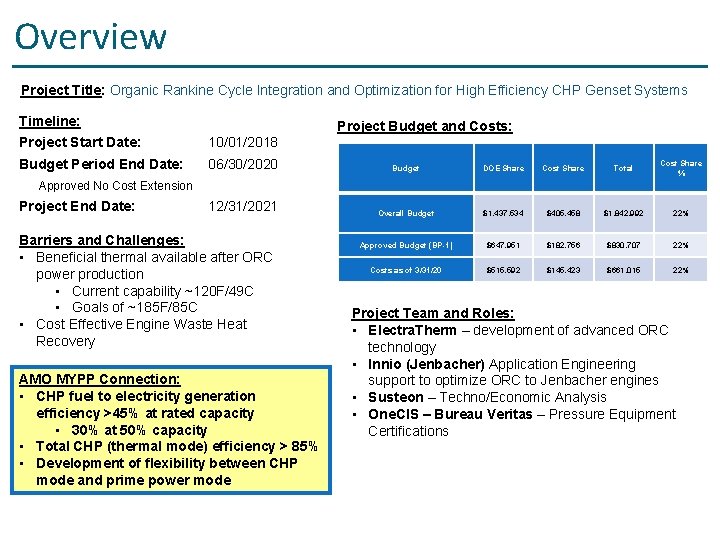
Overview Project Title: Organic Rankine Cycle Integration and Optimization for High Efficiency CHP Genset Systems Timeline: Project Budget and Costs: Project Start Date: 10/01/2018 Budget Period End Date: 06/30/2020 Budget DOE Share Cost Share Total Cost Share % 12/31/2021 Overall Budget $1, 437, 534 $405, 458 $1, 842, 992 22% Approved Budget (BP-1) $647, 951 $182, 756 $830, 707 22% Costs as of 3/31/20 $515, 592 $145, 423 $661, 015 22% Approved No Cost Extension Project End Date: Barriers and Challenges: • Beneficial thermal available after ORC power production • Current capability ~120 F/49 C • Goals of ~185 F/85 C • Cost Effective Engine Waste Heat Recovery AMO MYPP Connection: • CHP fuel to electricity generation efficiency >45% at rated capacity • 30% at 50% capacity • Total CHP (thermal mode) efficiency > 85% • Development of flexibility between CHP mode and prime power mode Project Team and Roles: • Electra. Therm – development of advanced ORC technology • Innio (Jenbacher) Application Engineering support to optimize ORC to Jenbacher engines • Susteon – Techno/Economic Analysis • One. CIS – Bureau Veritas – Pressure Equipment Certifications
Project Objective(s) Traditional CHP Challenge – what to do with all that heat? Create 24/7 thermal demand via ORC Advance engine based CHP offerings and enhance market acceptance Generate power from the CHP’s excess heat Increase prime power efficiency when heat is not required for the building Add flexibility via CHP mode Provide “usable thermal energy” after ORC power production. Target condensing side heat at 180 F-190 F range matching existing building hydronic infrastructure (today’s limit ~ 120 F) This will require new higher pressure expanders with new bearing schemes and lubrication methodology, new controls, new pressure ratings, certifications and potentially new working fluids.
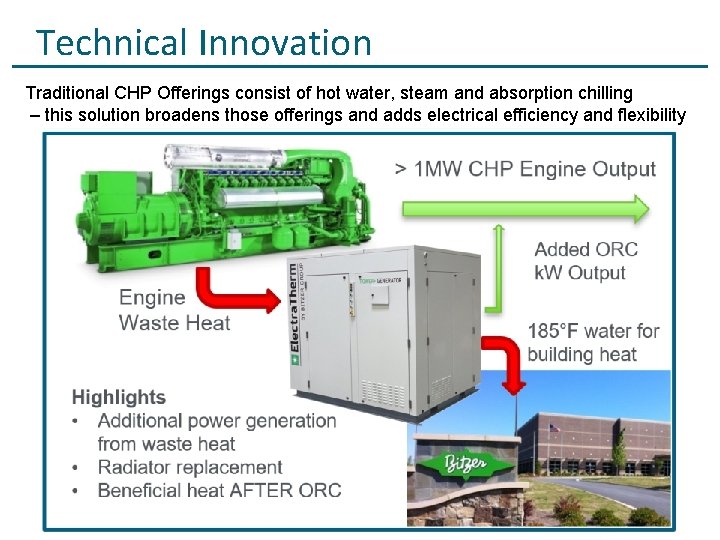
Technical Innovation Traditional CHP Offerings consist of hot water, steam and absorption chilling – this solution broadens those offerings and adds electrical efficiency and flexibility
Technical Innovation Currently engine + ORC packages are not considered for CHP applications Barriers are: COST - $/k. W of ORC equipment No use for ORC condensing heat – too low value (~120 F) Perceived complexity with “new” technology Technical Advancements Raise input and exit temps of ORC so beneficial use of thermal energy after power production is possible New expander technology Including: Higher pressure castings New lubrication and bearing schemes New controls Extreme focus on market acceptance and $/k. W – largest barrier Adding 24/7 thermal demand, added power generation when in prime power mode and offering beneficial thermal in CHP mode at the right price point will enable further CHP market acceptance and benefit to the US manufacturing sector
Technical Approach Utilize Electra. Therm’s 1, 000 hours + of fleet operation and experience to elevate baseline production equipment and advance expander and ORC system capability to meet engine + ORC market requirements Introduce and redesign BITZER semi-hermetic expanders to meet expander technical gaps Higher inlet temperature and pressures Establish a 24/7 expander fleet leader commercial site Raise condensing temperatures to match building thermal demands and designs Maintain acceptable system performance while driving for higher ORC condensing temperatures Investigate new low global warming potential refrigerants Address ORC shortfalls as expander weak link is addressed Utilize baseline designs as platforms to learn as BITZER expander and new controls are integrated and new capabilities are developed Design/build and test LOW cost clean sheet of paper design to meet strict $/k. W barrier to entry
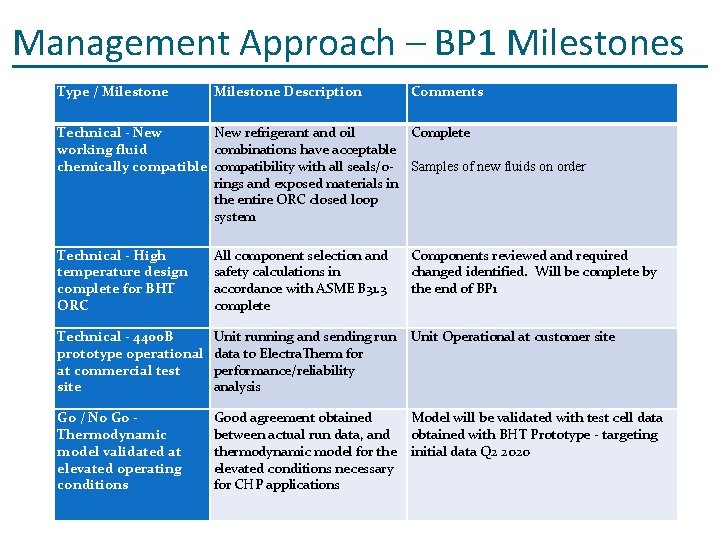
Management Approach – BP 1 Milestones Type / Milestone Description Comments Technical - New refrigerant and oil Complete working fluid combinations have acceptable chemically compatible compatibility with all seals/o- Samples of new fluids on order rings and exposed materials in the entire ORC closed loop system Technical - High temperature design complete for BHT ORC All component selection and safety calculations in accordance with ASME B 31. 3 complete Components reviewed and required changed identified. Will be complete by the end of BP 1 Technical - 4400 B prototype operational at commercial test site Unit running and sending run data to Electra. Therm for performance/reliability analysis Unit Operational at customer site Go / No Go Thermodynamic model validated at elevated operating conditions Good agreement obtained between actual run data, and thermodynamic model for the elevated conditions necessary for CHP applications Model will be validated with test cell data obtained with BHT Prototype - targeting initial data Q 2 2020
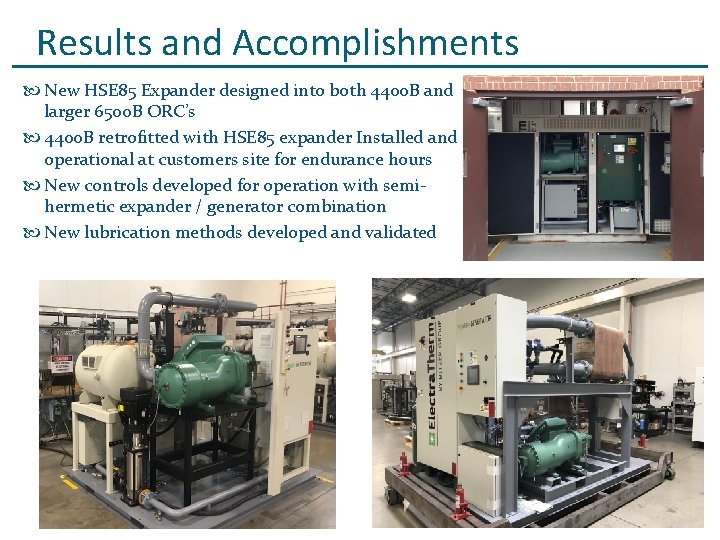
Results and Accomplishments New HSE 85 Expander designed into both 4400 B and larger 6500 B ORC’s 4400 B retrofitted with HSE 85 expander Installed and operational at customers site for endurance hours New controls developed for operation with semihermetic expander / generator combination New lubrication methods developed and validated
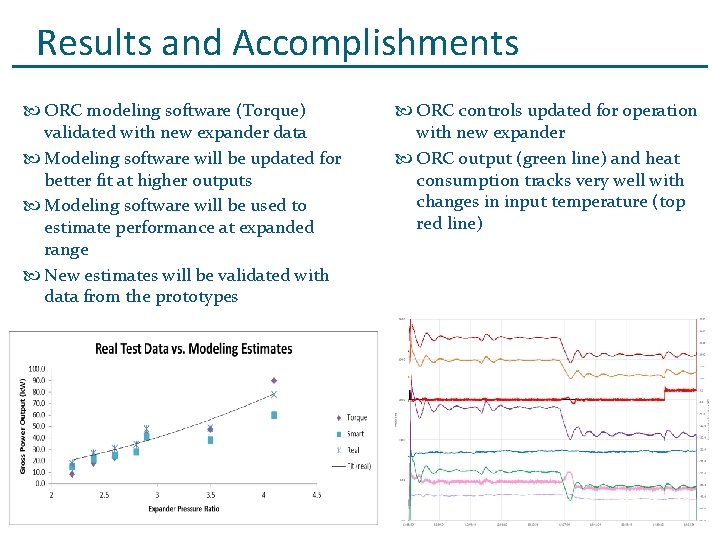
Results and Accomplishments ORC modeling software (Torque) validated with new expander data Modeling software will be updated for better fit at higher outputs Modeling software will be used to estimate performance at expanded range New estimates will be validated with data from the prototypes ORC controls updated for operation with new expander ORC output (green line) and heat consumption tracks very well with changes in input temperature (top red line)
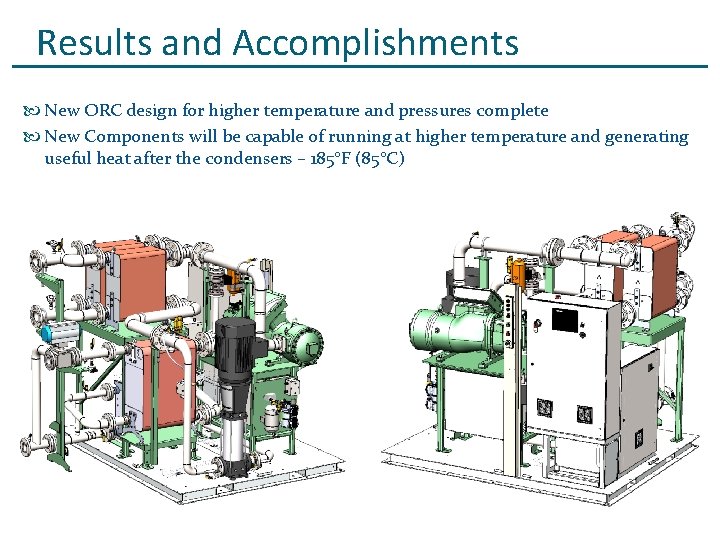
Results and Accomplishments New ORC design for higher temperature and pressures complete New Components will be capable of running at higher temperature and generating useful heat after the condensers – 185°F (85°C)
Transition (beyond DOE assistance) Continue education and discussions with CHP developers, engine distributors, and OEM’s to the potential of engine + ORC optimization for CHP Continue the search for first commercial application for engine + ORC at a CHP site Continued focus on being lowest cost producer for ORC’s in this specific size range Further understanding and optimization via the Innio/Jenbacher product families Further developments to optimize the engine + ORC system as one package
Questions? Thank You Tom Brokaw Engineering Manager tbrokaw@electratherm. com