
Organic Chemistry Nomenclature Alkanes Alkanes Hydrocarbon chains where
Organic Chemistry Nomenclature: Alkanes

Alkanes • Hydrocarbon chains where all the bonds between carbons are SINGLE bonds • Name uses the ending –ane • Examples: Methane, Propane, Butane, Octane, 2 -methylpentane
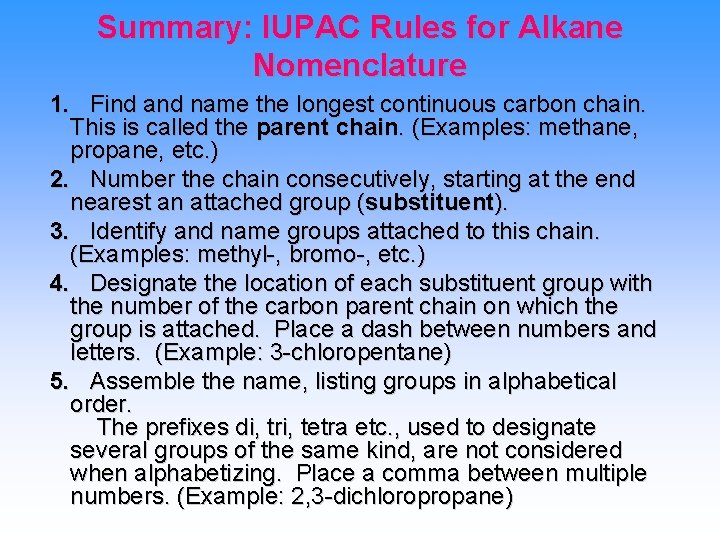
Summary: IUPAC Rules for Alkane Nomenclature 1. Find and name the longest continuous carbon chain. This is called the parent chain. (Examples: methane, propane, etc. ) 2. Number the chain consecutively, starting at the end nearest an attached group (substituent). 3. Identify and name groups attached to this chain. (Examples: methyl-, bromo-, etc. ) 4. Designate the location of each substituent group with the number of the carbon parent chain on which the group is attached. Place a dash between numbers and letters. (Example: 3 -chloropentane) 5. Assemble the name, listing groups in alphabetical order. The prefixes di, tri, tetra etc. , used to designate several groups of the same kind, are not considered when alphabetizing. Place a comma between multiple numbers. (Example: 2, 3 -dichloropropane)
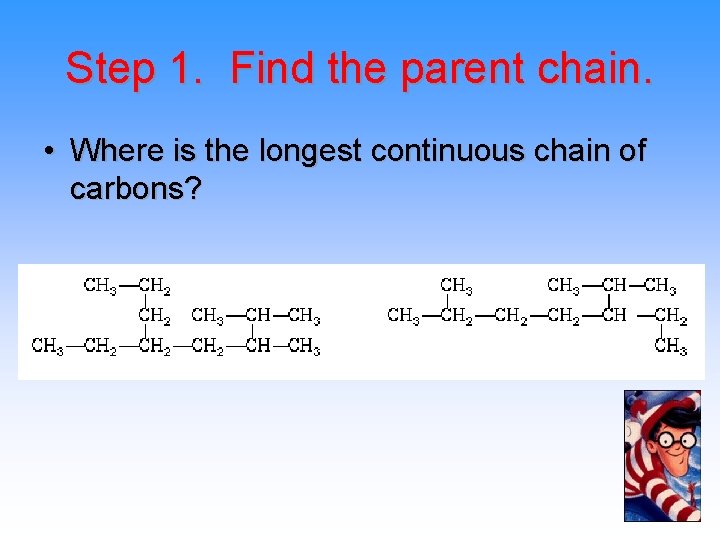
Step 1. Find the parent chain. • Where is the longest continuous chain of carbons?

Prefixes for # of Carbons 1 Meth 6 Hex 2 Eth 7 Hept 3 Prop 8 Oct 4 But 9 Non 5 Pent 10 Dec

Endings • Alkanes (all C-C single bonded parent chain) end in –ane – Methane CH 4 – Ethane C 2 H 6 – Propane C 3 H 8 • Attached carbon groups (substituents) end in –yl – Methyl CH 3 – Ethyl CH 3 CH 2– Propyl CH 3 CH 2 – – 3 -ethylpentane
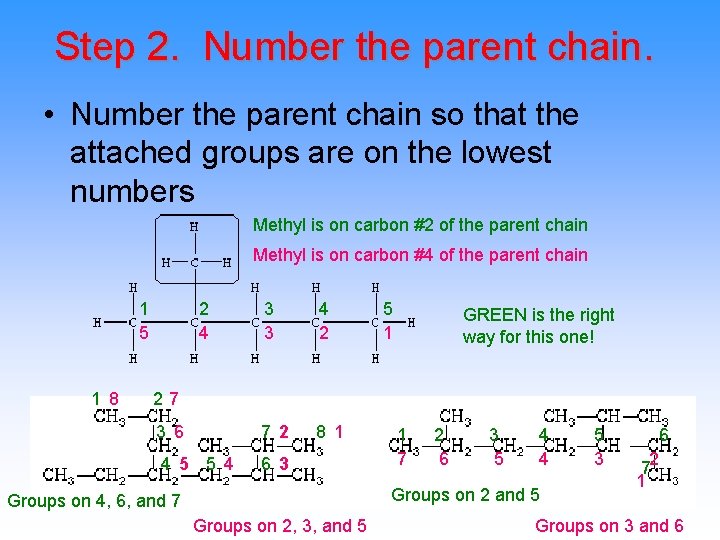
Step 2. Number the parent chain. • Number the parent chain so that the attached groups are on the lowest numbers Methyl is on carbon #2 of the parent chain Methyl is on carbon #4 of the parent chain 1 2 3 4 5 4 3 2 1 GREEN is the right way for this one! 1 8 7 2 3 7 8 6 2 1 4 5 6 5 4 3 Groups on 4, 6, and 7 Groups on 2, 3, and 5 1 2 3 4 5 6 7 6 5 4 3 2 7 1 Groups on 2 and 5 Groups on 3 and 6
Step 3. Name the attached groups. • Carbon (alkyl) groups – Methyl CH 3 – Ethyl CH 3 CH 2– Propyl CH 3 CH 2 – • Halogens – Fluoro (F-) – Chloro (Cl-) – Bromo (Br-) – Iodo (I-)
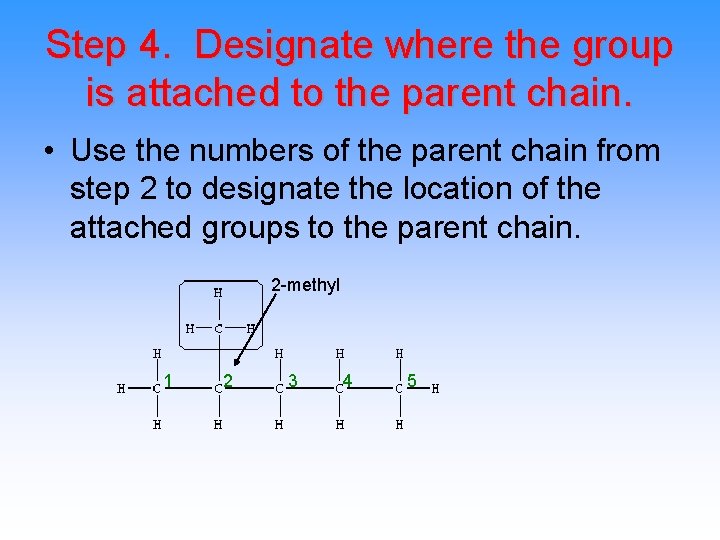
Step 4. Designate where the group is attached to the parent chain. • Use the numbers of the parent chain from step 2 to designate the location of the attached groups to the parent chain. 2 -methyl 1 2 3 4 5
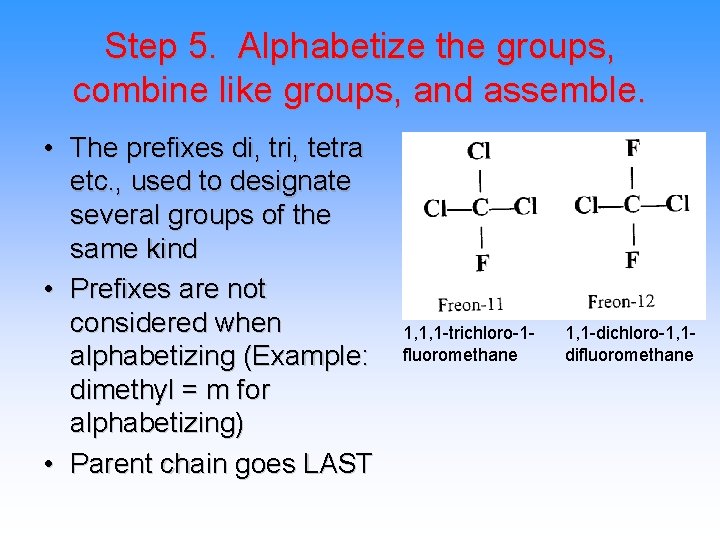
Step 5. Alphabetize the groups, combine like groups, and assemble. • The prefixes di, tri, tetra etc. , used to designate several groups of the same kind • Prefixes are not considered when alphabetizing (Example: dimethyl = m for alphabetizing) • Parent chain goes LAST 1, 1, 1 -trichloro-1 fluoromethane 1, 1 -dichloro-1, 1 difluoromethane
Draw Some Simple Alkanes • 2 -methylpentane • 3 -ethylhexane • 2, 2 -dimethylbutane • 2, 3 -dimethylbutane
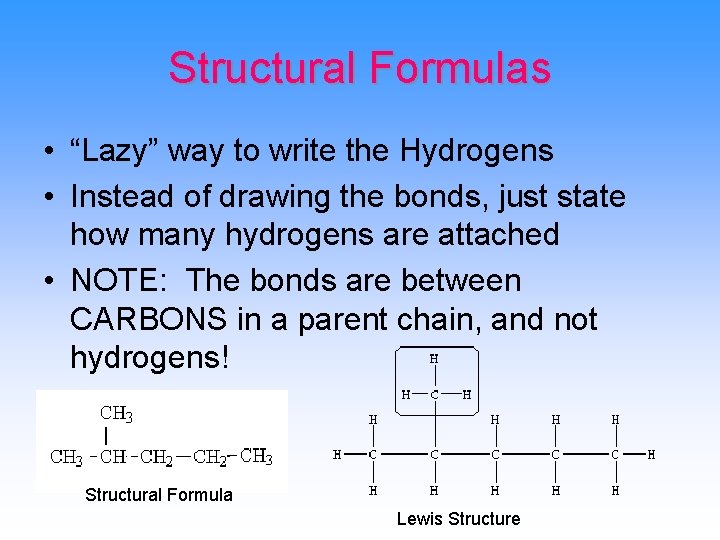
Structural Formulas • “Lazy” way to write the Hydrogens • Instead of drawing the bonds, just state how many hydrogens are attached • NOTE: The bonds are between CARBONS in a parent chain, and not hydrogens! Structural Formula Lewis Structure
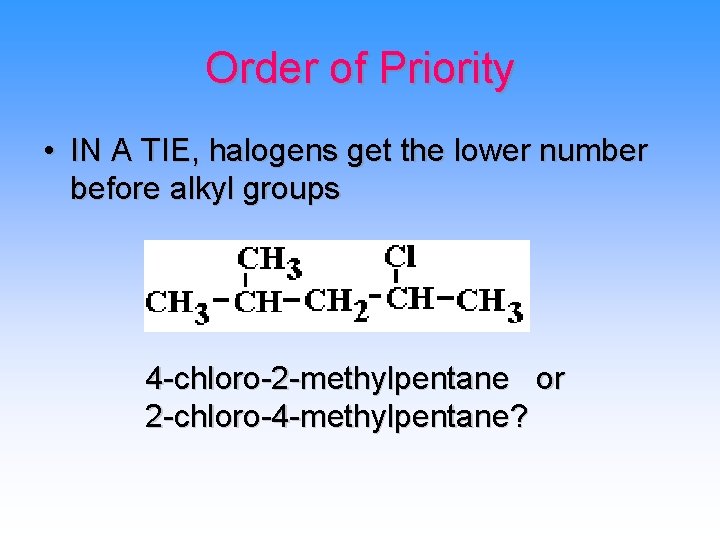
Order of Priority • IN A TIE, halogens get the lower number before alkyl groups 4 -chloro-2 -methylpentane or 2 -chloro-4 -methylpentane?
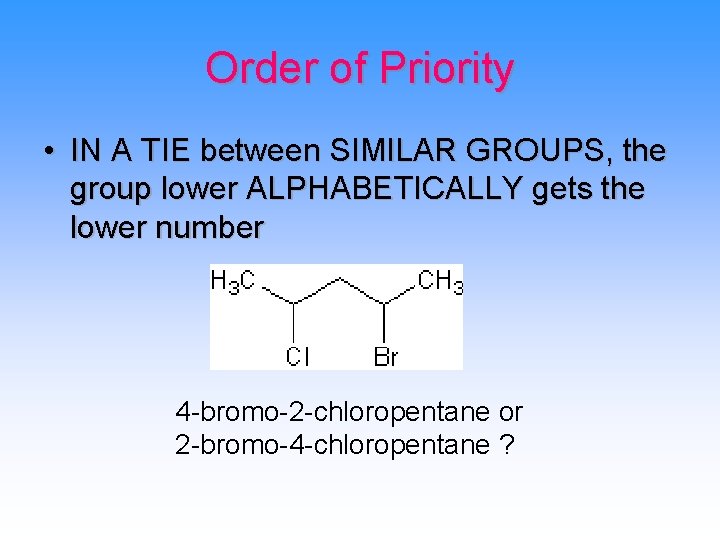
Order of Priority • IN A TIE between SIMILAR GROUPS, the group lower ALPHABETICALLY gets the lower number 4 -bromo-2 -chloropentane or 2 -bromo-4 -chloropentane ?

Isomers • Straight chain alkanes: An alkane that has all its carbons connected in a row. • Branched chain alkanes: An alkane that has a branching connection of carbons. • Isomers: Compounds with same molecular formula but different structures.

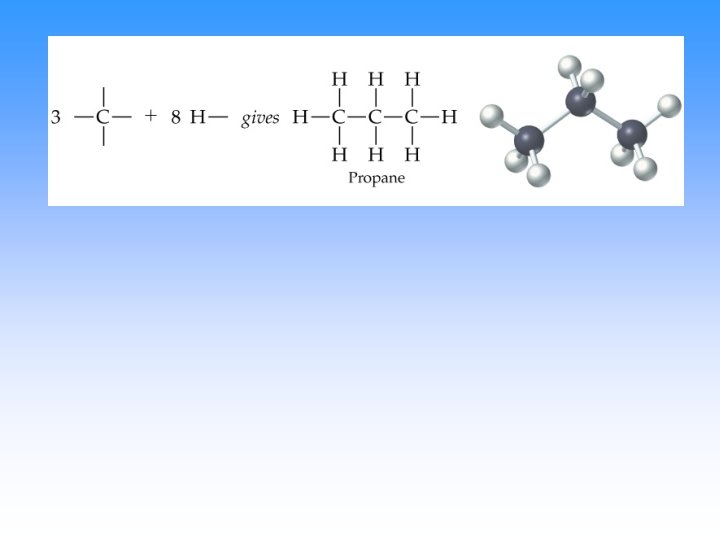
• There is only one possible way that the carbons in methane (CH 4), ethane (C 2 H 6), and propane (C 3 H 8) can be arranged.

• However, carbons in butane (C 4 H 10) can be arranged in two ways; four carbons in a row (linear alkane) or a branching (branched alkane). These two structures are two isomers for butane.
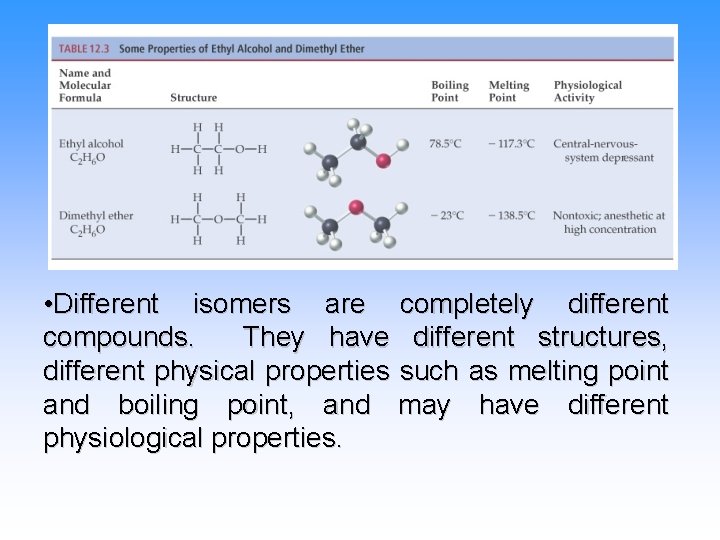
• Different isomers are completely different compounds. They have different structures, different physical properties such as melting point and boiling point, and may have different physiological properties.
Learning Check • Draw all possible structural isomers of C 5 H 12
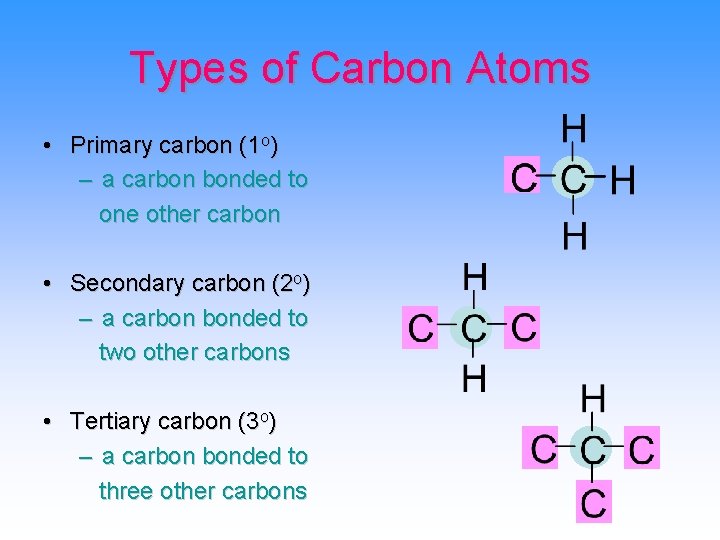
Types of Carbon Atoms • Primary carbon (1 o) – a carbon bonded to one other carbon • Secondary carbon (2 o) – a carbon bonded to two other carbons • Tertiary carbon (3 o) – a carbon bonded to three other carbons

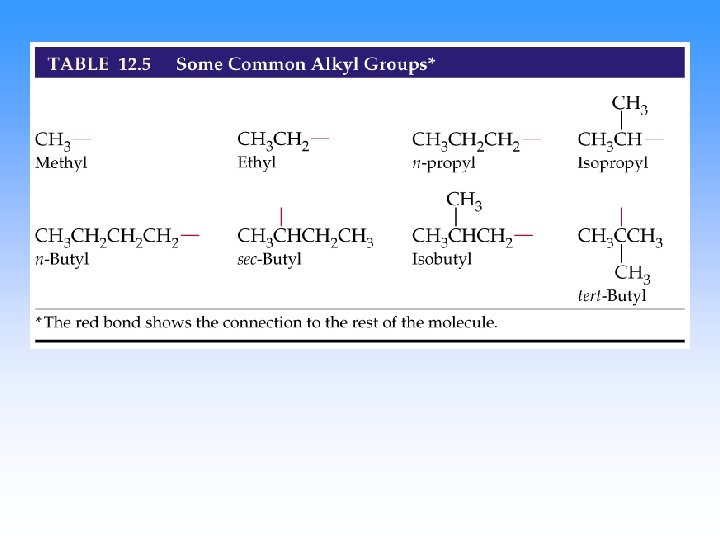

Alkanes Example: Name the following compounds:
Alkanes Example: Write the condensed structure for the following compounds: 3, 3 -dimethylpentane 2 -methyl-4 -sec-butyloctane 1, 2 -dichloro-3 -methylheptane
- Slides: 25