
Organic Chemistry Macromolecules 1 1 Compounds that are
- Slides: 30
Organic Chemistry Macromolecules 1
1. Compounds that are derived from living things are called organic compounds. All _____ organic compounds contain the carbon element ______. Compounds that are not derived from living things are called inorganic _______ compounds.
2. Carbon is important in living organisms because it can form four different bonds on each ______ atom. It can form single, double, and triple bonds _____________ and these bonds can create long chains and rings _________.
3. A macromolecule is a large molecule and is also called a polymer A polymer is made _____. formed when many smaller monomers bond molecules or ______ together.
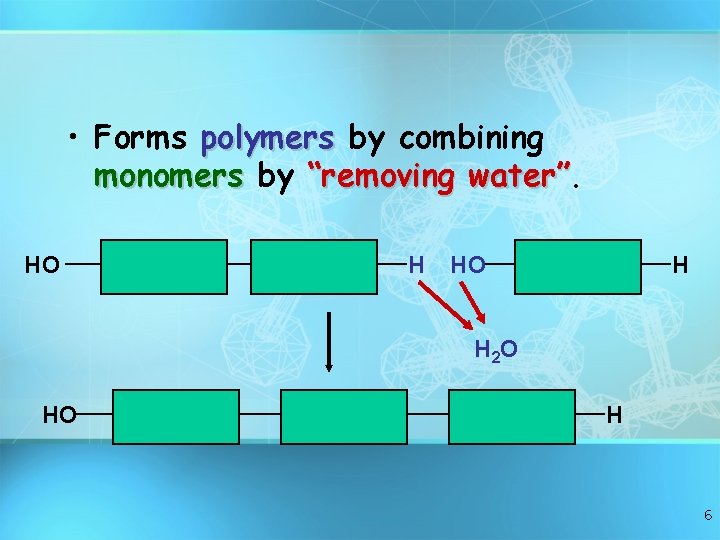
4. The process that forms polymers is called polymerization and happens ________ when a water molecule is removed from two monomers.
• Forms polymers by combining monomers by “removing water”. HO H H 2 O HO H 6
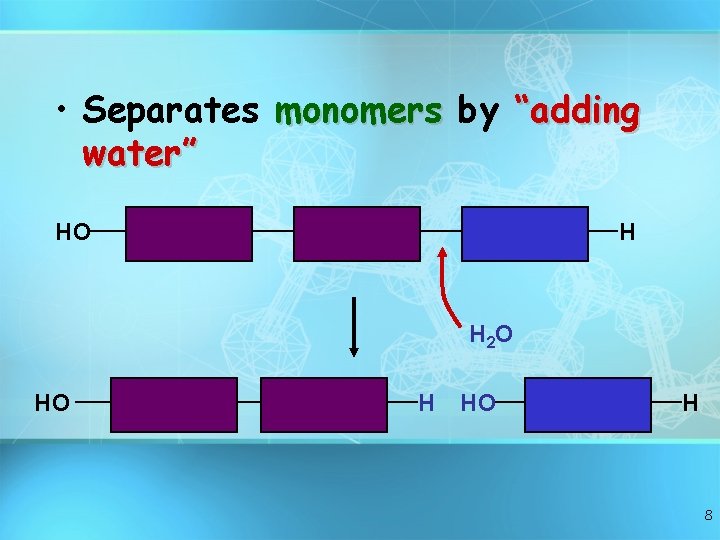
5. The process that breaks down polymers into monomers is called hydrolysis ______ and happens when a water molecule is added back to the polymer.
• Separates monomers by “adding water” HO H H 2 O HO H 8
6. The four macromolecules found in organisms are: • Carbohydrates • Lipids • Proteins • Nucleic acids
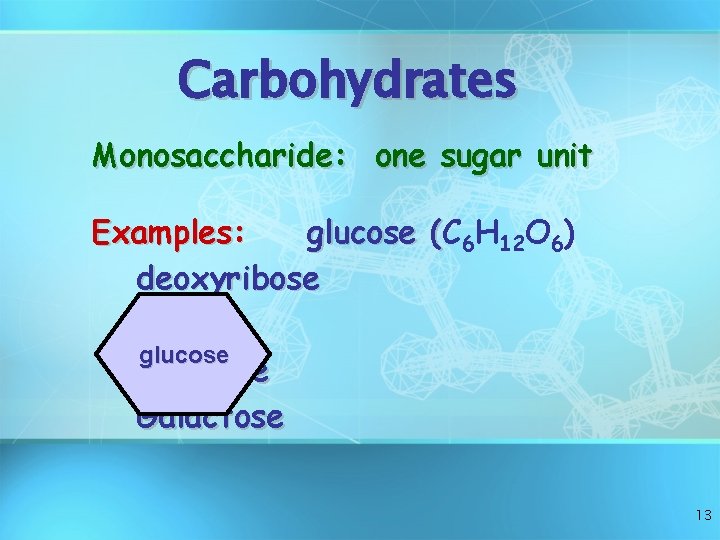
7. Carbohydrates ________ are the main energy source for our bodies. They are made of carbon, hydrogen and oxygen. The ratio of C-H-O in a carbohydrate is 1: 2: 1. Ex-C 6 H 12 O 6 The monomers of carbohydrates are monosaccharides or called __________ simple sugars ________.
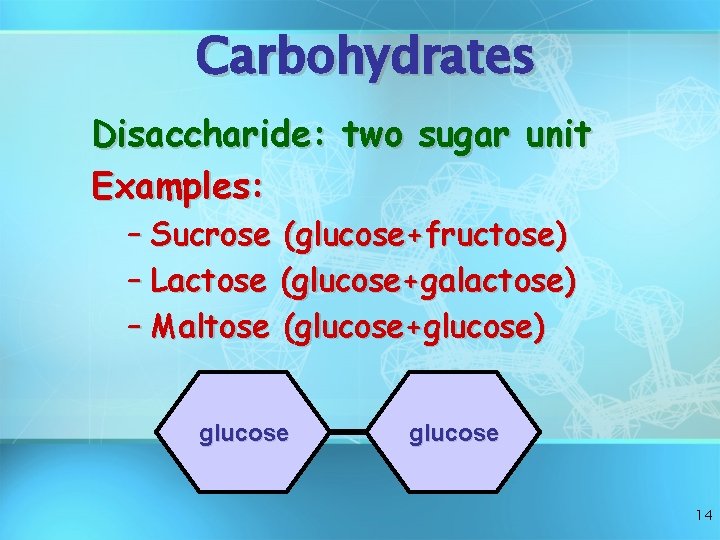
8. There are three main types of carbohydrates. – monosaccharides _________ are single sugars or simple sugars. Ex- glucose, galactose, fructose disaccharides are double sugars or a – _______ combination of two monosaccharides. Ex sucrose -____(table sugar) is glucose + lactose fructose ____(milk sugar) is glucose + galactose
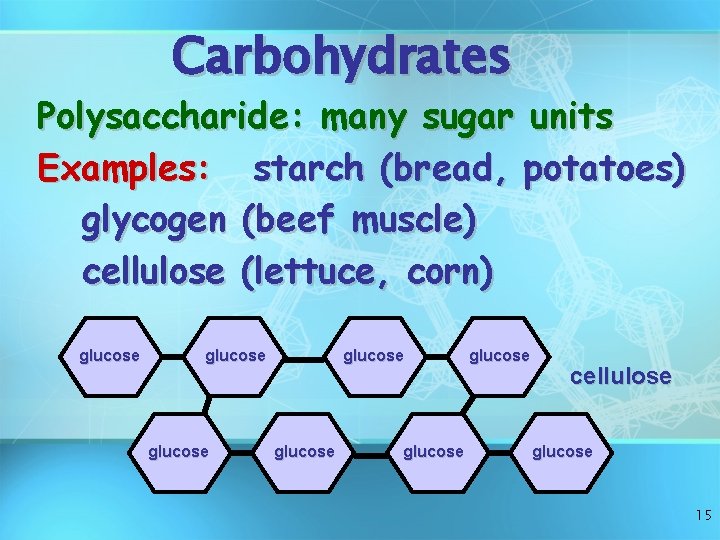
c. Polysaccharides are 3 or more sugars cellulose in combined together. Ex- _____ glycogen in animals. plants and _____
Carbohydrates Monosaccharide: one sugar unit Examples: glucose (C ( 6 H 12 O 6) deoxyribose glucose Fructose Galactose 13
Carbohydrates Disaccharide: two sugar unit Examples: – Sucrose (glucose+fructose) – Lactose (glucose+galactose) – Maltose (glucose+glucose) glucose 14
Carbohydrates Polysaccharide: many sugar units Examples: starch (bread, potatoes) glycogen (beef muscle) cellulose (lettuce, corn) glucose glucose cellulose glucose 15
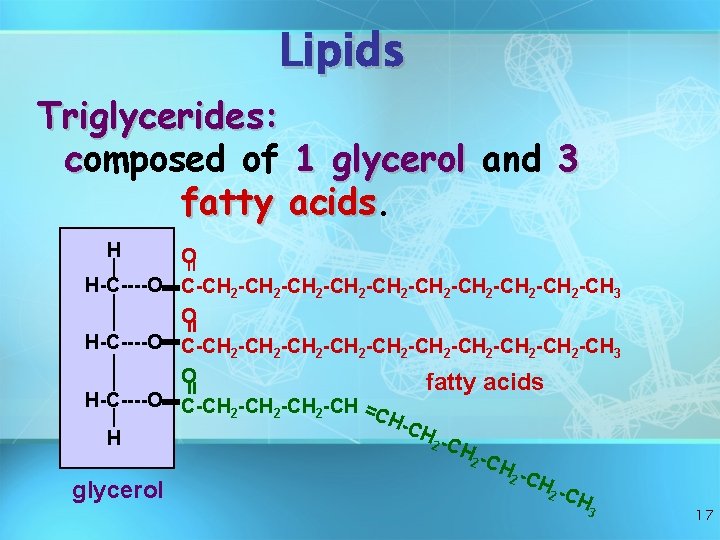
Lipids are macromolecules that 9. ______ also contain carbon, hydrogen and oxygen. They are commonly called fats, oils and waxes Lipids are __________. used for long term energy storage in living things as well as insulation, shock absorbers and protective coatings. The monomers of lipids are three fatty acid chains and one ________________ glycerol _____
Lipids Triglycerides: composed of 1 glycerol and 3 fatty acids H = O H-C----O C-CH 2 -CH 2 -CH 2 -CH 2 -CH 2 -CH 3 O fatty acids H-C----O C-CH -CH = 2 2 2 CH -CH H 2 -C H 2 C Hglycerol 2 C H = 3 17
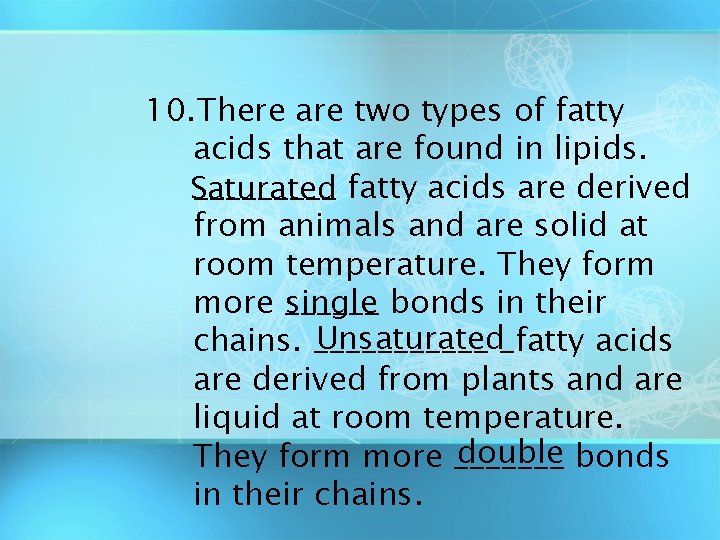
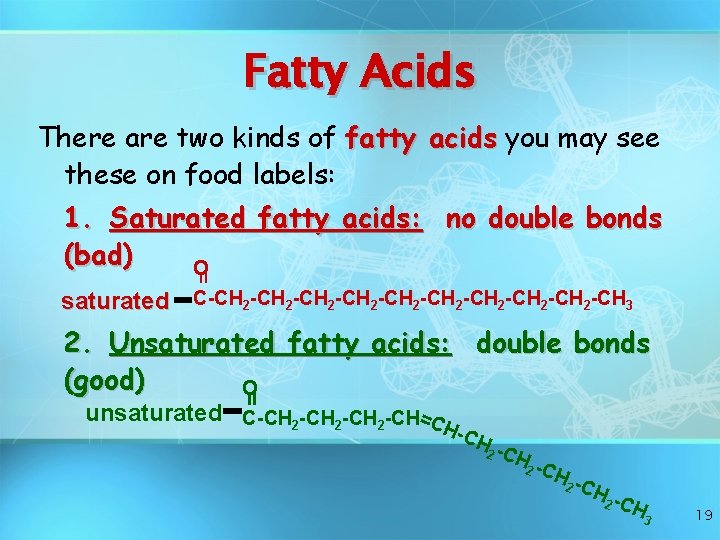
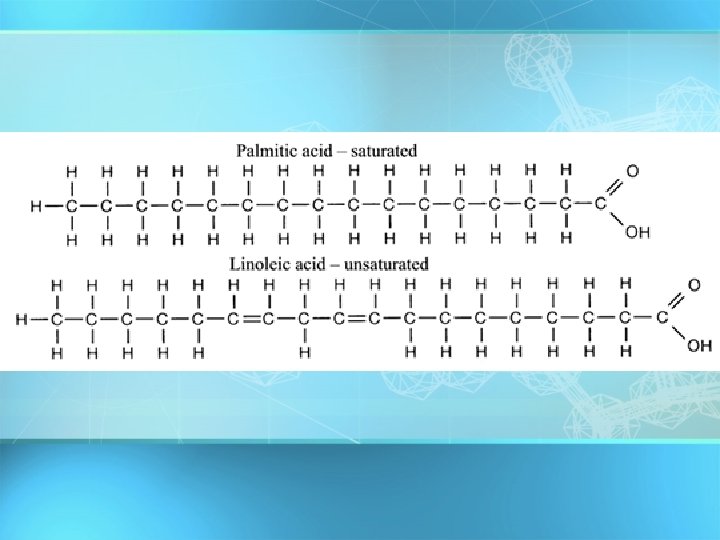
10. There are two types of fatty acids that are found in lipids. _____ fatty acids are derived Saturated from animals and are solid at room temperature. They form more ______ single bonds in their Unsaturated_fatty acids chains. ______ are derived from plants and are liquid at room temperature. double bonds They form more _______ in their chains.
Fatty Acids There are two kinds of fatty acids you may see these on food labels: = 1. Saturated fatty acids: no double bonds (bad) O saturated C-CH 2 -CH 2 -CH 2 -CH 3 = 2. Unsaturated fatty acids: double bonds (good) O unsaturated C-CH 2 -CH=C H -CH 2 -C H 2 C H 3 19
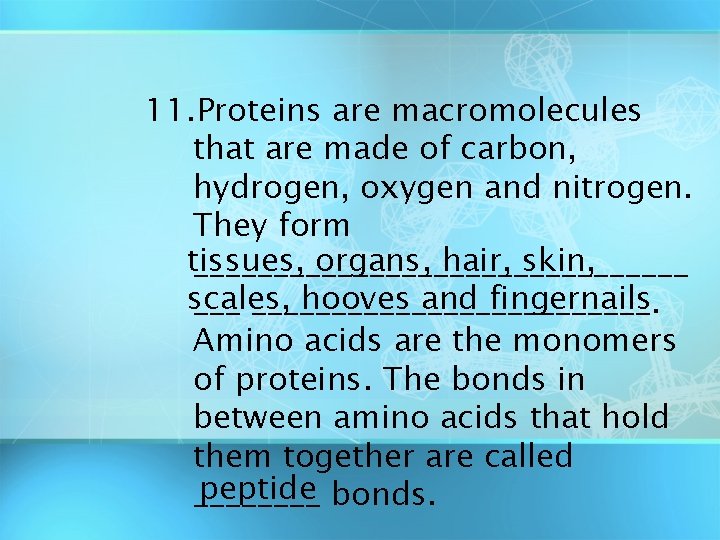
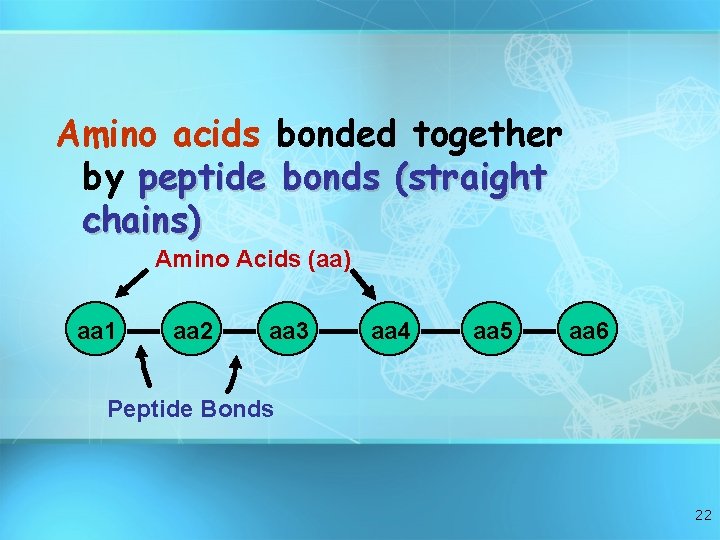
11. Proteins are macromolecules that are made of carbon, hydrogen, oxygen and nitrogen. They form tissues, organs, hair, skin, ________________ scales, hooves and fingernails ______________. Amino acids are the monomers of proteins. The bonds in between amino acids that hold them together are called peptide bonds. ____
Amino acids bonded together by peptide bonds (straight chains) Amino Acids (aa) aa 1 aa 2 aa 3 aa 4 aa 5 aa 6 Peptide Bonds 22
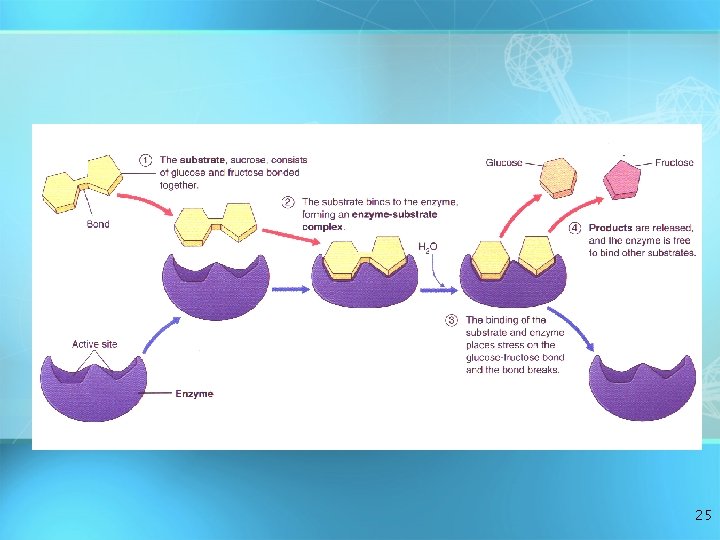
Enzymes are special proteins 12. _____ that speed up chemical reactions in your body. They are _____. catalysts
13. The molecule that the substrate enzymes is called the _____. The enzyme will change shape so that the substrate can be broken down into its component parts more easily. The enzyme is not affected and can be used again on the same type of substrate. Each enzyme fits specifically to one type of substrate.
25
14. Enzymes and the molecules that they act upon fit together lock and key The like a “_______”. _____ enzyme is the lock and the substrate is the key. _____
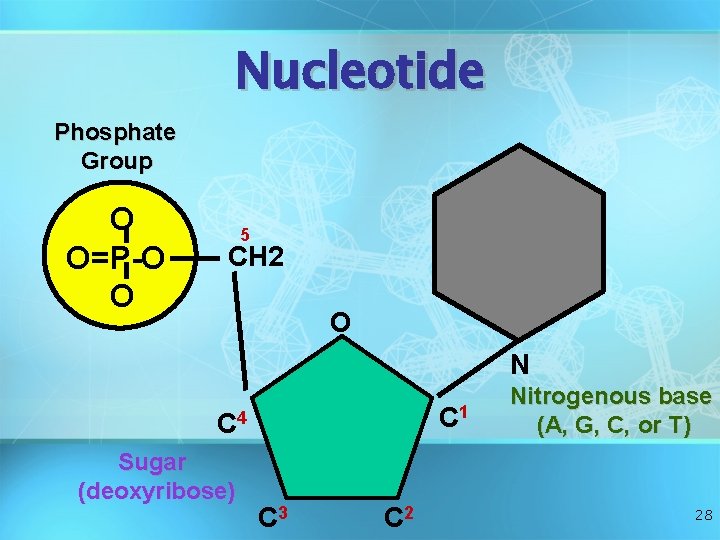
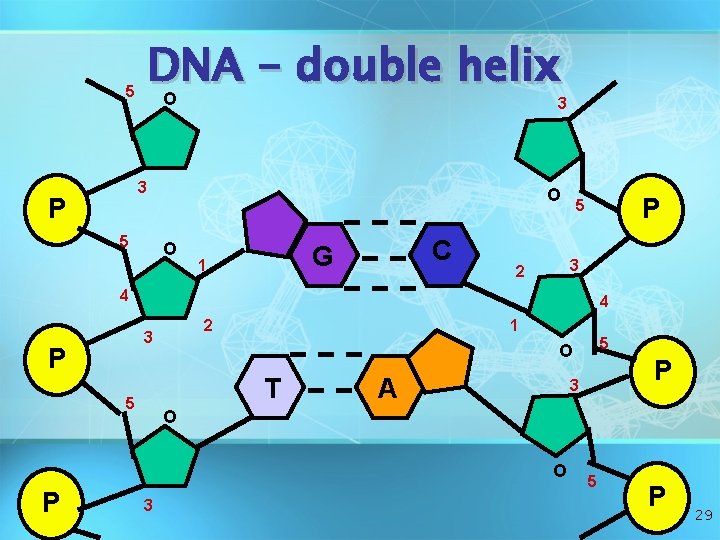
Nucleic acids are polymers 15. _______ that have nucleotides as their monomers. Ex-DNA and RNA 16. Nucleotides are composed of a ________________ 5 -carbon sugar, phosphate group _________. and nitrogen base
Nucleotide Phosphate Group O O=P-O O 5 CH 2 O N C 1 C 4 Sugar (deoxyribose) C 3 C 2 Nitrogenous base (A, G, C, or T) 28
5 DNA - double helix O 3 3 P 5 O O C G 1 P 5 3 2 4 4 2 3 P 1 T 5 A P 3 O O P 5 O 3 5 P 29
16. DNA and RNA control the proteins in your production of ____ body. They hold all the information to pass traits from generation to the next. one ______