
Organic Chemistry CHEM 240 King Saud University College
- Slides: 52
Organic Chemistry CHEM 240 King Saud University College of Science, Chemistry Department CHAPTER 3: Unsaturated Hydrocarbons: Alkenes, Cycloalkenes and Dienes 1
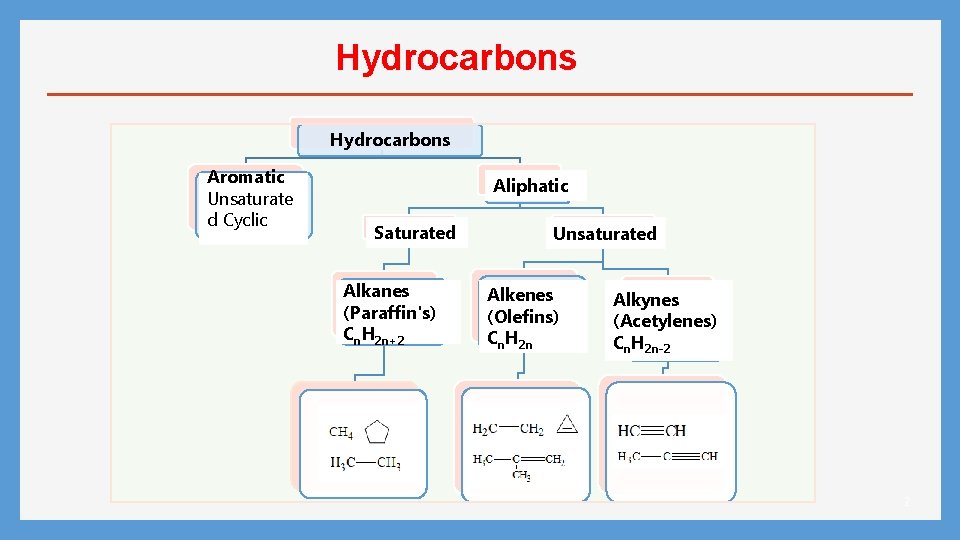
Hydrocarbons Aromatic Unsaturate d Cyclic Aliphatic Saturated Alkanes (Paraffin's) Cn. H 2 n+2 Unsaturated Alkenes (Olefins) Cn. H 2 n Alkynes (Acetylenes) Cn. H 2 n-2 2
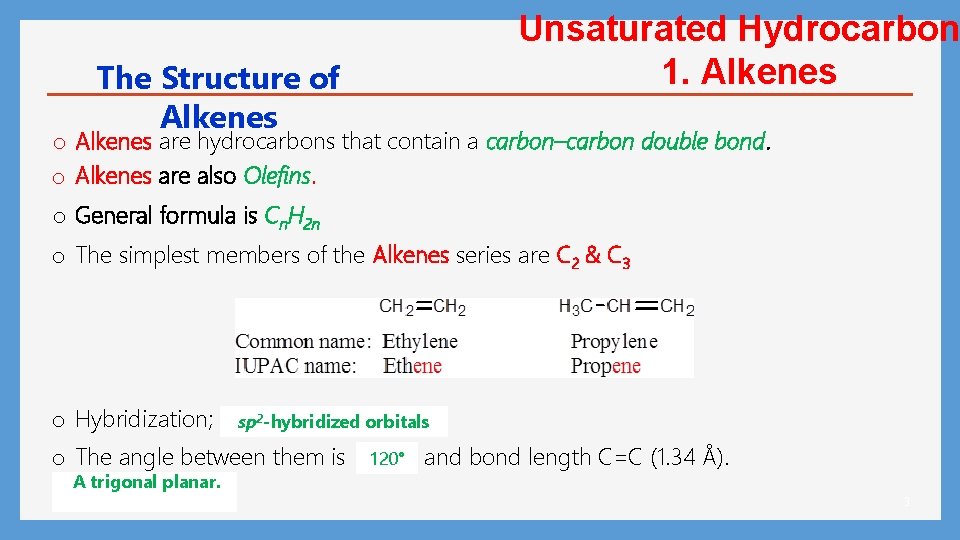
Unsaturated Hydrocarbon 1. Alkenes The Structure of Alkenes o Alkenes are hydrocarbons that contain a carbon–carbon double bond. o Alkenes are also Olefins. o General formula is Cn. H 2 n o The simplest members of the Alkenes series are C 2 & C 3 o Hybridization; sp 2 -hybridized orbitals o The angle between them is A trigonal planar. 120° and bond length C=C (1. 34 Å). 3
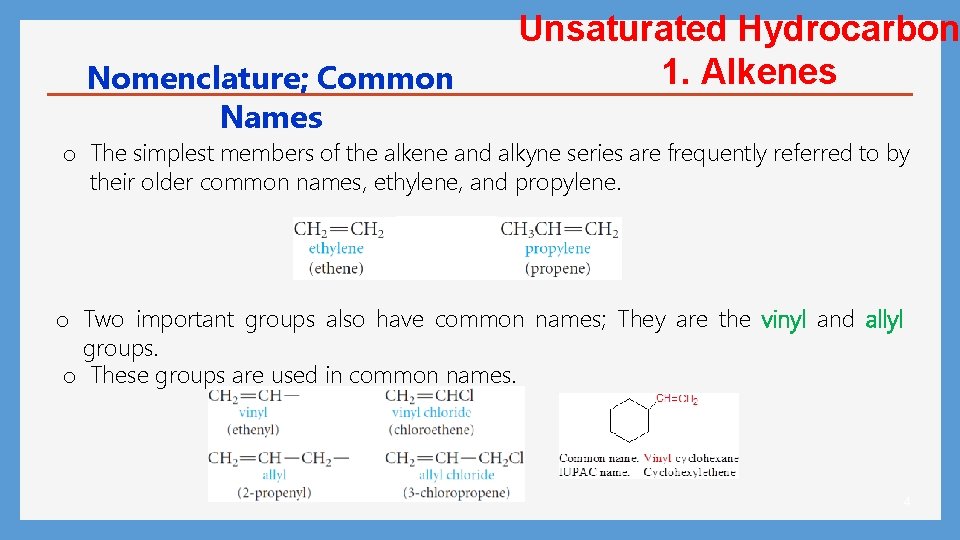
Nomenclature; Common Names Unsaturated Hydrocarbon 1. Alkenes o The simplest members of the alkene and alkyne series are frequently referred to by their older common names, ethylene, and propylene. o Two important groups also have common names; They are the vinyl and allyl groups. o These groups are used in common names. 4
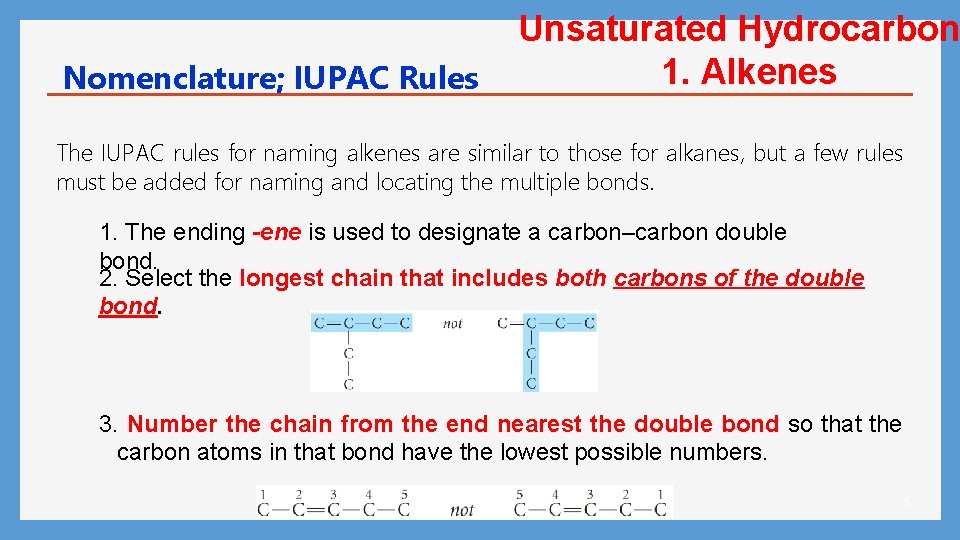
Nomenclature; IUPAC Rules Unsaturated Hydrocarbon 1. Alkenes The IUPAC rules for naming alkenes are similar to those for alkanes, but a few rules must be added for naming and locating the multiple bonds. 1. The ending -ene is used to designate a carbon–carbon double bond. 2. Select the longest chain that includes both carbons of the double bond. 3. Number the chain from the end nearest the double bond so that the carbon atoms in that bond have the lowest possible numbers. 5
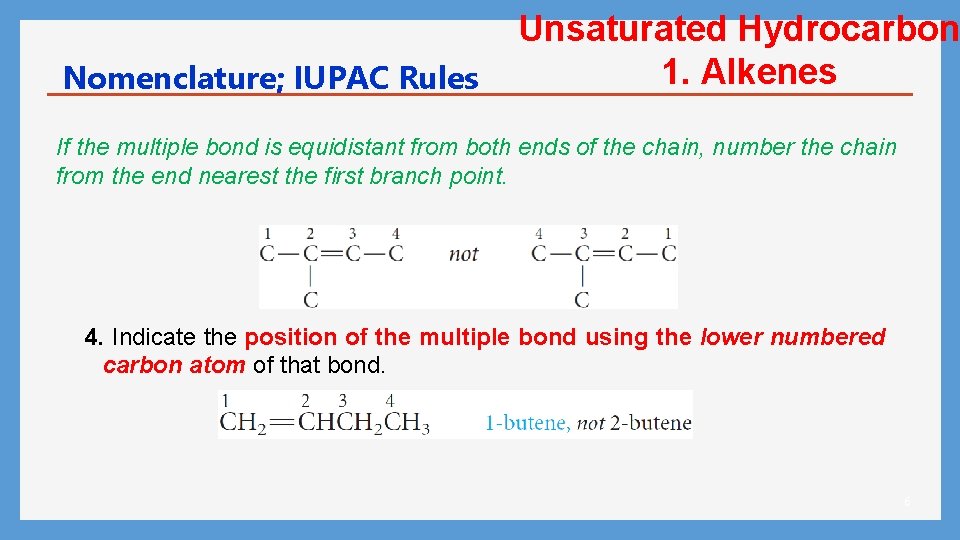
Nomenclature; IUPAC Rules Unsaturated Hydrocarbon 1. Alkenes If the multiple bond is equidistant from both ends of the chain, number the chain from the end nearest the first branch point. 4. Indicate the position of the multiple bond using the lower numbered carbon atom of that bond. 6
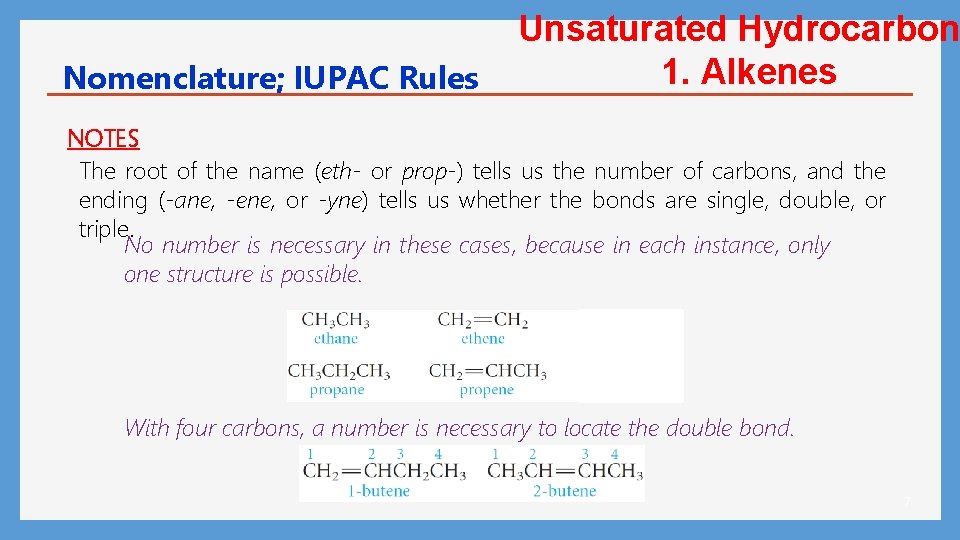
Nomenclature; IUPAC Rules Unsaturated Hydrocarbon 1. Alkenes NOTES The root of the name (eth- or prop-) tells us the number of carbons, and the ending (-ane, -ene, or -yne) tells us whether the bonds are single, double, or triple. No number is necessary in these cases, because in each instance, only one structure is possible. With four carbons, a number is necessary to locate the double bond. 7
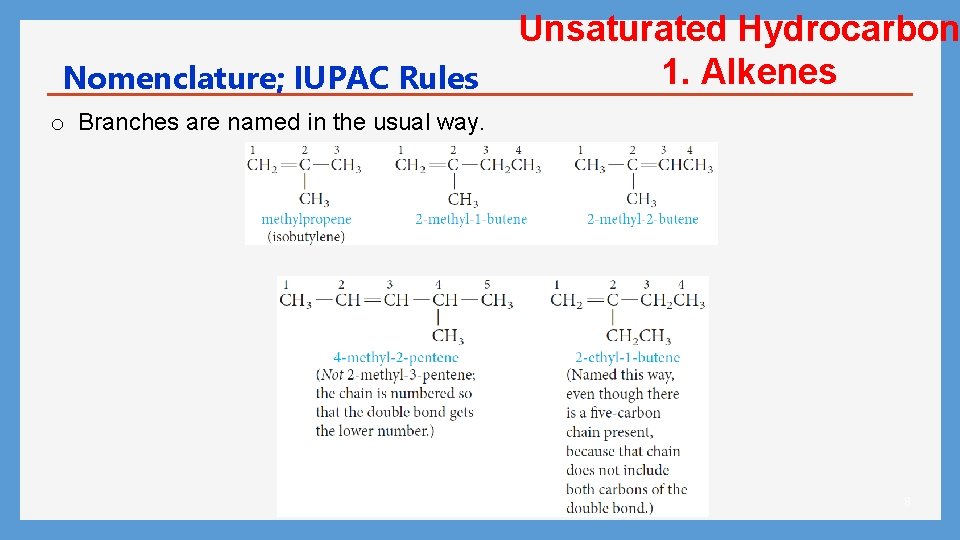
Nomenclature; IUPAC Rules Unsaturated Hydrocarbon 1. Alkenes o Branches are named in the usual way. 8
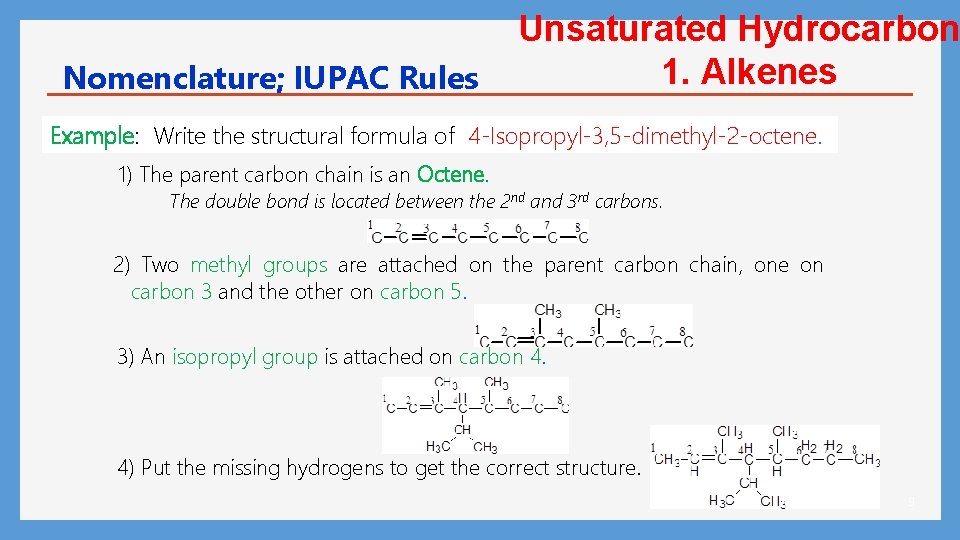
Nomenclature; IUPAC Rules Unsaturated Hydrocarbon 1. Alkenes Example: Write the structural formula of 4 -Isopropyl-3, 5 -dimethyl-2 -octene. 1) The parent carbon chain is an Octene. The double bond is located between the 2 nd and 3 rd carbons. 2) Two methyl groups are attached on the parent carbon chain, one on carbon 3 and the other on carbon 5. 3) An isopropyl group is attached on carbon 4. 4) Put the missing hydrogens to get the correct structure. 9
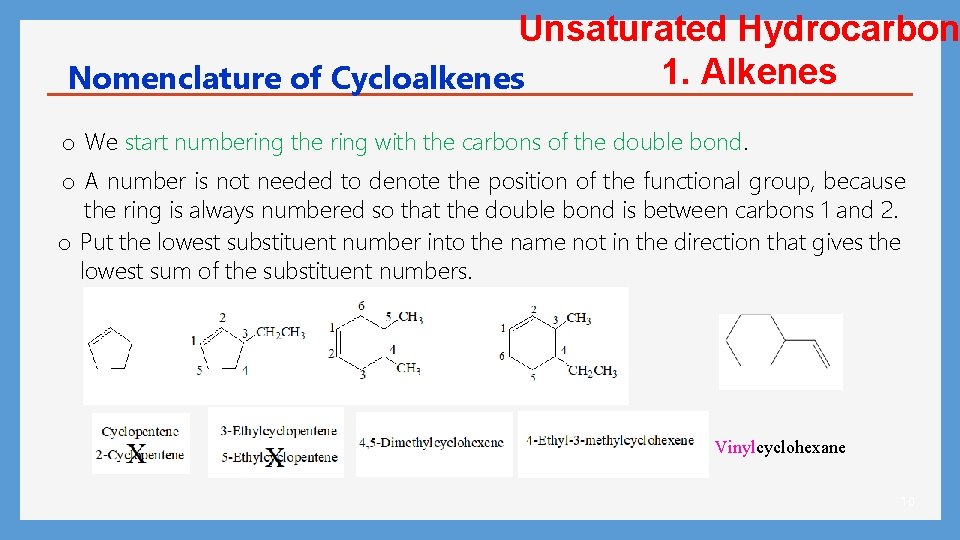
Unsaturated Hydrocarbon 1. Alkenes Nomenclature of Cycloalkenes o We start numbering the ring with the carbons of the double bond. o A number is not needed to denote the position of the functional group, because the ring is always numbered so that the double bond is between carbons 1 and 2. o Put the lowest substituent number into the name not in the direction that gives the lowest sum of the substituent numbers. Vinylcyclohexane 10
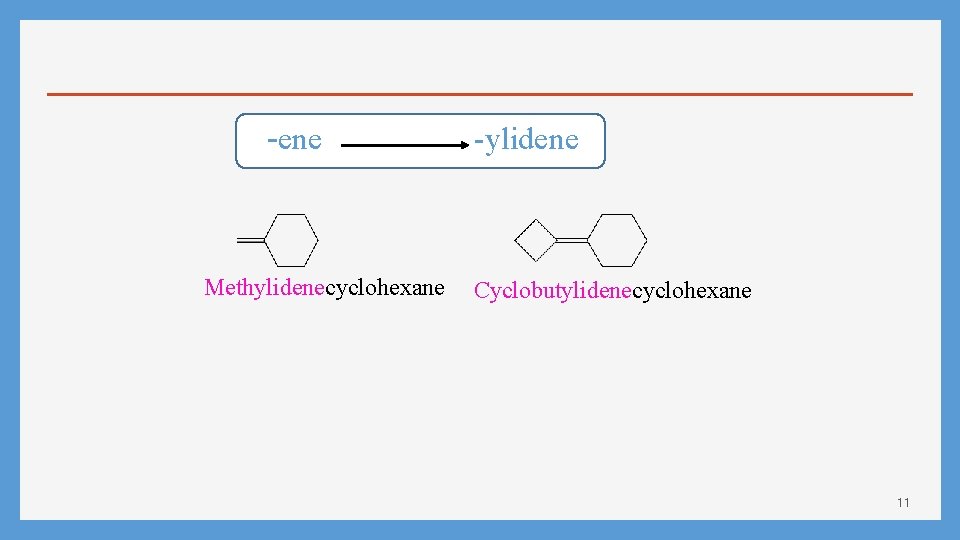
-ene Methylidenecyclohexane -ylidene Cyclobutylidenecyclohexane 11
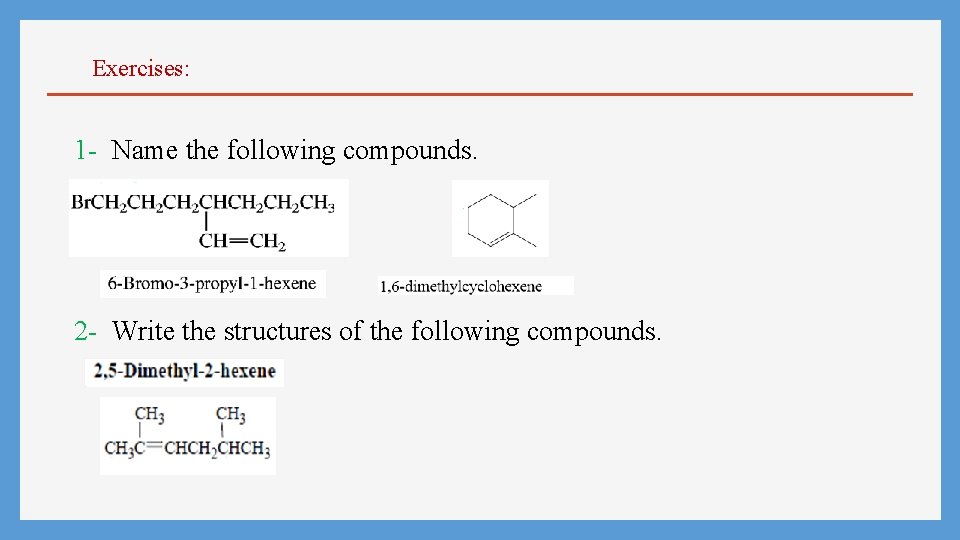
Exercises: 1 - Name the following compounds. 2 - Write the structures of the following compounds.
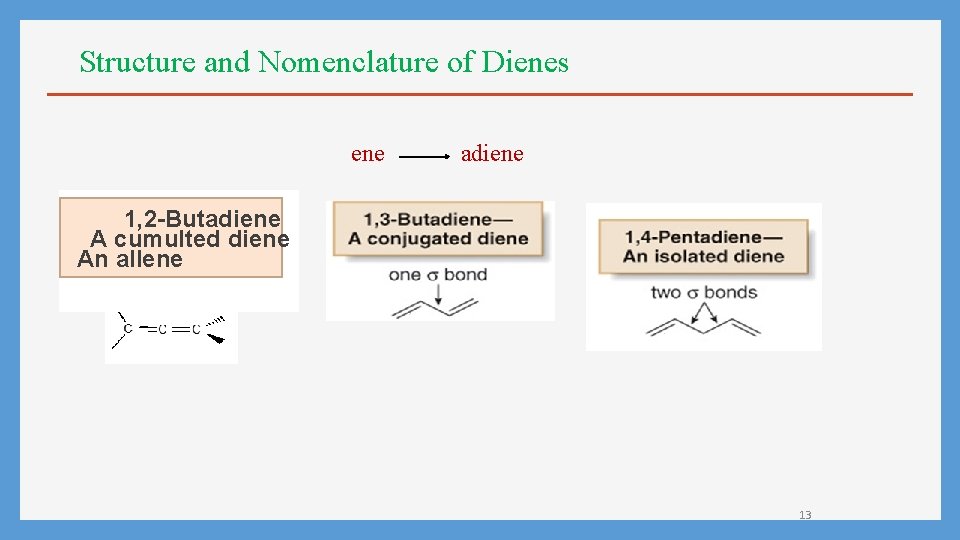
Structure and Nomenclature of Dienes ene adiene 1, 2 -Butadiene A cumulted diene An allene 13
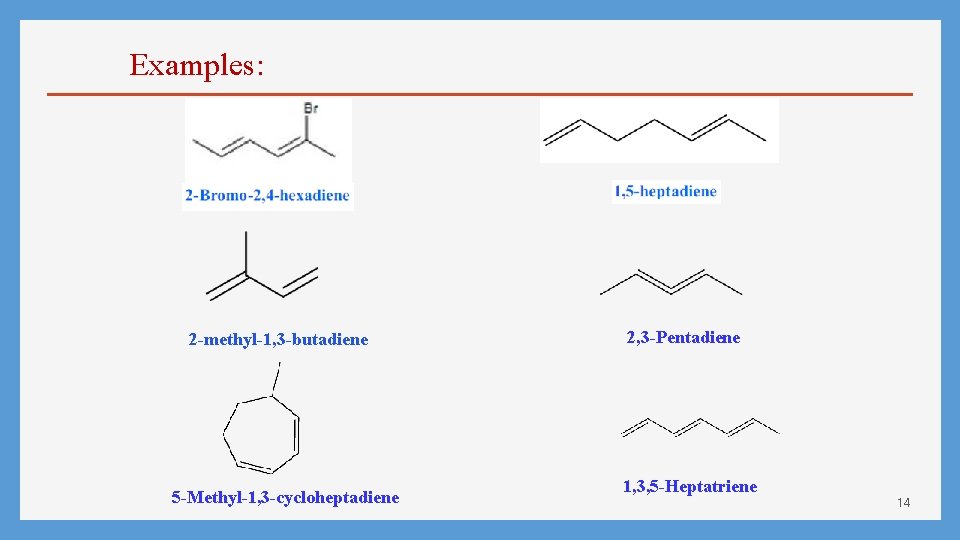
Examples: 2 -methyl-1, 3 -butadiene 5 -Methyl-1, 3 -cycloheptadiene 2, 3 -Pentadiene 1, 3, 5 -Heptatriene 14
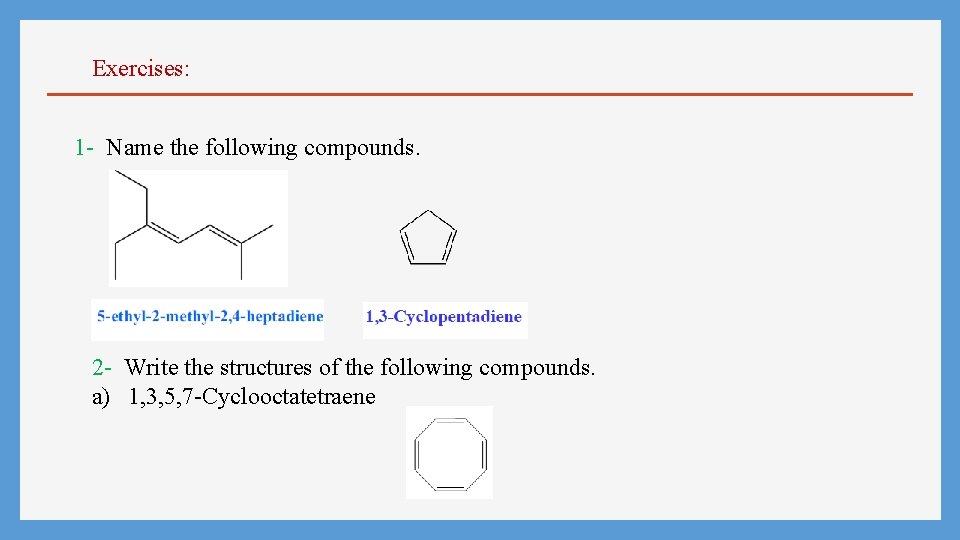
Exercises: 1 - Name the following compounds. 2 - Write the structures of the following compounds. a) 1, 3, 5, 7 -Cyclooctatetraene
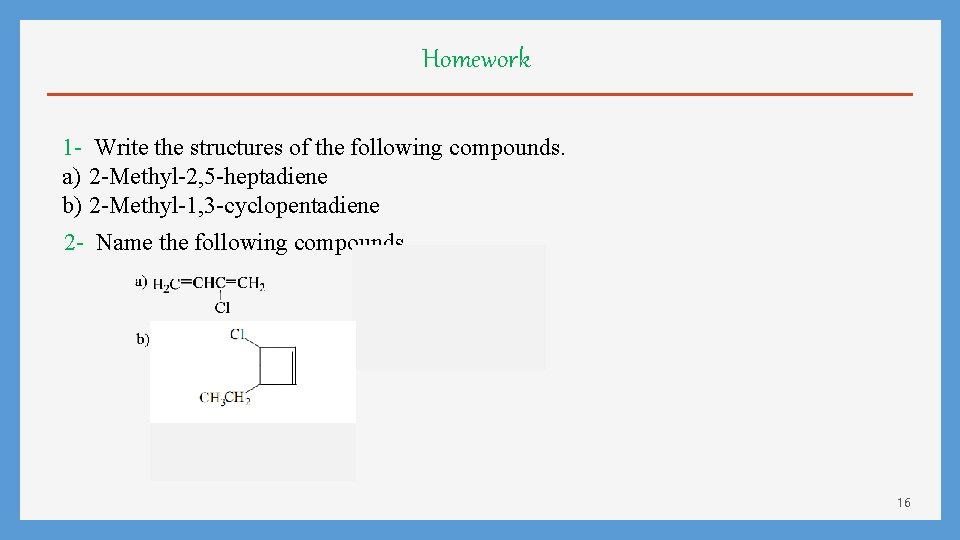
Homework 1 - Write the structures of the following compounds. a) 2 -Methyl-2, 5 -heptadiene b) 2 -Methyl-1, 3 -cyclopentadiene 2 - Name the following compounds. 16
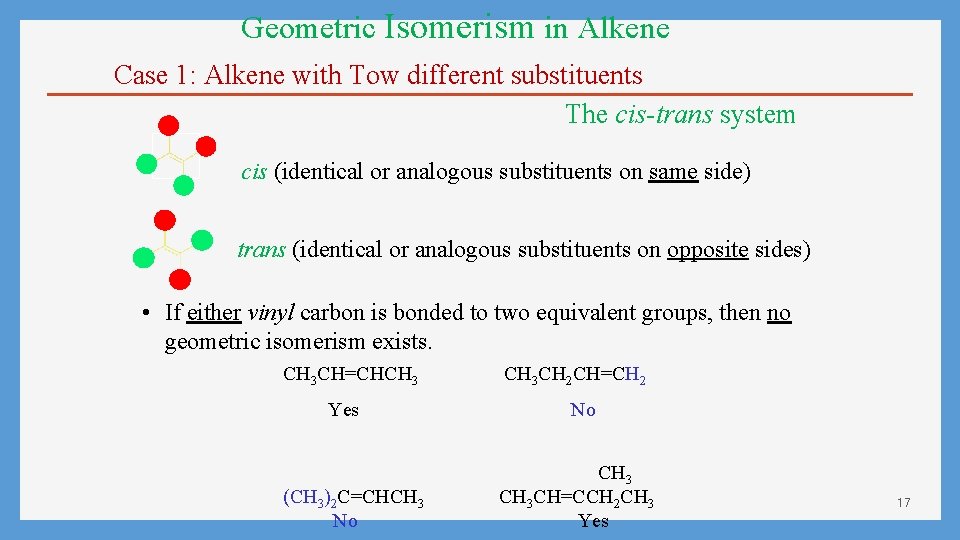
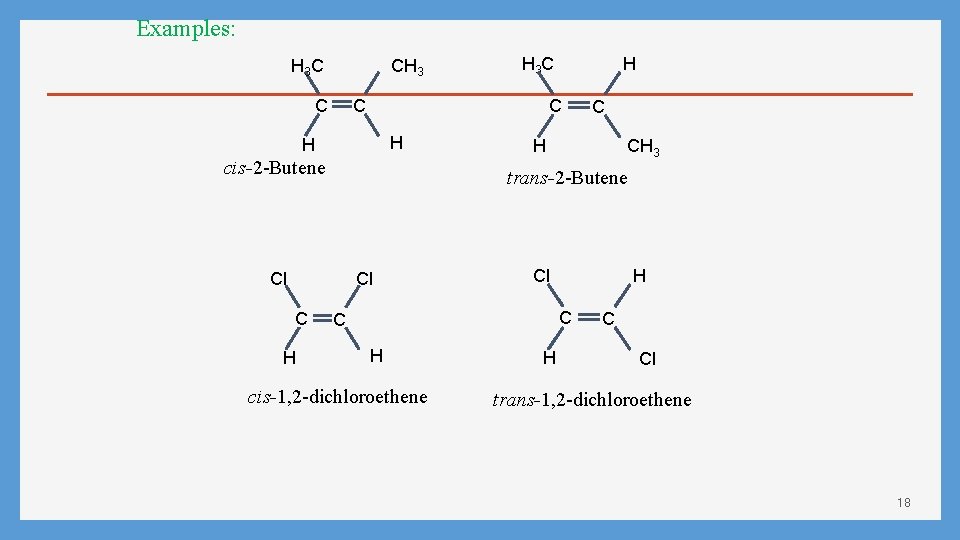
Geometric Isomerism in Alkene Case 1: Alkene with Tow different substituents The cis-trans system cis (identical or analogous substituents on same side) trans (identical or analogous substituents on opposite sides) • If either vinyl carbon is bonded to two equivalent groups, then no geometric isomerism exists. CH 3 CH=CHCH 3 Yes (CH 3)2 C=CHCH 3 No CH 3 CH 2 CH=CH 2 No CH 3 CH=CCH 2 CH 3 Yes 17
Examples: H 3 C CH 3 C H cis-2 -Butene C H CH 3 trans-2 -Butene Cl Cl H H C C H 3 C Cl H C C H cis-1, 2 -dichloroethene H C Cl trans-1, 2 -dichloroethene 18
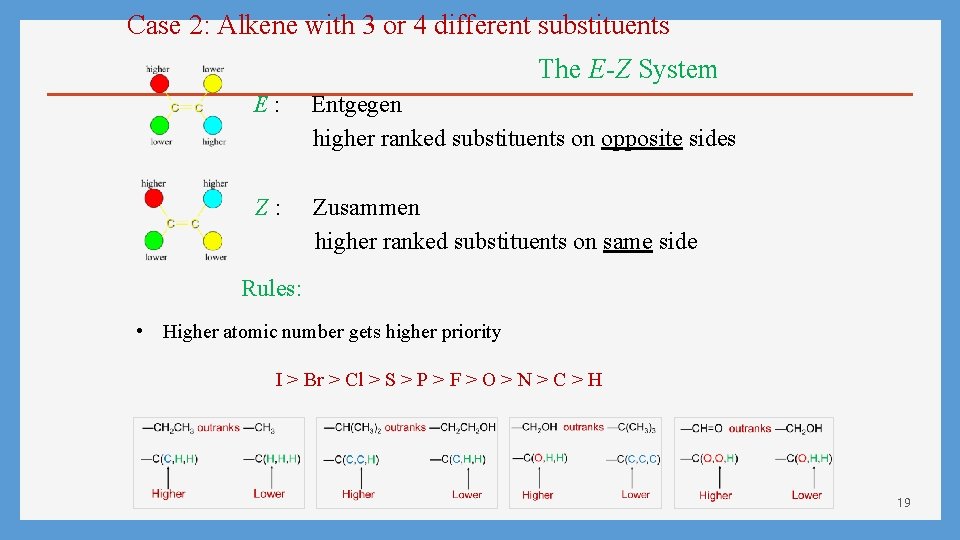
Case 2: Alkene with 3 or 4 different substituents The E-Z System E: Entgegen higher ranked substituents on opposite sides Z: Zusammen higher ranked substituents on same side Rules: • Higher atomic number gets higher priority I > Br > Cl > S > P > F > O > N > C > H 19
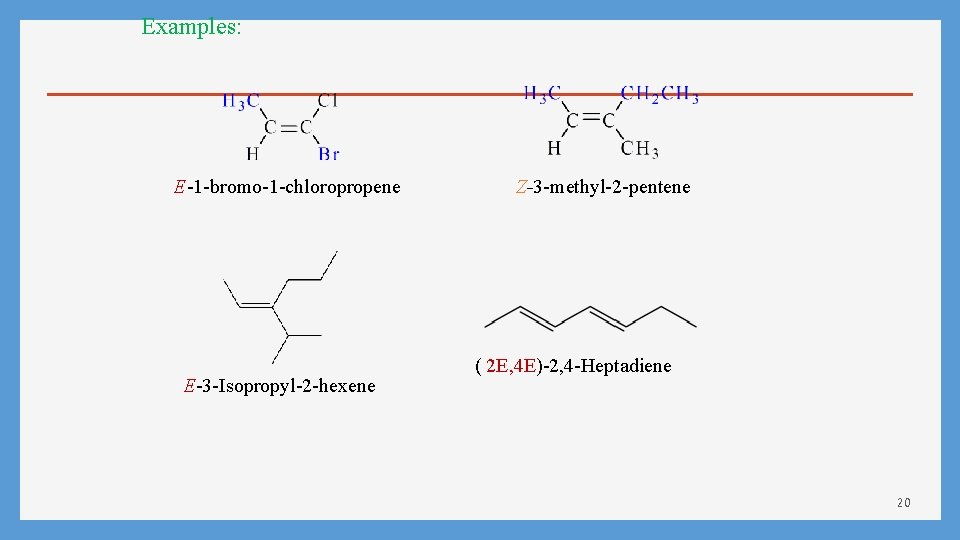
Examples: E-1 -bromo-1 -chloropropene E-3 -Isopropyl-2 -hexene Z-3 -methyl-2 -pentene ( 2 E, 4 E)-2, 4 -Heptadiene 20
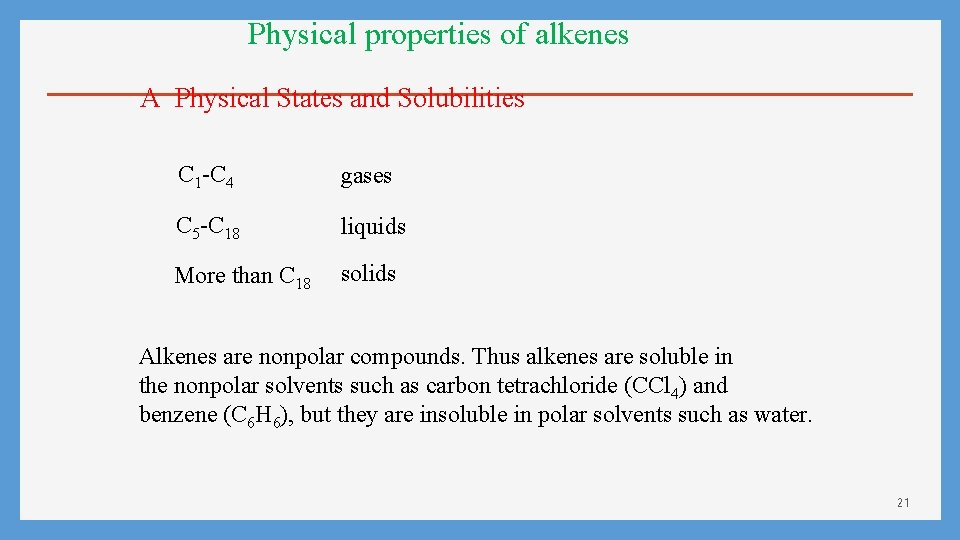
Physical properties of alkenes A Physical States and Solubilities C 1 -C 4 gases C 5 -C 18 liquids More than C 18 solids Alkenes are nonpolar compounds. Thus alkenes are soluble in the nonpolar solvents such as carbon tetrachloride (CCl 4) and benzene (C 6 H 6), but they are insoluble in polar solvents such as water. 21
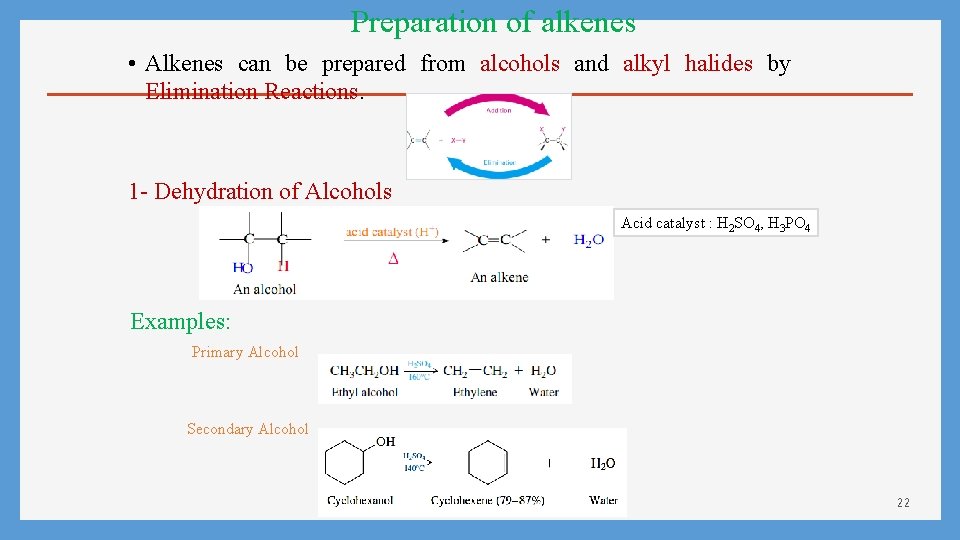
Preparation of alkenes • Alkenes can be prepared from alcohols and alkyl halides by Elimination Reactions. 1 - Dehydration of Alcohols Acid catalyst : H 2 SO 4, H 3 PO 4 Examples: Primary Alcohol Secondary Alcohol 22
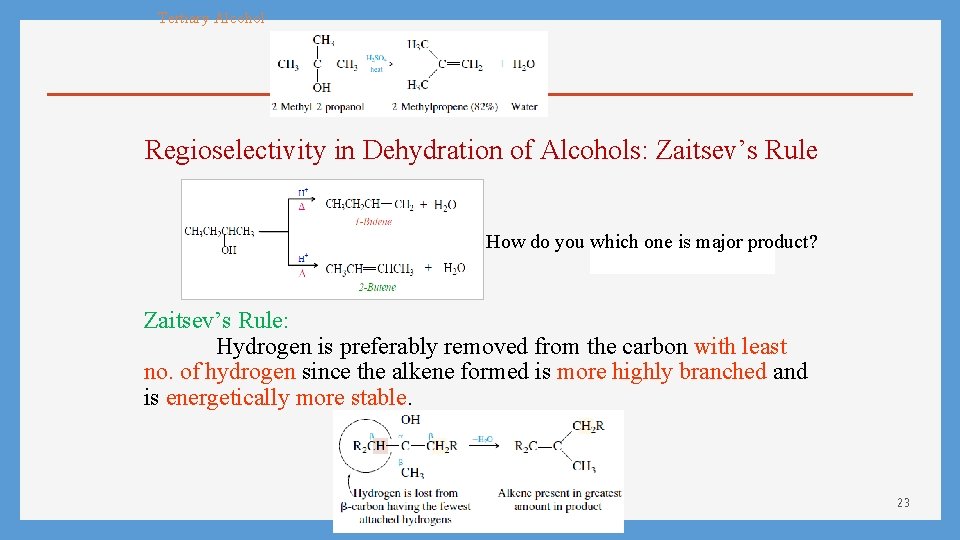
Tertiary Alcohol Regioselectivity in Dehydration of Alcohols: Zaitsev’s Rule How do you which one is major product? Zaitsev’s Rule: Hydrogen is preferably removed from the carbon with least no. of hydrogen since the alkene formed is more highly branched and is energetically more stable. 23
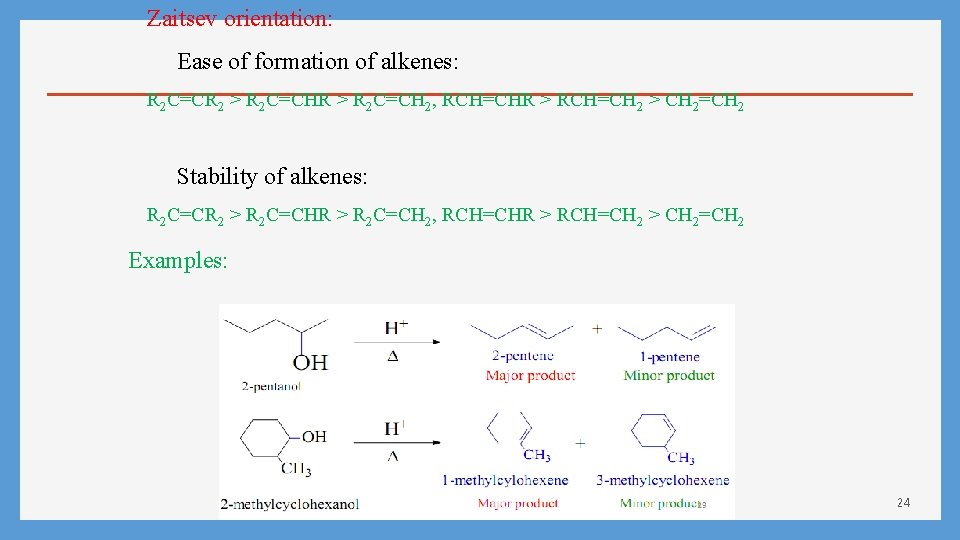
Zaitsev orientation: Ease of formation of alkenes: R 2 C=CR 2 > R 2 C=CHR > R 2 C=CH 2, RCH=CHR > RCH=CH 2 > CH 2=CH 2 Stability of alkenes: R 2 C=CR 2 > R 2 C=CHR > R 2 C=CH 2, RCH=CHR > RCH=CH 2 > CH 2=CH 2 Examples: 24
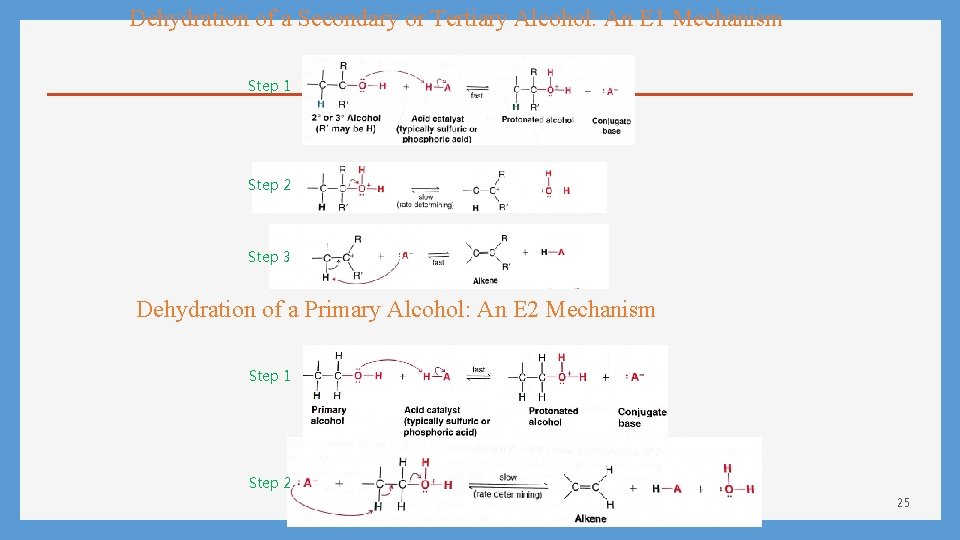
Dehydration of a Secondary or Tertiary Alcohol: An E 1 Mechanism Step 1 Step 2 Step 3 Dehydration of a Primary Alcohol: An E 2 Mechanism Step 1 Step 2 25
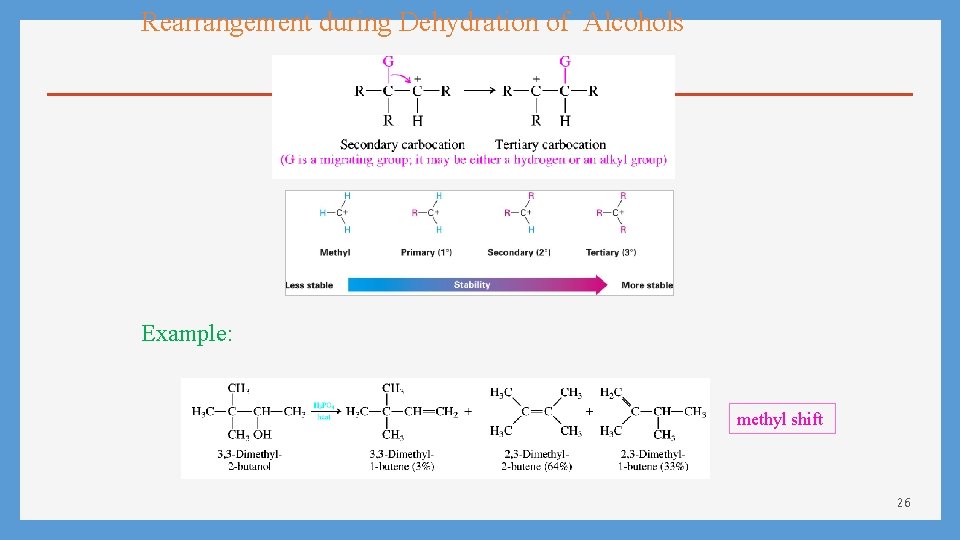
Rearrangement during Dehydration of Alcohols Example: methyl shift 26
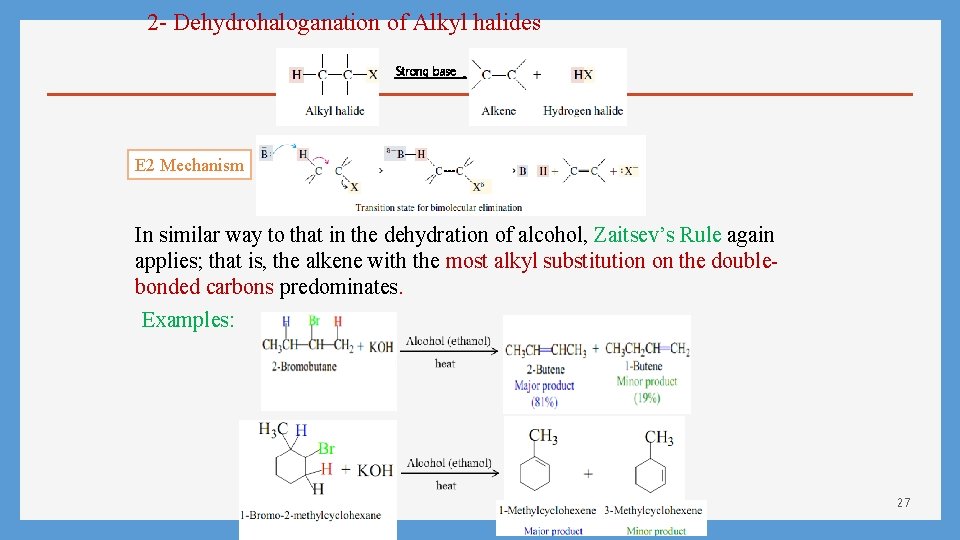
2 - Dehydrohaloganation of Alkyl halides Strong base E 2 Mechanism In similar way to that in the dehydration of alcohol, Zaitsev’s Rule again applies; that is, the alkene with the most alkyl substitution on the doublebonded carbons predominates. Examples: 27
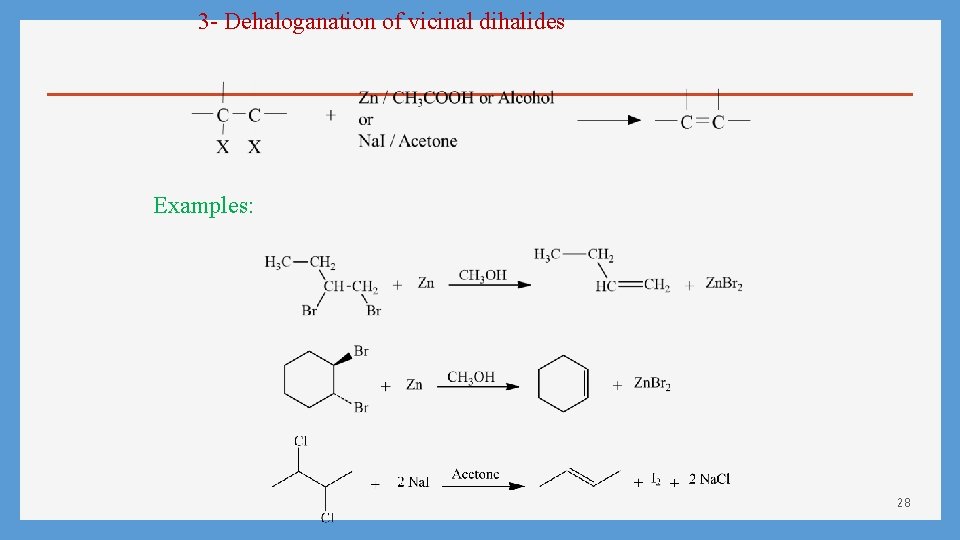
3 - Dehaloganation of vicinal dihalides Examples: 28
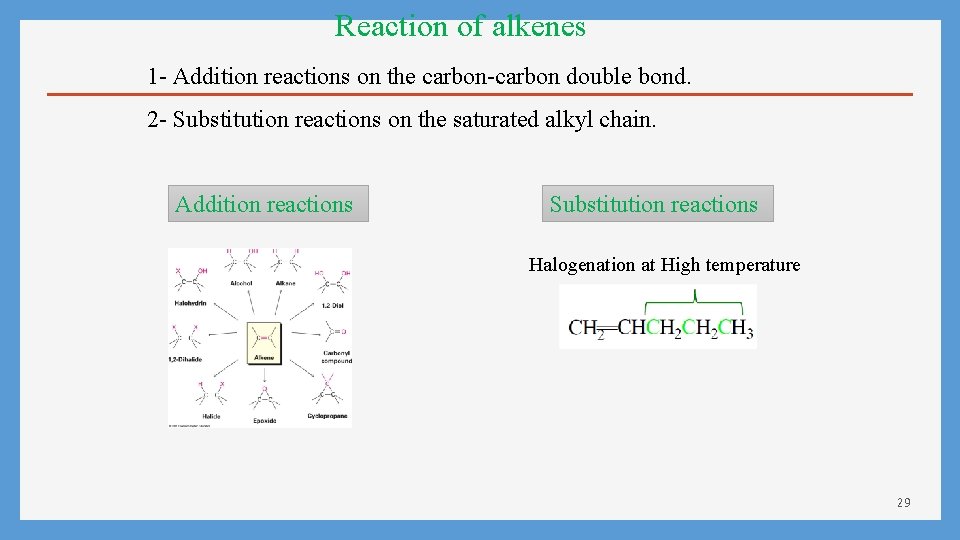
Reaction of alkenes 1 - Addition reactions on the carbon-carbon double bond. 2 - Substitution reactions on the saturated alkyl chain. Addition reactions Substitution reactions Halogenation at High temperature 29
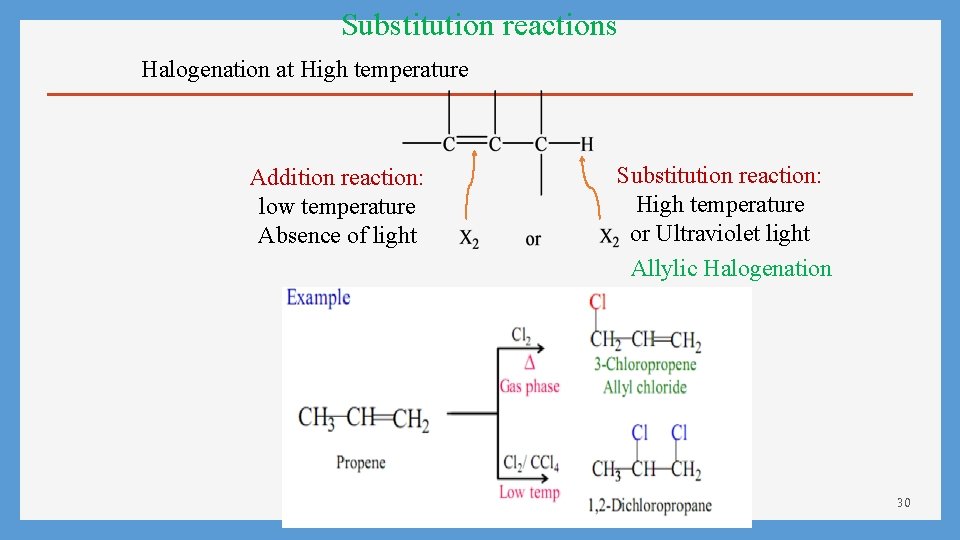
Substitution reactions Halogenation at High temperature Addition reaction: low temperature Absence of light Substitution reaction: High temperature or Ultraviolet light Allylic Halogenation 30
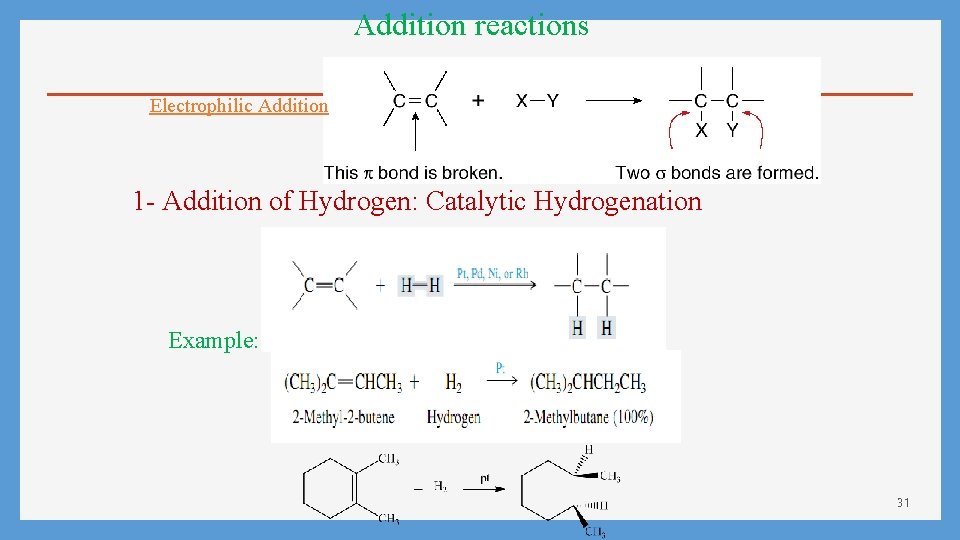
Addition reactions Electrophilic Addition 1 - Addition of Hydrogen: Catalytic Hydrogenation Example: 31
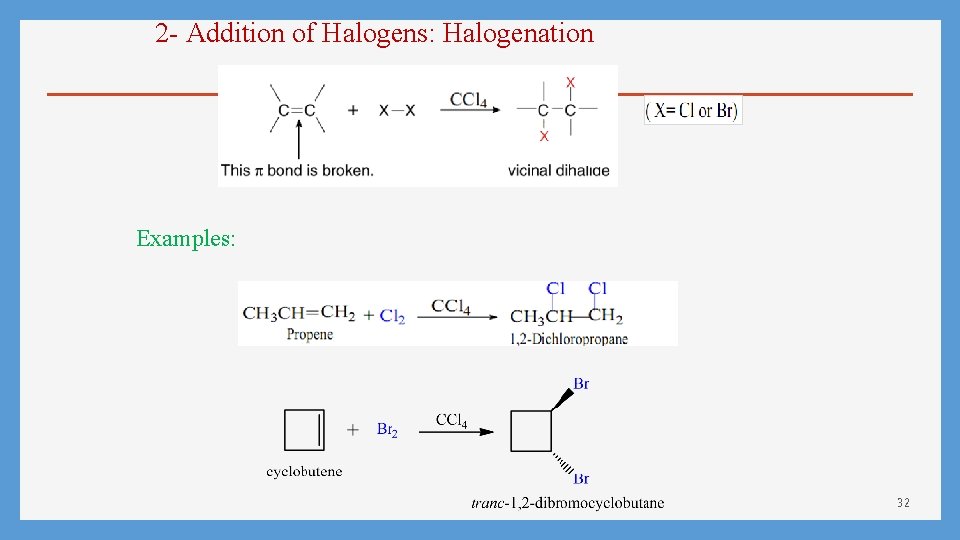
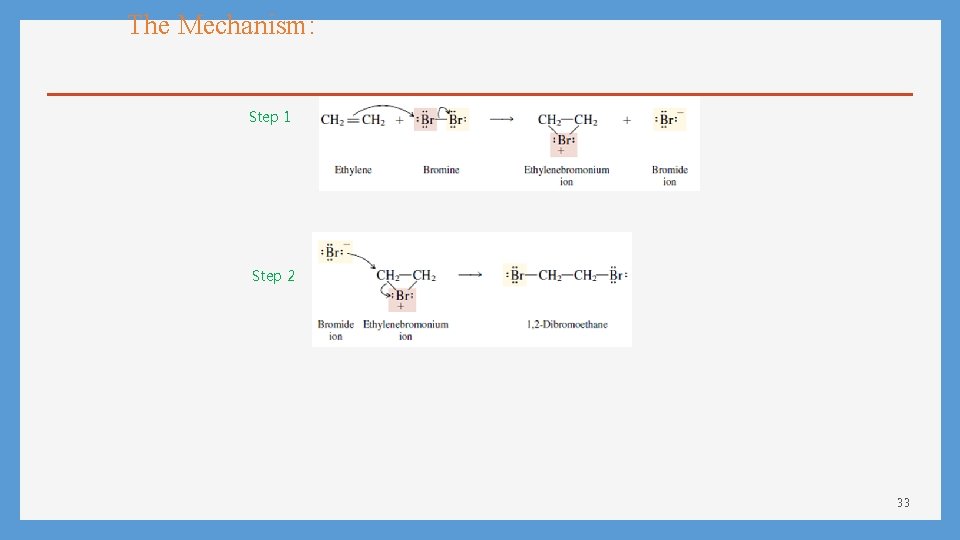
2 - Addition of Halogens: Halogenation Examples: 32
The Mechanism: Step 1 Step 2 33
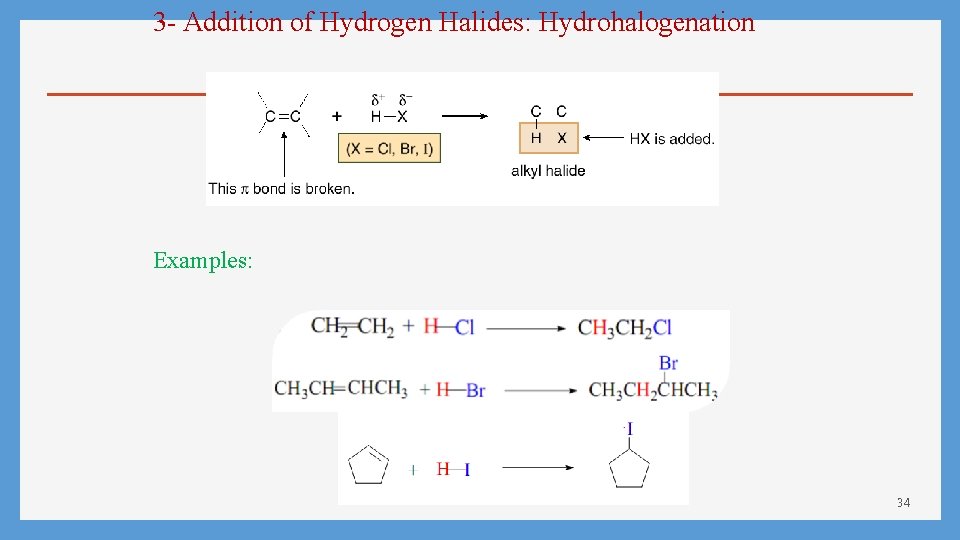
3 - Addition of Hydrogen Halides: Hydrohalogenation Examples: 34
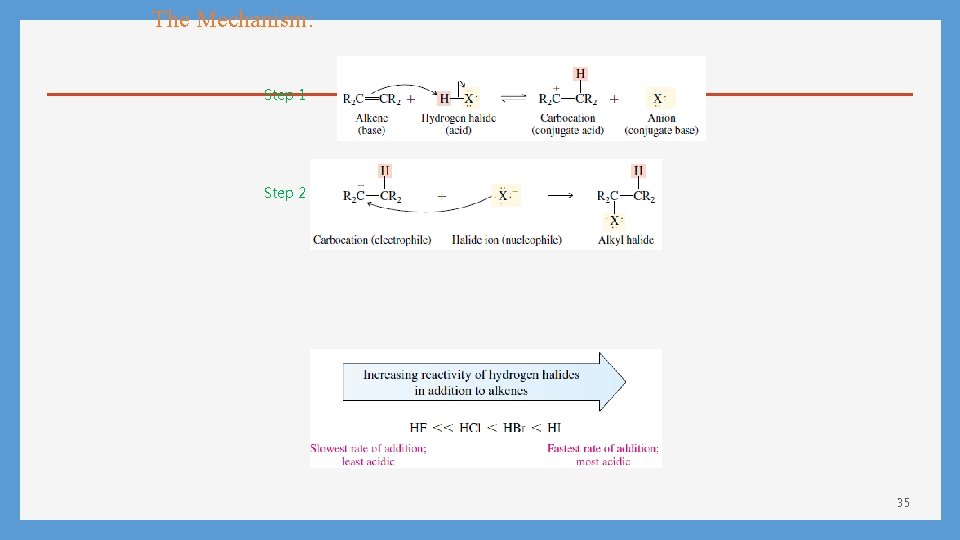
The Mechanism: Step 1 Step 2 35
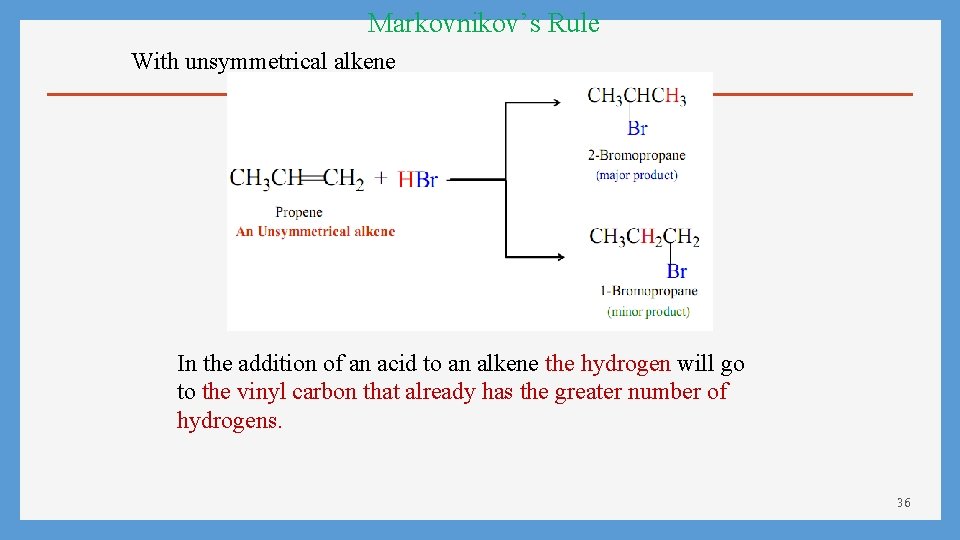
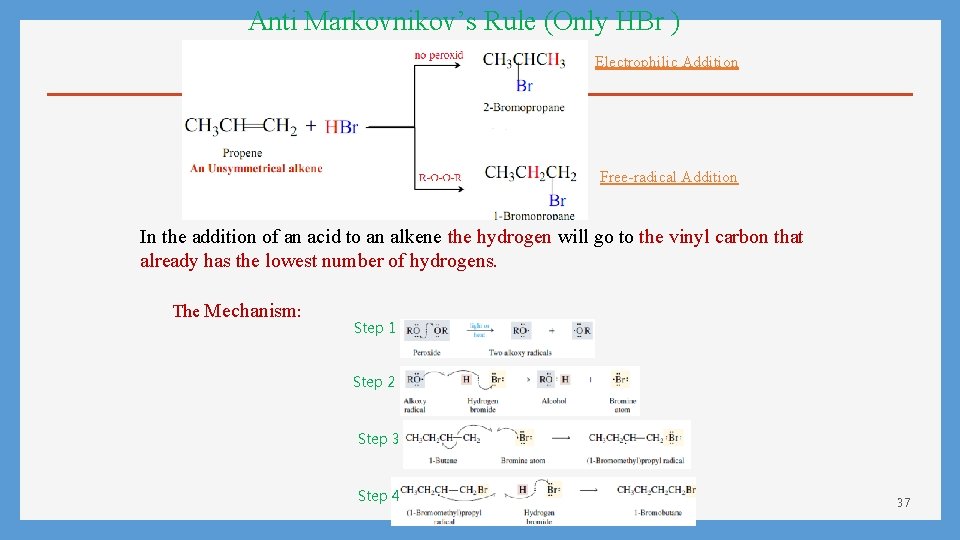
Markovnikov’s Rule With unsymmetrical alkene In the addition of an acid to an alkene the hydrogen will go to the vinyl carbon that already has the greater number of hydrogens. 36
Anti Markovnikov’s Rule (Only HBr ) Electrophilic Addition Free-radical Addition In the addition of an acid to an alkene the hydrogen will go to the vinyl carbon that already has the lowest number of hydrogens. The Mechanism: Step 1 Step 2 Step 3 Step 4 37
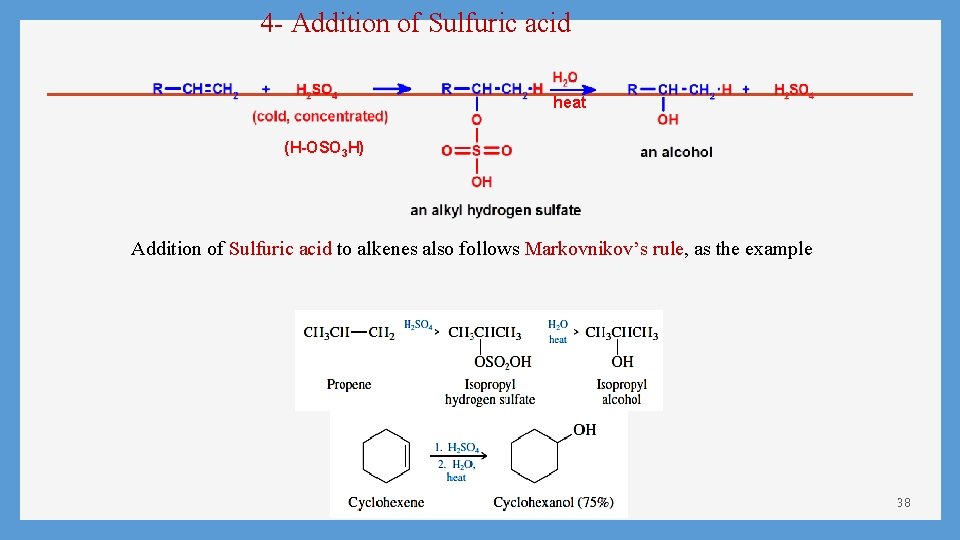
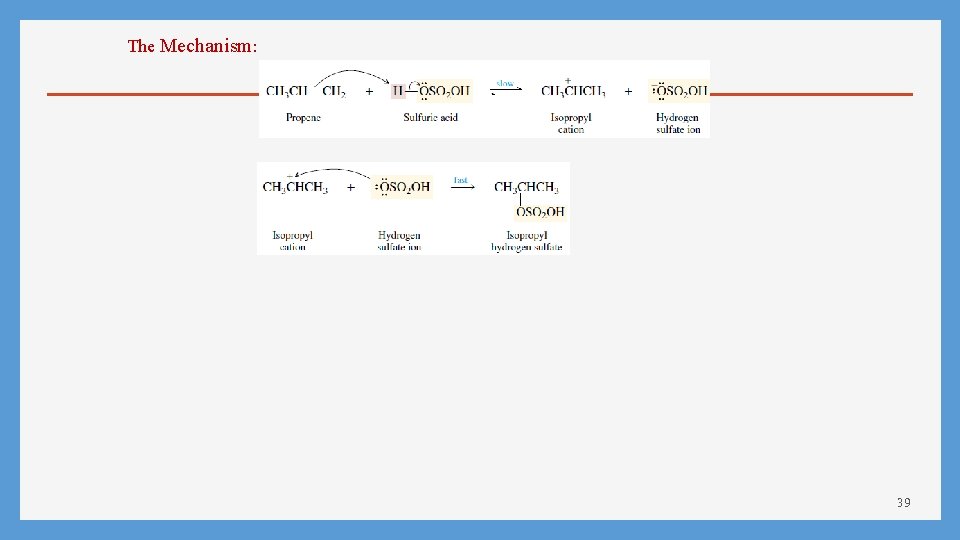
4 - Addition of Sulfuric acid heat (H-OSO 3 H) Addition of Sulfuric acid to alkenes also follows Markovnikov’s rule, as the example 38
The Mechanism: 39
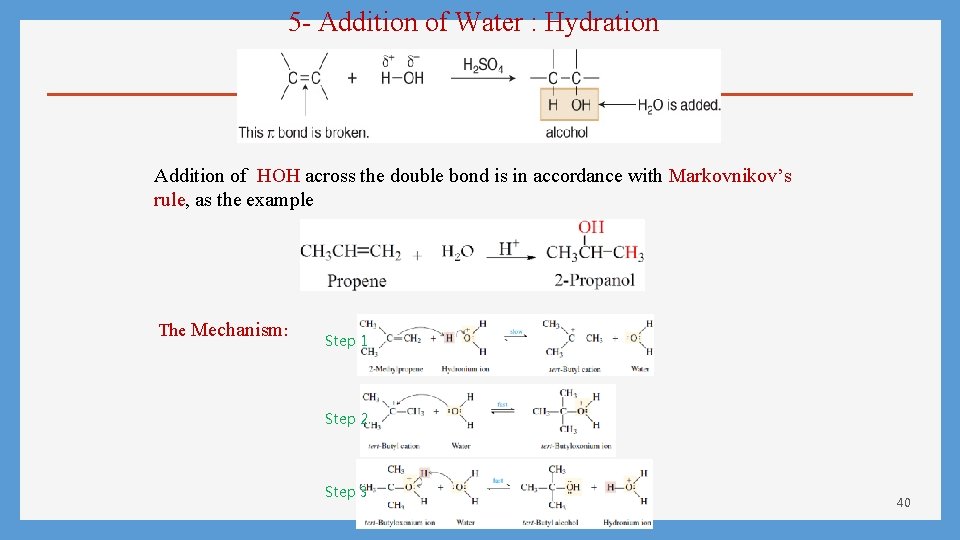
5 - Addition of Water : Hydration Addition of HOH across the double bond is in accordance with Markovnikov’s rule, as the example The Mechanism: Step 1 Step 2 Step 3 40
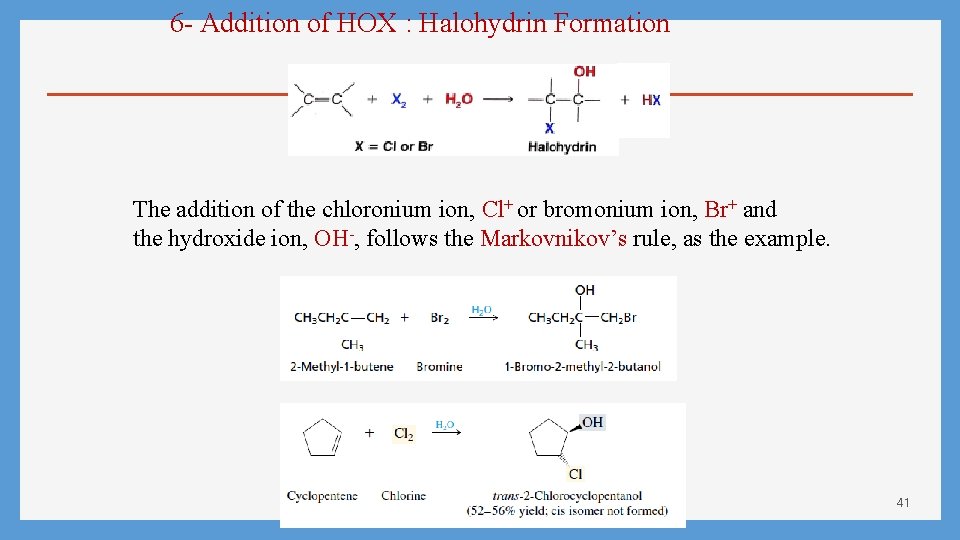
6 - Addition of HOX : Halohydrin Formation The addition of the chloronium ion, Cl+ or bromonium ion, Br+ and the hydroxide ion, OH-, follows the Markovnikov’s rule, as the example. 41
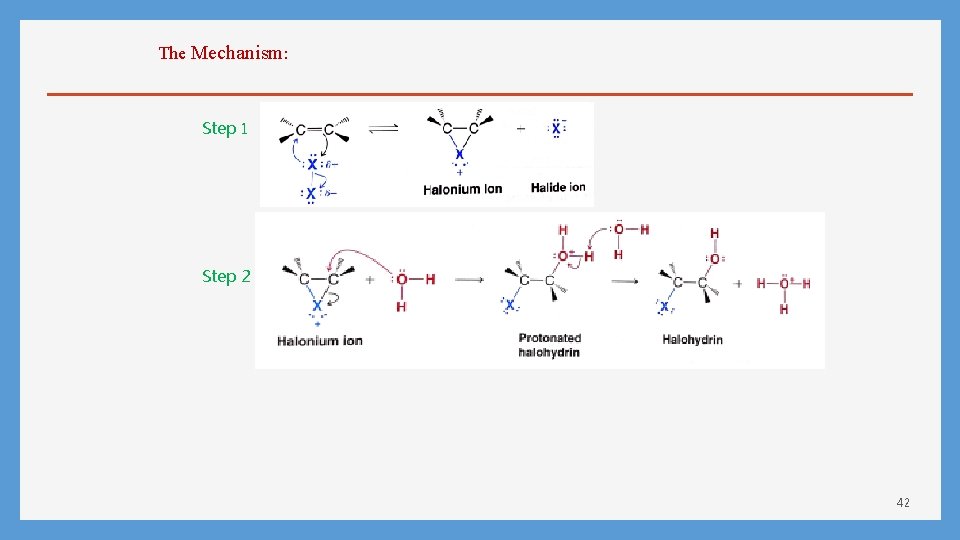
The Mechanism: Step 1 Step 2 42
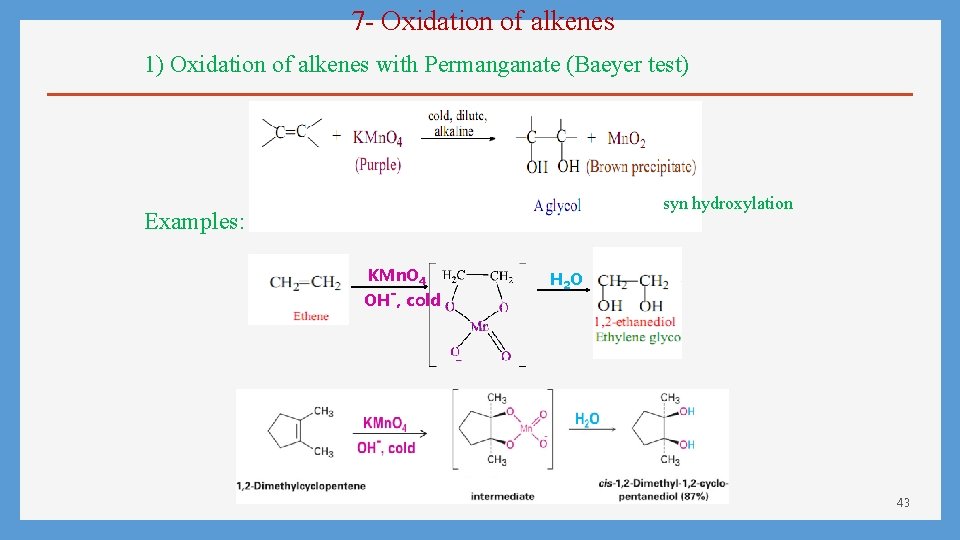
7 - Oxidation of alkenes 1) Oxidation of alkenes with Permanganate (Baeyer test) syn hydroxylation Examples: KMn. O 4 OH-, cold H 2 O 43
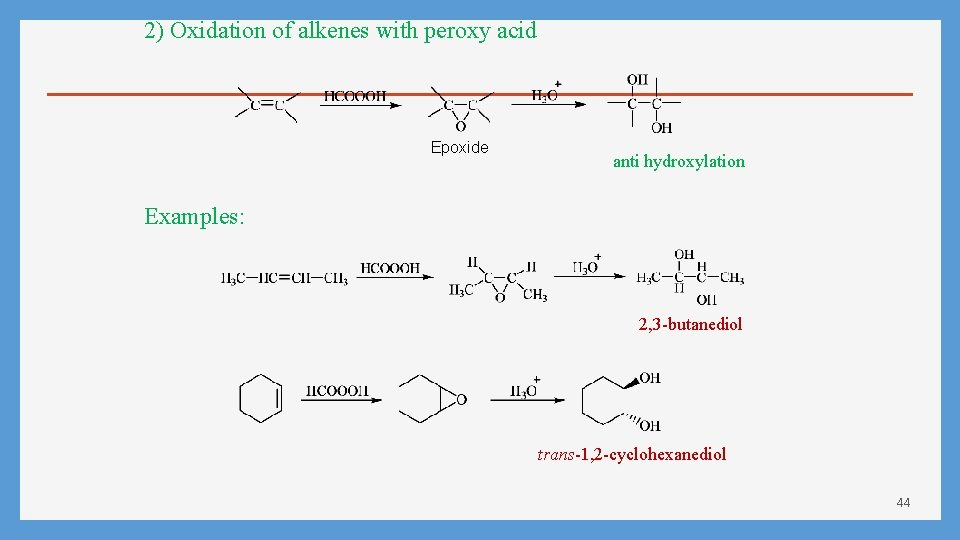
2) Oxidation of alkenes with peroxy acid Epoxide anti hydroxylation Examples: 2, 3 -butanediol trans-1, 2 -cyclohexanediol 44
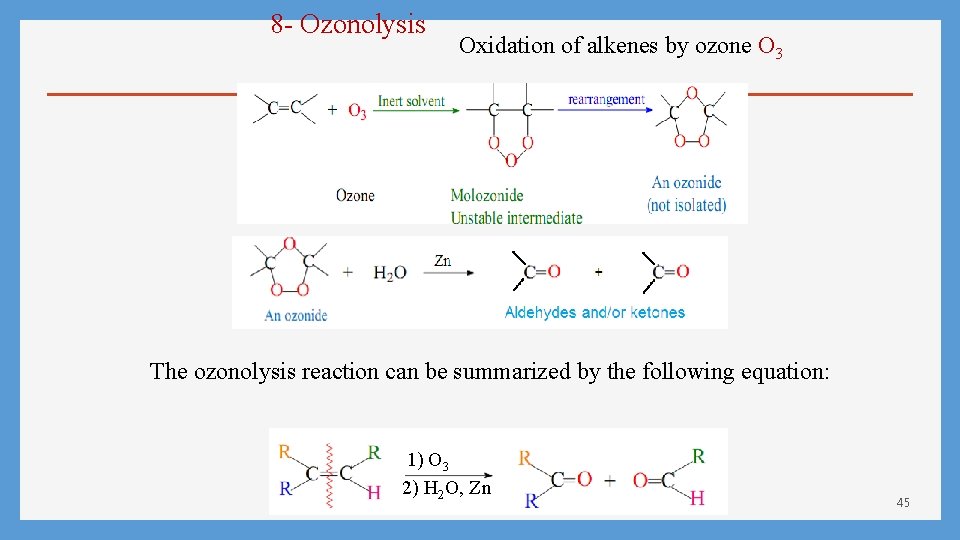
8 - Ozonolysis Oxidation of alkenes by ozone O 3 The ozonolysis reaction can be summarized by the following equation: 1) O 3 2) H 2 O, Zn 45
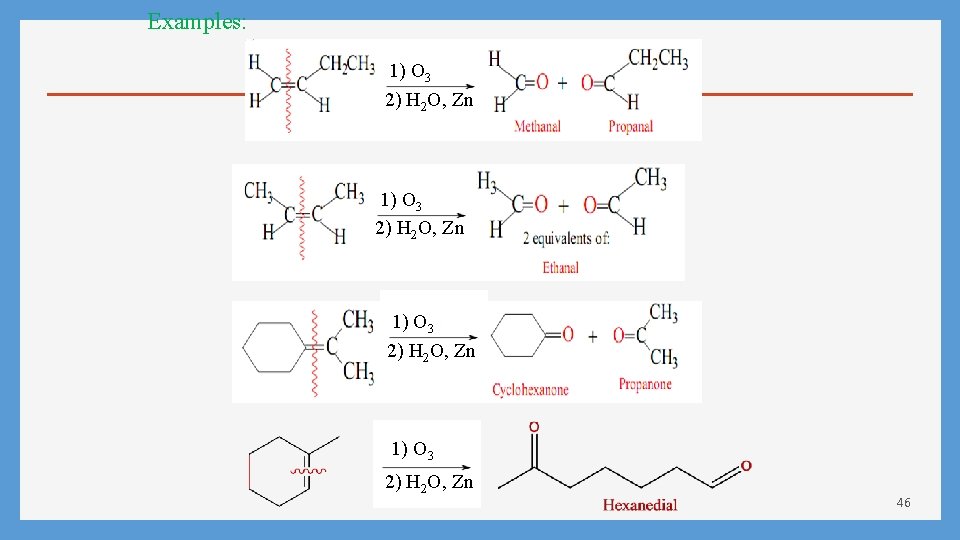
Examples: 1) O 3 2) H 2 O, Zn 46
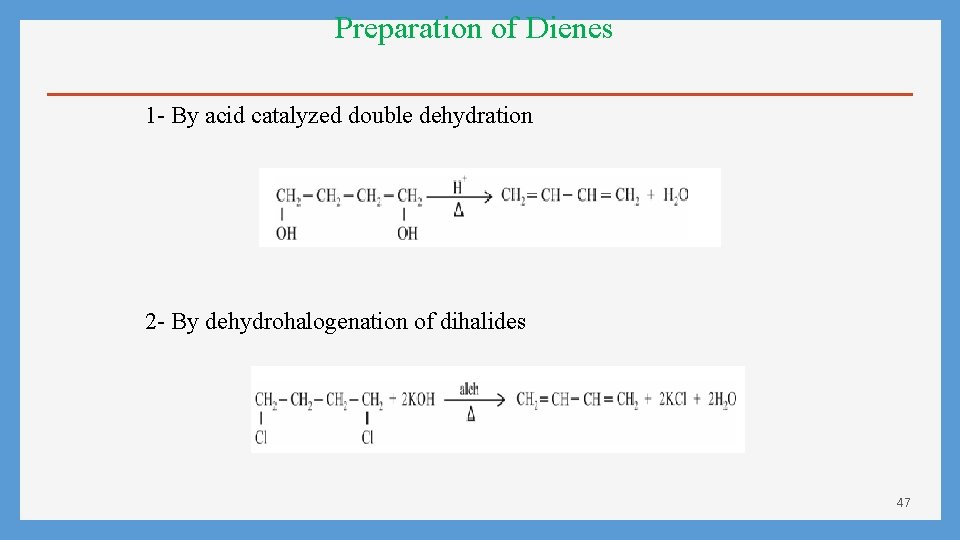
Preparation of Dienes 1 - By acid catalyzed double dehydration 2 - By dehydrohalogenation of dihalides 47
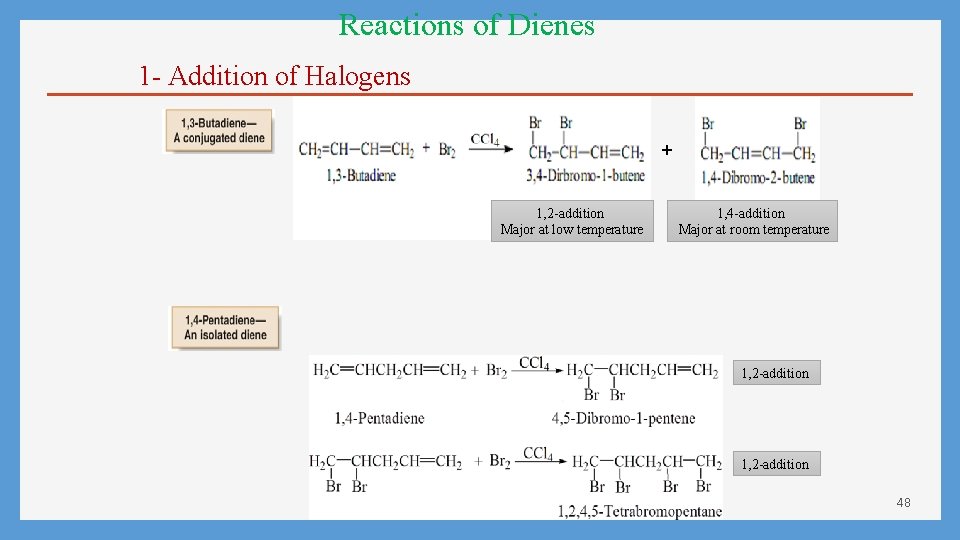
Reactions of Dienes 1 - Addition of Halogens + 1, 2 -addition Major at low temperature 1, 4 -addition Major at room temperature 1, 2 -addition 48
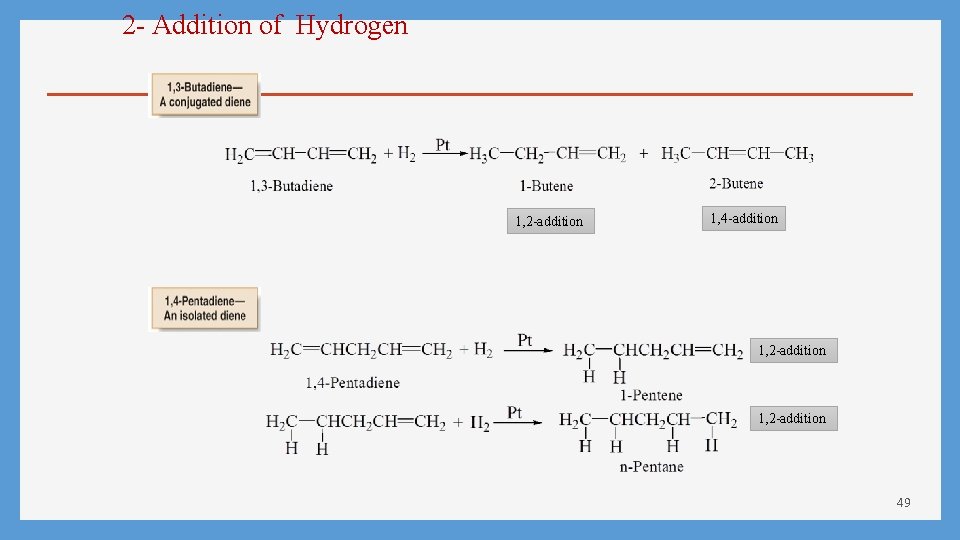
2 - Addition of Hydrogen 1, 2 -addition 1, 4 -addition 1, 2 -addition 49
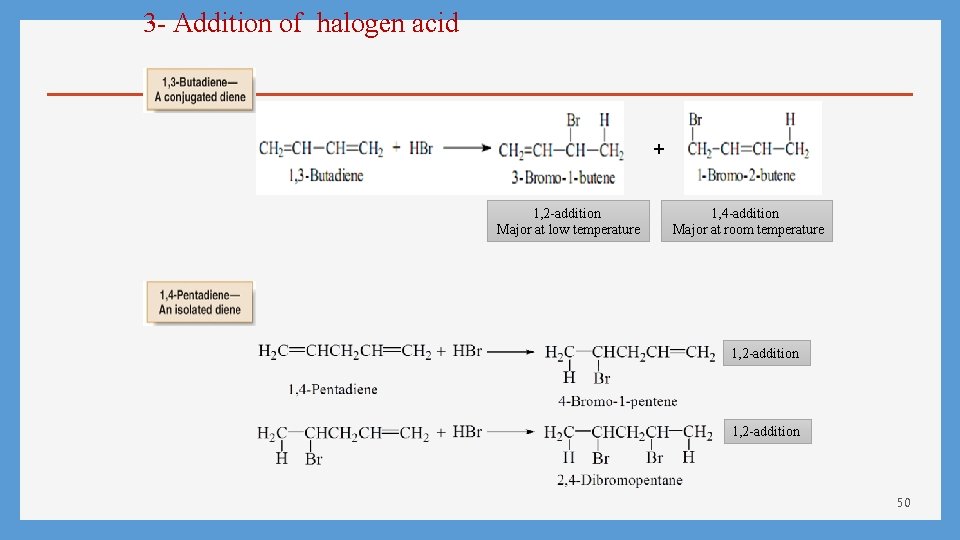
3 - Addition of halogen acid + 1, 2 -addition Major at low temperature 1, 4 -addition Major at room temperature 1, 2 -addition 50
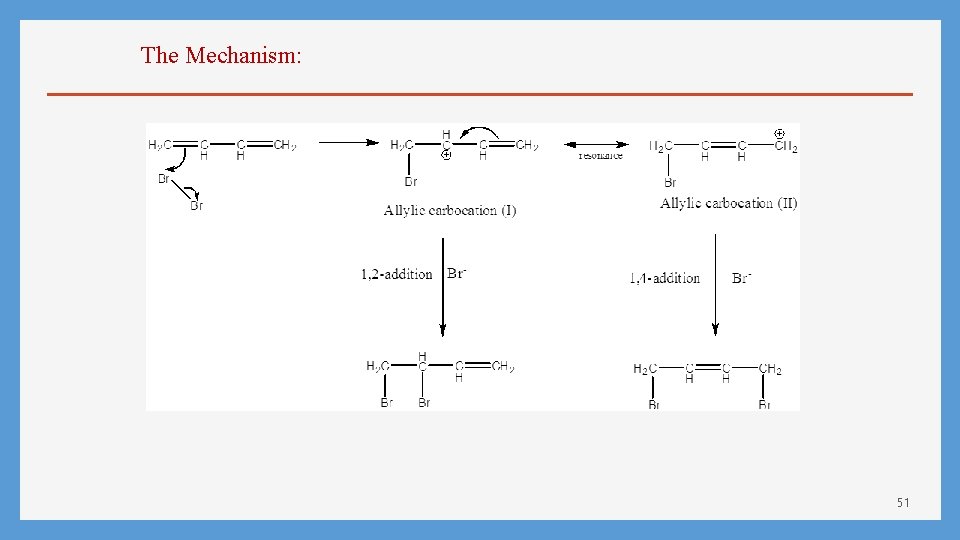
The Mechanism: 51
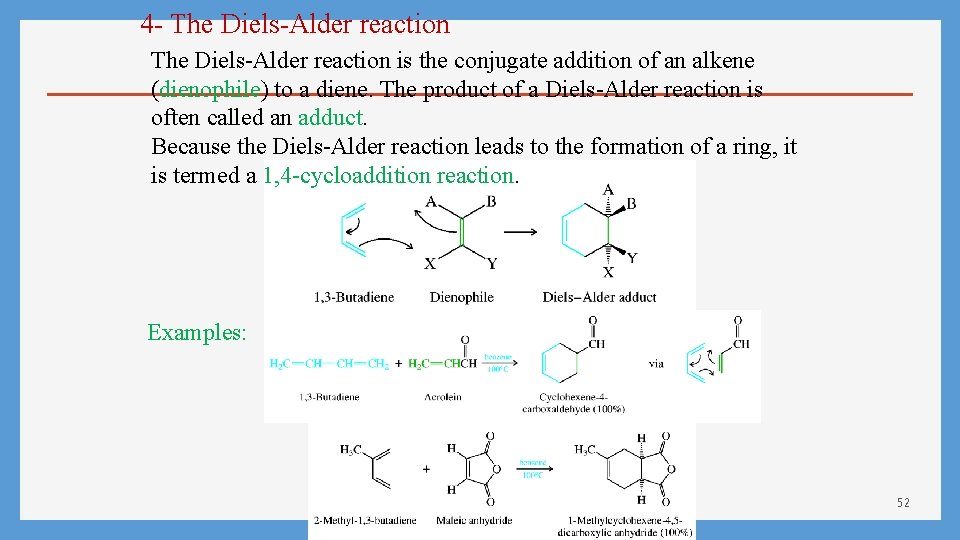
4 - The Diels-Alder reaction is the conjugate addition of an alkene (dienophile) to a diene. The product of a Diels-Alder reaction is often called an adduct. Because the Diels-Alder reaction leads to the formation of a ring, it is termed a 1, 4 -cycloaddition reaction. Examples: 52