
Organic Chemistry CHEM 145 Chemistry 2 Credit hrs

- Slides: 29
Organic Chemistry CHEM 145 Chemistry 2 Credit hrs Department College of Science King Saud By University Prof. Mohamed El-Newehy
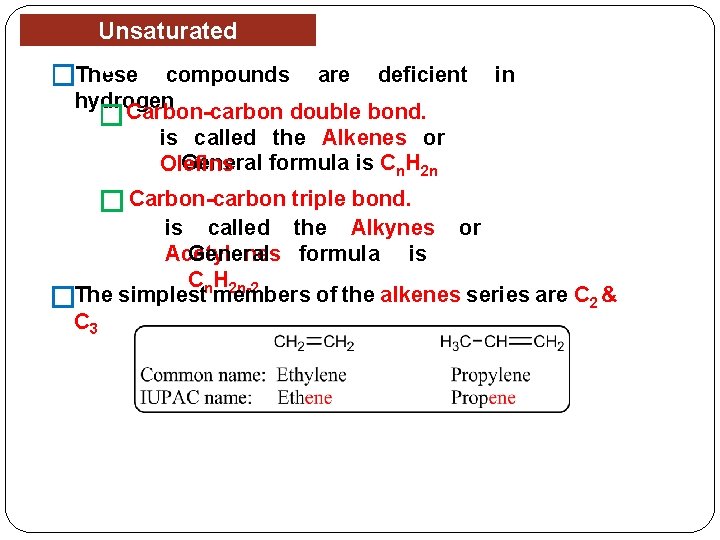
Unsaturated Hydrocarbons �These compounds are deficient hydrogen �Carbon-carbon double bond. in is called the Alkenes or General formula is Cn. H 2 n Olefins � Carbon-carbon triple bond. is called the Alkynes or General formula is Acetylenes Cn. H 2 n-2 �The simplest members of the alkenes series are C 2 & C 3
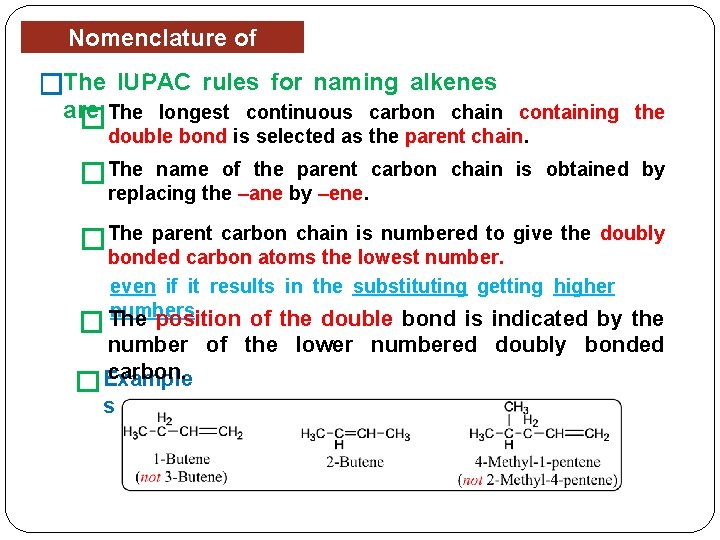
Nomenclature of Alkenes �The IUPAC rules for naming alkenes are: � The longest continuous carbon chain containing the double bond is selected as the parent chain. � The name of the parent carbon chain is obtained by replacing the –ane by –ene. � The parent carbon chain is numbered to give the doubly bonded carbon atoms the lowest number. even if it results in the substituting getting higher numbers. The position of the double bond is indicated by the � � number of the lower numbered doubly bonded carbon. Example s
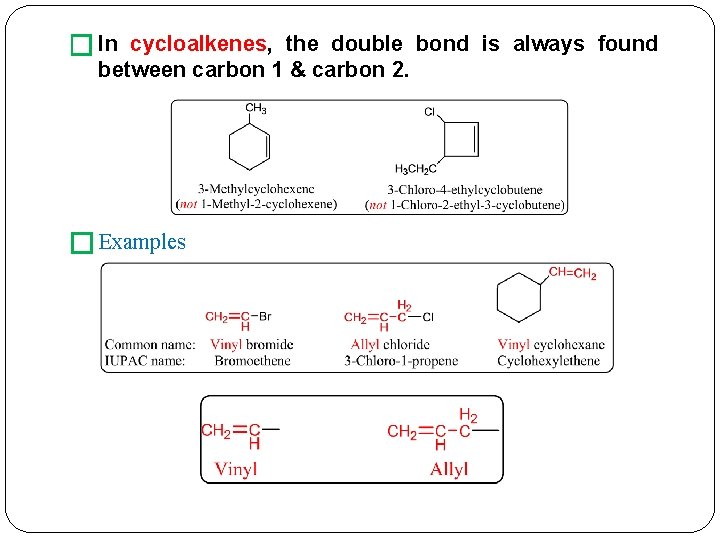
� In cycloalkenes, the double bond is always found between carbon 1 & carbon 2. � Examples
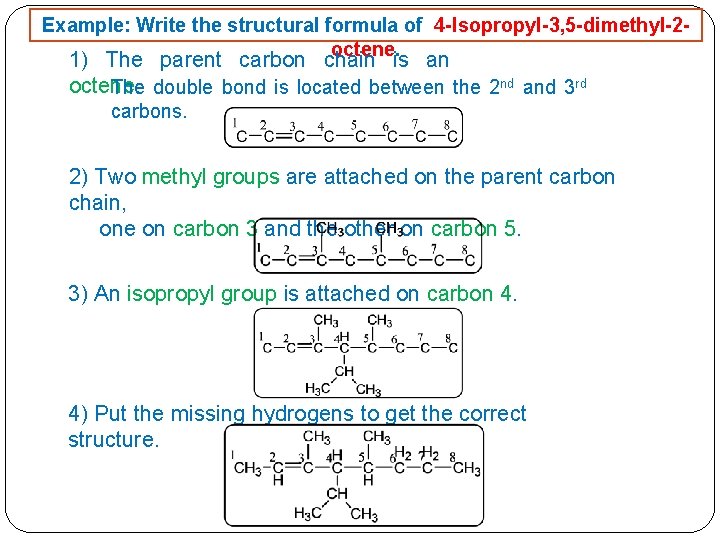
Example: Write the structural formula of 4 -Isopropyl-3, 5 -dimethyl-2 octene. 1) The parent carbon chain is an octene. The double bond is located between the 2 nd and 3 rd carbons. 2) Two methyl groups are attached on the parent carbon chain, one on carbon 3 and the other on carbon 5. 3) An isopropyl group is attached on carbon 4. 4) Put the missing hydrogens to get the correct structure.
Dienes or diolefins - Diene or diolefin is a hydrocarbon that contains two carbon double bonds. - Dienes occur occasionally in nature. - Conjugated dienes are widely used as monomers in the polymer industry
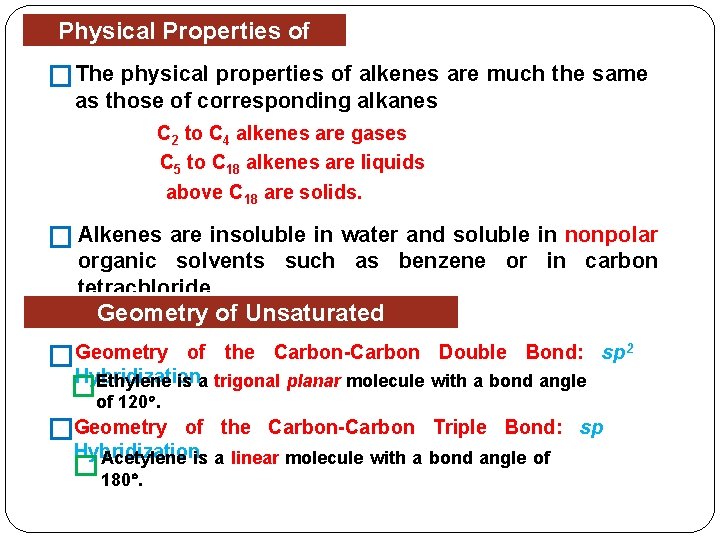
Physical Properties of Alkenes �The physical properties of alkenes are much the same as those of corresponding alkanes C 2 to C 4 alkenes are gases C 5 to C 18 alkenes are liquids above C 18 are solids. � Alkenes are insoluble in water and soluble in nonpolar organic solvents such as benzene or in carbon tetrachloride. Geometry of Unsaturated Hydrocarbones Geometry of the Carbon-Carbon Double Bond: sp 2 � Hybridization �Ethylene is a trigonal planar molecule with a bond angle of 120. �Geometry of the Carbon-Carbon Triple Bond: Hybridization is a linear molecule with a bond angle of � Acetylene 180. sp
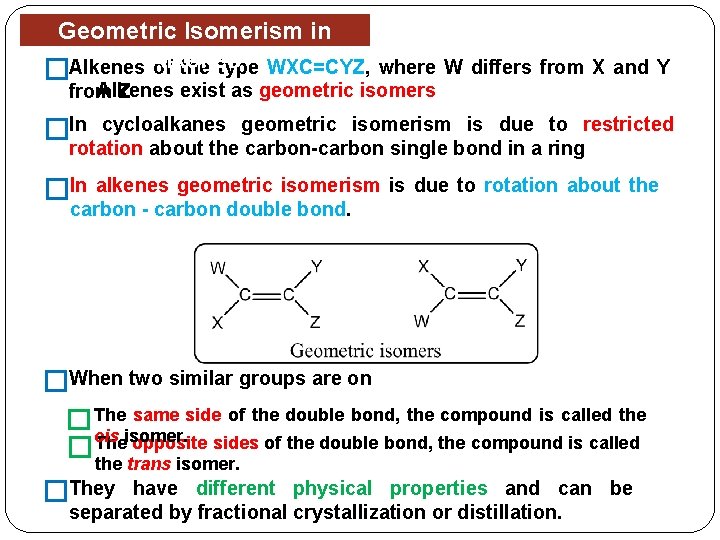
Geometric Isomerism in of the type WXC=CYZ, where W differs from X and Y �Alkenes exist as geometric isomers from Z �In cycloalkanes geometric isomerism is due to restricted rotation about the carbon-carbon single bond in a ring �In alkenes geometric isomerism is due to rotation about the carbon - carbon double bond. �When two similar groups are on same side of the double bond, the compound is called the � The cis isomer. The opposite sides of the double bond, the compound is called � the trans isomer. �They have different physical properties and can be separated by fractional crystallization or distillation.
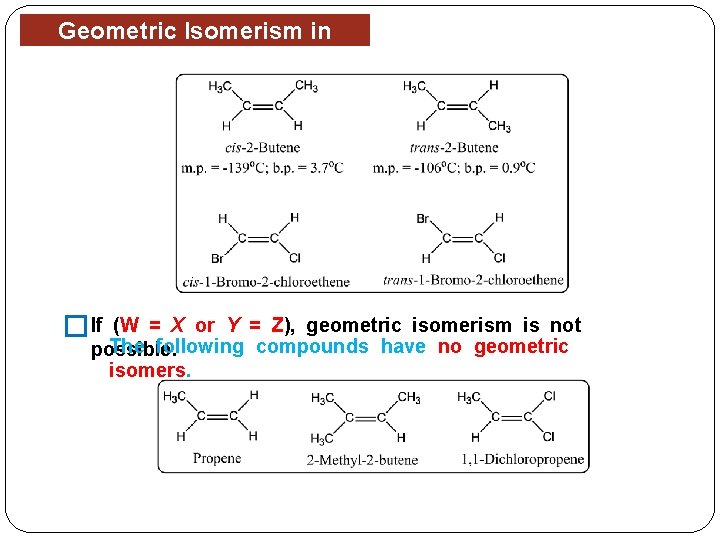
Geometric Isomerism in Alkenes �If (W = X or Y = Z), geometric isomerism is not The following compounds have no geometric possible. isomers.
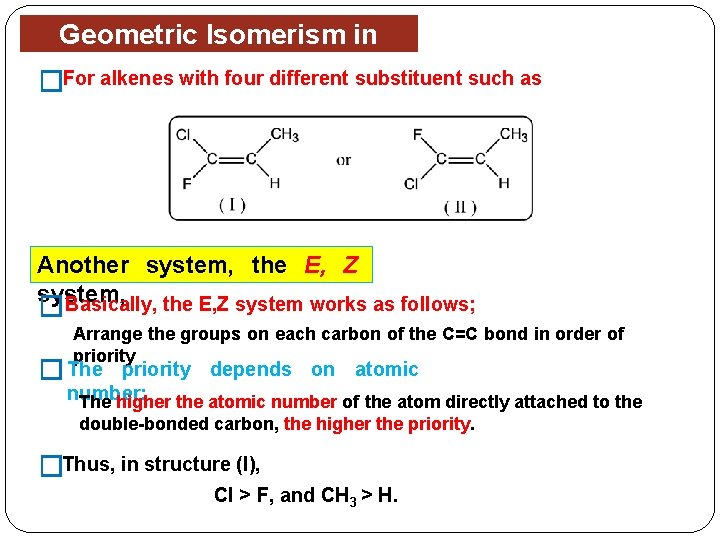
Geometric Isomerism in with four different substituent such as �For alkenes. Alkenes Another system, the E, Z system, Basically, the E, Z system works as follows; � Arrange the groups on each carbon of the C=C bond in order of priority � The priority depends on atomic number: The higher the atomic number of the atom directly attached to the double-bonded carbon, the higher the priority. �Thus, in structure (I), Cl > F, and CH 3 > H.
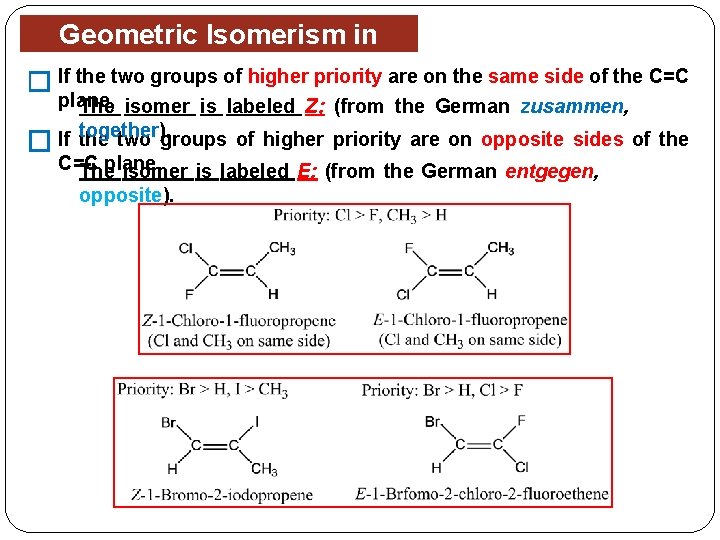
� Geometric Isomerism in Alkenes If the two groups of higher priority are on the same side of the C=C plane, The isomer is labeled Z; (from the German zusammen, together). two groups of higher priority are on opposite sides of the � If the C=C plane, The isomer is labeled E; (from the German entgegen, opposite).
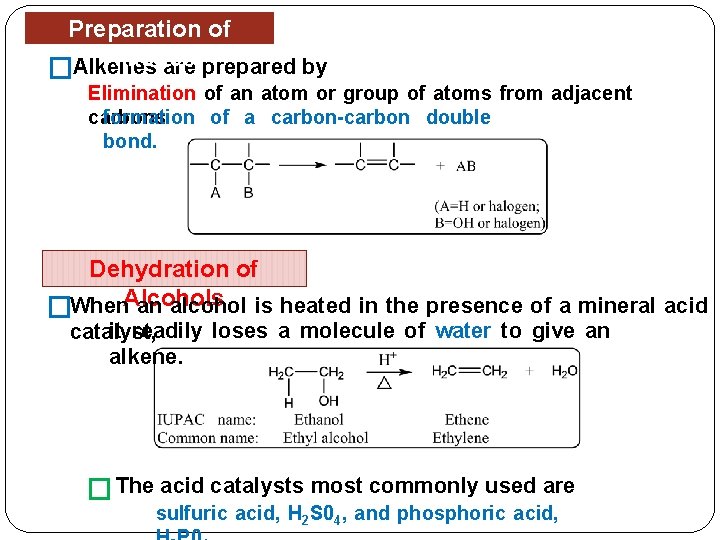
Preparation of Alkenes are prepared by � Elimination of an atom or group of atoms from adjacent carbons formation of a carbon-carbon double bond. Dehydration of an alcohol is heated in the presence of a mineral acid �When. Alcohols it readily loses a molecule of water to give an catalyst, alkene. � The acid catalysts most commonly used are sulfuric acid, H 2 S 04, and phosphoric acid,
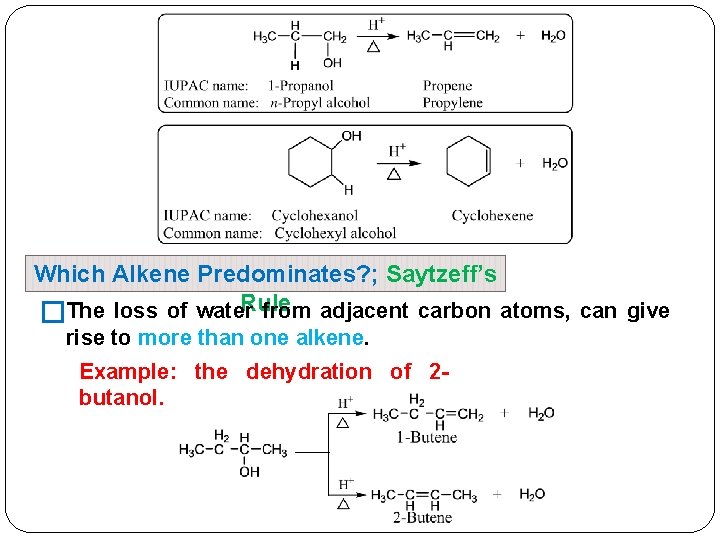
Which Alkene Predominates? ; Saytzeff’s from adjacent carbon atoms, can give �The loss of water. Rule rise to more than one alkene. Example: the dehydration of 2 butanol.
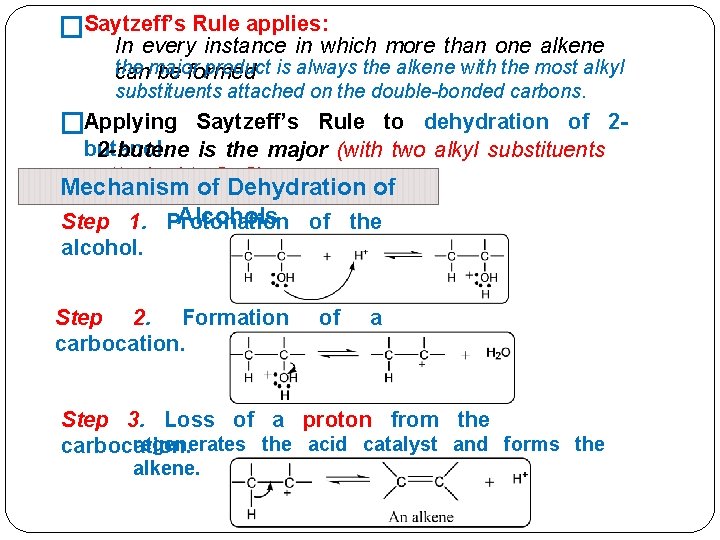
�Saytzeff’s Rule applies: In every instance in which more than one alkene the major product is always the alkene with the most alkyl can be formed substituents attached on the double-bonded carbons. �Applying Saytzeff’s Rule to dehydration of 2 butanol 2 -butene is the major (with two alkyl substituents attached to C=C) Mechanism of Dehydration of Alcohols of the Step 1. Protonation alcohol. Step 2. Formation carbocation. of a Step 3. Loss of a proton from the regenerates the acid catalyst and forms the carbocation. alkene.
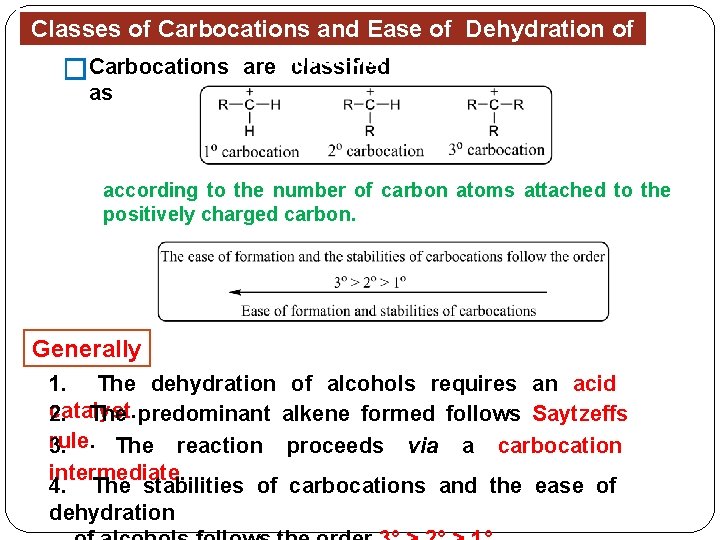
Classes of Carbocations and Ease of Dehydration of Carbocations are Alcohols classified � as according to the number of carbon atoms attached to the positively charged carbon. Generally 1. The dehydration of alcohols requires an acid catalyst. 2. The predominant alkene formed follows Saytzeffs rule. 3. The reaction proceeds via a carbocation intermediate. 4. The stabilities of carbocations and the ease of dehydration
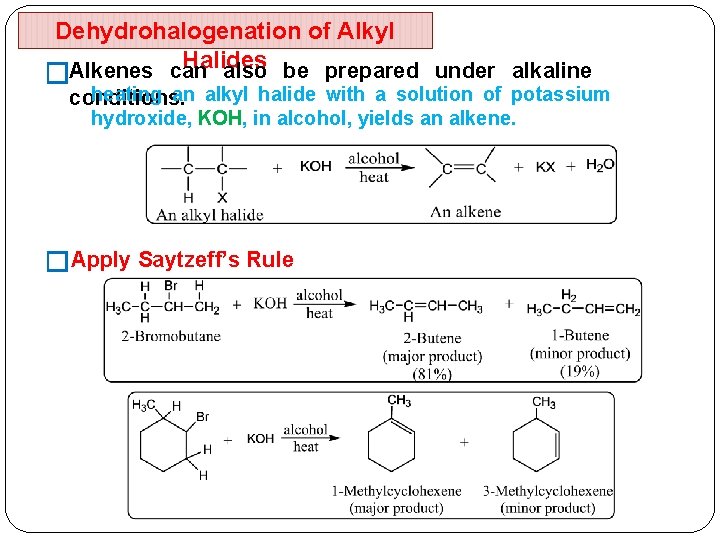
Dehydrohalogenation of Alkyl Halides Alkenes can also be prepared under alkaline � heating an alkyl halide with a solution of potassium conditions. hydroxide, KOH, in alcohol, yields an alkene. �Apply Saytzeff’s Rule
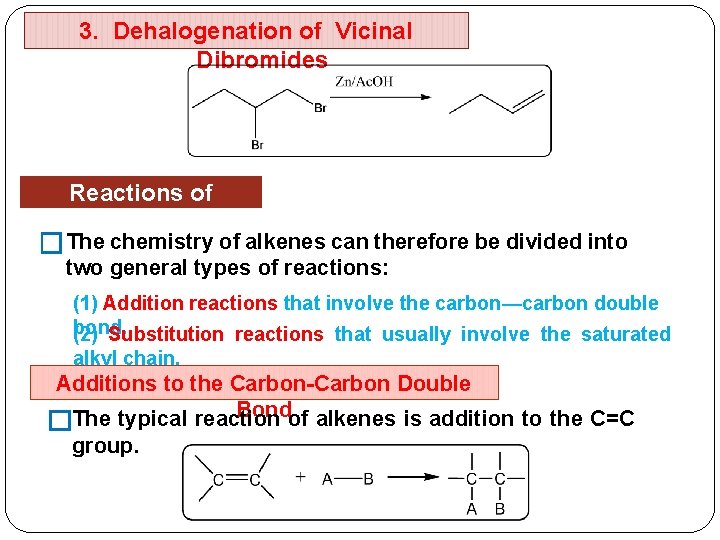
3. Dehalogenation of Vicinal Dibromides Reactions of Alkenes �The chemistry of alkenes can therefore be divided into two general types of reactions: (1) Addition reactions that involve the carbon—carbon double bond. (2) Substitution reactions that usually involve the saturated alkyl chain. Additions to the Carbon-Carbon Double Bondof alkenes is addition to the C=C �The typical reaction group.
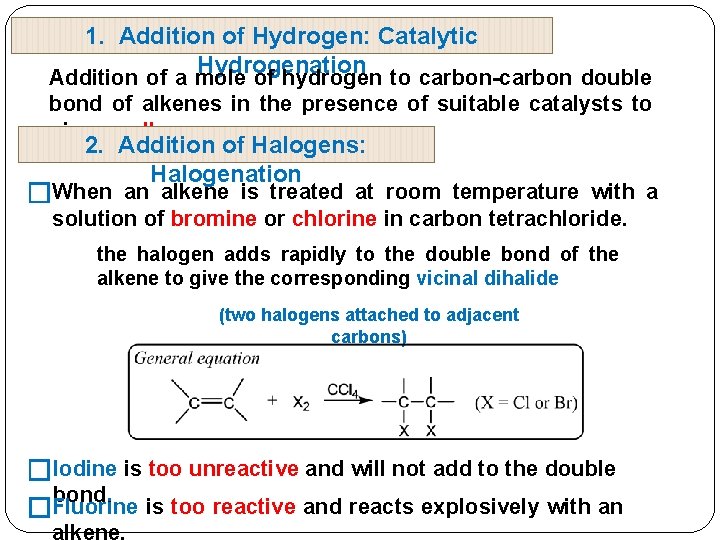
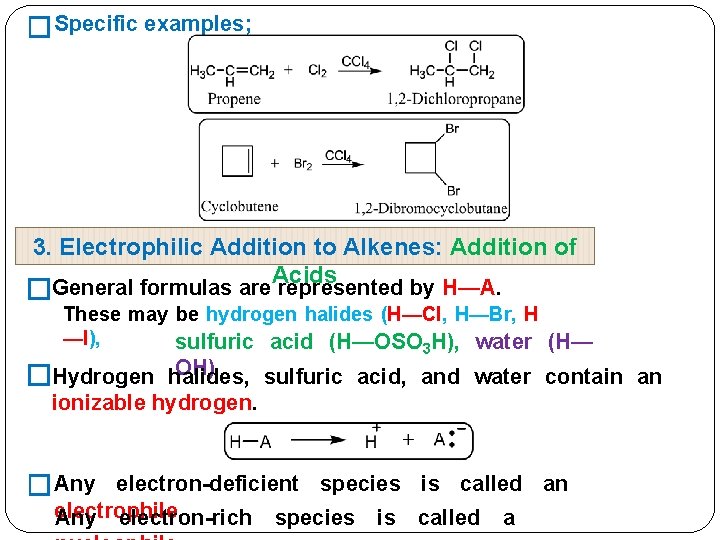
1. Addition of Hydrogen: Catalytic Hydrogenation Addition of a mole of hydrogen to carbon-carbon double bond of alkenes in the presence of suitable catalysts to give an alkane. 2. Addition of Halogens: Halogenation �When an alkene is treated at room temperature with a solution of bromine or chlorine in carbon tetrachloride. the halogen adds rapidly to the double bond of the alkene to give the corresponding vicinal dihalide (two halogens attached to adjacent carbons) �Iodine is too unreactive and will not add to the double bond. Fluorine is too reactive and reacts explosively with an � alkene.
�Specific examples; 3. Electrophilic Addition to Alkenes: Addition of Acids General formulas are represented by H—A. � These may be hydrogen halides (H—Cl, H—Br, H —I), sulfuric acid (H—OSO 3 H), water (H— OH) halides, sulfuric acid, and water contain an ionizable hydrogen. �Hydrogen � Any electron-deficient species is called an electrophile. Any electron-rich species is called a
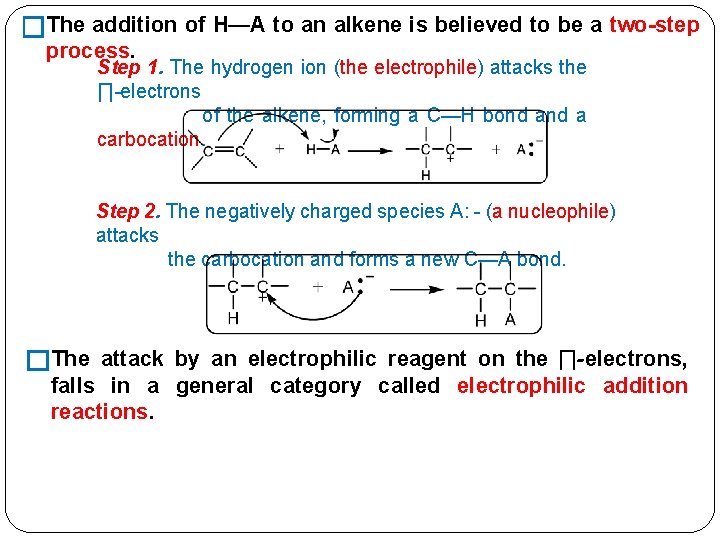
�The addition of H—A to an alkene is believed to be a two-step process. Step 1. The hydrogen ion (the electrophile) attacks the ∏-electrons of the alkene, forming a C—H bond a carbocation. Step 2. The negatively charged species A: - (a nucleophile) attacks the carbocation and forms a new C—A bond. �The attack by an electrophilic reagent on the ∏-electrons, falls in a general category called electrophilic addition reactions.
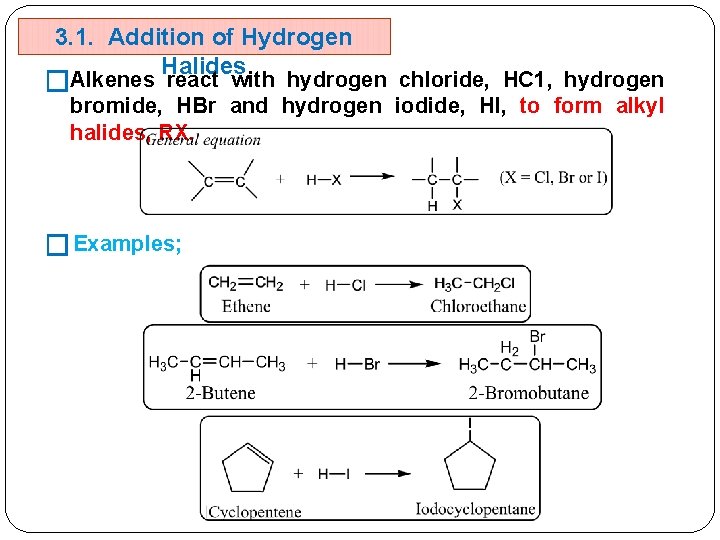
3. 1. Addition of Hydrogen Halides �Alkenes react with hydrogen chloride, HC 1, hydrogen bromide, HBr and hydrogen iodide, HI, to form alkyl halides, RX. � Examples;
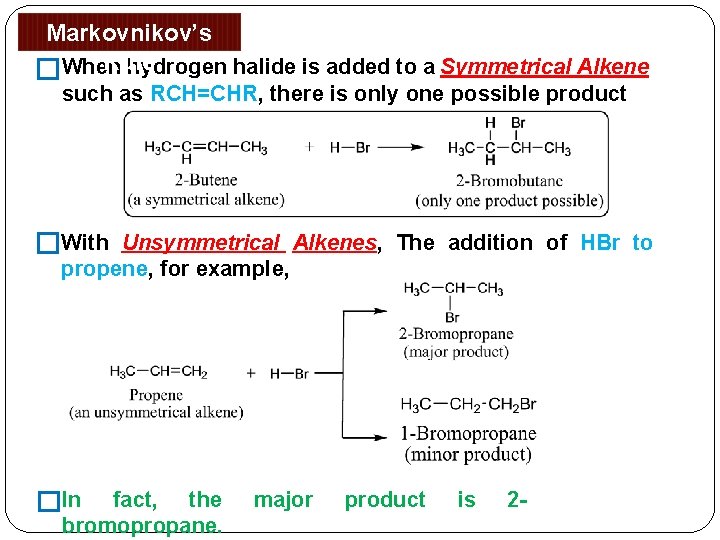
Markovnikov’s Rule hydrogen halide is added to a Symmetrical Alkene �When such as RCH=CHR, there is only one possible product �With Unsymmetrical Alkenes, The addition of HBr to propene, for example, �In fact, the bromopropane. major product is 2 -
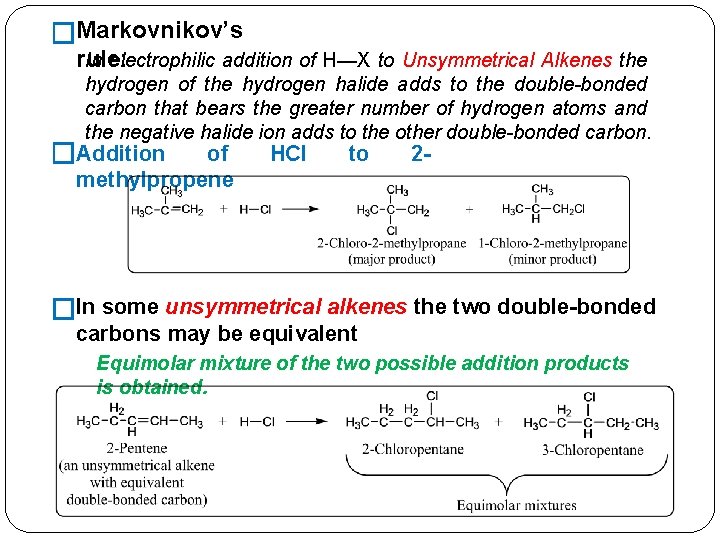
�Markovnikov’s rule: In electrophilic addition of H—X to Unsymmetrical Alkenes the hydrogen of the hydrogen halide adds to the double-bonded carbon that bears the greater number of hydrogen atoms and the negative halide ion adds to the other double-bonded carbon. �Addition of methylpropene HCl to 2 - �In some unsymmetrical alkenes the two double-bonded carbons may be equivalent Equimolar mixture of the two possible addition products is obtained.
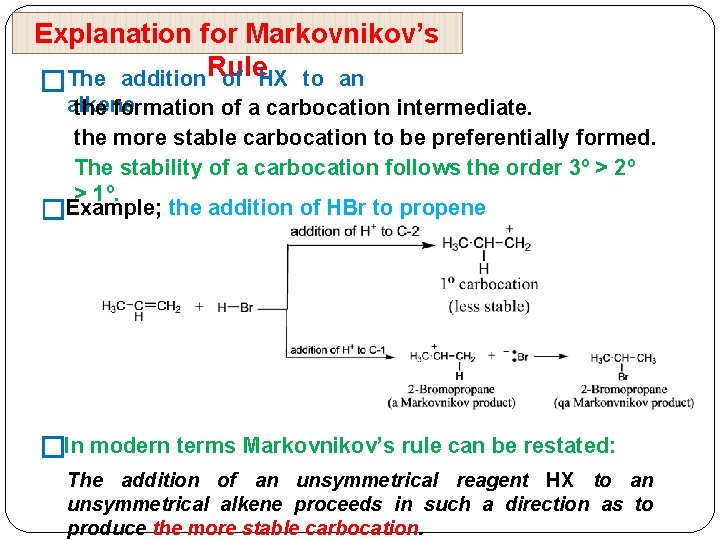
Explanation for Markovnikov’s Rule �The addition of HX to an alkene the formation of a carbocation intermediate. the more stable carbocation to be preferentially formed. The stability of a carbocation follows the order 3º > 2º > 1º. Example; the addition of HBr to propene � �In modern terms Markovnikov’s rule can be restated: The addition of an unsymmetrical reagent HX to an unsymmetrical alkene proceeds in such a direction as to produce the more stable carbocation.
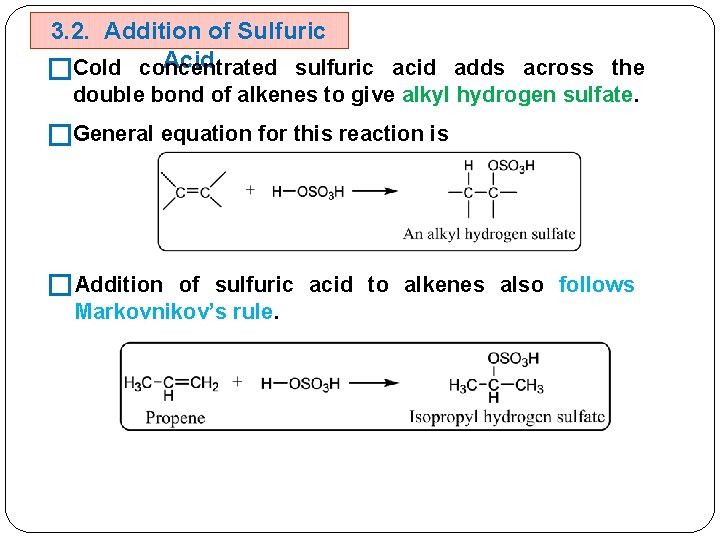
3. 2. Addition of Sulfuric Acid sulfuric acid adds across the �Cold concentrated double bond of alkenes to give alkyl hydrogen sulfate. �General equation for this reaction is � Addition of sulfuric acid to alkenes also follows Markovnikov’s rule.
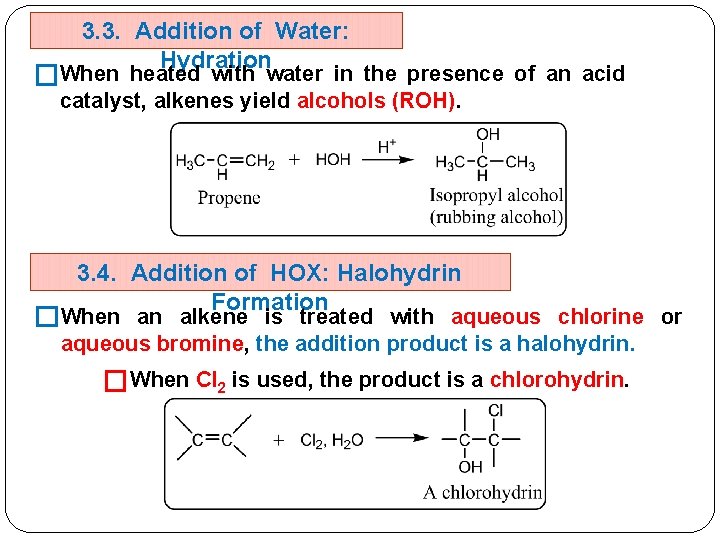
3. 3. Addition of Water: Hydration �When heated with water in the presence of an acid catalyst, alkenes yield alcohols (ROH). 3. 4. Addition of HOX: Halohydrin Formation �When an alkene is treated with aqueous chlorine or aqueous bromine, the addition product is a halohydrin. �When Cl 2 is used, the product is a chlorohydrin.
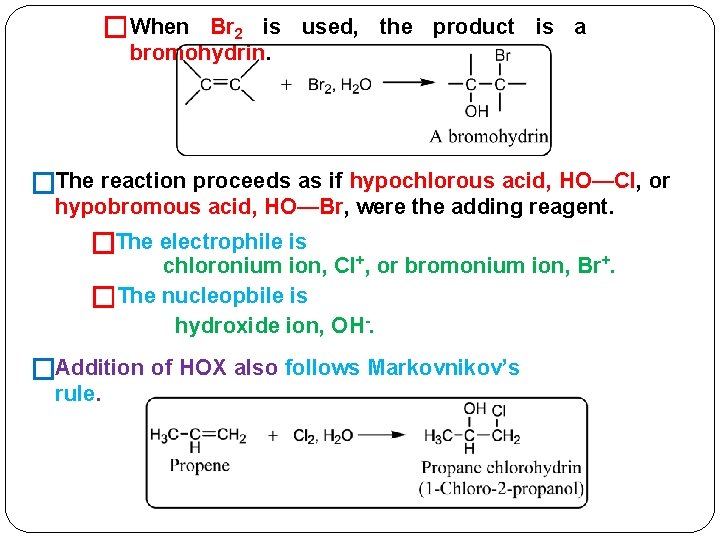
�When Br 2 is used, the product is a bromohydrin. �The reaction proceeds as if hypochlorous acid, HO—Cl, or hypobromous acid, HO—Br, were the adding reagent. �The electrophile is chloronium ion, Cl+, or bromonium ion, Br+. �The nucleopbile is hydroxide ion, OH-. �Addition of HOX also follows Markovnikov’s rule.
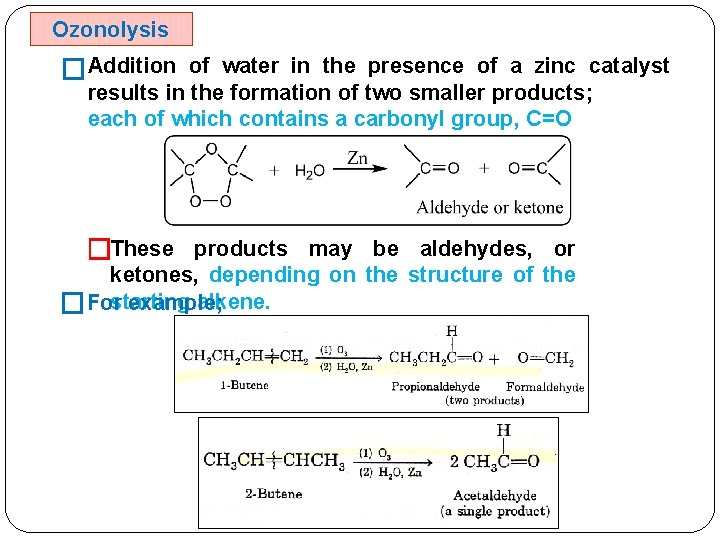
Ozonolysis �Addition of water in the presence of a zinc catalyst results in the formation of two smaller products; each of which contains a carbonyl group, C=O �These products may be aldehydes, or ketones, depending on the structure of the alkene. example; �Forstarting
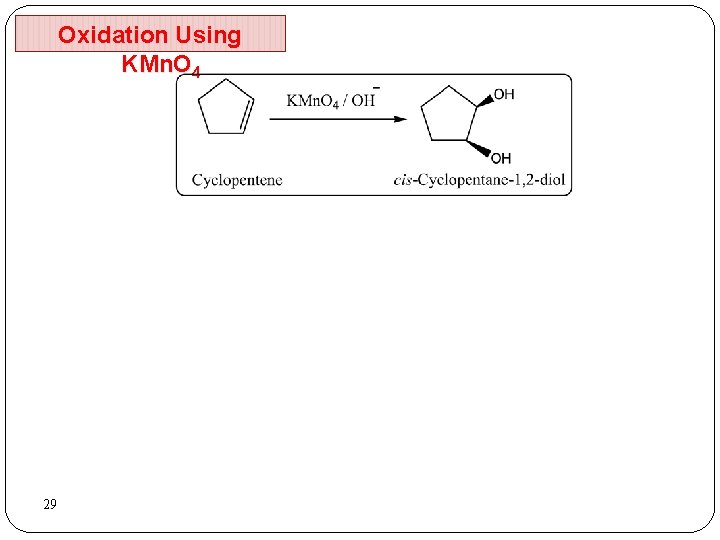
Oxidation Using KMn. O 4 29