
Organic Chemistry Chapter 22 Organic Chemistry Study of
- Slides: 13
Organic Chemistry Chapter 22
Organic Chemistry • Study of compounds containing Carbon • Oxides and Carbonates are NOT considered organic compounds
Hydrocarbons Hydrocarbon – the simplest organic compound which contains only carbon and hydrogen. • Thousands of compounds can be made from just carbon and hydrogen • Carbon forms four bonds • Hydrogen forms only one bond • Simplest hydrocarbon is methane: CH 4
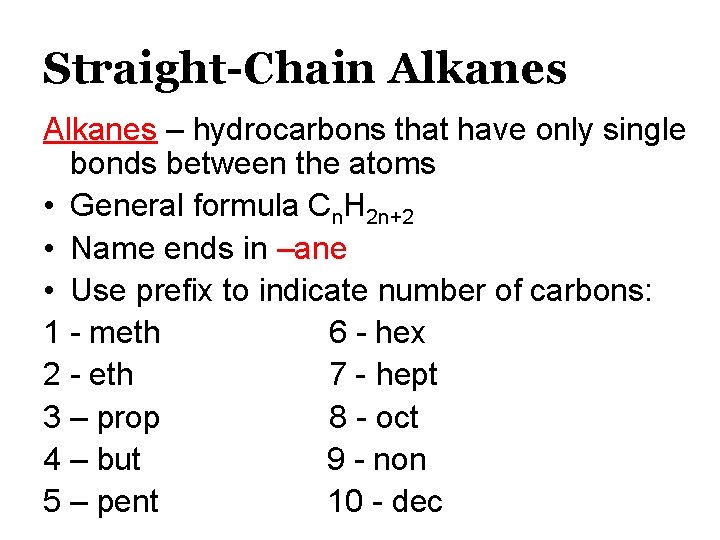
Straight-Chain Alkanes – hydrocarbons that have only single bonds between the atoms • General formula Cn. H 2 n+2 • Name ends in –ane • Use prefix to indicate number of carbons: 1 - meth 6 - hex 2 - eth 7 - hept 3 – prop 8 - oct 4 – but 9 - non 5 – pent 10 - dec
Straight-Chain Alkanes • Examples:
Branched – Chained Alkanes Branched-Chain Alkane – Alkanes that have other groups bonded to them. • The longest chain is the parent chain • The branches are called substituent groups (AP Chem – p. 1061)
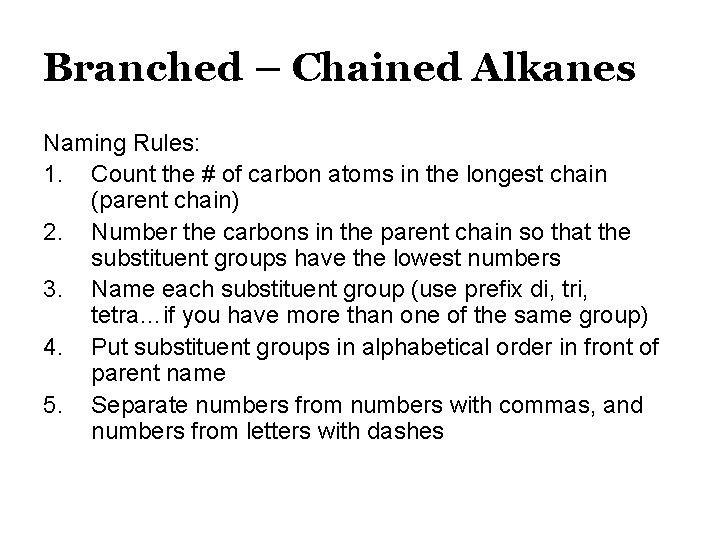
Branched – Chained Alkanes Naming Rules: 1. Count the # of carbon atoms in the longest chain (parent chain) 2. Number the carbons in the parent chain so that the substituent groups have the lowest numbers 3. Name each substituent group (use prefix di, tri, tetra…if you have more than one of the same group) 4. Put substituent groups in alphabetical order in front of parent name 5. Separate numbers from numbers with commas, and numbers from letters with dashes
Branched – Chained Alkanes Examples:
Alkenes – contain one or more double bond between the carbon atoms • -Parent chain ends in -ene • If there are more than 4 carbons, you need to number parent chain so that double bonds have the lowest number
Alkenes cont’d Example- ethene Example – 2 pentene
Alkynes – contain one or more triple bond between the carbon atoms • Parent chain ends in -yne • If there are more than 4 carbons, you need to number parent chain so that triple bonds have the lowest number
Alkynes cont’d Example - ethyne Example – 1 butyne
Saturated vs. Unsaturated • If a hydrocarbon has all single bonds it is said to be saturated - Alkane • If a hydrocarbon has double or triple bonds it is said to be unsaturated – Alkene or Alkyne • Unsaturated hydrocarbons are more reactive than saturated ones.