
Organic Chemistry 9 th Edition L G Wade

- Slides: 60
Organic Chemistry, 9 th Edition L. G. Wade, Jr. Chapter 4 Lecture The Study of Chemical Reactions Chad Snyder, Ph. D Grace College © 2017 Pearson Education, Inc. © 2014 Pearson Education, Inc.
Introduction • Overall reaction: reactants products • To learn more about a reaction: – Thermodynamics is the study of the energy changes that accompany chemical and physical transformations. – Kinetics is the study of reaction rates. • Mechanism: step-by-step description of how the reaction happens © 2017 Pearson Education, Inc.
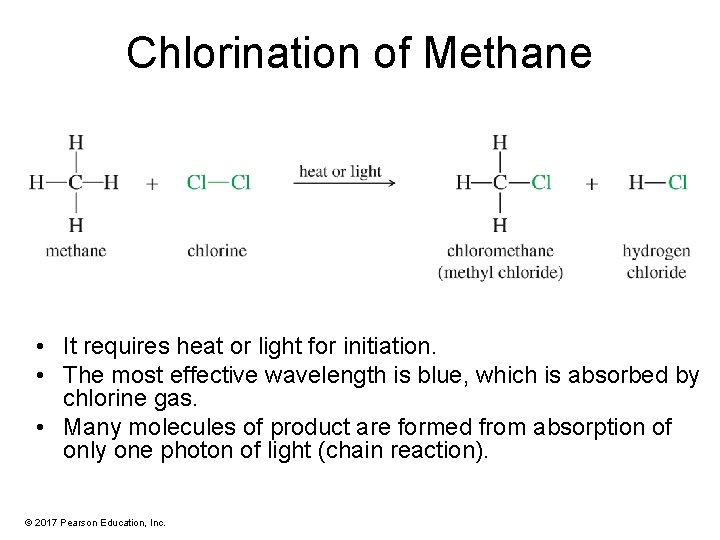
Chlorination of Methane • It requires heat or light for initiation. • The most effective wavelength is blue, which is absorbed by chlorine gas. • Many molecules of product are formed from absorption of only one photon of light (chain reaction). © 2017 Pearson Education, Inc.
The Free-Radical Chain Reaction • Initiation generates a radical intermediate. • Propagation: The intermediate reacts with a stable molecule to produce another reactive intermediate (and a product molecule). • Terminations are side reactions that destroy the reactive intermediate. © 2017 Pearson Education, Inc.
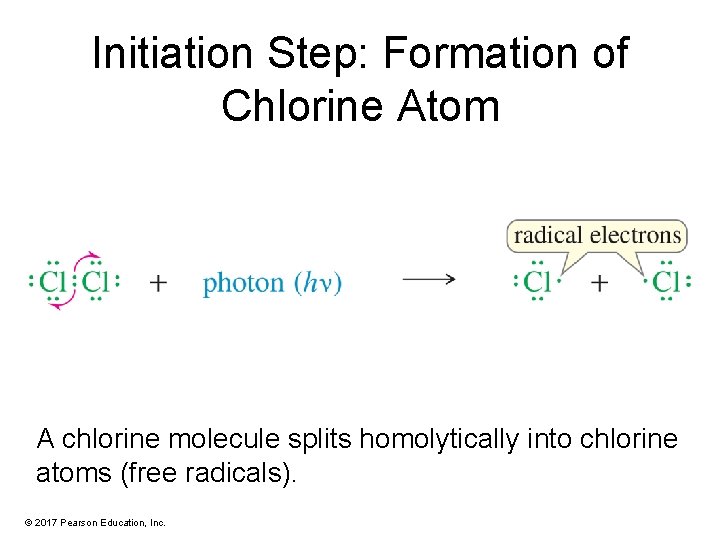
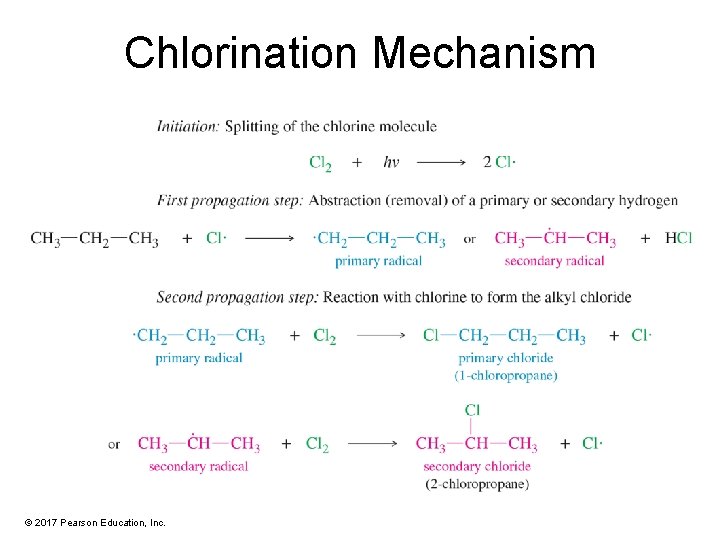
Initiation Step: Formation of Chlorine Atom A chlorine molecule splits homolytically into chlorine atoms (free radicals). © 2017 Pearson Education, Inc.
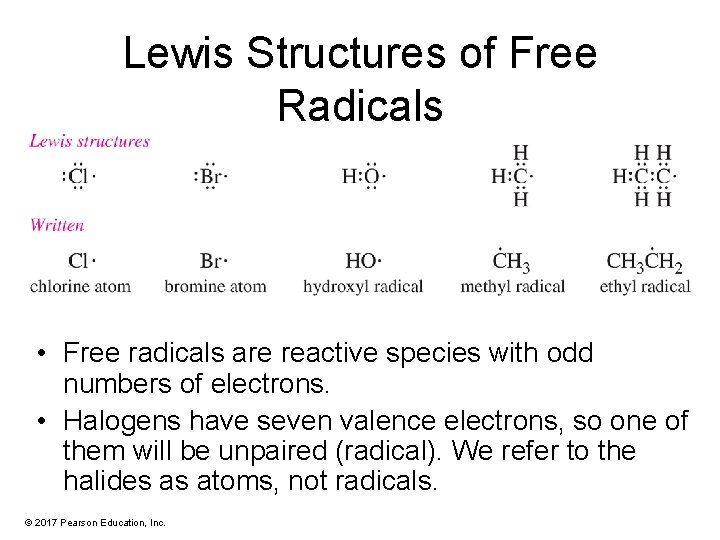
Lewis Structures of Free Radicals • Free radicals are reactive species with odd numbers of electrons. • Halogens have seven valence electrons, so one of them will be unpaired (radical). We refer to the halides as atoms, not radicals. © 2017 Pearson Education, Inc.
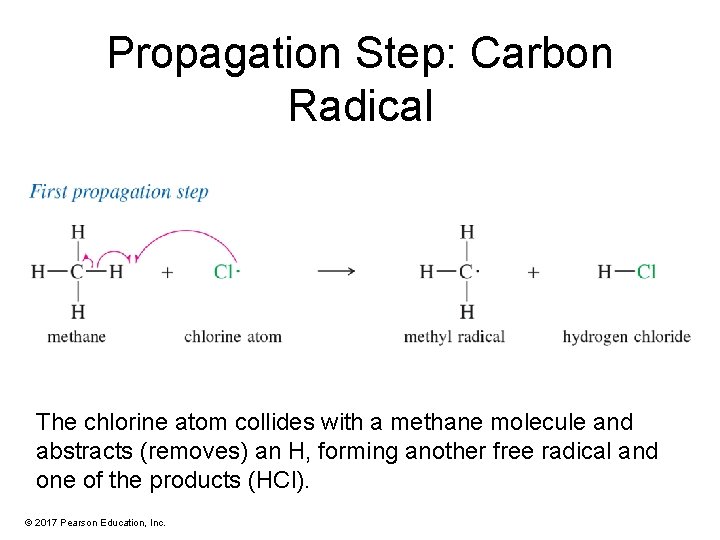
Propagation Step: Carbon Radical The chlorine atom collides with a methane molecule and abstracts (removes) an H, forming another free radical and one of the products (HCl). © 2017 Pearson Education, Inc.
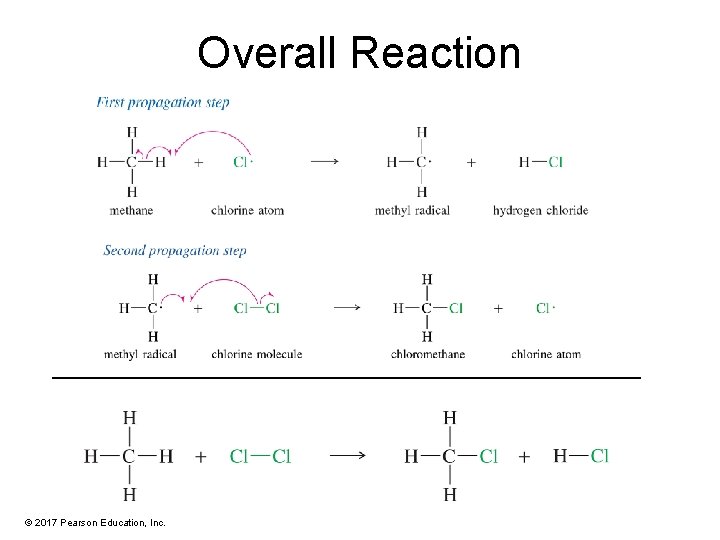
Propagation Step: Product Formation The methyl free radical collides with another chlorine molecule, producing the organic product (methyl chloride) and regenerating the chlorine radical. © 2017 Pearson Education, Inc.
Overall Reaction © 2017 Pearson Education, Inc.
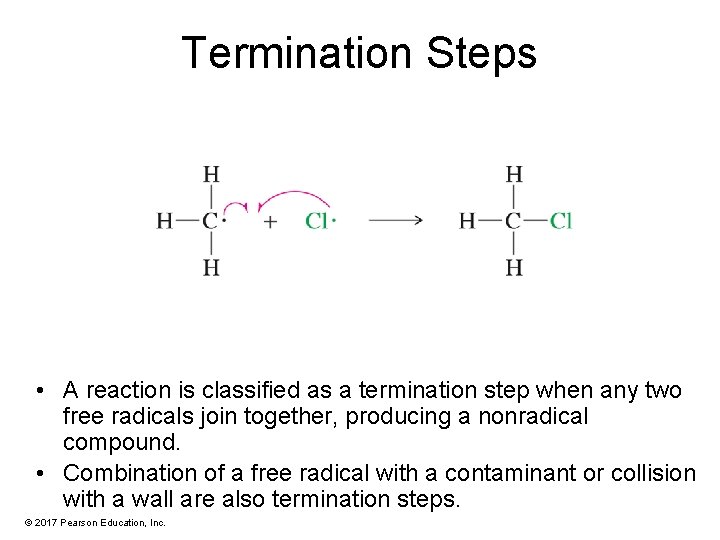
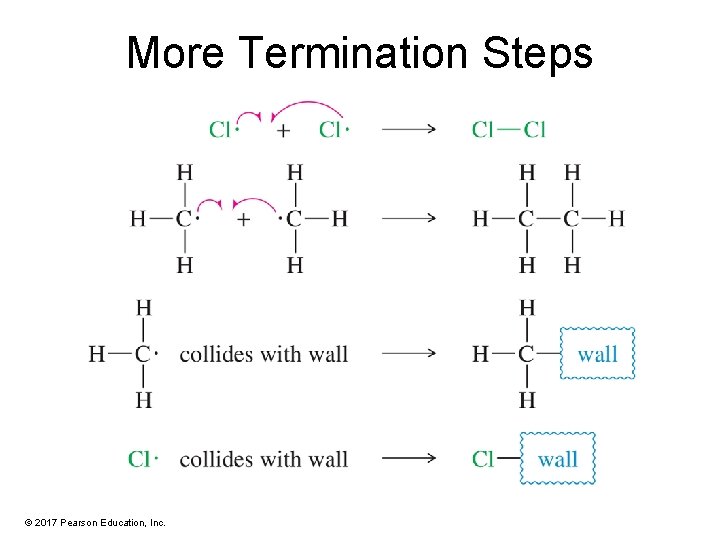
Termination Steps • A reaction is classified as a termination step when any two free radicals join together, producing a nonradical compound. • Combination of a free radical with a contaminant or collision with a wall are also termination steps. © 2017 Pearson Education, Inc.
More Termination Steps © 2017 Pearson Education, Inc.
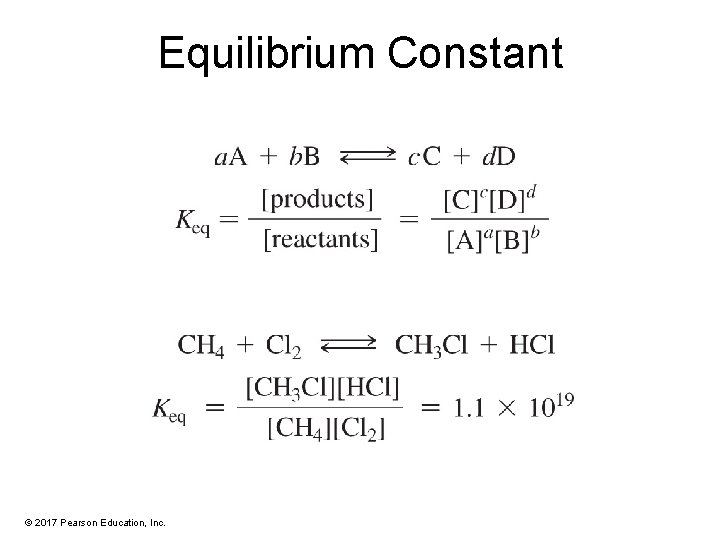
Equilibrium Constant © 2017 Pearson Education, Inc.
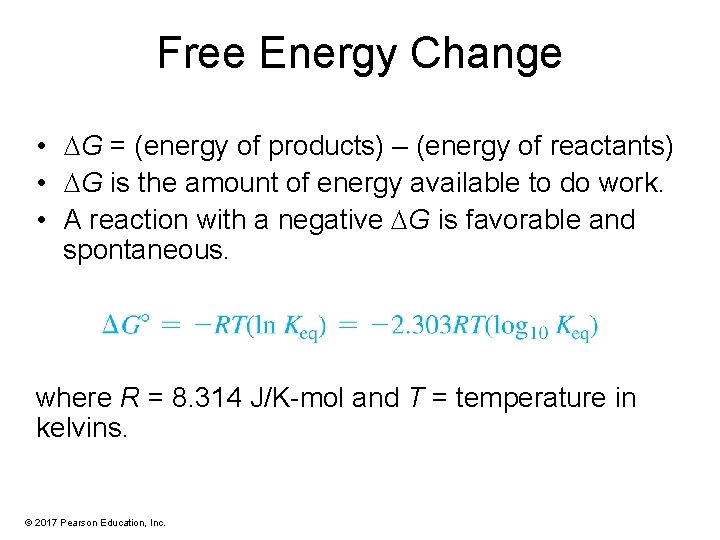
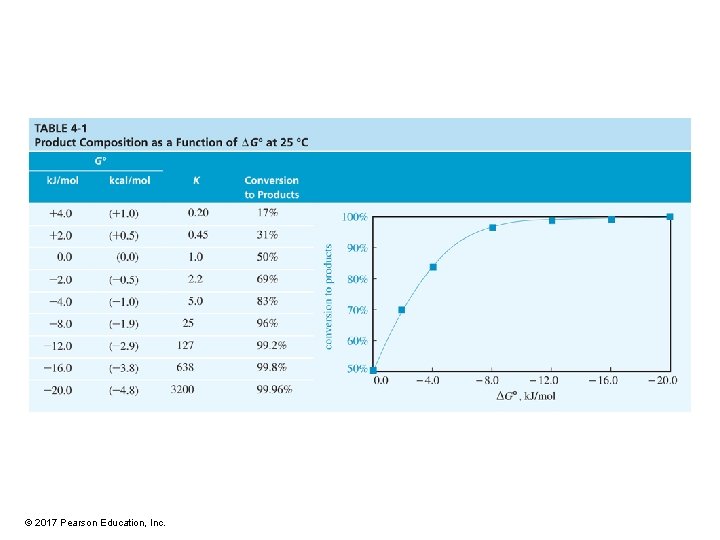
Free Energy Change • G = (energy of products) – (energy of reactants) • G is the amount of energy available to do work. • A reaction with a negative G is favorable and spontaneous. where R = 8. 314 J/K-mol and T = temperature in kelvins. © 2017 Pearson Education, Inc.
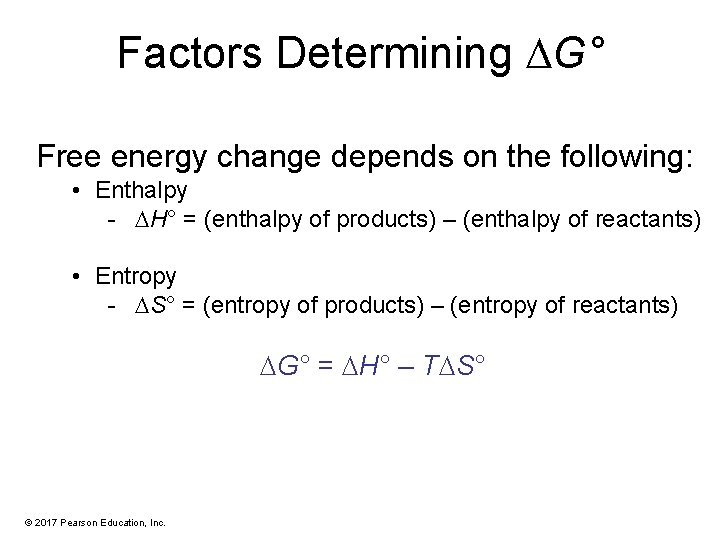
Factors Determining G° Free energy change depends on the following: • Enthalpy - H° = (enthalpy of products) – (enthalpy of reactants) • Entropy - S° = (entropy of products) – (entropy of reactants) G° = H° – T S° © 2017 Pearson Education, Inc.
© 2017 Pearson Education, Inc.
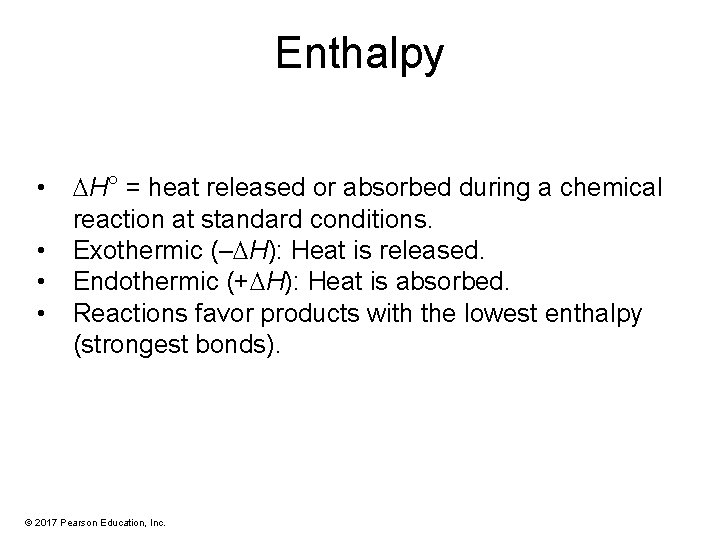
Enthalpy • • H° = heat released or absorbed during a chemical reaction at standard conditions. Exothermic (– H): Heat is released. Endothermic (+ H): Heat is absorbed. Reactions favor products with the lowest enthalpy (strongest bonds). © 2017 Pearson Education, Inc.
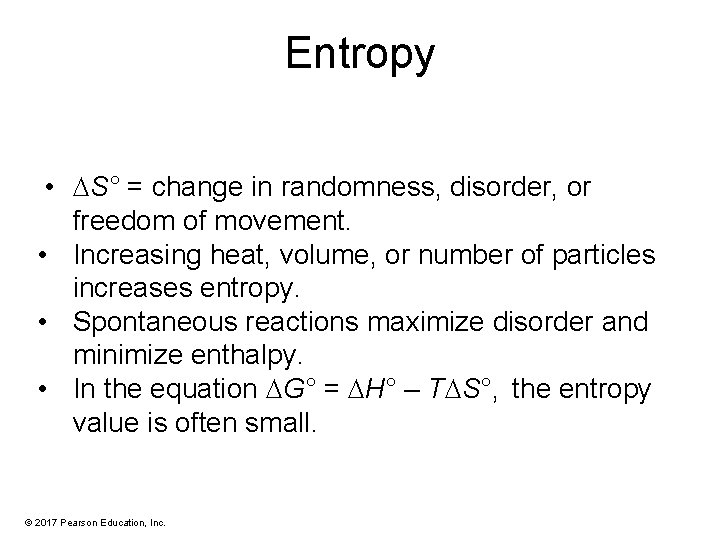
Entropy • S° = change in randomness, disorder, or freedom of movement. • Increasing heat, volume, or number of particles increases entropy. • Spontaneous reactions maximize disorder and minimize enthalpy. • In the equation G° = H° – T S°, the entropy value is often small. © 2017 Pearson Education, Inc.
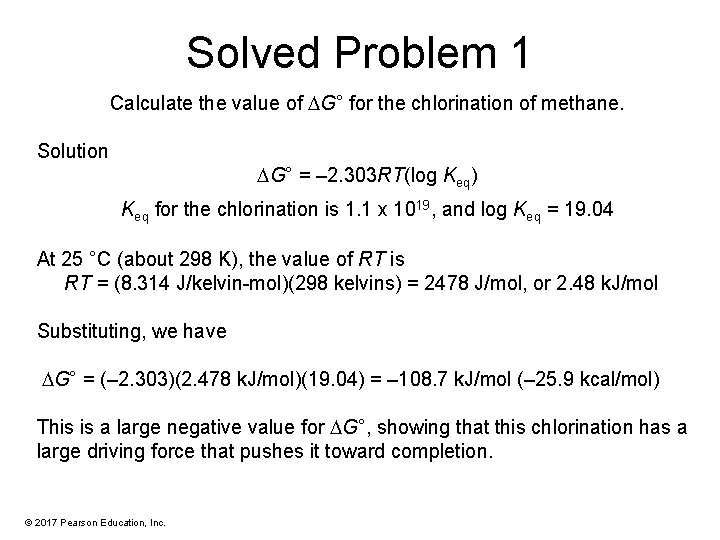
Solved Problem 1 Calculate the value of G° for the chlorination of methane. Solution G° = – 2. 303 RT(log Keq) Keq for the chlorination is 1. 1 x 10¹⁹, and log Keq = 19. 04 At 25 °C (about 298 K), the value of RT is RT = (8. 314 J/kelvin-mol)(298 kelvins) = 2478 J/mol, or 2. 48 k. J/mol Substituting, we have G° = (– 2. 303)(2. 478 k. J/mol)(19. 04) = – 108. 7 k. J/mol (– 25. 9 kcal/mol) This is a large negative value for G°, showing that this chlorination has a large driving force that pushes it toward completion. © 2017 Pearson Education, Inc.
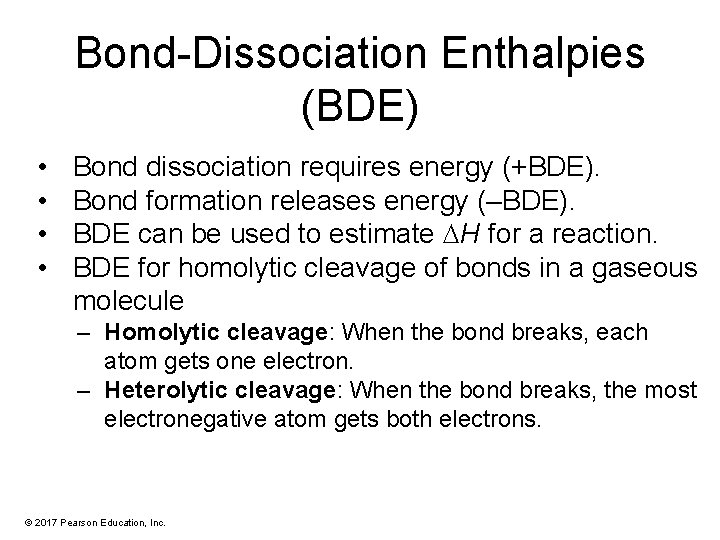
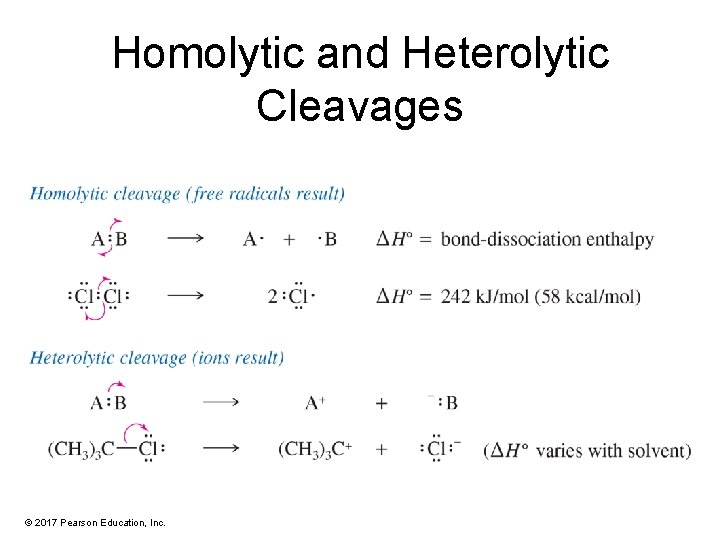
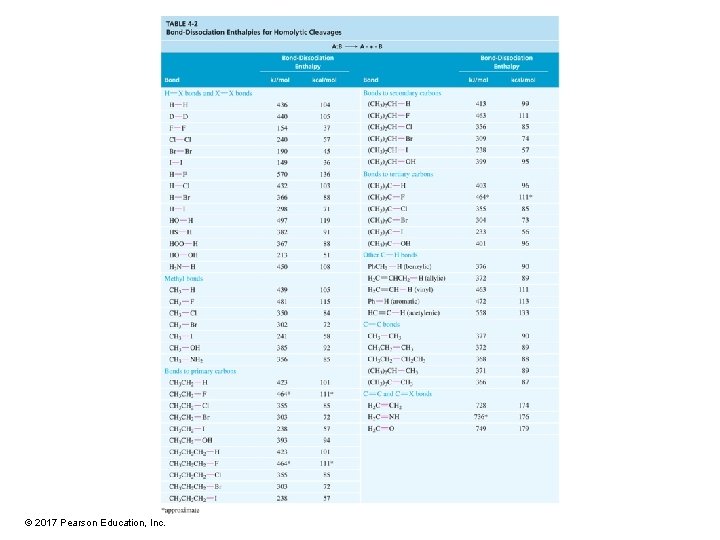
Bond-Dissociation Enthalpies (BDE) • • Bond dissociation requires energy (+BDE). Bond formation releases energy (–BDE). BDE can be used to estimate H for a reaction. BDE for homolytic cleavage of bonds in a gaseous molecule – Homolytic cleavage: When the bond breaks, each atom gets one electron. – Heterolytic cleavage: When the bond breaks, the most electronegative atom gets both electrons. © 2017 Pearson Education, Inc.
Homolytic and Heterolytic Cleavages © 2017 Pearson Education, Inc.
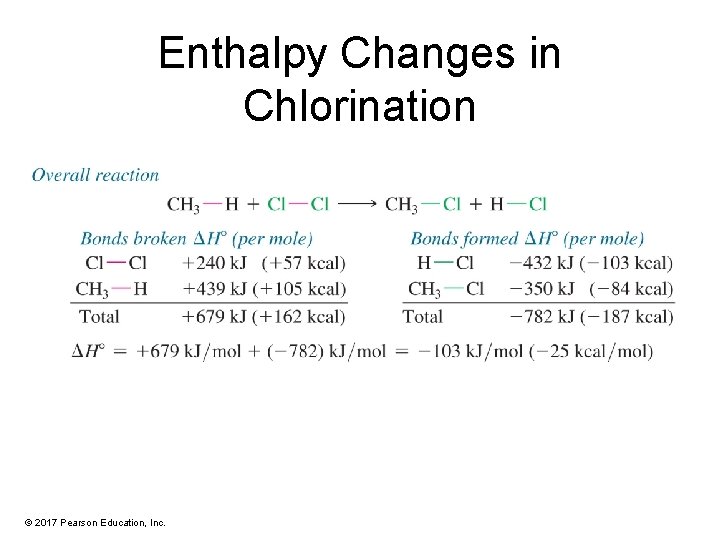
Enthalpy Changes in Chlorination © 2017 Pearson Education, Inc.
Kinetics • Kinetics is the study of reaction rates. • Rate of the reaction is a measure of how the concentration of the products increases while the concentration of the starting materials decreases. • A rate equation (also called the rate law) is the relationship between the concentrations of the reactants and the observed reaction rate. • Rate law is determined experimentally. © 2017 Pearson Education, Inc.
© 2017 Pearson Education, Inc.
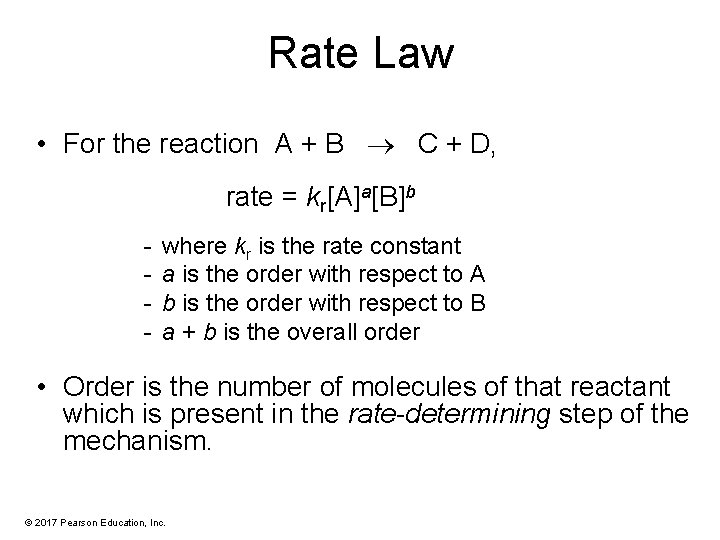
Rate Law • For the reaction A + B C + D, rate = kr[A]a[B]b - where kr is the rate constant a is the order with respect to A b is the order with respect to B a + b is the overall order • Order is the number of molecules of that reactant which is present in the rate-determining step of the mechanism. © 2017 Pearson Education, Inc.
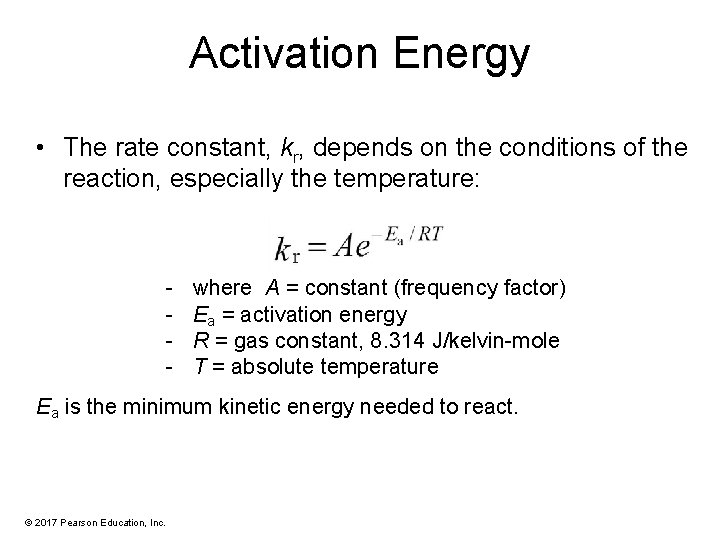
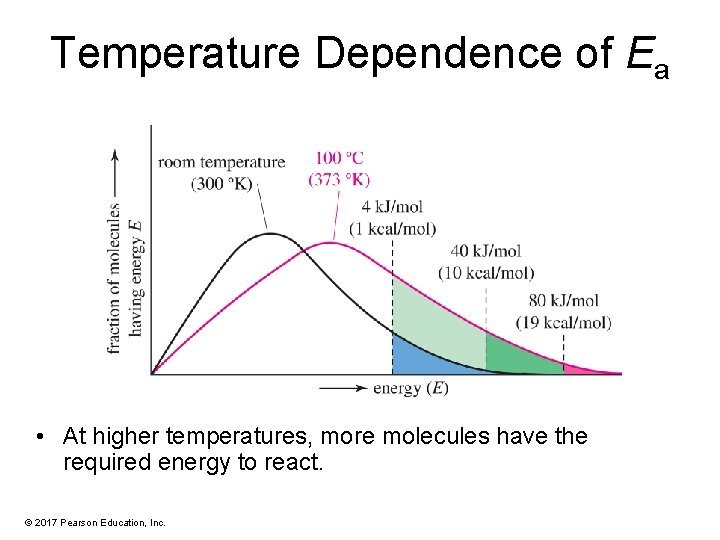
Activation Energy • The rate constant, kr, depends on the conditions of the reaction, especially the temperature: - where A = constant (frequency factor) Ea = activation energy R = gas constant, 8. 314 J/kelvin-mole T = absolute temperature Ea is the minimum kinetic energy needed to react. © 2017 Pearson Education, Inc.
Temperature Dependence of Ea • At higher temperatures, more molecules have the required energy to react. © 2017 Pearson Education, Inc.
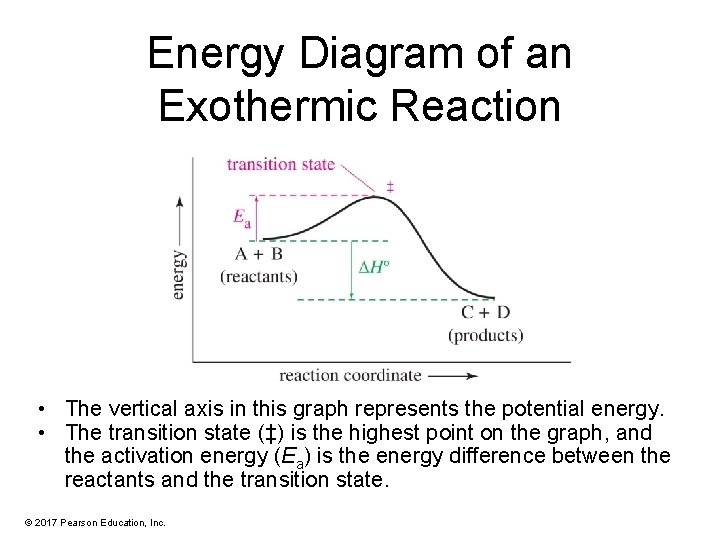
Energy Diagram of an Exothermic Reaction • The vertical axis in this graph represents the potential energy. • The transition state (‡) is the highest point on the graph, and the activation energy (Ea) is the energy difference between the reactants and the transition state. © 2017 Pearson Education, Inc.
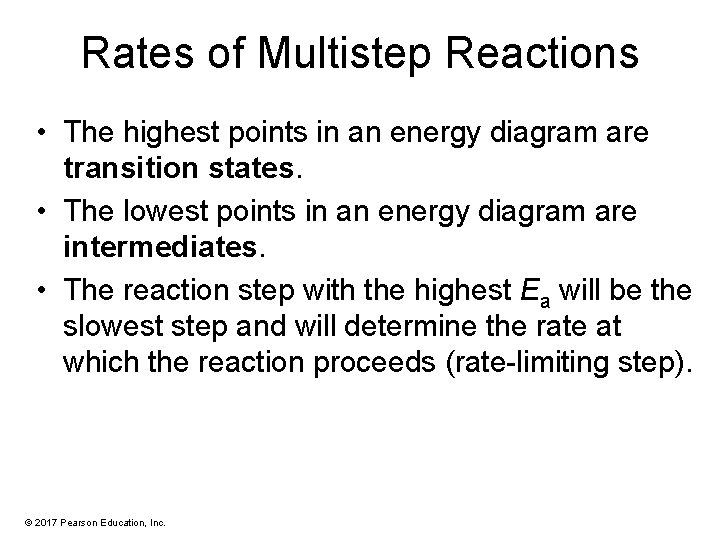
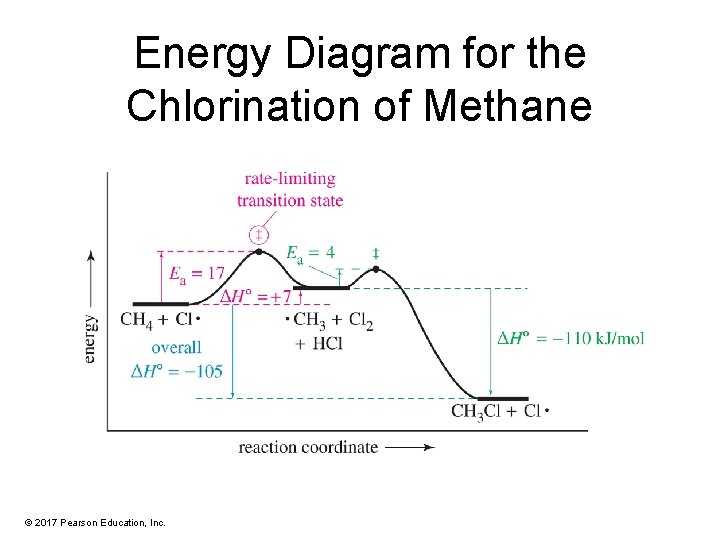
Rates of Multistep Reactions • The highest points in an energy diagram are transition states. • The lowest points in an energy diagram are intermediates. • The reaction step with the highest Ea will be the slowest step and will determine the rate at which the reaction proceeds (rate-limiting step). © 2017 Pearson Education, Inc.
Energy Diagram for the Chlorination of Methane © 2017 Pearson Education, Inc.
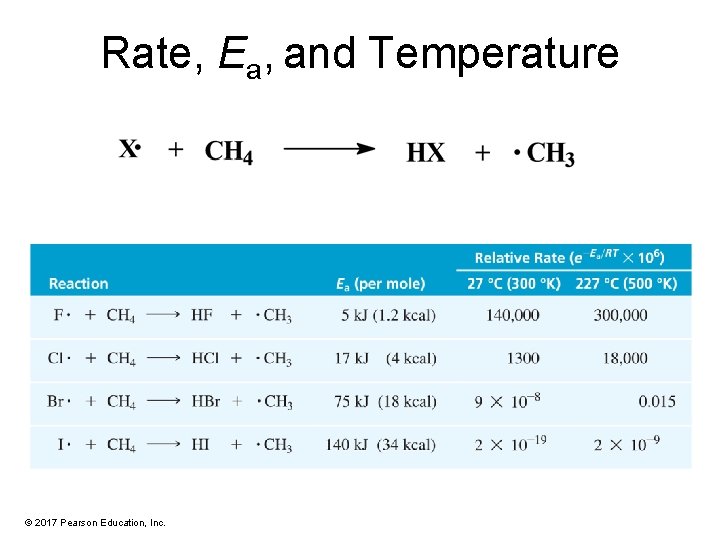
Rate, Ea, and Temperature © 2017 Pearson Education, Inc.
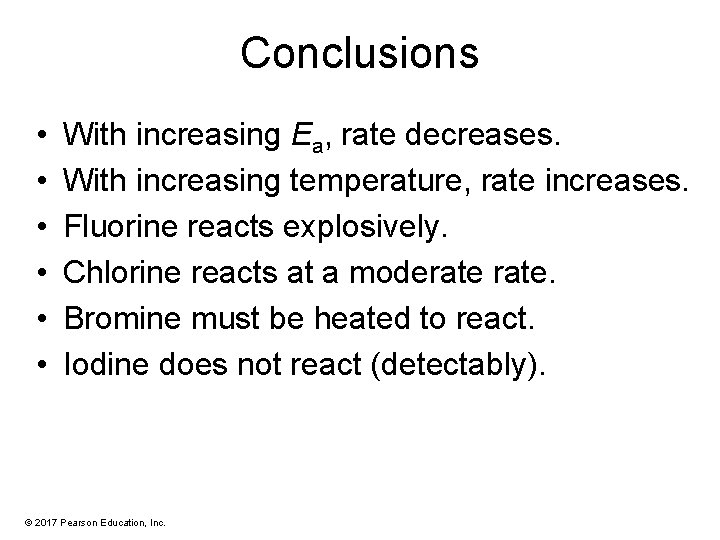
Conclusions • • • With increasing Ea, rate decreases. With increasing temperature, rate increases. Fluorine reacts explosively. Chlorine reacts at a moderate. Bromine must be heated to react. Iodine does not react (detectably). © 2017 Pearson Education, Inc.
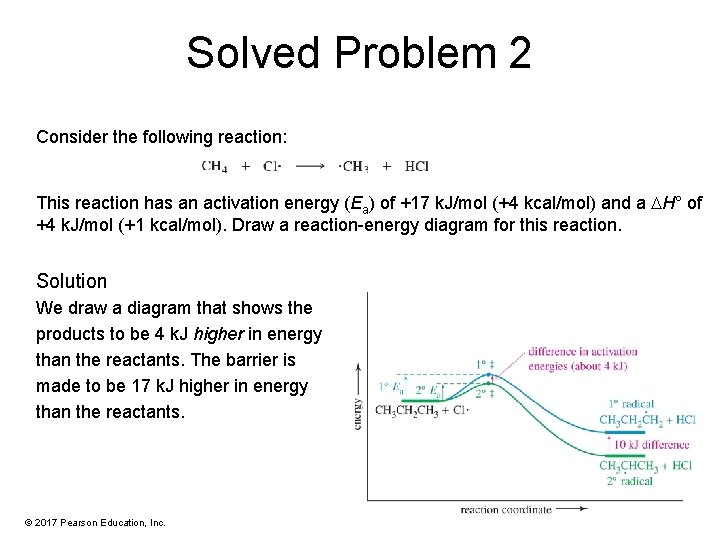
Solved Problem 2 Consider the following reaction: This reaction has an activation energy (Ea) of +17 k. J/mol (+4 kcal/mol) and a H° of +4 k. J/mol (+1 kcal/mol). Draw a reaction-energy diagram for this reaction. Solution We draw a diagram that shows the products to be 4 k. J higher in energy than the reactants. The barrier is made to be 17 k. J higher in energy than the reactants. © 2017 Pearson Education, Inc.
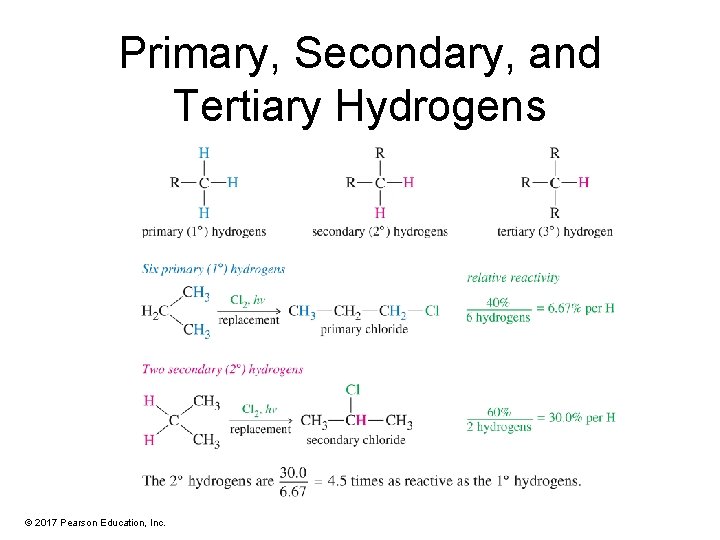
Primary, Secondary, and Tertiary Hydrogens © 2017 Pearson Education, Inc.
Chlorination Mechanism © 2017 Pearson Education, Inc.
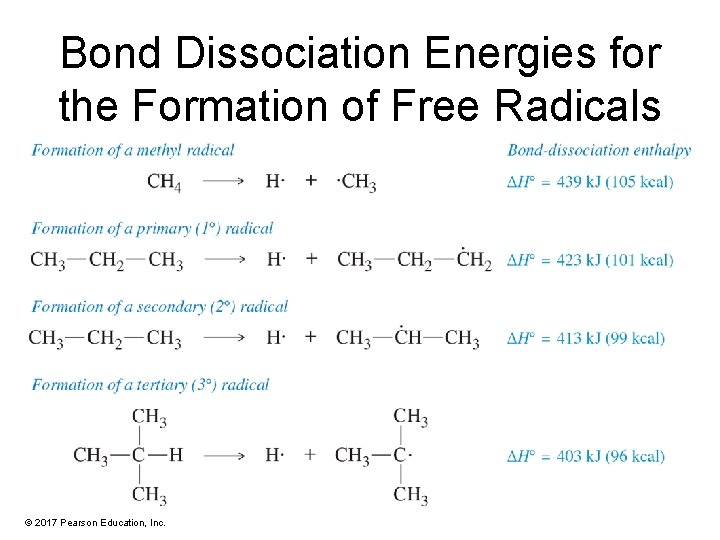
Bond Dissociation Energies for the Formation of Free Radicals © 2017 Pearson Education, Inc.
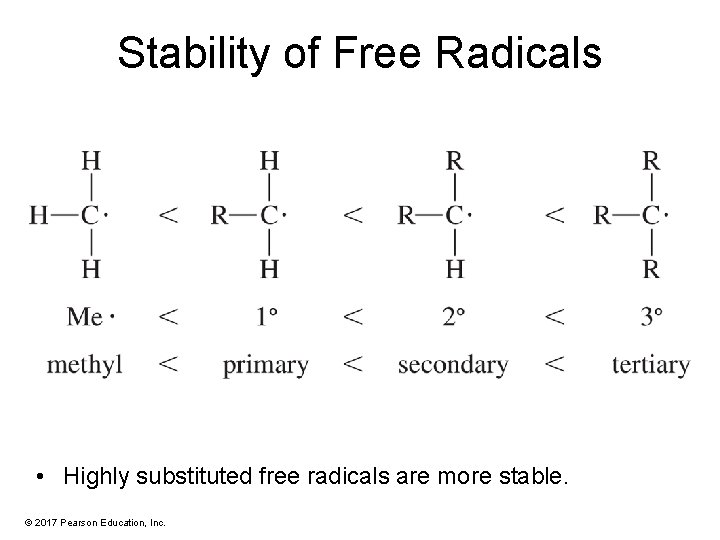
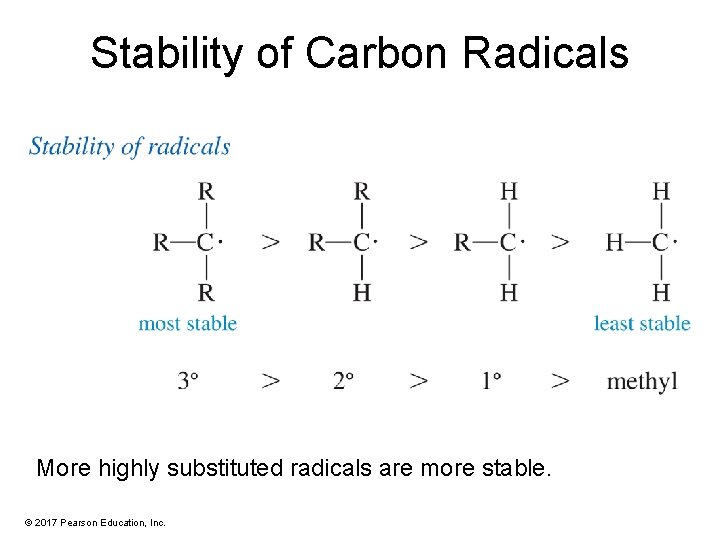
Stability of Free Radicals • Highly substituted free radicals are more stable. © 2017 Pearson Education, Inc.
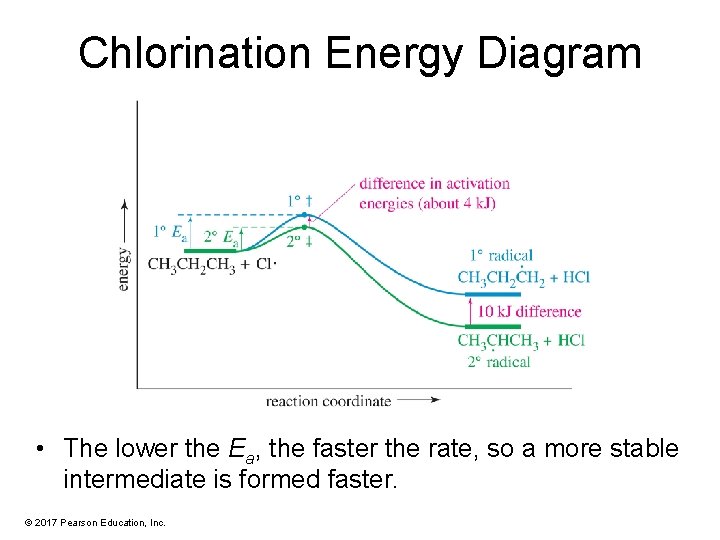
Chlorination Energy Diagram • The lower the Ea, the faster the rate, so a more stable intermediate is formed faster. © 2017 Pearson Education, Inc.
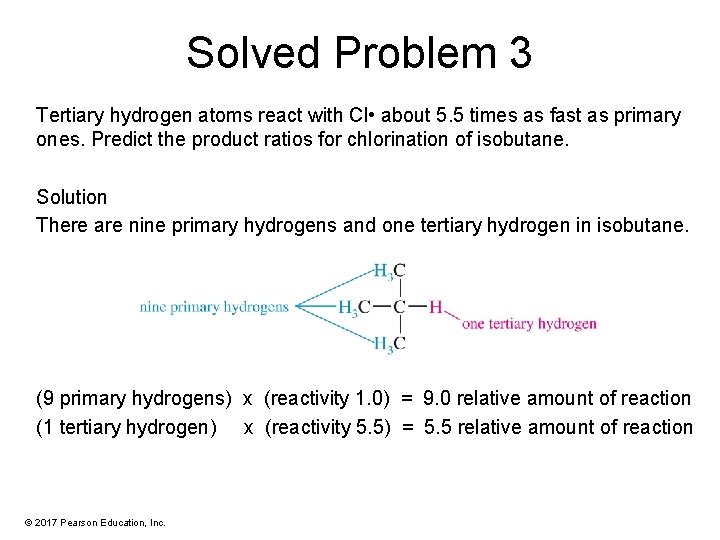
Solved Problem 3 Tertiary hydrogen atoms react with Cl • about 5. 5 times as fast as primary ones. Predict the product ratios for chlorination of isobutane. Solution There are nine primary hydrogens and one tertiary hydrogen in isobutane. (9 primary hydrogens) x (reactivity 1. 0) = 9. 0 relative amount of reaction (1 tertiary hydrogen) x (reactivity 5. 5) = 5. 5 relative amount of reaction © 2017 Pearson Education, Inc.
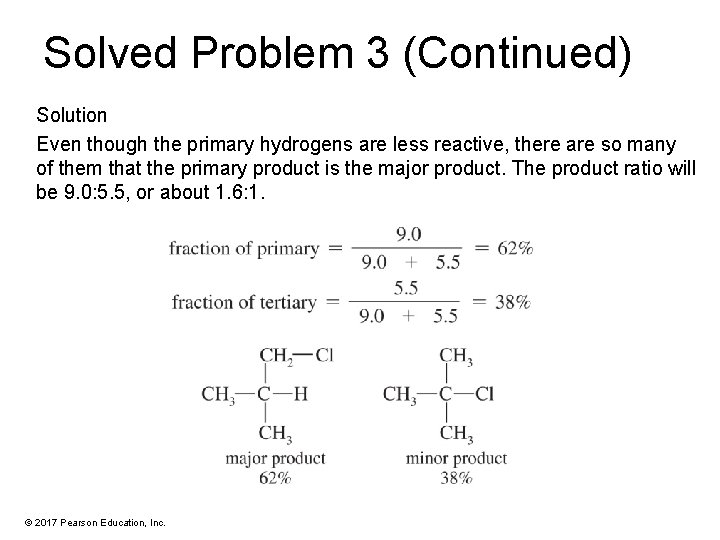
Solved Problem 3 (Continued) Solution Even though the primary hydrogens are less reactive, there are so many of them that the primary product is the major product. The product ratio will be 9. 0: 5. 5, or about 1. 6: 1. © 2017 Pearson Education, Inc.
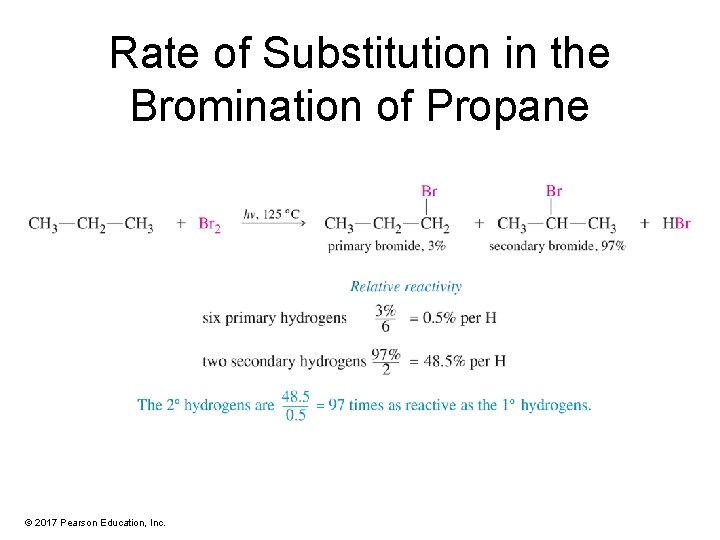
Rate of Substitution in the Bromination of Propane © 2017 Pearson Education, Inc.
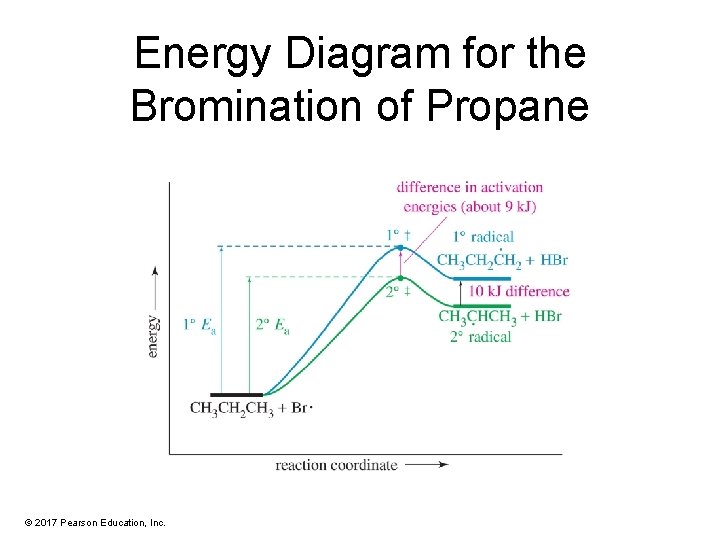
Energy Diagram for the Bromination of Propane © 2017 Pearson Education, Inc.
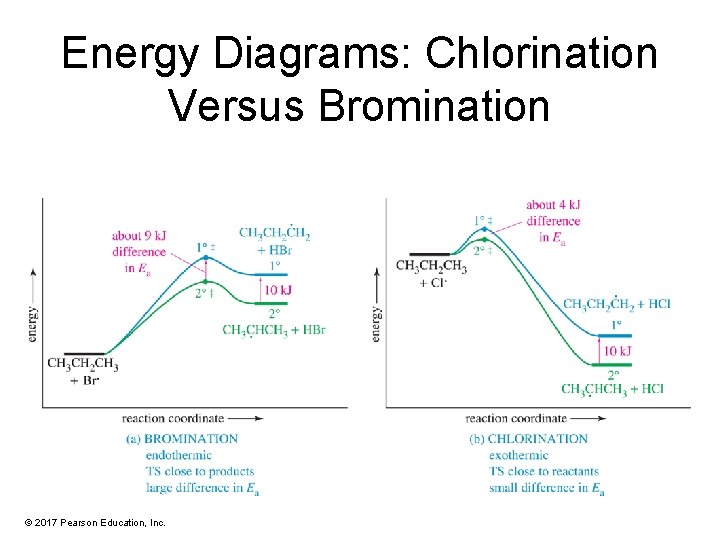
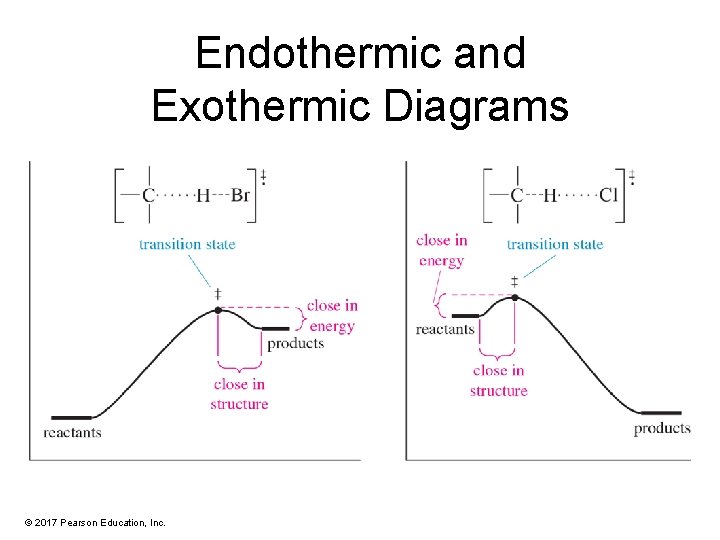
Hammond Postulate • Related species that are similar in energy are also similar in structure. • The structure of the transition state resembles the structure of the closest stable species. • Endothermic reaction: Transition state resembles the product. • Exothermic reaction: Transition state resembles the reactant. © 2017 Pearson Education, Inc.
Energy Diagrams: Chlorination Versus Bromination © 2017 Pearson Education, Inc.
Endothermic and Exothermic Diagrams © 2017 Pearson Education, Inc.
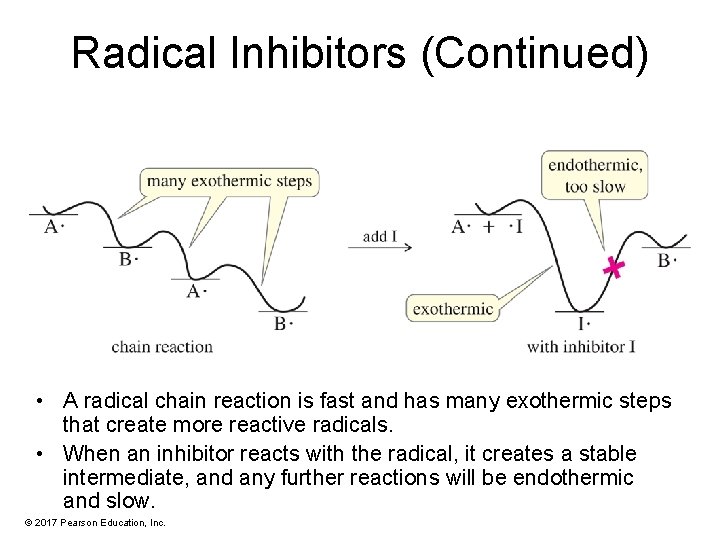
Radical Inhibitors • These are often added to food to retard spoilage by radical chain reactions. • Without an inhibitor, each initiation step will cause a chain reaction so that many molecules will react. • An inhibitor combines with the free radical to form a stable molecule. • Vitamin E and vitamin C are thought to protect living cells from free radicals. © 2017 Pearson Education, Inc.
Radical Inhibitors (Continued) • A radical chain reaction is fast and has many exothermic steps that create more reactive radicals. • When an inhibitor reacts with the radical, it creates a stable intermediate, and any further reactions will be endothermic and slow. © 2017 Pearson Education, Inc.
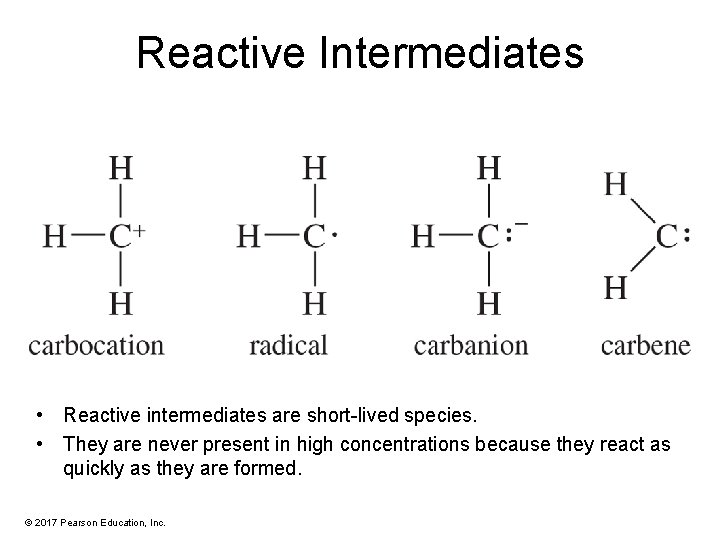
Reactive Intermediates • Reactive intermediates are short-lived species. • They are never present in high concentrations because they react as quickly as they are formed. © 2017 Pearson Education, Inc.
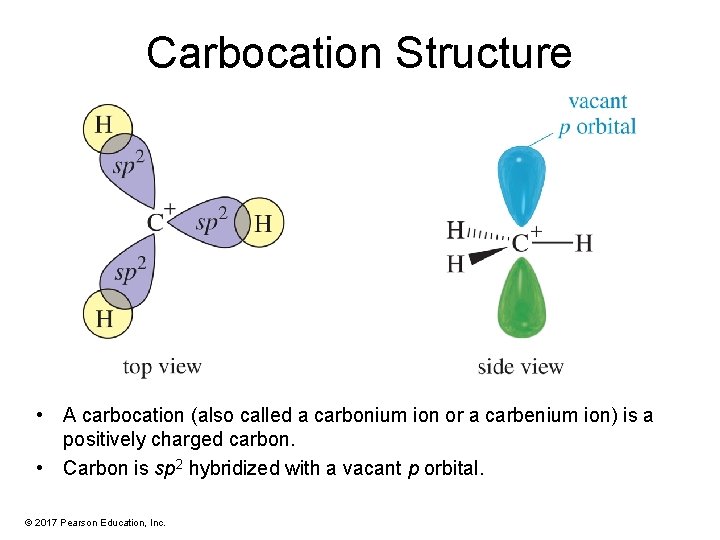
Carbocation Structure • A carbocation (also called a carbonium ion or a carbenium ion) is a positively charged carbon. • Carbon is sp 2 hybridized with a vacant p orbital. © 2017 Pearson Education, Inc.
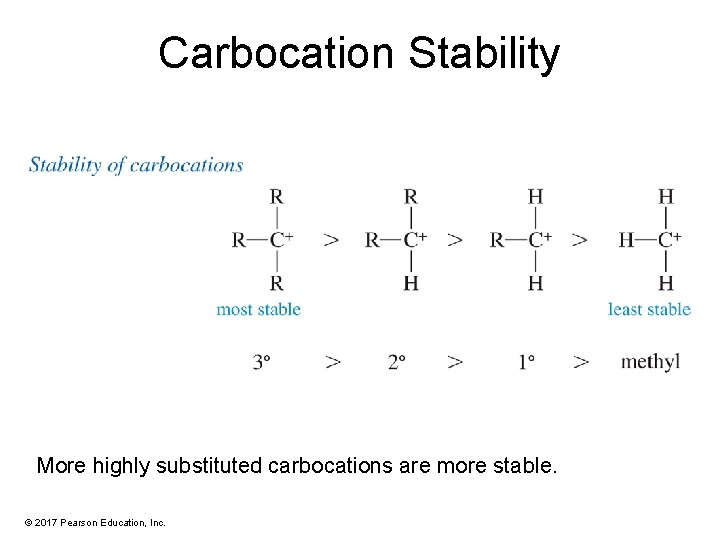
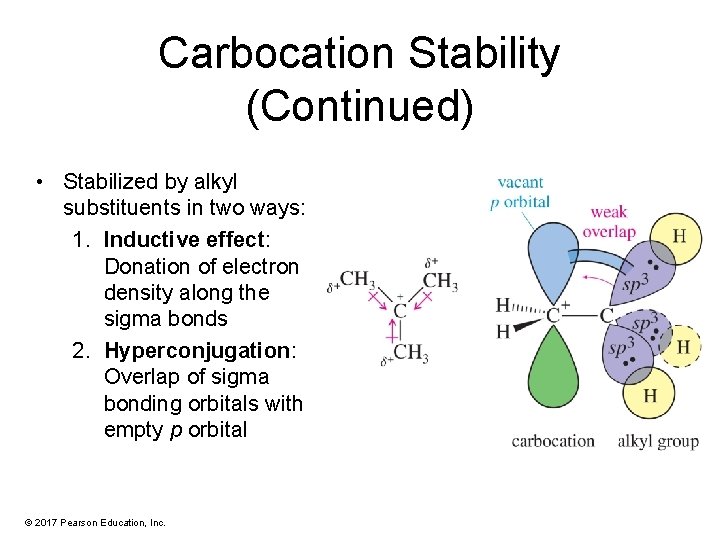
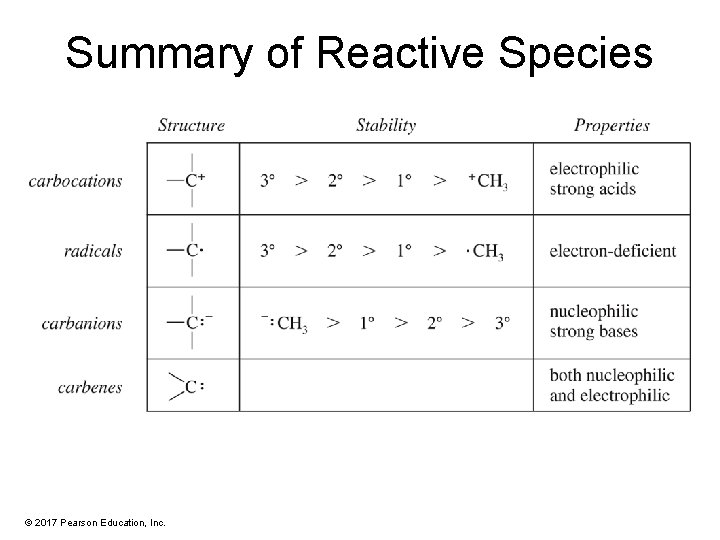
Carbocation Stability More highly substituted carbocations are more stable. © 2017 Pearson Education, Inc.
Carbocation Stability (Continued) • Stabilized by alkyl substituents in two ways: 1. Inductive effect: Donation of electron density along the sigma bonds 2. Hyperconjugation: Overlap of sigma bonding orbitals with empty p orbital © 2017 Pearson Education, Inc.
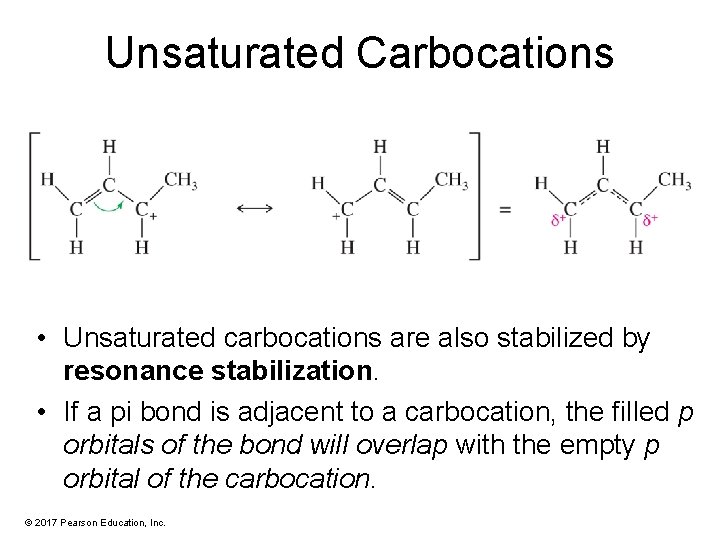
Unsaturated Carbocations • Unsaturated carbocations are also stabilized by resonance stabilization. • If a pi bond is adjacent to a carbocation, the filled p orbitals of the bond will overlap with the empty p orbital of the carbocation. © 2017 Pearson Education, Inc.
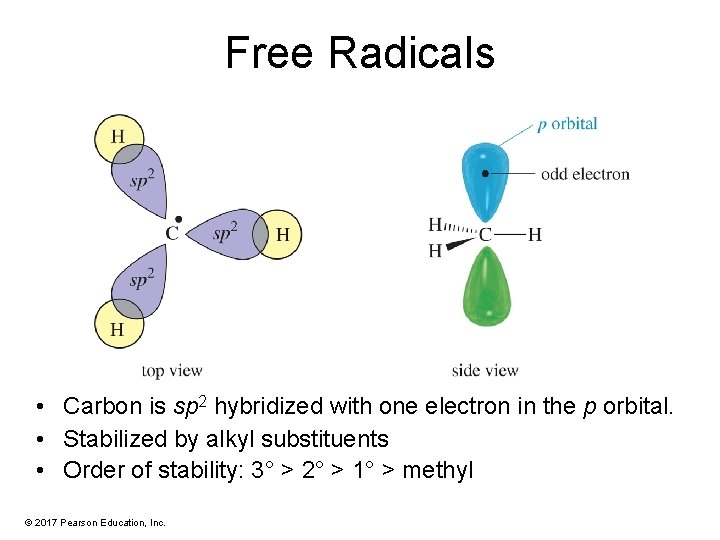
Free Radicals • Carbon is sp 2 hybridized with one electron in the p orbital. • Stabilized by alkyl substituents • Order of stability: 3° > 2° > 1° > methyl © 2017 Pearson Education, Inc.
Stability of Carbon Radicals More highly substituted radicals are more stable. © 2017 Pearson Education, Inc.
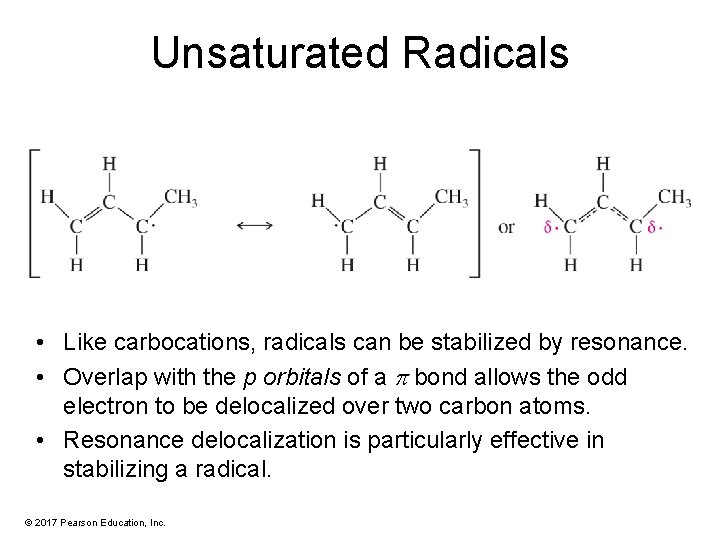
Unsaturated Radicals • Like carbocations, radicals can be stabilized by resonance. • Overlap with the p orbitals of a p bond allows the odd electron to be delocalized over two carbon atoms. • Resonance delocalization is particularly effective in stabilizing a radical. © 2017 Pearson Education, Inc.
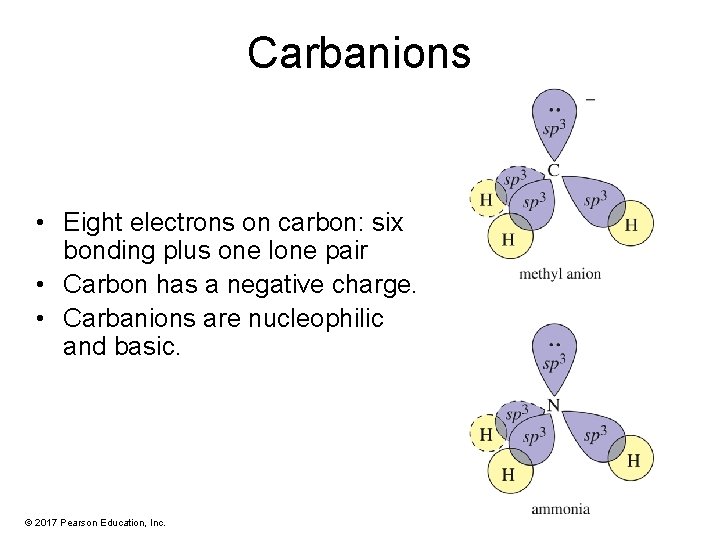
Carbanions • Eight electrons on carbon: six bonding plus one lone pair • Carbon has a negative charge. • Carbanions are nucleophilic and basic. © 2017 Pearson Education, Inc.
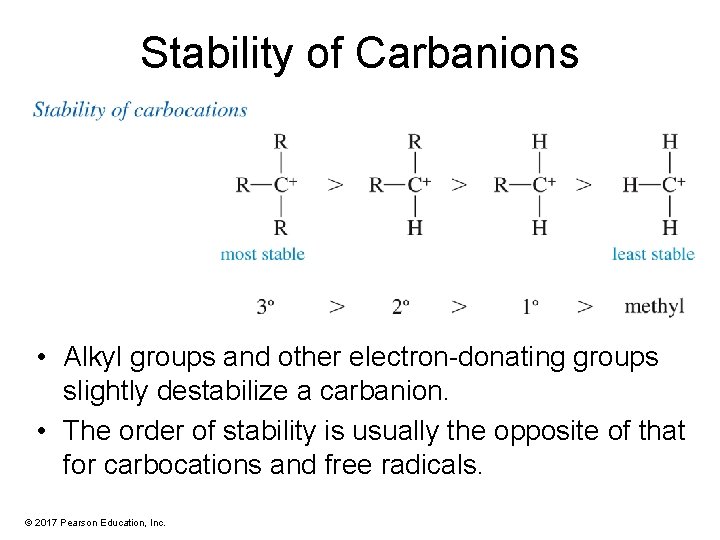
Stability of Carbanions • Alkyl groups and other electron-donating groups slightly destabilize a carbanion. • The order of stability is usually the opposite of that for carbocations and free radicals. © 2017 Pearson Education, Inc.
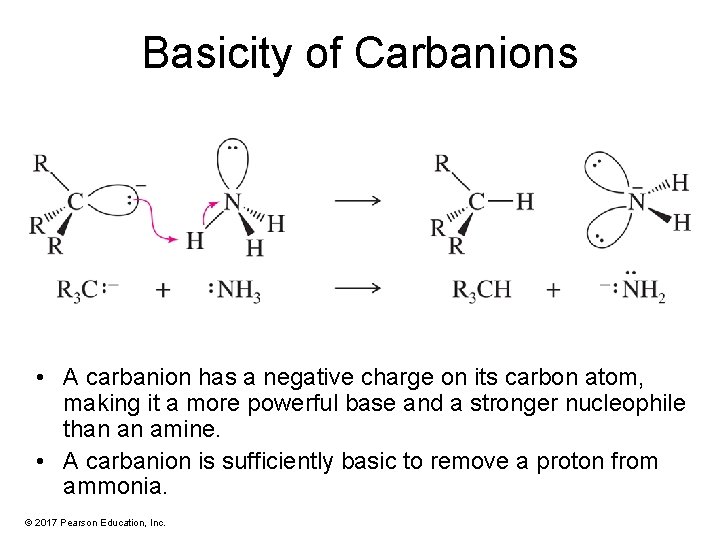
Basicity of Carbanions • A carbanion has a negative charge on its carbon atom, making it a more powerful base and a stronger nucleophile than an amine. • A carbanion is sufficiently basic to remove a proton from ammonia. © 2017 Pearson Education, Inc.
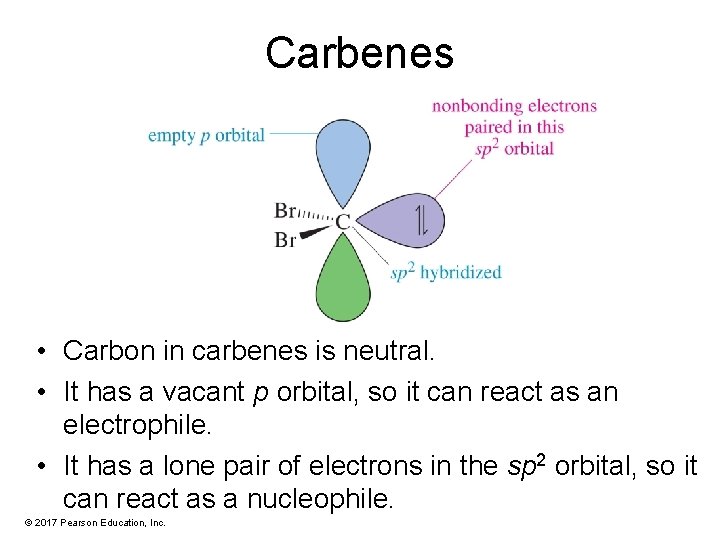
Carbenes • Carbon in carbenes is neutral. • It has a vacant p orbital, so it can react as an electrophile. • It has a lone pair of electrons in the sp 2 orbital, so it can react as a nucleophile. © 2017 Pearson Education, Inc.
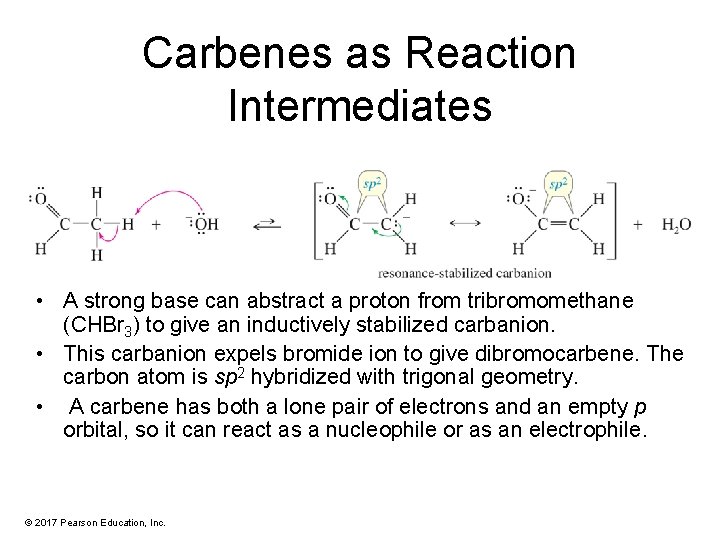
Carbenes as Reaction Intermediates • A strong base can abstract a proton from tribromomethane (CHBr 3) to give an inductively stabilized carbanion. • This carbanion expels bromide ion to give dibromocarbene. The carbon atom is sp 2 hybridized with trigonal geometry. • A carbene has both a lone pair of electrons and an empty p orbital, so it can react as a nucleophile or as an electrophile. © 2017 Pearson Education, Inc.
Summary of Reactive Species © 2017 Pearson Education, Inc.