
Organic Chemistry 7 th Edition L G Wade
- Slides: 49
Organic Chemistry, 7 th Edition L. G. Wade, Jr. Chapter 2 Structure and Properties of Organic Molecules © 2010, Prentice Hall
Wave properties • picture the atom as a miniature solar system • electrons orbiting around the nucleus • 1923, Louis de Broglie - properties of electrons in atoms are better explained by treating the electrons as waves rather than as particles
• two general kinds of waves • traveling waves and standing waves • traveling waves: sound waves that carry a thunderclap and water waves that form the wake of a boat
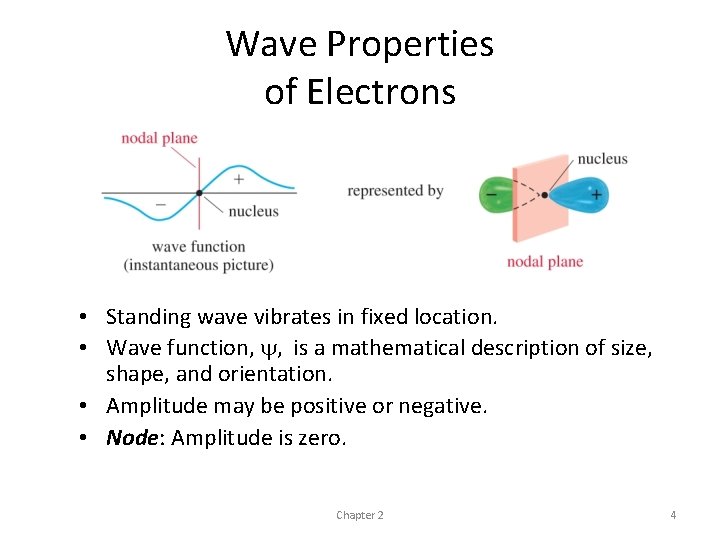
Wave Properties of Electrons • Standing wave vibrates in fixed location. • Wave function, , is a mathematical description of size, shape, and orientation. • Amplitude may be positive or negative. • Node: Amplitude is zero. Chapter 2 4
• orbital (a three-dimensional standing wave) • Compare with the vibration of a guitar string • pluck a guitar string at its middle, a standing wave results • all of the string is displaced upward for a fraction of a second, then downward for an equal time
• waveform of a 1 s orbital is like this guitar string • The orbital can be described by its wave function - mathematical description of the shape of the wave as it vibrates • electron density at any point is given by the square of the wave function at that point • The plus or minus sign is the instantaneous phase of the constantly changing wave function
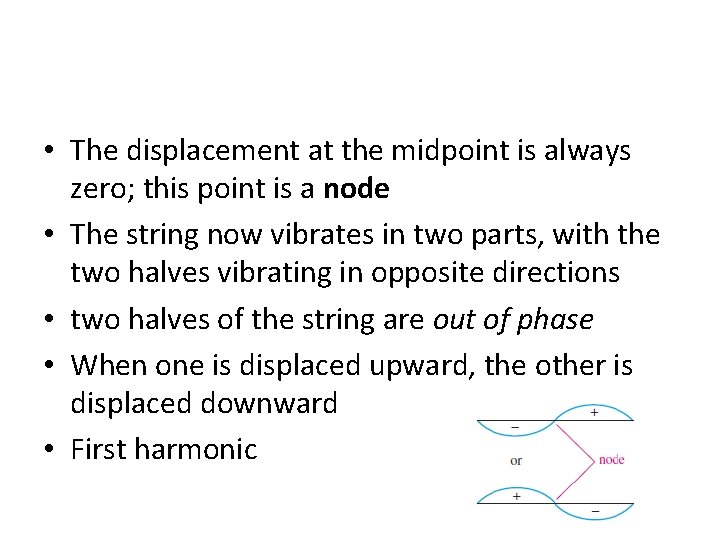
• The displacement at the midpoint is always zero; this point is a node • The string now vibrates in two parts, with the two halves vibrating in opposite directions • two halves of the string are out of phase • When one is displaced upward, the other is displaced downward • First harmonic
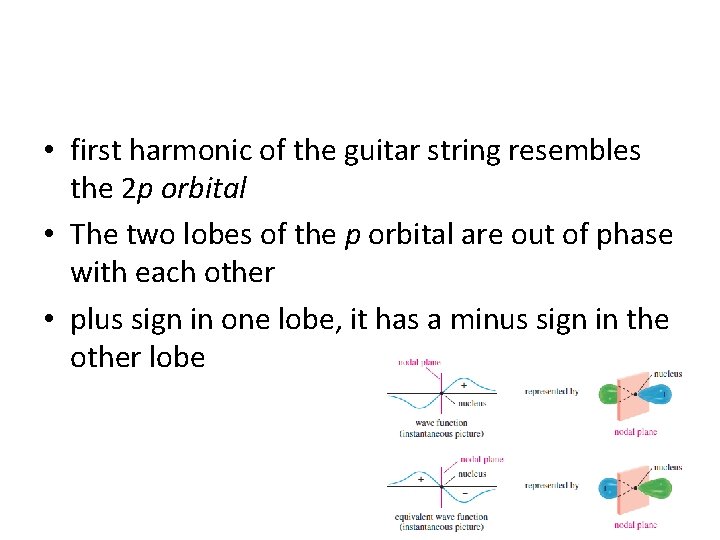
• first harmonic of the guitar string resembles the 2 p orbital • The two lobes of the p orbital are out of phase with each other • plus sign in one lobe, it has a minus sign in the other lobe
Linear Combination of Atomic Orbitals • Atomic orbitals can combine and overlap to give more complex standing waves • add and subtract their wave functions to give the wave functions of new orbitals • linear combination of atomic orbitals (LCAO) Ø When orbitals on different atoms interact, they produce molecular orbitalsthat lead to bonding (or antibonding) interactions Ø When orbitals on the same atom interact, they give hybrid atomic orbitals that define the geometry of the bonds
• The stability of a covalent bond results from a large amount of electron density in the bonding region, the space between the two nuclei • In the bonding region, the electrons are close to both nuclei, lowering the overall energy • bonding electrons - mask the positive charges of the nuclei • the nuclei do not repel each other as much as they would otherwise
• always an optimum distance for the two bonded nuclei • too far apart, their attraction for the bonding electrons is diminished • too close together, their electrostatic repulsion pushes them apart • bond length- internuclear distance where attraction and repulsion are balanced • also gives the minimum energy
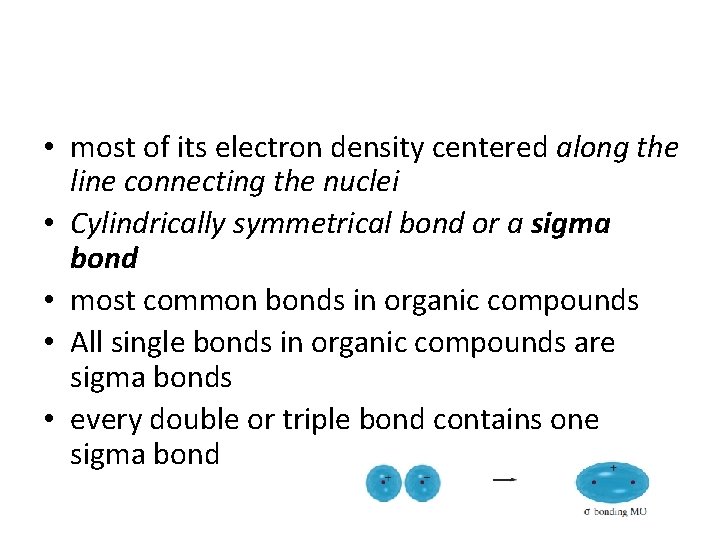
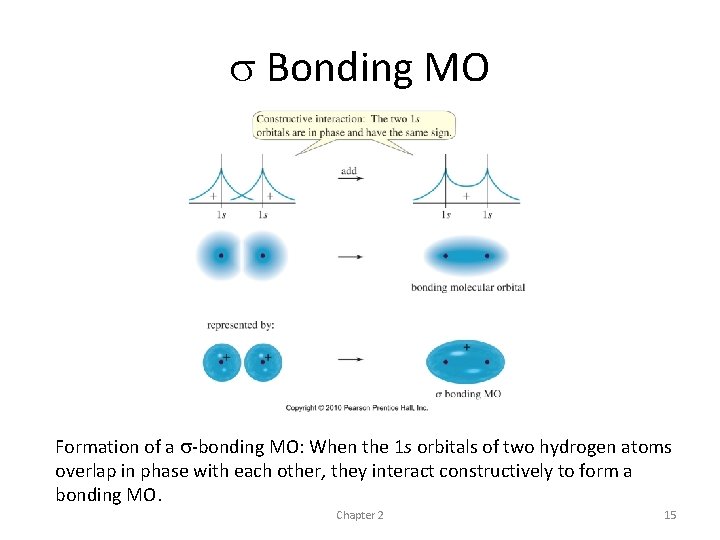
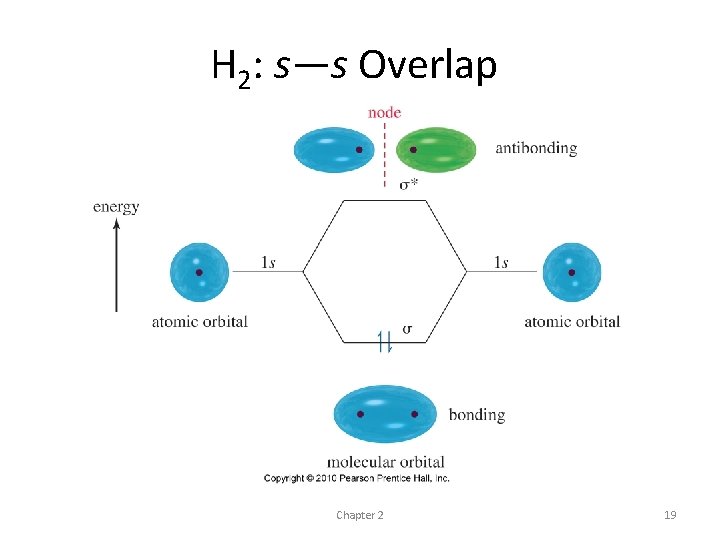
The hydrogen molecule • simplest example of covalent bonding • Atoms approaching - 1 s wave functions can add constructively so that they reinforce each other • destructively so that they cancel out where they overlap • The wave functions reinforce each other and increase the electron density in this bonding region - result is a bonding molecular orbital
• most of its electron density centered along the line connecting the nuclei • Cylindrically symmetrical bond or a sigma bond • most common bonds in organic compounds • All single bonds in organic compounds are sigma bonds • every double or triple bond contains one sigma bond
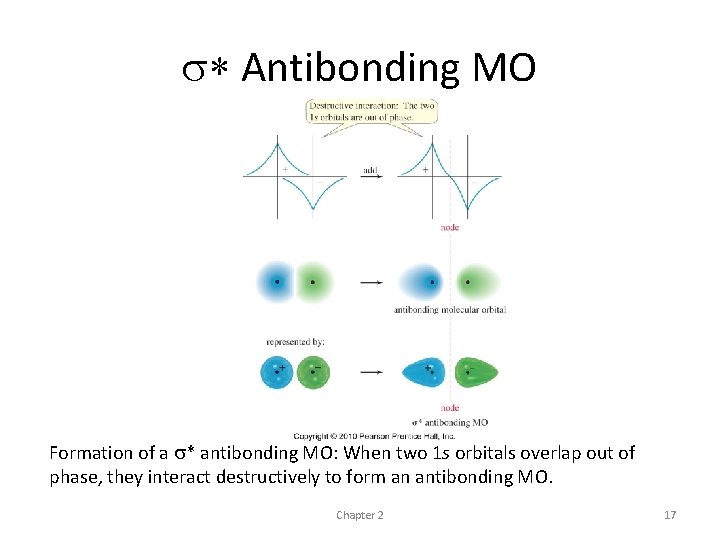
Sigma Bonding • Electron density lies between the nuclei. • A bond may be formed by s—s, p—p, s—p, or hybridized orbital overlaps. • The bonding molecular orbital (MO) is lower in energy than the original atomic orbitals. • The antibonding MO is higher in energy than the atomic orbitals • When two hydrogen 1 s orbitals overlap out of phase with each other, an antibonding molecular orbital results Chapter 2 14
s Bonding MO Formation of a s-bonding MO: When the 1 s orbitals of two hydrogen atoms overlap in phase with each other, they interact constructively to form a bonding MO. Chapter 2 15
• The two 1 s wave functions have opposite signs, so they tend to cancel out where they overlap • result is a node (actually a nodal plane) separating the two atoms • presence of a node - indicates that the orbital is antibonding σ*
s* Antibonding MO Formation of a s* antibonding MO: When two 1 s orbitals overlap out of phase, they interact destructively to form an antibonding MO. Chapter 2 17
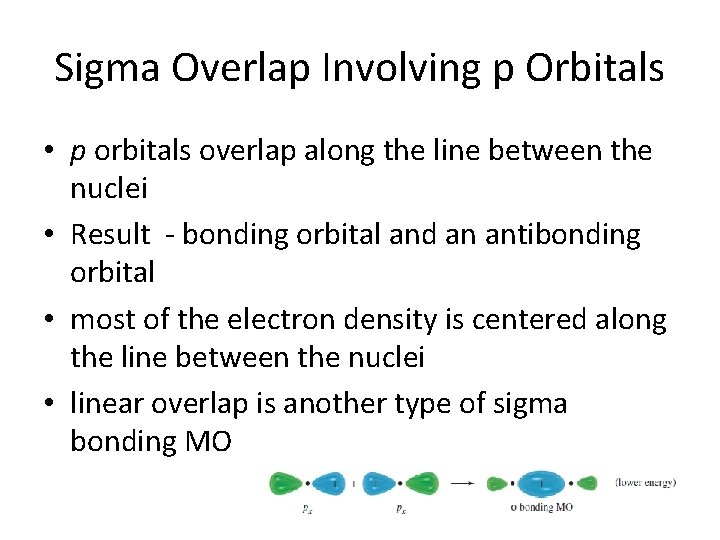
Sigma Overlap Involving p Orbitals • p orbitals overlap along the line between the nuclei • Result - bonding orbital and an antibonding orbital • most of the electron density is centered along the line between the nuclei • linear overlap is another type of sigma bonding MO
H 2: s—s Overlap Chapter 2 19
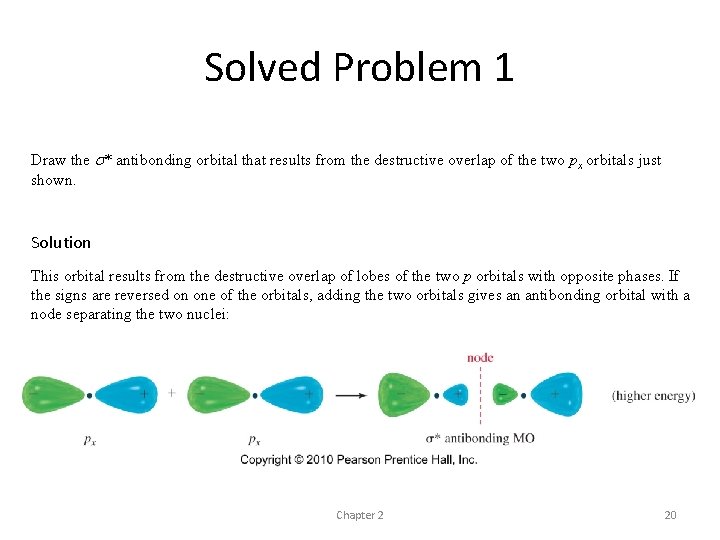
Solved Problem 1 Draw the s* antibonding orbital that results from the destructive overlap of the two px orbitals just shown. Solution This orbital results from the destructive overlap of lobes of the two p orbitals with opposite phases. If the signs are reversed on one of the orbitals, adding the two orbitals gives an antibonding orbital with a node separating the two nuclei: Chapter 2 20
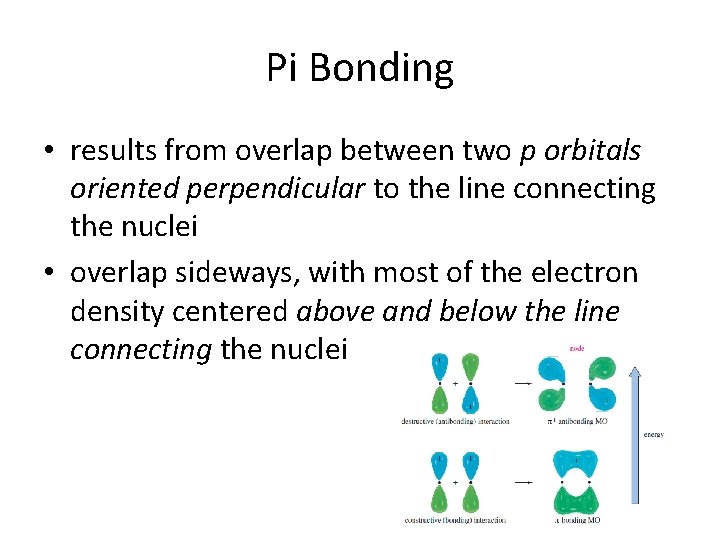
Pi Bonding • results from overlap between two p orbitals oriented perpendicular to the line connecting the nuclei • overlap sideways, with most of the electron density centered above and below the line connecting the nuclei
• overlap is parallel, not linear (compared to sigma) • pi molecular orbital is not cylindrically symmetrical
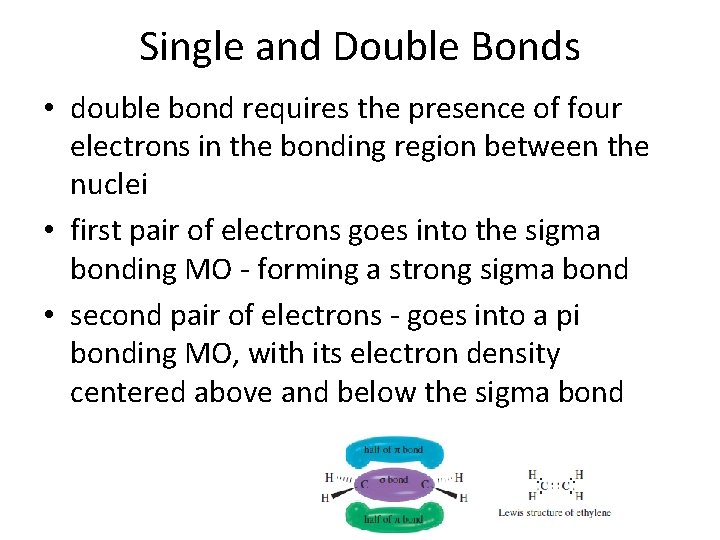
Single and Double Bonds • double bond requires the presence of four electrons in the bonding region between the nuclei • first pair of electrons goes into the sigma bonding MO - forming a strong sigma bond • second pair of electrons - goes into a pi bonding MO, with its electron density centered above and below the sigma bond
• combination of one sigma bond and one pi bond is the normal structure of a double bond • not as common as bonds formed using hybrid atomic orbitals • result from the mixing of orbitals on the same atom
Hybridization and Molecular Shapes • using just the simple s and p orbitals - expect bond angles of about 90° • s orbitals are nondirectional • p orbitals are oriented at 90° to one another • Experimental evidence - bond angles in organic compounds are usually close to 109°, 120°, or 180° • common way of accounting for these bond angles is the valence-shell electron-pair repulsion theory
• Electron pairs repel each other, and the bonds and lone pairs around a central atom generally are separated by the largest possible angles • 109. 5° - largest possible separation for four pairs of electrons • 120° - largest separation for three pairs • 180° - largest separation for two pairs
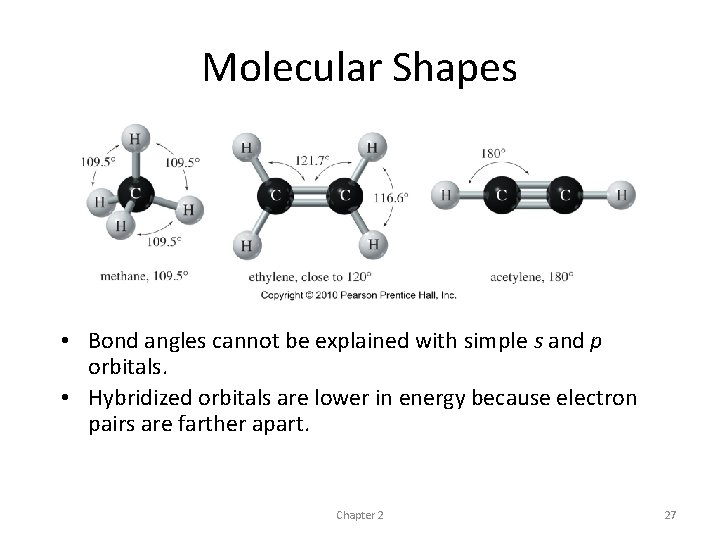
Molecular Shapes • Bond angles cannot be explained with simple s and p orbitals. • Hybridized orbitals are lower in energy because electron pairs are farther apart. Chapter 2 27
• shapes of these molecules cannot result from bonding between simple s and p atomic orbitals • s and p orbitals have the lowest energies for isolated atoms in space • To explain the shapes of common organic molecules - assume that the s and p orbitals combine to form hybrid atomic orbitals
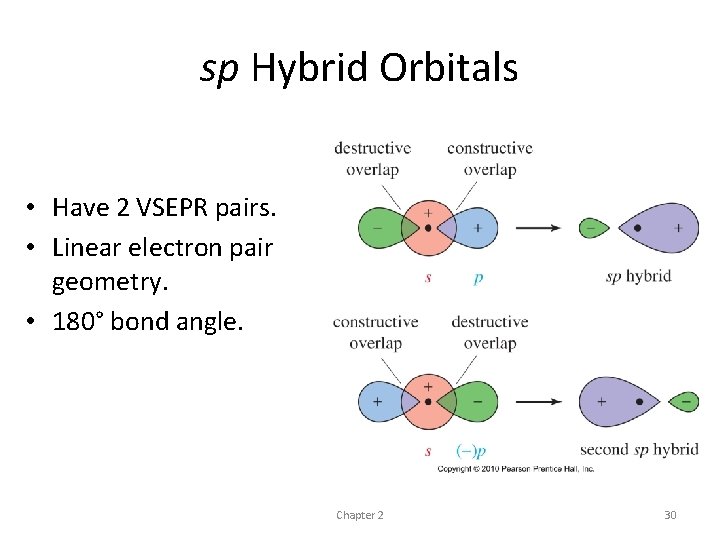
sp hybrid orbitals • We can also add and subtract orbitals on the same atom • combine a p orbital and an s orbital on the same atom • sp hybrid orbital • electron density is concentrated toward one side of the atom • result of this hybridization is a pair of directional sp hybrid orbitals pointed in opposite directions
sp Hybrid Orbitals • Have 2 VSEPR pairs. • Linear electron pair geometry. • 180° bond angle. Chapter 2 30
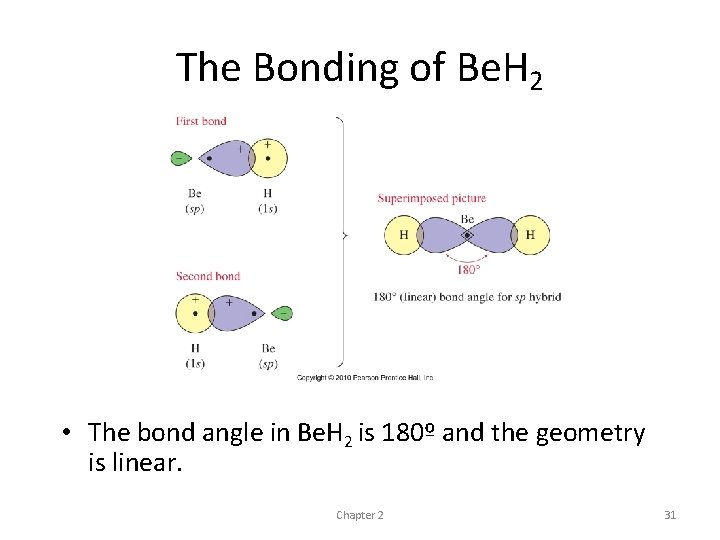
The Bonding of Be. H 2 • The bond angle in Be. H 2 is 180º and the geometry is linear. Chapter 2 31
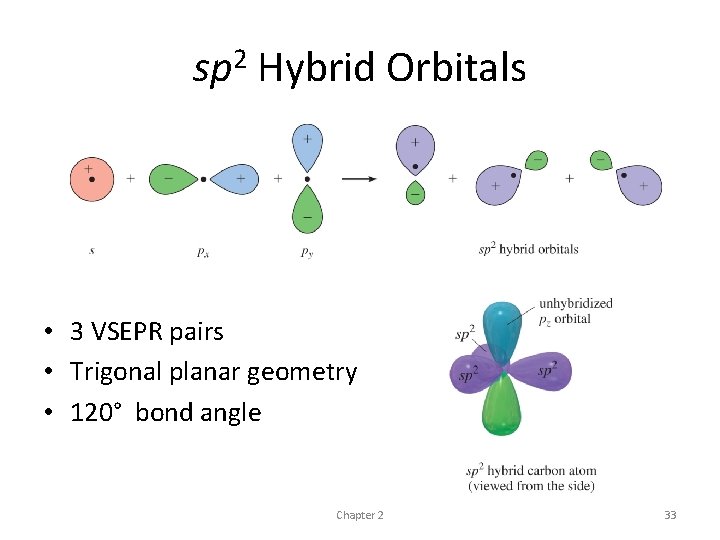
sp 2 Hybrid Orbitals • To orient three bonds as far apart as possible, bond angles of 120° are required • s orbital combines with two p orbitals • resulting three hybrid orbitals are oriented at 120° angles to each other • Called sp 2 hybrid orbitals • composed of one s and two p orbitals • 120° arrangement - trigonal geometry
sp 2 Hybrid Orbitals • 3 VSEPR pairs • Trigonal planar geometry • 120° bond angle Chapter 2 33
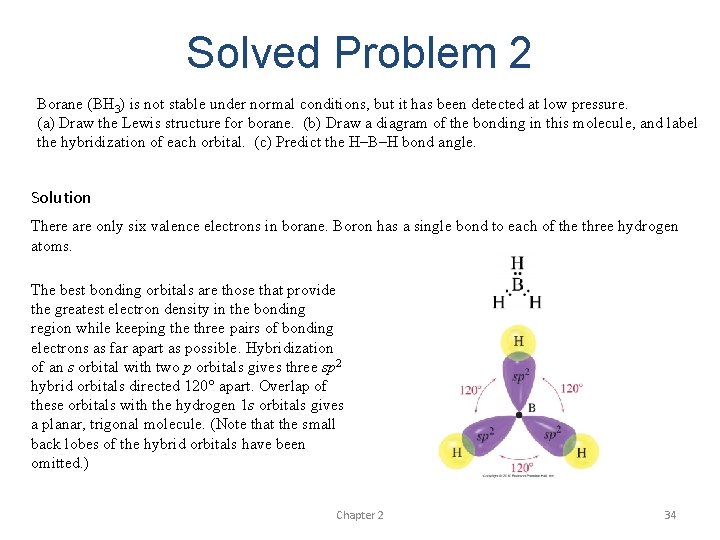
Solved Problem 2 Borane (BH 3) is not stable under normal conditions, but it has been detected at low pressure. (a) Draw the Lewis structure for borane. (b) Draw a diagram of the bonding in this molecule, and label the hybridization of each orbital. (c) Predict the H–B–H bond angle. Solution There are only six valence electrons in borane. Boron has a single bond to each of the three hydrogen atoms. The best bonding orbitals are those that provide the greatest electron density in the bonding region while keeping the three pairs of bonding electrons as far apart as possible. Hybridization of an s orbital with two p orbitals gives three sp 2 hybrid orbitals directed 120° apart. Overlap of these orbitals with the hydrogen 1 s orbitals gives a planar, trigonal molecule. (Note that the small back lobes of the hybrid orbitals have been omitted. ) Chapter 2 34
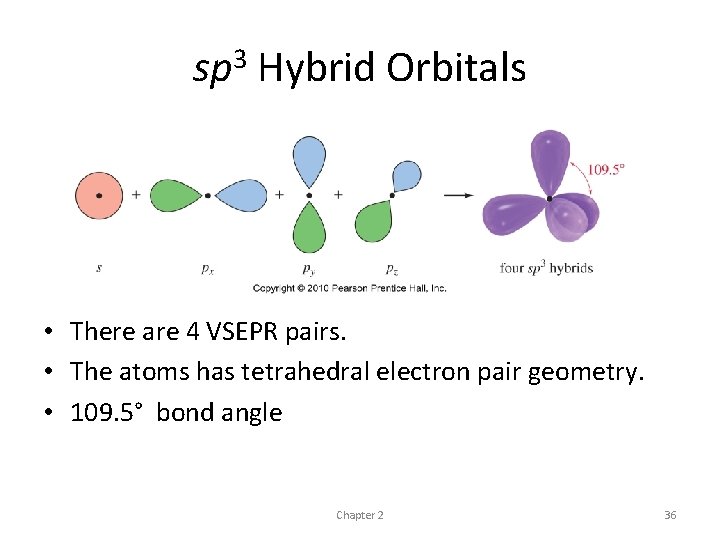
sp 3 Hybrid Orbitals • organic compounds contain carbon atoms that are bonded to four other atoms • four bonds are oriented as far apart as possible, they form a regular tetrahedron • 109. 5° bond angles • combining the s orbital with all three p orbitals • resulting four orbitals – sp 3 hybrid orbitals
sp 3 Hybrid Orbitals • There are 4 VSEPR pairs. • The atoms has tetrahedral electron pair geometry. • 109. 5° bond angle Chapter 2 36
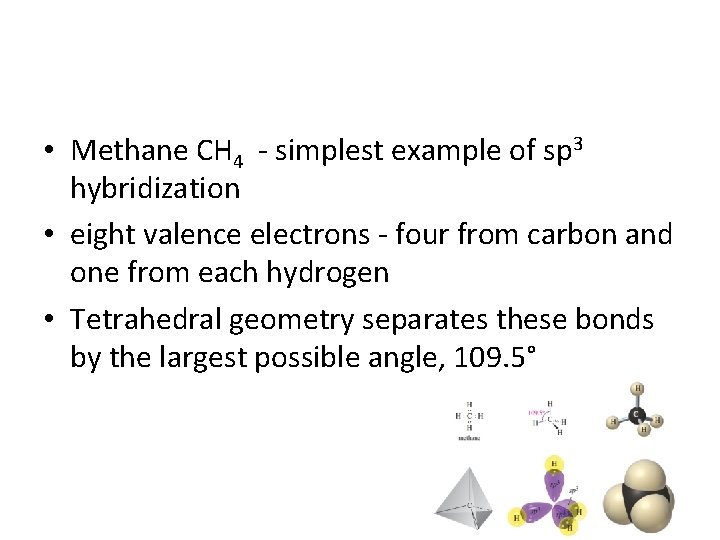
• Methane CH 4 - simplest example of sp 3 hybridization • eight valence electrons - four from carbon and one from each hydrogen • Tetrahedral geometry separates these bonds by the largest possible angle, 109. 5°
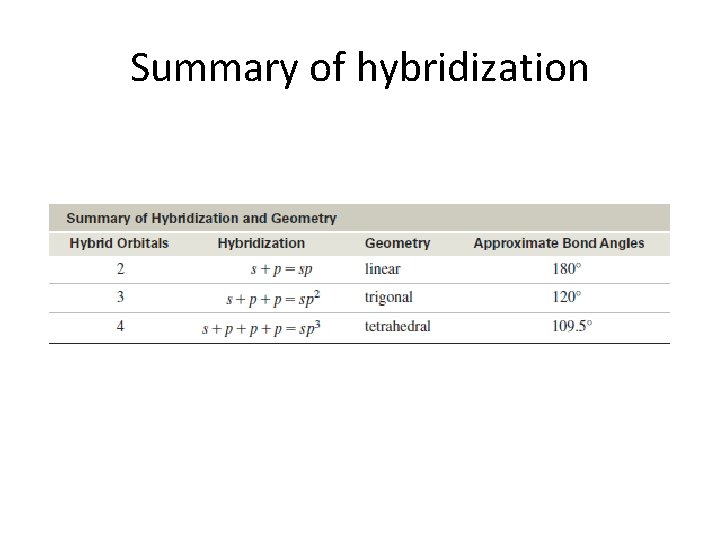
Summary of hybridization
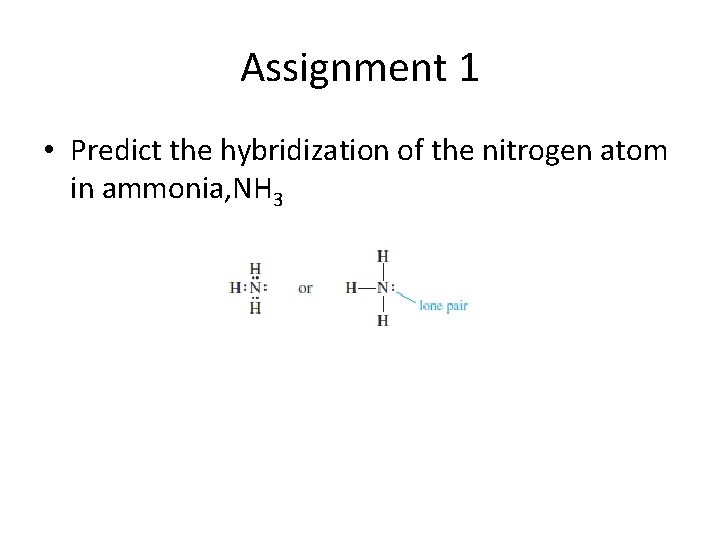
Assignment 1 • Predict the hybridization of the nitrogen atom in ammonia, NH 3
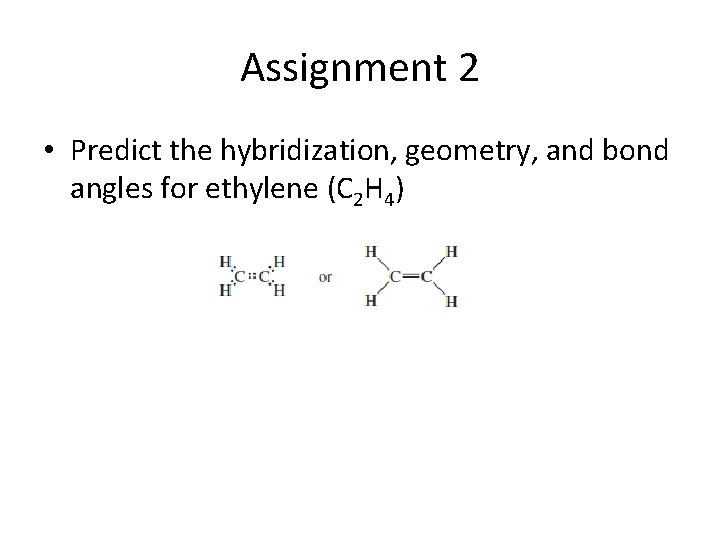
Assignment 2 • Predict the hybridization, geometry, and bond angles for ethylene (C 2 H 4)
Bond rotation • Some bonds rotate easily, but others do not • bond rotates easily - each molecule can rotate through the different angular arrangements of atoms • bond cannot rotate - different angular arrangements may be distinct compounds (isomers) with different properties
Rotation of Single Bonds • Example: ethane (CH 3 -CH 3) • both carbon atoms are sp 3 hybridized and tetrahedral • draw many structures for ethane - differing only in how one methyl group is twisted in relation to the other one • Structures differing only in rotations about a single bond are called conformations
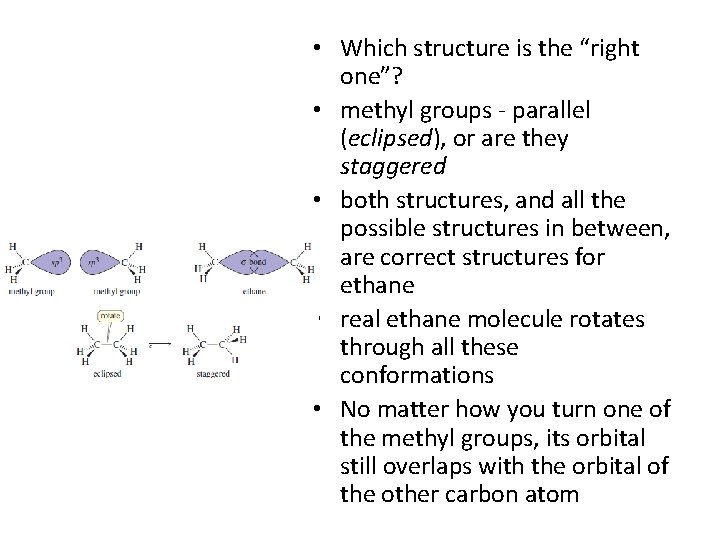
• Which structure is the “right one”? • methyl groups - parallel (eclipsed), or are they staggered • both structures, and all the possible structures in between, are correct structures for ethane • real ethane molecule rotates through all these conformations • No matter how you turn one of the methyl groups, its orbital still overlaps with the orbital of the other carbon atom
Rigidity of Double Bonds • Not all bonds allow free rotation • Example: ethylene is rigid • double bond between the two CH 2 groups consists of a sigma bond a pi bond • twist one of the two CH 2 groups - sigma bond is unaffected but the pi bond loses its overlap • two p orbitals cannot overlap when the two ends of the molecule are at right angles, and the pi bond is effectively broken in this geometry
• Generallization: Ø Rotation about single bonds is allowed, but double bonds are rigid and cannot be twisted • double bonds are rigid, we can separate and isolate compounds that differ only in how their substituents are arranged on a double bond
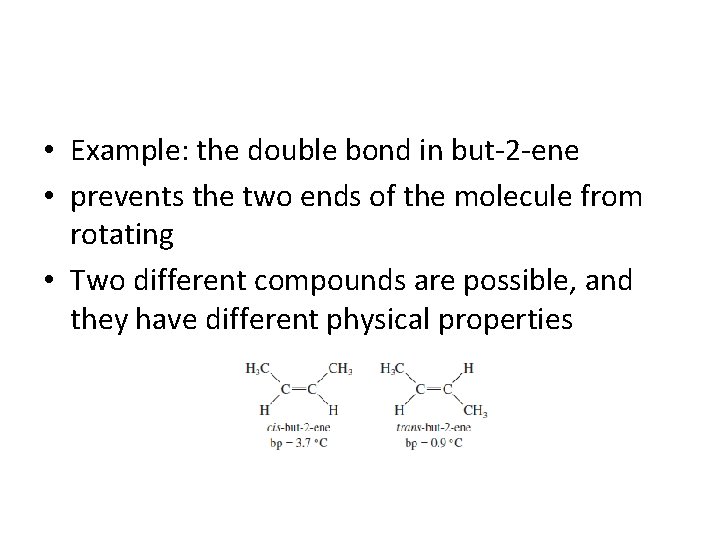
• Example: the double bond in but-2 -ene • prevents the two ends of the molecule from rotating • Two different compounds are possible, and they have different physical properties
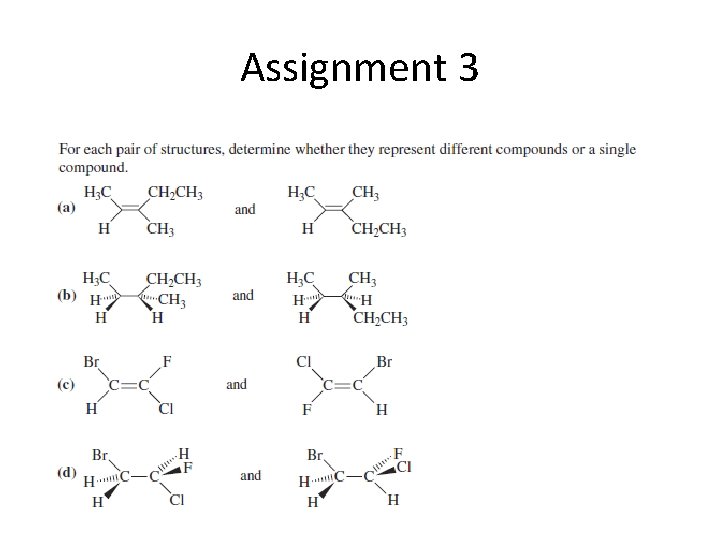
Assignment 3
Summary • • Sigma and pi bonds Molecular shapes Hybridization Rotation of bonds Chapter 1 48
• QUIZ 1 12. 03. 2019 • Chapters 1 and 2 • Pay attention to sp hybridization, formal charge calculation and electron configuration