
Organelles This is the membrane surrounding all animal
Organelles
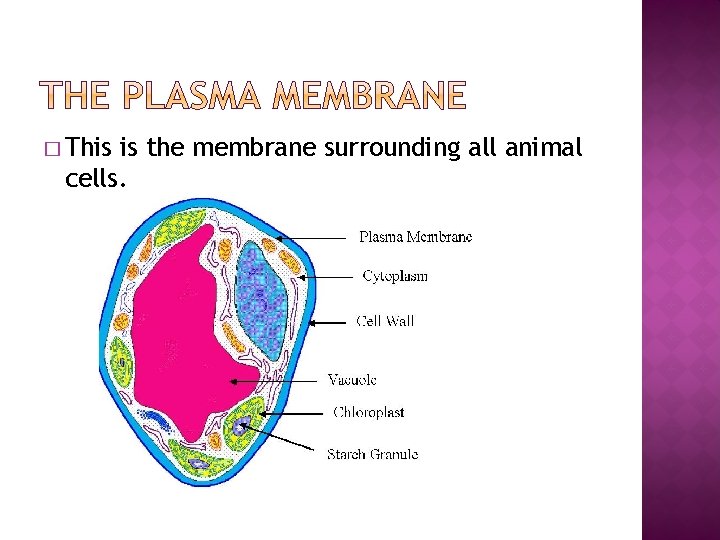
� This is the membrane surrounding all animal cells.
� This is the membrane surrounding the cell. � Fluid inside the cell is very different from fluid outside the cell, so must be kept separate.
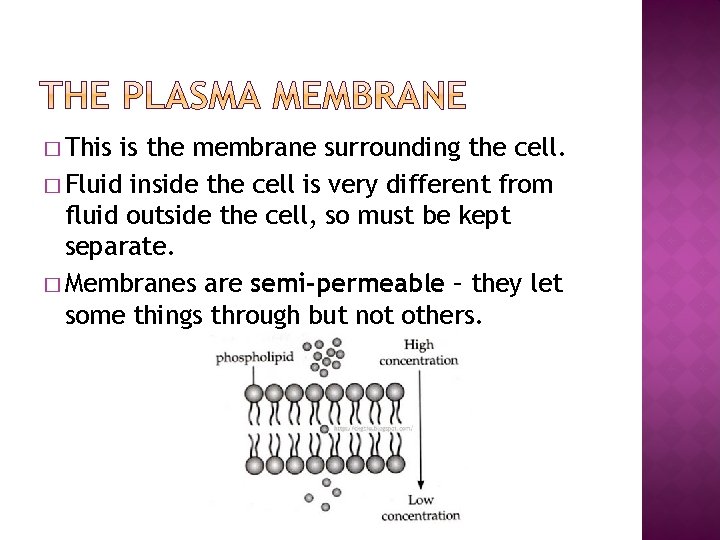
� This is the membrane surrounding the cell. � Fluid inside the cell is very different from fluid outside the cell, so must be kept separate. � Membranes are semi-permeable – they let some things through but not others.
� This is the membrane surrounding the cell. � Fluid inside the cell is very different from fluid outside the cell, so must be kept separate. � Membranes are semi-permeable – they let some things through but not others. - small molecules like O 2 and CO 2 can pass freely through ____ - larger molecules such as starch have to be actively transported across the membrane.
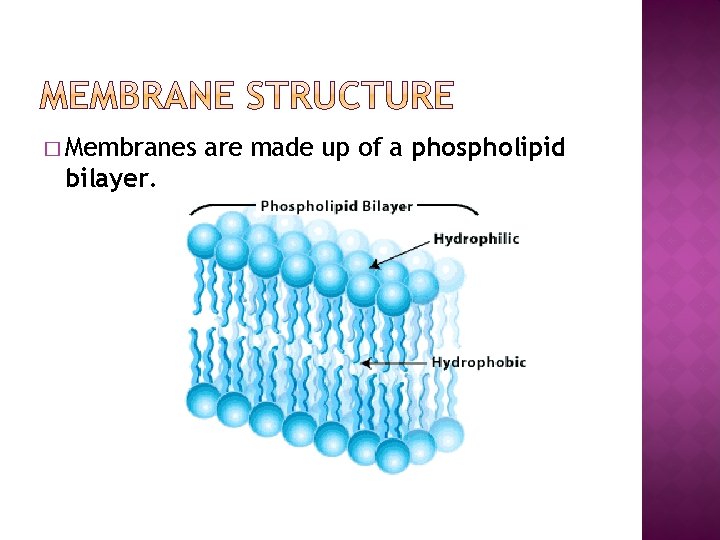
� Membranes bilayer. are made up of a phospholipid
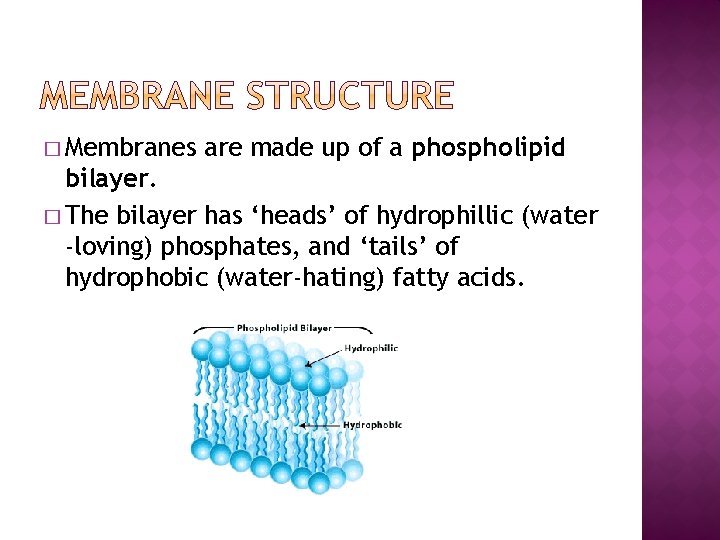
� Membranes are made up of a phospholipid bilayer. � The bilayer has ‘heads’ of hydrophillic (water -loving) phosphates, and ‘tails’ of hydrophobic (water-hating) fatty acids.
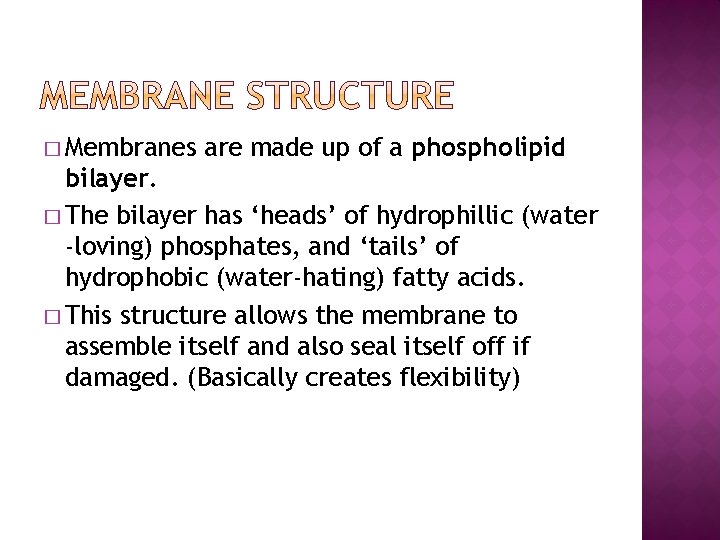
� Membranes are made up of a phospholipid bilayer. � The bilayer has ‘heads’ of hydrophillic (water -loving) phosphates, and ‘tails’ of hydrophobic (water-hating) fatty acids. � This structure allows the membrane to assemble itself and also seal itself off if damaged. (Basically creates flexibility)
� Membranes are made up of a phospholipid bilayer. � The bilayer has ‘heads’ of hydrophillic (water -loving) phosphates, and ‘tails’ of hydrophobic (water-hating) fatty acids. � This structure allows the membrane to assemble itself and also seal itself off if damaged. (Basically creates flexibility) � The surface of the membrane contains proteins which ‘communicate’ with the cell’s surroundings and the cell can respond accordingly.
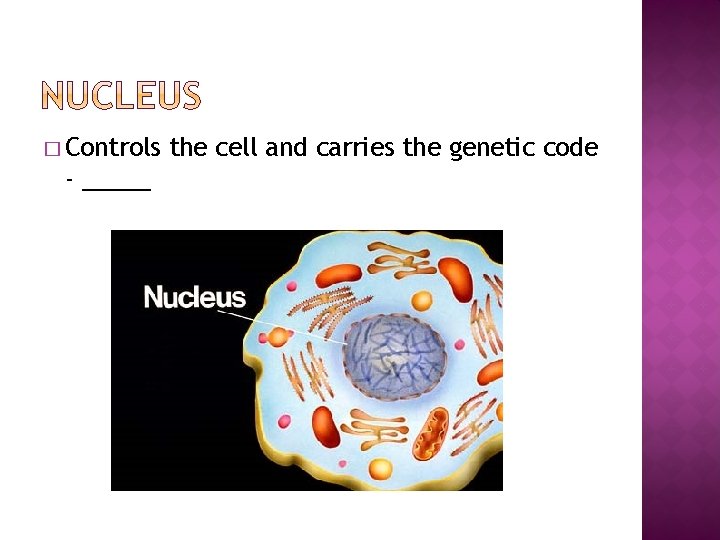
� Controls - _____ the cell and carries the genetic code
� Controls the cell and carries the genetic code – DNA � DNA is scattered throughout the nucleus as chromatin – these only form visible structures called chromosomes just before the cell is about to divide.
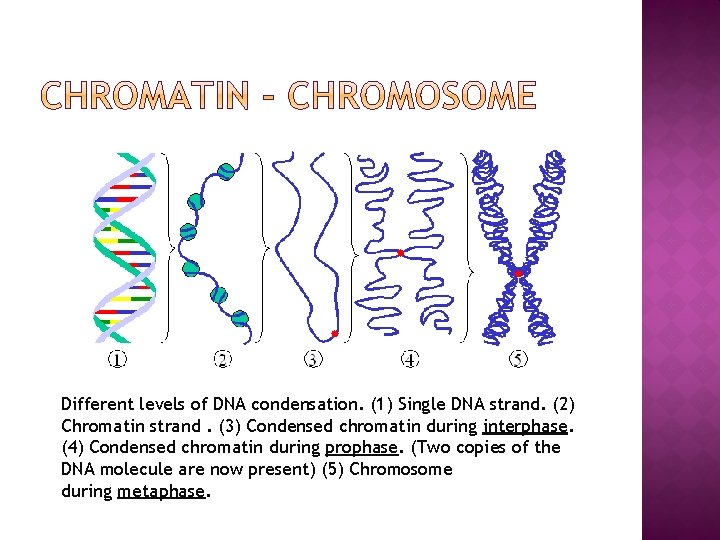
Different levels of DNA condensation. (1) Single DNA strand. (2) Chromatin strand. (3) Condensed chromatin during interphase. (4) Condensed chromatin during prophase. (Two copies of the DNA molecule are now present) (5) Chromosome during metaphase.
� Where cell. most chemical reactions occur in the
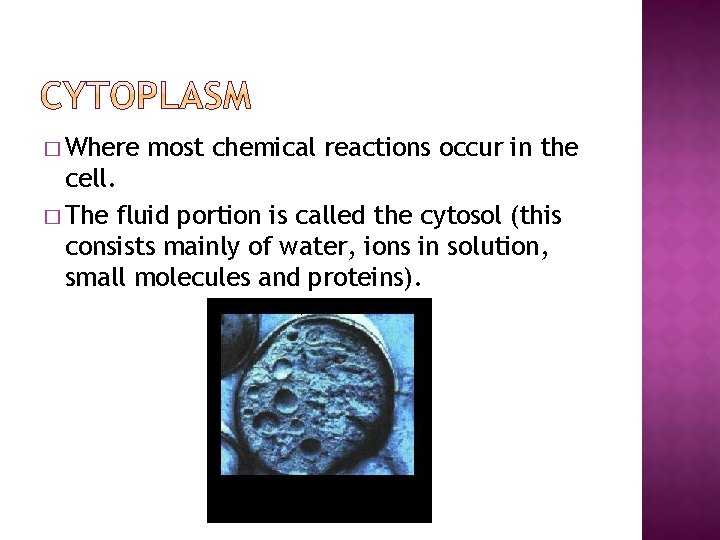
� Where most chemical reactions occur in the cell. � The fluid portion is called the cytosol (this consists mainly of water, ions in solution, small molecules and proteins).
� Where most chemical reactions occur in the cell. � The fluid portion is called the cytosol (this consists mainly of water, ions in solution, small molecules and proteins). � The rest of the cytoplasm has organelles in it and other cell structures.
� Endoplasmic – ‘within the cytoplasm’
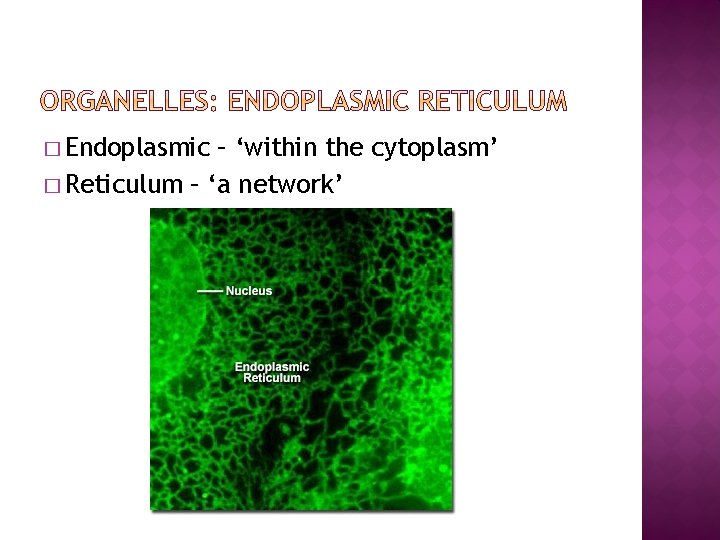
� Endoplasmic – ‘within the cytoplasm’ � Reticulum – ‘a network’
� Endoplasmic – ‘within the cytoplasm’ � Reticulum – ‘a network’ � Takes up most of the space in the cytoplasm.
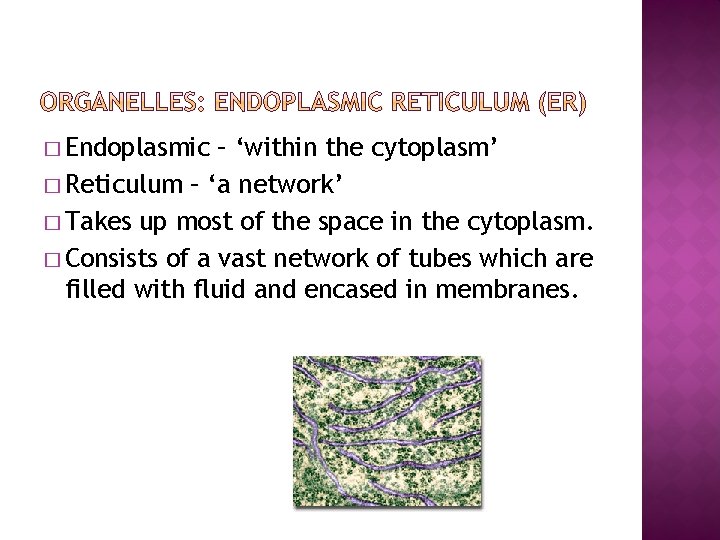
� Endoplasmic – ‘within the cytoplasm’ � Reticulum – ‘a network’ � Takes up most of the space in the cytoplasm. � Consists of a vast network of tubes which are filled with fluid and encased in membranes.
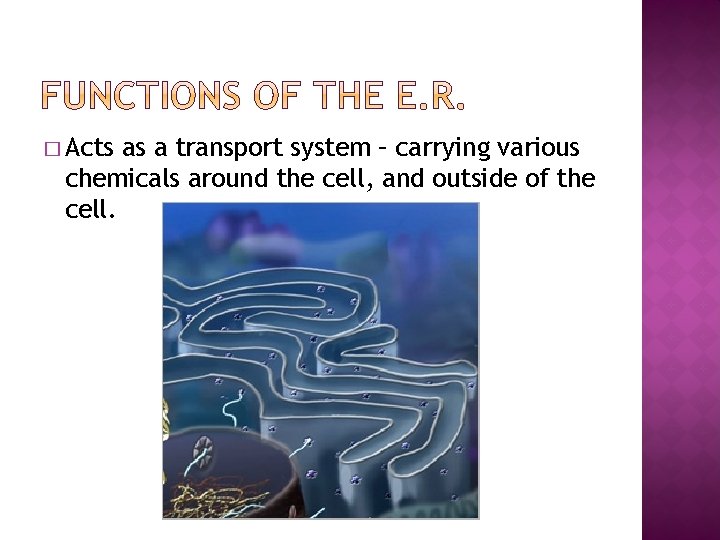
� Acts as a transport system – carrying various chemicals around the cell, and outside of the cell.
� Acts as a transport system – carrying various chemicals around the cell, and outside of the cell. � The E. R. Membranes can act as a surface where some biochemical reactions take place.
� Acts as a transport system – carrying various chemicals around the cell, and outside of the cell. � The E. R. Membranes can act as a surface where some biochemical reactions take place. - These include the synthesis of lipids, proteins, and carbs.
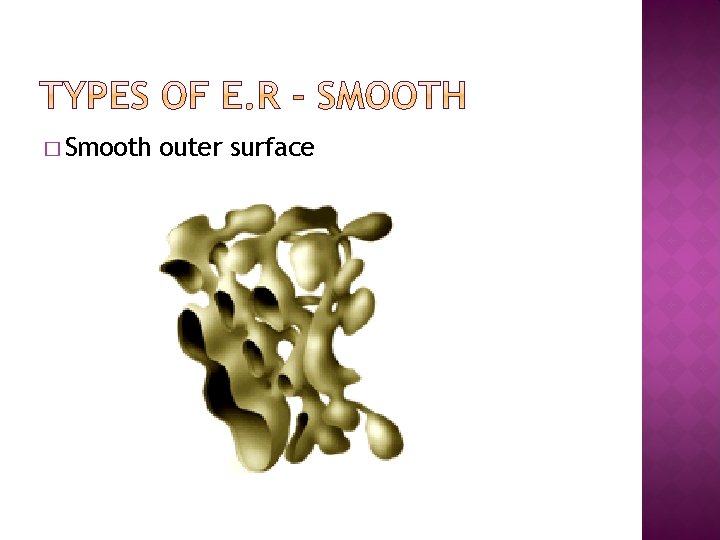
� Smooth outer surface
� Smooth outer surface. � Produces steroids.
� Smooth outer surface. � Produces steroids. � Helps with calcium storage in muscle cells and affects muscle contraction.
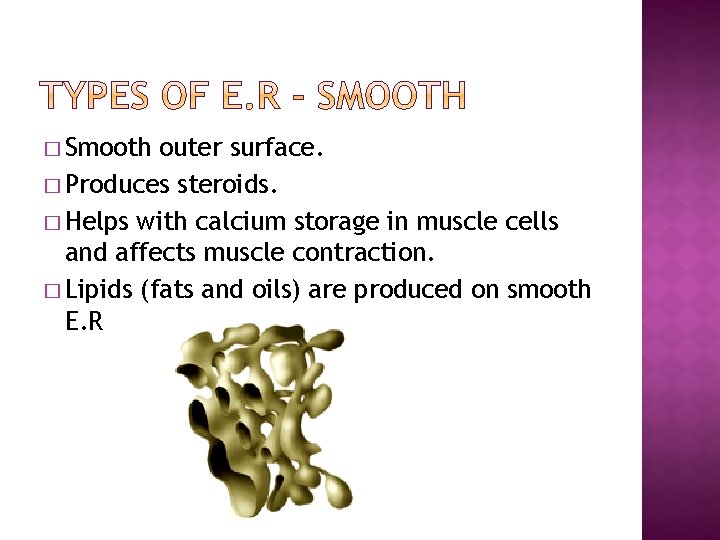
� Smooth outer surface. � Produces steroids. � Helps with calcium storage in muscle cells and affects muscle contraction. � Lipids (fats and oils) are produced on smooth E. R
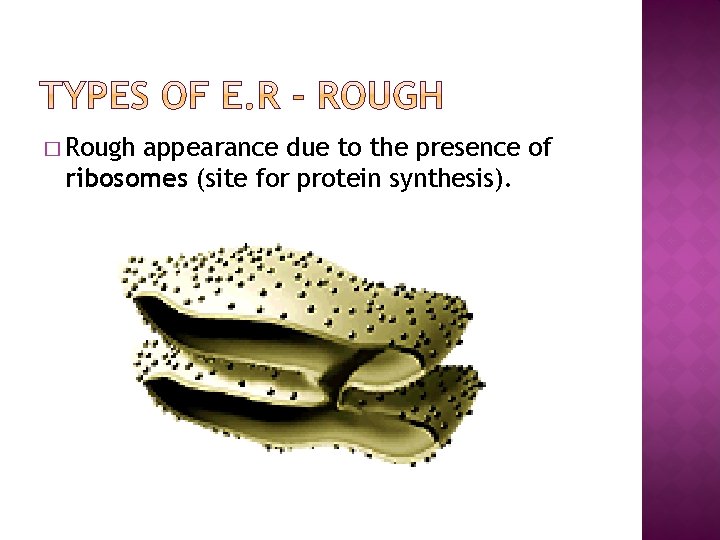
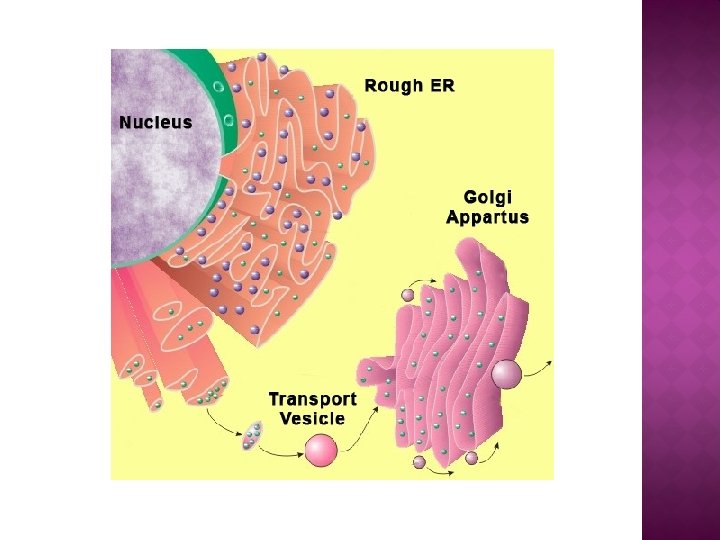
� Rough appearance due to the presence of ribosomes (site for protein synthesis).
� Rough appearance due to the presence of ribosomes (site for protein synthesis). � Makes secretory proteins which are kept apart from other proteins.
� Rough appearance due to the presence of ribosomes (site for protein synthesis). � Makes secretory proteins which are kept apart from other proteins. � These leave the ER membrane as ‘transport vesicles’ and carry secretory proteins to other parts of the cell.
� Most animal cells only have one golgi apparatus.
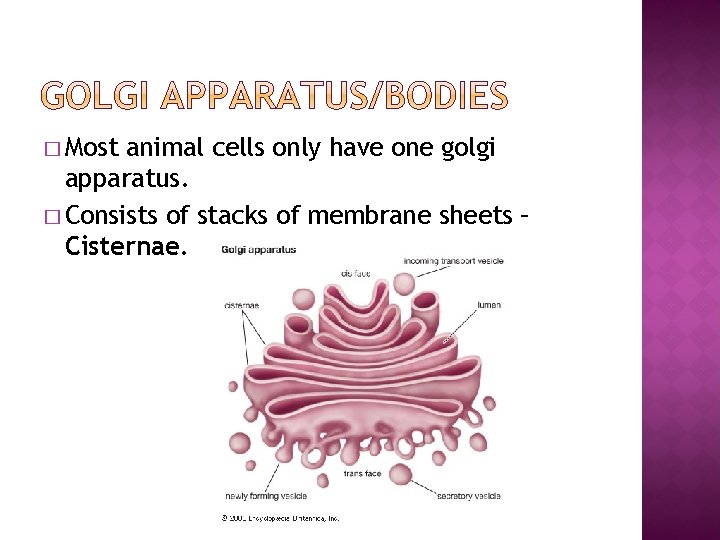
� Most animal cells only have one golgi apparatus. � Consists of stacks of membrane sheets – Cisternae.
� Most animal cells only have one golgi apparatus. � Consists of stacks of membrane sheets – Cisternae. � The G. A recieves the transport vesicles from the E. R and fuse onto the cis side of the G. A. Then, the contents are released into the G. A.
� Most animal cells only have one golgi apparatus. � Consists of stacks of membrane sheets – Cisternae. � The G. A receives the transport vesicles from the E. R and fuse onto the cis side of the G. A. Then, the contents are released into the G. A. � After passing through, these molecules are modified and completed and then ‘pinched off’ from the other side of the G. A.
� Most animal cells only have one golgi apparatus. � Consists of stacks of membrane sheets – Cisternae. � The G. A receives the transport vesicles from the E. R and fuse onto the cis side of the G. A. Then, the contents are released into the G. A. � After passing through, these molecules are modified and completed and then ‘pinched off’ from the other side of the G. A. � This is how cells secrete molecules such as enzymes and hormones.
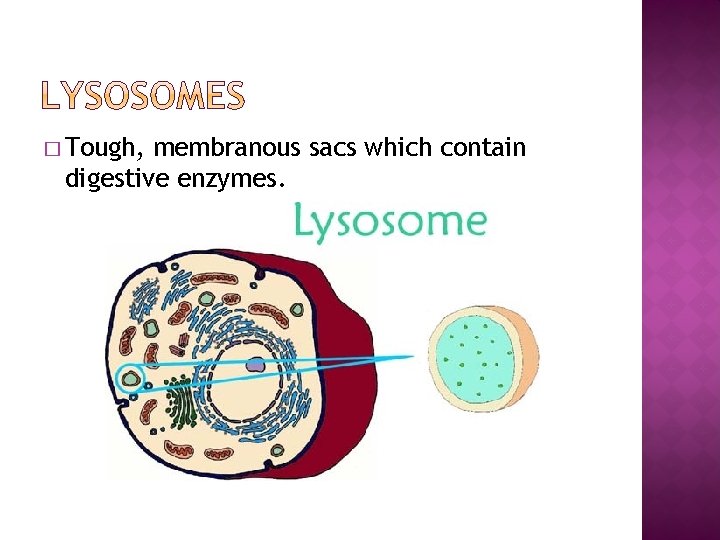
� Tough, membranous sacs which contain digestive enzymes.
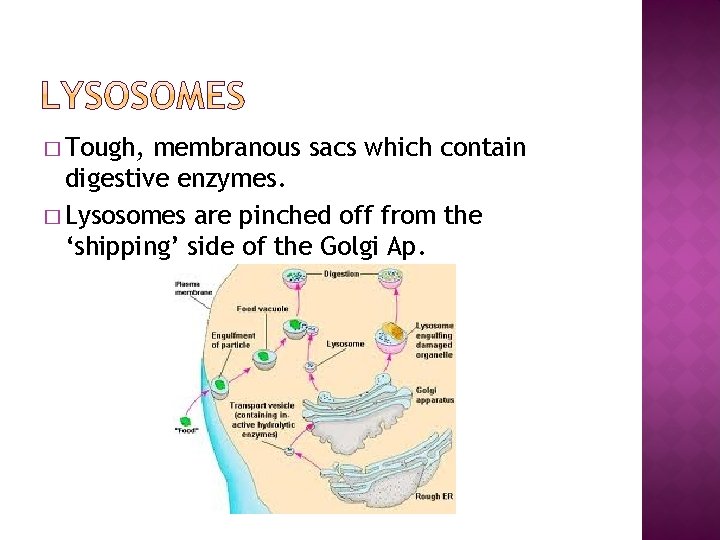
� Tough, membranous sacs which contain digestive enzymes. � Lysosomes are pinched off from the ‘shipping’ side of the Golgi Ap.
� Tough, membranous sacs which contain digestive enzymes. � Lysosomes are pinched off from the ‘shipping’ side of the Golgi Ap. � They contain enzymes which are discharged into food vacuoles in order to digest the food.
� Tough, membranous sacs which contain digestive enzymes. � Lysosomes are pinched off from the ‘shipping’ side of the Golgi Ap. � They contain enzymes which are discharged into food vacuoles in order to digest the food. � Help to renew the cell – by breaking down old worn-out mitochondria and other cells.
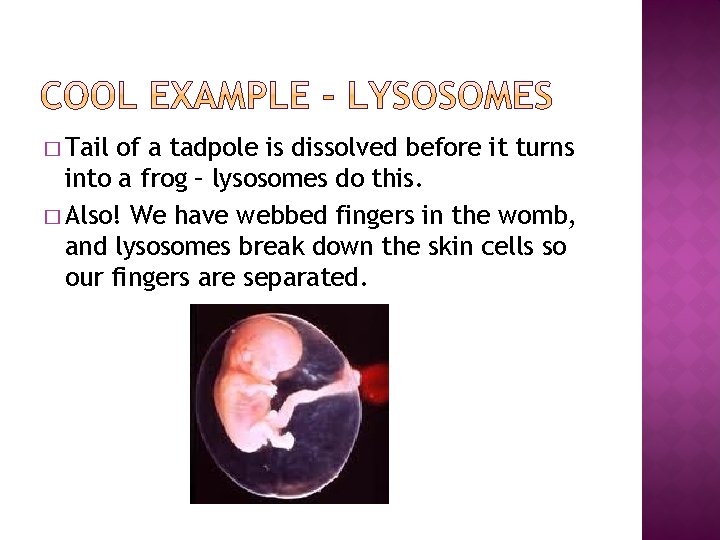
� Tail of a tadpole is dissolved before it turns into a frog – lysosomes do this. � Also! We have webbed fingers in the womb, and lysosomes break down the skin cells so our fingers are separated.
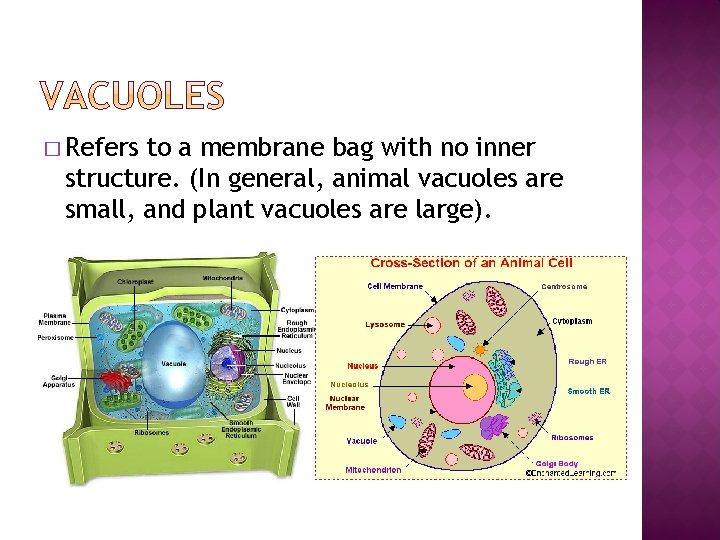
� Refers to a membrane bag with no inner structure. (In general, animal vacuoles are small, and plant vacuoles are large).
� Refers to a membrane bag with no inner structure. (In general, animal vacuoles are small, and plant vacuoles are large). � Animal cells – Food is engulfed by vacuoles and then digested by lysosomes.
� Refers to a membrane bag with no inner structure. (In general, animal vacuoles are small, and plant vacuoles are large). � Animal cells – Food is engulfed by vacuoles and then digested by ______. � Plant cells – Vacuoles take up most of the space and provide a place to store organic compounds.
� Refers to a membrane bag with no inner structure. (In general, animal vacuoles are small, and plant vacuoles are large). � Animal cells – Food is engulfed by vacuoles and then digested by ______. � Plant cells – Vacuoles take up most of the space and provide a place to store organic compounds. Some store pigments that colour petals, or store poison as defence.
� Refers to a membrane bag with no inner structure. (In general, animal vacuoles are small, and plant vacuoles are large). � Animal cells – Food is engulfed by vacuoles and then digested by ______. � Plant cells – Vacuoles take up most of the space and provide a place to store organic compounds. Some store pigments that colour petals, or store poison as defence. Vacuoles in plants play an important role in keeping the cells in a turgid (swollen) state.
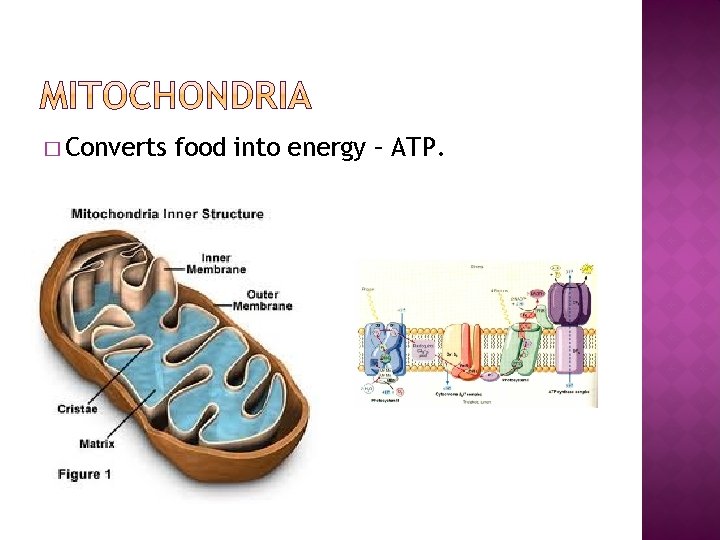
� Converts food into energy – ATP.
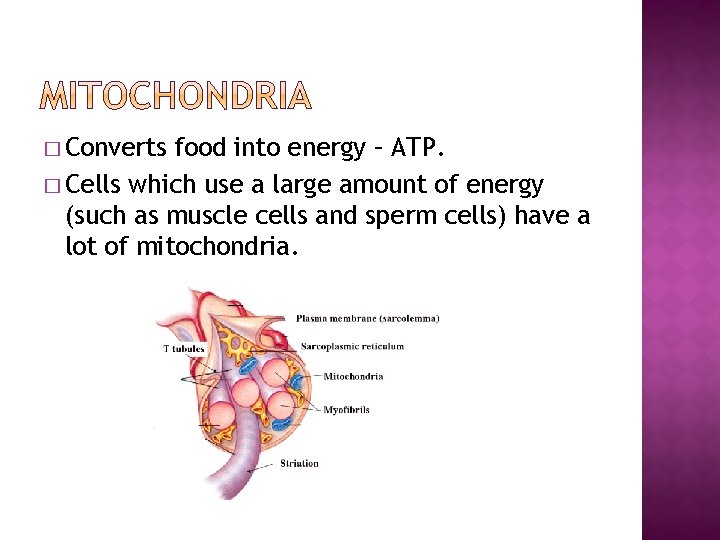
� Converts food into energy – ATP. � Cells which use a large amount of energy (such as muscle cells and sperm cells) have a lot of mitochondria.
� Converts food into energy – ATP. � Cells which use a large amount of energy (such as muscle cells and sperm cells) have a lot of mitochondria. � Place where aerobic cell respiration occurs – breaking down glucose/fats to produce CO 2, H 20 and energy (ATP)
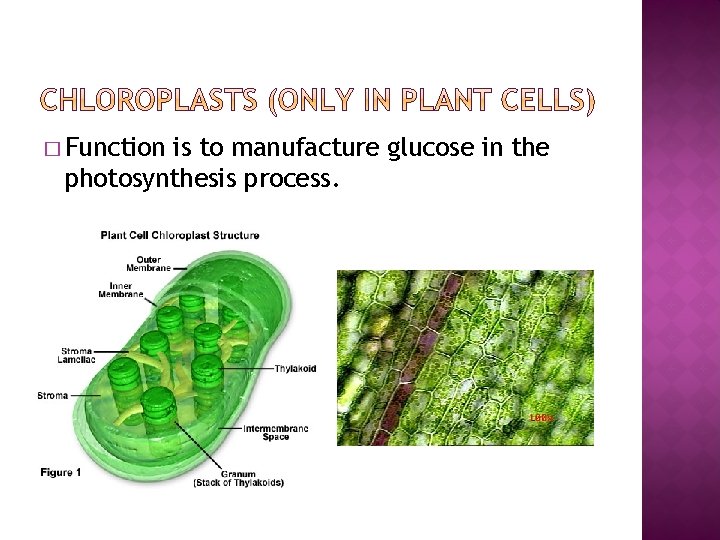
� Function is to manufacture glucose in the photosynthesis process.
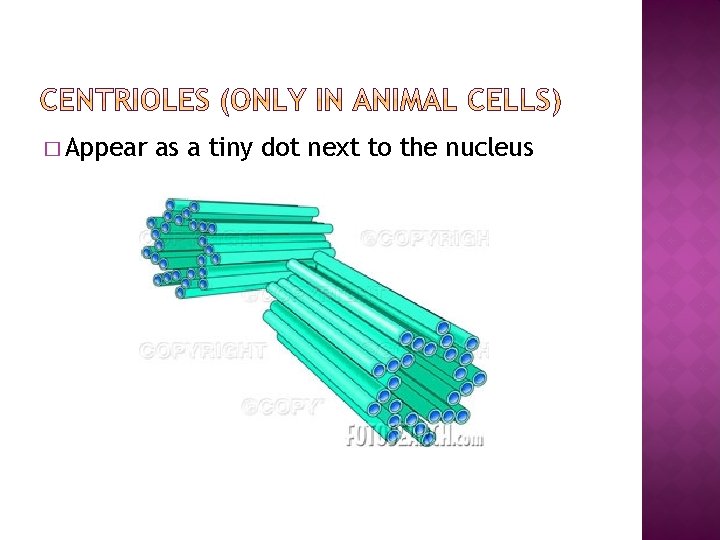
� Appear as a tiny dot next to the nucleus
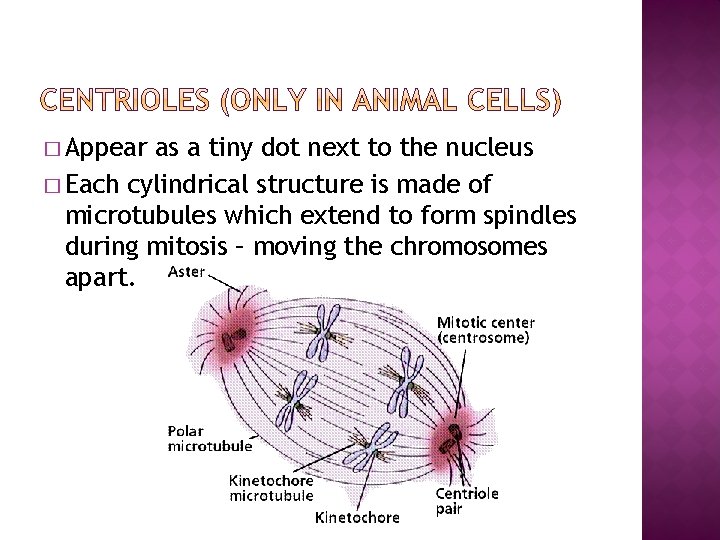
� Appear as a tiny dot next to the nucleus � Each cylindrical structure is made of microtubules which extend to form spindles during mitosis – moving the chromosomes apart.
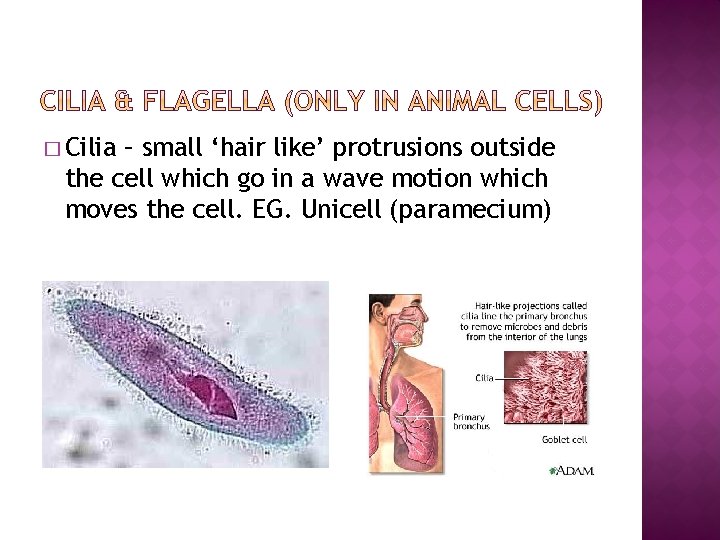
� Cilia – small ‘hair like’ protrusions outside the cell which go in a wave motion which moves the cell. EG. Unicell (paramecium)
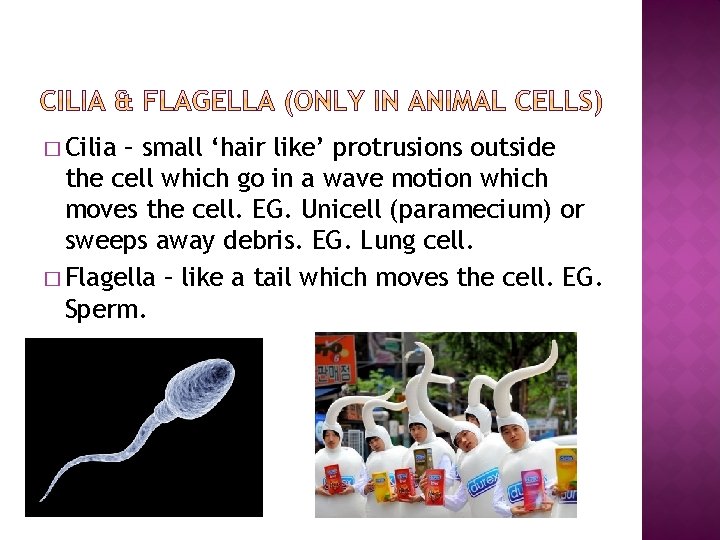
� Cilia – small ‘hair like’ protrusions outside the cell which go in a wave motion which moves the cell. EG. Unicell (paramecium) or sweeps away debris. EG. Lung cell. � Flagella – like a tail which moves the cell. EG. Sperm.

� http: //www. youtube. com/watch? v=LP 7 x. Ar 2 F DFU � https: //www. youtube. com/watch? v=Zy. WYID 2 c. TK 0
- Slides: 54