
Organa sensoria 1 Oculus 2 Auris 3 Cutis


- Slides: 11
Organa sensoria 1. Oculus. 2. Auris. 3. Cutis M. Petrova
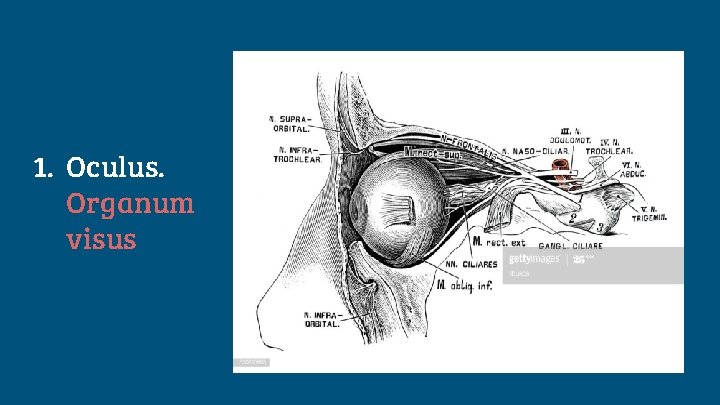
1. Oculus. Organum visus
Oculus. Anatomical terms. 1. Coats of the eye 1. 2. 3. bulbus oculi - the globe of the eye; eyeball tunica fibrosa bulbi - fibrous (outer) coat a. tunica sclera = sclera, ae, f * gr. scleros - hard sclera; the white of the eye b. cornea, ae, f - cornea; front part covering iris, pupil tunica vasculosa bulbi - vascular (middle) tunic= uvea, ae, f * lat. uva - grape; because it has grape-like appearance when stripped intact from a cadaveric eye a. iris, idis, f - iris * Iris - from the Greek goddess of the rainbow, because of the many colours of the iris b. pupilla, ae, f - pupil; from Latin pupilla, originally "little girl-doll, " diminutive of pupa "girl; doll" , so called from the tiny image one sees of oneself reflected in the eye of another 4. c. corpus ciliare - ciliary body d. choroidea, ae, f - choroid; vascular layer tunica interna bulbi - inner coat = retina, ae, f *lat. rete - net, literally "net-like tunic” a. b. c. macula lutea - macula; literally “yellow spot” discus (papilla) nervi optici - optic disc punctum caecum - blind spot
Oculus = gr. -OPHTHALM- Term-elements 1. Eye coats 1. bulbus oculi 2. tunica fibrosa bulbi a. tunica sclera = sclera, ae, f b. cornea, ae, f 3. tunica vasculosa bulbi = uvea, ae, f a. iris, idis, f b. pupilla, ae, f c. corpus ciliare d. chorioidea, ae, f 4. tunica interna bulbi = retina, ae, f 1. 2. -BULB- = OPHTHALM- (o) a. b. 3. -SCLER- (o) -CORNE- (o) / gr. - KERAT- *gr. keras, atos horn -UVE- (o) a. b. -IRID- (o) -PUPILL- / gr. -COR- (o) *gr. kore - Greek used the same word as in Latin, korē (literally "girl; " see Kore), to mean both "doll" and "pupil of the eye; ", source of 17 c. colloquial expression to look babies "stare lovingly into another's eyes. "etymology a. b. 1. -CYCL- (o) * gr. k/cyklos - circle, wheel, ring -CHORIOID- (o) *gr. chorio+ides - membranous -RETIN- (o)
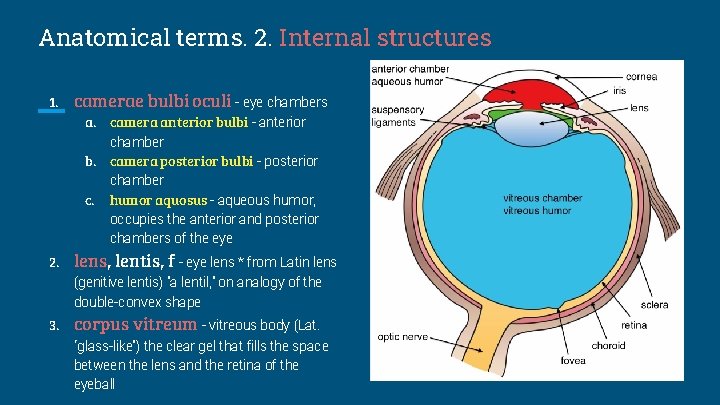
Anatomical terms. 2. Internal structures 1. camerae bulbi oculi - eye chambers a. camera anterior bulbi - anterior chamber b. camera posterior bulbi - posterior chamber c. humor aquosus - aqueous humor, occupies the anterior and posterior chambers of the eye 2. lens, lentis, f - eye lens * from Latin lens (genitive lentis) "a lentil, " on analogy of the double-convex shape 3. corpus vitreum - vitreous body (Lat. “glass-like”) the clear gel that fills the space between the lens and the retina of the eyeball
Term-elements 2. Internal structures 1. camerae bulbi oculi a. camera anterior bulbi b. camera posterior bulbi c. humor aquosus 2. lens, lentis, f 3. corpus vitreum a. humor vitreus 1. - c. -END-OPHTHALM- used for the intraocular fluids (humor aquosus, humor vitreus) 2. -PHAK- (o) / -PHAKIA *phakos - lentil, eye lens, lens 3. -VITRE- / -HYAL- (o) * hyal- word-forming element in scientific compounds meaning "of glass; glass-like, transparent, " from Greek hyalos "glass, clear alabaster, crystal lens used as a burning glass, " apparently a non-Greek word, said to be of Egyptian origin (glass was first made in Egypt). Hence terms as hyaline mean transparent, glass -like
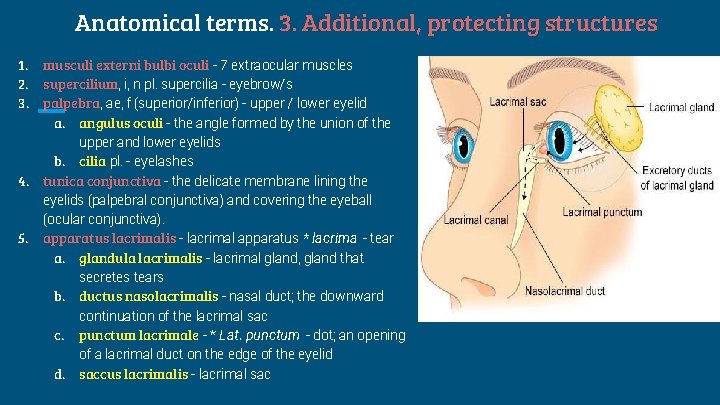
Anatomical terms. 3. Additional, protecting structures 1. 2. 3. 4. 5. musculi externi bulbi oculi - 7 extraocular muscles supercilium, i, n pl. supercilia - eyebrow/s palpebra, ae, f (superior/inferior) - upper / lower eyelid a. angulus oculi - the angle formed by the union of the upper and lower eyelids b. cilia pl. - eyelashes tunica conjunctiva - the delicate membrane lining the eyelids (palpebral conjunctiva) and covering the eyeball (ocular conjunctiva). apparatus lacrimalis - lacrimal apparatus * lacrima - tear a. glandula lacrimalis - lacrimal gland, gland that secretes tears b. ductus nasolacrimalis - nasal duct; the downward continuation of the lacrimal sac c. punctum lacrimale - * Lat. punctum - dot; an opening of a lacrimal duct on the edge of the eyelid d. saccus lacrimalis - lacrimal sac
Term-elements 3. Additional structures 1. 2. 3. 4. 5. musculi externi bulbi oculi supercilium, i, n pl. supercilia palpebra, ae, f tunica conjunctiva apparatus lacrimalis * lacrima a. glandula lacrimalis b. ductus nasolacrimalis c. punctum lacrimale d. saccus lacrimalis 1. 2. 3. 4. 5. -BLEPHAR- (o) / …-BLEPHARON -CONJUNCTIV-DACRY- * gr. dacryon - tear a. b. c. d. DACRY-o-ADENDACRY-o-CYST-
Term-elements. Eye[s]; sight; vision lat. visus, m = gr. -OP- (o), . . . -OPIA / -OPT-, OPTIC- (o) / -OPS-, -OPSI-, . . . -OPSIA ❖ ambly-opia *gr. ambly- dulled + ops - eye; weakening of the eyesight without any apparent defect in the eyes, calles also “lazy eye” click ❖ a-sthen-opia *gr. sthen- strenght; a fatigue/tiring of the eyes, usually characterized by discomfort, dimness of vision, and headache ❖ my-opia - nearsightedness, short sight ; hyper-metr-opia = hyper-opia - farsightedness, ; dipl-opia *gr. dipldouble; double vision, a single object appears double ❖ presby-opia *gr. presby- old, farsightedness, associated with aging ❖ hemeral-opia * gr. hemera - day; inability to see as clearly in bright light as in dim light; day blindness ❖ an-opsia = an-opia = a-bleps-ia- lat. caecitas - blindness ❖ amaurosis - blindness, esp. when occurring without observable damage to the eye: amaurosis fugax - (Lat. fugax meaning fleeting, Gr. amaurosis meaning darkening, dark, or obscure) is a painless temporary loss of vision in one or both eyes. ❖ hemi-an-opsia = hemi-an-opia -loss of vision in either the whole left or the whole right half of the field of vision. ; scotoma - gr. skot- dark; an area of diminished vision within the visual field. ❖ dys-chromat-opsia - color blindness ➢ mono-chromat-ismus = a-chromat-opsia - condition of being completely colorblind. ➢ di-chromat-ismus - only two of the three fundamental colors can be distinguished
Ophthalmology. General terms - conditions ● ● ● entropion/ectropion palpebrae -the turning inwards / outwards of the edge of the eyelid click horde-olum -medical name for a stye of the eye; hordeolum externum/internum click miosis - constriction of the pupil of the eye (both normal and pathol. ); mydriasis - dilation of the eye pupil click phot-o-phobia *phot- light *phobia -fear; abnormal sensitivity to or intolerance of light cor-ectopia - displacement of the eye's pupil from its normal, central position nystagmus - *gr. nystagm-nodding, drowsiness; involuntary eye movement; “dancing eye” ex-ophthalm-us /en-ophthalm-us - protrusion/ retrodisplacement of the eyeball from/within the orbit, caused by disease or injury. ophthalm-o-plegia - paralysis or weakness of the eye muscles epiphora = dacry-o-rrhoea - excessive flow of tears a-stigmat-ismus - type of refractive error caused by the irregularities in the shape of a person's cornea click cataracta - *gr. kataraktes- waterfall, broken water; a kind of portcullis - opacity/clouding of the lens of the eye or its capsule glauc-oma - * gr. -"cataract, opacity of the lens, " perhaps from glaukommatos "gray-eyed, " cataracts and glaucoma not distinguished until c. 1705. In the Hippocratic Aphorisms the term glaucoma was used to describe blindness coming on in advancing years associated with a glazed appearance of the pupil. Modern term glaucoma means a group of degenerative eye diseases characterized by damage to the optic nerve usually due to excessively high intraocular pressure - hypertensio intraocularis
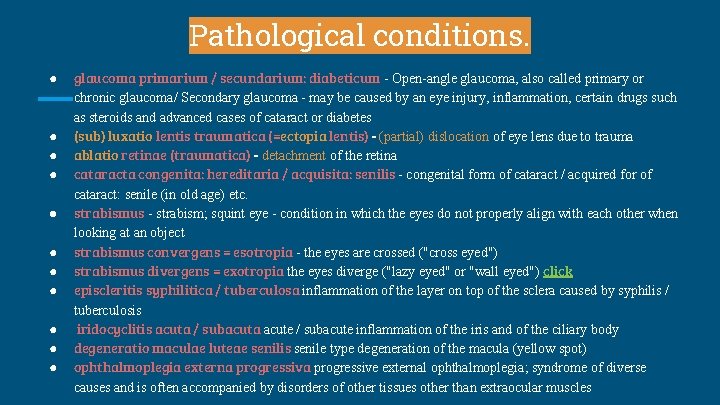
Pathological conditions. ● ● ● glaucoma primarium / secundarium: diabeticum - Open-angle glaucoma, also called primary or chronic glaucoma/ Secondary glaucoma - may be caused by an eye injury, inflammation, certain drugs such as steroids and advanced cases of cataract or diabetes (sub) luxatio lentis traumatica (=ectopia lentis) - (partial) dislocation of eye lens due to trauma ablatio retinae (traumatica) - detachment of the retina cataracta congenita: hereditaria / acquisita: senilis - congenital form of cataract / acquired for of cataract: senile (in old age) etc. strabismus - strabism; squint eye - condition in which the eyes do not properly align with each other when looking at an object strabismus convergens = esotropia - the eyes are crossed ("cross eyed") strabismus divergens = exotropia the eyes diverge ("lazy eyed" or "wall eyed") click episcleritis syphilitica / tuberculosa inflammation of the layer on top of the sclera caused by syphilis / tuberculosis iridocyclitis acuta / subacuta acute / subacute inflammation of the iris and of the ciliary body degeneratio maculae luteae senilis senile type degeneration of the macula (yellow spot) ophthalmoplegia externa progressive external ophthalmoplegia; syndrome of diverse causes and is often accompanied by disorders of other tissues other than extraocular muscles