
ORGAN TRANSPLANTATION PERSONS WITH CLOTTING DISORDERS Margaret Ragni
- Slides: 11
ORGAN TRANSPLANTATION: PERSONS WITH CLOTTING DISORDERS Margaret Ragni, MD University of Pittsburgh
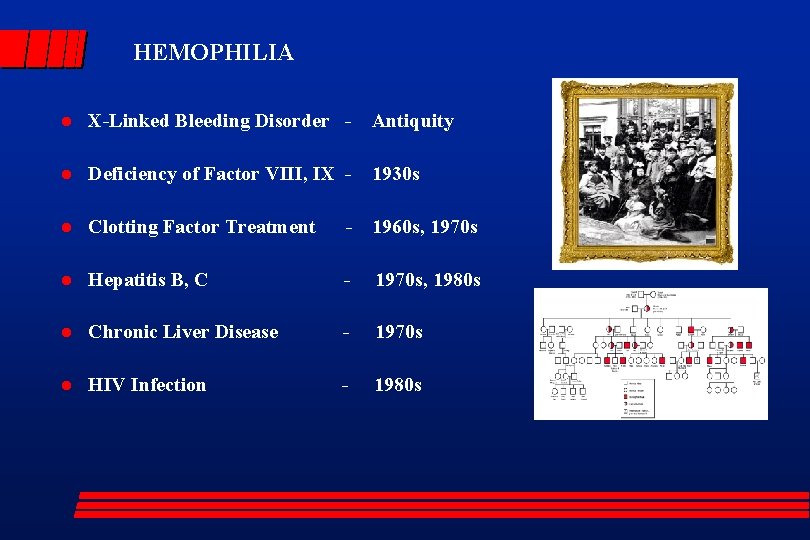
HEMOPHILIA l X-Linked Bleeding Disorder - Antiquity l Deficiency of Factor VIII, IX - 1930 s l Clotting Factor Treatment - 1960 s, 1970 s l Hepatitis B, C - 1970 s, 1980 s l Chronic Liver Disease - 1970 s l HIV Infection - 1980 s
Organ Transplant in Hemophilia 1. Bleeding Risk 2. Hepatotoxicity
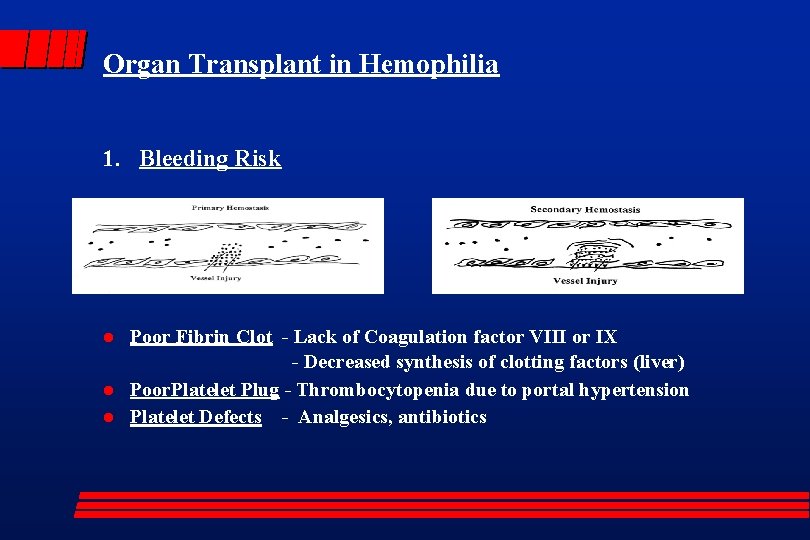
Organ Transplant in Hemophilia 1. Bleeding Risk l l l Poor Fibrin Clot - Lack of Coagulation factor VIII or IX - Decreased synthesis of clotting factors (liver) Poor. Platelet Plug - Thrombocytopenia due to portal hypertension Platelet Defects - Analgesics, antibiotics
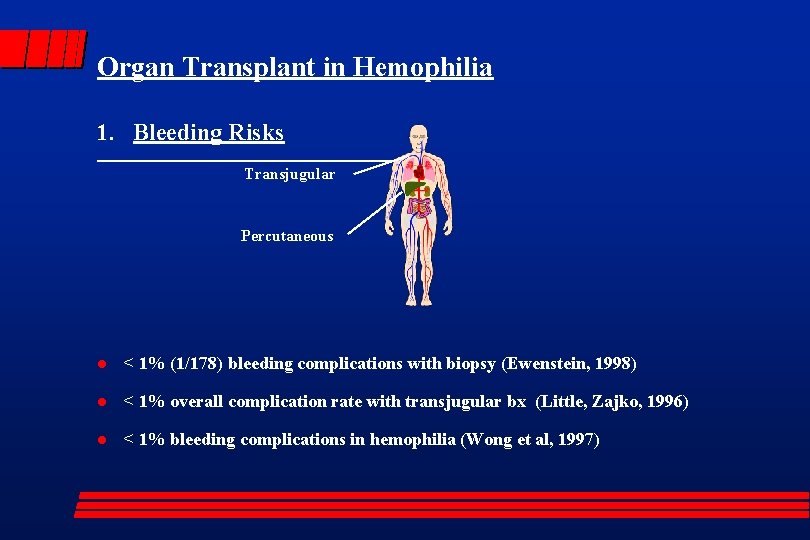
Organ Transplant in Hemophilia 1. Bleeding Risks Transjugular Percutaneous l < 1% (1/178) bleeding complications with biopsy (Ewenstein, 1998) l < 1% overall complication rate with transjugular bx (Little, Zajko, 1996) l < 1% bleeding complications in hemophilia (Wong et al, 1997)
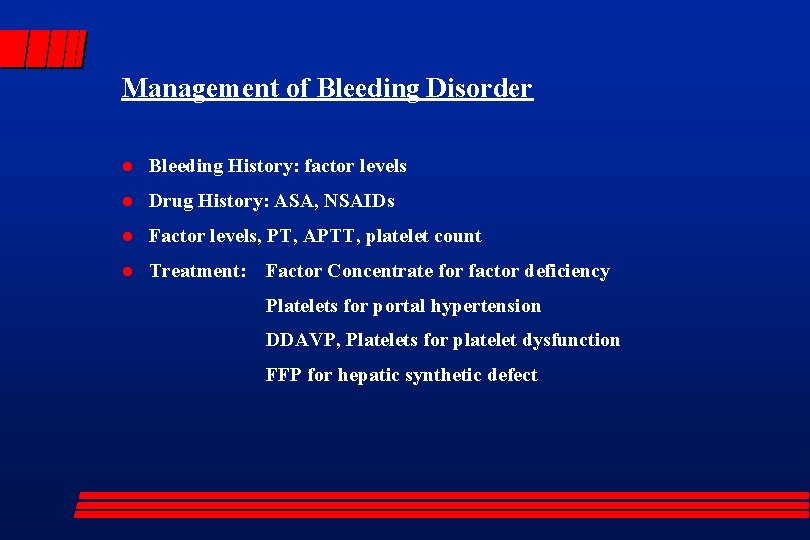
Management of Bleeding Disorder l Bleeding History: factor levels l Drug History: ASA, NSAIDs l Factor levels, PT, APTT, platelet count l Treatment: Factor Concentrate for factor deficiency Platelets for portal hypertension DDAVP, Platelets for platelet dysfunction FFP for hepatic synthetic defect
Organ Transplant in Hemophilia 2. Hepatotoxicity l Liver Function – Site of production of factor VIII or IX l Greater liver dysfunction – Multiple hepatitis exposures l More frequent drug interactions
Organ Transplant in Hemophilia 2. Hepatotoxicity l Greater toxicity with antiviral drugs, faster liver dysfunction l Potential for antiviral drug intolerance Hepatitis A, B, C, HIV Chronic analgesic, antiviral treatment l Liver transplant cures hemophilia
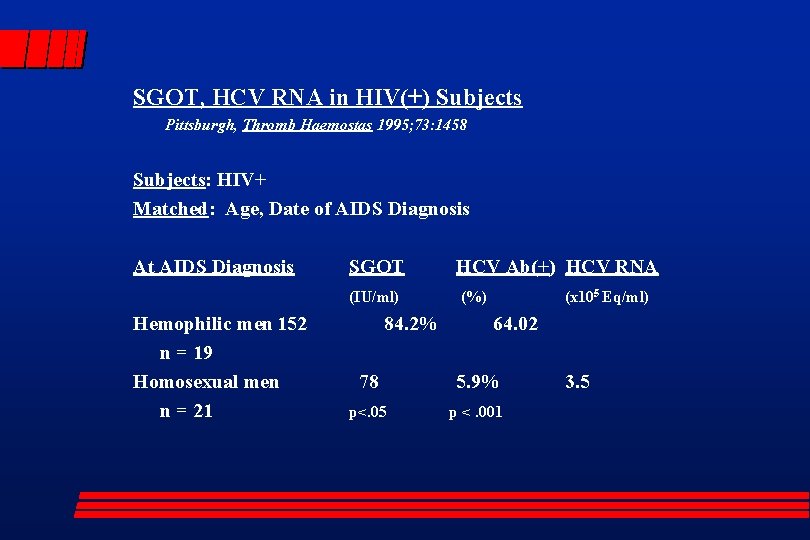
SGOT, HCV RNA in HIV(+) Subjects Pittsburgh, Thromb Haemostas 1995; 73: 1458 Subjects: HIV+ Matched: Age, Date of AIDS Diagnosis At AIDS Diagnosis SGOT (IU/ml) Hemophilic men 152 n = 19 Homosexual men n = 21 84. 2% HCV Ab(+) HCV RNA (%) (x 105 Eq/ml) 64. 02 78 5. 9% p<. 05 p <. 001 3. 5
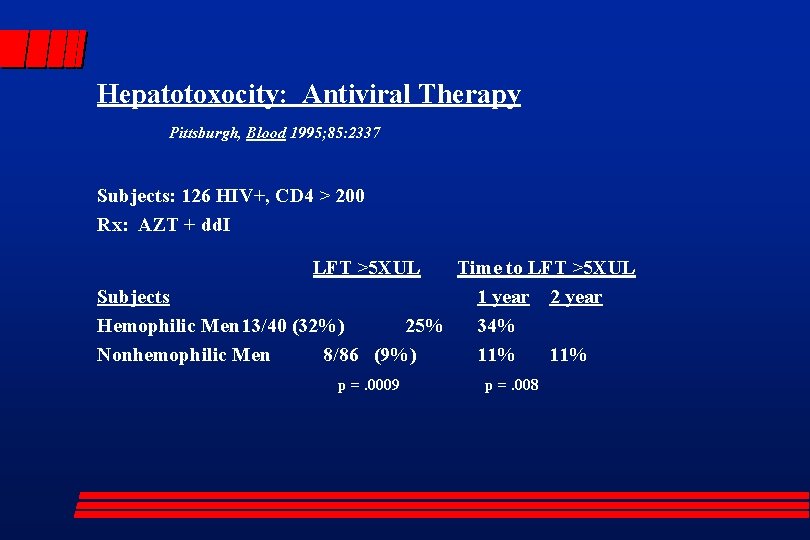
Hepatotoxocity: Antiviral Therapy Pittsburgh, Blood 1995; 85: 2337 Subjects: 126 HIV+, CD 4 > 200 Rx: AZT + dd. I LFT >5 XUL Time to LFT >5 XUL Subjects 1 year 2 year Hemophilic Men 13/40 (32%) 25% 34% Nonhemophilic Men 8/86 (9%) 11% p =. 0009 p =. 008
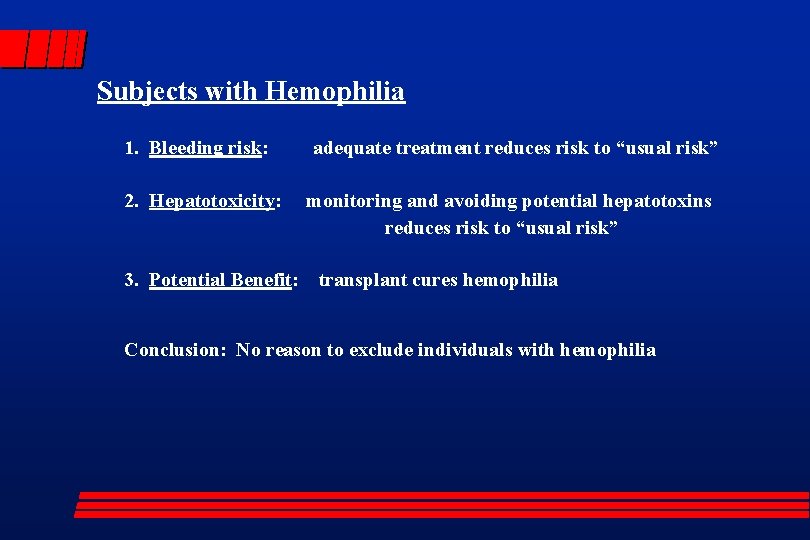
Subjects with Hemophilia 1. Bleeding risk: 2. Hepatotoxicity: 3. Potential Benefit: adequate treatment reduces risk to “usual risk” monitoring and avoiding potential hepatotoxins reduces risk to “usual risk” transplant cures hemophilia Conclusion: No reason to exclude individuals with hemophilia