
Oregons Home and Community Based Services and Settings
Oregon’s Home and Community. Based Services and Settings Implementation of the Requirements for Medicaid Home and Community-Based Services (HCBS) Settings
CMS HCBS Regulations Updated In 2014 the Centers for Medicare and Medicaid Services (CMS) issued regulations further defining the settings in which it is permissible for states to pay for 1915(i) Medicaid Home and Community-Based Services (HCBS). In order to continue to receive HCBS funding, states must ensure that their service providers are in compliance with the regulations no later than March 2019. 2
Oregon’s HCBS Transition Plan To move each state’s HCBS system into compliance, states have been required to submit a Global Transition Plan detailing the steps the state will take to meet the deadline. Oregon’s Global Transition Plan can be found at: https: //www. oregon. gov/DHS/SENIORSDISABILITIES/HCBS/Documents/Oregon's%20 R evised%20 Transition%20 Plan%20%20 Apr%202016. pdf 3
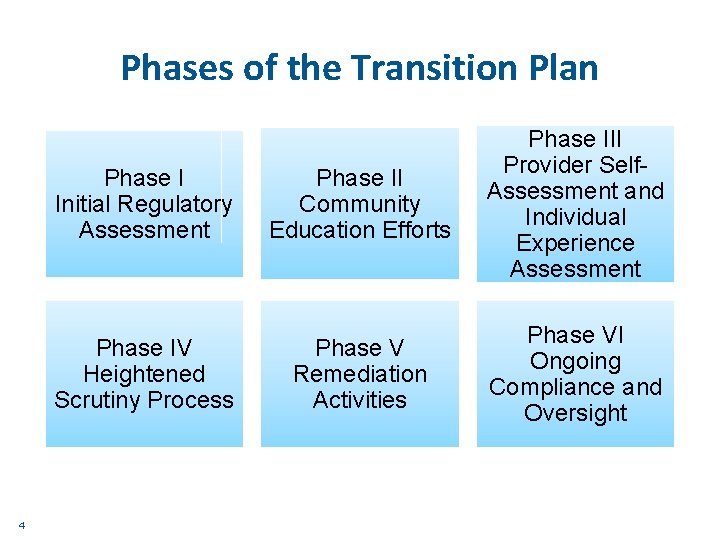
Phases of the Transition Plan Phase I Initial Regulatory Assessment Phase IV Heightened Scrutiny Process 4 Phase II Community Education Efforts Phase III Provider Self. Assessment and Individual Experience Assessment Phase V Remediation Activities Phase VI Ongoing Compliance and Oversight
Federal HCBS Regulations Updated The purpose of these updated regulations is to ensure individuals receive HCBS in settings that are integrated in and support full access to the greater community. 5
Federal HCBS Regulations Updated This includes opportunities to seek employment and work in competitive and integrated settings, engage in community life, control personal resources, and receive services in the community, to the same degree as individuals who do not receive HCBS. 6
Highlights of the Final Regulations Defines, describes, and aligns HCBS setting requirements across three Medicaid funding authorities: • 1915 (c) – HCBS Waivers • 1915 (i) – HCBS State Plan Services • 1915 (k) – Community First Choice State Plan Option 7
Highlights of the Final Regulations States must be in compliance to keep Medicaid HCBS funding!!! 8
HCBS Setting Requirements The final regulation establishes: • Mandatory requirements for the qualities of home and community-based service settings • Settings that are not home and communitybased • Settings “presumed” not to be home and community-based • State compliance and transition requirements

HCBS Setting Requirements HCBS settings must: • Be integrated in and support access to the greater community • Ensure individuals receiving Medicaid HCBS have the same access to the greater community as individuals not receiving Medicaid HCBS 10
HCBS Setting Requirements Settings provide opportunities to: • Seek employment and work in competitive integrated settings • Engage in community life • Control personal resources 11
HCBS Setting Requirements Are selected by the individual from among setting options, including: • Non-disability specific settings • Optional private unit in a residential setting 12
Home and Community-Based Setting Ensures the individual's rights of: • • 13 Privacy Dignity Respect Freedom from coercion and restraint
Home and Community-Based Setting Optimizes and does not control individual initiative, autonomy, nor independence in making life choices, including but not limited to: • daily activities • physical environment • with whom to interact 14
Home and Community-Based Setting Supports individual choice regarding: • Services • Supports • Who provides services and supports 15
Provider-owned, Controlled, or Operated Setting Requirements The unit must be a specific physical place that can be owned, rented, or occupied under a legally enforceable agreement. The individual has the same responsibilities and protections from eviction that tenants have under the landlord/tenant laws. 16
Provider-owned, Controlled, or Operated Setting Requirements For settings in which landlord/tenant laws do not apply: • The State must ensure that a lease or residency agreement is in place for each individual receiving HCBS services. • The agreement must provide protections from eviction and establish an eviction process with appeal rights comparable to those under landlord/tenant law.
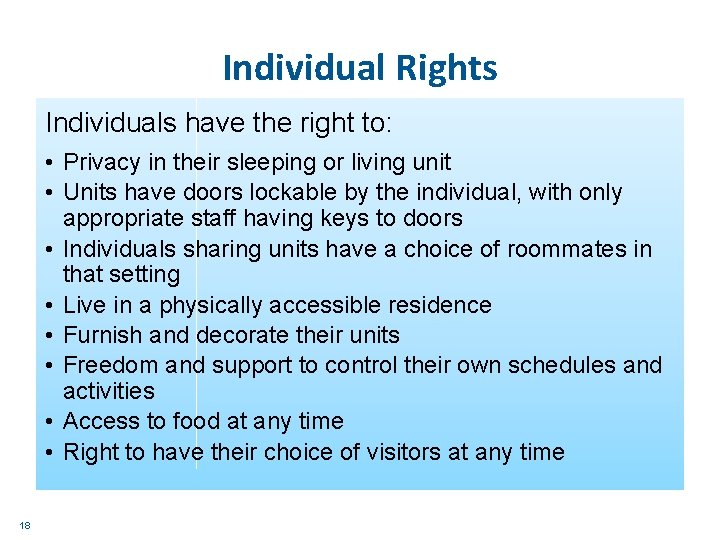
Individual Rights Individuals have the right to: • Privacy in their sleeping or living unit • Units have doors lockable by the individual, with only appropriate staff having keys to doors • Individuals sharing units have a choice of roommates in that setting • Live in a physically accessible residence • Furnish and decorate their units • Freedom and support to control their own schedules and activities • Access to food at any time • Right to have their choice of visitors at any time 18
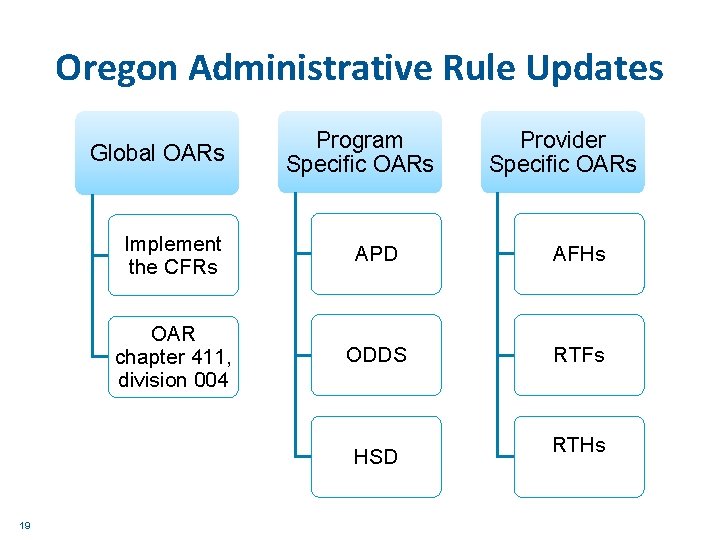
Oregon Administrative Rule Updates Global OARs Program Specific OARs Implement the CFRs APD AFHs OAR chapter 411, division 004 ODDS RTFs HSD 19 Provider Specific OARs RTHs
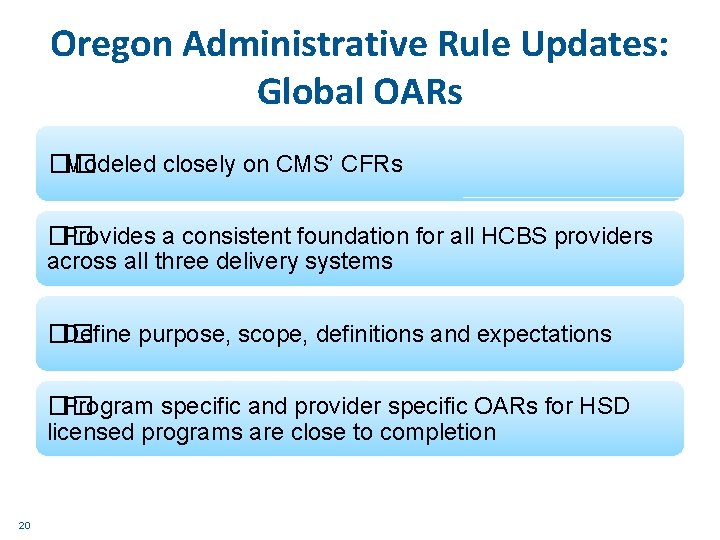
Oregon Administrative Rule Updates: Global OARs �� Modeled closely on CMS’ CFRs �� Provides a consistent foundation for all HCBS providers across all three delivery systems �� Define purpose, scope, definitions and expectations �� Program specific and provider specific OARs for HSD licensed programs are close to completion 20
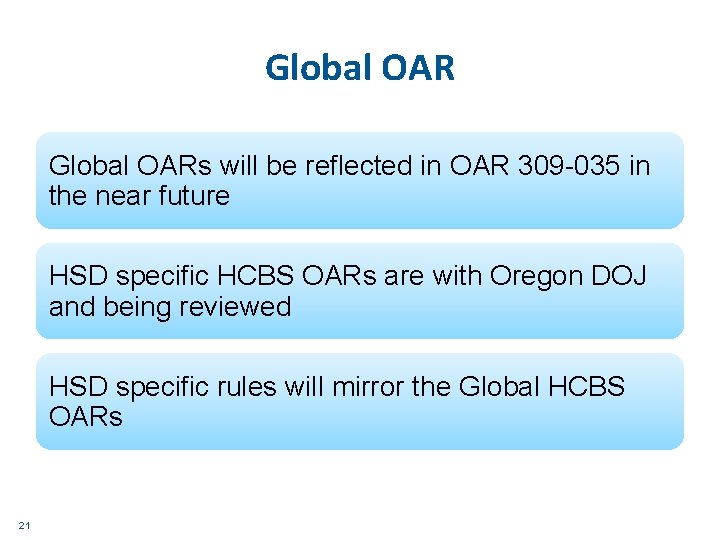
Global OARs will be reflected in OAR 309 -035 in the near future HSD specific HCBS OARs are with Oregon DOJ and being reviewed HSD specific rules will mirror the Global HCBS OARs 21
Statement of Purpose for Global OAR 411 -004 -0000 These rules ensure that individuals receive HCBS: • In settings that are integrated in the greater community and • Support the same degree of access to the greater community as people not receiving HCBS 22
Statement of Purpose for Global OAR 411 -004 -0000 �� Access includes opportunities for individuals to: • Seek employment and work in competitive integrated • employment settings • Engage in community life • Control personal resources • Receive services in the community 23
OAR 411 -004 -0020 �� Ensure the setting is selected by the individual from all available options including: • �� Non-disability setting • A private unit in a residential setting 24
OAR 411 -004 -0020 �� Ensure the setting is selected by the individual from all available options including: • �� Non-disability setting • A private unit in a residential setting 25
OAR 411 -004 -0020 �� Optimizes and does not control: • Individual initiative • Autonomy • Independence in making life choices 26
OAR 411 -004 -0020 Individual Choice includes: • Daily activities • Physical environment • With whom to interact 27
OAR 411 -004 -0020 Supports individual choice regarding: • Services • Supports • Who provides services and supports 28
OAR 411 -004 -0010 Critical Definitions �� "Provider Owned, Controlled, or Operated Residential Setting“ �� "Individually-Based Limitation" �� “Person-Centered Service Plan Coordinator" �� "Residency Agreement" 29
OAR 411 -004 -0010 Provider Owned, Controlled, or Operated Residential Settings ���� Residential settings that are considered provider owned, controlled, or operated include, but are not limited to: • • • 30 �� Group Homes Foster Homes Assisted Living Facilities Residential Treatment Homes/Facilities Some supported and specialized living programs
OAR 411 -004 -0010 - Provider Owned, Controlled, or Operated Residential Settings �� There are specific requirements for Provider Owned, Controlled, or Operated Residential Settings. �� These specific requirements are intended to ensure individuals in these settings are supported in having daily living experiences like other members of the community. 31
OAR 411 -004 -0010 - Provider Owned, Controlled, or Operated Residential Settings The unit must be a specific physical place that can be owned, rented, or occupied under a legally enforceable Residency Agreement; and �� The individual has the same responsibilities and protections from eviction that tenants have under landlord/tenant laws. 32
OAR 411 -004 -0010 - Provider Owned, Controlled, or Operated Residential Settings In Oregon, the current rules requiring eviction notices and appeal rights are considered to meet the Federal requirement for protections from eviction. What may be new for Oregon providers and individuals is the expectation to have a written Residency Agreement. 33
OAR 411 -004 -0010 - Provider Owned, Controlled, or Operated Residential Settings The setting is physically accessible. Units have doors lockable by the individual, with the individual and only appropriate staff having keys to doors. Each individual has privacy in their sleeping or living unit. Individuals sharing units have a choice of roommates in that setting. 34
OAR 411 -004 -0010 - Provider Owned, Controlled, or Operated Residential Settings Individuals have the freedom: To furnish and decorate their units as agreed to within the Residency agreement And support to control their own schedules and activities And support to have access to food at any time To have their choice of visitors at any time 35
Individual Rights Each individual has privacy in their sleeping or living unit. Units have doors lockable by the individual, with only appropriate staff having keys to doors. Individuals sharing units have a choice of roommates in that setting. 36
Individual Rights Individuals have the: • Freedom to furnish and decorate their units • Freedom and support to control their own schedules and activities • Freedom to access to food at any time • Right to have their choice of visitors at any time • Right to live in physically accessible setting 37
Limitations to Rights Any limits to these requirements must be supported by a specific assessed need and justified 38 Assessment and modifications must be completed by the case CMSmanager, calls this, “Modifications service to the Conditions”. coordinator, or personal agent. The individual must provide informed consent for any limitation.
HCBS Requirements Eligible for Possible Limitation When there is a significant health or safety risk, limitations may be made on these requirements: Lockable bedroom or unit doors Choice of roommate Written Residency Agreement Access to food Decorating and Furnishing Visitors at anytime Control of schedule and activities 39
Documentation of Limitations The following must be documented in the person-centered service plan when limits are applied: • Identify an individualized assessed and specific need • Document the positive interventions and supports used prior to any modifications • Document less intrusive methods of meeting the need that have been tried but did not work • Include a clear description of the condition that is directly proportionate to the specific assessed need • Include the informed consent of the individual • Include an assurance that interventions and supports will cause no harm to the individual
Documentation of Limitations Cont. Required time limits and data collection: • Include established time limits for periodic reviews to determine if the modification is still necessary or can be terminated; and • Include regular collection and review of data to measure the ongoing effectiveness of the modification.
Provider Responsibility for Limitations �� Maintain a copy of the completed and signed form documenting the consent to the appropriate limitation �� Regularly collect and review data to measure the ongoing effectiveness of and the continued need for the limitation; Request a review of the limitation when: a new limitation is indicated, or change of a limitation is required or removal of an limitation is appropriate Include established time limits for periodic reviews to determine if the limitation is still necessary �� Include regular collection and review of data to measure the ongoing effectiveness of the limitation 42
�� Person-Centered Service Plan Coordinator �� A contractor has been designated by HSD to function as the Person Centered Service Plan Coordinator for AFHs, RTHs, and RTFs licensed by HSD Coordinator will be responsible for sections of the person centered plan addressing HCBS services The Provider will be responsible for operationalizing the person centered service plan as well as planning for all other residential services 43
Settings Presumed to Have the Qualities of an Institution: The following settings are presumed to have the qualities of an institution: • Any setting that is located in a building that is also a facility that provides inpatient institutional treatment • Any setting that is located in a building or on the grounds of a public institution • Any setting that is immediately adjacent to a public institution • Any other setting that has the effect of isolating individuals receiving Medicaid HCBS from the broader community. 44
Settings That Are Not HCBS Settings that do not meet HCBS definition: • A nursing facility • An institution for mental diseases • An intermediate care facility for individuals with intellectual disabilities • A hospital • Any other locations that have qualities of an institutional setting, as determined by the Secretary.
OAR 411 -004 -0010 - Provider Owned, Controlled, or Operated Residential Settings In Oregon, the current rules requiring eviction notices and appeal rights are considered to meet the federal requirement for protections from eviction. What may be new for Oregon providers and individuals is the expectation to have a written Residency Agreement. 46
Residency Agreement The Residency Agreement: A Written, legally enforceable agreement Identifies the rights and responsibilities of the individual and the residential provider Must provide protections for the individual and address eviction and appeal processes that is substantially equivalent to the processes provided under landlord tenant laws �� Current OAR language on move out meets this requirement 47
Heightened Scrutiny Settings that are considered “institution-like” must go through a process at the state level to determine if the State believes there is sufficient evidence to support that a site meets HCBS. The State may then present a case to CMS that the setting is HCBS, and CMS must agree. Settings that are determined at the state or federal level to not be Home and Community-Based may not utilize Medicaid HCBS funding. 48
New Contact for HCBS Tamara Mc. Natt is your new HSD contact for all things HCBS Contact info: Tamara W. Mc. Natt, M. A. Compliance Specialist Licensing and Certification Unit Lead Cell: 503 -269 -5277 Fax: 503 -378 -8467 tamara. w. mcnatt@state. or. us 49
- Slides: 49