
Oregon Statewide Assessment System OSAS Test Coordinator Training
- Slides: 33
Oregon Statewide Assessment System (OSAS) Test Coordinator Training for Summative Assessments Required for DTCs & STCs
2 The Right Assessment for the Right Purpose • The Oregon Department of Education is committed to working with community partners to increase assessment literacy • ODE worked with several internal and external partners to develop this resource • This work is a direct response to recommendations made by community partners over the past five years (A New Path for Oregon: System of Assessment to Empower Meaningful Student Learning, Statewide Assessment Secretary of State Audit, and the Every Student Succeeds Act Standards and Accountability Workgroup) • ODE developed a new guidance document to begin these discussions, called The Right Assessment for the Right Purpose. The document provides information in the following areas: • • Shared understanding of a balanced approach to assessment Common definitions for assessment types and purposes Appropriate and inappropriate uses of assessment data Critical considerations about testing time for our statewide summative assessments in English language arts and Mathematics
Required Training Format • • Organized into short modules Designed to be delivered to district and school staff Focus on resource orientation Built in Q&A discussion opportunities
Test Coordinator Training Topics • • • Roles & Responsibilities Training Scheduling Student testing options Student Participation Resources Test Administration Manual
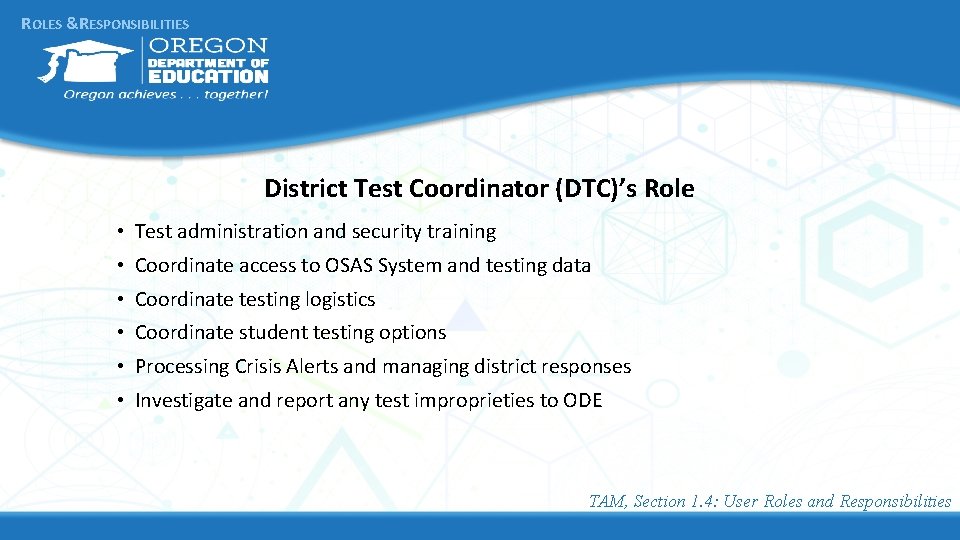
ROLES &RESPONSIBILITIES District Test Coordinator (DTC)’s Role • Test administration and security training • Coordinate access to OSAS System and testing data • Coordinate testing logistics • Coordinate student testing options • Processing Crisis Alerts and managing district responses • Investigate and report any test improprieties to ODE TAM, Section 1. 4: User Roles and Responsibilities
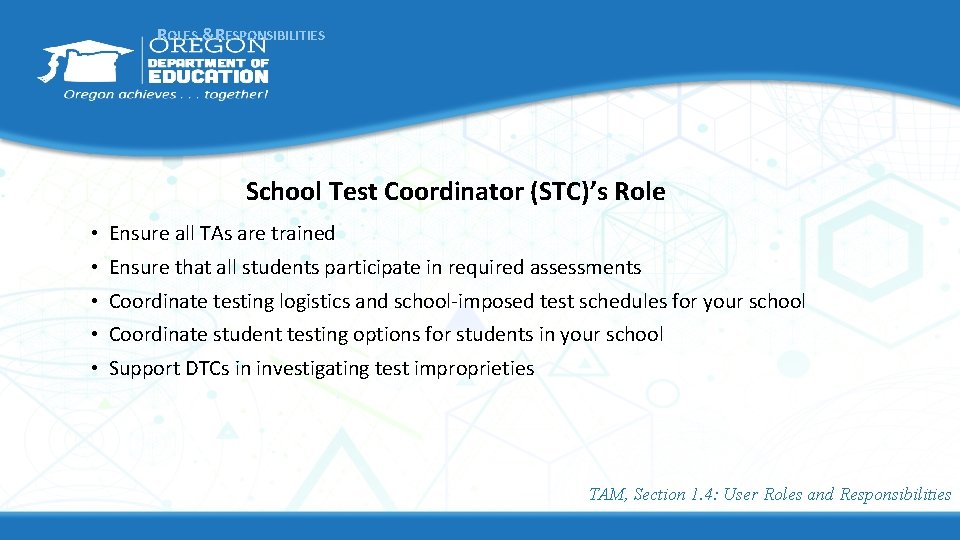
ROLES &RESPONSIBILITIES School Test Coordinator (STC)’s Role • Ensure all TAs are trained • Ensure that all students participate in required assessments • Coordinate testing logistics and school-imposed test schedules for your school • Coordinate student testing options for students in your school • Support DTCs in investigating test improprieties TAM, Section 1. 4: User Roles and Responsibilities
Training ensures consistency in test administration and supports equitable and secure testing environments for students across schools and districts.
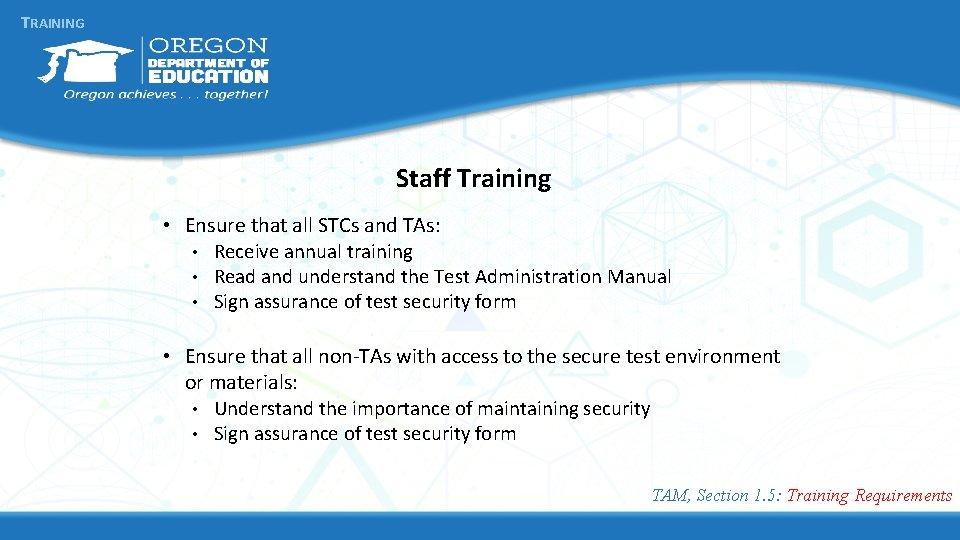
TRAINING Staff Training • Ensure that all STCs and TAs: • • • Receive annual training Read and understand the Test Administration Manual Sign assurance of test security form • Ensure that all non-TAs with access to the secure test environment or materials: • • Understand the importance of maintaining security Sign assurance of test security form TAM, Section 1. 5: Training Requirements
TRAINING Test Administrator (TA) Training Requirement Highlights • Use ODE-provided modules • Incorporate discussion and check for comprehension in training • Coordinate to identify all staff who need training TAM, Section 1. 5: Training Requirements
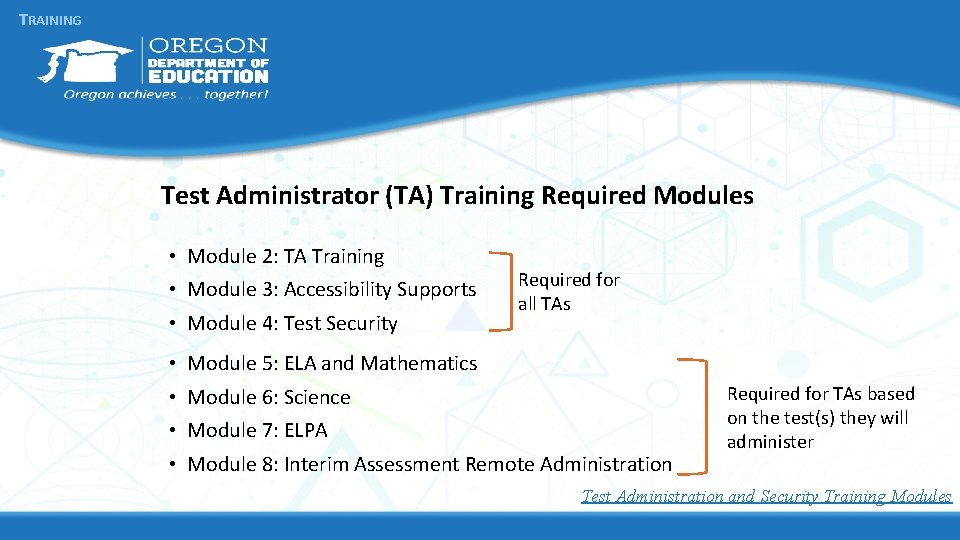
TRAINING Test Administrator (TA) Training Required Modules • Module 2: TA Training • Module 3: Accessibility Supports • Module 4: Test Security Required for all TAs • Module 5: ELA and Mathematics • Module 6: Science • Module 7: ELPA • Module 8: Interim Assessment Remote Administration Required for TAs based on the test(s) they will administer Test Administration and Security Training Modules
TRAINING Training Considerations • Trainings can incorporate independent study time for added flexibility • Track which staff have received training and signed an Assurance Form • Access to the OSAS System may be granted to staff only upon completion of training requirements • Develop a plan to provide “make-up” training to new hires or substitutes who will be involved in test administration • Provide a brief refresher training or supplemental resources before the start of each testing window TA Training Promising Practices
TRAINING Supporting Staff in Test Administration • Disseminate ODE-issued testing updates and alerts to staff involved in state testing* • Weekly AA Update • DTC Alerts • Reminders about test windows and downtimes • Respond to questions from staff using Regional ESD Assessment support partners when necessary * Monthly informal DTC webinars with ODE are another resource to get updates, ask questions, and share ideas with your peers TAM, Section 1. 5: Training Requirements
TRAINING Creating District and School Level User Accounts in TIDE • One “DTC” allowed per district, with multiple “District Level User” roles permitted • DTC creates district- and school-level accounts: • District Level Users • District Report Viewers • School Test Coordinators • School Report Viewers • Test Administrators • Test Technicians TIDE User Guide
Q & A Discussion • What are the local considerations and challenges around training within your school or district? • What are some effective approaches you could use to address these challenges? • Who within your school or district needs to be included when coordinating TA training? • What resources do you plan to use to assist you in planning and implementing TA training?
Scheduling accounts for local considerations and provides students adequate resources such as technology, space, and time to demonstrate what they know and can do on the test.
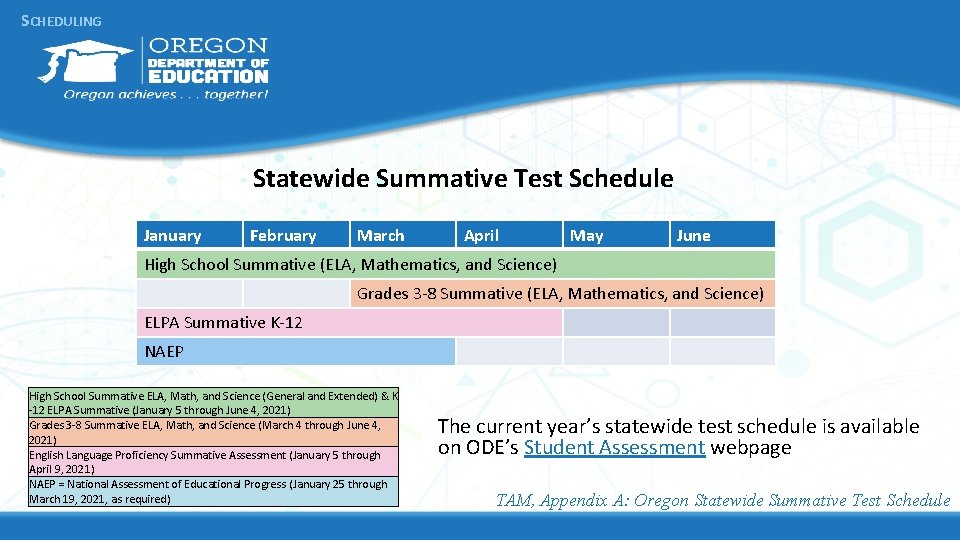
SCHEDULING Statewide Summative Test Schedule January February March April May June High School Summative (ELA, Mathematics, and Science) Grades 3 -8 Summative (ELA, Mathematics, and Science) ELPA Summative K-12 NAEP High School Summative ELA, Math, and Science (General and Extended) & K -12 ELPA Summative (January 5 through June 4, 2021) Grades 3 -8 Summative ELA, Math, and Science (March 4 through June 4, 2021) English Language Proficiency Summative Assessment (January 5 through April 9, 2021) NAEP = National Assessment of Educational Progress (January 25 through March 19, 2021, as required) The current year’s statewide test schedule is available on ODE’s Student Assessment webpage TAM, Appendix A: Oregon Statewide Summative Test Schedule
SCHEDULING School-Level Test Windows: Scheduling Considerations • Tests are not timed • Test times vary by grade and subject • Use average test times in TAM to guide scheduling TAM, Section 5: Scheduling Test Administration TAM, Section 6: Planning for Test Administration
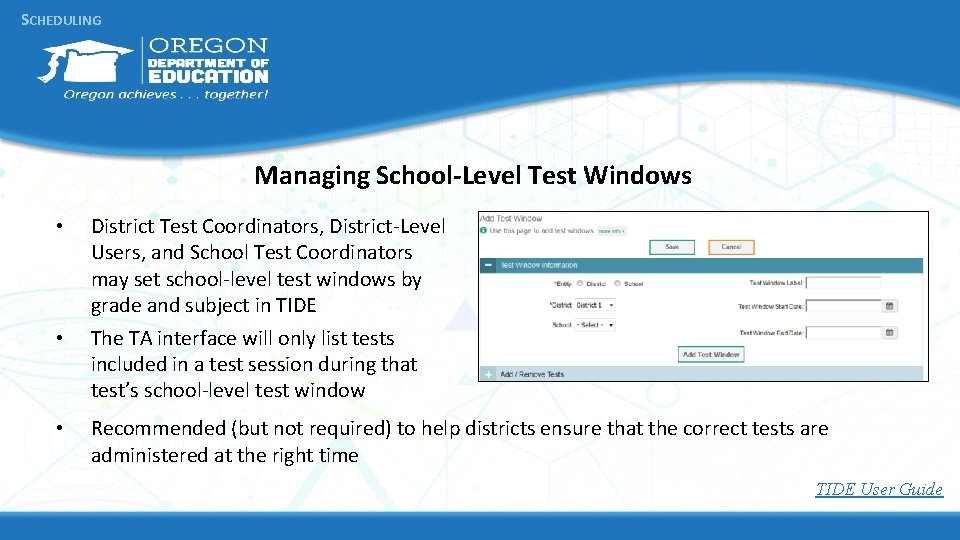
SCHEDULING Managing School-Level Test Windows • • • District Test Coordinators, District-Level Users, and School Test Coordinators may set school-level test windows by grade and subject in TIDE The TA interface will only list tests included in a test session during that test’s school-level test window Recommended (but not required) to help districts ensure that the correct tests are administered at the right time TIDE User Guide
SCHEDULING Building a Testing Schedule • Inventory all potential locations and devices for testing • Identify students who will be taking each test • Determine non-negotiables: • Previously scheduled events during testing • Sequence of grade levels and tests considering recommendations • Days of week and what time of day for testing • Schedule Format • Plan for transition time (traveling to and from testing location, logging in and out, etc. ) • Build in make-up sessions throughout testing • Plan for schedule adjustment processes • Plan staff, student, & parent communication
Q & A Discussion • What are the local considerations and challenges around scheduling within your school or district? • What are some effective approaches you could use to address these challenges? • Who within your school or district needs to be included when coordinating your school-level test windows and schedules? • What resources are available to assist you in planning and managing your school-level test windows and schedules? • How will your plans change to accommodate different instructional models (Comprehensive Distance Learning, Hybrid, or On-Site)
Student Testing Options Adequate planning ensures that students have access to appropriate and necessary resources.
TESTING Student Summative Assessment Options: Targeting Up to a Higher Grade Level Test • • • For the General ELA & Math, students in Grades 2 through 7 and 10* are allowed to target up one grade level For the General Science, students in Grade 10 may take the Grade 11 test Targeting up is not allowed for the ORExt or ELPA *Contact your ESD partner for assistance TAM, Appendix B: Student Inclusion TIDE User Guide
TESTING Student Test Options: Supports and Restricted Access • Assign embedded designated supports and accommodations in TIDE • Online tests may be restricted for students expected to take the Oregon Extended Assessment TAM, Section 5. 3 Opt-Outs and Parent Requests for Exemption from State Testing TAM, Appendix B: Student Inclusion OAM, Appendix A TIDE User Guide
Student Participation ensures representation of all students in assessment results.
PARTICIPATION Participation Requirements Participation calculations are based upon all students enrolled on the first instructional day in May ESEA requires: • 95% student participation in ELA, Mathematics, and Science • 100% of students identified as English Learners participate in the statewide summative ELPA TAM, Section 5: Scheduling Test Administration
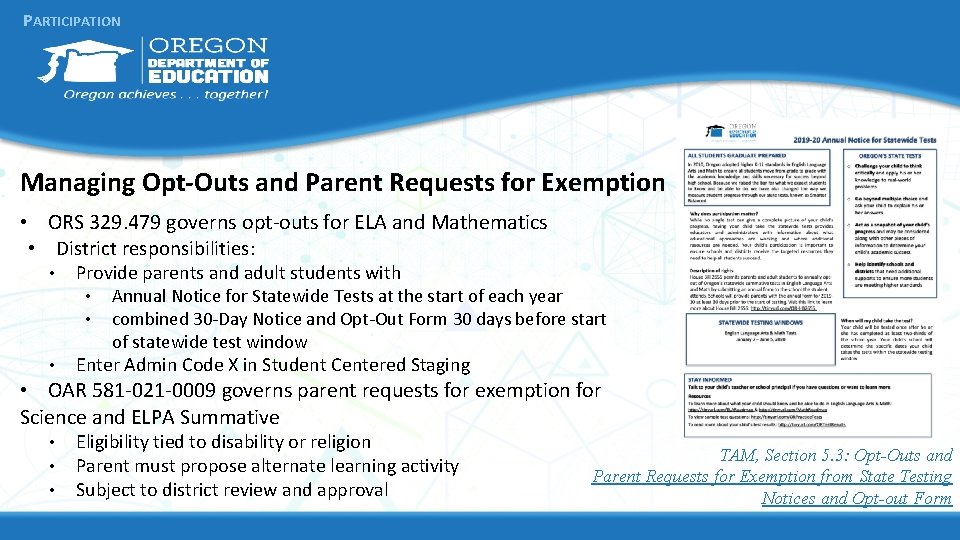
PARTICIPATION Managing Opt-Outs and Parent Requests for Exemption • ORS 329. 479 governs opt-outs for ELA and Mathematics • District responsibilities: • Provide parents and adult students with • • • Annual Notice for Statewide Tests at the start of each year combined 30 -Day Notice and Opt-Out Form 30 days before start of statewide test window Enter Admin Code X in Student Centered Staging • OAR 581 -021 -0009 governs parent requests for exemption for Science and ELPA Summative • • • Eligibility tied to disability or religion Parent must propose alternate learning activity Subject to district review and approval TAM, Section 5. 3: Opt-Outs and Parent Requests for Exemption from State Testing Notices and Opt-out Form
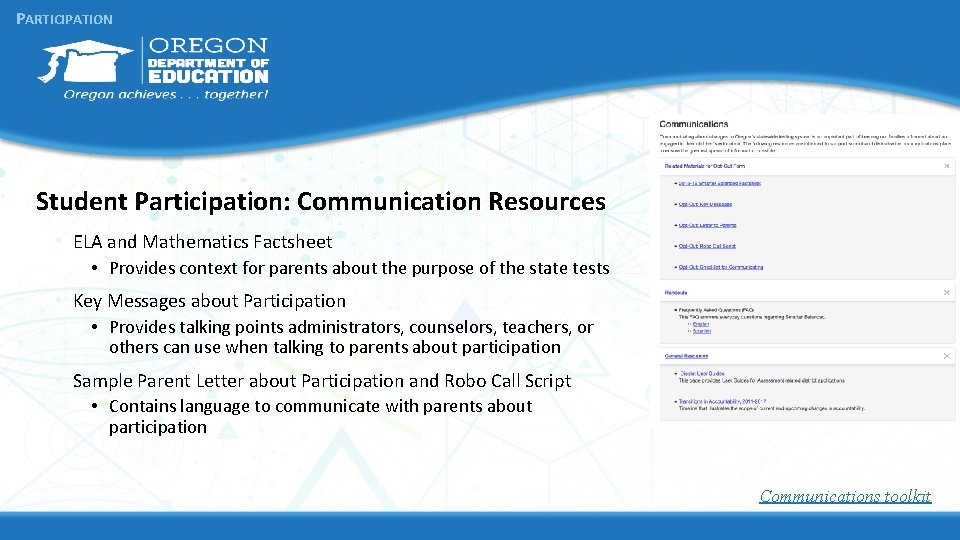
PARTICIPATION Student Participation: Communication Resources • ELA and Mathematics Factsheet • Provides context for parents about the purpose of the state tests • Key Messages about Participation • Provides talking points administrators, counselors, teachers, or others can use when talking to parents about participation • Sample Parent Letter about Participation and Robo Call Script • Contains language to communicate with parents about participation Communications toolkit
Q & A Discussion • What are the local considerations and challenges around managing student participation within your school or district? • What are some effective approaches you could use to address these challenges? • Who within your school or district needs to be included in tracking student participation and parent requested opt-outs? • What resources are available to assist you in tracking and managing student participation?
Contacts and Resources
RESOURCES Regional Assessment Support • • ODE will provide information through DTC listserv and Regional ESD helpdesks Regional ESD Partners are the best source for assessment support The state is divided into three regions Regional ESD Partner contact information online
RESOURCES ODE Policy Contacts Dan Farley, Director of Assessment o Test Development and Administration o Accessibility & Accommodations o Extended Assessment dan. farley@state. or. us, (503)947 -5721 Jon Wiens, Manager of Accountability & Reporting o Accountability and Reporting jon. wiens@state. or. us, (503)947 -5764 Holly Carter, Assessment Policy Analyst o Test Security and Administration Policies holly. carter@state. or. us, (503)947 -5739 Beth La. Duca, NAEP State Coordinator beth. laduca@state. or. us, (503)947 -5836
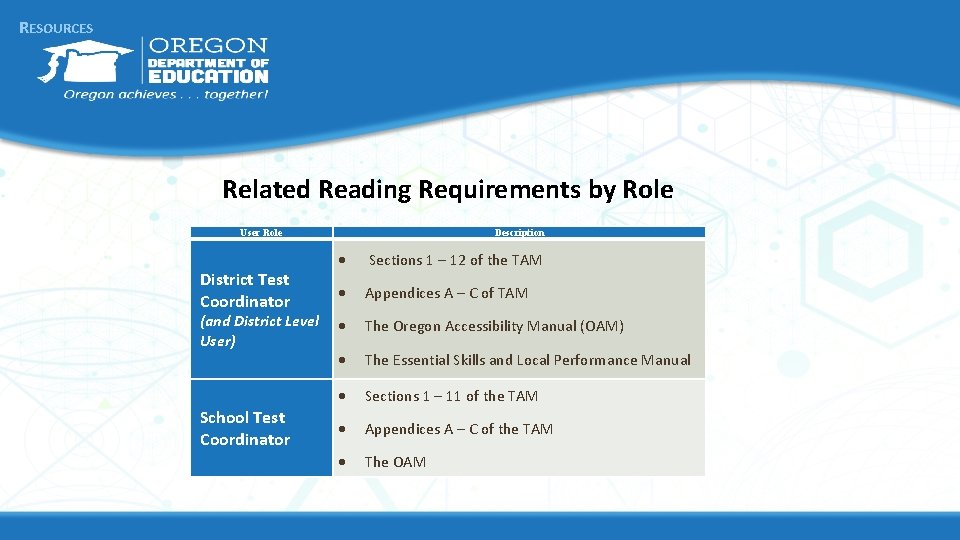
RESOURCES Related Reading Requirements by Role User Role District Test Coordinator (and District Level User) School Test Coordinator Description Sections 1 – 12 of the TAM Appendices A – C of TAM The Oregon Accessibility Manual (OAM) The Essential Skills and Local Performance Manual Sections 1 – 11 of the TAM Appendices A – C of the TAM The OAM
RESOURCES Online Resources • • ODE staff contact information • • • Accommodations Manual and Webpage Assessment Regional ESD Helpdesk contacts Test Administration Manual and Right Assessment for the Right Purpose guidance document Extended Assessment Promising Practices Training Modules Test Security Forms