
Oregon State University Honors College You CAN Trust
- Slides: 1
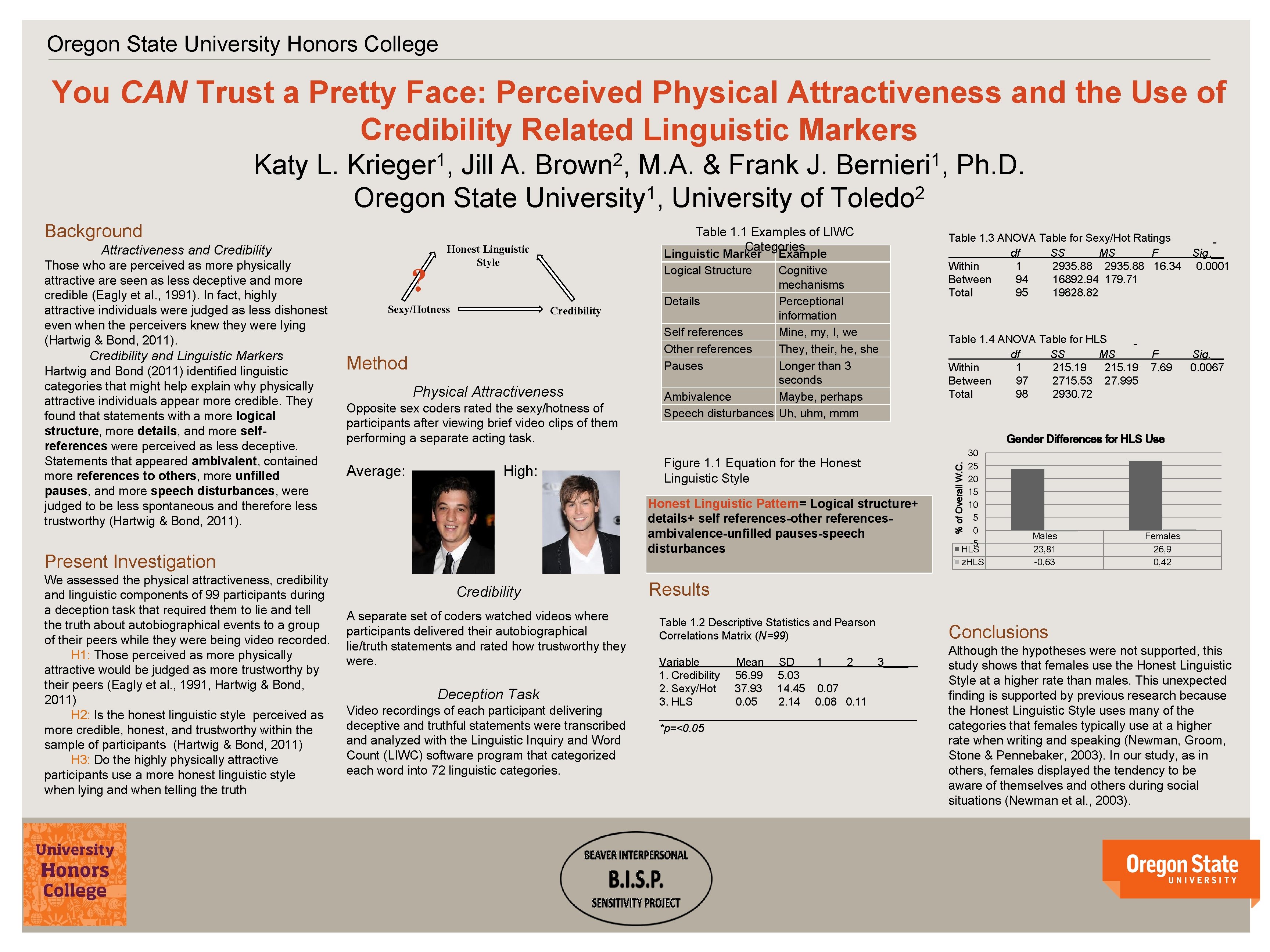
Oregon State University Honors College You CAN Trust a Pretty Face: Perceived Physical Attractiveness and the Use of Credibility Related Linguistic Markers 2 Brown , 1 Bernieri , Jill A. M. A. & Frank J. 1 2 Oregon State University , University of Toledo Background Attractiveness and Credibility Those who are perceived as more physically attractive are seen as less deceptive and more credible (Eagly et al. , 1991). In fact, highly attractive individuals were judged as less dishonest even when the perceivers knew they were lying (Hartwig & Bond, 2011). Credibility and Linguistic Markers Hartwig and Bond (2011) identified linguistic categories that might help explain why physically attractive individuals appear more credible. They found that statements with a more logical structure, more details, and more selfreferences were perceived as less deceptive. Statements that appeared ambivalent, contained more references to others, more unfilled pauses, and more speech disturbances, were judged to be less spontaneous and therefore less trustworthy (Hartwig & Bond, 2011). ? Table 1. 1 Examples of LIWC Categories Honest Linguistic Style Sexy/Hotness Linguistic Marker Logical Structure Credibility Method Physical Attractiveness Opposite sex coders rated the sexy/hotness of participants after viewing brief video clips of them performing a separate acting task. Average: High: Credibility A separate set of coders watched videos where participants delivered their autobiographical lie/truth statements and rated how trustworthy they were. Deception Task Video recordings of each participant delivering deceptive and truthful statements were transcribed analyzed with the Linguistic Inquiry and Word Count (LIWC) software program that categorized each word into 72 linguistic categories. Table 1. 3 ANOVA Table for Sexy/Hot Ratings df SS MS F Within 1 2935. 88 16. 34 Between 94 16892. 94 179. 71 Total 95 19828. 82 Table 1. 4 ANOVA Table for HLS df SS MS Within 1 215. 19 Between 97 2715. 53 27. 995 Total 98 2930. 72 F 7. 69 Sig. __ 0. 0001 Sig. __ 0. 0067 Gender Differences for HLS Use v Figure 1. 1 Equation for the Honest Linguistic Style Honest Linguistic Pattern= Logical structure+ details+ self references-other referencesambivalence-unfilled pauses-speech disturbances Present Investigation We assessed the physical attractiveness, credibility and linguistic components of 99 participants during a deception task that required them to lie and tell the truth about autobiographical events to a group of their peers while they were being video recorded. H 1: Those perceived as more physically attractive would be judged as more trustworthy by their peers (Eagly et al. , 1991, Hartwig & Bond, 2011) H 2: Is the honest linguistic style perceived as more credible, honest, and trustworthy within the sample of participants (Hartwig & Bond, 2011) H 3: Do the highly physically attractive participants use a more honest linguistic style when lying and when telling the truth Example Cognitive mechanisms Details Perceptional information Self references Mine, my, I, we Other references They, their, he, she Pauses Longer than 3 seconds Ambivalence Maybe, perhaps Speech disturbances Uh, uhm, mmm Ph. D. 30 25 20 15 10 5 0 -5 HLS z. HLS % of Overall W. C. Katy L. 1 Krieger , Males 23, 81 -0, 63 Females 26, 9 0, 42 Results Table 1. 2 Descriptive Statistics and Pearson Correlations Matrix (N=99) Variable Mean SD 1 2 3____ 1. Credibility 56. 99 5. 03 2. Sexy/Hot 37. 93 14. 45 0. 07 3. HLS 0. 05 2. 14 0. 08 0. 11 _____________________ *p=<0. 05 Conclusions Although the hypotheses were not supported, this study shows that females use the Honest Linguistic Style at a higher rate than males. This unexpected finding is supported by previous research because the Honest Linguistic Style uses many of the categories that females typically use at a higher rate when writing and speaking (Newman, Groom, Stone & Pennebaker, 2003). In our study, as in others, females displayed the tendency to be aware of themselves and others during social situations (Newman et al. , 2003).