
Oregon Reading First Cohort B Supplemental and Intervention
Oregon Reading First Cohort B Supplemental and Intervention Programs September 27, 2005 1
Oregon Reading First Institutes on Beginning Reading Content developed by: Edward J. Kame’enui, Ph. D. Professor, College of Education University of Oregon Deborah C. Simmons, Ph. D. Professor, College of Education University of Oregon Michael D. Coyne, Ph. D. University of Connecticut Beth Harn, Ph. D University of Oregon Prepared by: Patrick Kennedy-Paine University of Oregon Katie Tate University of Oregon 2
Cohort B, Supplemental and Intervention Programs, Content Development Content developed by: Patricia Travers Additional support: Katie Tate 3
Copyright ØAll materials are copy written and should not be reproduced or used without expressed permission of Dr. Carrie Thomas Beck, Oregon Reading First Center. Selected slides were reproduced from other sources and original references cited. 4
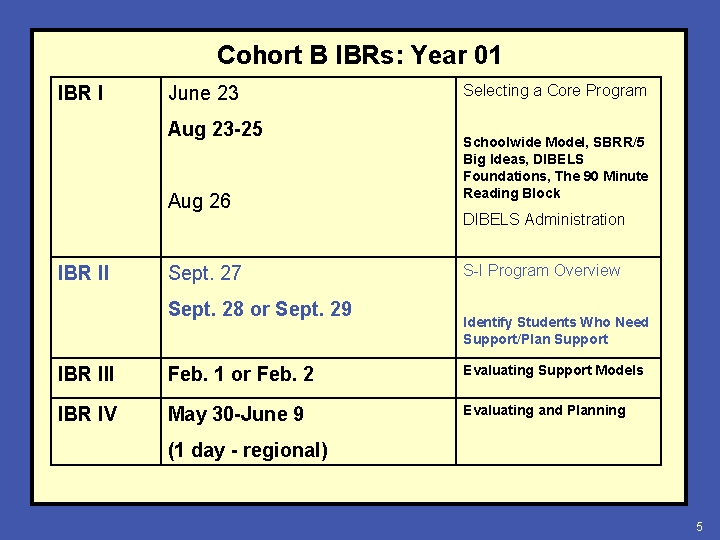
Cohort B IBRs: Year 01 IBR I June 23 Aug 23 -25 Aug 26 IBR II Sept. 27 Sept. 28 or Sept. 29 Selecting a Core Program Schoolwide Model, SBRR/5 Big Ideas, DIBELS Foundations, The 90 Minute Reading Block DIBELS Administration S-I Program Overview Identify Students Who Need Support/Plan Support IBR III Feb. 1 or Feb. 2 Evaluating Support Models IBR IV May 30 -June 9 Evaluating and Planning (1 day - regional) 5
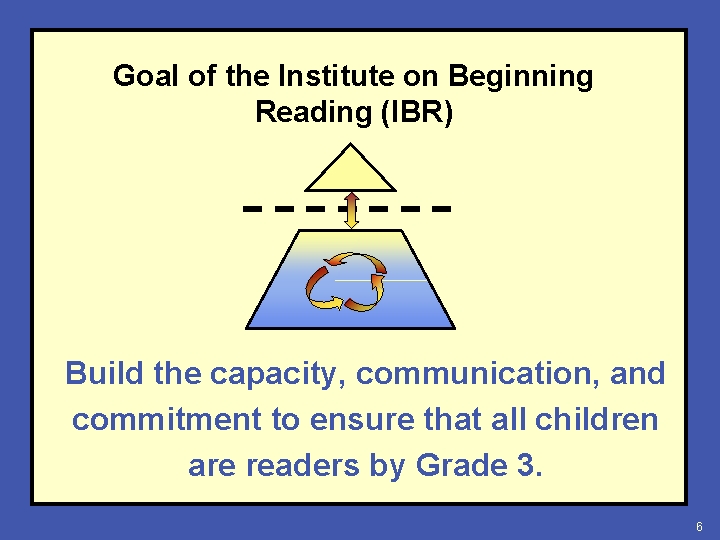
Goal of the Institute on Beginning Reading (IBR) Build the capacity, communication, and commitment to ensure that all children are readers by Grade 3. 6
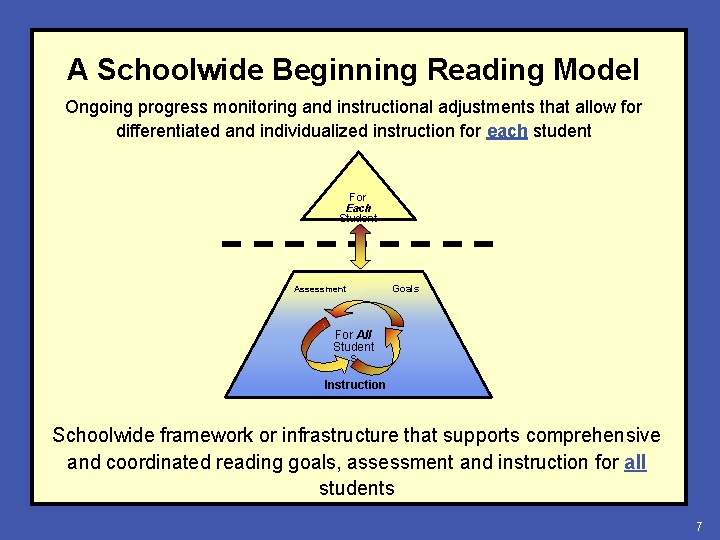
A Schoolwide Beginning Reading Model Ongoing progress monitoring and instructional adjustments that allow for differentiated and individualized instruction for each student For Each Student Assessment Goals For All Student s Instruction Schoolwide framework or infrastructure that supports comprehensive and coordinated reading goals, assessment and instruction for all students 7
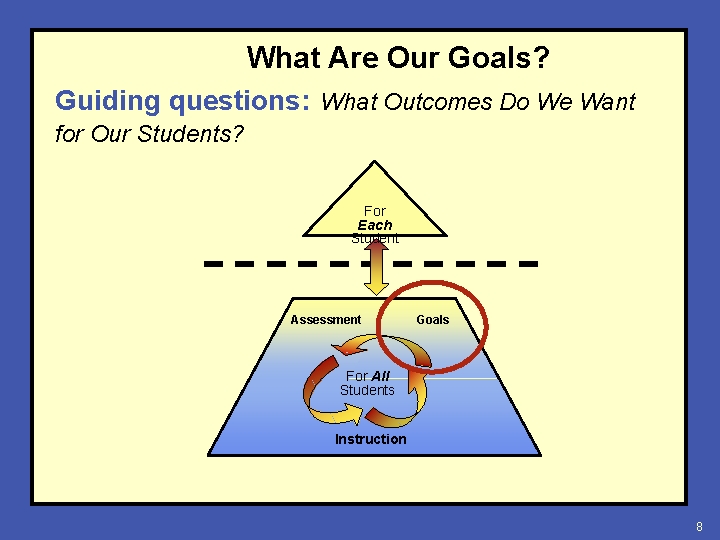
What Are Our Goals? Guiding questions: What Outcomes Do We Want for Our Students? For Each Student Assessment Goals For All Students Instruction 8
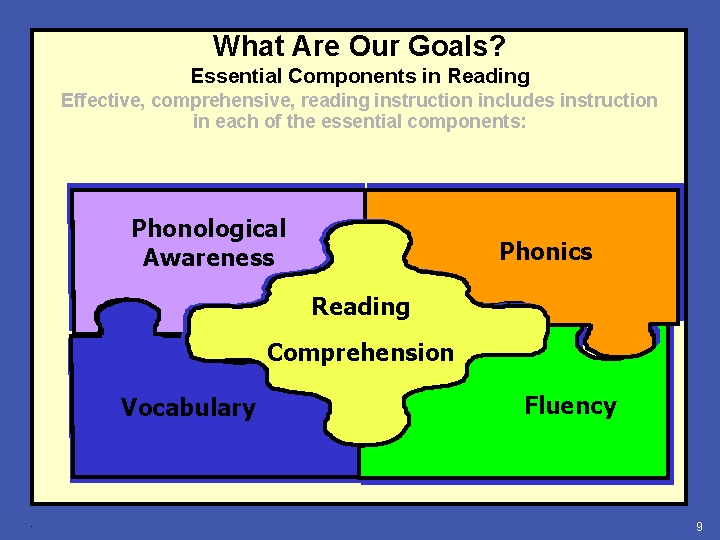
What Are Our Goals? Essential Components in Reading Effective, comprehensive, reading instruction includes instruction in each of the essential components: Phonological Awareness Phonics Reading Comprehension Vocabulary . Fluency 9
What Are Our Goals? Planning & Evaluation Tool PET 10

What Are Our Goals?
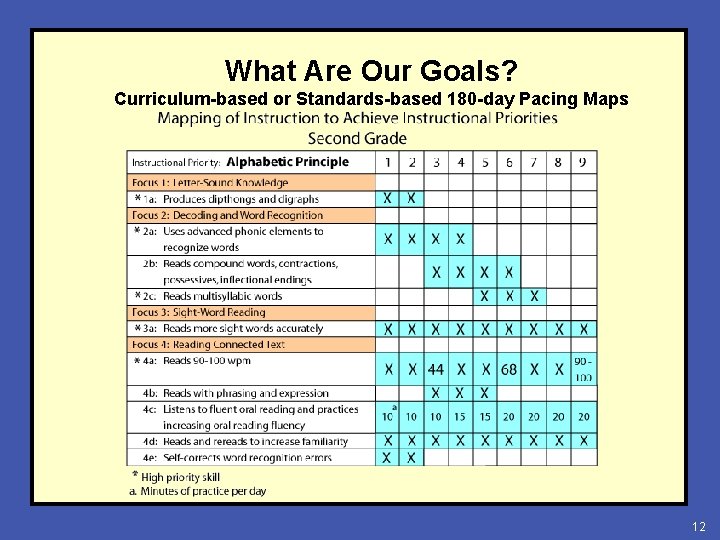
What Are Our Goals? Curriculum-based or Standards-based 180 -day Pacing Maps 12
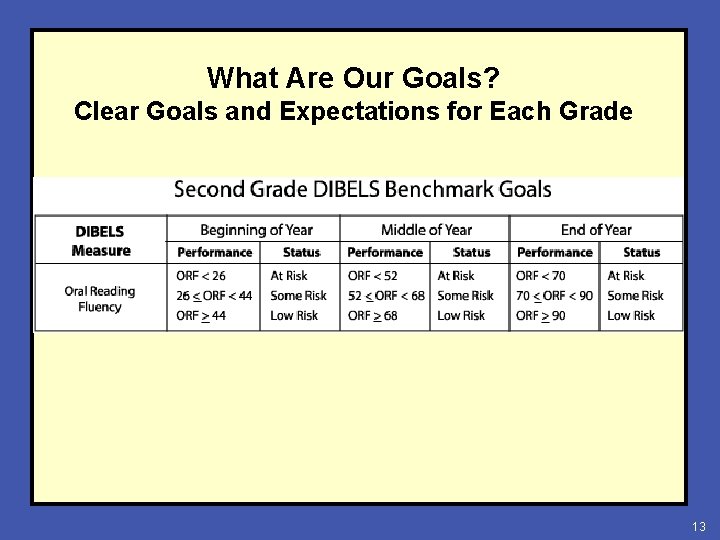
What Are Our Goals? Clear Goals and Expectations for Each Grade 13
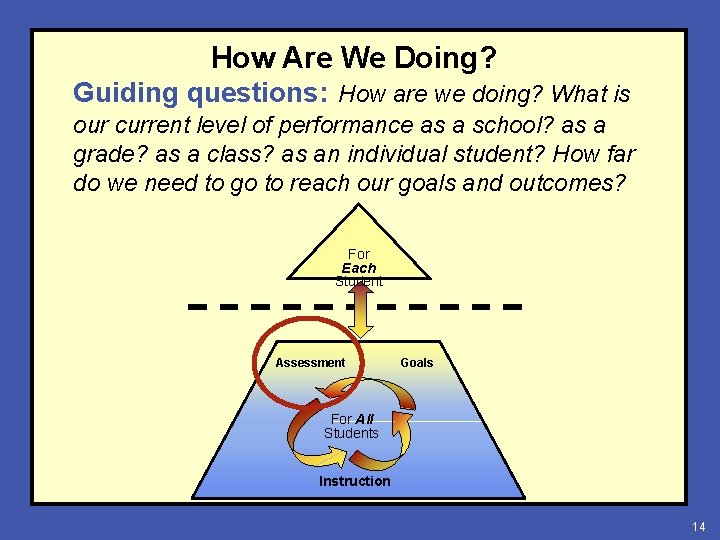
How Are We Doing? Guiding questions: How are we doing? What is our current level of performance as a school? as a grade? as a class? as an individual student? How far do we need to go to reach our goals and outcomes? For Each Student Assessment Goals For All Students Instruction 14
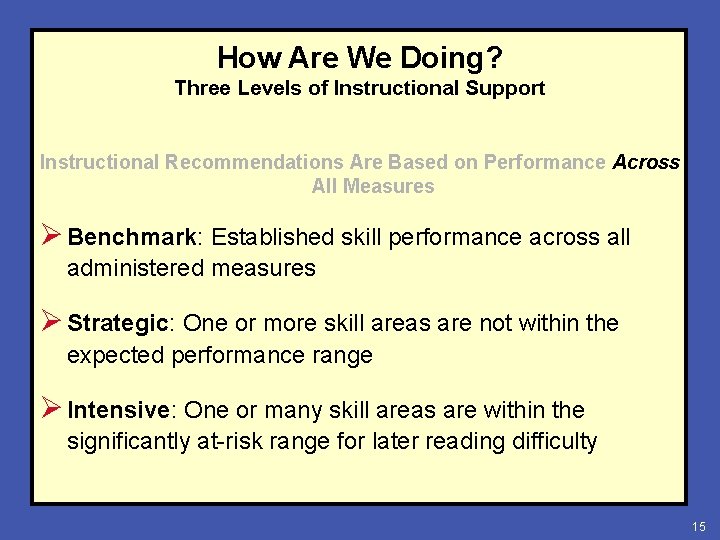
How Are We Doing? Three Levels of Instructional Support Instructional Recommendations Are Based on Performance Across All Measures Ø Benchmark: Established skill performance across all administered measures Ø Strategic: One or more skill areas are not within the expected performance range Ø Intensive: One or many skill areas are within the significantly at-risk range for later reading difficulty 15
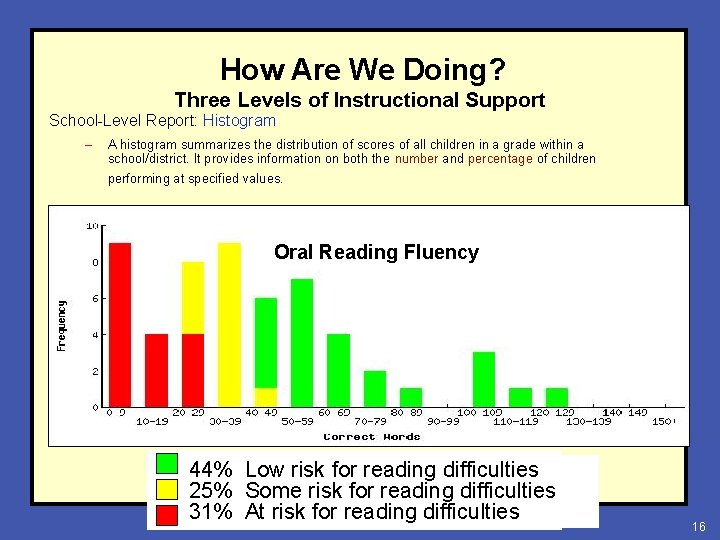
How Are We Doing? Three Levels of Instructional Support School-Level Report: Histogram – A histogram summarizes the distribution of scores of all children in a grade within a school/district. It provides information on both the number and percentage of children performing at specified values. Oral Reading Fluency 44% Low risk for reading difficulties 25% Some risk for reading difficulties 31% At risk for reading difficulties 16
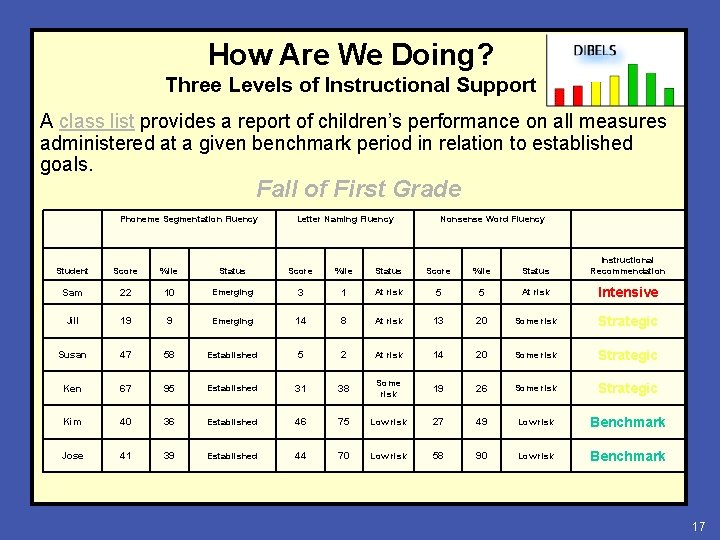
How Are We Doing? Three Levels of Instructional Support A class list provides a report of children’s performance on all measures administered at a given benchmark period in relation to established goals. Fall of First Grade Phoneme Segmentation Fluency Letter Naming Fluency Nonsense Word Fluency Student Score %ile Status Instructional Recommendation Sam 22 10 Emerging 3 1 At risk 5 5 At risk Intensive Jill 19 9 Emerging 14 8 At risk 13 20 Some risk Strategic Susan 47 58 Established 5 2 At risk 14 20 Some risk Strategic Ken 67 95 Established 31 38 Some risk 19 26 Some risk Strategic Kim 40 36 Established 46 75 Low risk 27 49 Low risk Benchmark Jose 41 39 Established 44 70 Low risk 58 90 Low risk Benchmark 17
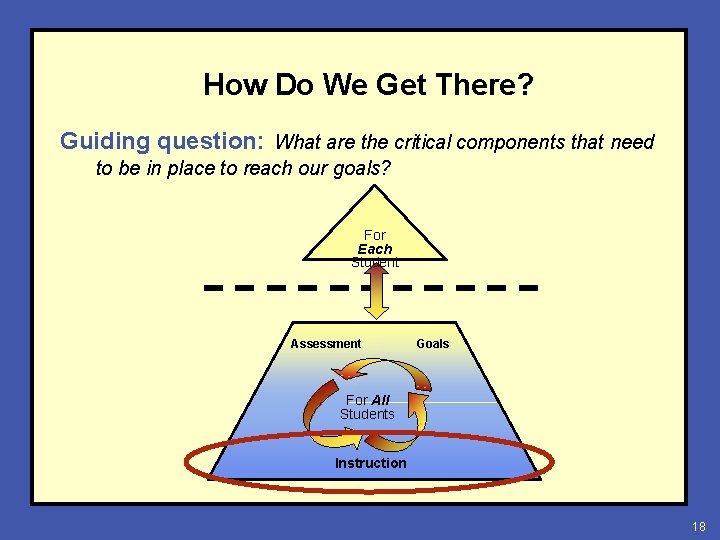
How Do We Get There? Guiding question: What are the critical components that need to be in place to reach our goals? For Each Student Assessment Goals For All Students Instruction 18
How Do We Get There? Why Focus on a Reading Program? Aligning what we know and what we do to maximize outcomes. Ø Unprecedented convergence on skills children need to be successful readers Ø Much classroom practice is shaped by reading programs – Publishers have responded to the research and redesigned programs. – A program provides continuity across classrooms and grades in approach. Ø Many state standards are using research to guide expectations 19
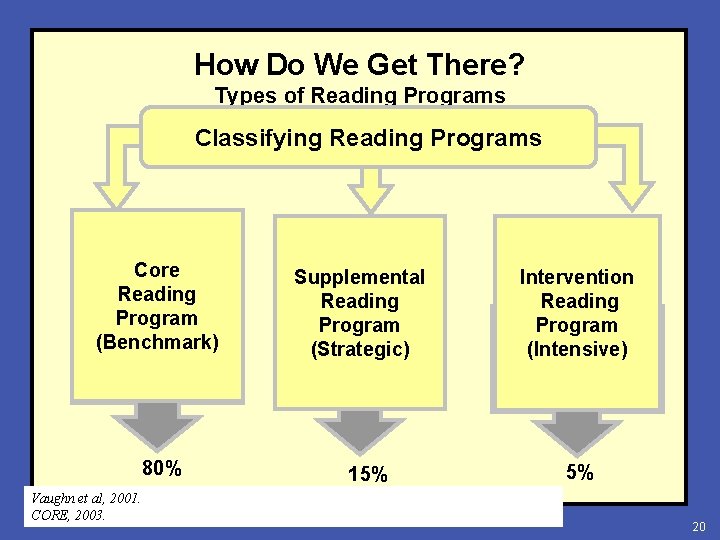
How Do We Get There? Types of Reading Programs Classifying Reading Programs Core Reading Program (Benchmark) 80% Vaughn et al, 2001. CORE, 2003. Supplemental Reading Program (Strategic) 15% Intervention Reading Program (Intensive) 5% 20
How Do We Get There? Types of Reading Programs Ø Core Reading Programs: – Provide instruction on the essential areas of reading for the majority of students Ø Supplemental Programs: – Provide additional instruction in one or more areas of reading (e. g. , phonological awareness, fluency, etc. ) to support the core Ø Intervention Programs: – Provide additional instruction to students performing below grade level on one or more essential instructional skills (e. g. , increasing structure and time to accelerate learning). 21
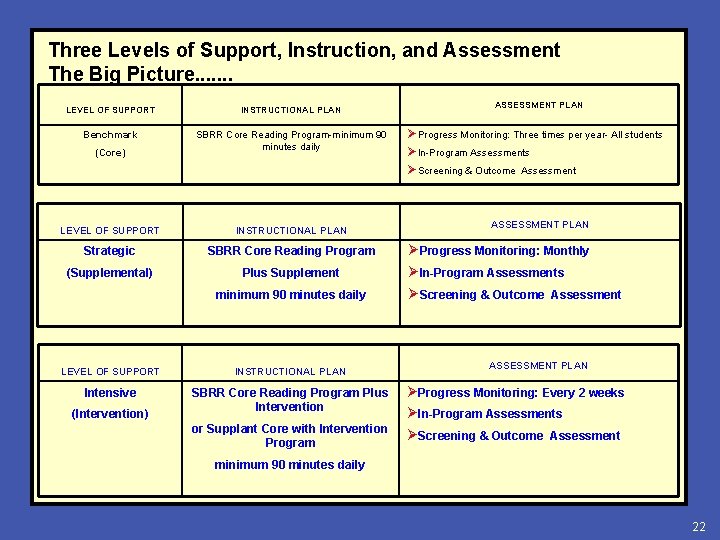
Three Levels of Support, Instruction, and Assessment The Big Picture. . . . LEVEL OF SUPPORT INSTRUCTIONAL PLAN Benchmark SBRR Core Reading Program-minimum 90 minutes daily (Core) LEVEL OF SUPPORT INSTRUCTIONAL PLAN Strategic SBRR Core Reading Program (Supplemental) Plus Supplement minimum 90 minutes daily LEVEL OF SUPPORT INSTRUCTIONAL PLAN Intensive SBRR Core Reading Program Plus Intervention (Intervention) or Supplant Core with Intervention Program ASSESSMENT PLAN ØProgress Monitoring: Three times per year- All students ØIn-Program Assessments ØScreening & Outcome Assessment ASSESSMENT PLAN ØProgress Monitoring: Monthly ØIn-Program Assessments ØScreening & Outcome Assessment ASSESSMENT PLAN ØProgress Monitoring: Every 2 weeks ØIn-Program Assessments ØScreening & Outcome Assessment minimum 90 minutes daily 22
How Do We Get There? Ø Getting to 100% requires going through the bottom 20%. Ø Children who are at reading risk face the “tyranny of time” (Kame’enui, 1998). Ø Assuming students will ‘catch up’ with practice as usual is not wise. Catching up is a low probability occurrence. Ø The bottom 20% will require a very different kind of effort in both the short and long run. 23
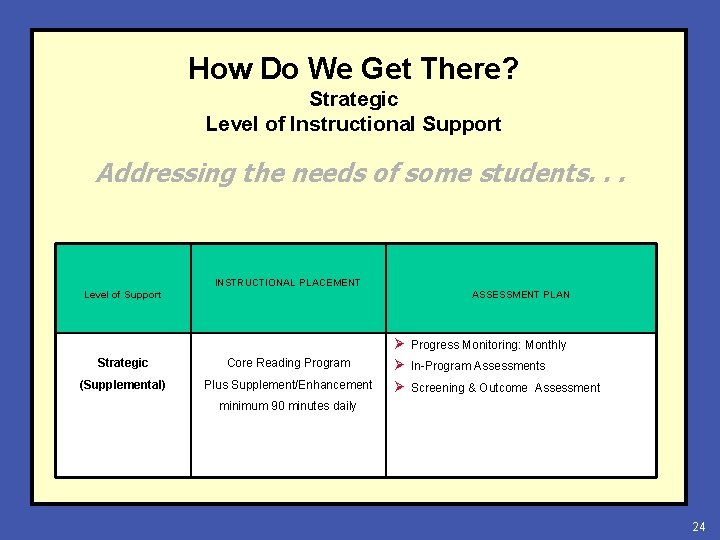
How Do We Get There? Strategic Level of Instructional Support Addressing the needs of some students. . . INSTRUCTIONAL PLACEMENT Level of Support ASSESSMENT PLAN Strategic Core Reading Program (Supplemental) Plus Supplement/Enhancement Ø Ø Ø Progress Monitoring: Monthly In-Program Assessments Screening & Outcome Assessment minimum 90 minutes daily 24
Instructional Adjustments Supplement core with appropriate materials 25
Supplemental Reading Programs . Ø Support and extend the critical elements of a core reading program. Ø Provide additional instruction in one or two areas (i. e. , fill the gaps for phonological awareness, fluency). Ø Provide more instruction or practice in particular area(s) of need. Ø Can often be effective in supporting an identified gap in an otherwise strong core reading program Ø Ø Ø May include large group, small group, one-on-one instruction. Provide more teacher scaffolding. Provide more explicit and systematic instruction. 26
Supplemental Programs 27
Let’s look at some examples. . 28

Touchphonics Video Clip 30

Phonics for Reading Video Clip 32
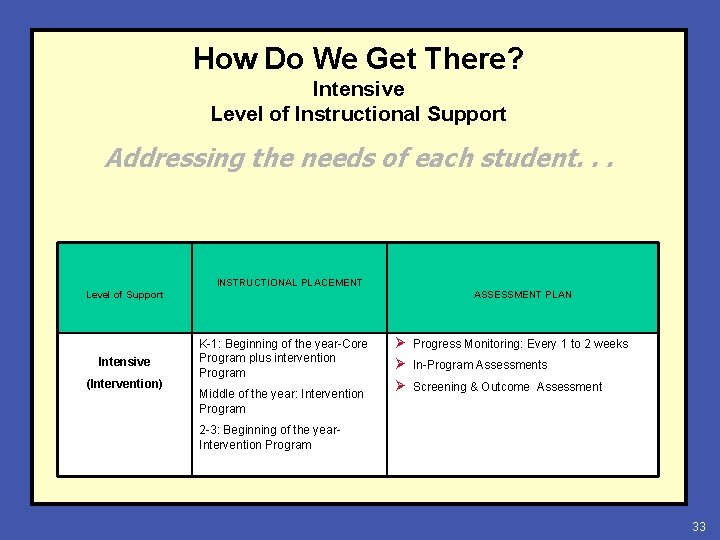
How Do We Get There? Intensive Level of Instructional Support Addressing the needs of each student. . . INSTRUCTIONAL PLACEMENT Level of Support Intensive (Intervention) ASSESSMENT PLAN K-1: Beginning of the year-Core Program plus intervention Program Middle of the year: Intervention Program Ø Ø Ø Progress Monitoring: Every 1 to 2 weeks In-Program Assessments Screening & Outcome Assessment 2 -3: Beginning of the year. Intervention Program 33
Instructional Adjustments Supplement or Replace core with appropriate materials or program 34
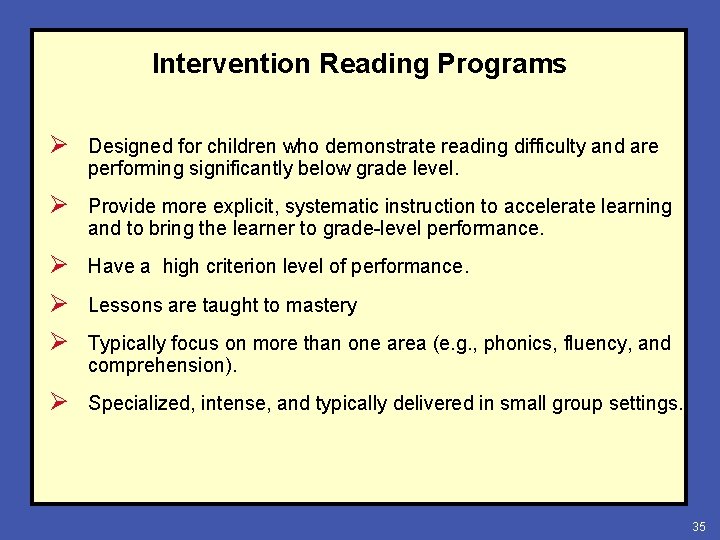
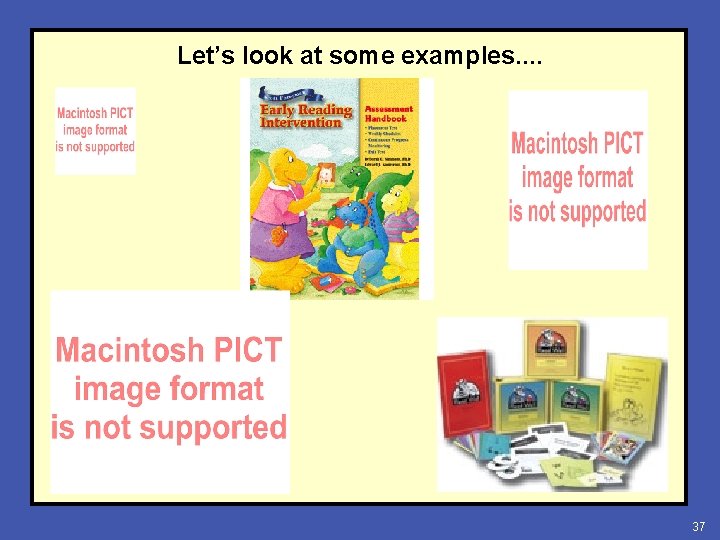
Intervention Reading Programs Ø Designed for children who demonstrate reading difficulty and are performing significantly below grade level. Ø Provide more explicit, systematic instruction to accelerate learning and to bring the learner to grade-level performance. Ø Have a high criterion level of performance. Ø Lessons are taught to mastery Ø Typically focus on more than one area (e. g. , phonics, fluency, and comprehension). Ø Specialized, intense, and typically delivered in small group settings. 35
Intervention Programs 36
Let’s look at some examples. . 37

Early Reading Intervention Video Clip 39

Reading Mastery Video Clip 41



Read Well Video Clip 44

Language for Learning Video Clip 46


Read Naturally Video Clip 48

Horizons Video Clip 50
One Final---But Critical Note. . . . 51
Choose programs with “good bones, ” but once you’ve chosen the program don’t assume good outcomes will follow. 52
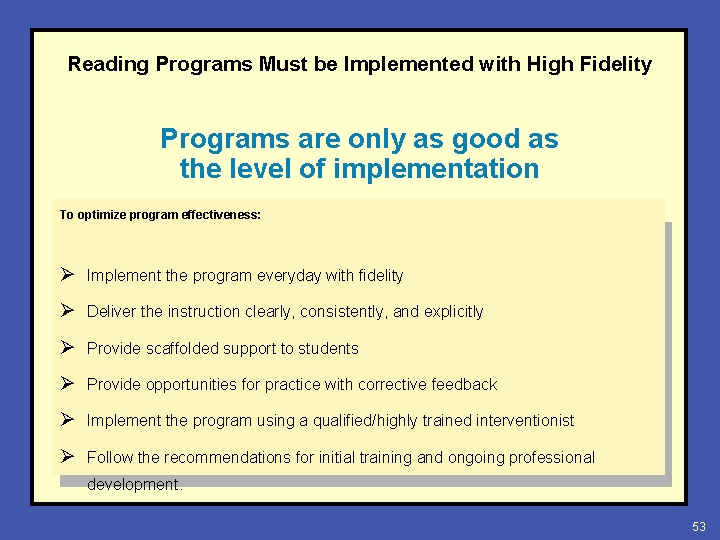
Reading Programs Must be Implemented with High Fidelity Programs are only as good as the level of implementation To optimize program effectiveness: Ø Implement the program everyday with fidelity Ø Deliver the instruction clearly, consistently, and explicitly Ø Provide scaffolded support to students Ø Provide opportunities for practice with corrective feedback Ø Implement the program using a qualified/highly trained interventionist Ø Follow the recommendations for initial training and ongoing professional development. 53
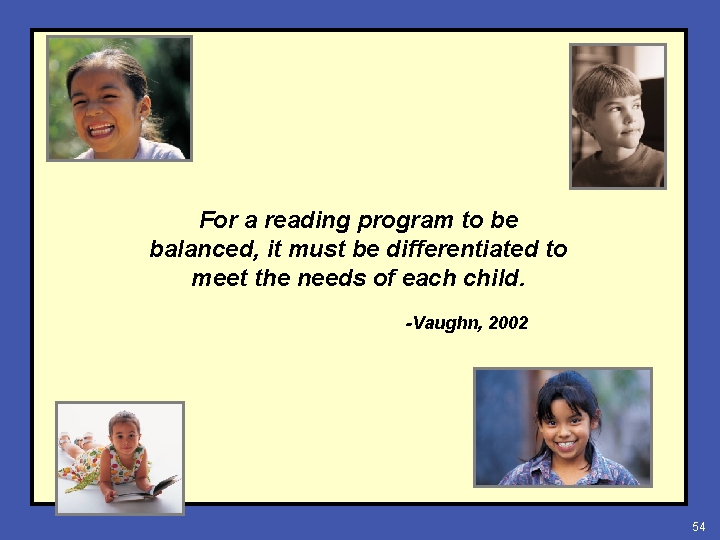
For a reading program to be balanced, it must be differentiated to meet the needs of each child. -Vaughn, 2002 54
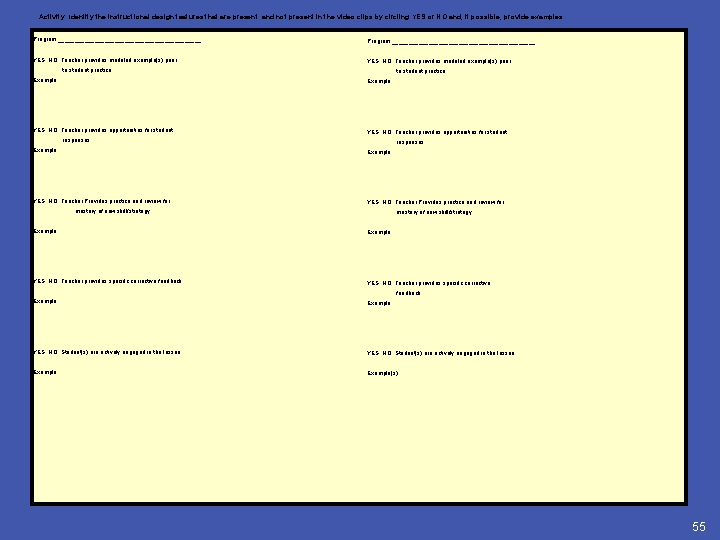
Activity: Identify the instructional design features that are present and not present in the video clips by circling YES or NO and, if possible, provide examples. Program: ___________________________________________ YES NO Teacher provides modeled example(s) prior to student practice. Example: YES NO Teacher provides opportunities for student responses. Example: YES NO Teacher Provides practice and review for mastery of new skill/strategy. Example: YES NO Teacher provides specific corrective feedback. YES NO Teacher provides specific corrective Example: YES NO Student(s) are actively engaged in the lesson. Example: Example(s): feedback. 55
- Slides: 55