
Ordinary Simple and General Annuities Unit 10 Learning
- Slides: 31
Ordinary Simple and General Annuities Unit 10
Learning Objectives • Distinguish between types of annuities based on term, Payment date, and conversion period • Compute the future value for ordinary simple annuities • Compute the present value for ordinary simple annuities • Compute the payment for ordinary simple annuities • Compute the number of periods for ordinary simple annuities • Compute the interest rate for ordinary simple annuities
What is an Annuity? • Definitions • An annuity is a series of payments, usually of equal size, made at periodic intervals • The Payment Interval is the time between the successive payments • The payment period is the length of time from the beginning of the first payment • The term of the annuity is the interval to the end of the last payment interval
Annuity Examples • Examples of annuities: • Residential mortgages • Car loans or leases • Student loan payments • Each of these examples involve equal payments between equal periods of time , for example monthly, bi-monthly etc. • Typical payment periods are monthly, quarterly, semi-annually and yearly
Types of Annuities 1. 2. 3. 4. 5. Simple and general annuities Ordinary annuities and annuities due Deferred annuities Perpetuities Annuities certain and contingent annuities
Types of Annuities • Simple and general annuities • In a simple annuity, the conversion period is the same length as the payment interval • An example is when there are monthly payments on a loan for which the interest is compounded monthly • We will discuss this type on the current set of slides • In a general annuity, the conversion period and the payment interval are not equal • For a residential mortgage, interest is compounded semiannually but payments may be made monthly, semi-monthly, bi-weekly, or weekly • We will discuss this type on the next set of annuity slides
Types of Annuities • Ordinary annuities and annuities due • In an ordinary annuity, payments are made at the end of each payment period • Loan payments, mortgage payments, and interest payments on bonds are all examples of ordinary annuities • In an annuity due, payments are made at the beginning of each payment period • Examples of annuities due include lease rental payments on real estate or equipment • Car leases
Types of Annuities • Deferred annuities • The first payment is delayed for a period of time • Example: A severance amount may be deposited into a fund that earns interest, and then later converted into another fund that pays out a series of payments until the fund is exhausted • Don’t pay until______ sales • Really just a combination of compound interest and annuity concepts
Types of Annuities • Perpetuities • An annuity for which the payments continue forever • When the size of the periodic payment from a fund is equal to or less than the periodic interest earned by the fund a perpetuity is the result • Example: An endowment fund to a university or a continuous benefit from a capital investment, UK gilts (these have reappeared).
Types of Annuities • Annuities certain and contingent annuities • If both the beginning date and ending date of an annuity are known, indicating a fixed term, the classification is an annuity certain • Example: lease payments on equipment, instalment payments on loans, and interest payments on bonds • If the beginning date, the ending date, or both, are unknown, the classification is a contingent annuity • Example: life insurance premiums or pension payments – dependent on an event like retiring which doesn’t necessarily happen on a date certain.
Ordinary Simple Annuity • Payments are made at the end of each payment interval (Ordinary) and the interest conversion period and payment interval are the same (Simple)
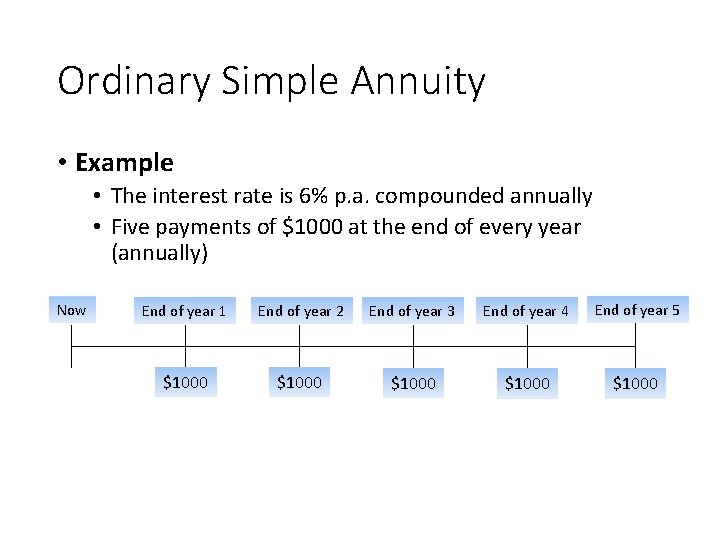
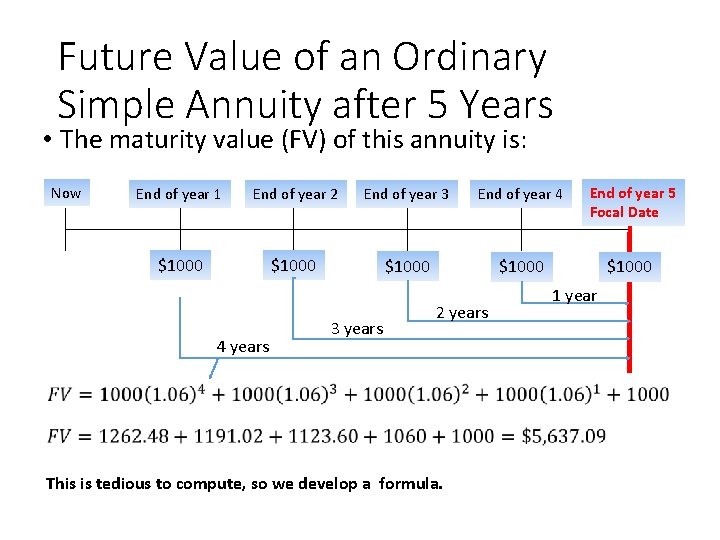
Ordinary Simple Annuity • Example • The interest rate is 6% p. a. compounded annually • Five payments of $1000 at the end of every year (annually) Now End of year 1 End of year 2 End of year 3 End of year 4 End of year 5 $1000 $1000
Future Value of an Ordinary Simple Annuity after 5 Years • The maturity value (FV) of this annuity is: Now End of year 1 End of year 2 End of year 3 End of year 4 End of year 5 Focal Date $1000 $1000 4 years 3 years 2 years This is tedious to compute, so we develop a formula. 1 year
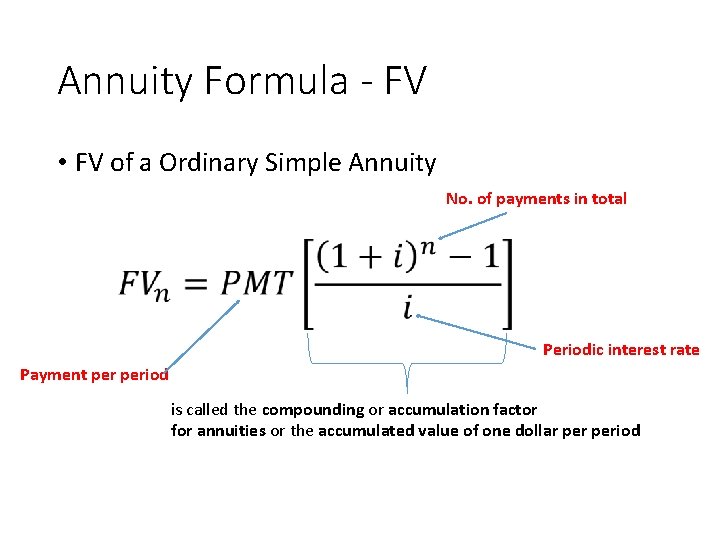
Annuity Formula - FV • FV of a Ordinary Simple Annuity No. of payments in total Periodic interest rate Payment period is called the compounding or accumulation factor for annuities or the accumulated value of one dollar period
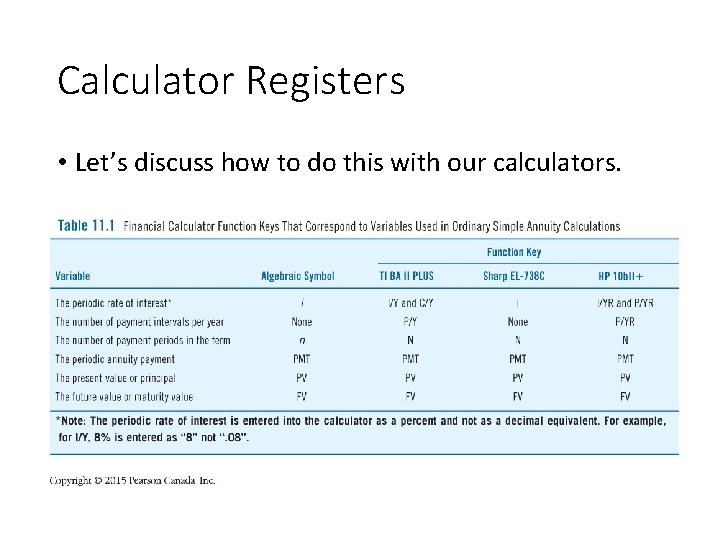
Calculator Registers • Let’s discuss how to do this with our calculators.
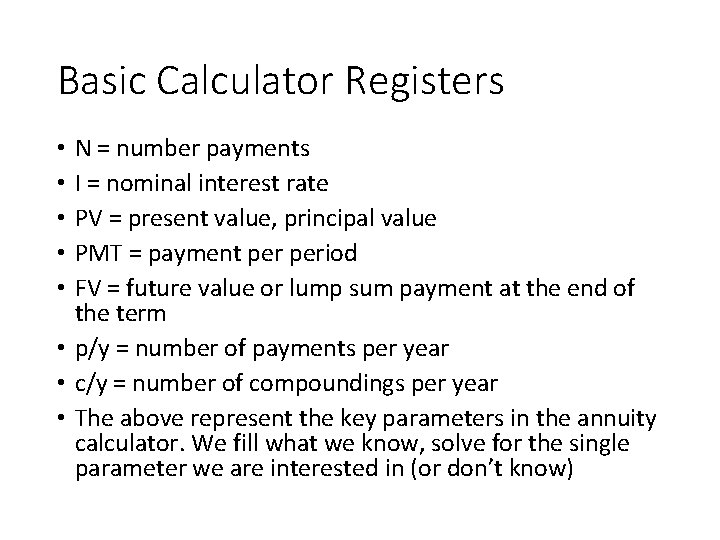
Basic Calculator Registers N = number payments I = nominal interest rate PV = present value, principal value PMT = payment period FV = future value or lump sum payment at the end of the term • p/y = number of payments per year • c/y = number of compoundings per year • The above represent the key parameters in the annuity calculator. We fill what we know, solve for the single parameter we are interested in (or don’t know) • • •
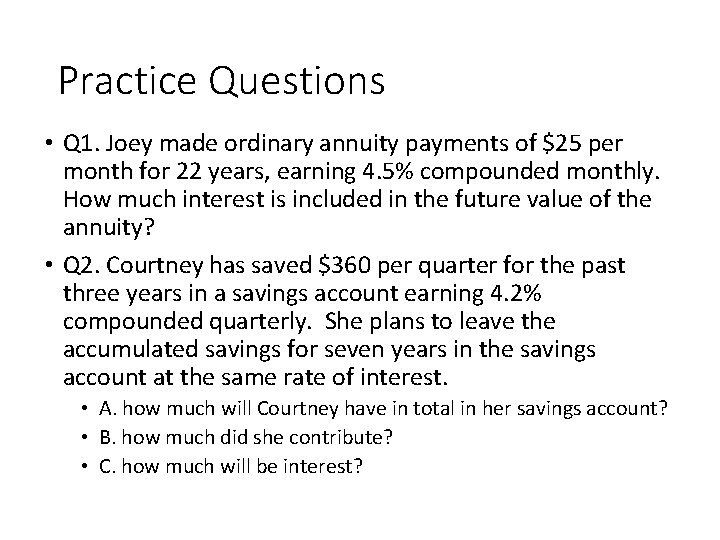
Practice Questions • Q 1. Joey made ordinary annuity payments of $25 per month for 22 years, earning 4. 5% compounded monthly. How much interest is included in the future value of the annuity? • Q 2. Courtney has saved $360 per quarter for the past three years in a savings account earning 4. 2% compounded quarterly. She plans to leave the accumulated savings for seven years in the savings account at the same rate of interest. • A. how much will Courtney have in total in her savings account? • B. how much did she contribute? • C. how much will be interest?
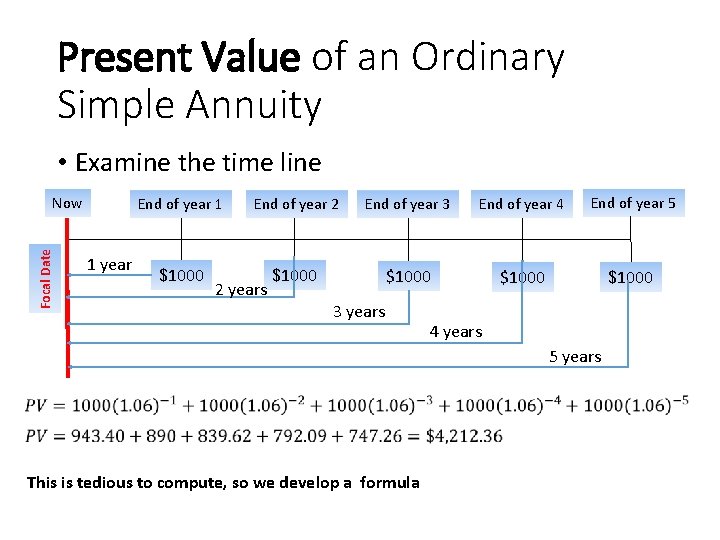
Present Value of an Ordinary Simple Annuity • Examine the time line Focal Date Now 1 year End of year 1 End of year 2 End of year 3 End of year 4 End of year 5 $1000 $1000 2 years 3 years 4 years 5 years This is tedious to compute, so we develop a formula
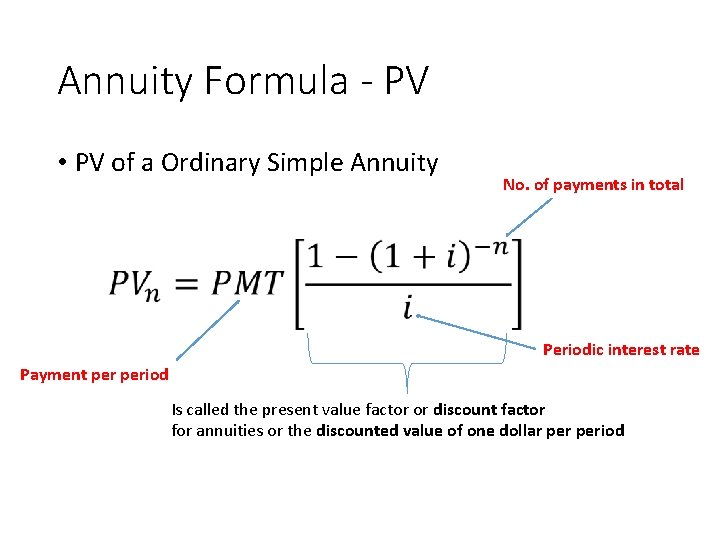
Annuity Formula - PV • PV of a Ordinary Simple Annuity No. of payments in total Periodic interest rate Payment period Is called the present value factor or discount factor for annuities or the discounted value of one dollar period
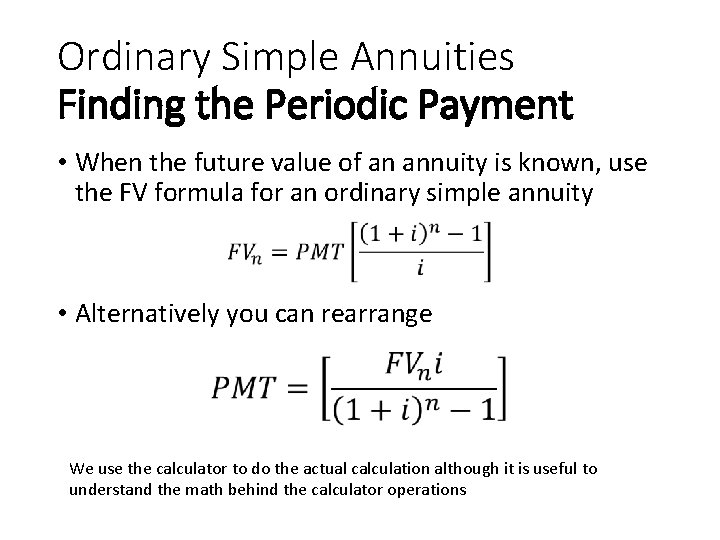
Ordinary Simple Annuities Finding the Periodic Payment • When the future value of an annuity is known, use the FV formula for an ordinary simple annuity • Alternatively you can rearrange We use the calculator to do the actual calculation although it is useful to understand the math behind the calculator operations
Applications • A small initial payment on a large loan for a purchase (for example a property) is called a down payment • A mortgage loan from a financial institution is needed to supply the balance of the purchase price • The amount of the loan is the present value of the future periodic payments
Applications • The cash value is the price of the property at the date of purchase (paid now) • CASH VALUE = DOWN PAYMENT + PRESENT VALUE OF THE PERIODIC PAYMENTS
Practice Questions • Q 1. A sales contract for the purchase of a car requires payments of $352. 17 at the end of each month for the next four years. Suppose interest is 6. 4% p. a. compounded monthly. • A. what is the amount financed? (same as asking for PV) • B. how much is the interest cost?
More Practice Questions • Q 2. Bird Construction agreed to lease payments of $742. 79 on construction equipment to be made at the end of each month for three years. Financing is at 7% compounded monthly. • A. what is the value of the original lease contract? • B. if, due to delays, the first eight payments were deferred, how much money would be needed after nine months to bring the lease payments up to date? • C. how much money would be required to pay off the lease after nine months (assuming no payments were made)?
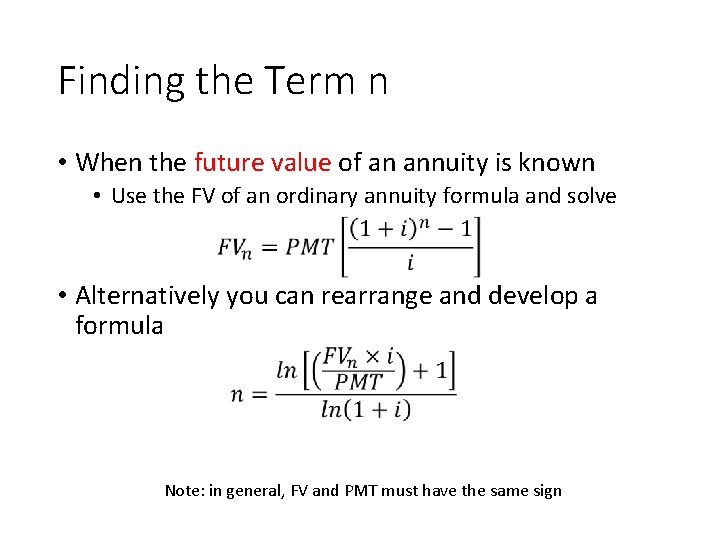
Finding the Term n • When the future value of an annuity is known • Use the FV of an ordinary annuity formula and solve • Alternatively you can rearrange and develop a formula Note: in general, FV and PMT must have the same sign
Finding the Periodic Rate of Interest i • Preprogrammed financial calculators are especially helpful when solving for the conversion rate I (periodic interest rate) • Determining i without a financial calculator is extremely time-consuming
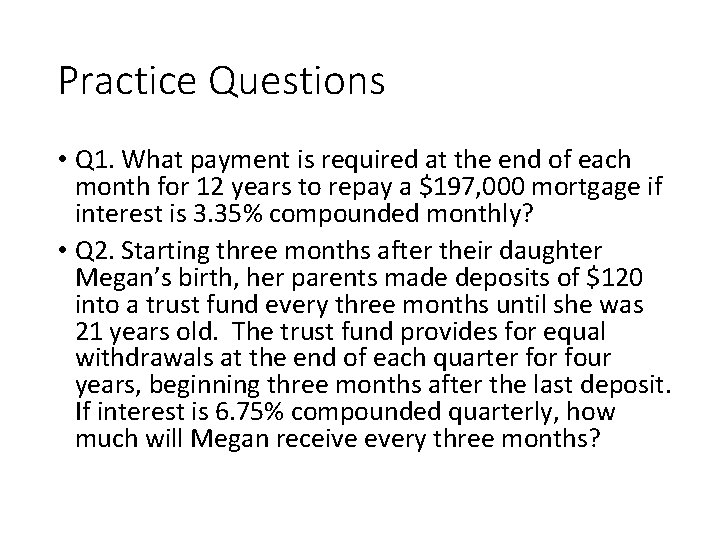
Practice Questions • Q 1. What payment is required at the end of each month for 12 years to repay a $197, 000 mortgage if interest is 3. 35% compounded monthly? • Q 2. Starting three months after their daughter Megan’s birth, her parents made deposits of $120 into a trust fund every three months until she was 21 years old. The trust fund provides for equal withdrawals at the end of each quarter four years, beginning three months after the last deposit. If interest is 6. 75% compounded quarterly, how much will Megan receive every three months?
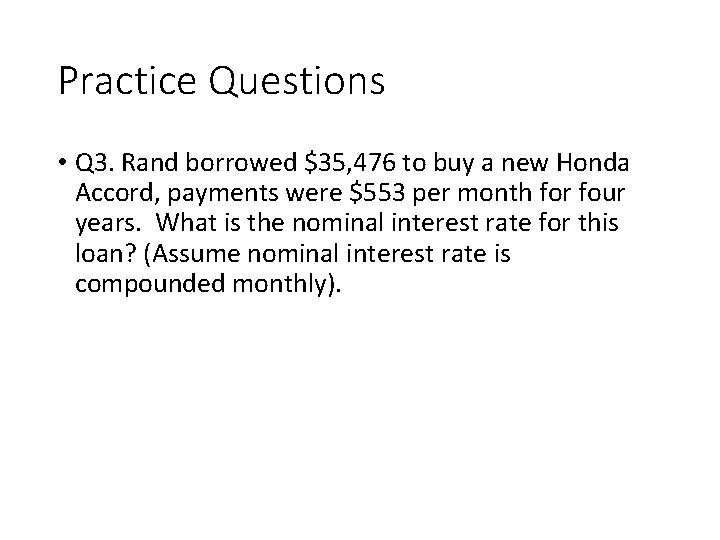
Practice Questions • Q 3. Rand borrowed $35, 476 to buy a new Honda Accord, payments were $553 per month for four years. What is the nominal interest rate for this loan? (Assume nominal interest rate is compounded monthly).
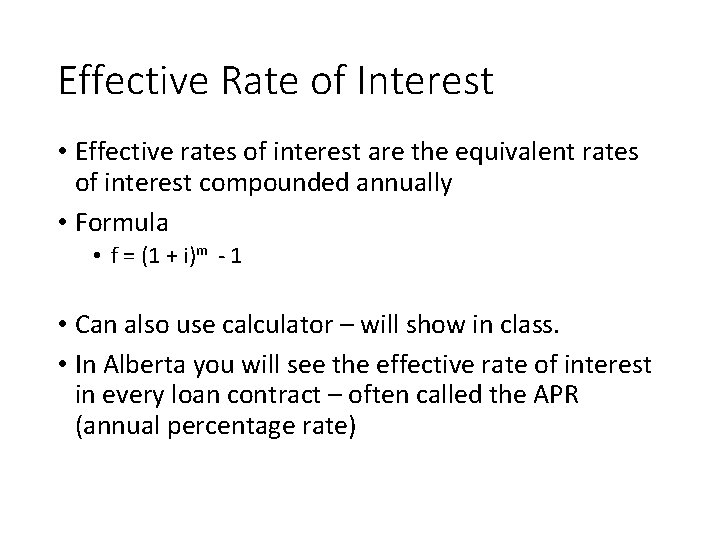
Effective Rate of Interest • Effective rates of interest are the equivalent rates of interest compounded annually • Formula • f = (1 + i)m - 1 • Can also use calculator – will show in class. • In Alberta you will see the effective rate of interest in every loan contract – often called the APR (annual percentage rate)
Ordinary General Annuity • Similar to simple annuities except p/y ≠ c/y • On the calculator we change p/y first then c/y. • See next set of annuity slides for details.
Summary • The ordinary simple annuity satisfies the following two conditions: • Payments are made at the end of the interest conversion interval with the first payment at the end of the first interval ( Ordinary) • The payment period interval and the interest conversion interval are equal (Simple) • Payments, number of payments can be solved using the appropriate version of the PMT and n formulas (FV or PV) • Solving for the conversion rate (periodic rate) i is tedious manually and is best solved using a programmed solution