
Ordinary irreversible computation can be viewed as an
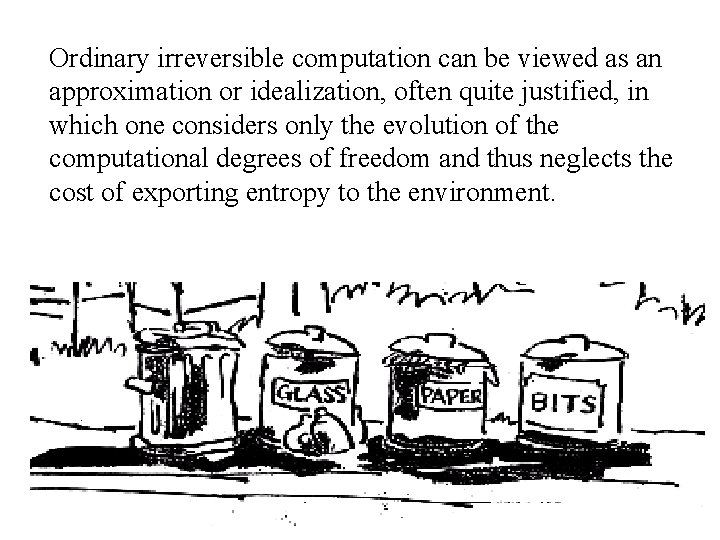
Ordinary irreversible computation can be viewed as an approximation or idealization, often quite justified, in which one considers only the evolution of the computational degrees of freedom and thus neglects the cost of exporting entropy to the environment.
Why study reversible classical computing, when Landauer erasure cost is negligible compared to other sources of dissipation in today’s computers? • Practice for quantum computing • Improving thermodynamic efficiency of computing at the practical ½ CV 2 level (rather than the k. T level) • Understanding ultimate limits and scaling of computation and, by extension, self-organization
Heat generation is a serious problem in today’s computers, limiting packing density and therefore performance. Making gates less dissipative, even if slower, can sometimes increase performance FLOPS/watt, while reduced clock speed is offset by increased parallelism • Resonant clock to reduce ½ CV 2 losses from non-adiabatic switching • Thicker gates to reduce gate leakage current • More conductive materials to reduce I 2 R resistive losses (talks by Michael Frank today and Tom Theis on Wednesday)
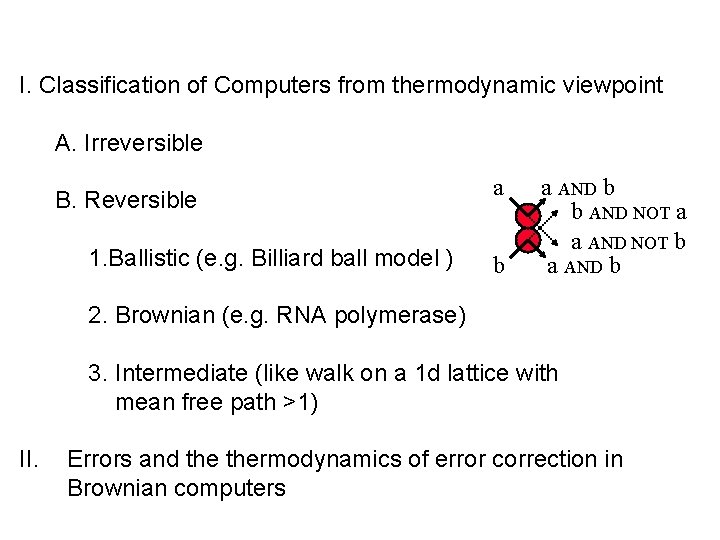
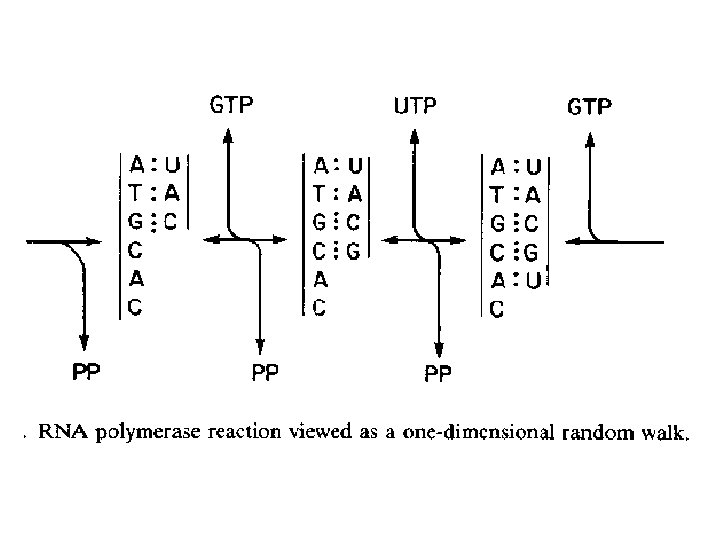
I. Classification of Computers from thermodynamic viewpoint A. Irreversible B. Reversible 1. Ballistic (e. g. Billiard ball model ) a b a AND b b AND NOT a a AND NOT b a AND b 2. Brownian (e. g. RNA polymerase) 3. Intermediate (like walk on a 1 d lattice with mean free path >1) II. Errors and thermodynamics of error correction in Brownian computers
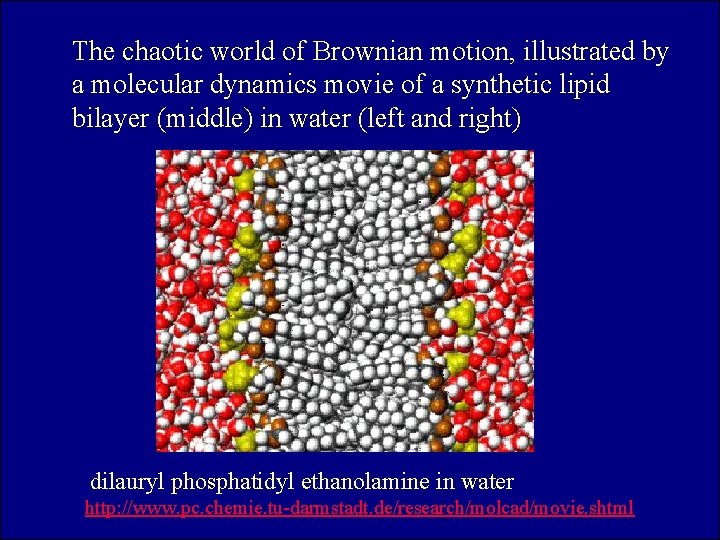
The chaotic world of Brownian motion, illustrated by a molecular dynamics movie of a synthetic lipid bilayer (middle) in water (left and right) dilauryl phosphatidyl ethanolamine in water http: //www. pc. chemie. tu-darmstadt. de/research/molcad/movie. shtml
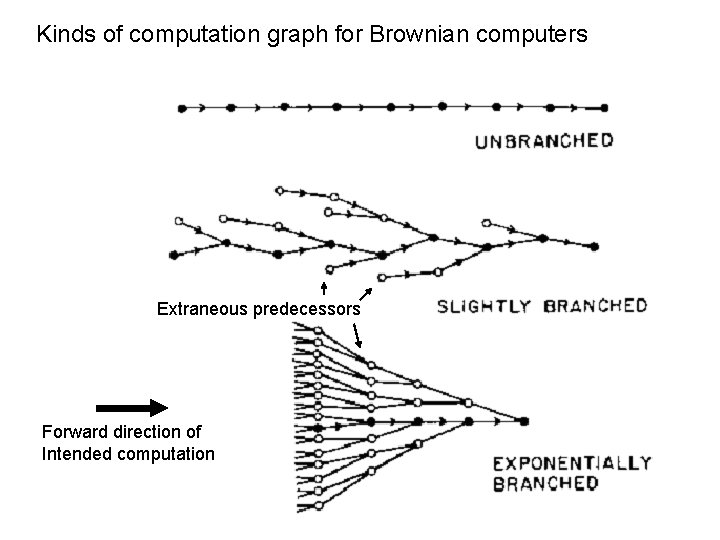
Kinds of computation graph for Brownian computers Extraneous predecessors Forward direction of Intended computation
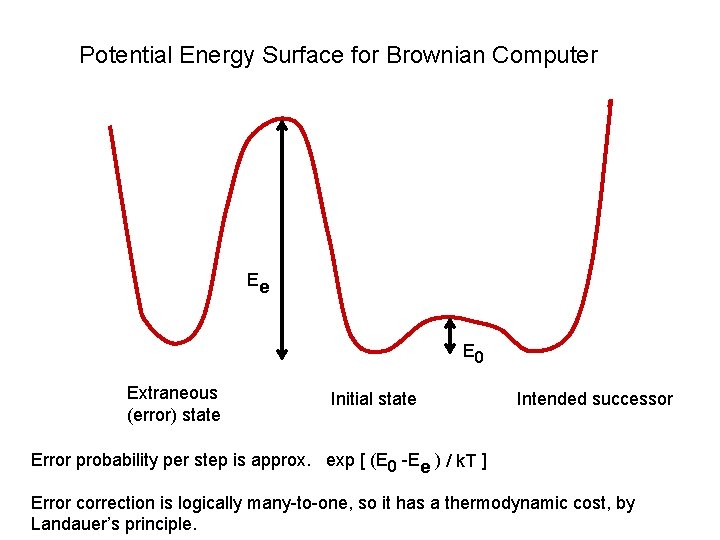
Potential Energy Surface for Brownian Computer Ee E 0 Extraneous (error) state Initial state Intended successor Error probability per step is approx. exp [ (E 0 -Ee ) / k. T ] Error correction is logically many-to-one, so it has a thermodynamic cost, by Landauer’s principle.
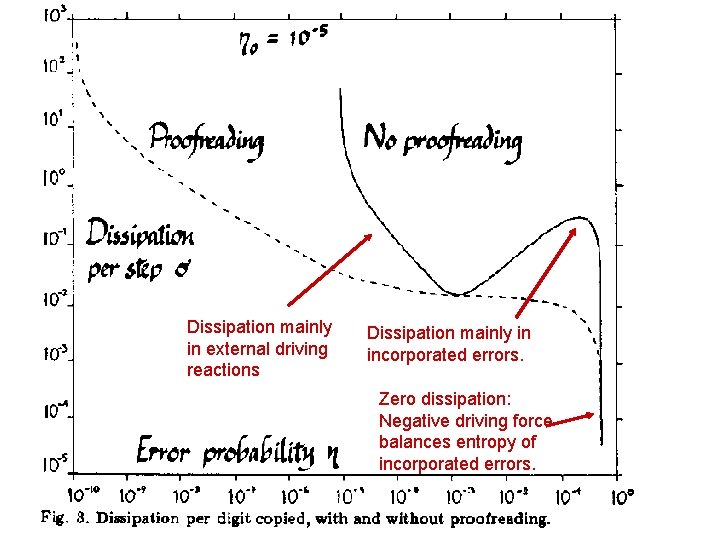
Dissipation mainly in external driving reactions Dissipation mainly in incorporated errors. Zero dissipation: Negative driving force balances entropy of incorporated errors.
For any given hardware environment, e. g. CMOS, DNA polymerase, there will be some tradeoff among dissipation, error, and computation rate. More complicated hardware might reduce the error, and/or increase the amount of computation done per unit energy dissipated. This tradeoff is largely unexplored, except by engineers.
Ultimate scaling of computation. Obviously a 3 dimensional computer that produces heat uniformly throughout its volume is not scalable. A 1 - or 2 - dimensional computer can dispose of heat by radiation, if it is warmer than 3 K. Conduction won’t work unless a cold reservoir is nearby. Convection is more complicated, involving gravity, hydrodynamics, and equation of state of the coolant fluid.
Fortunately 1 and 2 - dimensional fault tolerant universal computers exist: i. e. cellular automata that correct errors by a self-organized hierarchy of majority voting in larger and larger blocks, even though all local transition probabilities are positive. (P. Gacs math. PR/0003117) (For quantum computations, two dimensions appear sufficient for fault tolerance (J. Harrington Poster 2002 PASI conference, Buzios, Brazil))
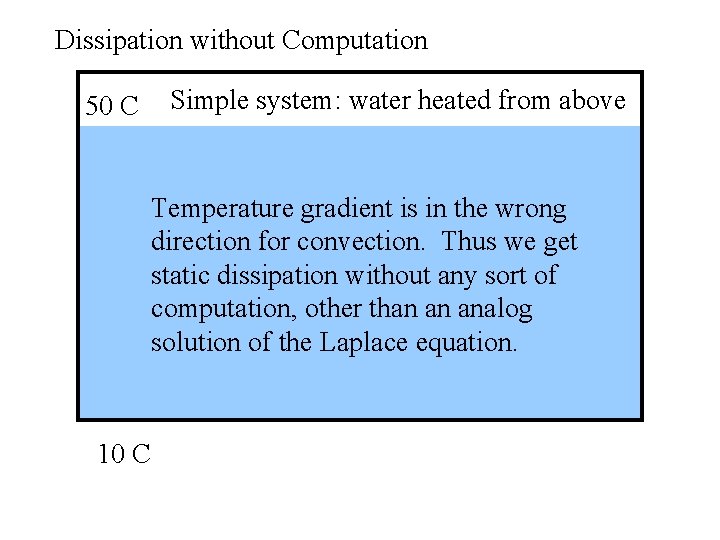
Dissipation without Computation 50 C Simple system: water heated from above Temperature gradient is in the wrong direction for convection. Thus we get static dissipation without any sort of computation, other than an analog solution of the Laplace equation. 10 C
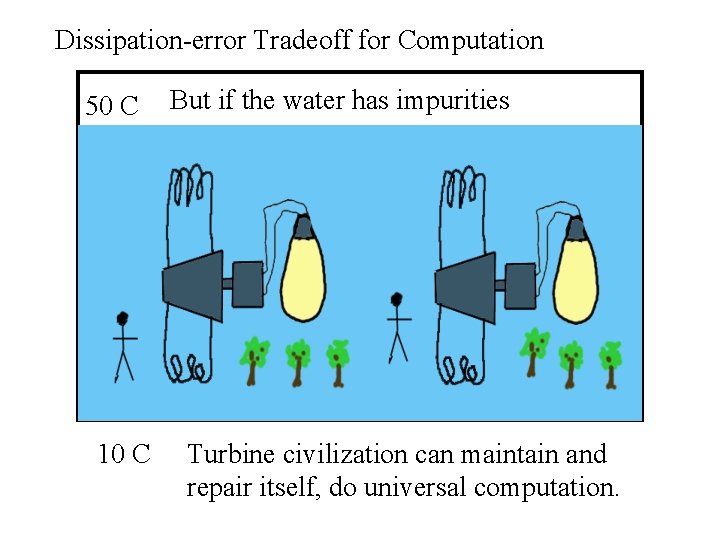
Dissipation-error Tradeoff for Computation 50 C 10 C But if the water has impurities Turbine civilization can maintain and repair itself, do universal computation.
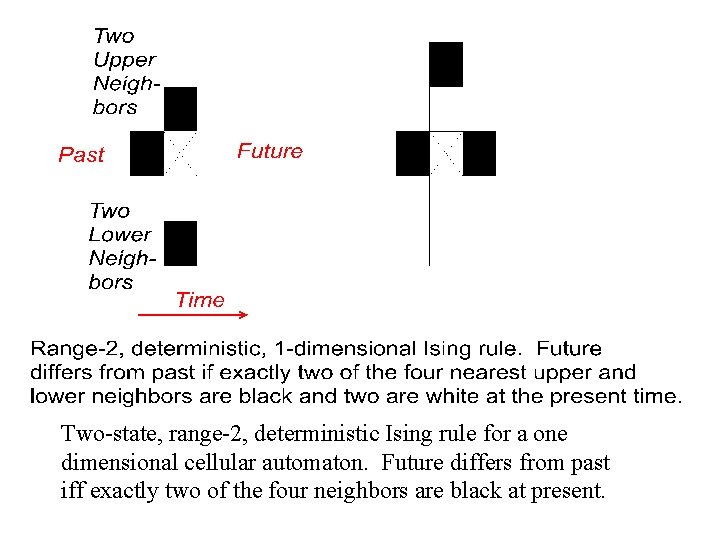
Two-state, range-2, deterministic Ising rule for a one dimensional cellular automaton. Future differs from past iff exactly two of the four neighbors are black at present.
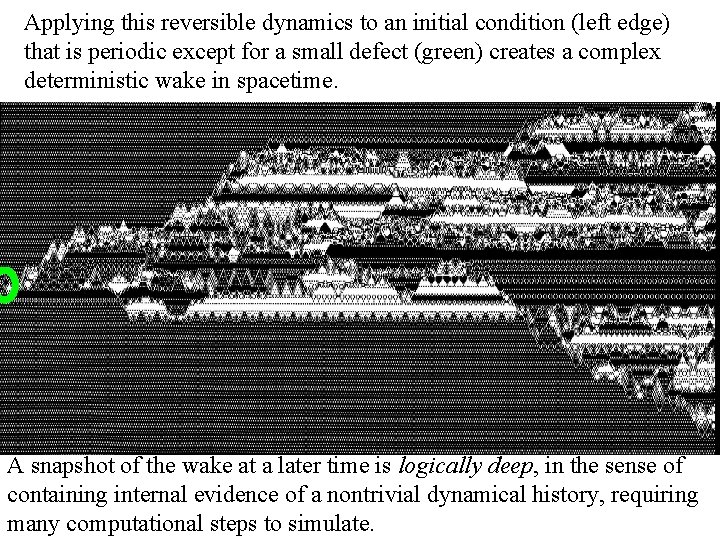
Applying this reversible dynamics to an initial condition (left edge) that is periodic except for a small defect (green) creates a complex deterministic wake in spacetime. A snapshot of the wake at a later time is logically deep, in the sense of containing internal evidence of a nontrivial dynamical history, requiring many computational steps to simulate.
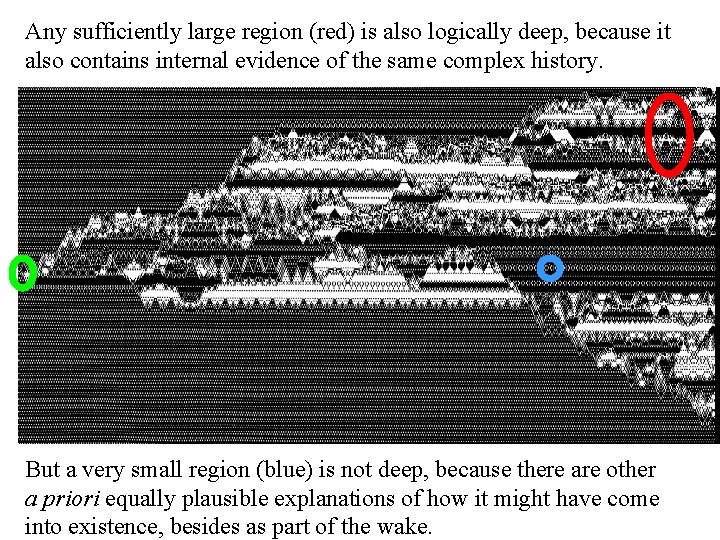
Any sufficiently large region (red) is also logically deep, because it also contains internal evidence of the same complex history. But a very small region (blue) is not deep, because there are other a priori equally plausible explanations of how it might have come into existence, besides as part of the wake.
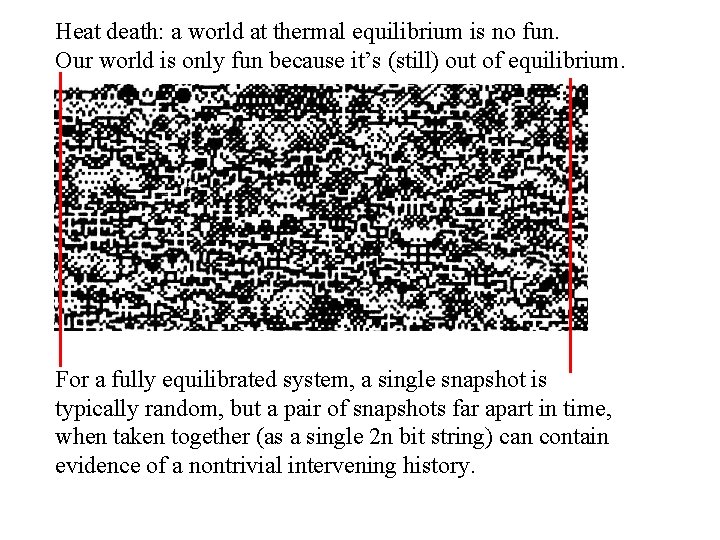
Heat death: a world at thermal equilibrium is no fun. Our world is only fun because it’s (still) out of equilibrium. For a fully equilibrated system, a single snapshot is typically random, but a pair of snapshots far apart in time, when taken together (as a single 2 n bit string) can contain evidence of a nontrivial intervening history.
IBM Yorktown Quantum Information Group Staff: Nabil Amer (manager) CHB David Di. Vincenzo John Smolin Barbara Terhal Postdocs: Roberto Oliveira Sergey Bravyi (Igor Devetak) (Guido Burkard) (Debbie Leung) Present & Former Grad Students Aram Harrow Patrick Hayden Ashish Thapliyal Krysta Svore Collaborators Andrew Childs Michal & Pawel Horodecki Jonathan Oppenheim Daniel Loss Peter Shor Andreas Winter …
Lipid bilayer MD dilaurylphosphatidylethanolamine http: //www. pc. chemie. tu-darmstadt. de/research/molcad/movie. shtml Bennett, Charles H. , "Dissipation-Error Tradeoff in Proofreading" Bio. Systems 11, 85 -91 (1979) C. H. Bennett "The Thermodynamics of Computation-- a Review" Internat. J. Theoret. Phys. 21, pp. 905 -940 (1982). http: //www. research/ibm. com/people/b/bennetc
(the end)
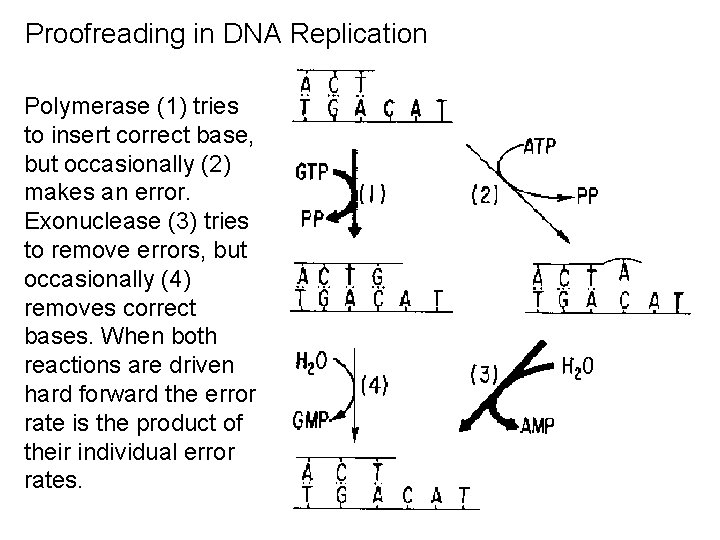
Proofreading in DNA Replication Polymerase (1) tries to insert correct base, but occasionally (2) makes an error. Exonuclease (3) tries to remove errors, but occasionally (4) removes correct bases. When both reactions are driven hard forward the error rate is the product of their individual error rates.

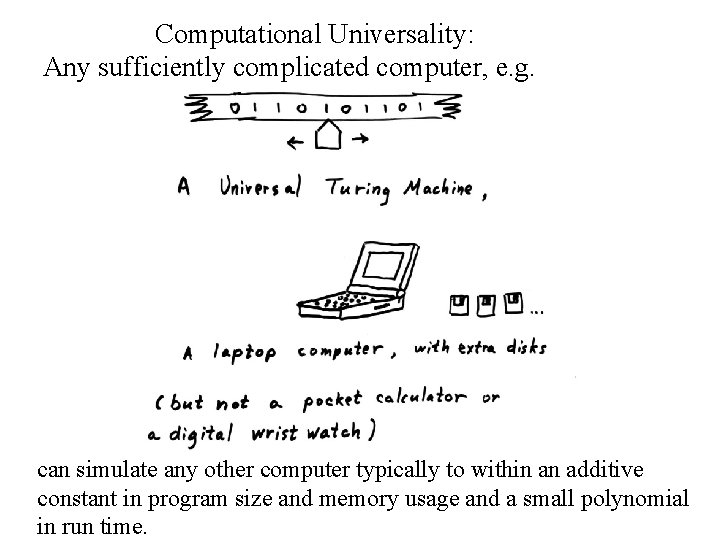
Computational Universality: Any sufficiently complicated computer, e. g. can simulate any other computer typically to within an additive constant in program size and memory usage and a small polynomial in run time.
- Slides: 25