
Ordinal Number 2019 CONTENTS 1 D in f

Ordinal Number 2019 匡亚明学院 方宇航

CONTENTS 1 D in f e n o i it 2 Tr an te i in f s 3 A m h t ri ic t e 4 r a C ls a n di
1 PART 01 D e fin itio n 1、Equivalence class 2、Well-ordered sets 3、Von Neumann definition













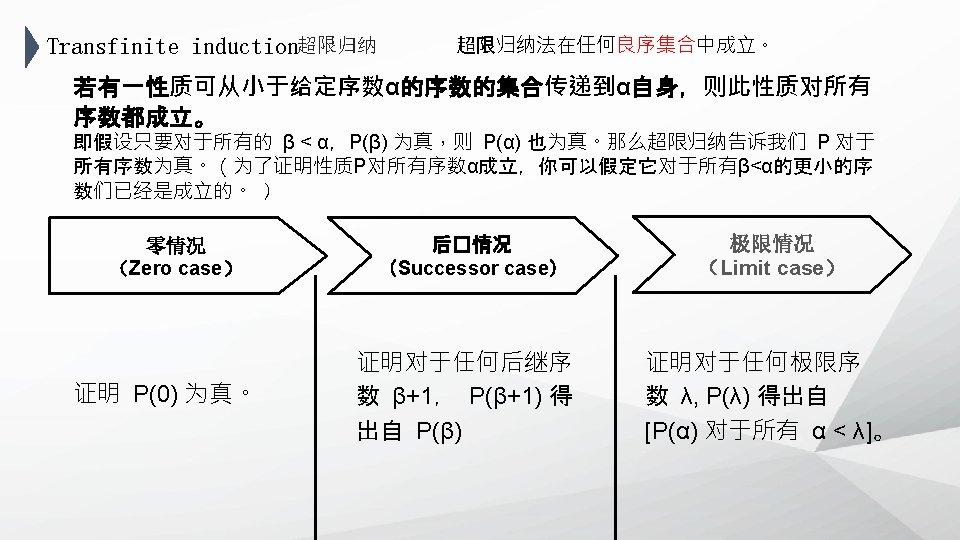
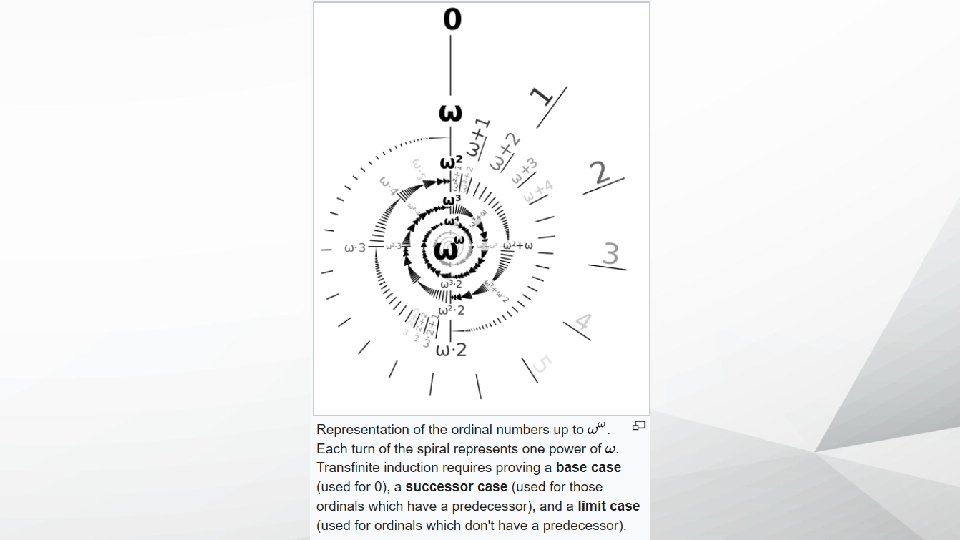
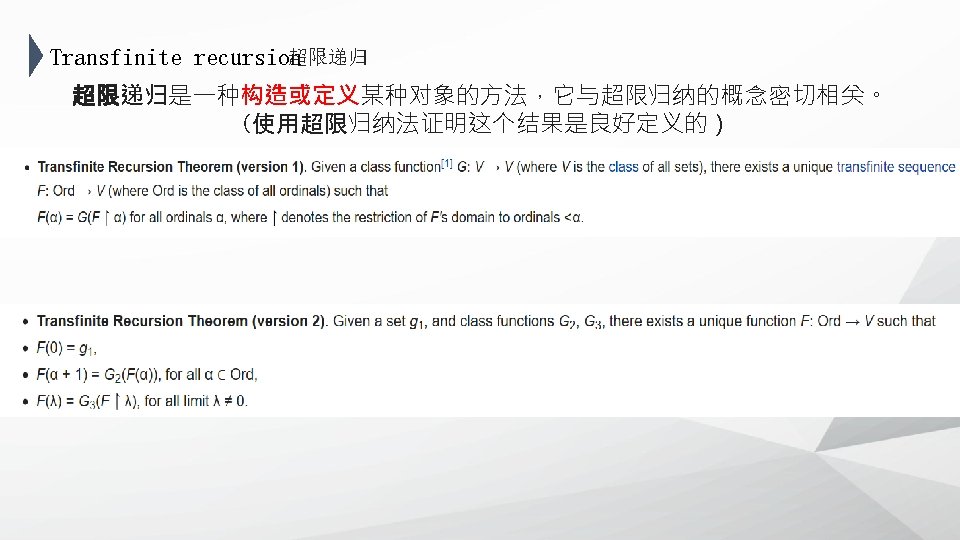
2 PART 02 T r a n s f in it e 1、transfinite induction 2、transfinite recursion
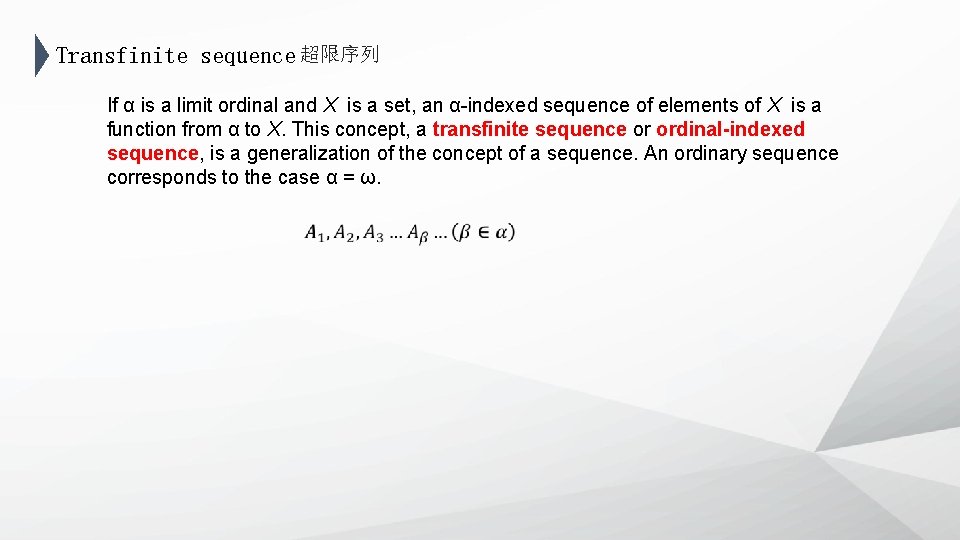
Transfinite sequence 超限序列 If α is a limit ordinal and X is a set, an α-indexed sequence of elements of X is a function from α to X. This concept, a transfinite sequence or ordinal-indexed sequence, is a generalization of the concept of a sequence. An ordinary sequence corresponds to the case α = ω.
3 PART 03 A r ith m e tic 1、Addition 2、Multiplication 3、Exponentiation 4、Cantor normal form 5、Factorization into primes
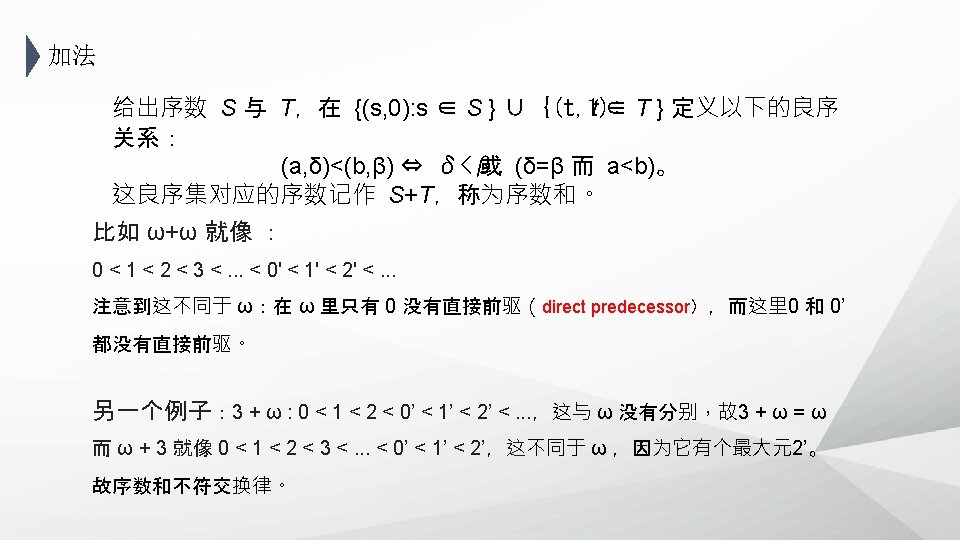
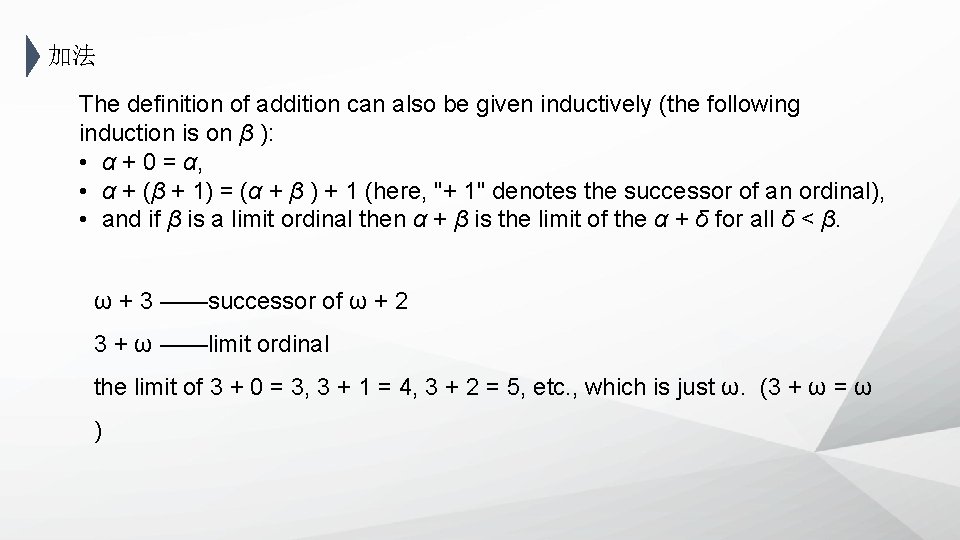
加法 The definition of addition can also be given inductively (the following induction is on β ): • α + 0 = α, • α + (β + 1) = (α + β ) + 1 (here, "+ 1" denotes the successor of an ordinal), • and if β is a limit ordinal then α + β is the limit of the α + δ for all δ < β. ω + 3 ——successor of ω + 2 3 + ω ——limit ordinal the limit of 3 + 0 = 3, 3 + 1 = 4, 3 + 2 = 5, etc. , which is just ω. (3 + ω = ω )
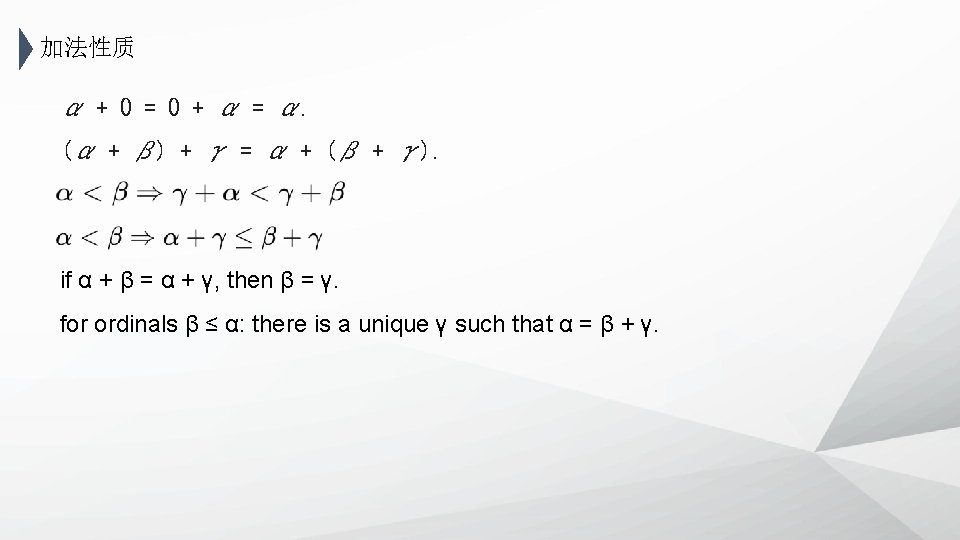
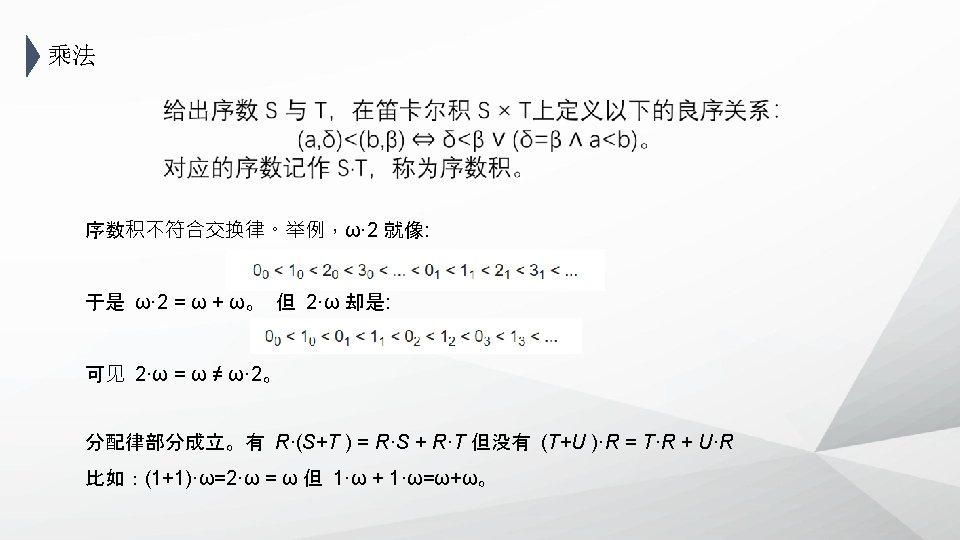
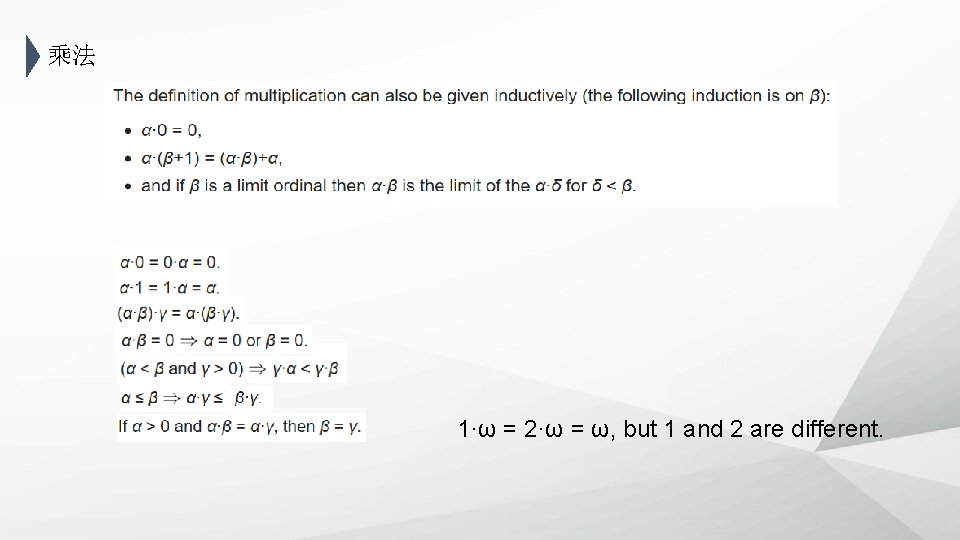
乘法 1·ω = 2·ω = ω, but 1 and 2 are different.

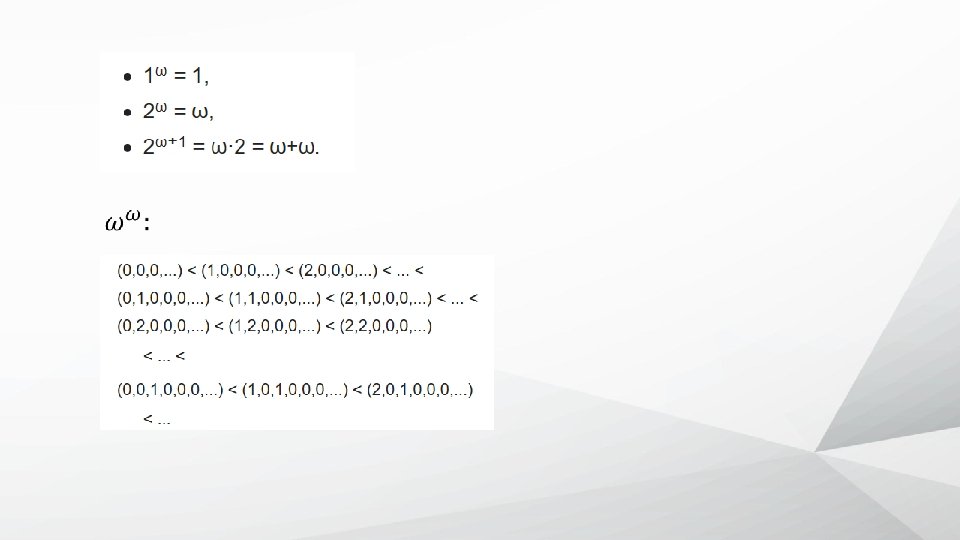
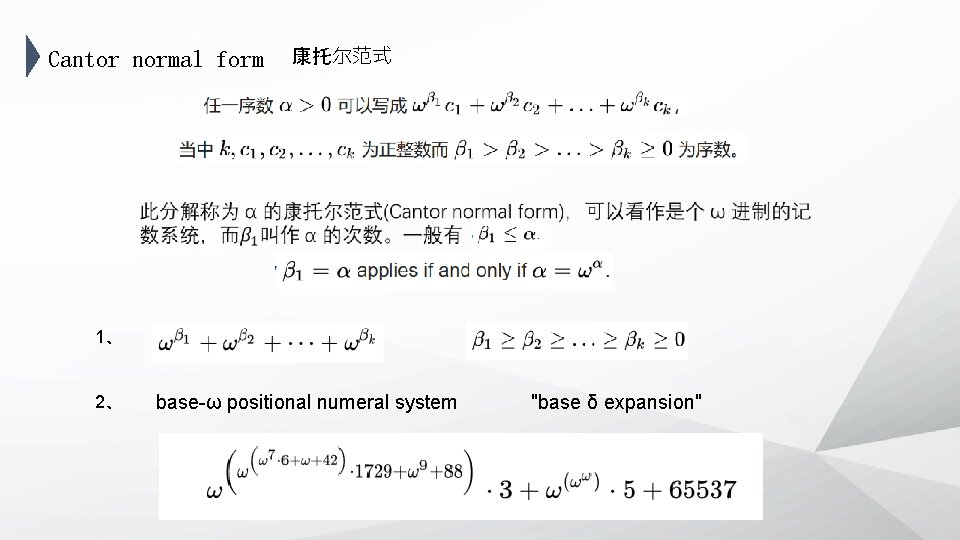
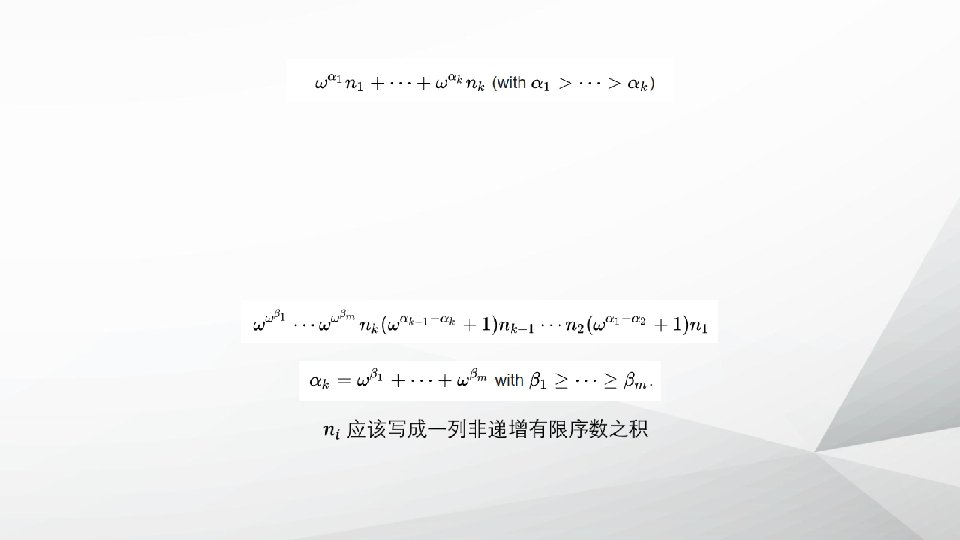
Cantor normal form 康托尔范式 1、 2、 base-ω positional numeral system "base δ expansion"
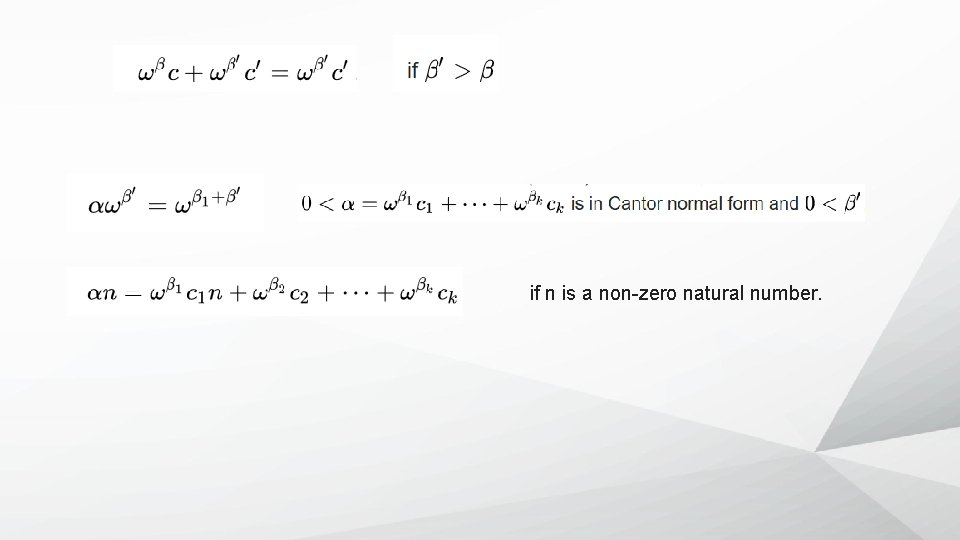
if n is a non-zero natural number.
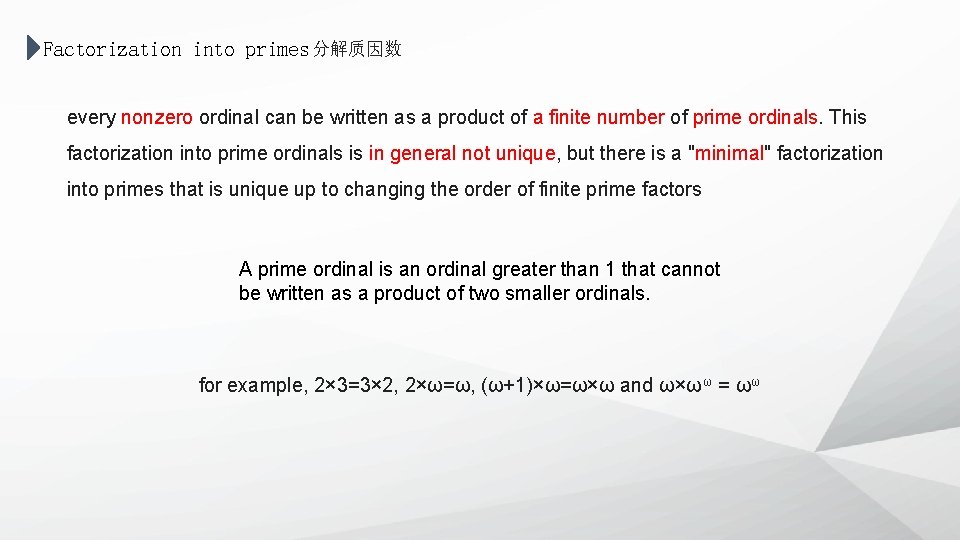
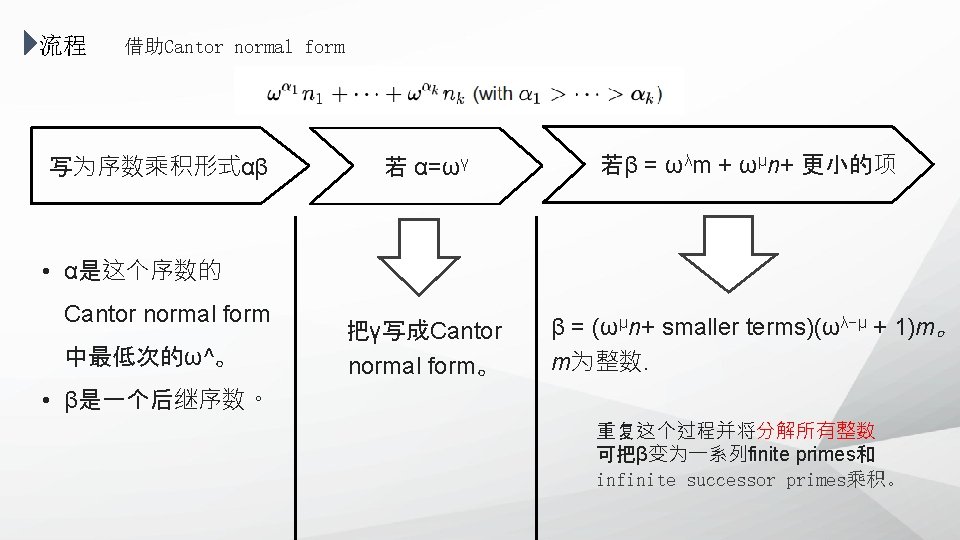
Factorization into primes 分解质因数 every nonzero ordinal can be written as a product of a finite number of prime ordinals. This factorization into prime ordinals is in general not unique, but there is a "minimal" factorization into primes that is unique up to changing the order of finite prime factors A prime ordinal is an ordinal greater than 1 that cannot be written as a product of two smaller ordinals. for example, 2× 3=3× 2, 2×ω=ω, (ω+1)×ω=ω×ω and ω×ωω = ωω
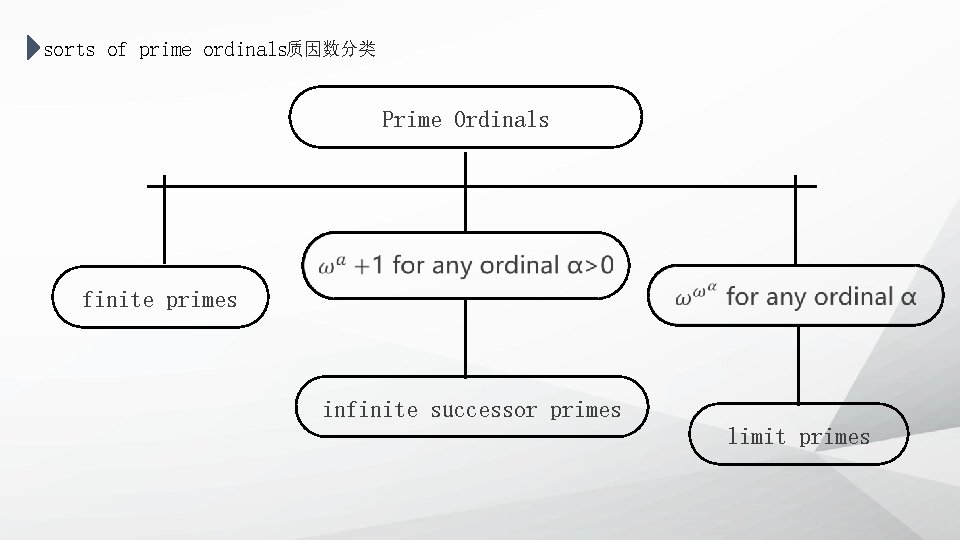
sorts of prime ordinals质因数分类 Prime Ordinals finite primes infinite successor primes limit primes
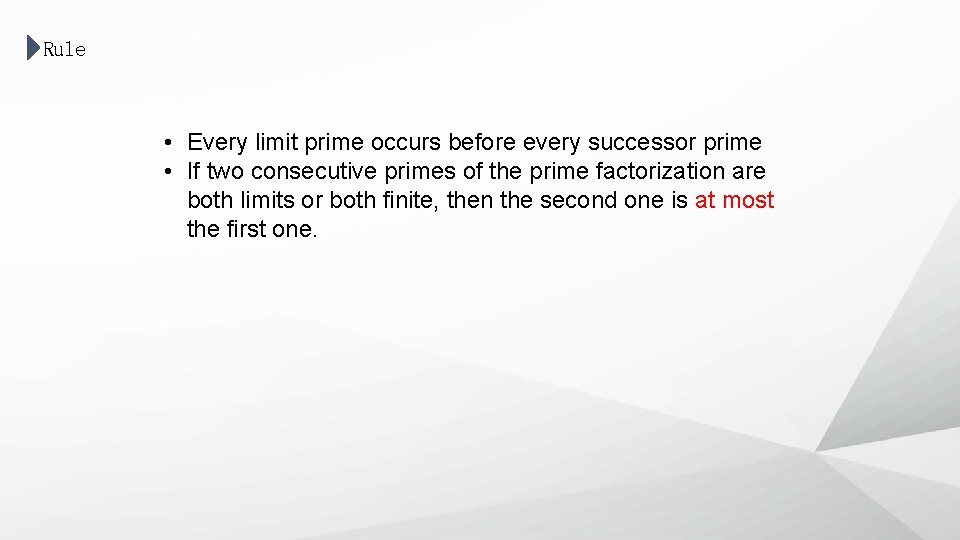
Rule • Every limit prime occurs before every successor prime • If two consecutive primes of the prime factorization are both limits or both finite, then the second one is at most the first one.

Natural operations https: //en. wikipedia. org/wiki/Ordinal_arithmetic Nimber arithmetic https: //en. wikipedia. org/wiki/Nimber
4 PART 04 C a rd in a ls Initial ordinal of a cardinal
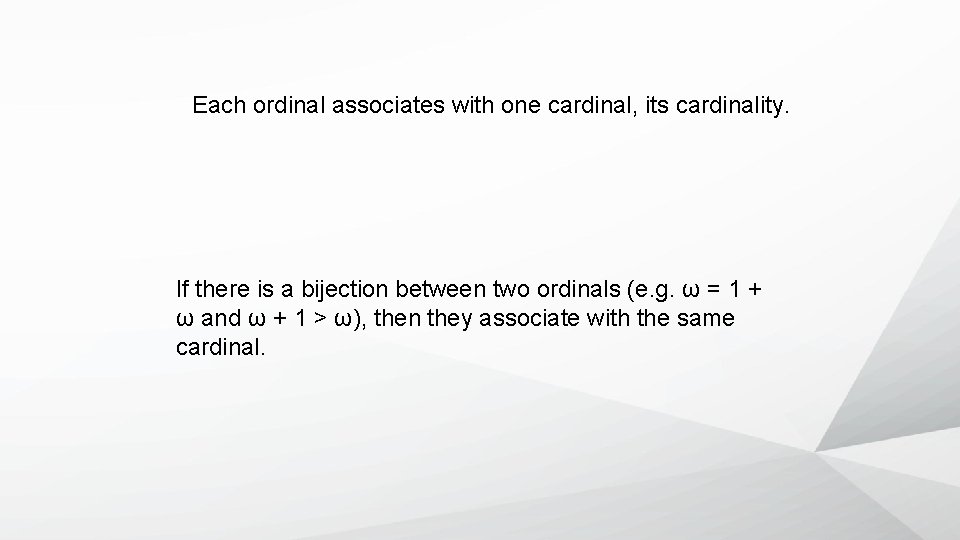
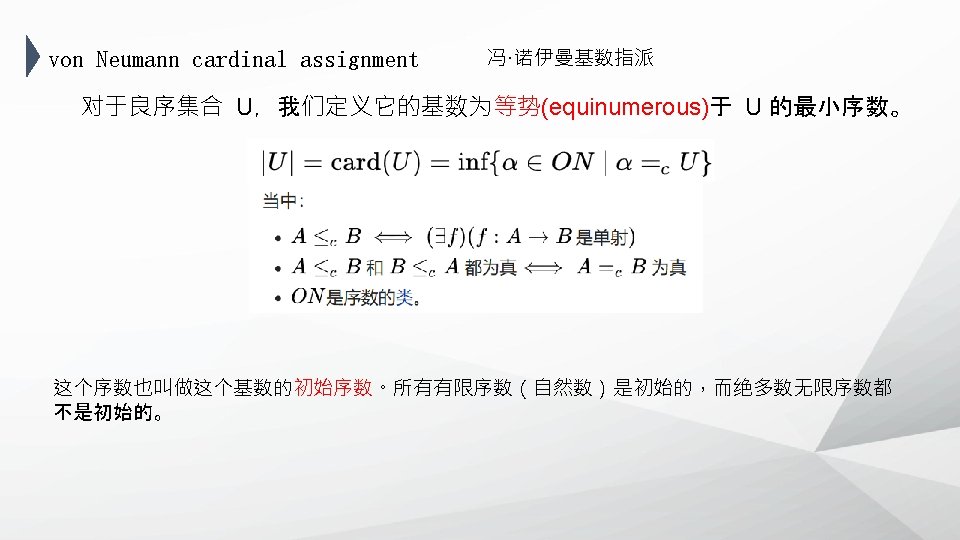
Each ordinal associates with one cardinal, its cardinality. If there is a bijection between two ordinals (e. g. ω = 1 + ω and ω + 1 > ω), then they associate with the same cardinal.


- Slides: 43