
Ordering to Administration Parameters for a Successful Titratable

Ordering to Administration: Parameters for a Successful Titratable Infusion Rebuild Casey Olsen, Pharm. D. PGY 2 Pharmacy Informatics Resident Milwaukee, Wisconsin Casey. Olsen@aurora. org

Disclosure • I have had no actual or relevant financial relationships to create a potential conflict of interest in relation to this program. • This project has been reviewed by the Aurora Health Care Institutional Review Board (IRB), and does not constitute human subject research. As such, it does not require Aurora IRB oversight.

Learning Objective • Identify available functionality within electronic health records that may be utilized to improve compliance to Joint Commission standards

Aurora Health Care • Private, not-for-profit, integrated health system • 16 hospitals • Integrated health care system with a shared electronic medical record • ~20, 000 orders for titratable infusions placed monthly
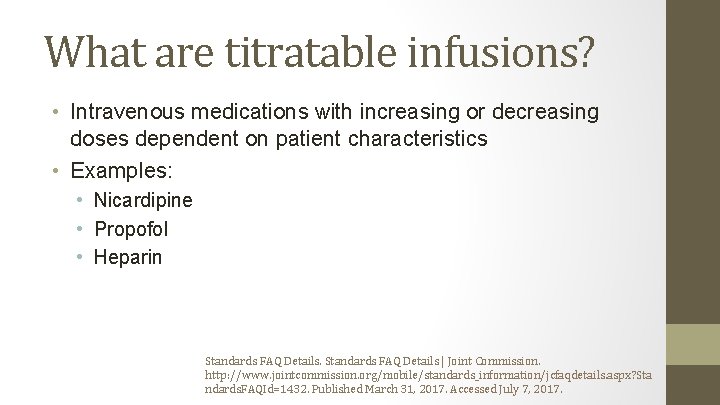
What are titratable infusions? • Intravenous medications with increasing or decreasing doses dependent on patient characteristics • Examples: • Nicardipine • Propofol • Heparin Standards FAQ Details | Joint Commission. http: //www. jointcommission. org/mobile/standards_information/jcfaqdetails. aspx? Sta ndards. FAQId=1432. Published March 31, 2017. Accessed July 7, 2017.
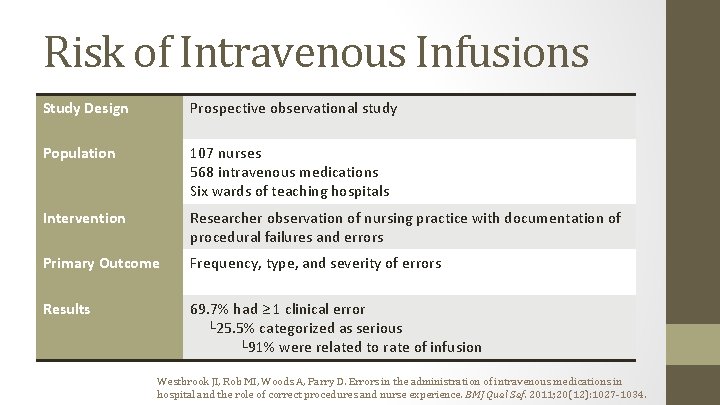
Risk of Intravenous Infusions Study Design Prospective observational study Population 107 nurses 568 intravenous medications Six wards of teaching hospitals Intervention Researcher observation of nursing practice with documentation of procedural failures and errors Primary Outcome Frequency, type, and severity of errors Results 69. 7% had ≥ 1 clinical error └ 25. 5% categorized as serious └ 91% were related to rate of infusion Westbrook JI, Rob MI, Woods A, Parry D. Errors in the administration of intravenous medications in hospital and the role of correct procedures and nurse experience. BMJ Qual Saf. 2011; 20(12): 1027 -1034.
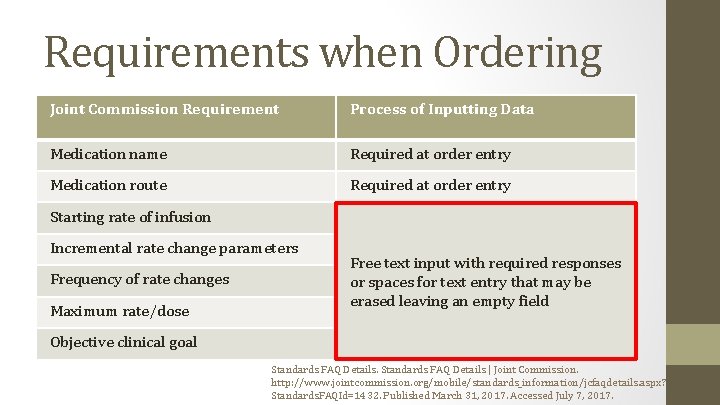
Requirements when Ordering Joint Commission Requirement Process of Inputting Data Medication name Required at order entry Medication route Required at order entry Starting rate of infusion Incremental rate change parameters Frequency of rate changes Maximum rate/dose Free text input with required responses or spaces for text entry that may be erased leaving an empty field Objective clinical goal Standards FAQ Details | Joint Commission. http: //www. jointcommission. org/mobile/standards_information/jcfaqdetails. aspx? Standards. FAQId=1432. Published March 31, 2017. Accessed July 7, 2017.
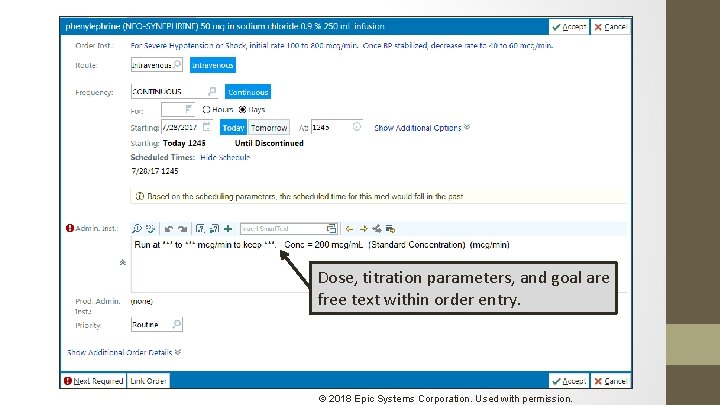
Dose, titration parameters, and goal are free text within order entry. © 2018 Epic Systems Corporation. Used with permission.
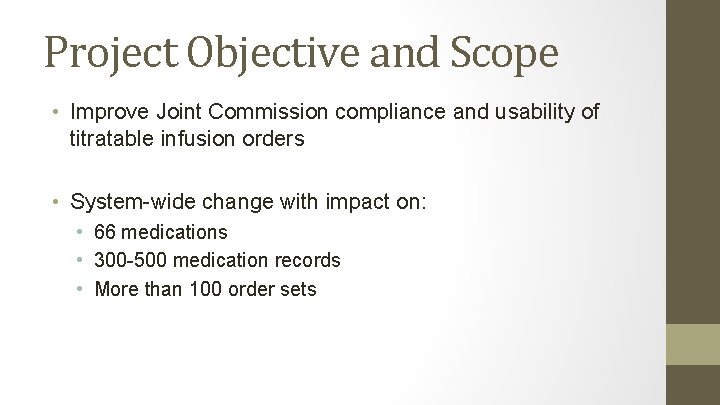
Project Objective and Scope • Improve Joint Commission compliance and usability of titratable infusion orders • System-wide change with impact on: • 66 medications • 300 -500 medication records • More than 100 order sets
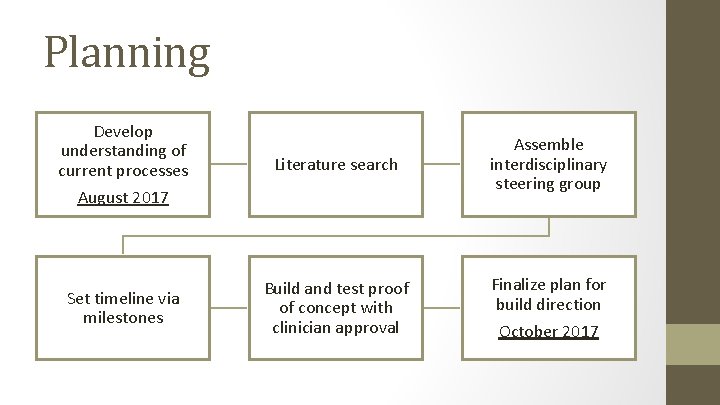
Planning Develop understanding of current processes August 2017 Literature search Assemble interdisciplinary steering group Set timeline via milestones Build and test proof of concept with clinician approval Finalize plan for build direction October 2017

Steering Committee • Clinical • Pharmacist clinical coordinators • Medication safety officer (pharmacist) • IT • Orders team (order sets) • Willow (medication build) • Clinical documentation • Educators • Nursing • Pharmacy

Initial Timeline Milestones Milestone Deadline Dependencies 9/1/2017 Approvals 9/29/2017 Build and validation 12/22/2017 Training materials 12/22/2017 Communication 1/5/2018 Go-live 1/25/2018
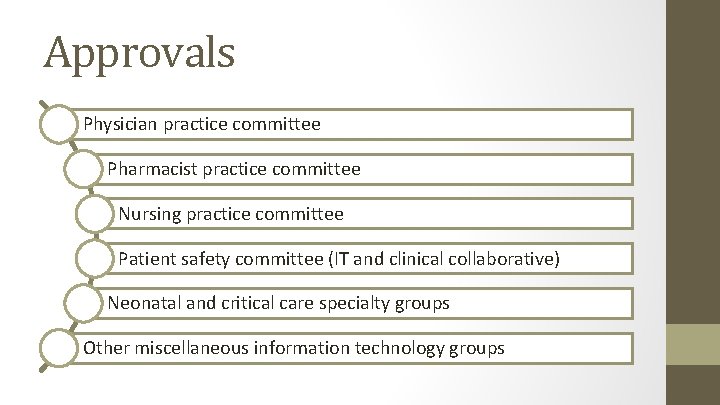
Approvals Physician practice committee Pharmacist practice committee Nursing practice committee Patient safety committee (IT and clinical collaborative) Neonatal and critical care specialty groups Other miscellaneous information technology groups
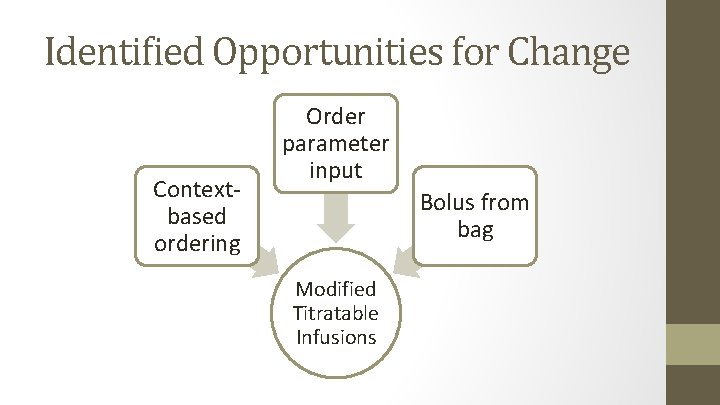
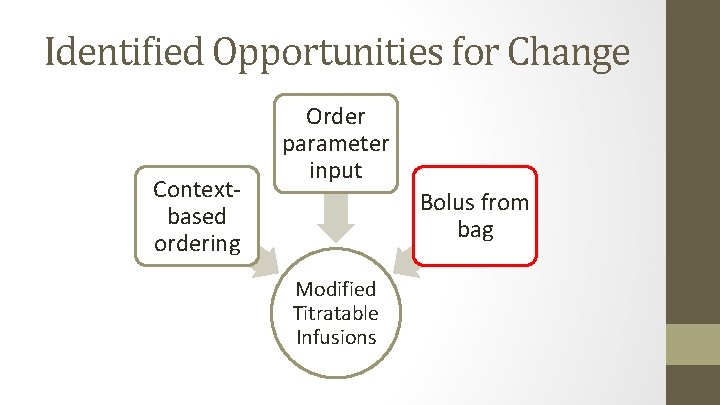
Identified Opportunities for Change Contextbased ordering Order parameter input Bolus from bag Modified Titratable Infusions
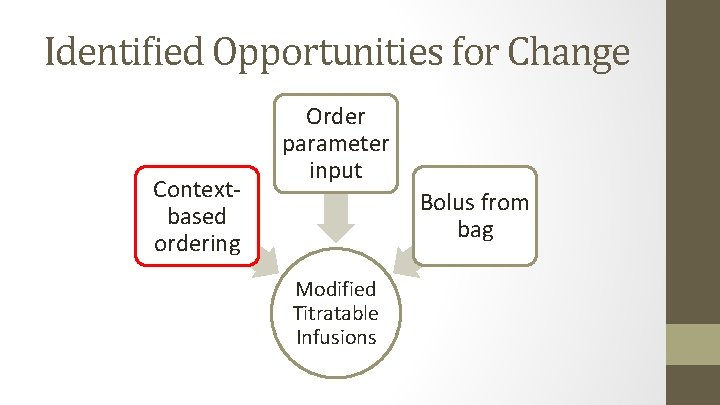
Identified Opportunities for Change Contextbased ordering Order parameter input Bolus from bag Modified Titratable Infusions
Context-based ordering • Definition: • Enabling selection of a ‘single medication’ during the ordering process which will provide access to specific defaults, warnings, and dispensed product based on patient characteristics (ex. age and weight) • Pre-implementation practice: • Separate orders for neonatal and adult populations • Limited pediatric-specific orders • Problem: incorrect order may be selected
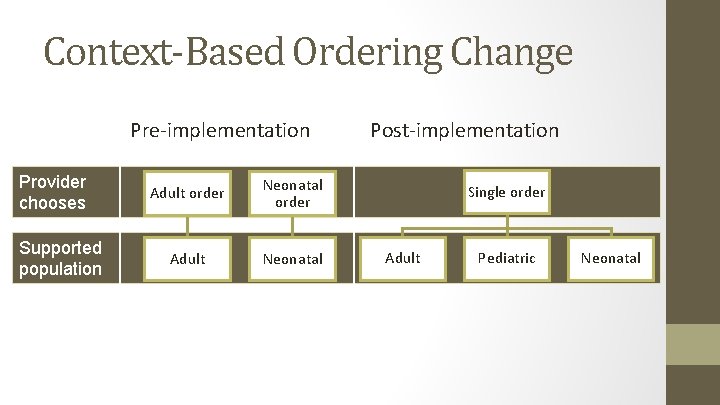
Context-Based Ordering Change Pre-implementation Provider chooses Supported population Adult order Neonatal order Adult Neonatal Post-implementation Single order Adult Pediatric Neonatal
Context-based Ordering Benefits • Selection • Less options available within the navigator • Data entry • Ensures relevant clinical decision support is used • Pertinent additional references can be provided • Improved ability to modify dispensed product in cases of shortage (using Epic orderable functionality)
Barrier Encountered • Neonatal and adult infusion orders historically used different bases (saline versus dextrose) • Decision made to maintain separate orders to ensure correct bases were selected for each population • Final outcome: • Two orders still exist for physicians (neonatal and adult/pediatric) • Each order has safety catches to ensure clinical decision support is appropriate
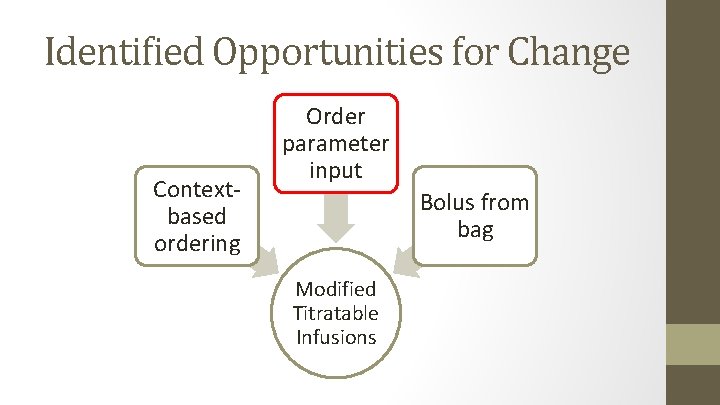
Identified Opportunities for Change Contextbased ordering Order parameter input Bolus from bag Modified Titratable Infusions
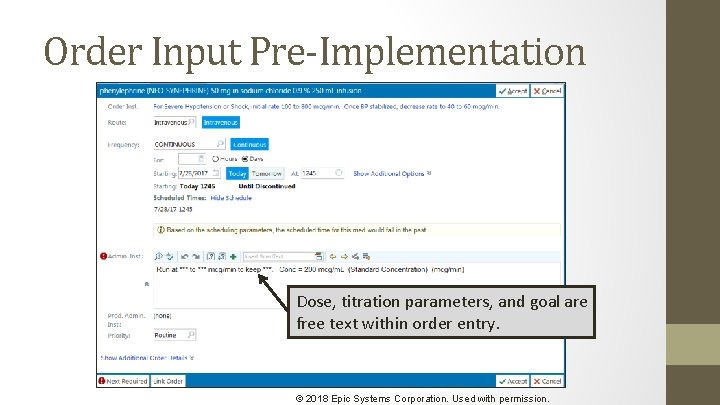
Order Input Pre-Implementation Dose, titration parameters, and goal are free text within order entry. © 2018 Epic Systems Corporation. Used with permission.
Order Parameter Input • Use of free text fields results in missed capture of required elements for orders • Benefits of discrete field use: • Limits potential for missing information 1 -2 • Improved data tracking and reporting • Clinical decision support 1. Schneider E, Franz W, Spitznagel R, Bascom DA, Obuchowski NA. Effect of computerized physician order entry on radiologic examination order indication quality. Arch Intern Med. 2011; 171(11): 1036 -1038. 2. Dumitru D. The Pharmacy Informatics Primer. American Society of Health-System Pharmacists. September 2008.
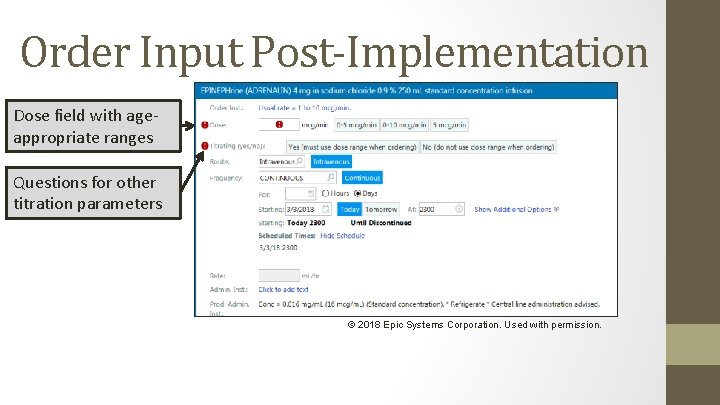
Order Input Post-Implementation Dose field with ageappropriate ranges Questions for other titration parameters © 2018 Epic Systems Corporation. Used with permission.
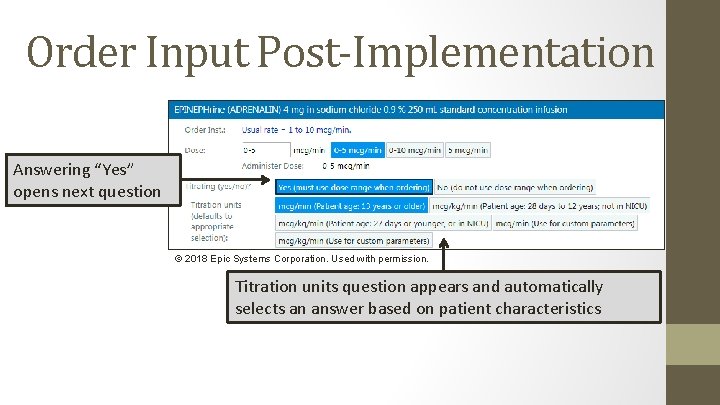
Order Input Post-Implementation Answering “Yes” opens next question © 2018 Epic Systems Corporation. Used with permission. Titration units question appears and automatically selects an answer based on patient characteristics
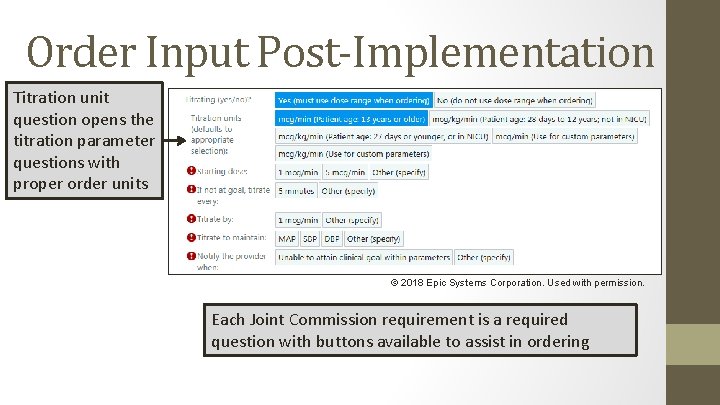
Order Input Post-Implementation Titration unit question opens the titration parameter questions with proper order units © 2018 Epic Systems Corporation. Used with permission. Each Joint Commission requirement is a required question with buttons available to assist in ordering
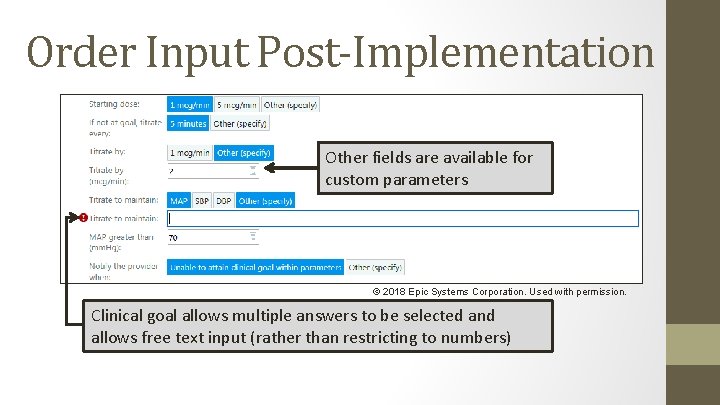
Order Input Post-Implementation Other fields are available for custom parameters © 2018 Epic Systems Corporation. Used with permission. Clinical goal allows multiple answers to be selected and allows free text input (rather than restricting to numbers)
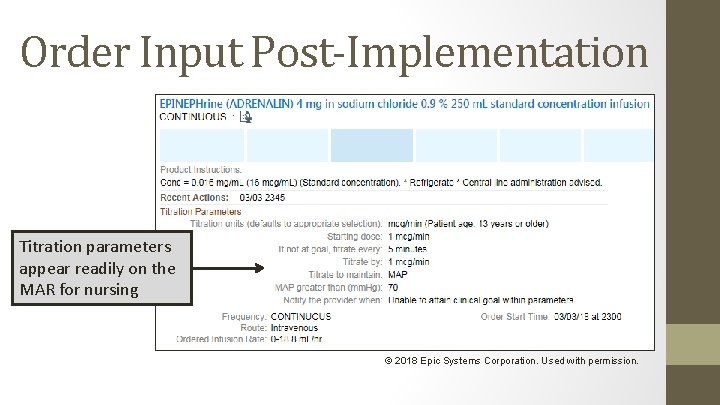
Order Input Post-Implementation Titration parameters appear readily on the MAR for nursing © 2018 Epic Systems Corporation. Used with permission.
Barrier Encountered • Weight based orders require dosing weight • Not documented in emergency department due to workflows in which weights are estimated • Concern over an estimated dosing weight continuing through admission • Final outcome: • Order-specific weight made available on infusion orders • Workflows put in place to transition order-specific weights to dosing weight when entered at admission
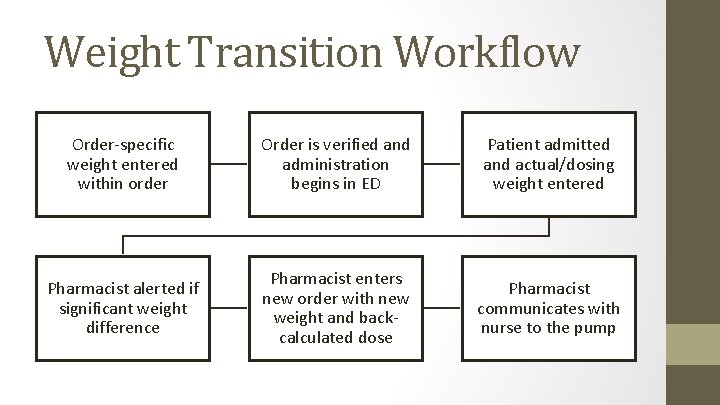
Weight Transition Workflow Order-specific weight entered within order Order is verified and administration begins in ED Patient admitted and actual/dosing weight entered Pharmacist alerted if significant weight difference Pharmacist enters new order with new weight and backcalculated dose Pharmacist communicates with nurse to the pump
Identified Opportunities for Change Contextbased ordering Order parameter input Bolus from bag Modified Titratable Infusions
Bolus from Bag • Definition: • Bolus of an intravenous infusion administered from the same bag as the continuous infusion • Pre-implementation practice: • Functionality exists within smart pumps, but has limited electronic medical record orders to facilitate its use
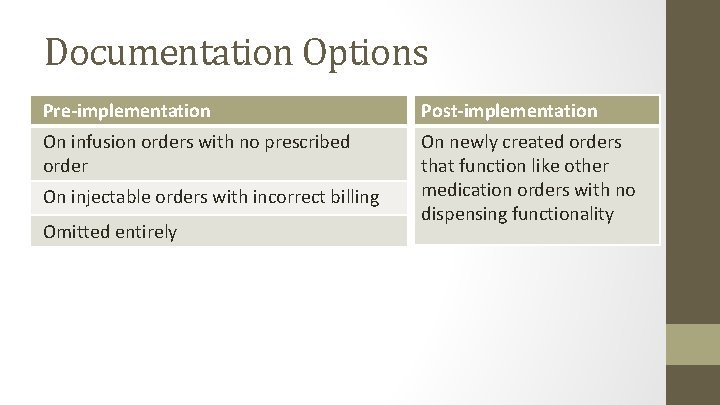
Documentation Options Pre-implementation Post-implementation On infusion orders with no prescribed order On newly created orders that function like other medication orders with no dispensing functionality On injectable orders with incorrect billing Omitted entirely
Barrier Encountered • One site used infusion pumps not supporting bolus from bag workflows • Bolus from bag orders would not be usable at this site leaving nurses unable to administer medication or force them to use unsafe workflows • Final outcome: • Bolus from bag orders automatically (behind the scenes) become a stand-in bolus order (most frequently injectable) when selected
Limitation Remaining • Smart infusion pumps make use of weight-based dose entry • Example: esmolol 500 mcg/kg bolus is entered into the pump as 500 mcg/kg rather than the calculated dose • Epic calculates weight-based doses on the MAR for nursing • Potential for error if nursing inputs calculated dose into the infusion pump rather than the pre-calculated weight-based dose • Smart infusion pumps have maximum limits built which will catch most potential errors
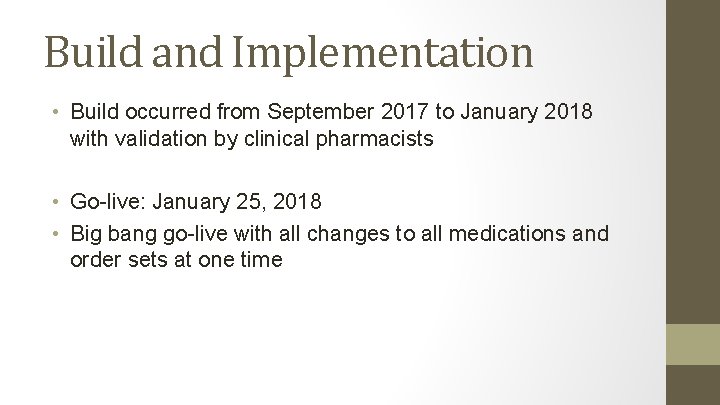
Build and Implementation • Build occurred from September 2017 to January 2018 with validation by clinical pharmacists • Go-live: January 25, 2018 • Big bang go-live with all changes to all medications and order sets at one time
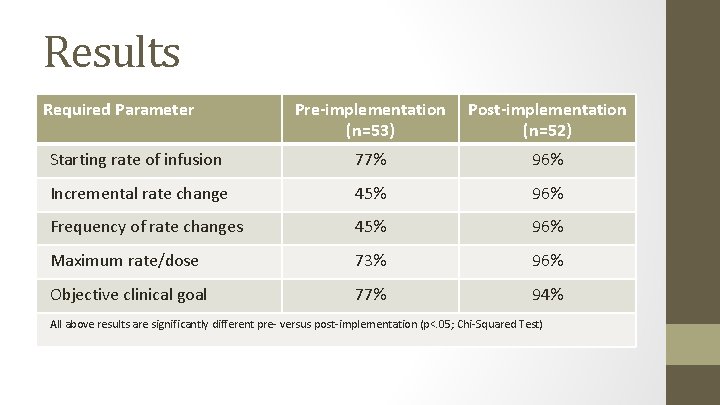
Results Required Parameter Pre-implementation (n=53) Post-implementation (n=52) Starting rate of infusion 77% 96% Incremental rate change 45% 96% Frequency of rate changes 45% 96% Maximum rate/dose 73% 96% Objective clinical goal 77% 94% All above results are significantly different pre- versus post-implementation (p<. 05; Chi-Squared Test)
Results
Results
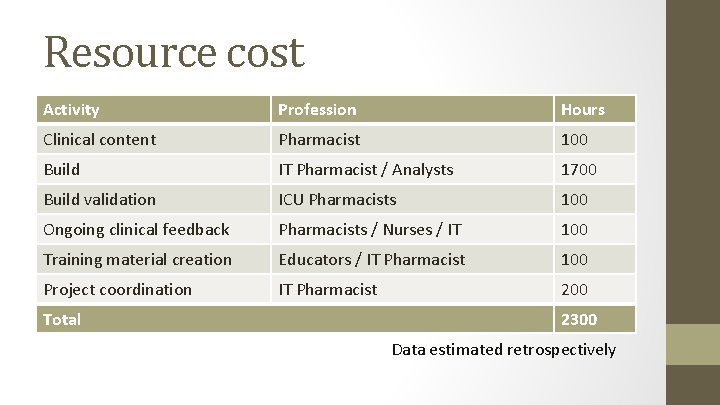
Resource cost Activity Profession Hours Clinical content Pharmacist 100 Build IT Pharmacist / Analysts 1700 Build validation ICU Pharmacists 100 Ongoing clinical feedback Pharmacists / Nurses / IT 100 Training material creation Educators / IT Pharmacist 100 Project coordination IT Pharmacist 200 Total 2300 Data estimated retrospectively

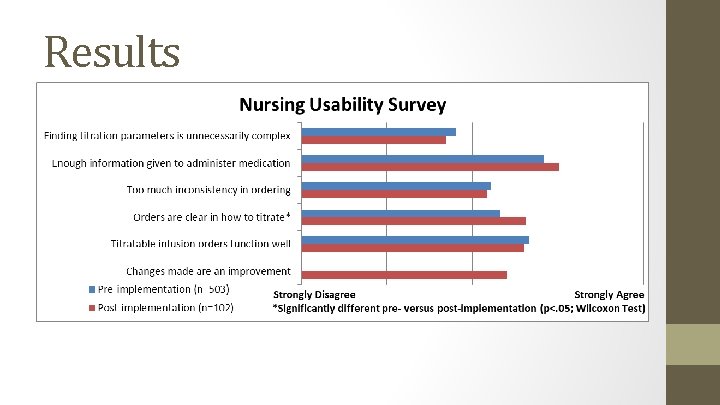
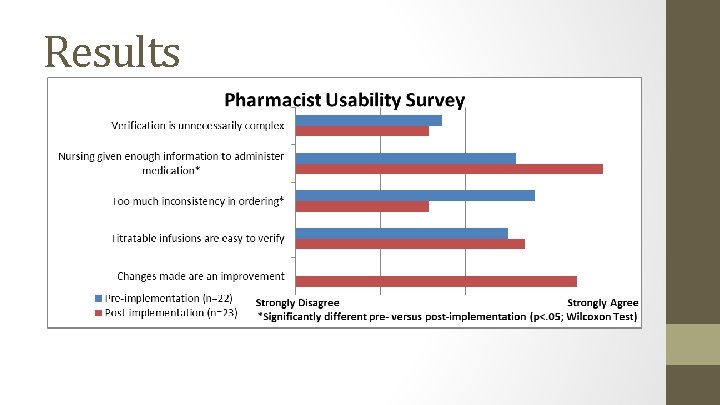
Conclusion • Use of discrete required fields for titration parameters improves adherence to Joint Commission criteria over free text fields with minimal impact to usability

Future Direction • Utilize discrete data elements for future clinical projects • Create and optimize clinical decision support from discrete fields

Ordering to Administration: Parameters for a Successful Titratable Infusion Rebuild Casey Olsen, Pharm. D. PGY 2 Pharmacy Informatics Resident Milwaukee, Wisconsin Casey. Olsen@aurora. org
- Slides: 42