
Ordered Neurons Integrating Tree Structures Into Recurrent Neural

- Slides: 20
Ordered Neurons: Integrating Tree Structures Into Recurrent Neural Networks Best paper at ICLR 2019 Mohammadali(Sobhan) Niknamian CS 886: Deep Learning and Natural Language Processing Winter 2020
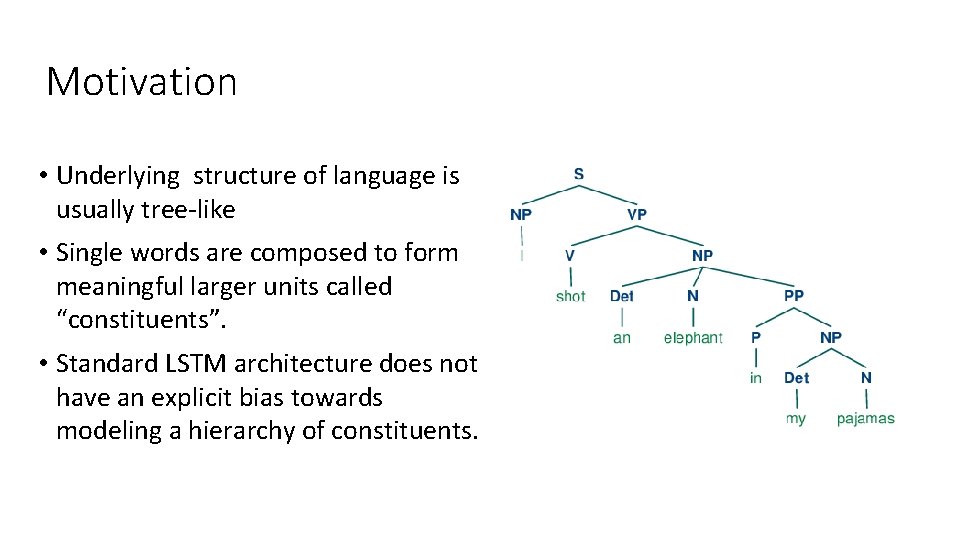
Motivation • Underlying structure of language is usually tree-like • Single words are composed to form meaningful larger units called “constituents”. • Standard LSTM architecture does not have an explicit bias towards modeling a hierarchy of constituents.
How to predict the latent tree structure? • Supervised Syntactic parser • This solution is limiting for several reasons: 1) Few languages have annotated data for training such a parser. 2) In some situations, syntactic rules tend to be broken (e. g. in tweets). 3) Languages change over time, So syntax rules may evolve. • Grammar induction: The task of learning the syntactic structure of language from raw corpora without access to expert-labeled data. • This is an open problem.
How to predict the latent tree structure? • Recurrent Neural Networks (RNNs) • RNNs impose a chain structure on the data. • This assumption is in conflict with the latent non-sequential structure of language. • This gives rise to problems such as: • Capturing long-term dependencies • Achieving good generalization • Handling negation • However, some evidence exist that traditional LSTMs with sufficient capacity may encode the tree structure implicitly.
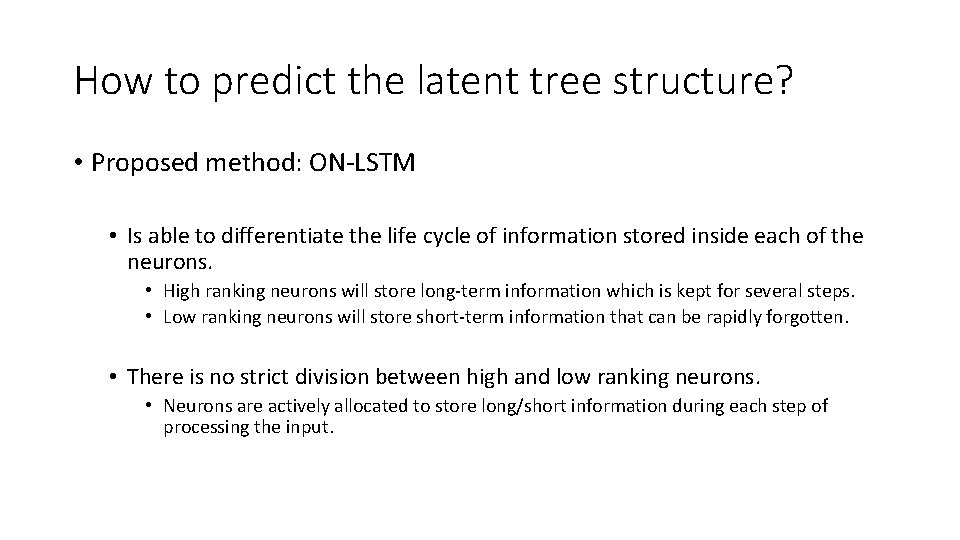
How to predict the latent tree structure? • Proposed method: ON-LSTM • Is able to differentiate the life cycle of information stored inside each of the neurons. • High ranking neurons will store long-term information which is kept for several steps. • Low ranking neurons will store short-term information that can be rapidly forgotten. • There is no strict division between high and low ranking neurons. • Neurons are actively allocated to store long/short information during each step of processing the input.
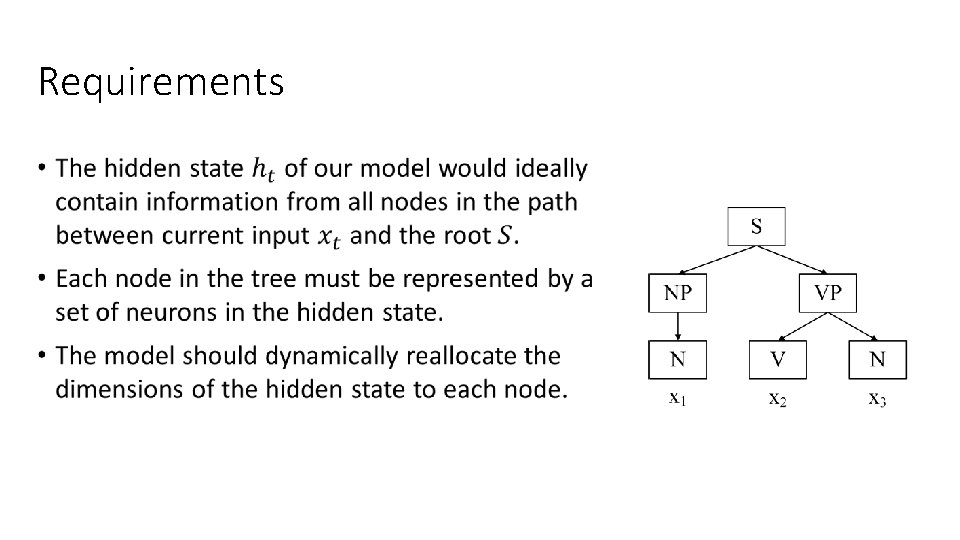
Requirements •
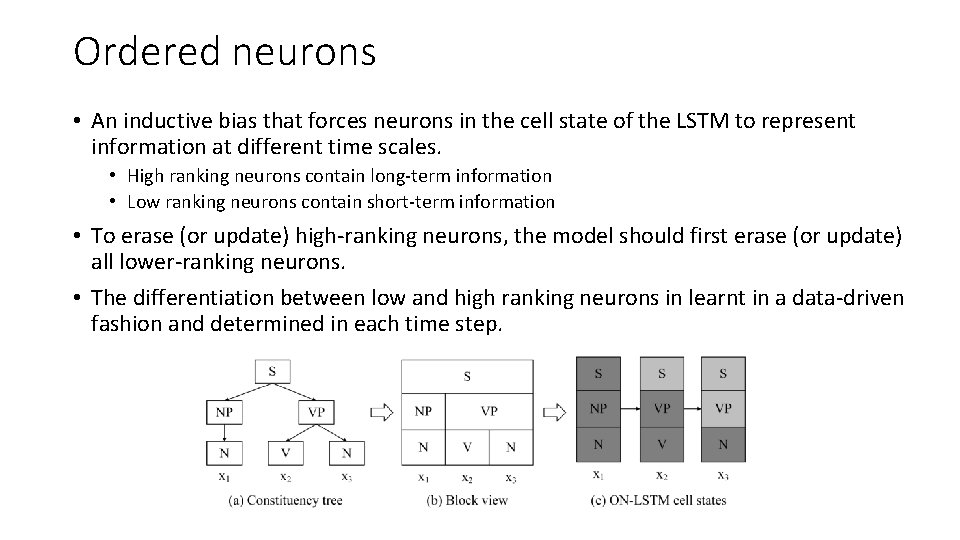
Ordered neurons • An inductive bias that forces neurons in the cell state of the LSTM to represent information at different time scales. • High ranking neurons contain long-term information • Low ranking neurons contain short-term information • To erase (or update) high-ranking neurons, the model should first erase (or update) all lower-ranking neurons. • The differentiation between low and high ranking neurons in learnt in a data-driven fashion and determined in each time step.
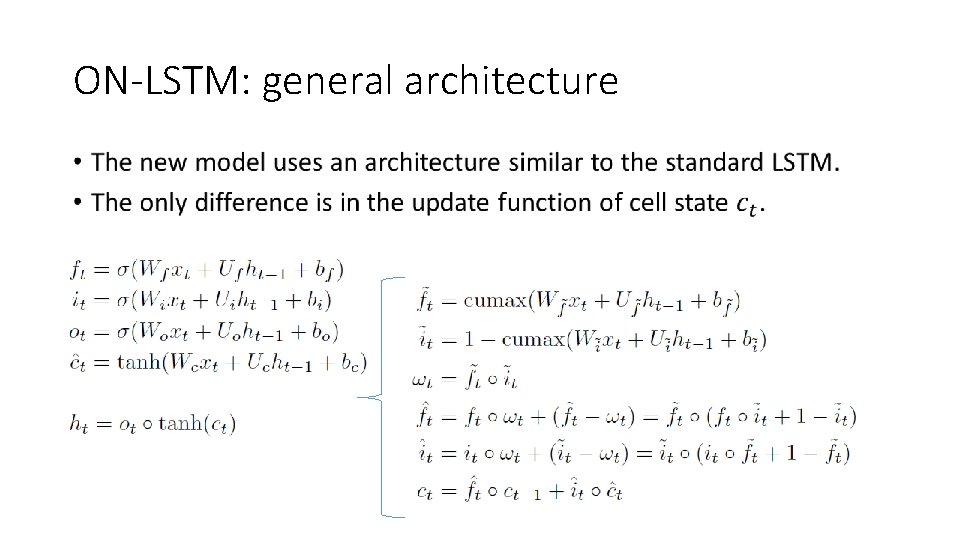
ON-LSTM: general architecture •
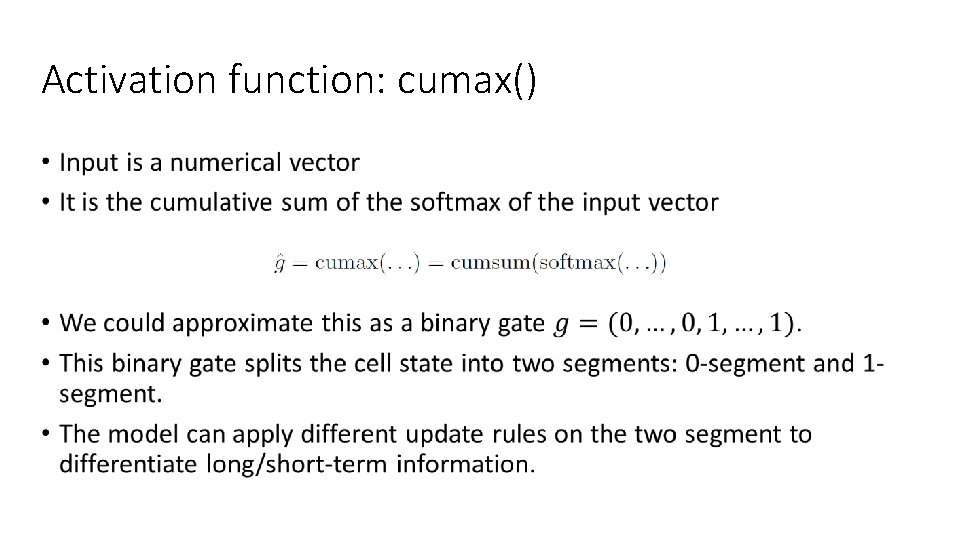
Activation function: cumax() •
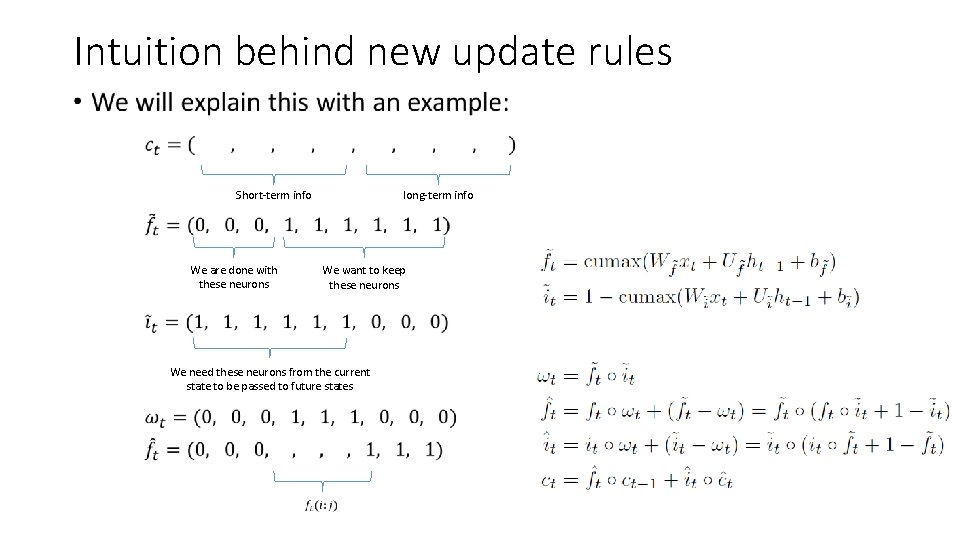
Intuition behind new update rules • Short-term info We are done with these neurons long-term info We want to keep these neurons We need these neurons from the current state to be passed to future states
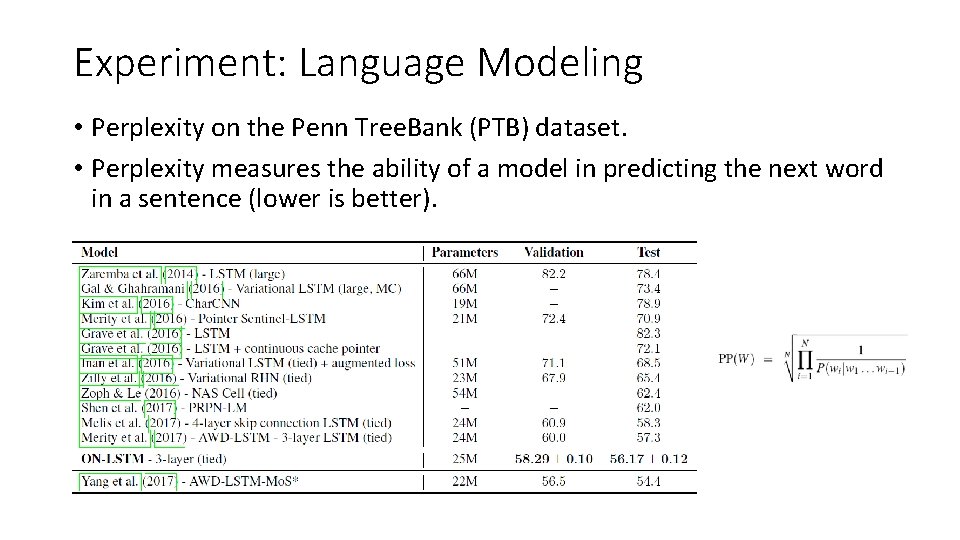
Experiment: Language Modeling • Perplexity on the Penn Tree. Bank (PTB) dataset. • Perplexity measures the ability of a model in predicting the next word in a sentence (lower is better).
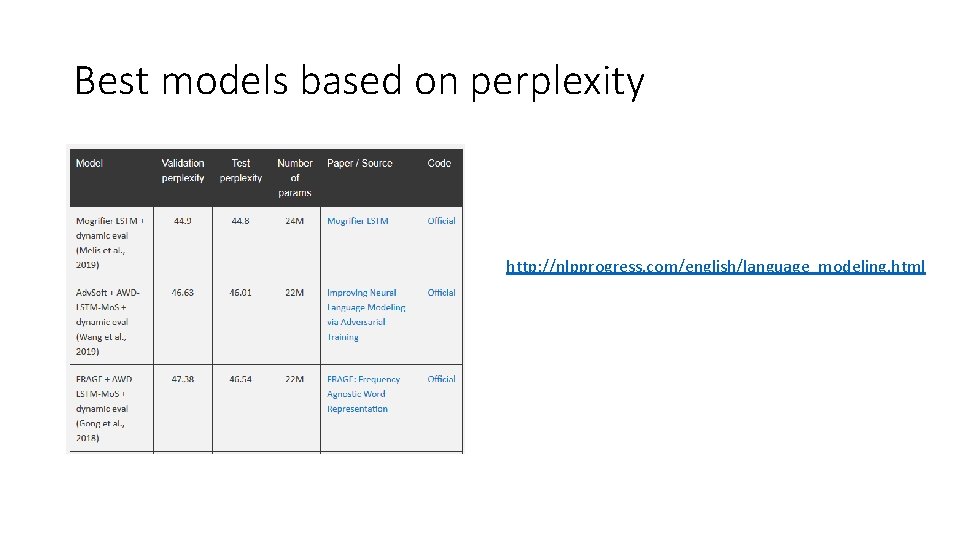
Best models based on perplexity http: //nlpprogress. com/english/language_modeling. html
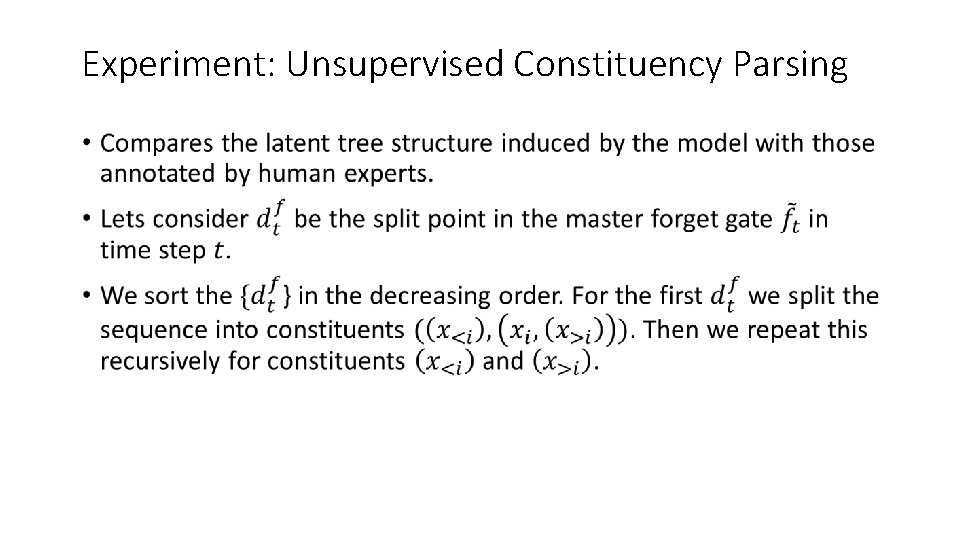
Experiment: Unsupervised Constituency Parsing •
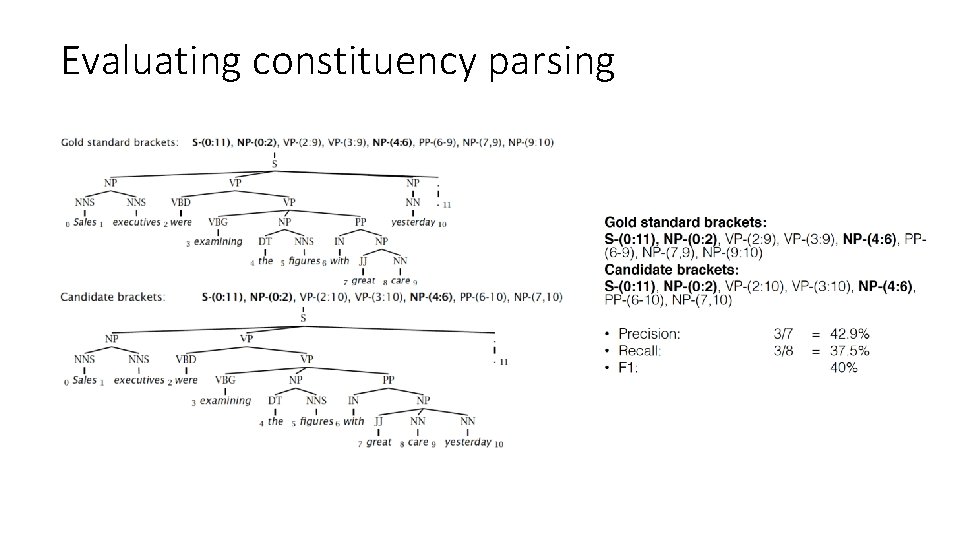
Evaluating constituency parsing
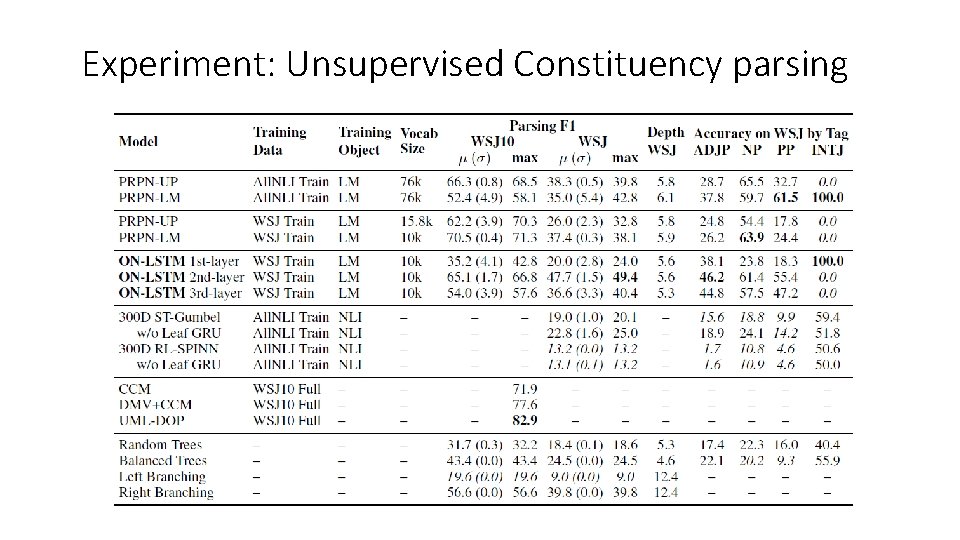
Experiment: Unsupervised Constituency parsing
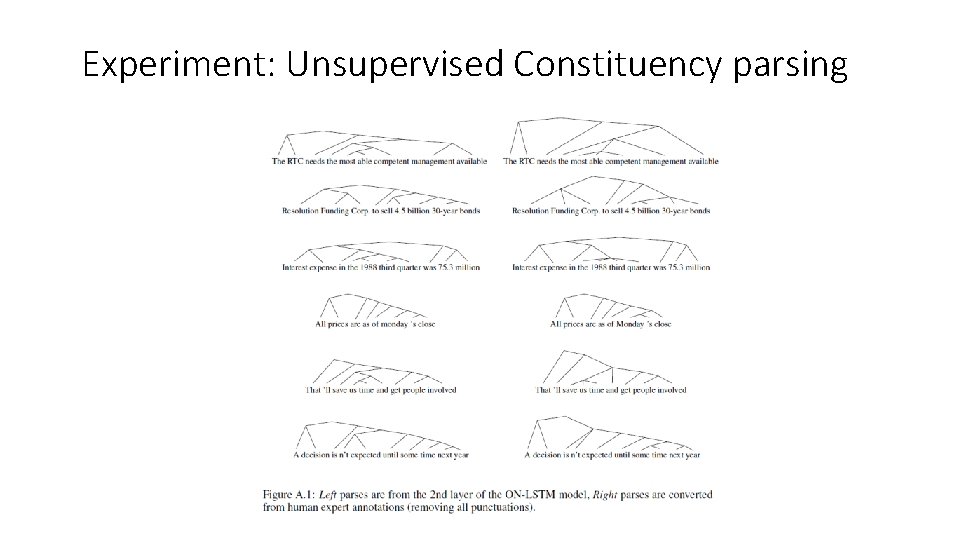
Experiment: Unsupervised Constituency parsing
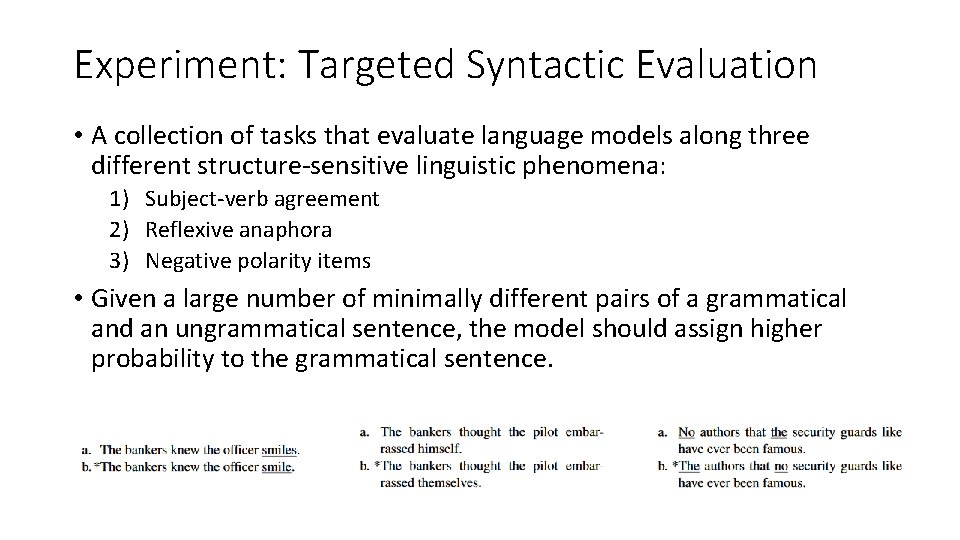
Experiment: Targeted Syntactic Evaluation • A collection of tasks that evaluate language models along three different structure-sensitive linguistic phenomena: 1) Subject-verb agreement 2) Reflexive anaphora 3) Negative polarity items • Given a large number of minimally different pairs of a grammatical and an ungrammatical sentence, the model should assign higher probability to the grammatical sentence.
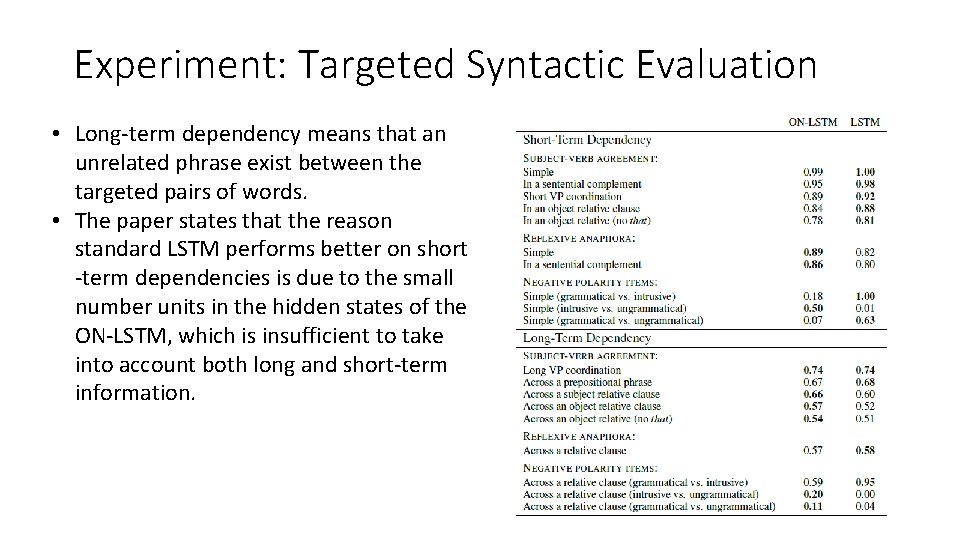
Experiment: Targeted Syntactic Evaluation • Long-term dependency means that an unrelated phrase exist between the targeted pairs of words. • The paper states that the reason standard LSTM performs better on short -term dependencies is due to the small number units in the hidden states of the ON-LSTM, which is insufficient to take into account both long and short-term information.
References • Shen, Yikang, Shawn Tan, Alessandro Sordoni, and Aaron Courville. "Ordered neurons: Integrating tree structures into recurrent neural networks. " ar. Xiv preprint ar. Xiv: 1810. 09536 (2018). • Marvin, Rebecca, and Tal Linzen. "Targeted syntactic evaluation of language models. " ar. Xiv preprint ar. Xiv: 1808. 09031 (2018). • http: //www. cs. cornell. edu/courses/cs 5740/2017 sp/lectures/13 -parsing-const. pdf
Thank you!