
Order of Magnitude Scaling of Complex Engineering Problems
Order of Magnitude Scaling of Complex Engineering Problems Patricio F. Mendez Thomas W. Eagar May 14 th, 1999

MOTIVATION • There are some engineering problems for which: – measurements are difficult – numerical treatment is difficult – idealizations and lumped parameter models are not reliable – dimensional analysis cannot simplify the problem significantly – there is previous insight into the problem – order of magnitude solutions are acceptable Order of Magnitude Scaling of Complex Engineering Problems 2

OBJECTIVES • To determine the best combination in a problem involving many dimensionless groups. • These dimensionless groups should provide – an estimation of the unknowns – a description of the relative importance of the phenomena involved Order of Magnitude Scaling of Complex Engineering Problems 3
OUTLINE • Order of magnitude scaling. Basic concept: – – Normalization Functional requirements Domain partition Transformation of differential equations into algebraic – Matrix algebra • • Related techniques Results Discussion Conclusion Order of Magnitude Scaling of Complex Engineering Problems 4
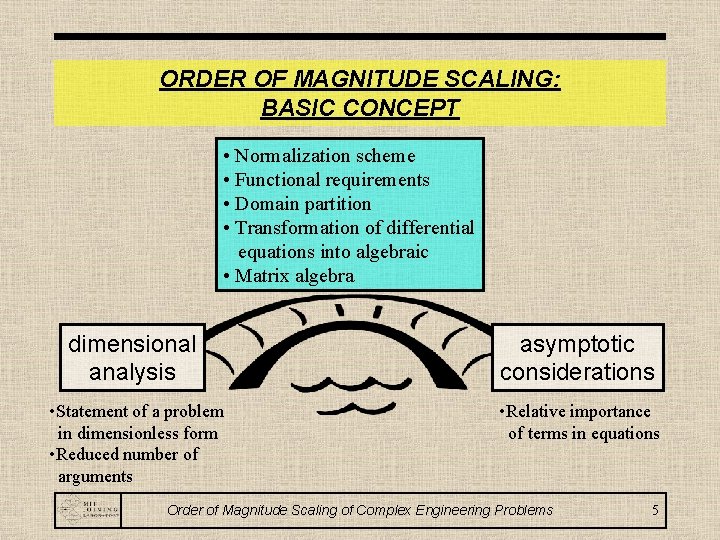
ORDER OF MAGNITUDE SCALING: BASIC CONCEPT • Normalization scheme • Functional requirements • Domain partition • Transformation of differential equations into algebraic • Matrix algebra dimensional analysis asymptotic considerations • Statement of a problem in dimensionless form • Reduced number of arguments • Relative importance of terms in equations Order of Magnitude Scaling of Complex Engineering Problems 5
RESULTS • Order of magnitude estimations are obtained. • These estimations allow one to estimate the relative importance of the different driving forces • The estimations are related to the governing parameters through power laws • The functional dependence on the governing dimensionless groups are of less importance that in dimensional analysis. Order of Magnitude Scaling of Complex Engineering Problems 6
DISCUSSION included • Non-linear equations – Navier-Stokes – Heat transfer • Singular limit problem. excluded • Differential equations of order higher than second. • Vector operators. • Analysis of stability, such as capillary instabilities, buckling, etc. Order of Magnitude Scaling of Complex Engineering Problems 7

CONCLUSION • Previous insight can be used to transform a complex set of differential equations into a more manageable set of algebraic considerations. • The results obtained are approximate. • The physical insight gained can be used to choose representative asymptotic cases. Order of Magnitude Scaling of Complex Engineering Problems 8
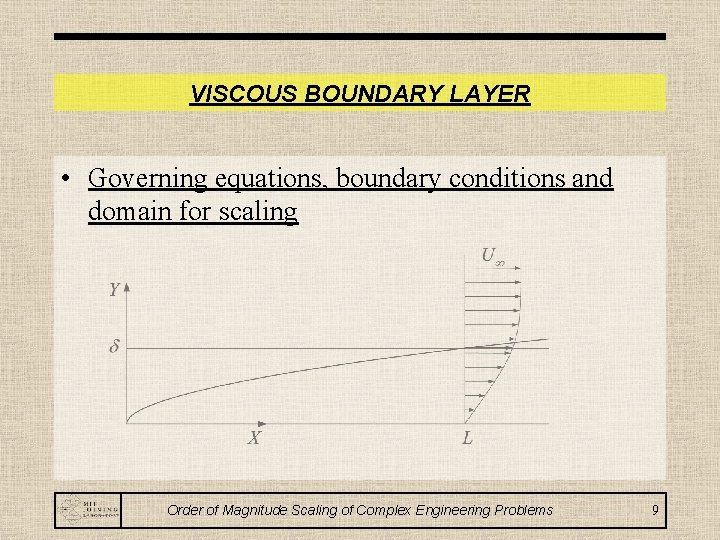
VISCOUS BOUNDARY LAYER • Governing equations, boundary conditions and domain for scaling Order of Magnitude Scaling of Complex Engineering Problems 9

VISCOUS BOUNDARY LAYER Continuity: Navier-Stokes: Boundary Conditions: Order of Magnitude Scaling of Complex Engineering Problems 10
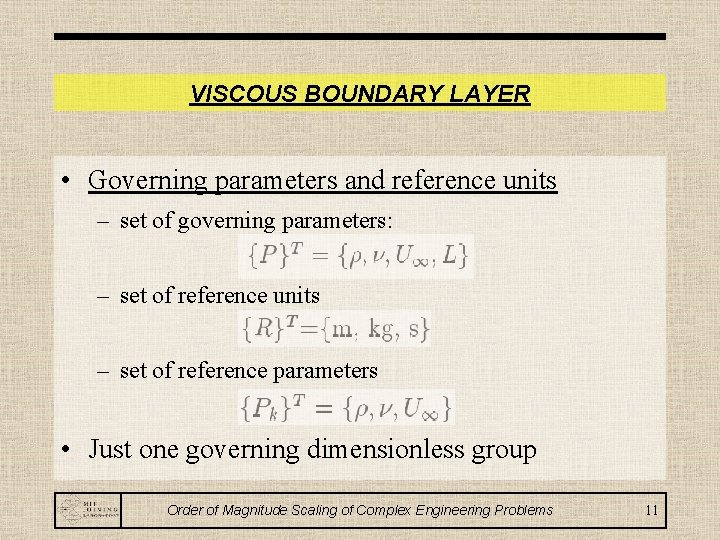
VISCOUS BOUNDARY LAYER • Governing parameters and reference units – set of governing parameters: – set of reference units – set of reference parameters • Just one governing dimensionless group Order of Magnitude Scaling of Complex Engineering Problems 11
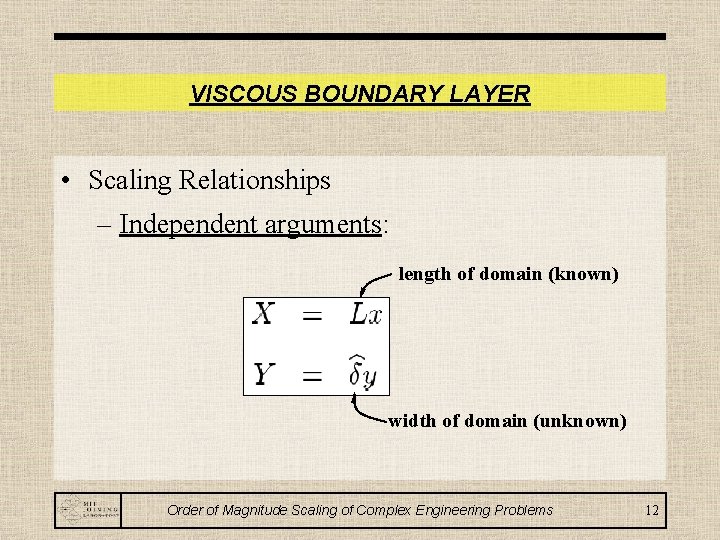
VISCOUS BOUNDARY LAYER • Scaling Relationships – Independent arguments: length of domain (known) width of domain (unknown) Order of Magnitude Scaling of Complex Engineering Problems 12
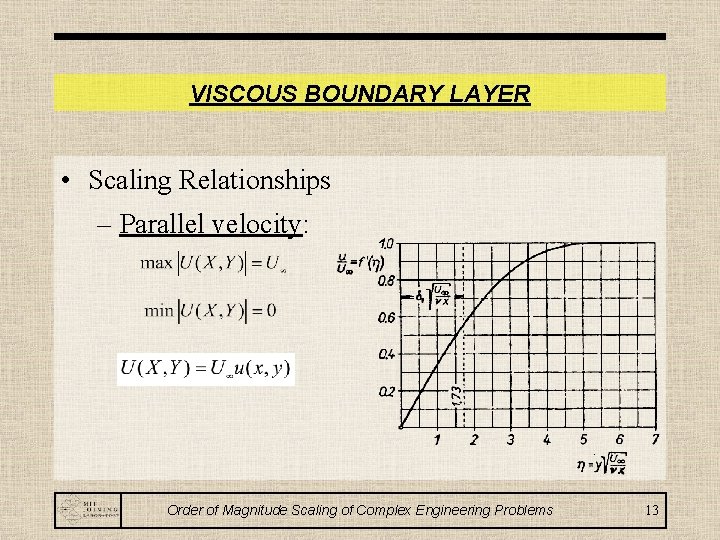
VISCOUS BOUNDARY LAYER • Scaling Relationships – Parallel velocity: Order of Magnitude Scaling of Complex Engineering Problems 13
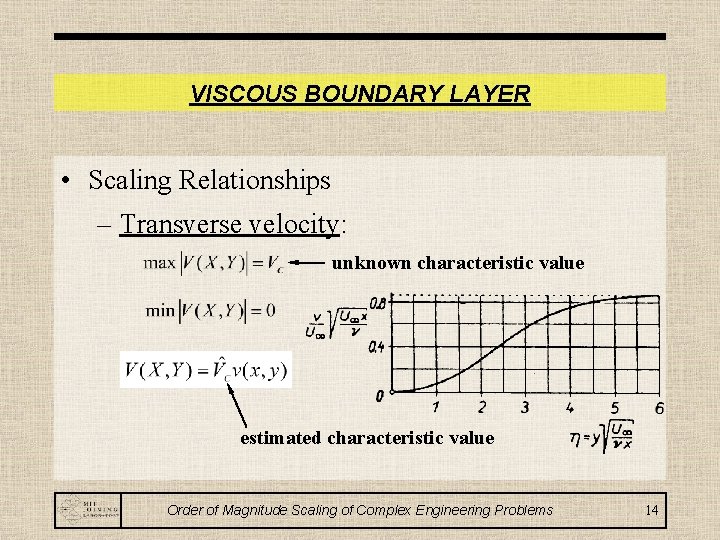
VISCOUS BOUNDARY LAYER • Scaling Relationships – Transverse velocity: unknown characteristic value estimated characteristic value Order of Magnitude Scaling of Complex Engineering Problems 14
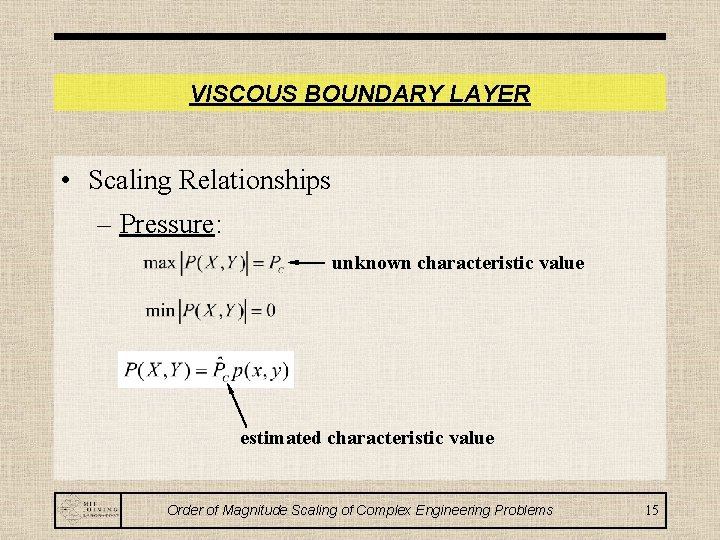
VISCOUS BOUNDARY LAYER • Scaling Relationships – Pressure: unknown characteristic value estimated characteristic value Order of Magnitude Scaling of Complex Engineering Problems 15
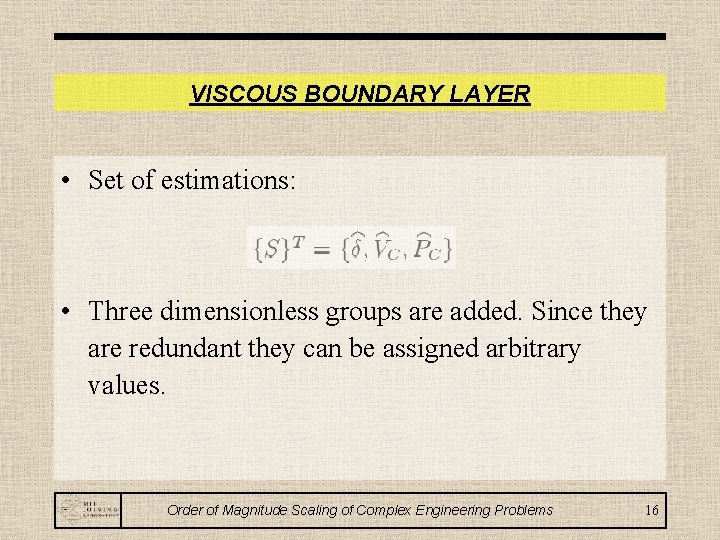
VISCOUS BOUNDARY LAYER • Set of estimations: • Three dimensionless groups are added. Since they are redundant they can be assigned arbitrary values. Order of Magnitude Scaling of Complex Engineering Problems 16
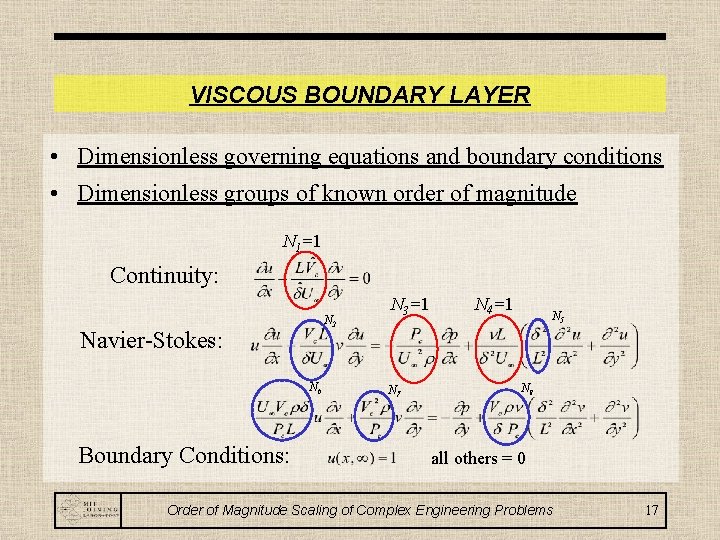
VISCOUS BOUNDARY LAYER • Dimensionless governing equations and boundary conditions • Dimensionless groups of known order of magnitude N 1=1 Continuity: N 2 Navier-Stokes: N 6 Boundary Conditions: N 3=1 N 7 N 4=1 N 5 N 8 all others = 0 Order of Magnitude Scaling of Complex Engineering Problems 17
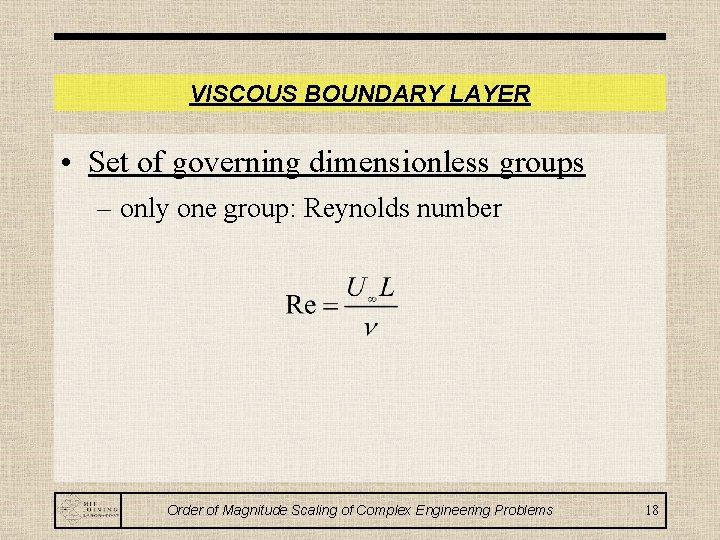
VISCOUS BOUNDARY LAYER • Set of governing dimensionless groups – only one group: Reynolds number Order of Magnitude Scaling of Complex Engineering Problems 18
![VISCOUS BOUNDARY LAYER • Calculation of the estimations (matrix algebra) [A 11] Governing parameters](http://slidetodoc.com/presentation_image_h2/70fb0b8fb34f634baf8731f267803bb2/image-19.jpg "VISCOUS BOUNDARY LAYER • Calculation of the estimations (matrix algebra) [A 11] Governing parameters")
VISCOUS BOUNDARY LAYER • Calculation of the estimations (matrix algebra) [A 11] Governing parameters Estimations [A 12] Dimensionless groups of known order of magnitude Governing dimensionless group Dimensionless coefficients Matrix [A] Order of Magnitude Scaling of Complex Engineering Problems 19
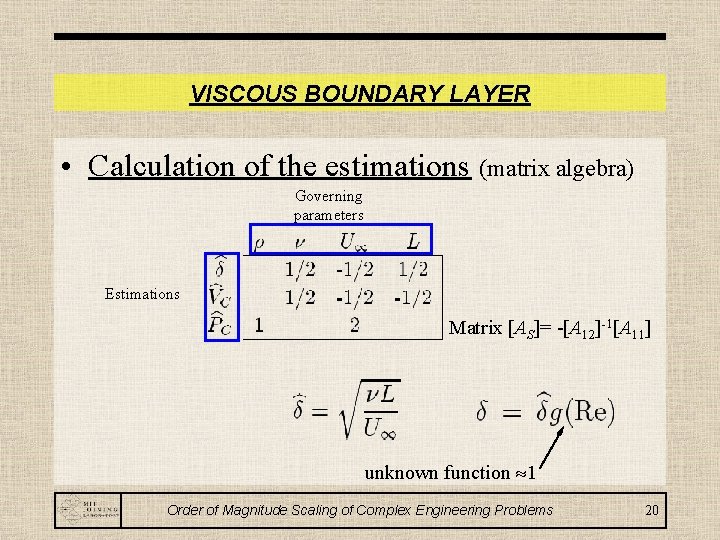
VISCOUS BOUNDARY LAYER • Calculation of the estimations (matrix algebra) Governing parameters Estimations Matrix [AS]= -[A 12]-1[A 11] unknown function 1 Order of Magnitude Scaling of Complex Engineering Problems 20
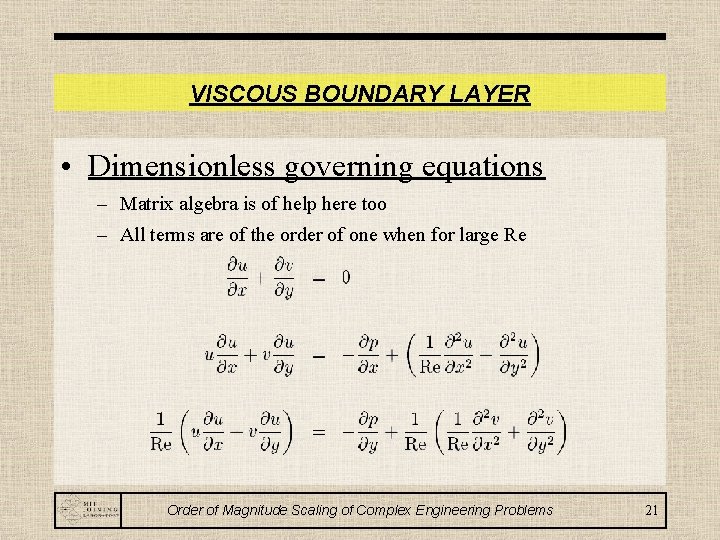
VISCOUS BOUNDARY LAYER • Dimensionless governing equations – Matrix algebra is of help here too – All terms are of the order of one when for large Re Order of Magnitude Scaling of Complex Engineering Problems 21
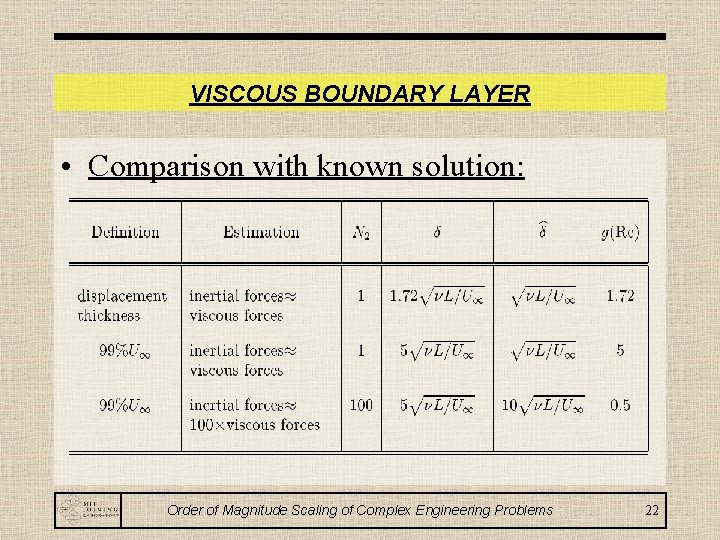
VISCOUS BOUNDARY LAYER • Comparison with known solution: Order of Magnitude Scaling of Complex Engineering Problems 22

HIGH PRODUCTIVITY ARC WELDING Low current: • recirculating flows. • small surface depression. • experimental, numerical and analytical studies. High productivity • no recirculating flows. • large surface depression. • gouging region. • only experimental studies and simple analysis. Order of Magnitude Scaling of Complex Engineering Problems 23
CHALLENGES • Direct observations are very difficult. • Not all of the necessary physics is known. • The equations cannot be solved in closed form. • Numerical solutions are difficult. • Application of dimensional analysis is limited. Order of Magnitude Scaling of Complex Engineering Problems 24
FEATURES INCLUDED • • Deformed free surface Gas shear on the surface Arc pressure Electromagnetic forces Hydrostatic forces Capillary forces Marangoni forces Buoyancy forces Order of Magnitude Scaling of Complex Engineering Problems 25
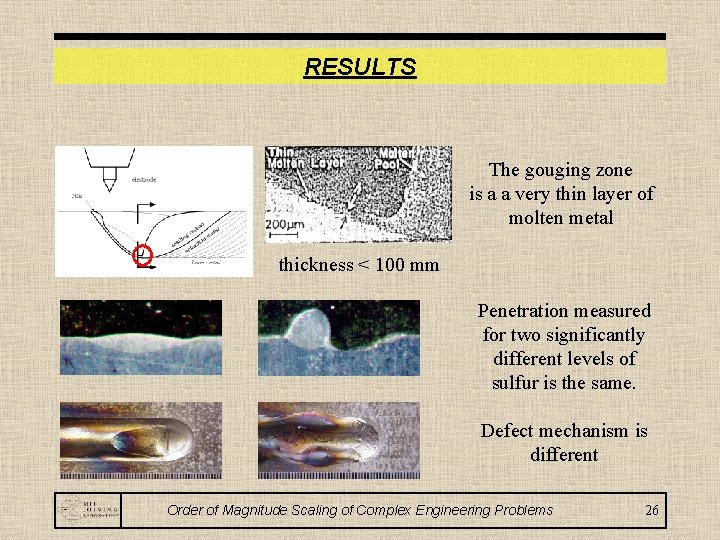
RESULTS The gouging zone is a a very thin layer of molten metal thickness < 100 mm Penetration measured for two significantly different levels of sulfur is the same. Defect mechanism is different Order of Magnitude Scaling of Complex Engineering Problems 26
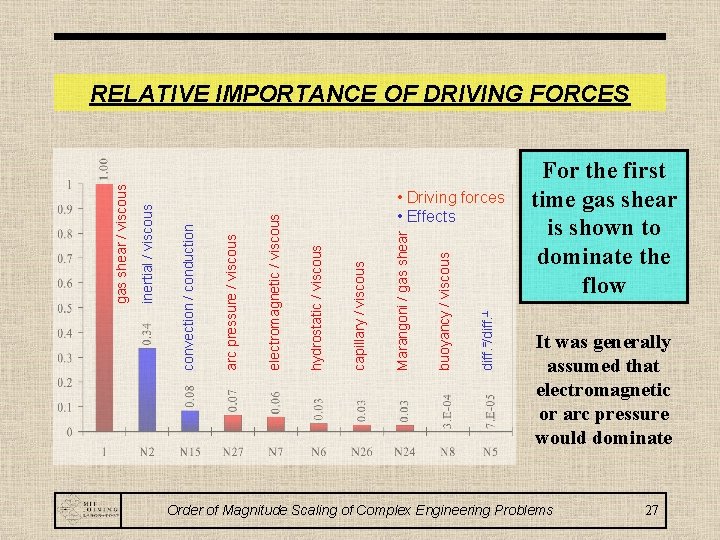
diff. =/diff. ^ buoyancy / viscous Marangoni / gas shear capillary / viscous • Driving forces • Effects hydrostatic / viscous electromagnetic / viscous arc pressure / viscous convection / conduction inertial / viscous gas shear / viscous RELATIVE IMPORTANCE OF DRIVING FORCES For the first time gas shear is shown to dominate the flow It was generally assumed that electromagnetic or arc pressure would dominate Order of Magnitude Scaling of Complex Engineering Problems 27
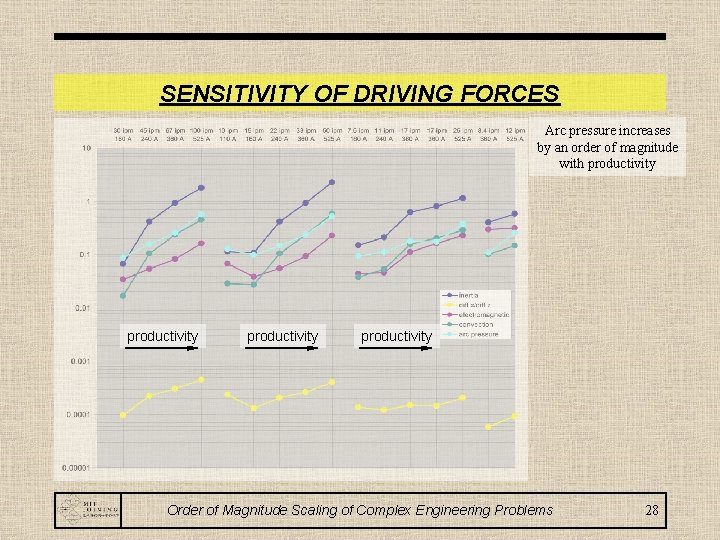
SENSITIVITY OF DRIVING FORCES Arc pressure increases by an order of magnitude with productivity Order of Magnitude Scaling of Complex Engineering Problems 28
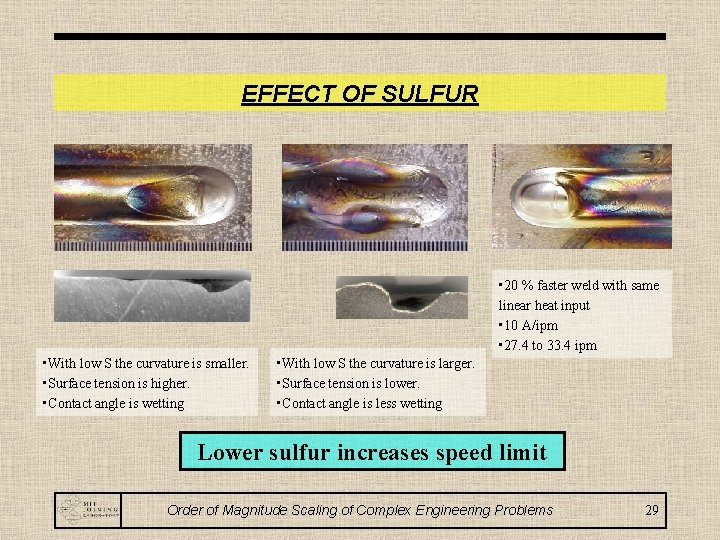
EFFECT OF SULFUR • 20 % faster weld with same linear heat input • 10 A/ipm • 27. 4 to 33. 4 ipm • With low S the curvature is smaller. • Surface tension is higher. • Contact angle is wetting • With low S the curvature is larger. • Surface tension is lower. • Contact angle is less wetting Lower sulfur increases speed limit Order of Magnitude Scaling of Complex Engineering Problems 29
- Slides: 29