
Order of growth Suppose you have analyzed two
- Slides: 11
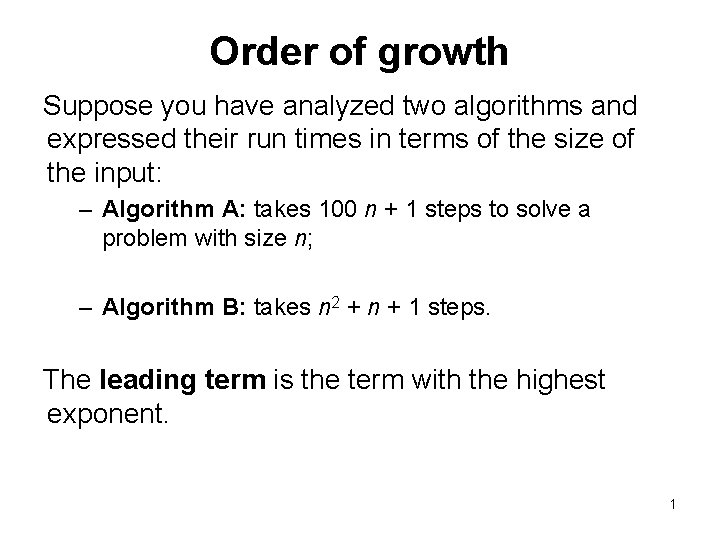
Order of growth Suppose you have analyzed two algorithms and expressed their run times in terms of the size of the input: – Algorithm A: takes 100 n + 1 steps to solve a problem with size n; – Algorithm B: takes n 2 + n + 1 steps. The leading term is the term with the highest exponent. 1
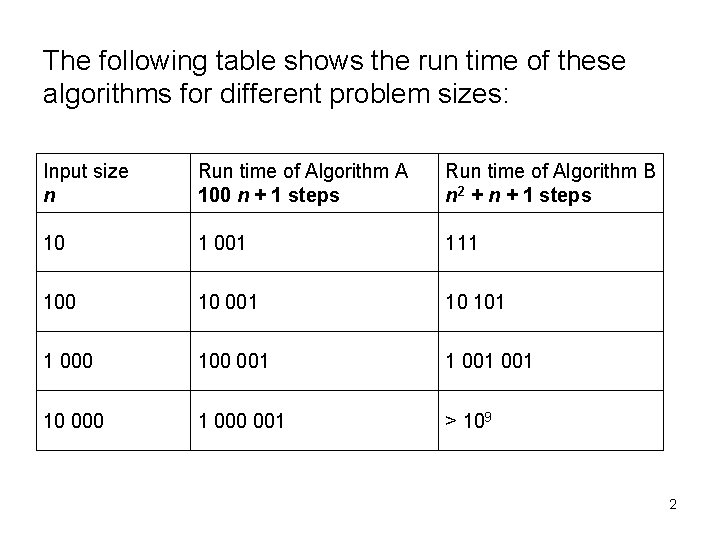
The following table shows the run time of these algorithms for different problem sizes: Input size n Run time of Algorithm A 100 n + 1 steps Run time of Algorithm B n 2 + n + 1 steps 10 1 001 111 100 10 001 10 101 1 000 100 001 10 000 1 000 001 > 109 2
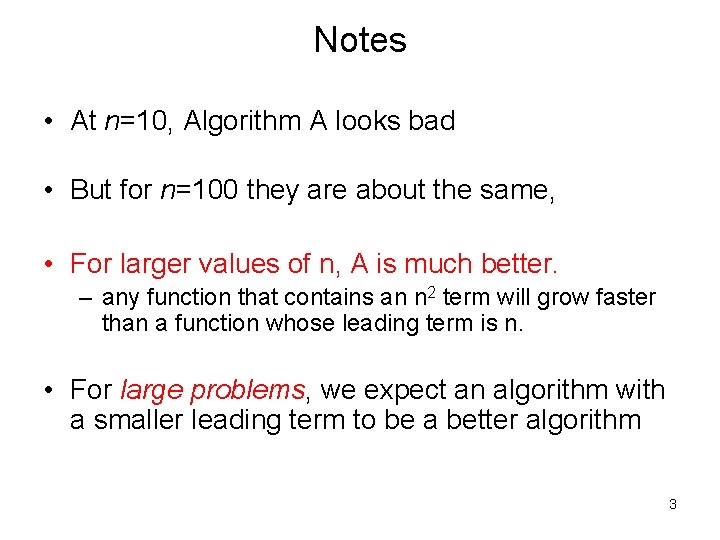
Notes • At n=10, Algorithm A looks bad • But for n=100 they are about the same, • For larger values of n, A is much better. – any function that contains an n 2 term will grow faster than a function whose leading term is n. • For large problems, we expect an algorithm with a smaller leading term to be a better algorithm 3
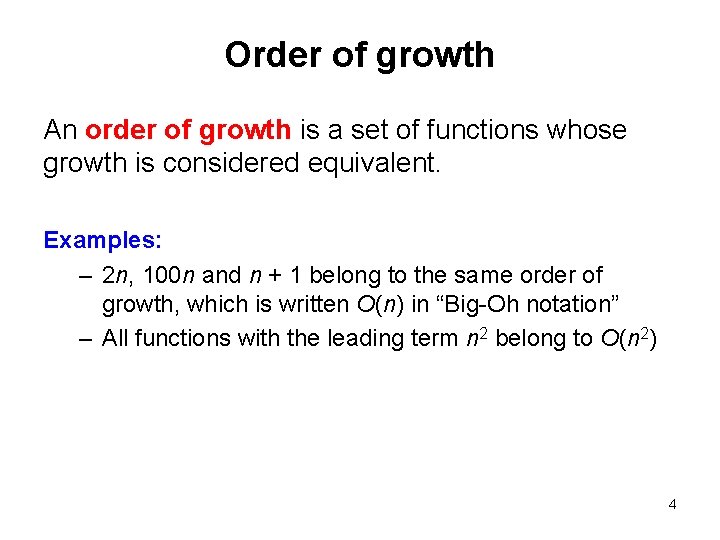
Order of growth An order of growth is a set of functions whose growth is considered equivalent. Examples: – 2 n, 100 n and n + 1 belong to the same order of growth, which is written O(n) in “Big-Oh notation” – All functions with the leading term n 2 belong to O(n 2) 4
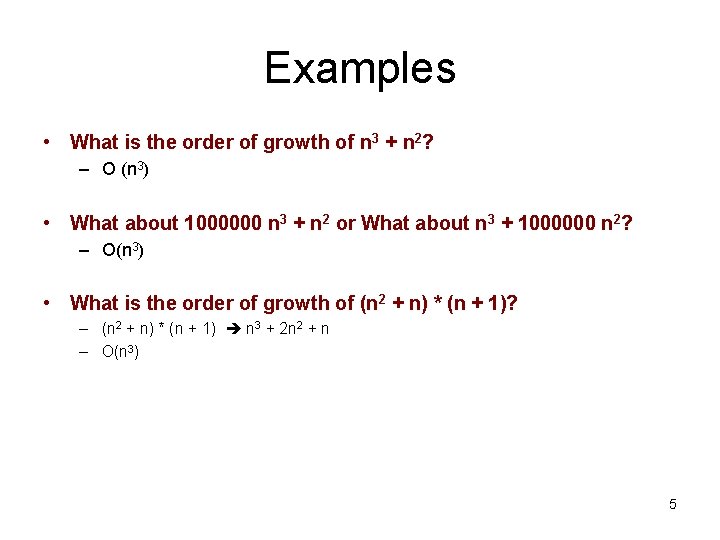
Examples • What is the order of growth of n 3 + n 2? – O (n 3) • What about 1000000 n 3 + n 2 or What about n 3 + 1000000 n 2? – O(n 3) • What is the order of growth of (n 2 + n) * (n + 1)? – (n 2 + n) * (n + 1) n 3 + 2 n 2 + n – O(n 3) 5
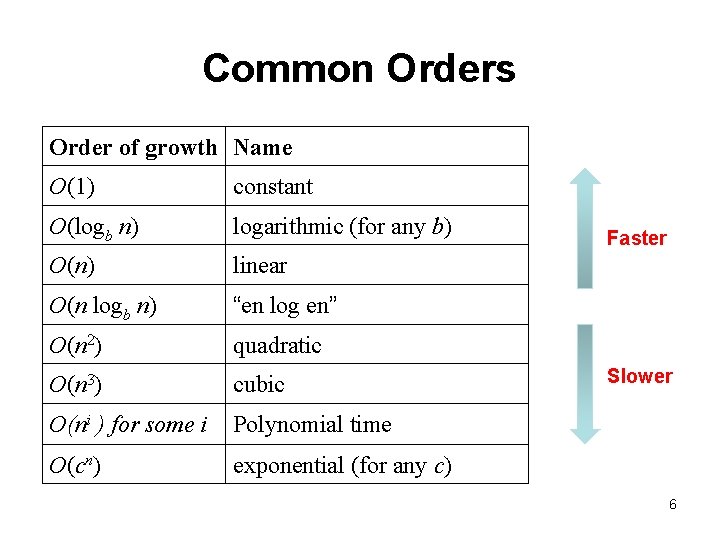
Common Orders Order of growth Name O(1) constant O(logb n) logarithmic (for any b) O(n) linear O(n logb n) “en log en” O(n 2) quadratic O(n 3) cubic O(ni ) for some i Polynomial time O(cn) exponential (for any c) Faster Slower 6
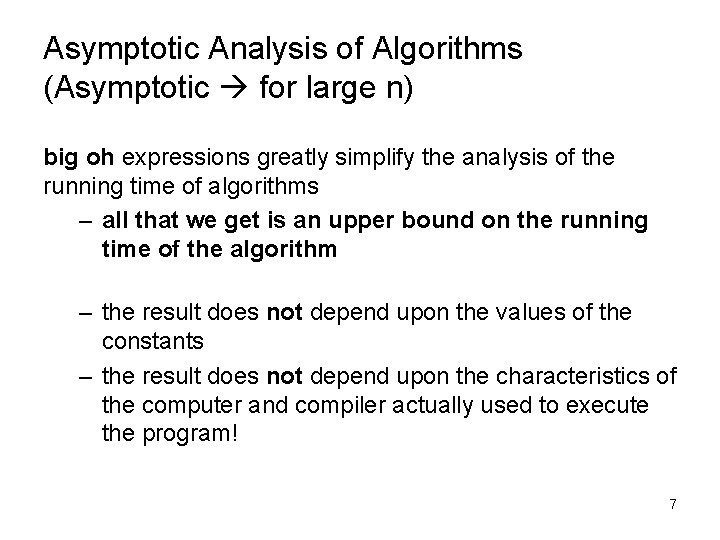
Asymptotic Analysis of Algorithms (Asymptotic for large n) big oh expressions greatly simplify the analysis of the running time of algorithms – all that we get is an upper bound on the running time of the algorithm – the result does not depend upon the values of the constants – the result does not depend upon the characteristics of the computer and compiler actually used to execute the program! 7
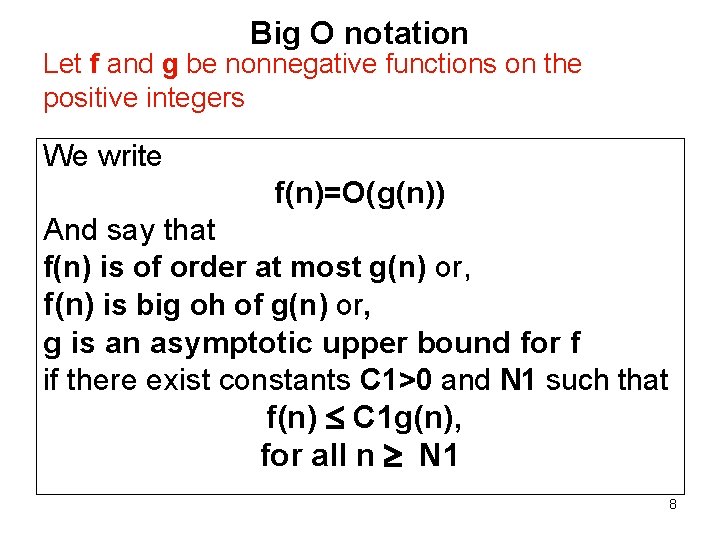
Big O notation Let f and g be nonnegative functions on the positive integers We write f(n)=O(g(n)) And say that f(n) is of order at most g(n) or, f(n) is big oh of g(n) or, g is an asymptotic upper bound for f if there exist constants C 1>0 and N 1 such that f(n) C 1 g(n), for all n N 1 8
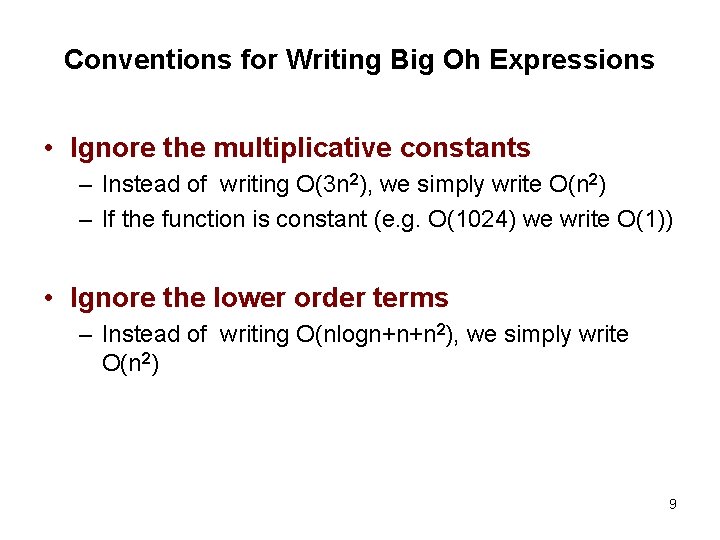
Conventions for Writing Big Oh Expressions • Ignore the multiplicative constants – Instead of writing O(3 n 2), we simply write O(n 2) – If the function is constant (e. g. O(1024) we write O(1)) • Ignore the lower order terms – Instead of writing O(nlogn+n+n 2), we simply write O(n 2) 9
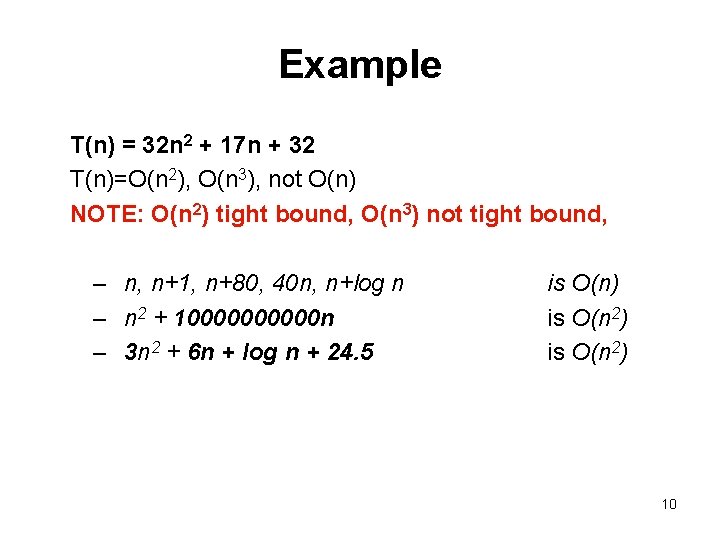
Example T(n) = 32 n 2 + 17 n + 32 T(n)=O(n 2), O(n 3), not O(n) NOTE: O(n 2) tight bound, O(n 3) not tight bound, – n, n+1, n+80, 40 n, n+log n – n 2 + 100000 n – 3 n 2 + 6 n + log n + 24. 5 is O(n) is O(n 2) 10
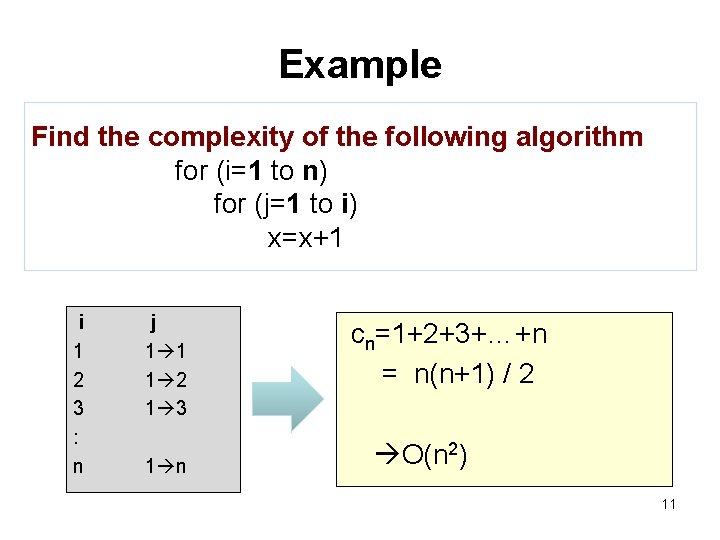
Example Find the complexity of the following algorithm for (i=1 to n) for (j=1 to i) x=x+1 i 1 2 3 : n j 1 1 1 2 1 3 1 n cn=1+2+3+…+n = n(n+1) / 2 O(n 2) 11