
Order of events Qtr 3 Evolution Classification Intro
















- Slides: 47
Order of events – Qtr 3 Evolution & Classification Intro to Evolution Quiz – Thurs, 1/31 & Fri, 2/1
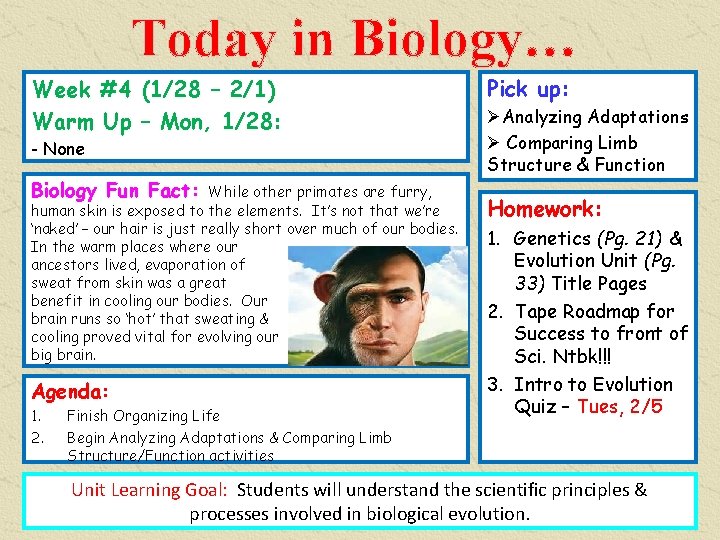
Today in Biology… Week #4 (1/28 – 2/1) Warm Up – Mon, 1/28: - None Biology Fun Fact: While other primates are furry, human skin is exposed to the elements. It’s not that we’re ‘naked’ – our hair is just really short over much of our bodies. In the warm places where our ancestors lived, evaporation of sweat from skin was a great benefit in cooling our bodies. Our brain runs so ‘hot’ that sweating & cooling proved vital for evolving our big brain. Agenda: 1. 2. Finish Organizing Life Begin Analyzing Adaptations & Comparing Limb Structure/Function activities Pick up: ØAnalyzing Adaptations Ø Comparing Limb Structure & Function Homework: 1. Genetics (Pg. 21) & Evolution Unit (Pg. 33) Title Pages 2. Tape Roadmap for Success to front of Sci. Ntbk!!! 3. Intro to Evolution Quiz – Tues, 2/5 Unit Learning Goal: Students will understand the scientific principles & processes involved in biological evolution.
Unity Week Schedule Today, Mon, 1/28 – Per. 1 - 6 Tomorrow, Tues, 1/29 – Per. 1, 3, 5 Wed, 1/30 – Per. 2, 4, 6 (Unity Assembly during Per. 2) Thurs, 1/31 – Per. 2, 4, 6 Fri, 2/1 – Per. 1, 3, 5
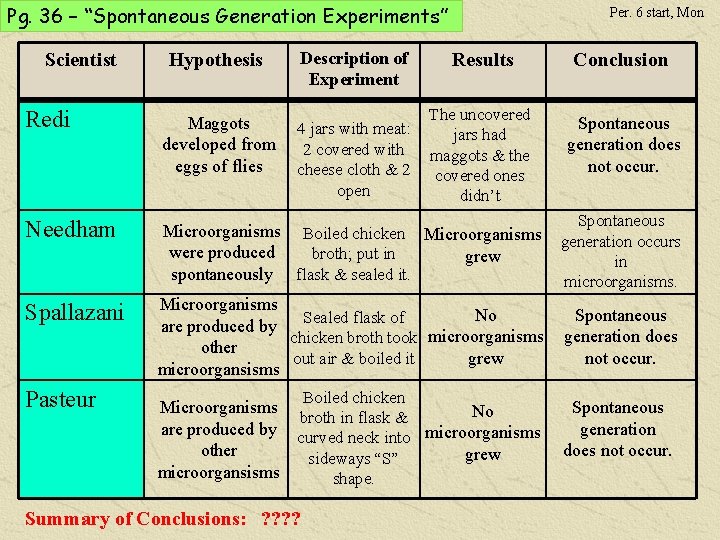
Pg. 36 – “Spontaneous Generation Experiments” Scientist Hypothesis Description of Experiment Per. 6 start, Mon Results Conclusion The uncovered jars had maggots & the covered ones didn’t Spontaneous generation does not occur. Redi Maggots developed from eggs of flies Needham Microorganisms Boiled chicken Microorganisms were produced broth; put in grew spontaneously flask & sealed it. Spontaneous generation occurs in microorganisms. Spallazani Microorganisms No are produced by Sealed flask of chicken broth took microorganisms other out air & boiled it grew microorgansisms Spontaneous generation does not occur. Pasteur 4 jars with meat: 2 covered with cheese cloth & 2 open Boiled chicken Microorganisms No broth in flask & are produced by curved neck into microorganisms other grew sideways “S” microorgansisms shape. Summary of Conclusions: ? ? Spontaneous generation does not occur.
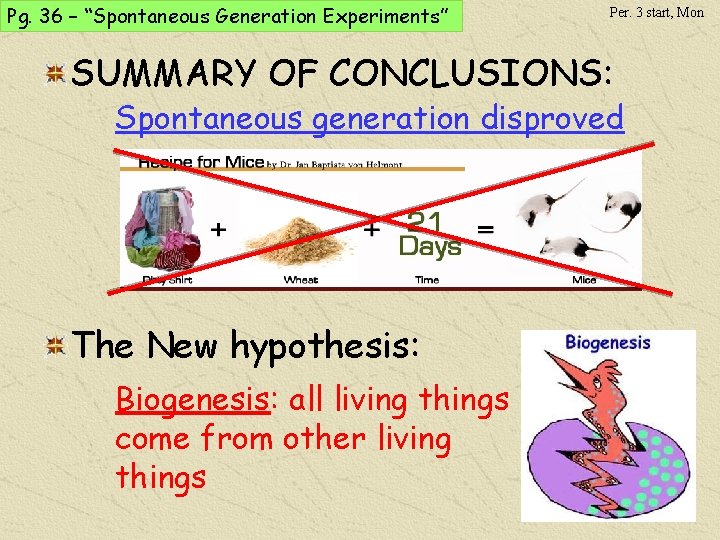
Pg. 36 – “Spontaneous Generation Experiments” Per. 3 start, Mon SUMMARY OF CONCLUSIONS: Spontaneous generation disproved The New hypothesis: Biogenesis: all living things come from other living things
Pg. 35 – “Evolution & Origin of Life notes”
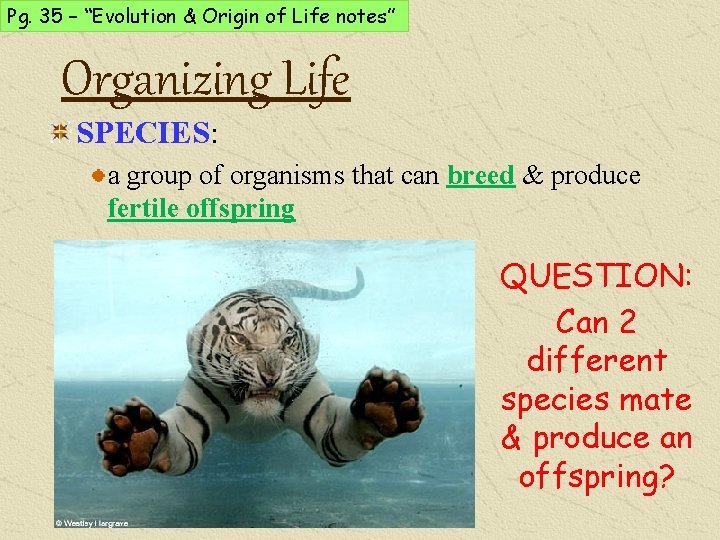
Pg. 35 – “Evolution & Origin of Life notes” Organizing Life SPECIES: a group of organisms that can breed & produce fertile offspring QUESTION: Can 2 different species mate & produce an offspring?
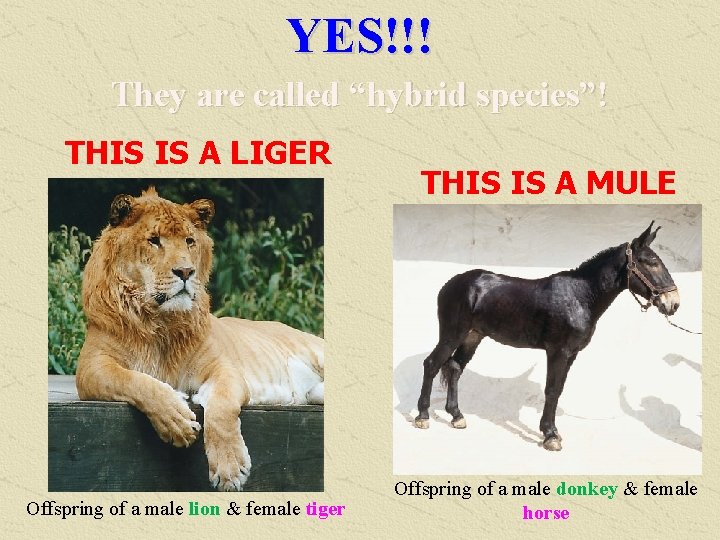
YES!!! They are called “hybrid species”! THIS IS A LIGER Offspring of a male lion & female tiger THIS IS A MULE Offspring of a male donkey & female horse
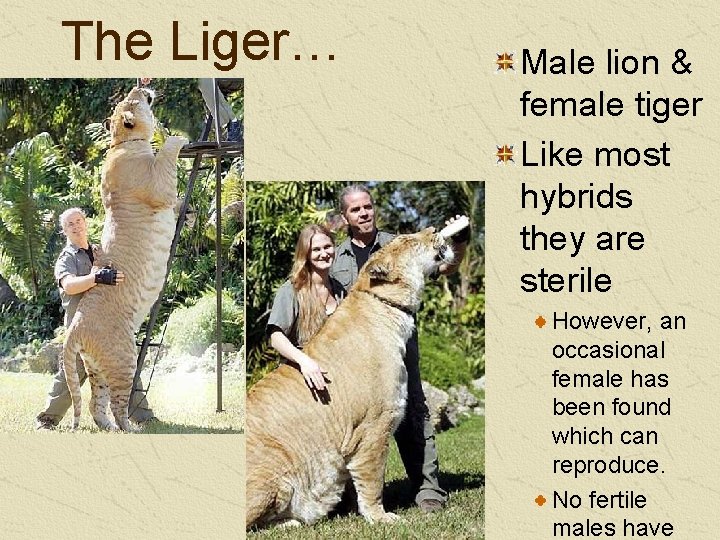
The Liger… Male lion & female tiger Like most hybrids they are sterile However, an occasional female has been found which can reproduce. No fertile males have
Pg. 35 – “Evolution & Origin of Life notes” Per. 2 start Organizing Life POPULATION: Øa group of organisms of the same species who live in the same area at the same time.
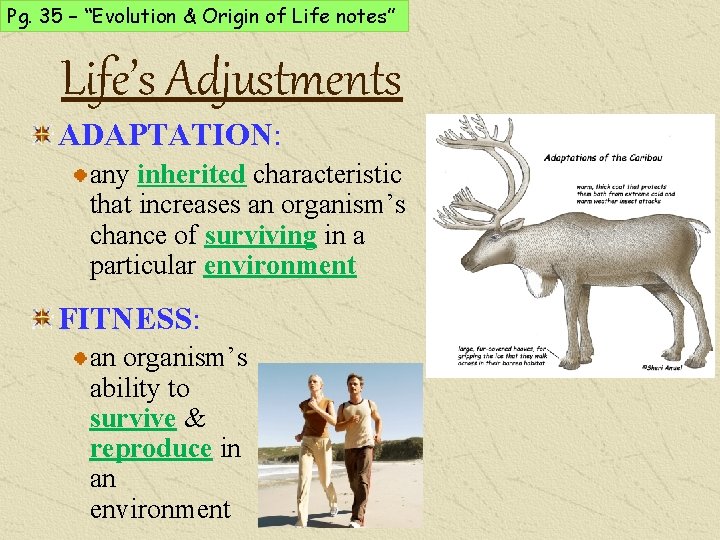
Pg. 35 – “Evolution & Origin of Life notes” Life’s Adjustments ADAPTATION: any inherited characteristic that increases an organism’s chance of surviving in a particular environment FITNESS: an organism’s ability to survive & reproduce in an environment
Pg. 64 – “Analyzing Adaptations: Living of Land” Pg. 65 – “Comparing Limb Structure & Function” Analyzing Adaptations: Living of Land & Comparing Limb Structure & Function observational labs DISCLAIMER!!!! You are NOT writing a Lab Report on this lab… BUT…I will be collecting 1 group member’s handout (with all names on it) for each lab for 2 LAB GRADES!!! What does this tell you? ? ?
Pg. 64 – “Analyzing Adaptations: Living of Land” Pg. 65 – “Comparing Limb Structure & Function” Analyzing Adaptations: Living of Land & Comparing Limb Structure & Function observational labs Analyzing Adaptations: Living of Land: ? ? ? s In your groups, you will travel between 4 stations to observe 8 different species. Discuss & identify on your wkst: • What kind of habitat (aquatic or terrestrial) each live in, • Observable structural features of each organism & • How those features are adaptations for life on land. Study & analyze each of your 8 species & their adaptations. Discuss & answer (in COMPLETE, THOUGHTFUL, THOROUGH SENTENCES) each of the Analysis & Conclusion Questions.
Pg. 64 – “Analyzing Adaptations: Living of Land” Pg. 65 – “Comparing Limb Structure & Function” Analyzing Adaptations: Living of Land & Comparing Limb Structure & Function observational labs Comparing Limb Structure & Function: ? ? ? s In your groups, discuss the similarities & differences between the limbs of the different organisms. Identify on your wkst: • The approximate number of bones in the upper & lower limbs & record in the data table • The function of the limbs of each organism. Study & analyze the data collected about each of your 8 species. Discuss & answer (in COMPLETE, THOUGHTFUL, THOROUGH SENTENCES) each of the Analysis & Conclusion Questions.
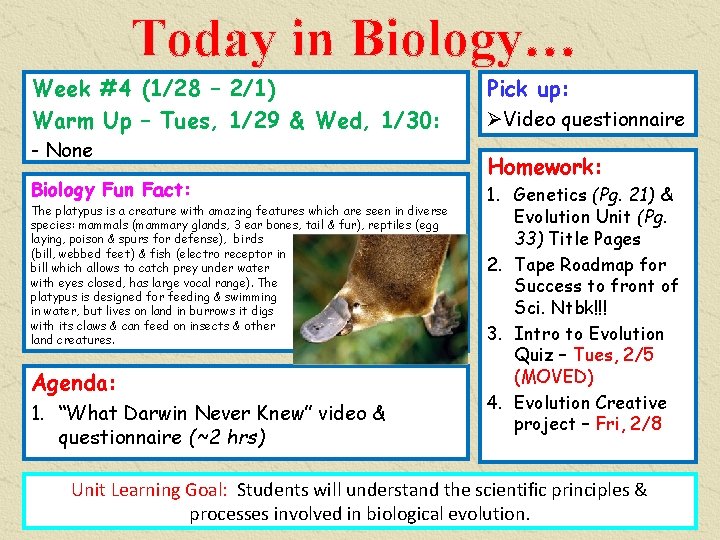
Today in Biology… Week #4 (1/28 – 2/1) Warm Up – Tues, 1/29 & Wed, 1/30: - None Biology Fun Fact: The platypus is a creature with amazing features which are seen in diverse species: mammals (mammary glands, 3 ear bones, tail & fur), reptiles (egg laying, poison & spurs for defense), birds (bill, webbed feet) & fish (electro receptor in bill which allows to catch prey under water with eyes closed, has large vocal range). The platypus is designed for feeding & swimming in water, but lives on land in burrows it digs with its claws & can feed on insects & other land creatures. Agenda: 1. “What Darwin Never Knew” video & questionnaire (~2 hrs) Pick up: ØVideo questionnaire Homework: 1. Genetics (Pg. 21) & Evolution Unit (Pg. 33) Title Pages 2. Tape Roadmap for Success to front of Sci. Ntbk!!! 3. Intro to Evolution Quiz – Tues, 2/5 (MOVED) 4. Evolution Creative project – Fri, 2/8 Unit Learning Goal: Students will understand the scientific principles & processes involved in biological evolution.
Unity Week Schedule Today, Tues, 1/29 – Per. 1, 3 5 Wed, 1/30 – Per. 2, 4, 6 (Unity Assembly during Per. 2) Tomorrow, Thurs, 1/31 – Per. 2, 4, 6 Fri, 2/1 – Per. 1, 3, 5 http: //www. youtube. com/watch? feature=player_embed ded&v=NOHz. Y 1 fu. Oz 4 - video link (~2 hrs) As you watch the video, listen & look for answers to the video questions. This will be collected at the end of
Today in Biology… Week #4 (1/28 – 2/1) Warm Up – Thurs, 1/31 & Fri, 2/1: Pick up: - AIMS Warm-up: Examples of Evolution (Pg. 39) ØExamples of Evolution (Pg. 39) Biology Fun Fact: Homework: Panspermia is the idea that microorganisms, spores or bacteria attached to tiny particles of matter have traveled through space, landing on a suitable planet & initiating the rise of life there. Lord Kelvin first suggested this scientific hypothesis in the mid 1800 s. 1. Genetics (Pg. 21) & Evolution Unit (Pg. 33) Title Pages 2. Tape/glue Roadmap for Success to front of Sci. Ntbk!!! 3. Intro to Evolution Quiz – Tues, 2/5 (MOVED) 4. Evolution Creative project – Fri, 2/8 Agenda: 1. 2. 3. Finish & discuss Analyzing Adaptations & Comparing Limb Structure/Function activities Finish “What Darwin Never Knew” video & collect questionnaire Discuss Evolution Creative project Unit Learning Goal: Students will understand the scientific principles & processes involved in biological evolution.
Unity Week Schedule Today, Thurs, 1/31 – Per. 2, 4, 6 Fri, 2/1 – Per. 1, 3, 5 What Darwin Never Knew - video link (~2 hrs) As you watch the video, listen & look for answers to the video questions. This will be collected at the end of the period for credit.
Pg. 64 – “Analyzing Adaptations: Living of Land” Pg. 65 – “Comparing Limb Structure & Function” Analyzing Adaptations: Living of Land & Comparing Limb Structure & Function observational labs DISCLAIMER!!!! You are NOT writing a Lab Report on this lab… BUT…I will be collecting 1 group member’s handout (with all names on it) for each lab for 2 LAB GRADES!!! What does this tell you? ? ?
Pg. 64 – “Analyzing Adaptations: Living of Land” Pg. 65 – “Comparing Limb Structure & Function” Analyzing Adaptations: Living of Land & Comparing Limb Structure & Function observational labs Analyzing Adaptations: Living of Land: In your groups, you will travel between 4 stations to observe 8 different species. Discuss & identify on your wkst: • What kind of habitat (aquatic or terrestrial) each live in, • Observable structural features of each organism & • How those features are adaptations for life on land. Study & analyze each of your 8 species & their adaptations. Discuss & answer (in COMPLETE, THOUGHTFUL, THOROUGH SENTENCES) each of the Analysis & Conclusion Questions.
Pg. 64 – “Analyzing Adaptations: Living of Land” Pg. 65 – “Comparing Limb Structure & Function” Analyzing Adaptations: Living of Land & Comparing Limb Structure & Function observational labs Comparing Limb Structure & Function: In your groups, discuss the similarities & differences between the limbs of the different organisms. Identify on your wkst: • The approximate number of bones in the upper & lower limbs & record in the data table • The function of the limbs of each organism. Study & analyze the data collected about each of your 8 species. Discuss & answer (in COMPLETE, THOUGHTFUL, THOROUGH SENTENCES) each of the Analysis & Conclusion Questions.
Pg. 64 – “Analyzing Adaptations: Living of Land” Pg. 65 – “Comparing Limb Structure & Function” Analyzing Adaptations: Living of Land & Comparing Limb Structure & Function observational labs Let’s discuss… Analyzing Adaptations: Living of Land Comparing Limb Structure & Function
Pg. 64 – “Analyzing Adaptations: Living of Land” Pg. 65 – “Comparing Limb Structure & Function” Analyzing Adaptations: Living of Land & Comparing Limb Structure & Function observational labs Since our Fun Fact last time was about human hair, the group members with the most/longest hair in your group will be turning in YOUR GROUP’S WKSTS for 2 Lab Grades! Make sure ALL MEMBER’S NAMES are on 1 wkst for each lab & turn in to the Hmwk Bin!
Taking the place of 1 Quiz grade will be a “creative assignment”. Here are your 2 options: Choose 1 of the following options to complete: Amazing, Adorable Adaptations OR Darwin vs. Lamarck Comic Strip EVOLUTION CREATIVE PROJECT
Homework (takes place of Quiz grade): due Fri, 2/8 OPTION 1: Amazing, Adorable Adaptations Create an environment & organism (that don’t already exist) 1. Draw & name the environment on the front side of your paper (use at least 4 colors & your imagination) 2. On the back side of your paper, describe the environment (temperature, plant life, atmosphere, soil type, etc) 3. On the front side, now create & name an organism that lives in your environment v. Draw your organism inside your environment v. On the back side of your paper, list the following: Ø 2 Structural Adaptations Ø 2 Behavioral Adaptations Ø 2 Physiological Adaptations v. Explain in detail how these 6 adaptations have increased the fitness of your organism.
“Land of Oogley-Boogley” Ciliasquibble
“Land of Oogley-Boogley” This environment is very…(describe the temperature, plant life, atmosphere, soil type, etc. ) Ciliasquibble has the following adaptations: Ø 2 Structural Adaptations – ØLong hair. . . so that it can…protect itself from the sun’s damaging radiation. Ø? ? ? . . . so that it can…? ? ? Ø 2 Behavioral Adaptations Ø? ? ? . . . so that it can…? ? ? Ø 2 Physiological Adaptations Ø? ? ? . . . so that it can…? ? ?
OPTION 2: Darwin vs. Lamarck cartoon Pick an animal (that’s real). Create a comic strip of the following: 1. Show your animal may have evolved by way of Lamarck’s theory of acquired traits. 2. Show this same animal may have evolved by way of Darwin’s theory of natural selection. - Comic strips need to include: - pictures, - conversation bubbles &/or captions with content in them & - color, creativity & originality. Choose 1 of the Options to complete! 30 pts (Quiz grade)
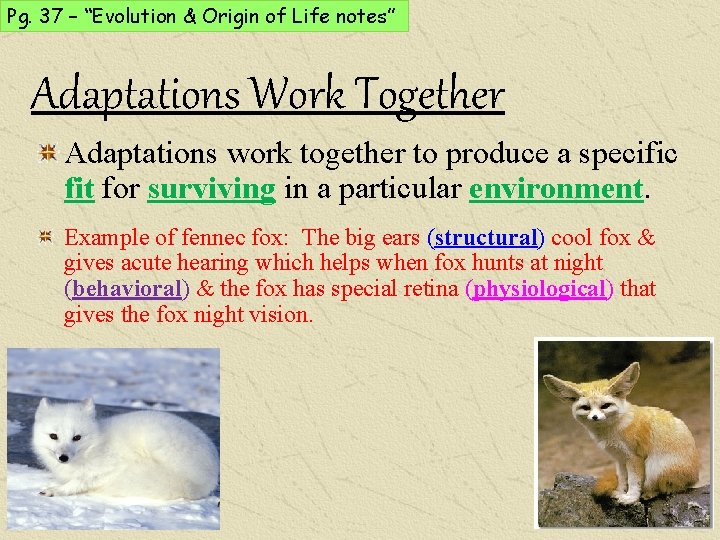
Pg. 37 – “Evolution & Origin of Life notes” TYPES OF ADAPTATIONS Structural Physiological Behavioral Let’s look at each type as we consider 2 species: the tundra & icecap-dwelling arctic fox & the desert dwelling fennec fox.
Pg. 37 – “Evolution & Origin of Life notes” Vs. arctic fox (Alopex lagopus) fennec fox (Vulpes zerda) Structural Adaptation: physical appearance of an organism EX: Big ears & small ears of foxes. • Large ears allow heat to escape easily from the blood vessels near the surface – cooler blood keeps fennec fox from overheating • Small ears prevent arctic fox from losing heat
QUESTION: An arctic fox can weigh as much as 8 kg. A fennec fox weighs at most 1. 5 kg. Make a claim for how this difference in mass is a structural adaptation to the foxes’ respective environments. ANSWER: The large size of the arctic fox allows it to retain more heat than the smaller fennec fox.
Pg. 37 – “Evolution & Origin of Life notes” Vs. Physiological Adaptation: related to biochemical processes at work within an organism’s body Compare the processing of food & water: Arctic fox: food is scarce in winter; effective at storing food energy as fat. Fennec fox: little free water available; adapted to get all moisture it needs from fruits, roots, & leaves.
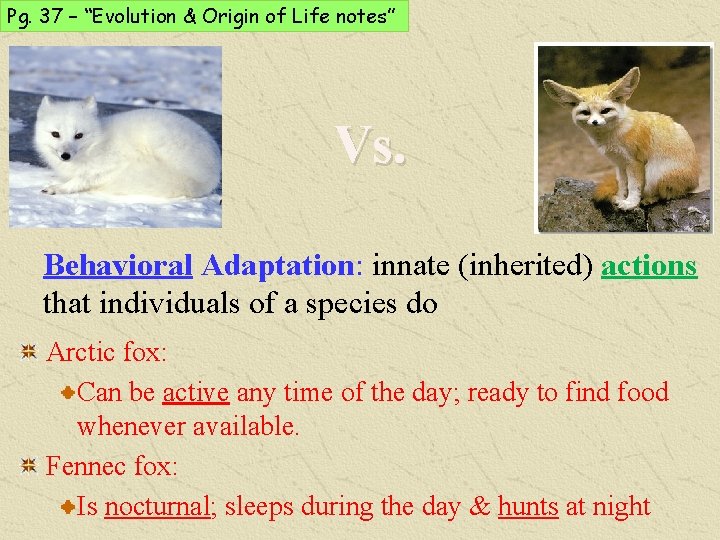
Pg. 37 – “Evolution & Origin of Life notes” Vs. Behavioral Adaptation: innate (inherited) actions that individuals of a species do Arctic fox: Can be active any time of the day; ready to find food whenever available. Fennec fox: Is nocturnal; sleeps during the day & hunts at night
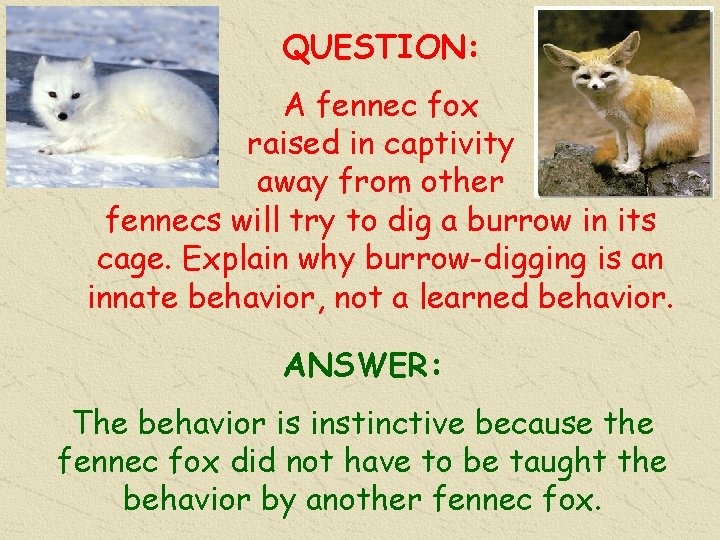
QUESTION: A fennec fox raised in captivity away from other fennecs will try to dig a burrow in its cage. Explain why burrow-digging is an innate behavior, not a learned behavior. ANSWER: The behavior is instinctive because the fennec fox did not have to be taught the behavior by another fennec fox.
Pg. 37 – “Evolution & Origin of Life notes” Adaptations Work Together Adaptations work together to produce a specific fit for surviving in a particular environment. Example of fennec fox: The big ears (structural) cool fox & gives acute hearing which helps when fox hunts at night (behavioral) & the fox has special retina (physiological) that gives the fox night vision.
Pg. 64 – “Analyzing Adaptations: Living of Land” Pg. 65 – “Comparing Limb Structure & Function” Analyzing Adaptations: Living of Land & Comparing Limb Structure & Function observational labs Let’s connect… Where did you see Structural, Behavioral or Physiological adaptations in the organisms you studied?
Today in Biology… Week #4 (1/28 – 2/1) Warm Up – Fri, 2/1: - Process of Natural Selection wkst (Pg. 43) Biology Fun Fact: Pick up: Ø Theory Comparison wkst Ø Process of Natural Selection wkst The Red Queen hypothesis (law of constant extinction) suggests that an evolutionary advance by one species represents a deterioration of the environment for all remaining species. The other have to “keep up with the times or they will die off! Homework: Agenda: 4. 1. Types of Adaptations notes 2. Natural Selection & Theory Comparison notes 1. 2. 3. 5. Genetics (Pg. 21) & Evolution Unit (Pg. 33) Title Pages Tape/glue Roadmap for Success to Sci. Ntbk!!! Intro to Evolution Quiz – Tues, 2/5 (MOVED) Theory Comparison wkst – Wed, 2/6 & Thurs, 2/7 Evolution Creative project – Fri, 2/8 Unit Learning Goal: Students will understand the scientific principles & processes involved in biological evolution.
Unity Week Schedule Today, Fri, 2/1 – Per. 1, 3, 5
Pg. 40 – “Evolution & Origin of Life notes” When looking at several adaptations over time, a species is seen to EVOLVE!!!!!
Pg. 40 – “Evolution & Origin of Life notes” EVOLUTION Genetic change in a species over time How does this happen? The following scientists came up with possible hypotheses: • Jean Baptiste de Lamarck • Charles Darwin • Alfred Russell Wallace
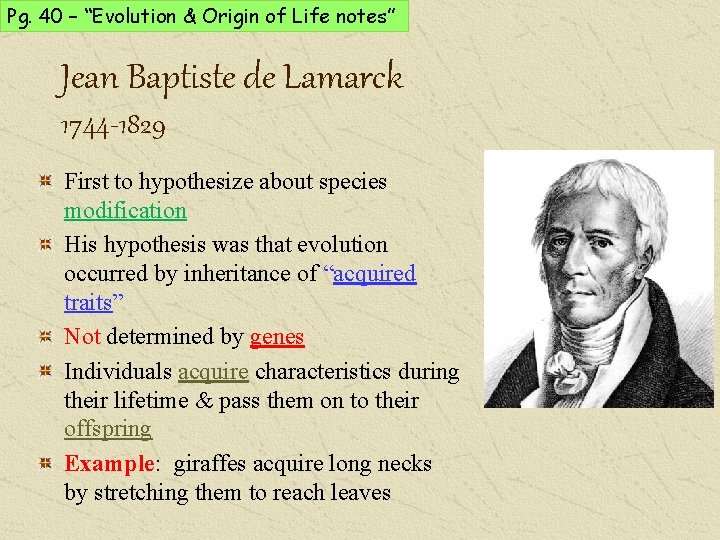
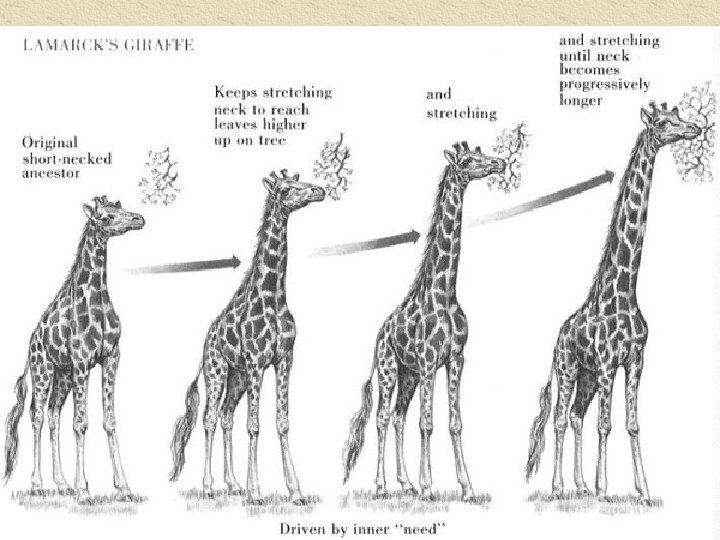
Pg. 40 – “Evolution & Origin of Life notes” Jean Baptiste de Lamarck 1744 -1829 First to hypothesize about species modification His hypothesis was that evolution occurred by inheritance of “acquired traits” Not determined by genes Individuals acquire characteristics during their lifetime & pass them on to their offspring Example: giraffes acquire long necks by stretching them to reach leaves
Lamarck’s Hypothesis
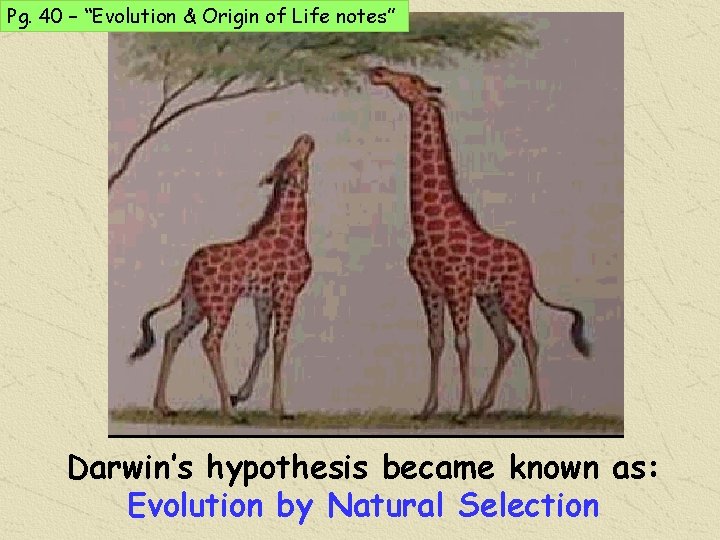
Pg. 40 – “Evolution & Origin of Life notes” CHARLES DARWIN 1809 -1882 v Darwin agreed with Lamarck about species modification but disagreed with how it occurred. v Hypothesis: selection acts on a variation already present v Darwin believed giraffes had various sizes of necks & the environment selected the characteristic that was best suited (beneficial) v Giraffes with longer necks were the ones that survived & passed on their genes v Variation (neck size) happens through random mutation, not created by experience
Pg. 40 – “Evolution & Origin of Life notes” Darwin’s hypothesis became known as: Evolution by Natural Selection
HOW DID DARWIN COME UP WITH HIS HYPOTHESIS? ? ?
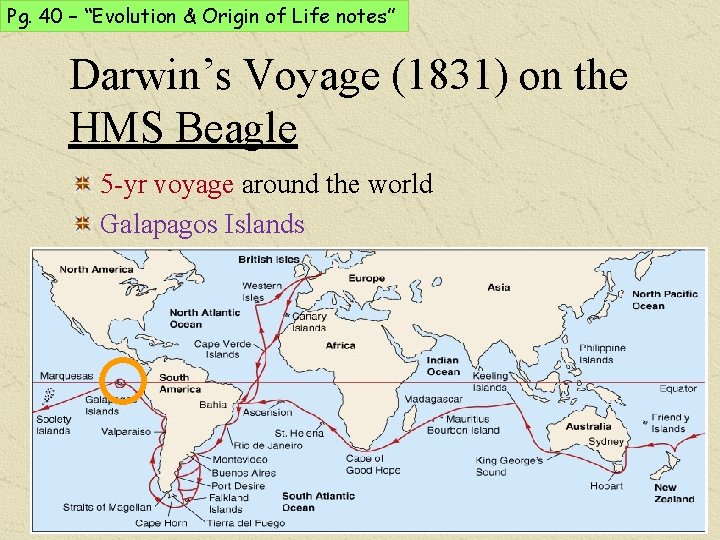
Pg. 40 – “Evolution & Origin of Life notes” Darwin’s Voyage (1831) on the HMS Beagle 5 -yr voyage around the world Galapagos Islands