
Orbits l Bony cavities in which the eyes
Orbits l Bony cavities in which the eyes are firmly encased and cushioned by fatty tissue l Formed by parts of seven bones – frontal, sphenoid, zygomatic, maxilla, palatine, lacrimal, and ethmoid

Orbits Figure 7. 9 b
Nasal Cavity l Constructed of bone and hyaline cartilage l Roof – formed by the cribriform plate of the ethmoid l Lateral walls – formed by the superior and middle conchae of the ethmoid, the perpendicular plate of the palatine, and the inferior nasal conchae l Floor – formed by palatine process of the maxillae and palatine bone
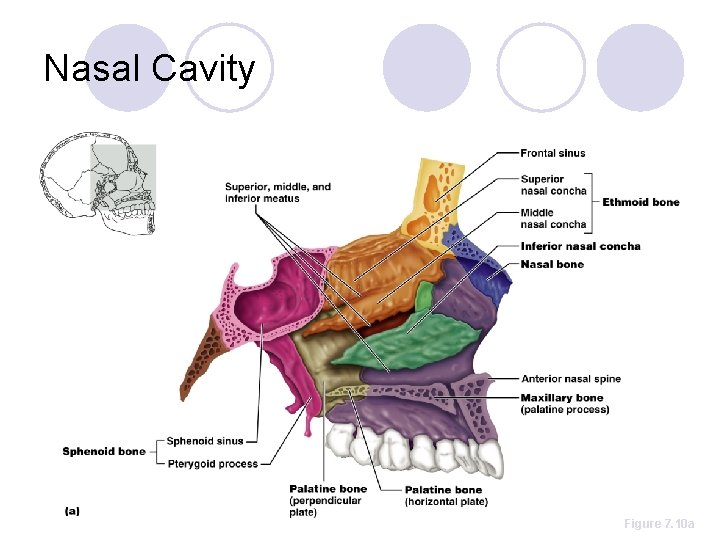
Nasal Cavity Figure 7. 10 a
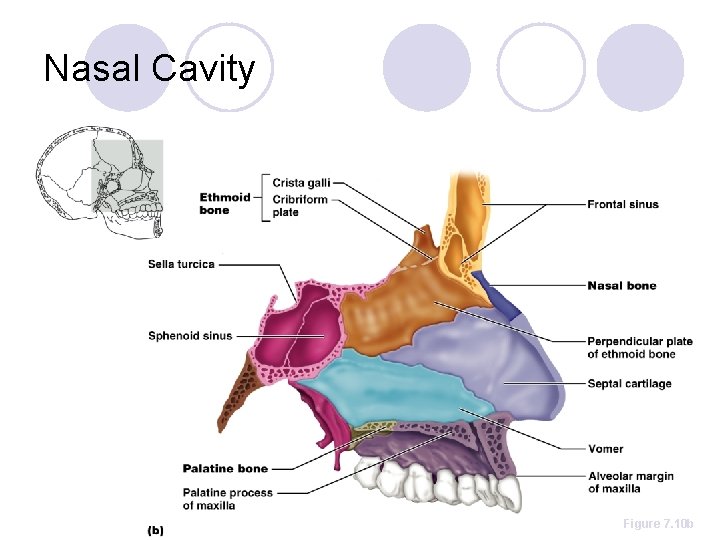
Nasal Cavity Figure 7. 10 b
Paranasal Sinuses l Mucosa-lined, air-filled sacs found in five skull bones – the frontal, sphenoid, ethmoid, and paired maxillary bones l Air enters the paranasal sinuses from the nasal cavity and mucus drains into the nasal cavity from the sinuses l Lighten the skull and enhance the resonance of the voice
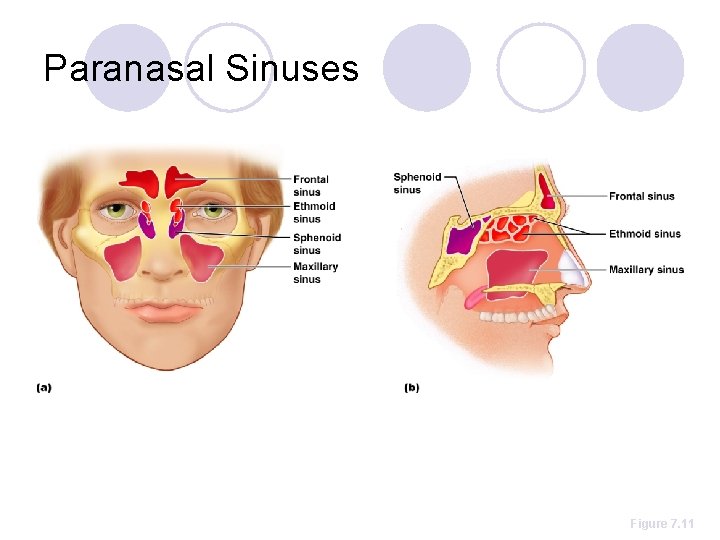
Paranasal Sinuses Figure 7. 11
Hyoid Bone l Not actually part of the skull, but lies just inferior to the mandible in the anterior neck l Only bone of the body that does not articulate directly with another bone l Attachment point for neck muscles that raise and lower the larynx during swallowing and speech
Vertebral Column l Formed from 26 irregular bones (vertebrae) connected in such a way that a flexible curved structure results ¡ Cervical vertebrae – 7 bones of the neck ¡ Thoracic vertebrae – 12 bones of the torso ¡ Lumbar vertebrae – 5 bones of the lower back ¡ Sacrum – bone inferior to the lumbar vertebrae that articulates with the hip bones
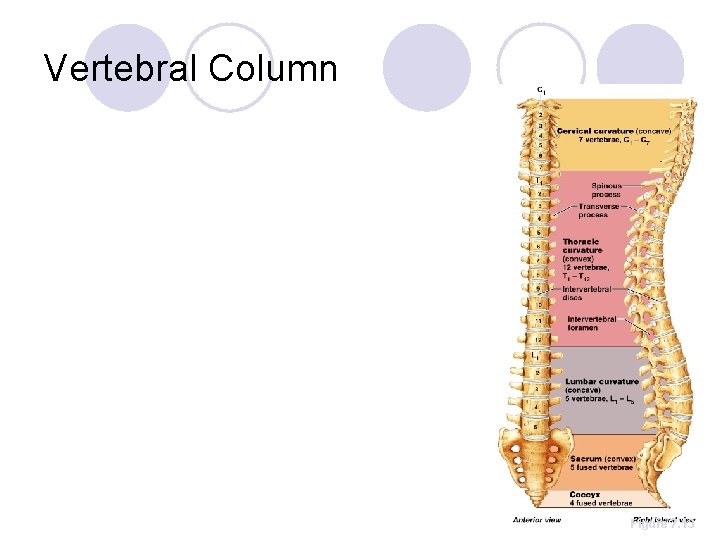
Vertebral Column Figure 7. 13
Vertebral Column: Curvatures l Posteriorly concave curvatures – cervical and lumbar l Posteriorly convex curvatures – thoracic and sacral l Abnormal spine curvatures include scoliosis (abnormal lateral curve), kyphosis (hunchback), and lordosis (swayback)
Vertebral Column: Ligaments l Anterior and posterior longitudinal ligaments – continuous bands down the front and back of the spine from the neck to the sacrum l Short ligaments connect adjoining vertebrae together
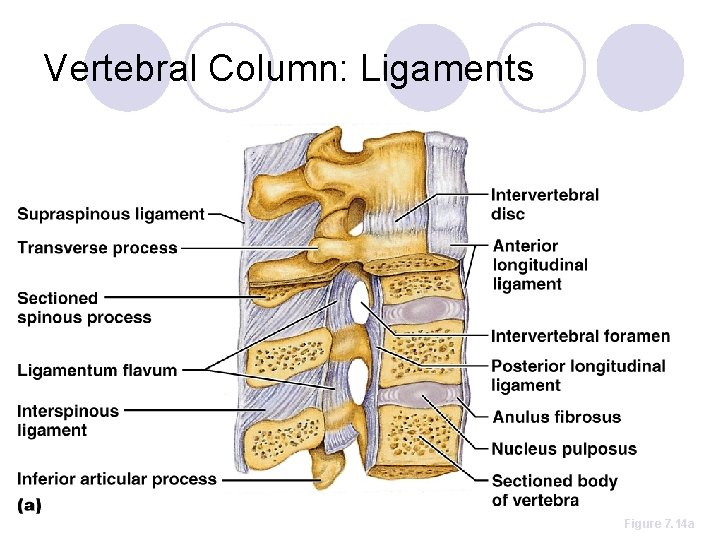
Vertebral Column: Ligaments Figure 7. 14 a
Vertebral Column: Intervertebral Discs l Cushion-like ¡ Nucleus pad composed of two parts pulposus – inner gelatinous nucleus that gives the disc its elasticity and compressibility ¡ Annulus fibrosus – surrounds the nucleus pulposus with a collar composed of collagen and fibrocartilage
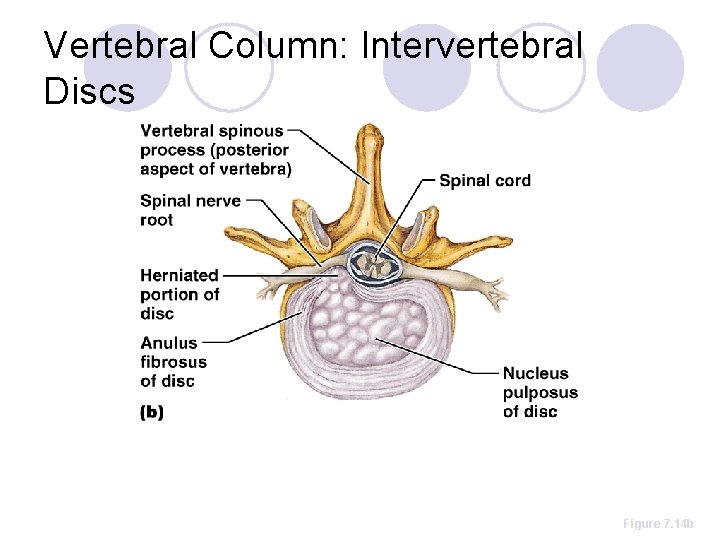
Vertebral Column: Intervertebral Discs Figure 7. 14 b
General Structure of Vertebrae l Body or centrum – disc-shaped, weightbearing region l Vertebral arch – composed of pedicles and laminae that, along with the centrum, enclose the vertebral foramen l Vertebral foramina – make up the vertebral canal through which the spinal cord passes
General Structure of Vertebrae l Spinous processes project posteriorly, and transverse processes project laterally l Superior and inferior articular processes – protrude superiorly and inferiorly from the pedicle-lamina junctions l Intervertebral foramina – lateral openings formed from notched areas on the superior and inferior borders of adjacent pedicles
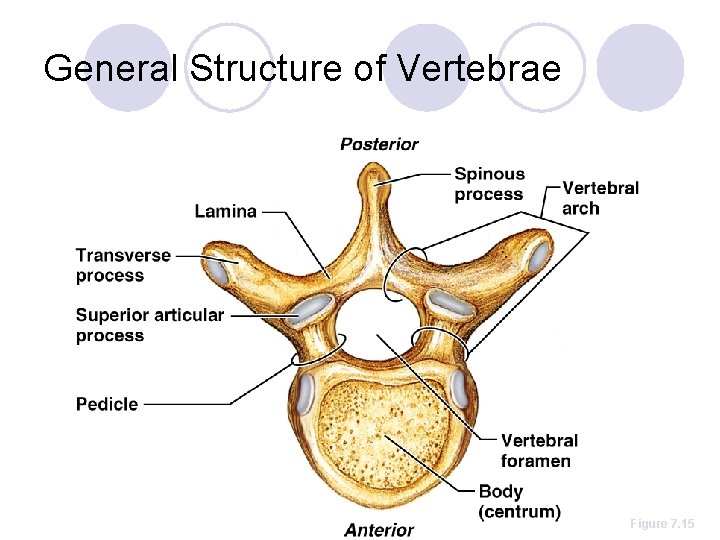
General Structure of Vertebrae Figure 7. 15
- Slides: 18