
Orbital Mechanics Why do we care Fundamental properties
Orbital Mechanics • Why do we care? – Fundamental properties of solar system objects – Examples: synchronous rotation, tidal heating, orbital decay, eccentricity damping etc. • What are we going to study? – Kepler’s laws / Newtonian analysis – Angular momentum and spin dynamics – Tidal torques and tidal dissipation • These will come back to haunt us later in the course • Good textbook – Murray and Dermott, Solar System Dynamics, C. U. P. , 1999 F. Nimmo EART 290 Q Spring 09
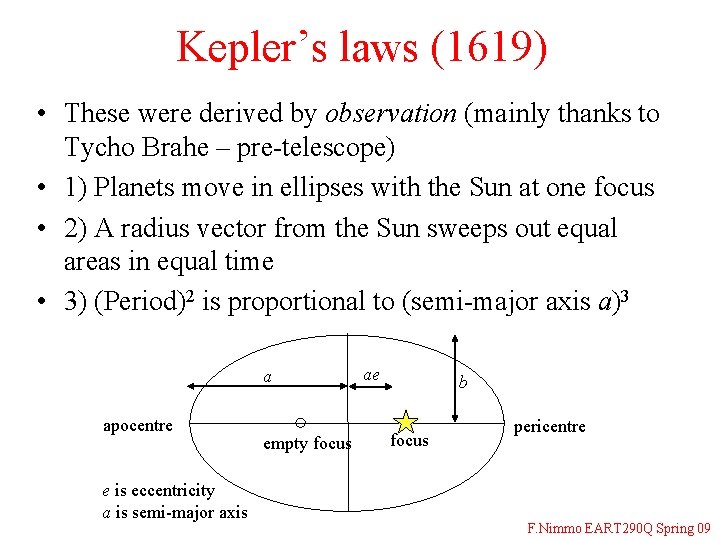
Kepler’s laws (1619) • These were derived by observation (mainly thanks to Tycho Brahe – pre-telescope) • 1) Planets move in ellipses with the Sun at one focus • 2) A radius vector from the Sun sweeps out equal areas in equal time • 3) (Period)2 is proportional to (semi-major axis a)3 a apocentre e is eccentricity a is semi-major axis empty focus ae b focus pericentre F. Nimmo EART 290 Q Spring 09
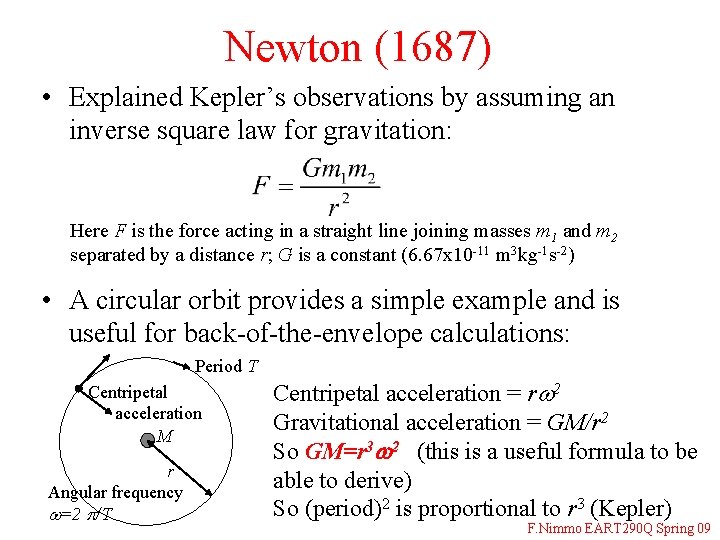
Newton (1687) • Explained Kepler’s observations by assuming an inverse square law for gravitation: Here F is the force acting in a straight line joining masses m 1 and m 2 separated by a distance r; G is a constant (6. 67 x 10 -11 m 3 kg-1 s-2) • A circular orbit provides a simple example and is useful for back-of-the-envelope calculations: Period T Centripetal acceleration M r Angular frequency w=2 p/T Centripetal acceleration = rw 2 Gravitational acceleration = GM/r 2 So GM=r 3 w 2 (this is a useful formula to be able to derive) So (period)2 is proportional to r 3 (Kepler) F. Nimmo EART 290 Q Spring 09
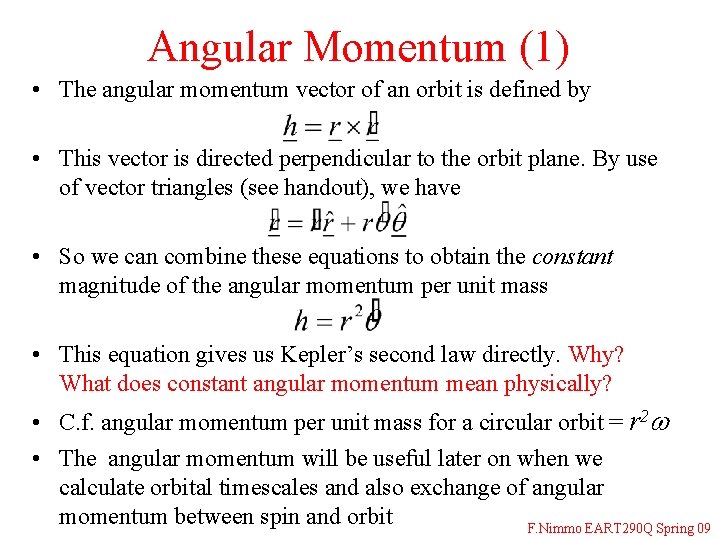
Angular Momentum (1) • The angular momentum vector of an orbit is defined by • This vector is directed perpendicular to the orbit plane. By use of vector triangles (see handout), we have • So we can combine these equations to obtain the constant magnitude of the angular momentum per unit mass • This equation gives us Kepler’s second law directly. Why? What does constant angular momentum mean physically? • C. f. angular momentum per unit mass for a circular orbit = r 2 w • The angular momentum will be useful later on when we calculate orbital timescales and also exchange of angular momentum between spin and orbit F. Nimmo EART 290 Q Spring 09
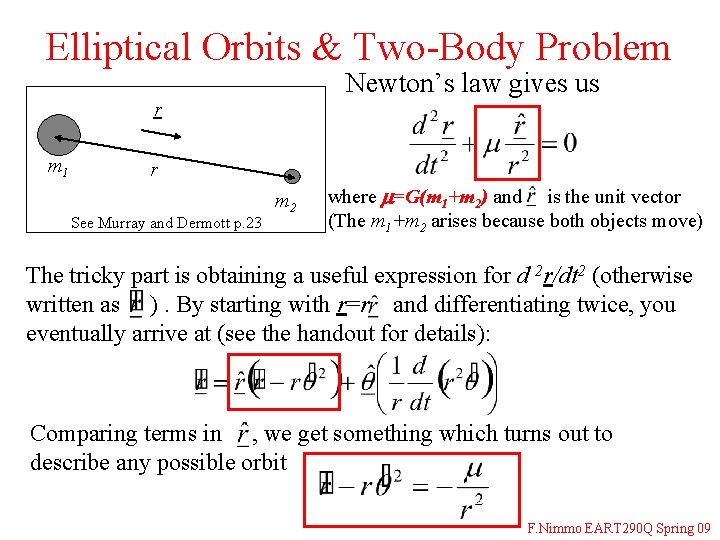
Elliptical Orbits & Two-Body Problem Newton’s law gives us r m 1 r See Murray and Dermott p. 23 m 2 where m=G(m 1+m 2) and is the unit vector (The m 1+m 2 arises because both objects move) The tricky part is obtaining a useful expression for d 2 r/dt 2 (otherwise written as ). By starting with r=r and differentiating twice, you eventually arrive at (see the handout for details): Comparing terms in , we get something which turns out to describe any possible orbit F. Nimmo EART 290 Q Spring 09
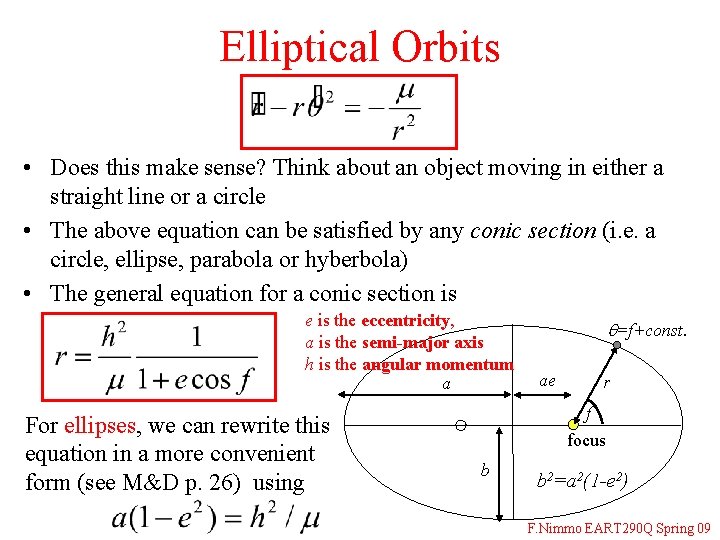
Elliptical Orbits • Does this make sense? Think about an object moving in either a straight line or a circle • The above equation can be satisfied by any conic section (i. e. a circle, ellipse, parabola or hyberbola) • The general equation for a conic section is e is the eccentricity, a is the semi-major axis h is the angular momentum a For ellipses, we can rewrite this equation in a more convenient form (see M&D p. 26) using q=f+const. ae r f focus b b 2=a 2(1 -e 2) F. Nimmo EART 290 Q Spring 09
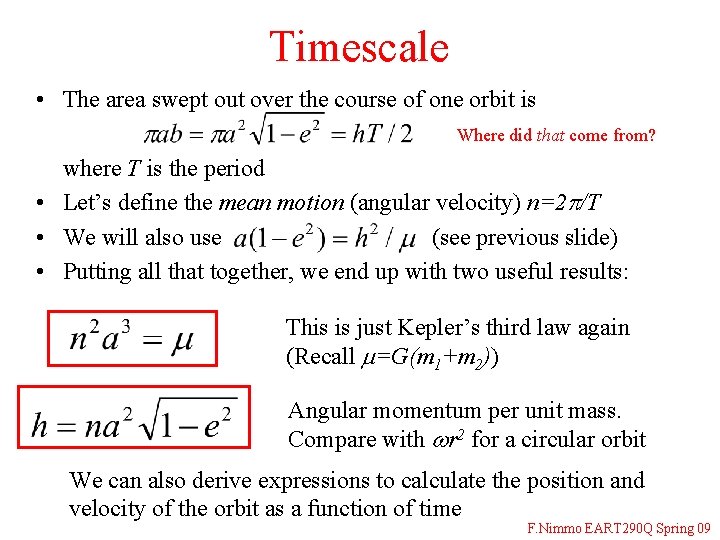
Timescale • The area swept out over the course of one orbit is Where did that come from? where T is the period • Let’s define the mean motion (angular velocity) n=2 p/T • We will also use (see previous slide) • Putting all that together, we end up with two useful results: This is just Kepler’s third law again (Recall m=G(m 1+m 2)) Angular momentum per unit mass. Compare with wr 2 for a circular orbit We can also derive expressions to calculate the position and velocity of the orbit as a function of time F. Nimmo EART 290 Q Spring 09
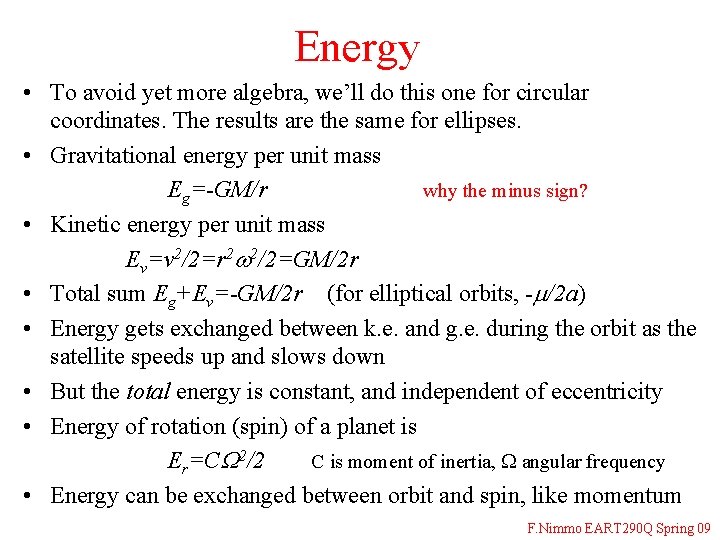
Energy • To avoid yet more algebra, we’ll do this one for circular coordinates. The results are the same for ellipses. • Gravitational energy per unit mass Eg=-GM/r why the minus sign? • Kinetic energy per unit mass Ev=v 2/2=r 2 w 2/2=GM/2 r • Total sum Eg+Ev=-GM/2 r (for elliptical orbits, -m/2 a) • Energy gets exchanged between k. e. and g. e. during the orbit as the satellite speeds up and slows down • But the total energy is constant, and independent of eccentricity • Energy of rotation (spin) of a planet is Er=CW 2/2 C is moment of inertia, W angular frequency • Energy can be exchanged between orbit and spin, like momentum F. Nimmo EART 290 Q Spring 09
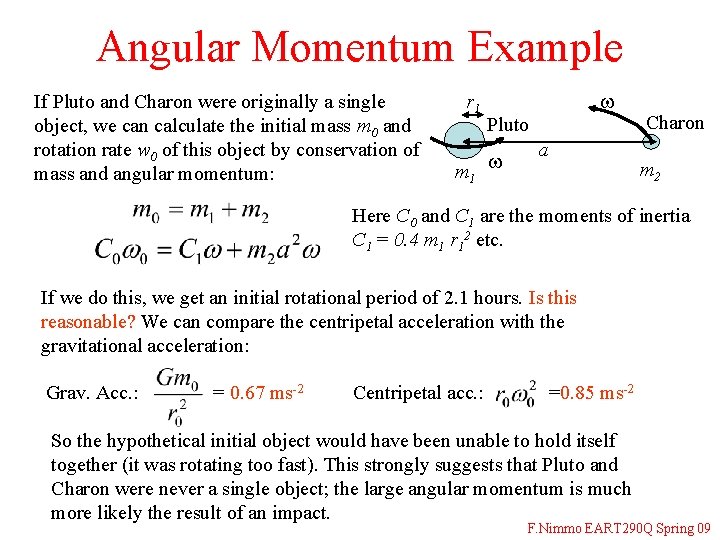
Angular Momentum Example If Pluto and Charon were originally a single object, we can calculate the initial mass m 0 and rotation rate w 0 of this object by conservation of mass and angular momentum: r 1 m 1 w Pluto w a Charon m 2 Here C 0 and C 1 are the moments of inertia C 1 = 0. 4 m 1 r 12 etc. If we do this, we get an initial rotational period of 2. 1 hours. Is this reasonable? We can compare the centripetal acceleration with the gravitational acceleration: Grav. Acc. : = 0. 67 ms-2 Centripetal acc. : =0. 85 ms-2 So the hypothetical initial object would have been unable to hold itself together (it was rotating too fast). This strongly suggests that Pluto and Charon were never a single object; the large angular momentum is much more likely the result of an impact. F. Nimmo EART 290 Q Spring 09
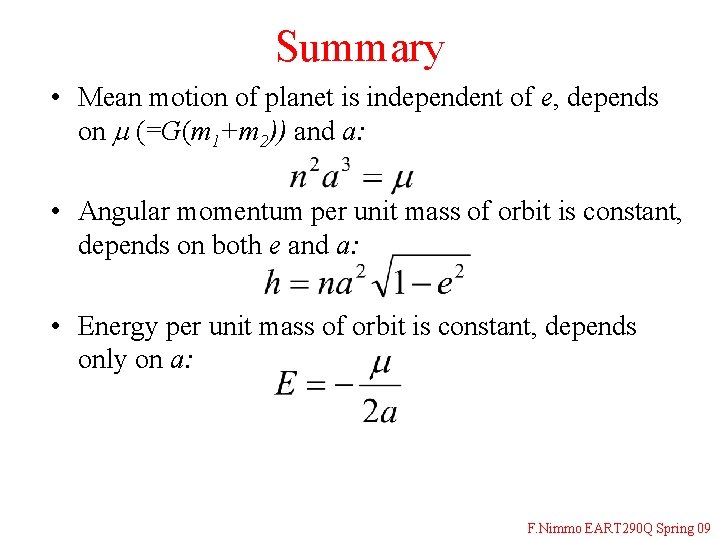
Summary • Mean motion of planet is independent of e, depends on m (=G(m 1+m 2)) and a: • Angular momentum per unit mass of orbit is constant, depends on both e and a: • Energy per unit mass of orbit is constant, depends only on a: F. Nimmo EART 290 Q Spring 09
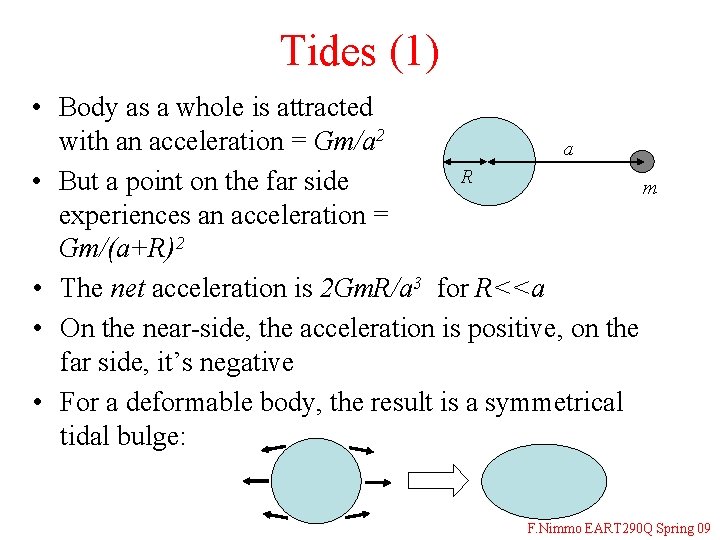
Tides (1) • Body as a whole is attracted with an acceleration = Gm/a 2 a R • But a point on the far side m experiences an acceleration = Gm/(a+R)2 • The net acceleration is 2 Gm. R/a 3 for R<<a • On the near-side, the acceleration is positive, on the far side, it’s negative • For a deformable body, the result is a symmetrical tidal bulge: F. Nimmo EART 290 Q Spring 09
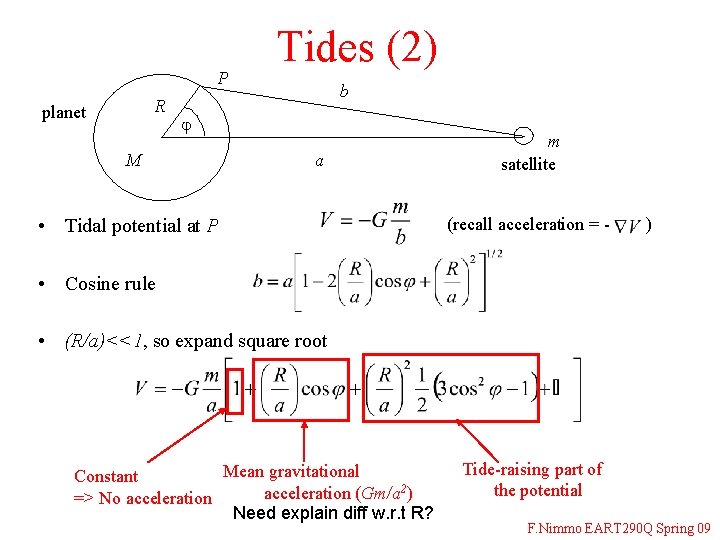
P R planet Tides (2) b j M a • Tidal potential at P m satellite (recall acceleration = - ) • Cosine rule • (R/a)<<1, so expand square root Mean gravitational Constant acceleration (Gm/a 2) => No acceleration Need explain diff w. r. t R? Tide-raising part of the potential F. Nimmo EART 290 Q Spring 09
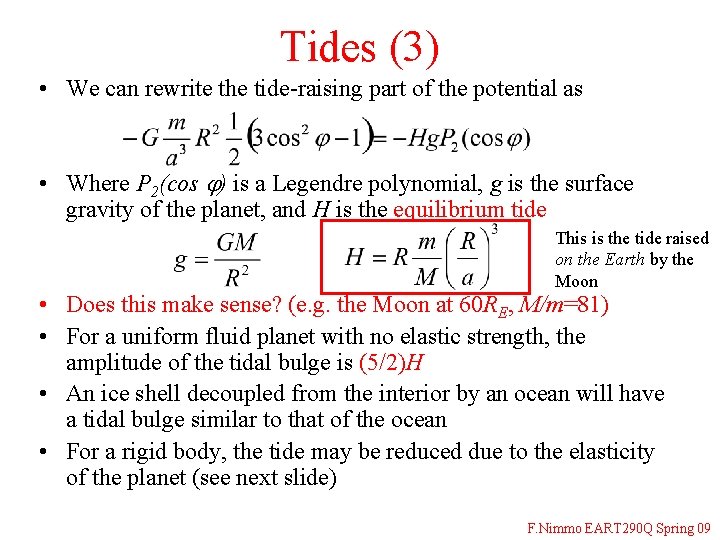
Tides (3) • We can rewrite the tide-raising part of the potential as • Where P 2(cos j) is a Legendre polynomial, g is the surface gravity of the planet, and H is the equilibrium tide This is the tide raised on the Earth by the Moon • Does this make sense? (e. g. the Moon at 60 RE, M/m=81) • For a uniform fluid planet with no elastic strength, the amplitude of the tidal bulge is (5/2)H • An ice shell decoupled from the interior by an ocean will have a tidal bulge similar to that of the ocean • For a rigid body, the tide may be reduced due to the elasticity of the planet (see next slide) F. Nimmo EART 290 Q Spring 09
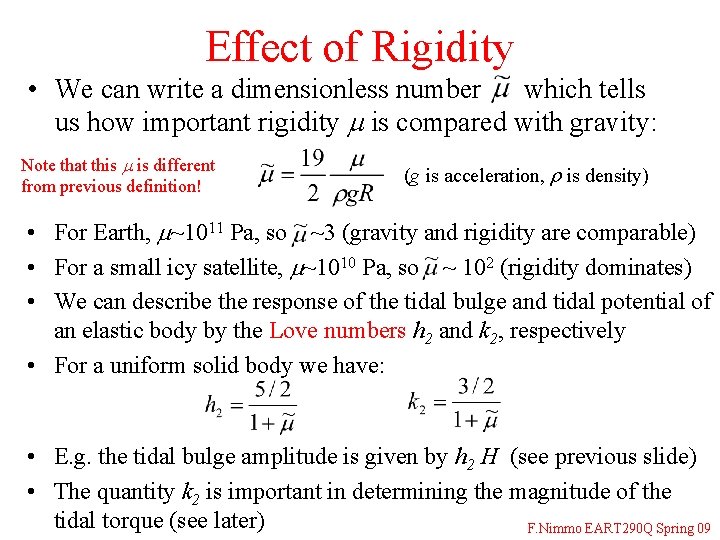
Effect of Rigidity • We can write a dimensionless number which tells us how important rigidity m is compared with gravity: Note that this m is different from previous definition! (g is acceleration, r is density) • For Earth, m~1011 Pa, so ~3 (gravity and rigidity are comparable) • For a small icy satellite, m~1010 Pa, so ~ 102 (rigidity dominates) • We can describe the response of the tidal bulge and tidal potential of an elastic body by the Love numbers h 2 and k 2, respectively • For a uniform solid body we have: • E. g. the tidal bulge amplitude is given by h 2 H (see previous slide) • The quantity k 2 is important in determining the magnitude of the tidal torque (see later) F. Nimmo EART 290 Q Spring 09
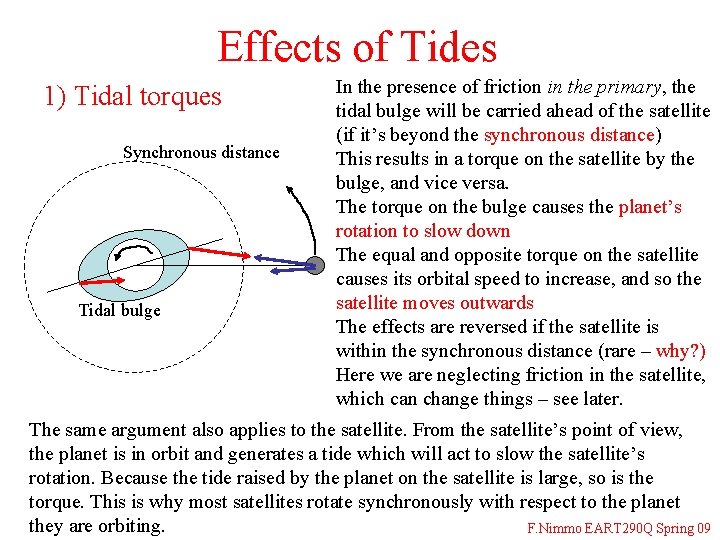
Effects of Tides 1) Tidal torques Synchronous distance Tidal bulge In the presence of friction in the primary, the tidal bulge will be carried ahead of the satellite (if it’s beyond the synchronous distance) This results in a torque on the satellite by the bulge, and vice versa. The torque on the bulge causes the planet’s rotation to slow down The equal and opposite torque on the satellite causes its orbital speed to increase, and so the satellite moves outwards The effects are reversed if the satellite is within the synchronous distance (rare – why? ) Here we are neglecting friction in the satellite, which can change things – see later. The same argument also applies to the satellite. From the satellite’s point of view, the planet is in orbit and generates a tide which will act to slow the satellite’s rotation. Because the tide raised by the planet on the satellite is large, so is the torque. This is why most satellites rotate synchronously with respect to the planet they are orbiting. F. Nimmo EART 290 Q Spring 09
Tidal Torques • Examples of tidal torques in action – – – Almost all satellites are in synchronous rotation Phobos is spiralling in towards Mars (why? ) So is Triton (towards Neptune) (why? ) Pluto and Charon are doubly synchronous (why? ) Mercury is in a 3: 2 spin: orbit resonance (not known until radar observations became available) – The Moon is currently receding from the Earth (at about 3. 5 cm/yr), and the Earth’s rotation is slowing down (in 150 million years, 1 day will equal 25 hours). What evidence do we have? How could we interpret this in terms of angular momentum conservation? Why did the recession rate cause problems? F. Nimmo EART 290 Q Spring 09

Diurnal Tides (1) • Consider a satellite which is in a synchronous, eccentric orbit • Both the size and the orientation of the tidal bulge will change 2 ae over the course of each orbit Tidal bulge Fixed point on satellite’s surface a Empty focus Planet a This tidal pattern consists of a static part plus an oscillation • From a fixed point on the satellite, the resulting tidal pattern can be represented as a static tide (permanent) plus a much smaller component that oscillates (the diurnal tide) N. B. it’s often helpful to think about tides from the satellite’s viewpoint F. Nimmo EART 290 Q Spring 09
Diurnal tides (2) • The amplitude of the diurnal tide is 3 e times the static tide (does this make sense? ) • Why are diurnal tides important? – Stress – the changing shape of the bulge at any point on the satellite generates time-varying stresses – Heat – time-varying stresses generate heat (assuming some kind of dissipative process, like viscosity or friction). NB the heating rate goes as e 2 – why? – Dissipation has important consequences for the internal state of the satellite, and the orbital evolution of the system (the energy has to come from somewhere) • We will see that diurnal tides dominate the behaviour of some of the Galilean satellites F. Nimmo EART 290 Q Spring 09
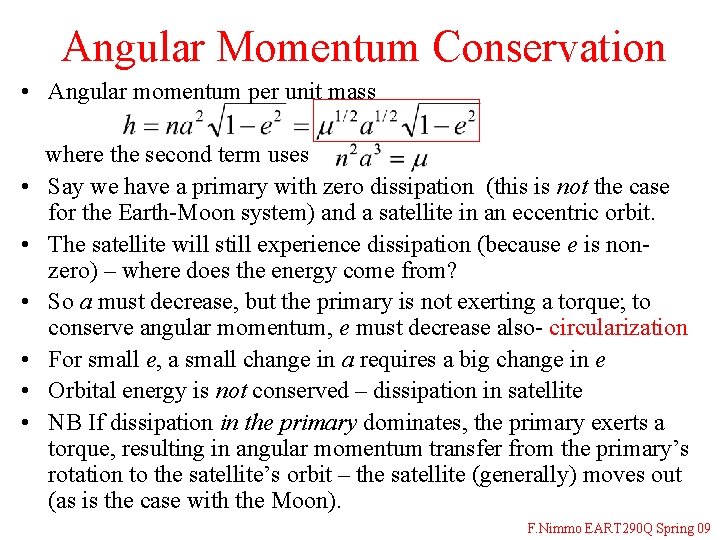
Angular Momentum Conservation • Angular momentum per unit mass • • • where the second term uses Say we have a primary with zero dissipation (this is not the case for the Earth-Moon system) and a satellite in an eccentric orbit. The satellite will still experience dissipation (because e is nonzero) – where does the energy come from? So a must decrease, but the primary is not exerting a torque; to conserve angular momentum, e must decrease also- circularization For small e, a small change in a requires a big change in e Orbital energy is not conserved – dissipation in satellite NB If dissipation in the primary dominates, the primary exerts a torque, resulting in angular momentum transfer from the primary’s rotation to the satellite’s orbit – the satellite (generally) moves out (as is the case with the Moon). F. Nimmo EART 290 Q Spring 09
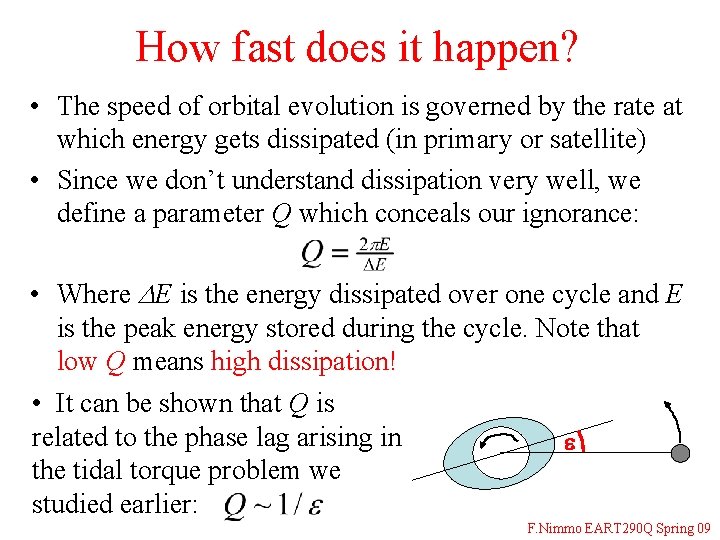
How fast does it happen? • The speed of orbital evolution is governed by the rate at which energy gets dissipated (in primary or satellite) • Since we don’t understand dissipation very well, we define a parameter Q which conceals our ignorance: • Where DE is the energy dissipated over one cycle and E is the peak energy stored during the cycle. Note that low Q means high dissipation! • It can be shown that Q is related to the phase lag arising in e the tidal torque problem we studied earlier: F. Nimmo EART 290 Q Spring 09
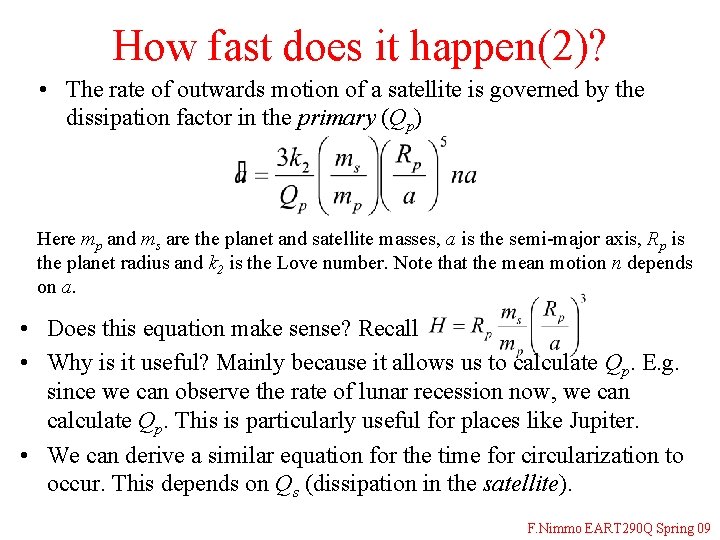
How fast does it happen(2)? • The rate of outwards motion of a satellite is governed by the dissipation factor in the primary (Qp) Here mp and ms are the planet and satellite masses, a is the semi-major axis, Rp is the planet radius and k 2 is the Love number. Note that the mean motion n depends on a. • Does this equation make sense? Recall • Why is it useful? Mainly because it allows us to calculate Qp. E. g. since we can observe the rate of lunar recession now, we can calculate Qp. This is particularly useful for places like Jupiter. • We can derive a similar equation for the time for circularization to occur. This depends on Qs (dissipation in the satellite). F. Nimmo EART 290 Q Spring 09
Tidal Effects - Summary • Tidal despinning of satellite – generally rapid, results in synchronous rotation. This happens first. • If dissipation in the synchronous satellite is negligible (e=0 or Qs>>Qp) then – If the satellite is outside the synchronous point, its orbit expands outwards (why? ) and the planet spins down (e. g. the Moon) – If the satellite is inside the synchronous point, its orbit contracts and the planet spins up (e. g. Phobos) • If dissipation in the primary is negligible compared to the satellite (Qp>>Qs), then the satellite’s eccentricity decreases to zero and the orbit contracts a bit (why? ) (e. g. Titan? ) F. Nimmo EART 290 Q Spring 09
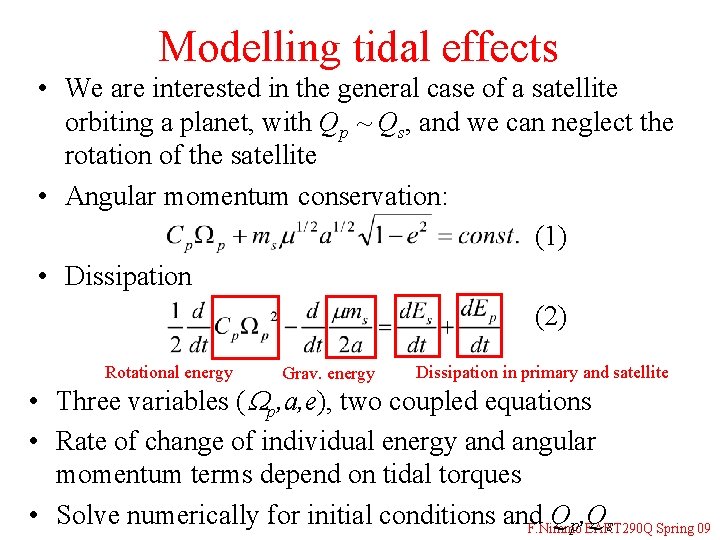
Modelling tidal effects • We are interested in the general case of a satellite orbiting a planet, with Qp ~ Qs, and we can neglect the rotation of the satellite • Angular momentum conservation: (1) • Dissipation (2) Rotational energy Grav. energy Dissipation in primary and satellite • Three variables (Wp, a, e), two coupled equations • Rate of change of individual energy and angular momentum terms depend on tidal torques • Solve numerically for initial conditions and Qp, Q s F. Nimmo EART 290 Q Spring 09
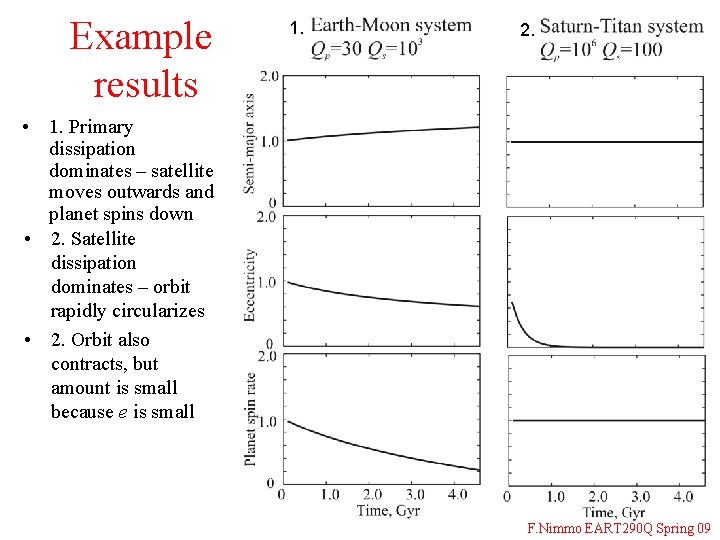
Example results 1. 2. • 1. Primary dissipation dominates – satellite moves outwards and planet spins down • 2. Satellite dissipation dominates – orbit rapidly circularizes • 2. Orbit also contracts, but amount is small because e is small F. Nimmo EART 290 Q Spring 09
Summary • Tidal bulges arise because bodies are not point masses, but have a radius and hence a gradient in acceleration • A tidal bulge which varies in size or position will generate heat, depending on the value of Q • If the tidal bulge lags (dissipation - finite Q), it will generate torques on the tide-raising body • Torques due to a tide raised by the satellite on the primary will (generally) drive the satellite outwards • Torques due to a tide raised by the primary on the satellite will tend to circularize the satellite’s orbit • The relative importance of these two effects is governed by the relative values of Q F. Nimmo EART 290 Q Spring 09
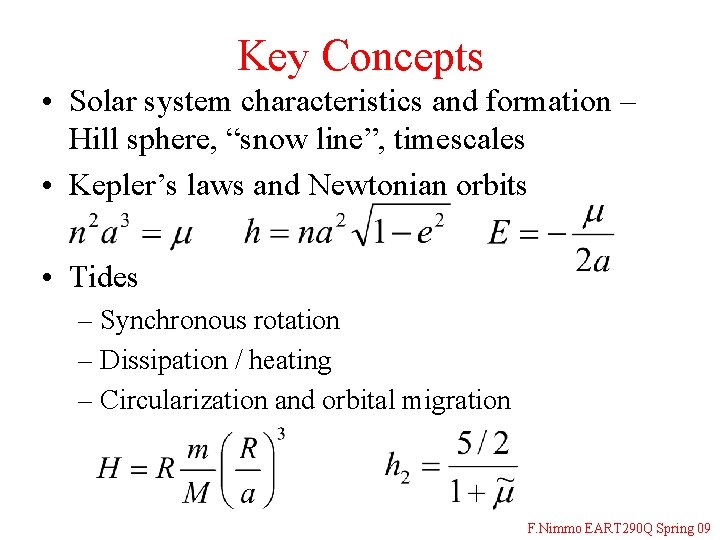
Key Concepts • Solar system characteristics and formation – Hill sphere, “snow line”, timescales • Kepler’s laws and Newtonian orbits • Tides – Synchronous rotation – Dissipation / heating – Circularization and orbital migration F. Nimmo EART 290 Q Spring 09
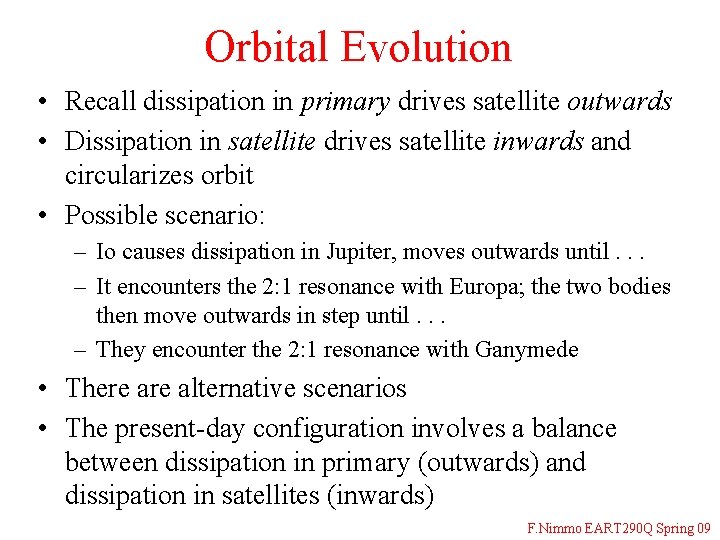
Orbital Evolution • Recall dissipation in primary drives satellite outwards • Dissipation in satellite drives satellite inwards and circularizes orbit • Possible scenario: – Io causes dissipation in Jupiter, moves outwards until. . . – It encounters the 2: 1 resonance with Europa; the two bodies then move outwards in step until. . . – They encounter the 2: 1 resonance with Ganymede • There alternative scenarios • The present-day configuration involves a balance between dissipation in primary (outwards) and dissipation in satellites (inwards) F. Nimmo EART 290 Q Spring 09
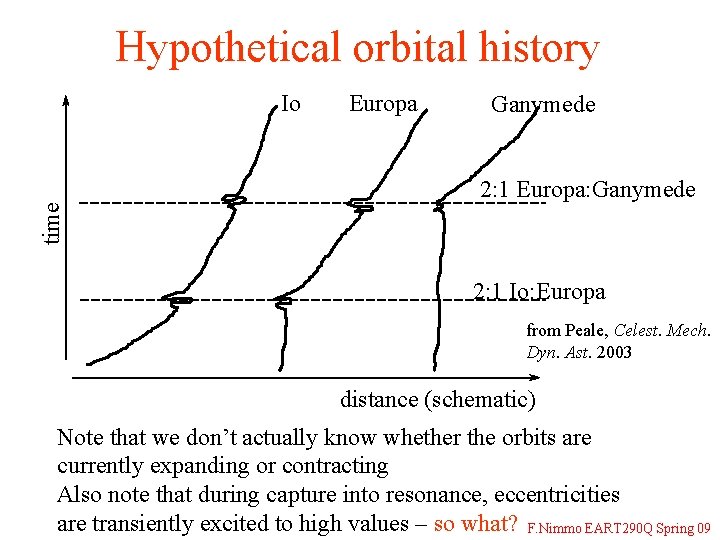
Hypothetical orbital history time Io Europa Ganymede 2: 1 Europa: Ganymede 2: 1 Io: Europa from Peale, Celest. Mech. Dyn. Ast. 2003 distance (schematic) Note that we don’t actually know whether the orbits are currently expanding or contracting Also note that during capture into resonance, eccentricities are transiently excited to high values – so what? F. Nimmo EART 290 Q Spring 09
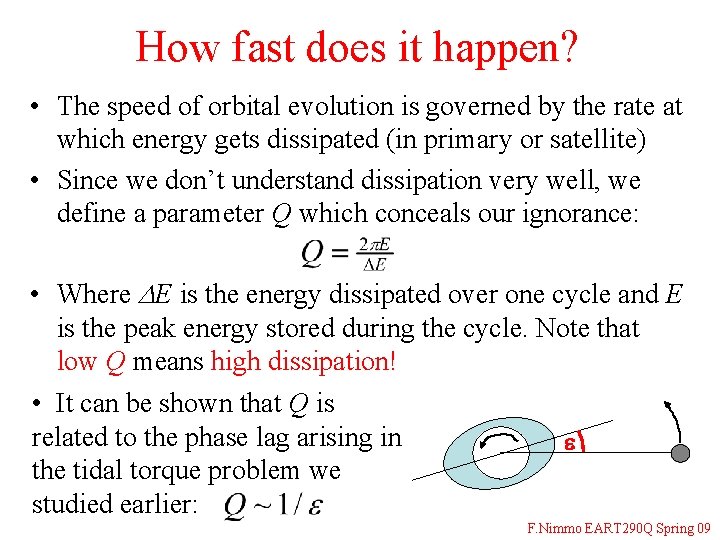
How fast does it happen? • The speed of orbital evolution is governed by the rate at which energy gets dissipated (in primary or satellite) • Since we don’t understand dissipation very well, we define a parameter Q which conceals our ignorance: • Where DE is the energy dissipated over one cycle and E is the peak energy stored during the cycle. Note that low Q means high dissipation! • It can be shown that Q is related to the phase lag arising in e the tidal torque problem we studied earlier: F. Nimmo EART 290 Q Spring 09
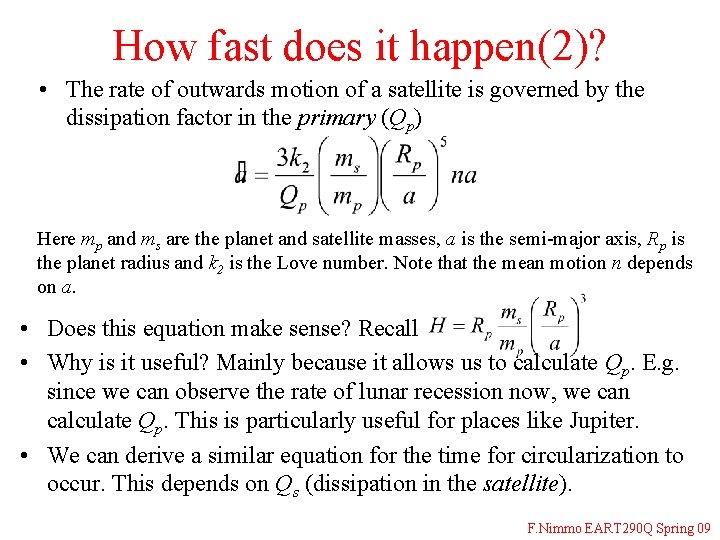
How fast does it happen(2)? • The rate of outwards motion of a satellite is governed by the dissipation factor in the primary (Qp) Here mp and ms are the planet and satellite masses, a is the semi-major axis, Rp is the planet radius and k 2 is the Love number. Note that the mean motion n depends on a. • Does this equation make sense? Recall • Why is it useful? Mainly because it allows us to calculate Qp. E. g. since we can observe the rate of lunar recession now, we can calculate Qp. This is particularly useful for places like Jupiter. • We can derive a similar equation for the time for circularization to occur. This depends on Qs (dissipation in the satellite). F. Nimmo EART 290 Q Spring 09
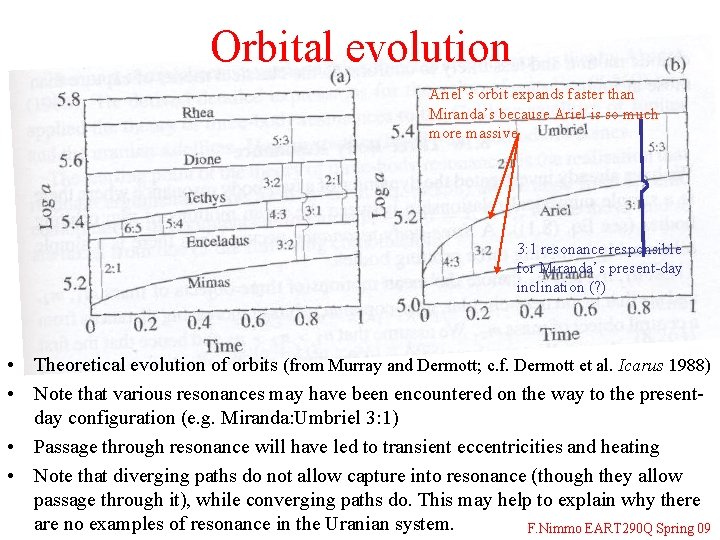
Orbital evolution Ariel’s orbit expands faster than Miranda’s because Ariel is so much more massive 3: 1 resonance responsible for Miranda’s present-day inclination (? ) • Theoretical evolution of orbits (from Murray and Dermott; c. f. Dermott et al. Icarus 1988) • Note that various resonances may have been encountered on the way to the presentday configuration (e. g. Miranda: Umbriel 3: 1) • Passage through resonance will have led to transient eccentricities and heating • Note that diverging paths do not allow capture into resonance (though they allow passage through it), while converging paths do. This may help to explain why there are no examples of resonance in the Uranian system. F. Nimmo EART 290 Q Spring 09
Estimating Q • Recall that the rate of outwards motion of a satellite depends on planetary dissipation Qp • If we assume that Io formed 4. 5 Gyr B. P. , and has been moving outwards ever since, we get a lower bound on Jupiter’s Q of ~105 (why a lower bound? ) • This value is typical of gas giants, but is much higher than for silicate bodies (~102) • The Earth’s Q is anomalously high (~12) because the current continental configuration means oceanic tides are close to resonance – lots of dissipation • We’ll calculate the rate of dissipation in a second F. Nimmo EART 290 Q Spring 09
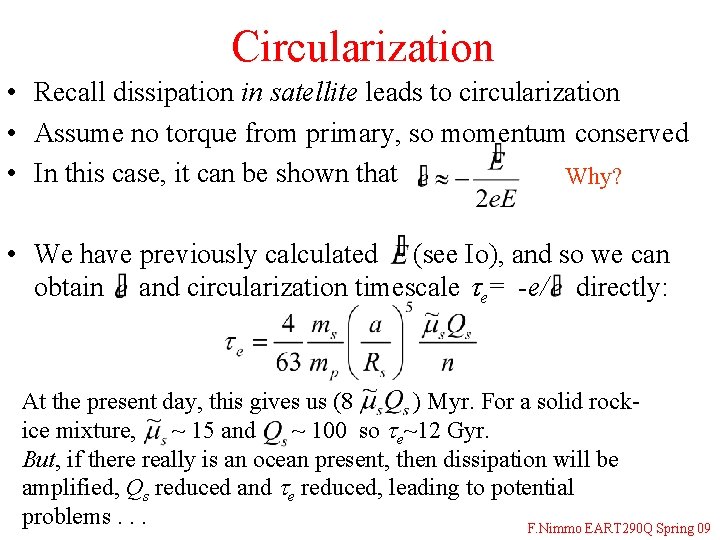
Circularization • Recall dissipation in satellite leads to circularization • Assume no torque from primary, so momentum conserved • In this case, it can be shown that Why? • We have previously calculated (see Io), and so we can obtain and circularization timescale te= -e/ directly: At the present day, this gives us (8 ) Myr. For a solid rockice mixture, ~ 15 and ~ 100 so te~12 Gyr. But, if there really is an ocean present, then dissipation will be amplified, Qs reduced and te reduced, leading to potential problems. . . F. Nimmo EART 290 Q Spring 09
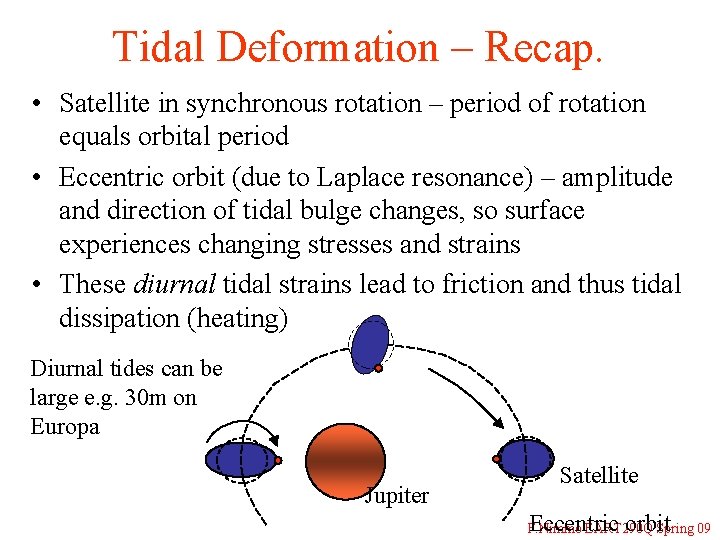
Tidal Deformation – Recap. • Satellite in synchronous rotation – period of rotation equals orbital period • Eccentric orbit (due to Laplace resonance) – amplitude and direction of tidal bulge changes, so surface experiences changing stresses and strains • These diurnal tidal strains lead to friction and thus tidal dissipation (heating) Diurnal tides can be large e. g. 30 m on Europa Jupiter Satellite Eccentric orbit F. Nimmo EART 290 Q Spring 09
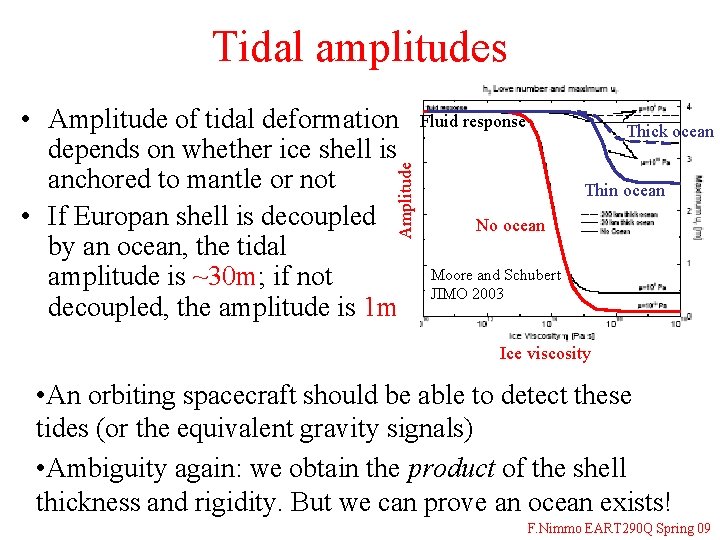
Tidal amplitudes Amplitude • Amplitude of tidal deformation depends on whether ice shell is anchored to mantle or not • If Europan shell is decoupled by an ocean, the tidal amplitude is ~30 m; if not decoupled, the amplitude is 1 m Fluid response Thick ocean Thin ocean No ocean Moore and Schubert JIMO 2003 Ice viscosity • An orbiting spacecraft should be able to detect these tides (or the equivalent gravity signals) • Ambiguity again: we obtain the product of the shell thickness and rigidity. But we can prove an ocean exists! F. Nimmo EART 290 Q Spring 09

Tidal Heating (1) • Recall diurnal tidal amplitude goes as in the limit when rigidity dominates ( ) • So strain goes as • Energy stored per unit volume = stress x strain • In an elastic body, stress = strain x m (rigidity) • So total energy stored goes as me 2 H 2 Rs/ • For tide raised on satellite H=Rs(mp/ms)(Rs/a)3 • From the above, we expect the energy stored E to go as Note that here we have used F. Nimmo EART 290 Q Spring 09
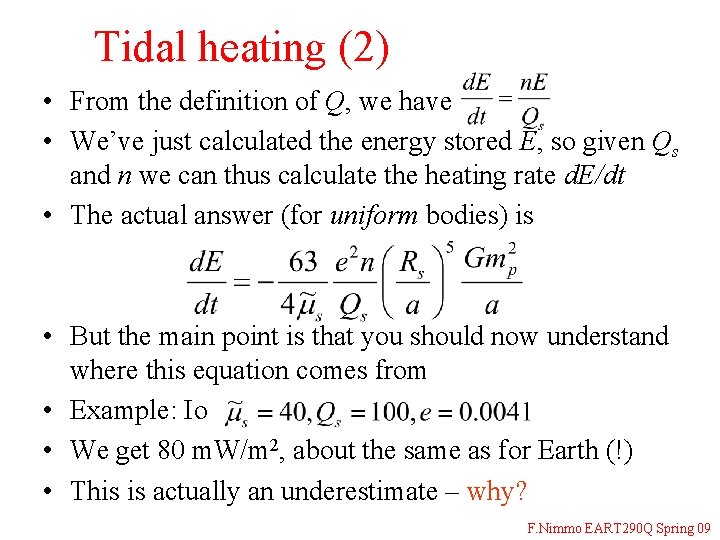
Tidal heating (2) • From the definition of Q, we have • We’ve just calculated the energy stored E, so given Qs and n we can thus calculate the heating rate d. E/dt • The actual answer (for uniform bodies) is • But the main point is that you should now understand where this equation comes from • Example: Io • We get 80 m. W/m 2, about the same as for Earth (!) • This is actually an underestimate – why? F. Nimmo EART 290 Q Spring 09
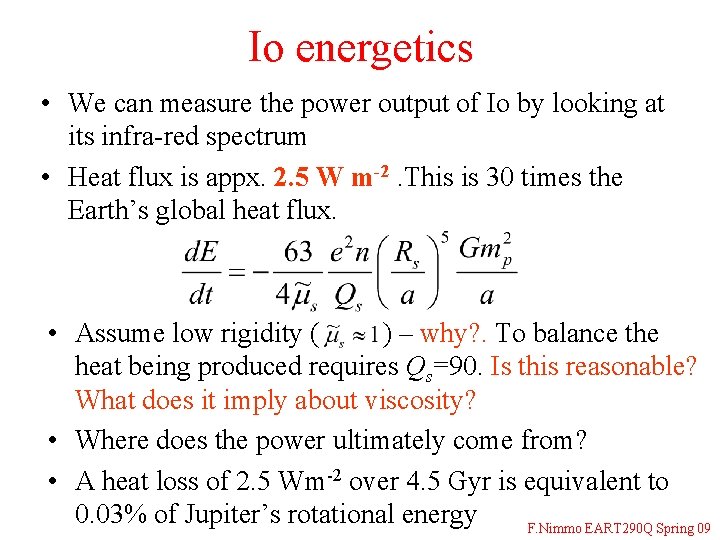
Io energetics • We can measure the power output of Io by looking at its infra-red spectrum • Heat flux is appx. 2. 5 W m-2. This is 30 times the Earth’s global heat flux. • Assume low rigidity ( ) – why? . To balance the heat being produced requires Qs=90. Is this reasonable? What does it imply about viscosity? • Where does the power ultimately come from? • A heat loss of 2. 5 Wm-2 over 4. 5 Gyr is equivalent to 0. 03% of Jupiter’s rotational energy F. Nimmo EART 290 Q Spring 09
Tidal heating examples • Enceladus is small but active, and currently in a resonance with Dione – differential orbital expansion similar to Io (? ) • So likely that tidal heating is responsible, but details are unclear (Squyres et al. Icarus 1983). In particular why did Enceladus melt if Mimas didn’t? (Mimas is in a 2: 1 resonance with Tethys) • Mimas is also puzzling because its eccentricity is high (how? ) while at the same time it shows no sign of tidal deformation • Ariel (also small and active) is not in a resonance now, but may have been (e. g. with Umbriel) in the past. How? • The same also goes for Miranda (tiny and active). The fact that Miranda’s orbit is inclined at 4 o is also suggestive of an ancient resonant episode (Tittemore and Wisdom, Icarus 1989) • As with Ganymede, orbital evolution may explain present-day features. . . F. Nimmo EART 290 Q Spring 09
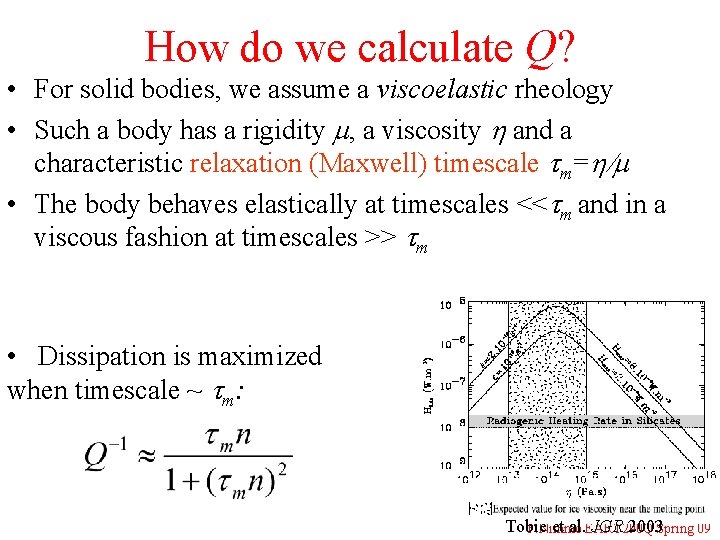
How do we calculate Q? • For solid bodies, we assume a viscoelastic rheology • Such a body has a rigidity m, a viscosity h and a characteristic relaxation (Maxwell) timescale tm=h/m • The body behaves elastically at timescales <<tm and in a viscous fashion at timescales >> tm • Dissipation is maximized when timescale ~ tm: Tobie et al. EART 290 Q JGR 2003 Spring 09 F. Nimmo
Calculating Q (cont’d) • Ice has rigidity ~109 Pa and viscosity ~1014 Pa s, so the Maxwell time is ~105 s which is comparable to the orbital period, so we expect dissipation in the ice shells • Silicates m~1011 Pa, h~1021 Pa s, so less dissipation • But silicate viscosity decreases significantly if melting occurs, which will lead to an increase in dissipation, and thus a feedback effect • This runaway situation was first identified by Peale et al. (1979), who predicted massive volcanism on Io two weeks before it was observed for the first time • A similar feedback effect may also occur in ice (see previous diagram) F. Nimmo EART 290 Q Spring 09
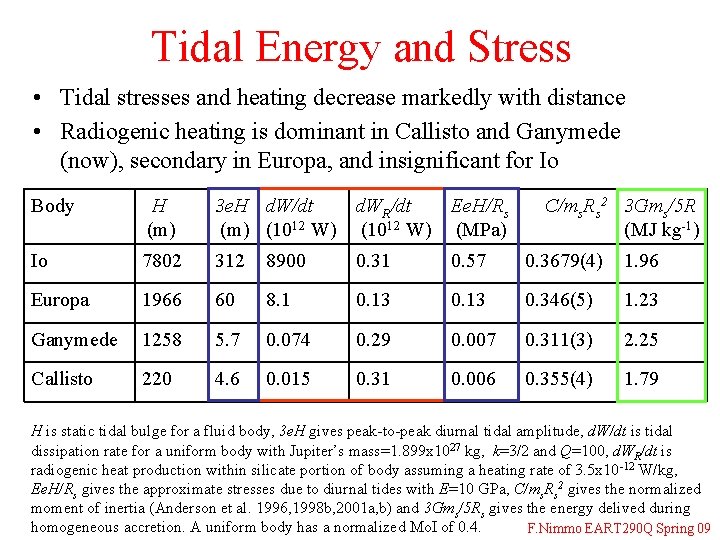
Tidal Energy and Stress • Tidal stresses and heating decrease markedly with distance • Radiogenic heating is dominant in Callisto and Ganymede (now), secondary in Europa, and insignificant for Io Body H (m) 3 e. H d. W/dt d. WR/dt Ee. H/Rs (m) (1012 W) (MPa) C/ms. Rs 2 3 Gms/5 R (MJ kg-1) Io 7802 312 8900 0. 31 0. 57 0. 3679(4) 1. 96 Europa 1966 60 8. 1 0. 13 0. 346(5) 1. 23 Ganymede 1258 5. 7 0. 074 0. 29 0. 007 0. 311(3) 2. 25 Callisto 220 4. 6 0. 015 0. 31 0. 006 0. 355(4) 1. 79 H is static tidal bulge for a fluid body, 3 e. H gives peak-to-peak diurnal tidal amplitude, d. W/dt is tidal dissipation rate for a uniform body with Jupiter’s mass=1. 899 x 1027 kg, k=3/2 and Q=100, d. WR/dt is radiogenic heat production within silicate portion of body assuming a heating rate of 3. 5 x 10 -12 W/kg, Ee. H/Rs gives the approximate stresses due to diurnal tides with E=10 GPa, C/ms. Rs 2 gives the normalized moment of inertia (Anderson et al. 1996, 1998 b, 2001 a, b) and 3 Gms/5 Rs gives the energy delived during homogeneous accretion. A uniform body has a normalized Mo. I of 0. 4. F. Nimmo EART 290 Q Spring 09
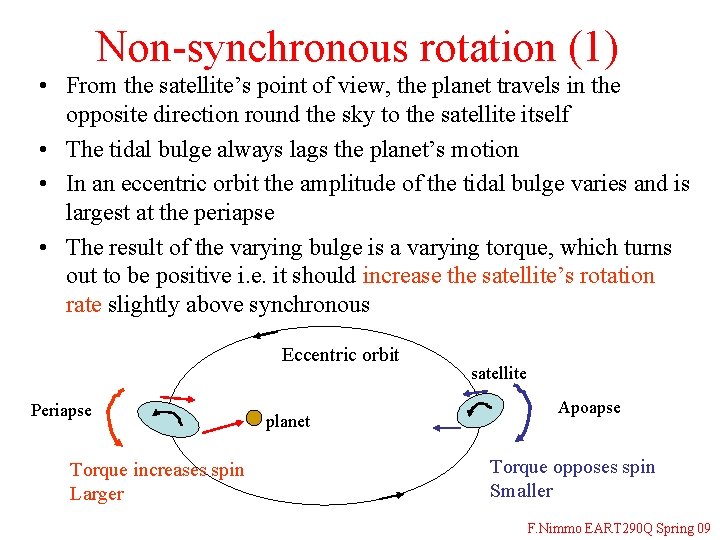
Non-synchronous rotation (1) • From the satellite’s point of view, the planet travels in the opposite direction round the sky to the satellite itself • The tidal bulge always lags the planet’s motion • In an eccentric orbit the amplitude of the tidal bulge varies and is largest at the periapse • The result of the varying bulge is a varying torque, which turns out to be positive i. e. it should increase the satellite’s rotation rate slightly above synchronous Eccentric orbit Periapse Torque increases spin Larger planet satellite Apoapse Torque opposes spin Smaller F. Nimmo EART 290 Q Spring 09
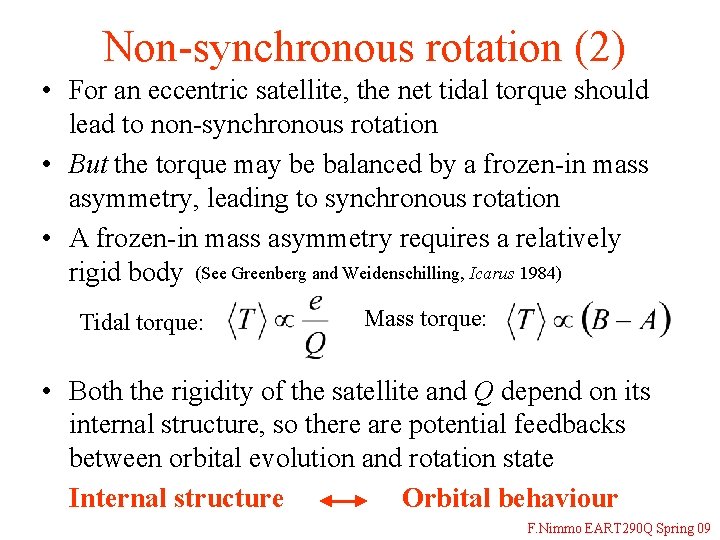
Non-synchronous rotation (2) • For an eccentric satellite, the net tidal torque should lead to non-synchronous rotation • But the torque may be balanced by a frozen-in mass asymmetry, leading to synchronous rotation • A frozen-in mass asymmetry requires a relatively rigid body (See Greenberg and Weidenschilling, Icarus 1984) Tidal torque: Mass torque: • Both the rigidity of the satellite and Q depend on its internal structure, so there are potential feedbacks between orbital evolution and rotation state Internal structure Orbital behaviour F. Nimmo EART 290 Q Spring 09
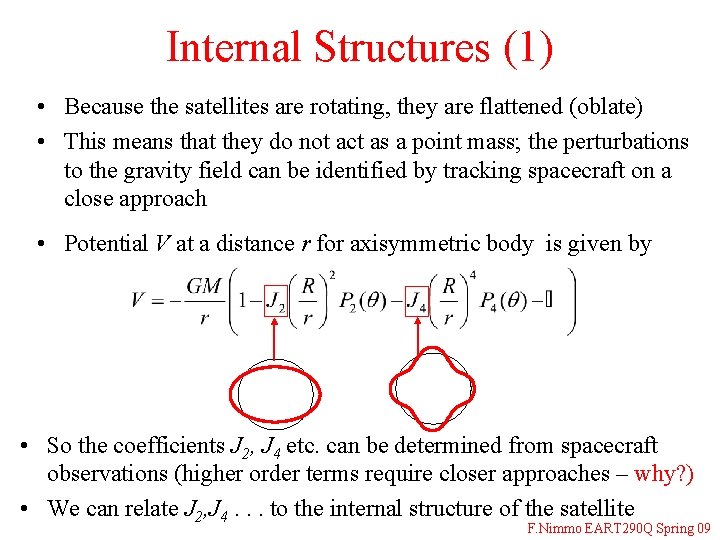
Internal Structures (1) • Because the satellites are rotating, they are flattened (oblate) • This means that they do not act as a point mass; the perturbations to the gravity field can be identified by tracking spacecraft on a close approach • Potential V at a distance r for axisymmetric body is given by • So the coefficients J 2, J 4 etc. can be determined from spacecraft observations (higher order terms require closer approaches – why? ) • We can relate J 2, J 4. . . to the internal structure of the satellite F. Nimmo EART 290 Q Spring 09
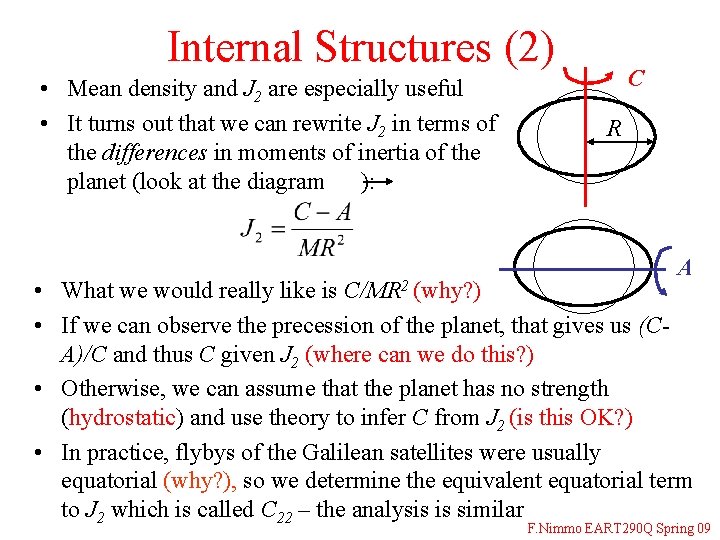
Internal Structures (2) • Mean density and J 2 are especially useful • It turns out that we can rewrite J 2 in terms of the differences in moments of inertia of the planet (look at the diagram ): C R A • What we would really like is C/MR 2 (why? ) • If we can observe the precession of the planet, that gives us (CA)/C and thus C given J 2 (where can we do this? ) • Otherwise, we can assume that the planet has no strength (hydrostatic) and use theory to infer C from J 2 (is this OK? ) • In practice, flybys of the Galilean satellites were usually equatorial (why? ), so we determine the equivalent equatorial term to J 2 which is called C 22 – the analysis is similar F. Nimmo EART 290 Q Spring 09
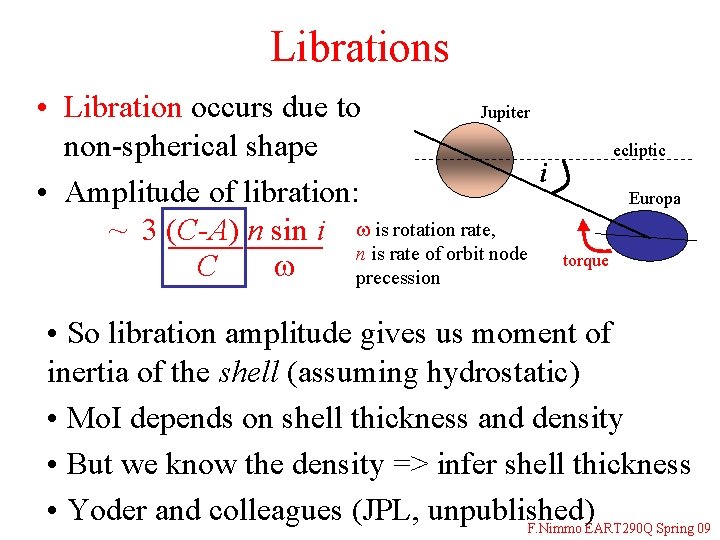
Librations • Libration occurs due to Jupiter non-spherical shape i • Amplitude of libration: ~ 3 (C-A) n sin i w is rotation rate, n is rate of orbit node C w precession ecliptic Europa torque • So libration amplitude gives us moment of inertia of the shell (assuming hydrostatic) • Mo. I depends on shell thickness and density • But we know the density => infer shell thickness • Yoder and colleagues (JPL, unpublished) F. Nimmo EART 290 Q Spring 09
- Slides: 47