
Orbital Mechanics Energy and velocity in orbit Elliptical

Orbital Mechanics • • • Energy and velocity in orbit Elliptical orbit parameters Orbital elements Coplanar orbital transfers Noncoplanar transfers Time and flight path angle as a function of orbital position • Relative orbital motion (“proximity operations”) UNIVERSITY OF MARYLAND © 2003 David L. Akin - All rights reserved http: //spacecraft. ssl. umd. edu Orbital Mechanics Principles of Space Systems Design
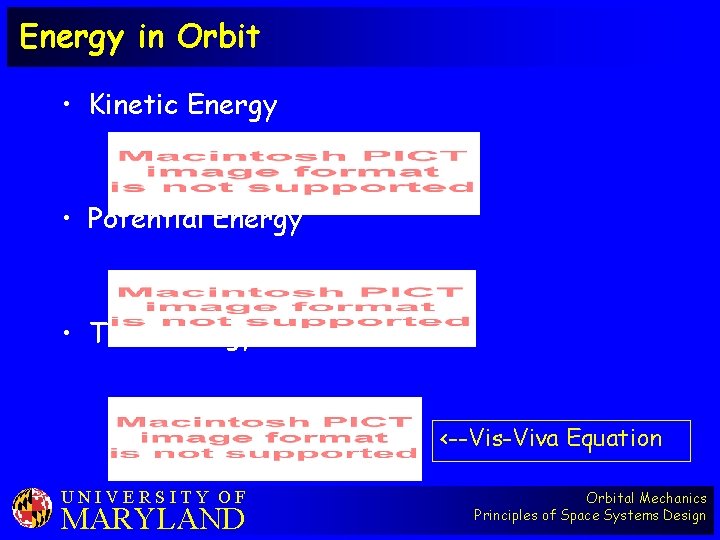
Energy in Orbit • Kinetic Energy • Potential Energy • Total Energy <--Vis-Viva Equation UNIVERSITY OF MARYLAND Orbital Mechanics Principles of Space Systems Design
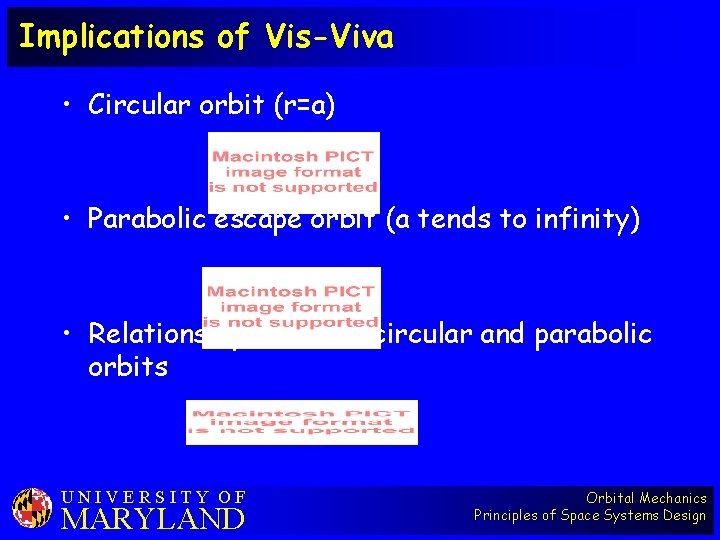
Implications of Vis-Viva • Circular orbit (r=a) • Parabolic escape orbit (a tends to infinity) • Relationship between circular and parabolic orbits UNIVERSITY OF MARYLAND Orbital Mechanics Principles of Space Systems Design
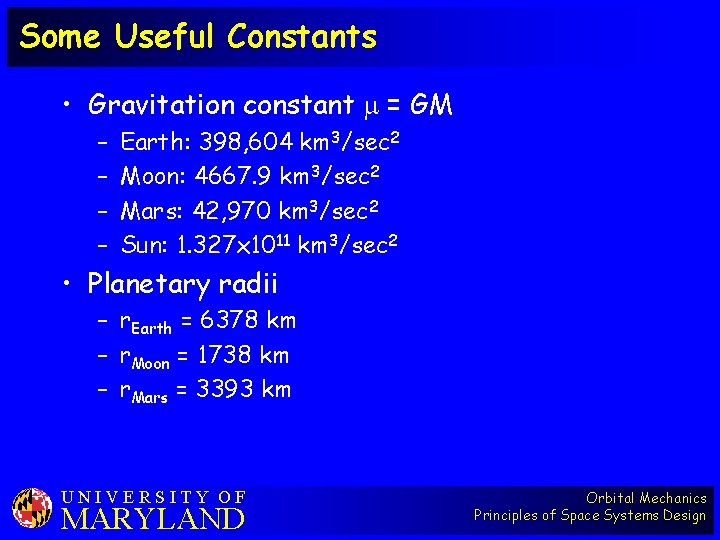
Some Useful Constants • Gravitation constant = GM – – Earth: 398, 604 km 3/sec 2 Moon: 4667. 9 km 3/sec 2 Mars: 42, 970 km 3/sec 2 Sun: 1. 327 x 1011 km 3/sec 2 • Planetary radii – r. Earth = 6378 km – r. Moon = 1738 km – r. Mars = 3393 km UNIVERSITY OF MARYLAND Orbital Mechanics Principles of Space Systems Design
Classical Parameters of Elliptical Orbits UNIVERSITY OF MARYLAND Orbital Mechanics Principles of Space Systems Design
Basic Orbital Parameters • Semi-latus rectum (or parameter) • Radial distance as function of orbital position • Periapse and apoapse distances • Angular momentum UNIVERSITY OF MARYLAND Orbital Mechanics Principles of Space Systems Design
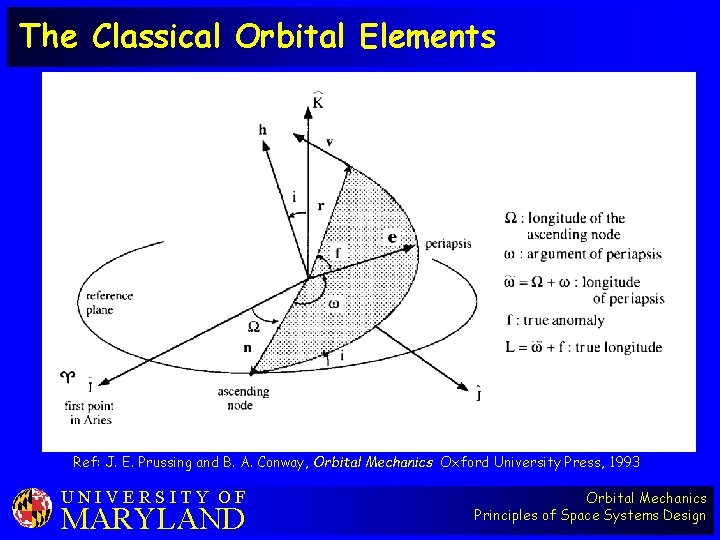
The Classical Orbital Elements Ref: J. E. Prussing and B. A. Conway, Orbital Mechanics Oxford University Press, 1993 UNIVERSITY OF MARYLAND Orbital Mechanics Principles of Space Systems Design
The Hohmann Transfer v 2 vapogee v 1 vperigee UNIVERSITY OF MARYLAND Orbital Mechanics Principles of Space Systems Design
First Maneuver Velocities • Initial vehicle velocity • Needed final velocity • Delta-V UNIVERSITY OF MARYLAND Orbital Mechanics Principles of Space Systems Design
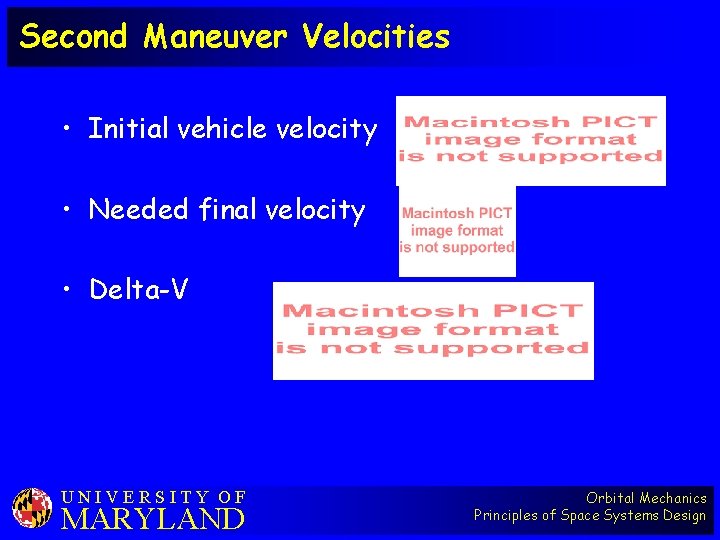
Second Maneuver Velocities • Initial vehicle velocity • Needed final velocity • Delta-V UNIVERSITY OF MARYLAND Orbital Mechanics Principles of Space Systems Design

Limitations on Launch Inclinations UNIVERSITY OF MARYLAND Orbital Mechanics Principles of Space Systems Design
Differences in Inclination UNIVERSITY OF MARYLAND Orbital Mechanics Principles of Space Systems Design
Choosing the Wrong Line of Apsides UNIVERSITY OF MARYLAND Orbital Mechanics Principles of Space Systems Design
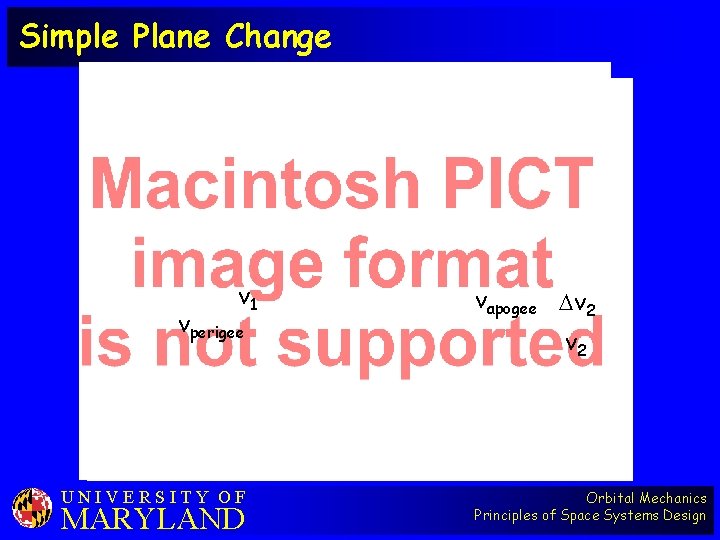
Simple Plane Change v 1 vperigee UNIVERSITY OF MARYLAND vapogee Dv 2 Orbital Mechanics Principles of Space Systems Design
Optimal Plane Change vperigee v 1 Dv 1 UNIVERSITY OF MARYLAND vapogee Dv 2 Orbital Mechanics Principles of Space Systems Design
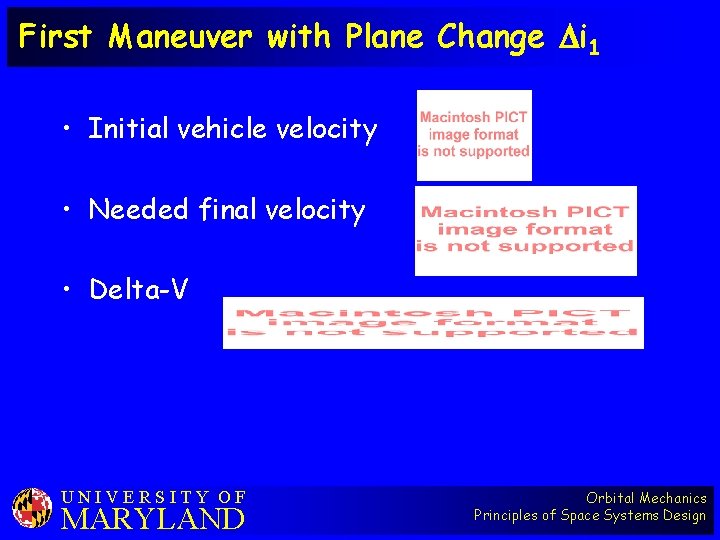
First Maneuver with Plane Change Di 1 • Initial vehicle velocity • Needed final velocity • Delta-V UNIVERSITY OF MARYLAND Orbital Mechanics Principles of Space Systems Design
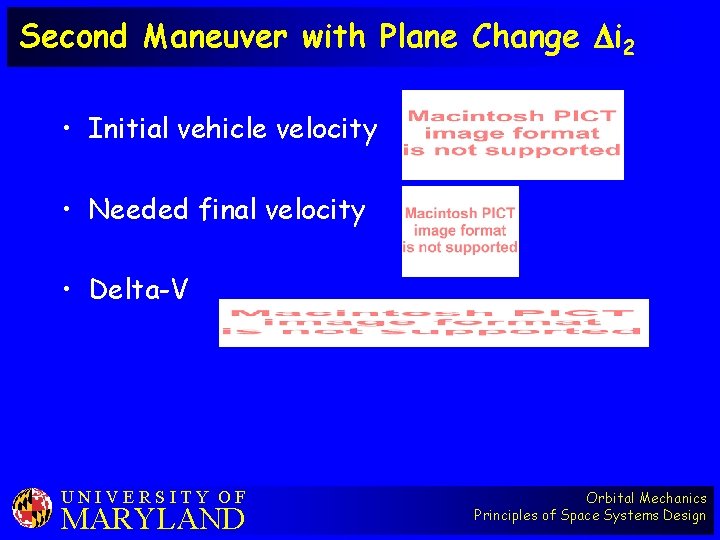
Second Maneuver with Plane Change Di 2 • Initial vehicle velocity • Needed final velocity • Delta-V UNIVERSITY OF MARYLAND Orbital Mechanics Principles of Space Systems Design
Sample Plane Change Maneuver Optimum initial plane change = 2. 20° UNIVERSITY OF MARYLAND Orbital Mechanics Principles of Space Systems Design
Bielliptic Transfer UNIVERSITY OF MARYLAND Orbital Mechanics Principles of Space Systems Design
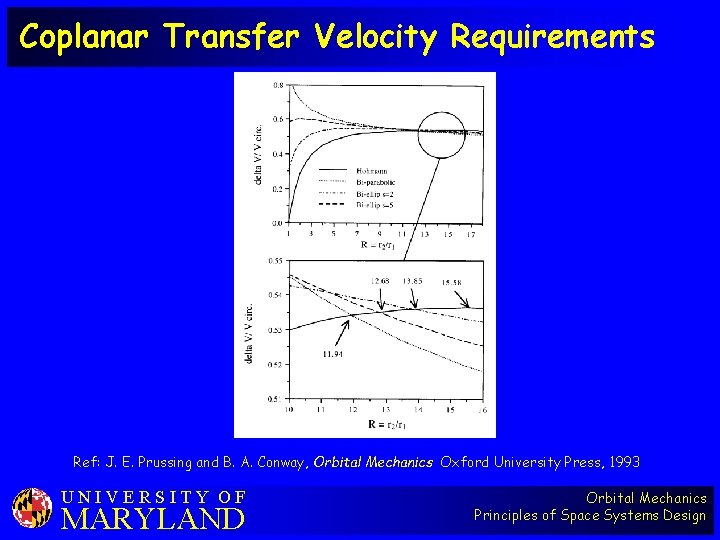
Coplanar Transfer Velocity Requirements Ref: J. E. Prussing and B. A. Conway, Orbital Mechanics Oxford University Press, 1993 UNIVERSITY OF MARYLAND Orbital Mechanics Principles of Space Systems Design

Noncoplanar Bielliptic Transfers UNIVERSITY OF MARYLAND Orbital Mechanics Principles of Space Systems Design
Calculating Time in Orbit UNIVERSITY OF MARYLAND Orbital Mechanics Principles of Space Systems Design
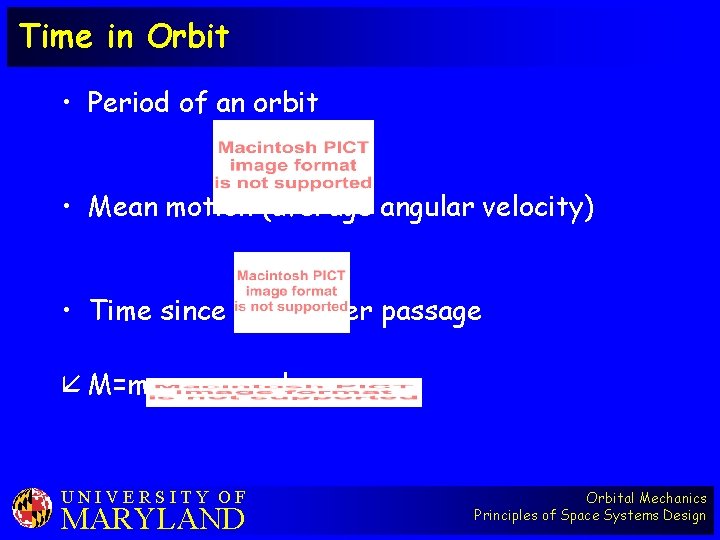
Time in Orbit • Period of an orbit • Mean motion (average angular velocity) • Time since pericenter passage å M=mean anomaly UNIVERSITY OF MARYLAND Orbital Mechanics Principles of Space Systems Design
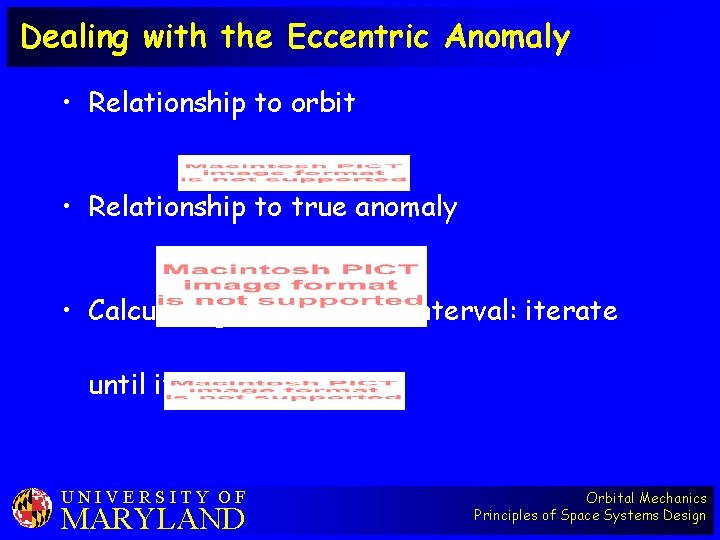
Dealing with the Eccentric Anomaly • Relationship to orbit • Relationship to true anomaly • Calculating M from time interval: iterate until it converges UNIVERSITY OF MARYLAND Orbital Mechanics Principles of Space Systems Design
Patched Conics • Simple approximation to multi-body motion (e. g. , traveling from Earth orbit through solar orbit into Martian orbit) • Treats multibody problem as “hand-offs” between gravitating bodies --> reduces analysis to sequential two-body problems • Caveat Emptor: There a number of formal methods to perform patched conic analysis. The approach presented here is a very simple, convenient, and not altogether accurate method for performing this calculation. Results will be accurate to a few percent, which is adequate at this level of design analysis. UNIVERSITY OF MARYLAND Orbital Mechanics Principles of Space Systems Design
Example: Lunar Orbit Insertion • v 2 is velocity of moon around Earth • Moon overtakes spacecraft with velocity of (v 2 -vapogee) • This is the velocity of the spacecraft relative to the moon while it is effectively “infinitely” far away (before lunar gravity accelerates it) = “hyperbolic excess velocity” UNIVERSITY OF MARYLAND v 2 vapogee Orbital Mechanics Principles of Space Systems Design
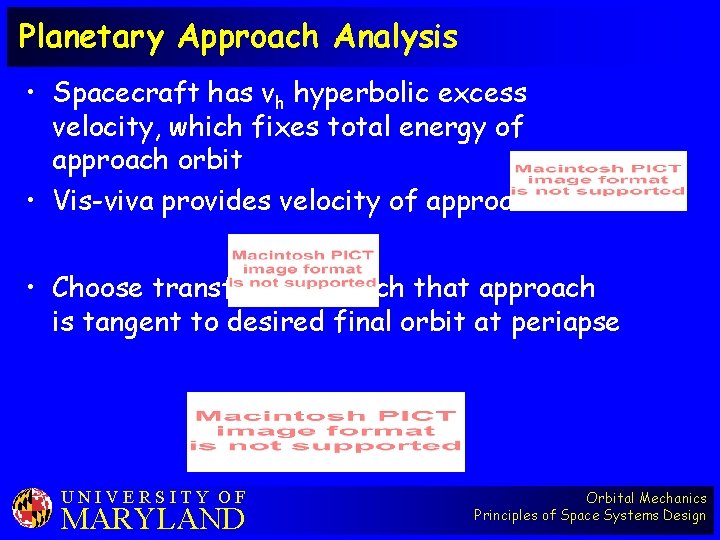
Planetary Approach Analysis • Spacecraft has vh hyperbolic excess velocity, which fixes total energy of approach orbit • Vis-viva provides velocity of approach • Choose transfer orbit such that approach is tangent to desired final orbit at periapse UNIVERSITY OF MARYLAND Orbital Mechanics Principles of Space Systems Design
Project Diana DV Requirements for Lunar Missions Space Systems Laboratory – University of Maryland
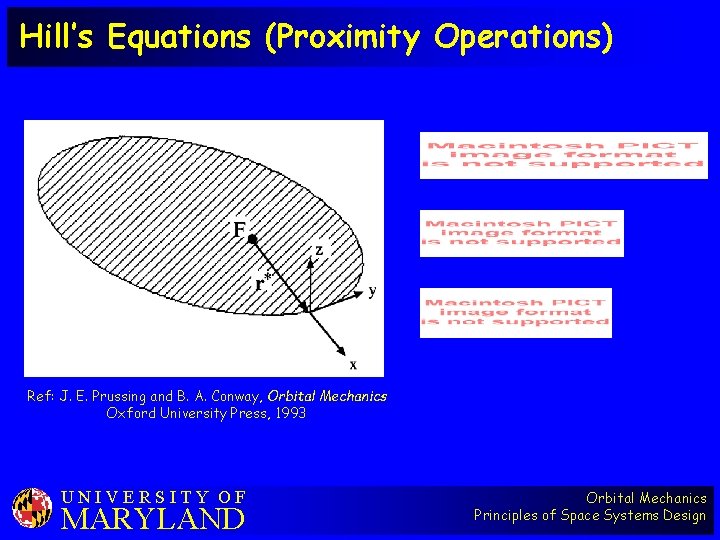
Hill’s Equations (Proximity Operations) Ref: J. E. Prussing and B. A. Conway, Orbital Mechanics Oxford University Press, 1993 UNIVERSITY OF MARYLAND Orbital Mechanics Principles of Space Systems Design
Clohessy-Wiltshire (“CW”) Equations UNIVERSITY OF MARYLAND Orbital Mechanics Principles of Space Systems Design
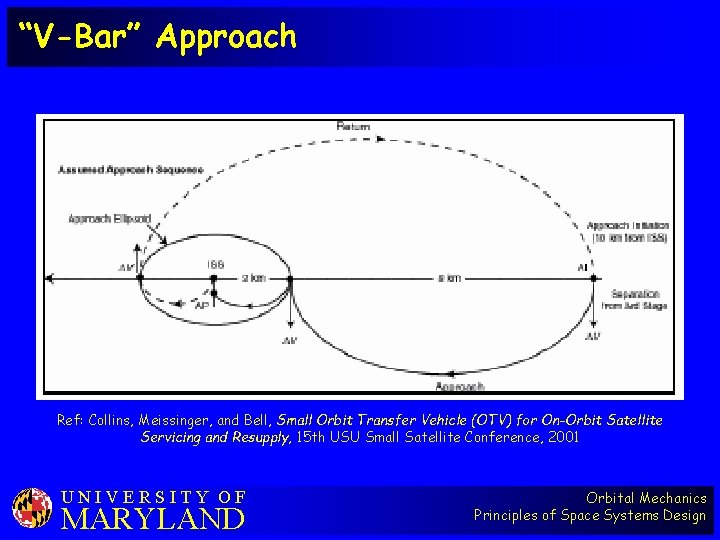
“V-Bar” Approach Ref: Collins, Meissinger, and Bell, Small Orbit Transfer Vehicle (OTV) for On-Orbit Satellite Servicing and Resupply, 15 th USU Small Satellite Conference, 2001 UNIVERSITY OF MARYLAND Orbital Mechanics Principles of Space Systems Design
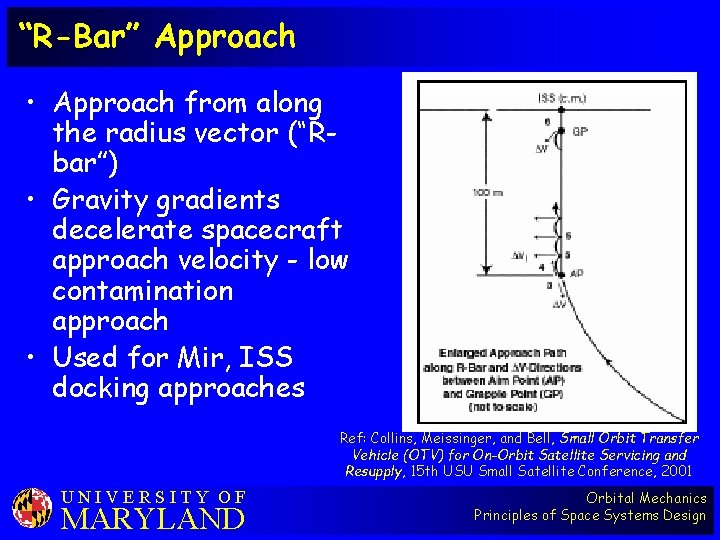
“R-Bar” Approach • Approach from along the radius vector (“Rbar”) • Gravity gradients decelerate spacecraft approach velocity - low contamination approach • Used for Mir, ISS docking approaches Ref: Collins, Meissinger, and Bell, Small Orbit Transfer Vehicle (OTV) for On-Orbit Satellite Servicing and Resupply, 15 th USU Small Satellite Conference, 2001 UNIVERSITY OF MARYLAND Orbital Mechanics Principles of Space Systems Design
References for Lecture 3 • Wernher von Braun, The Mars Project University of Illinois Press, 1962 • William Tyrrell Thomson, Introduction to Space Dynamics Dover Publications, 1986 • Francis J. Hale, Introduction to Space Flight Prentice-Hall, 1994 • William E. Wiesel, Spaceflight Dynamics Mac. Graw-Hill, 1997 • J. E. Prussing and B. A. Conway, Orbital Mechanics Oxford University Press, 1993 UNIVERSITY OF MARYLAND Orbital Mechanics Principles of Space Systems Design
- Slides: 33