
Orbital Express A New Chapter In Space Tracey
Orbital Express: A New Chapter In Space Tracey M Espero The Boeing Company
Orbital Express Overview • Orbital Express (OE) Demonstration System is to demonstrate the operational utility, cost effectiveness, and technical feasibility of autonomous techniques for on-orbit satellite servicing • The specific objectives of OE are to develop and demonstrate on orbit: – An autonomous guidance, navigation, and control system – Autonomous rendezvous, proximity operations, and capture – Orbit fluid transfer between a depot/serviceable satellite and a servicing satellite – Component transfer and verified operation of the component – A nonproprietary satellite servicing interface specification http: //www. boeing. com/ids/advanced_systems/orbital/pdf/orbital_express_demosys_03. pdf
OE Vehicles Introduction • ASTRO: Autonomous Space Transfer and Robotic Orbiter – Servicing satellite • NEXTSat/CSC: Next Generation Satellite/Commodity Spacecraft – Functions as the satellite being serviced by ASTRO and as a supply depot for ASTRO http: //www. boeing. com/ids/advanced_systems/orbital/pdf/orbital_express_demosys_03. pdf

Orbital Express Vehicles ASTRO (Servicer) NEXTSat (Client) Capture (Docking) & Fluid Transfer Interfaces Robotic Arm 14 April 2006 http: //www. aviationweek. com/aw/generic/story_channel. jsp? channel=space&id=news/aw 060506 p 1. xml 1 Dec. 2005

ASTRO Servicing Vehicle Battery ORU Container Battery AC-3 ORU Container FTAPS Fill and Drain Manipulator Arm GPS Antenna- #2 TDRSS Antenna- #2 Cross. Link Antenna SGLS Antenna- #2 Boeing Thrusters Spacecraft Separation Ring Z Fluid Coupler Y Active Capture System X MDR Starsys NGST BATC

NEXTSat Client/Commodities Vehicle Sensor Targets Probe Fixture Assy Crosslink FTS Capture Mechanism Sep System I/F Ring Vis-Star Target ORU Interface Assy
Major Mission Objectives • On-Orbit demonstration of technologies required to support autonomous on-orbit servicing of satellites – Perform autonomous fluid transfer • Transfer of propellant in a 0 -g environment – Perform autonomous ORU transfer • Component replacement – Battery Transfer – Computer Transfer – Perform autonomous rendezvous and capture of a client satellite • Direct Capture • Free-Flyer Capture http: //www. boeing. com/ids/advanced_systems/orbital/pdf/orbital_express_demosys_03. pdf
Mission Plan • Mission Duration: ~90 days • Certified Spacecraft Life: 1 year • Mission Phases: – Launch & Activation – Checkouts • Core bus subsystems • Servicing subsystems – Robotic Arm, Capture, Fluid Transfer – Advanced Technology Demonstrations • Execution of 8 Scenarios http: //www. boeing. com/ids/advanced_systems/orbital/pdf/orbital_express_demosys_03. pdf
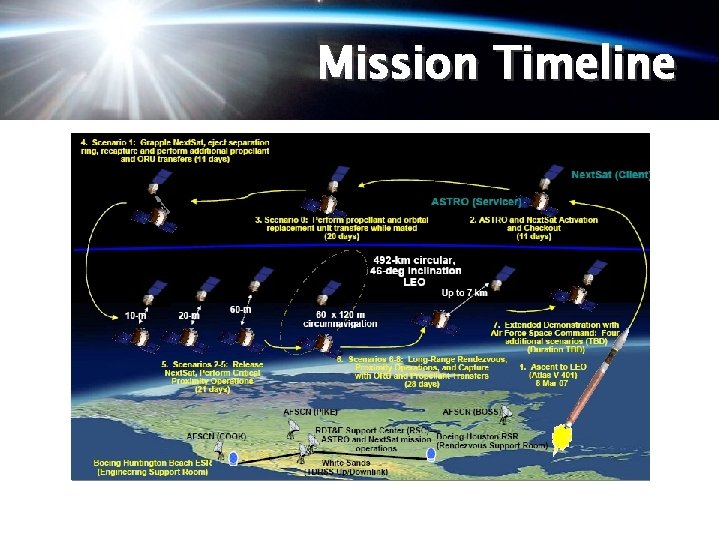
Mission Timeline
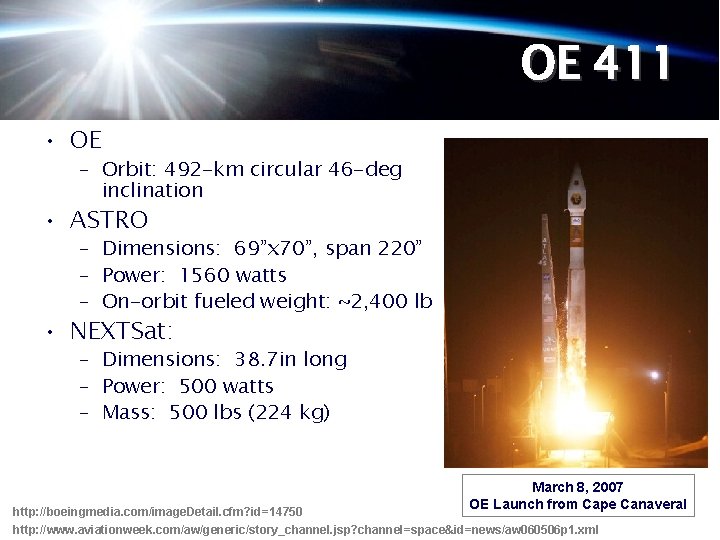
OE 411 • OE – Orbit: 492 -km circular 46 -deg inclination • ASTRO – Dimensions: 69”x 70”, span 220” – Power: 1560 watts – On-orbit fueled weight: ~2, 400 lb • NEXTSat: – Dimensions: 38. 7 in long – Power: 500 watts – Mass: 500 lbs (224 kg) http: //boeingmedia. com/image. Detail. cfm? id=14750 March 8, 2007 OE Launch from Cape Canaveral http: //www. aviationweek. com/aw/generic/story_channel. jsp? channel=space&id=news/aw 060506 p 1. xml
Autonomous Operations • Autonomous Mission Manager – Implements operations requirements by using sequences and related information in a database • Ability to plan missions dynamically • Command subsystems within the vehicle management system • Monitor systems and diagnose their failures – Database executed fully autonomously, but with high level of input from ground team into database creation – Controls starting, interruption, managing Authority-To-Proceeds, aborting of sequences; and enables human supervision of the sequences running autonomously • • Executive Sequencer Monitor Contingency Responder Resource Predictor/Ground Communicator – Autonomous mission controllers use man-machine collaborative autonomy, which allows systems to be implemented with variable levels of autonomy • Ground Segment – Assemble and verify sequences for upload – Displays status of Mission Manager and next planned event http: //www. draper. com/technology/autosys/autonomous. htm http: //www. draper. com/publications/explorations/summer. pdf
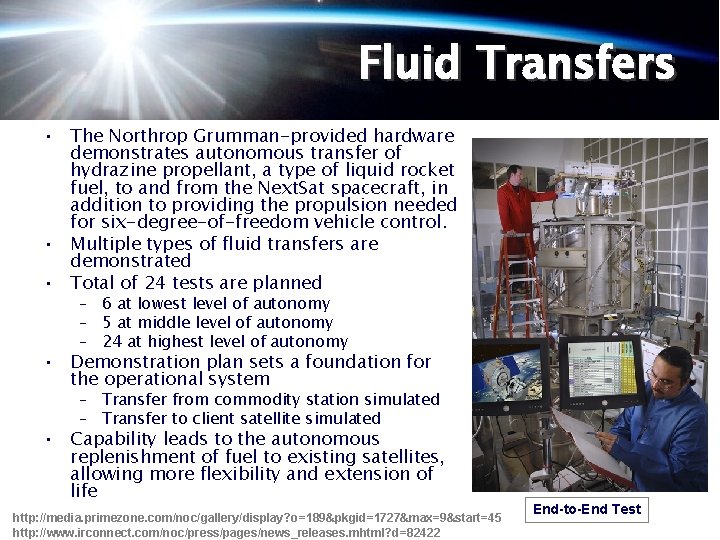
Fluid Transfers • The Northrop Grumman-provided hardware demonstrates autonomous transfer of hydrazine propellant, a type of liquid rocket fuel, to and from the Next. Sat spacecraft, in addition to providing the propulsion needed for six-degree-of-freedom vehicle control. • Multiple types of fluid transfers are demonstrated • Total of 24 tests are planned – 6 at lowest level of autonomy – 5 at middle level of autonomy – 24 at highest level of autonomy • Demonstration plan sets a foundation for the operational system – Transfer from commodity station simulated – Transfer to client satellite simulated • Capability leads to the autonomous replenishment of fuel to existing satellites, allowing more flexibility and extension of life http: //media. primezone. com/noc/gallery/display? o=189&pkgid=1727&max=9&start=45 http: //www. irconnect. com/noc/press/pages/news_releases. mhtml? d=82422 End-to-End Test

Orbital Express Demonstration Manipulator System • MDA developed the Orbital Express Autonomous Robotic Manipulator System comprising the following space and ground elements: – Small next generation Robotic arm on ASTRO avionics and autonomous vision system – Grapple fixtures and vision target for Capture and ORU transfer – Mating interface camera and lighting system – Standard, non-proprietary ORU containers and interfaces – Proximity-Ops lighting system – Autonomous Software – Robotic Ground Segment Manipulator Arm Specifics Length 3 m Mass 71 kg Volume 65 cm x 49 cm x 186 cm Power 131 watts DOF 6 http: //sm. mdacorporation. com/what_we_do/oe_7. html with Free-Flyer mating
Orbital Express Demonstration Manipulator System Functions • Autonomous Free-Flyer Capture of Client Satellite – Robotic Arm on ASTRO will drive autonomously using highly-reliable vision feedback from a camera at its tip to capture NEXTSat • Autonomous Positioning of Client Satellite for Mating – Following capture, the Arm will position the client satellite at the mating interface between the spacecraft, allowing the ASTRO Capture System to close around NEXTSat • Autonomous Video Survey of Client Spacecraft – Robotic System will be used to perform a visual inspection of the spacecraft for spacecraft status and situational awareness – Sites for video inspection include deployment mechanisms, antennae, ORU mating interfaces, cameras, and solar arrays • Autonomous ORU Transfer – The standard ORU container may contain batteries, a new flight computer, science instruments, or any other replaceable component – OE Robotic System will demonstrate transfer of a battery and a replacement flight computer to and from the client satellite • Autonomy – OE has been designed to operate under four levels of supervised autonomy, and will demonstrate servicing operations under each increasingly challenging level http: //sm. mdacorporation. com/what_we_do/oe_4. html
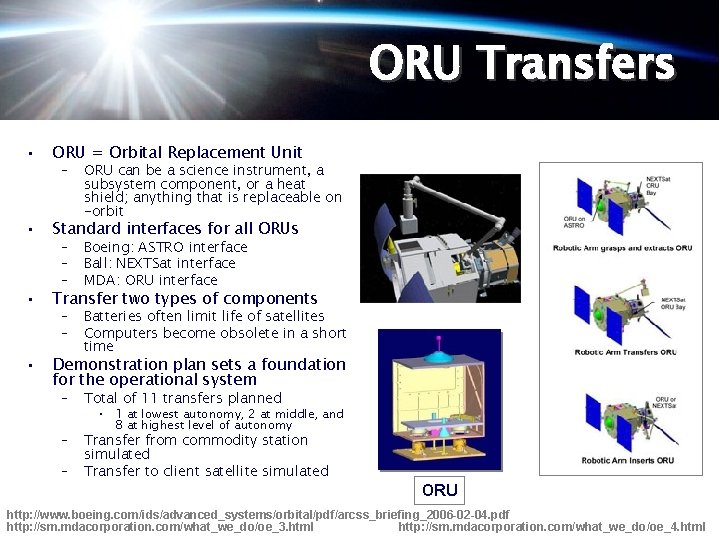
ORU Transfers • ORU = Orbital Replacement Unit • Standard interfaces for all ORUs • Transfer two types of components • Demonstration plan sets a foundation for the operational system – ORU can be a science instrument, a subsystem component, or a heat shield; anything that is replaceable on -orbit – – – Boeing: ASTRO interface Ball: NEXTSat interface MDA: ORU interface – – Batteries often limit life of satellites Computers become obsolete in a short time – Total of 11 transfers planned – Transfer from commodity station simulated Transfer to client satellite simulated – • 1 at lowest autonomy, 2 at middle, and 8 at highest level of autonomy ORU http: //www. boeing. com/ids/advanced_systems/orbital/pdf/arcss_briefing_2006 -02 -04. pdf http: //sm. mdacorporation. com/what_we_do/oe_3. html http: //sm. mdacorporation. com/what_we_do/oe_4. html
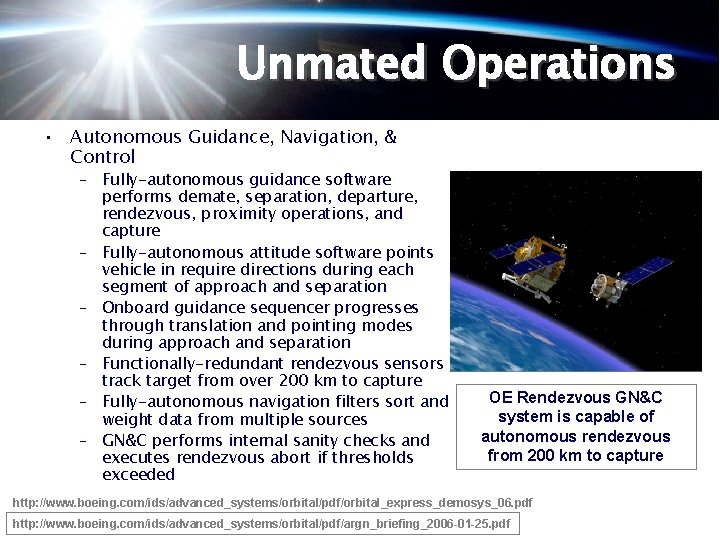
Unmated Operations • Autonomous Guidance, Navigation, & Control – Fully-autonomous guidance software performs demate, separation, departure, rendezvous, proximity operations, and capture – Fully-autonomous attitude software points vehicle in require directions during each segment of approach and separation – Onboard guidance sequencer progresses through translation and pointing modes during approach and separation – Functionally-redundant rendezvous sensors track target from over 200 km to capture – Fully-autonomous navigation filters sort and weight data from multiple sources – GN&C performs internal sanity checks and executes rendezvous abort if thresholds exceeded OE Rendezvous GN&C system is capable of autonomous rendezvous from 200 km to capture http: //www. boeing. com/ids/advanced_systems/orbital/pdf/orbital_express_demosys_06. pdf http: //www. boeing. com/ids/advanced_systems/orbital/pdf/argn_briefing_2006 -01 -25. pdf
Unmated Operations • Autonomous Rendezvous & Capture Sensor Suite – Provides real-time, critical relative state information about the client satellite seamlessly across the entire mission scenario • Patented Vis-STAR tracking algorithm provides robust tracking from point source to capture • Algorithms are nearly sensor independent – Mission reliability is enhanced through redundant sensors which can operate across a broad range of viewing conditions (in various lighting conditions, with clear space and cluttered earth backgrounds) • NFOV and WFOV visible sensors covering ranges from zero meters to hundreds of kilometers • An infrared sensor for viewing even in complete darkness • An independent laser-based imaging tracker activates during final approach and capture operations http: //www. boeing. com/ids/advanced_systems/orbital/pdf/arcss_briefing_2006 -02 -04. pdf
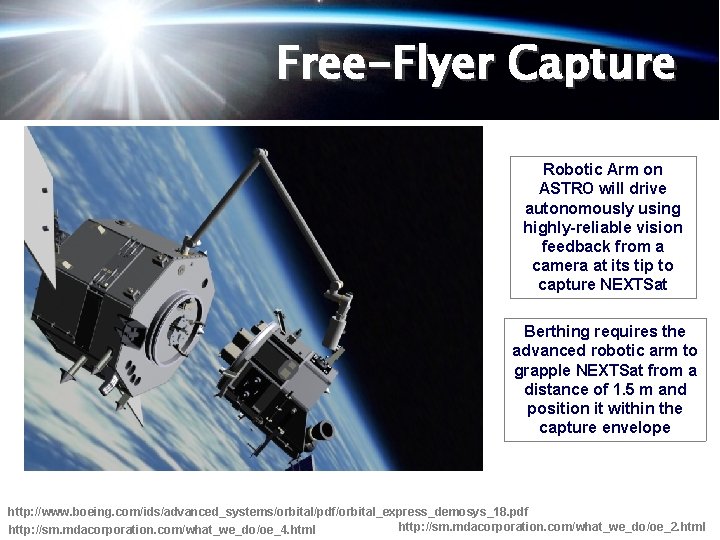
Free-Flyer Capture Robotic Arm on ASTRO will drive autonomously using highly-reliable vision feedback from a camera at its tip to capture NEXTSat Berthing requires the advanced robotic arm to grapple NEXTSat from a distance of 1. 5 m and position it within the capture envelope http: //www. boeing. com/ids/advanced_systems/orbital/pdf/orbital_express_demosys_18. pdf http: //sm. mdacorporation. com/what_we_do/oe_2. html http: //sm. mdacorporation. com/what_we_do/oe_4. html
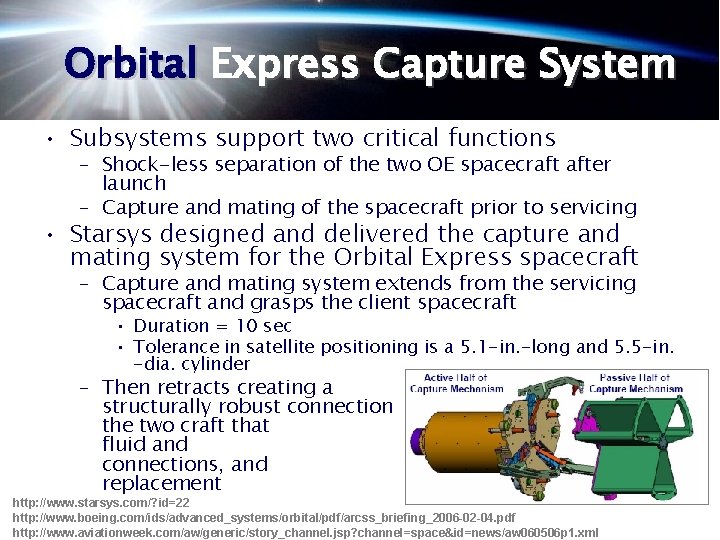
Orbital Express Capture System • Subsystems support two critical functions – Shock-less separation of the two OE spacecraft after launch – Capture and mating of the spacecraft prior to servicing • Starsys designed and delivered the capture and mating system for the Orbital Express spacecraft – Capture and mating system extends from the servicing spacecraft and grasps the client spacecraft • Duration = 10 sec • Tolerance in satellite positioning is a 5. 1 -in. -long and 5. 5 -in. -dia. cylinder – Then retracts creating a structurally robust connection the two craft that fluid and connections, and replacement between allows for electrical component http: //www. starsys. com/? id=22 http: //www. boeing. com/ids/advanced_systems/orbital/pdf/arcss_briefing_2006 -02 -04. pdf http: //www. aviationweek. com/aw/generic/story_channel. jsp? channel=space&id=news/aw 060506 p 1. xml
Current Mission Status ü Launch & Early Activation checkouts complete ü FTS Activation in prep for 1 st fluid transfer ü ARCSS checkouts ü OEDMS deployed! ü OEDMS Video Recording • Complete OEDMS Checkouts • Prep for first scenario next week http: //www. boeing. com/ids/advanced_systems/orbital/updates. html
Summary • Orbital Express is demonstrating the technologies required for on-orbit servicing • Currently orbiting test bed for potential servicing scenarios • Plenty of spacecraft life after baseline mission is complete • Potential VIP visit for FISO members to KAFB for a servicing scenario
- Slides: 21