
Orbital ATK Space Systems Group Systems Engineering Fault
Orbital ATK Space Systems Group: Systems Engineering Fault Management and System Autonomy Automated Testing and MBSE 2016 © 2016 Orbital ATK. All Rights Reserved.
System Modeling Language (Sys. ML) Orbital ATK Technical Operations (East) Systems Engineering (SE) department has been sponsoring initial training and focused efforts to improve the use of Model Based Systems Engineering (MBSE), and in particular the introduction of System Modeling Language (Sys. ML) Sys. ML is intended to enable improvements in the integrity and efficiency of SE process, methods, and tools and provide a means of integrating with existing Model Based Engineering (MBE) approaches Ø Sys. ML is an extension of Unified Modeling Language (UML) familiar to software engineers The initial deployment of Sys. ML is being focused in two, related areas that Ø Do not have strong, existing methods of ensuring systematic methods are applied Ø Provide an opportunity for improving both the integrity and efficiency of SE efforts Ø Provide or improve upon a product that can be used by existing and new programs Ø Provide a potential for MBE/MBSE connectivity with existing products/efforts Additional applications are being applied and examined to identify other areas of opportunity and future growth paths The initial efforts are a proving ground of potential application and a means of developing and initial Sys. ML understanding and skill set Systematic application of these approaches requires Ø An initial, standard ontology and model structure for Orbital ATK systems Ø Selection and funding of a standard Sys. ML toolset Ø Establishment of initial guidelines and work instructions for identified products An initial user of Sys. ML within the SE department is the Fault Management and System Autonomy (FM & SA) group The concepts and approaches discussed and demonstrated represent initial efforts to identify specific areas of systematic application that should be pursued, and the minimum effort to deploy them © 2016 Orbital ATK. All Rights Reserved. 2
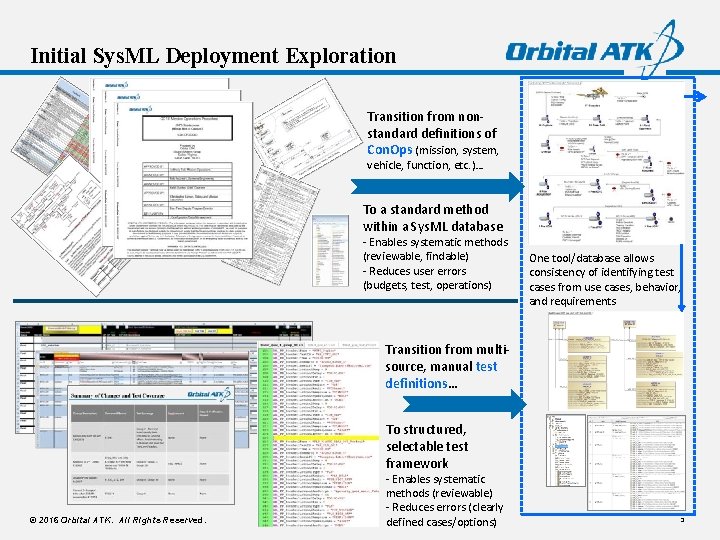
Initial Sys. ML Deployment Exploration Transition from nonstandard definitions of Con. Ops (mission, system, vehicle, function, etc. )… To a standard method within a Sys. ML database - Enables systematic methods (reviewable, findable) - Reduces user errors (budgets, test, operations) One tool/database allows consistency of identifying test cases from use cases, behavior, and requirements Transition from multisource, manual test definitions… To structured, selectable test framework © 2016 Orbital ATK. All Rights Reserved. - Enables systematic methods (reviewable) - Reduces errors (clearly defined cases/options) 3
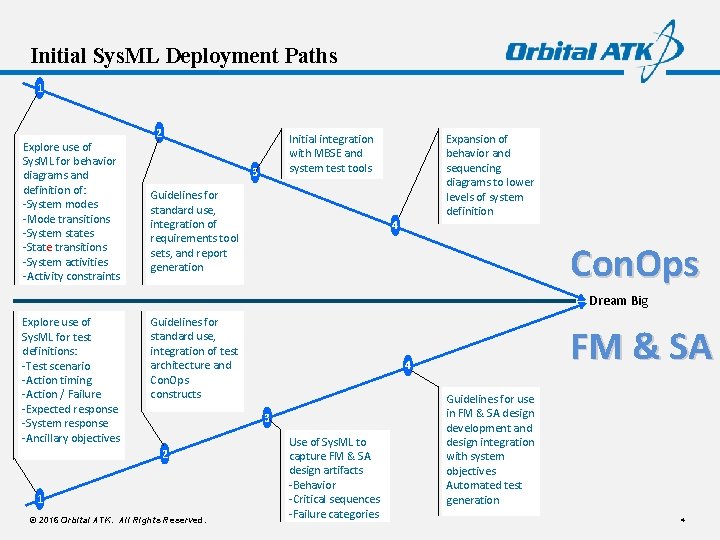
Initial Sys. ML Deployment Paths 1 Explore use of Sys. ML for behavior diagrams and definition of: -System modes -Mode transitions -System states -State transitions -System activities -Activity constraints 2 Expansion of behavior and sequencing diagrams to lower levels of system definition Initial integration with MBSE and system test tools 3 Guidelines for standard use, integration of requirements tool sets, and report generation 4 Con. Ops Dream Big Explore use of Sys. ML for test definitions: -Test scenario -Action timing -Action / Failure -Expected response -System response -Ancillary objectives Guidelines for standard use, integration of test architecture and Con. Ops constructs 3 2 1 © 2016 Orbital ATK. All Rights Reserved. FM & SA 4 Use of Sys. ML to capture FM & SA design artifacts -Behavior -Critical sequences -Failure categories Guidelines for use in FM & SA design development and design integration with system objectives Automated test generation 4
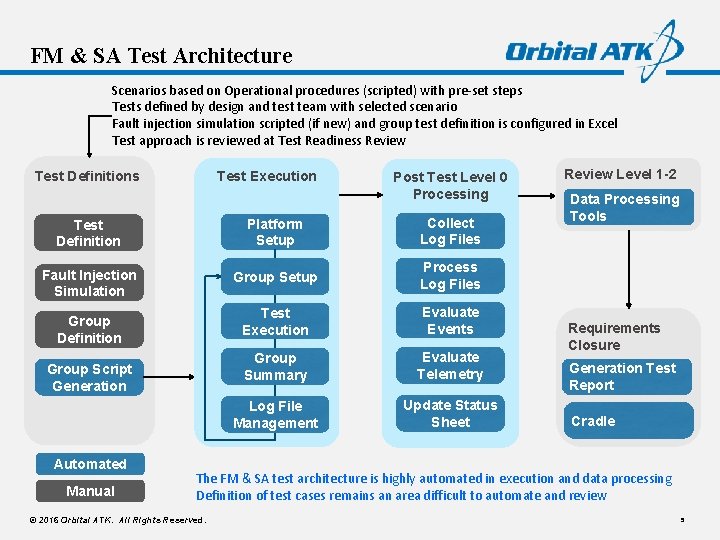
FM & SA Test Architecture Scenarios based on Operational procedures (scripted) with pre-set steps Tests defined by design and test team with selected scenario Fault injection simulation scripted (if new) and group test definition is configured in Excel Test approach is reviewed at Test Readiness Review Test Definitions Test Execution Post Test Level 0 Processing Test Definition Platform Setup Collect Log Files Fault Injection Simulation Group Setup Process Log Files Test Execution Evaluate Events Group Summary Evaluate Telemetry Log File Management Update Status Sheet Group Definition Group Script Generation Automated Manual Review Level 1 -2 Data Processing Tools Requirements Closure Generation Test Report Cradle The FM & SA test architecture is highly automated in execution and data processing Definition of test cases remains an area difficult to automate and review © 2016 Orbital ATK. All Rights Reserved. 5
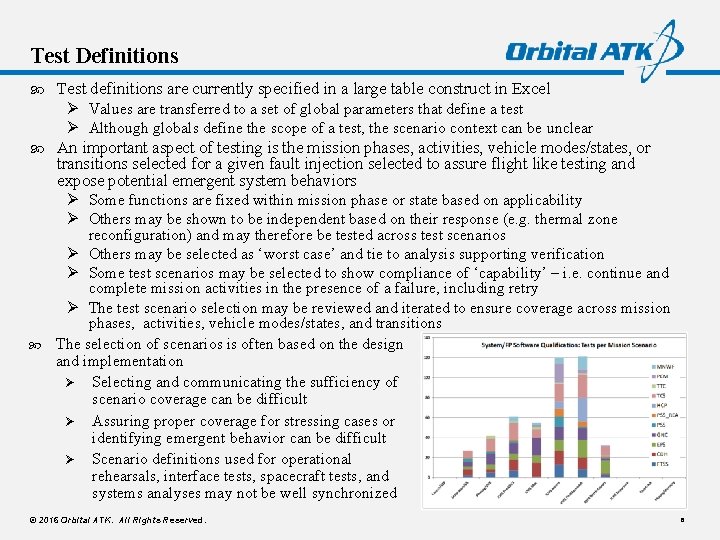
Test Definitions Test definitions are currently specified in a large table construct in Excel Ø Values are transferred to a set of global parameters that define a test Ø Although globals define the scope of a test, the scenario context can be unclear An important aspect of testing is the mission phases, activities, vehicle modes/states, or transitions selected for a given fault injection selected to assure flight like testing and expose potential emergent system behaviors Ø Some functions are fixed within mission phase or state based on applicability Ø Others may be shown to be independent based on their response (e. g. thermal zone reconfiguration) and may therefore be tested across test scenarios Ø Others may be selected as ‘worst case’ and tie to analysis supporting verification Ø Some test scenarios may be selected to show compliance of ‘capability’ – i. e. continue and complete mission activities in the presence of a failure, including retry Ø The test scenario selection may be reviewed and iterated to ensure coverage across mission phases, activities, vehicle modes/states, and transitions The selection of scenarios is often based on the design and implementation Ø Selecting and communicating the sufficiency of scenario coverage can be difficult Ø Assuring proper coverage for stressing cases or identifying emergent behavior can be difficult Ø Scenario definitions used for operational rehearsals, interface tests, spacecraft tests, and systems analyses may not be well synchronized © 2016 Orbital ATK. All Rights Reserved. 6
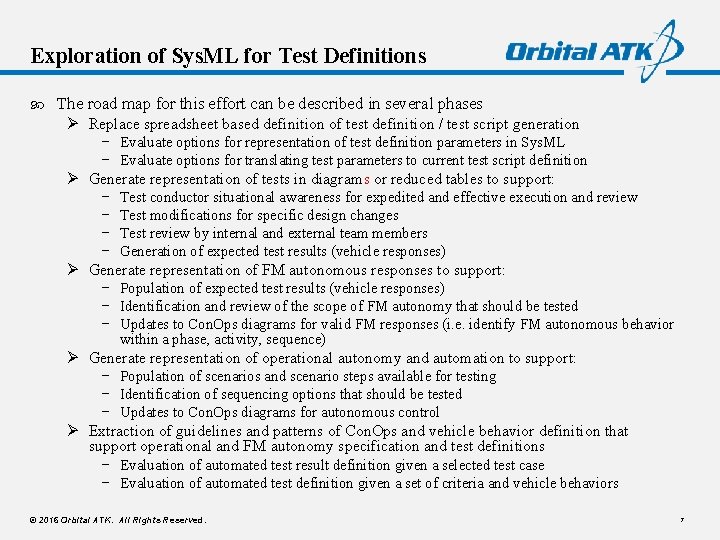
Exploration of Sys. ML for Test Definitions The road map for this effort can be described in several phases Ø Replace spreadsheet based definition of test definition / test script generation Ø Ø − Evaluate options for representation of test definition parameters in Sys. ML − Evaluate options for translating test parameters to current test script definition Generate representation of tests in diagrams or reduced tables to support: − Test conductor situational awareness for expedited and effective execution and review − Test modifications for specific design changes − Test review by internal and external team members − Generation of expected test results (vehicle responses) Generate representation of FM autonomous responses to support: − Population of expected test results (vehicle responses) − Identification and review of the scope of FM autonomy that should be tested − Updates to Con. Ops diagrams for valid FM responses (i. e. identify FM autonomous behavior within a phase, activity, sequence) Generate representation of operational autonomy and automation to support: − Population of scenarios and scenario steps available for testing − Identification of sequencing options that should be tested − Updates to Con. Ops diagrams for autonomous control Extraction of guidelines and patterns of Con. Ops and vehicle behavior definition that support operational and FM autonomy specification and test definitions − Evaluation of automated test result definition given a selected test case − Evaluation of automated test definition given a set of criteria and vehicle behaviors © 2016 Orbital ATK. All Rights Reserved. 7
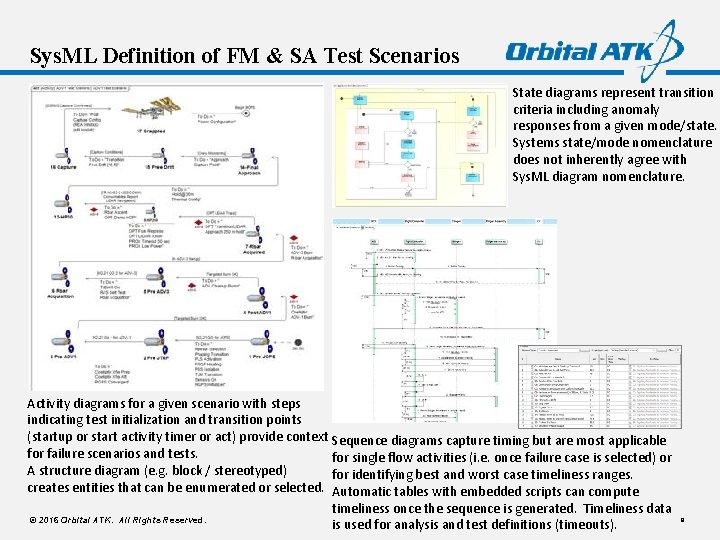
Sys. ML Definition of FM & SA Test Scenarios State diagrams represent transition criteria including anomaly responses from a given mode/state. Systems state/mode nomenclature does not inherently agree with Sys. ML diagram nomenclature. Activity diagrams for a given scenario with steps indicating test initialization and transition points (startup or start activity timer or act) provide context Sequence diagrams capture timing but are most applicable for failure scenarios and tests. for single flow activities (i. e. once failure case is selected) or A structure diagram (e. g. block / stereotyped) for identifying best and worst case timeliness ranges. creates entities that can be enumerated or selected. Automatic tables with embedded scripts can compute timeliness once the sequence is generated. Timeliness data © 2016 Orbital ATK. All Rights Reserved. is used for analysis and test definitions (timeouts). 8
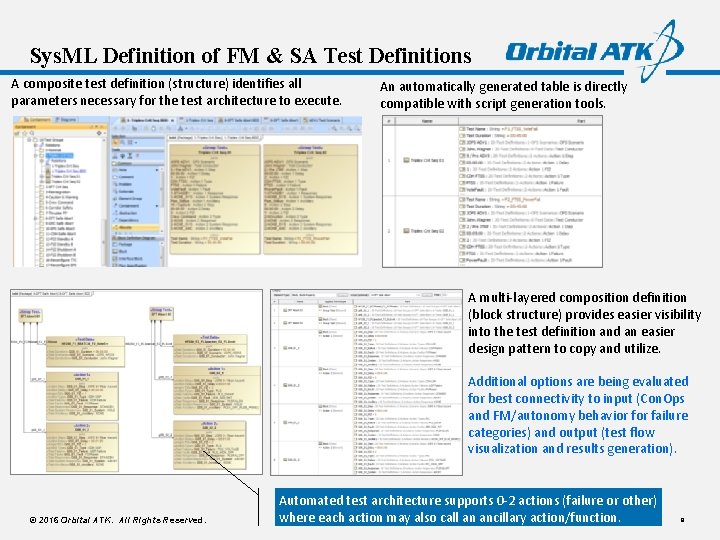
Sys. ML Definition of FM & SA Test Definitions A composite test definition (structure) identifies all parameters necessary for the test architecture to execute. An automatically generated table is directly compatible with script generation tools. A multi-layered composition definition (block structure) provides easier visibility into the test definition and an easier design pattern to copy and utilize. Additional options are being evaluated for best connectivity to input (Con. Ops and FM/autonomy behavior failure categories) and output (test flow visualization and results generation). © 2016 Orbital ATK. All Rights Reserved. Automated test architecture supports 0 -2 actions (failure or other) where each action may also call an ancillary action/function. 9
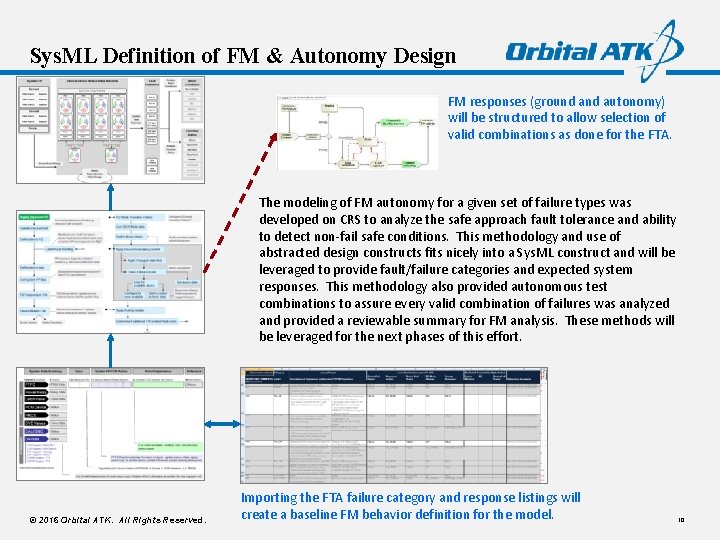
Sys. ML Definition of FM & Autonomy Design FM responses (ground autonomy) will be structured to allow selection of valid combinations as done for the FTA. The modeling of FM autonomy for a given set of failure types was developed on CRS to analyze the safe approach fault tolerance and ability to detect non-fail safe conditions. This methodology and use of abstracted design constructs fits nicely into a Sys. ML construct and will be leveraged to provide fault/failure categories and expected system responses. This methodology also provided autonomous test combinations to assure every valid combination of failures was analyzed and provided a reviewable summary for FM analysis. These methods will be leveraged for the next phases of this effort. © 2016 Orbital ATK. All Rights Reserved. Importing the FTA failure category and response listings will create a baseline FM behavior definition for the model. 10
Summary of Status and Findings Behavior diagrams for system Con. Ops and FM/autonomy behavior Ø Modified use of activity, state, and sequence diagrams have been applied Ø There are limitations in the ability to designate general transitions in Safety, FM, and Autonomy capabilities or constraints within a phase, activity, or sequence Ø Looking into the best diagram methods for scenarios that are more detailed than a standard Use Case, but are not as detailed (or flow oriented) as a standard activity Ø Looking into the best object definitions of behavior descriptions that can be easily applied to test definition (i. e. transitions or intermediate points) Block diagrams for test definitions Ø Several approaches for object specification that define a test case have been applied Ø Looking into improved methods of selecting test specifications (enumerations) Ø Looking into scripted or other connected definitions of test specification items (connecting diagram information to selectable test definitions) Ø Beginning scripting for test definition output (test architecture accepts a script defining a list of globals) Diagrams for test definitions Ø Looking into the generation of test-specific diagrams (manual then automatic) − These fit more closely with standard behavior diagrams (sequence diagrams) This effort is initiating what will be a Sys. ML capability development cycle – with enough beginning pieces to generate products for existing capabilities, and following cycles to determine best practice and improvements for Con. Ops, behavior definitions, FM requirements, and V&V © 2016 Orbital ATK. All Rights Reserved. 11
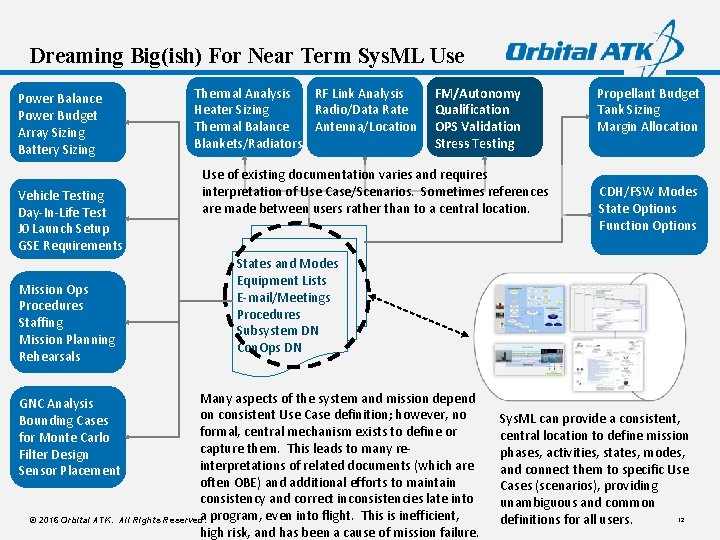
Dreaming Big(ish) For Near Term Sys. ML Use Power Balance Power Budget Array Sizing Battery Sizing Vehicle Testing Day-In-Life Test J 0 Launch Setup GSE Requirements Mission Ops Procedures Staffing Mission Planning Rehearsals Thermal Analysis RF Link Analysis Heater Sizing Radio/Data Rate Thermal Balance Antenna/Location Blankets/Radiators FM/Autonomy Qualification OPS Validation Stress Testing Use of existing documentation varies and requires interpretation of Use Case/Scenarios. Sometimes references are made between users rather than to a central location. CDH/FSW Modes State Options Function Options States and Modes Equipment Lists E-mail/Meetings Procedures Subsystem DN Con. Ops DN Many aspects of the system and mission depend on consistent Use Case definition; however, no formal, central mechanism exists to define or capture them. This leads to many reinterpretations of related documents (which are often OBE) and additional efforts to maintain consistency and correct inconsistencies late into a program, even into flight. This is inefficient, © 2016 Orbital ATK. All Rights Reserved. high risk, and has been a cause of mission failure. GNC Analysis Bounding Cases for Monte Carlo Filter Design Sensor Placement Propellant Budget Tank Sizing Margin Allocation Sys. ML can provide a consistent, central location to define mission phases, activities, states, modes, and connect them to specific Use Cases (scenarios), providing unambiguous and common 12 definitions for all users.
- Slides: 12