
Orbital Aspects of Satellite Communications Joe Montana IT
Orbital Aspects of Satellite Communications Joe Montana IT 488 - Fall 2003 1
Agenda • Orbital Mechanics • Look Angle Determination 2
Orbital Mechanics 3
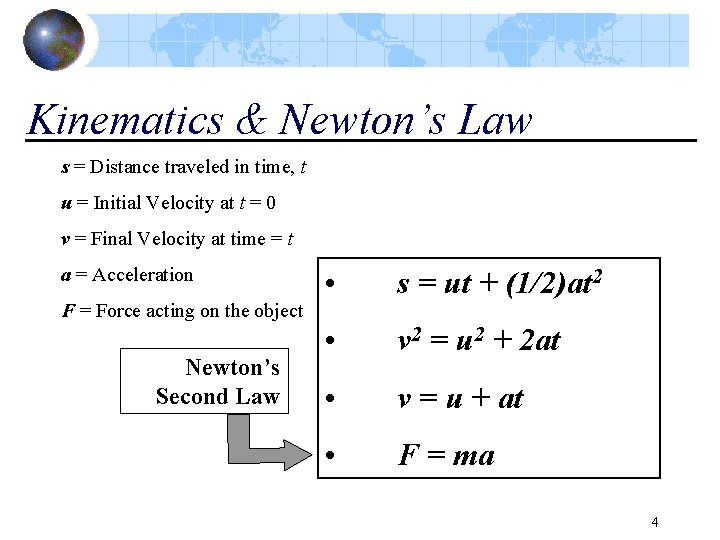
Kinematics & Newton’s Law s = Distance traveled in time, t u = Initial Velocity at t = 0 v = Final Velocity at time = t a = Acceleration F = Force acting on the object Newton’s Second Law • s = ut + (1/2)at 2 • v 2 = u 2 + 2 at • v = u + at • F = ma 4
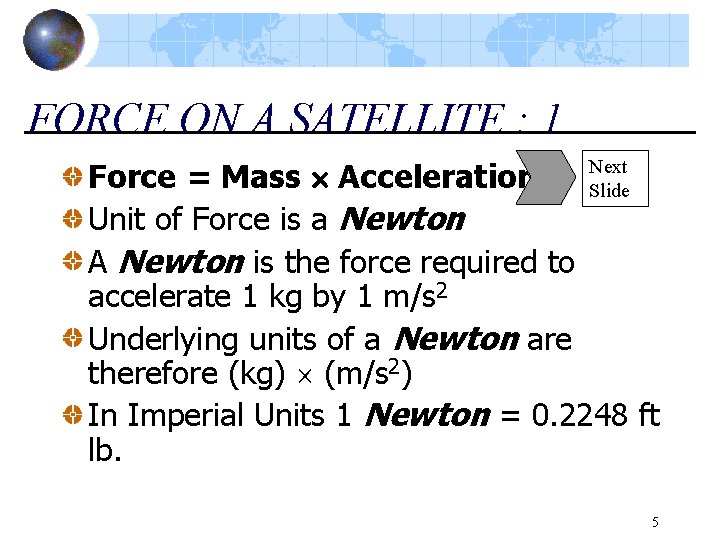
FORCE ON A SATELLITE : 1 Next Force = Mass Acceleration Slide Unit of Force is a Newton A Newton is the force required to accelerate 1 kg by 1 m/s 2 Underlying units of a Newton are therefore (kg) (m/s 2) In Imperial Units 1 Newton = 0. 2248 ft lb. 5

ACCELERATION FORMULA a = acceleration due to gravity = / r 2 km/s 2 r = radius from center of earth = universal gravitational constant G multiplied by the mass of the earth ME is Kepler’s constant and = 3. 9861352 105 km 3/s 2 G = 6. 672 10 -11 Nm 2/kg 2 or 6. 672 10 -20 km 3/kg s 2 in the older units 6
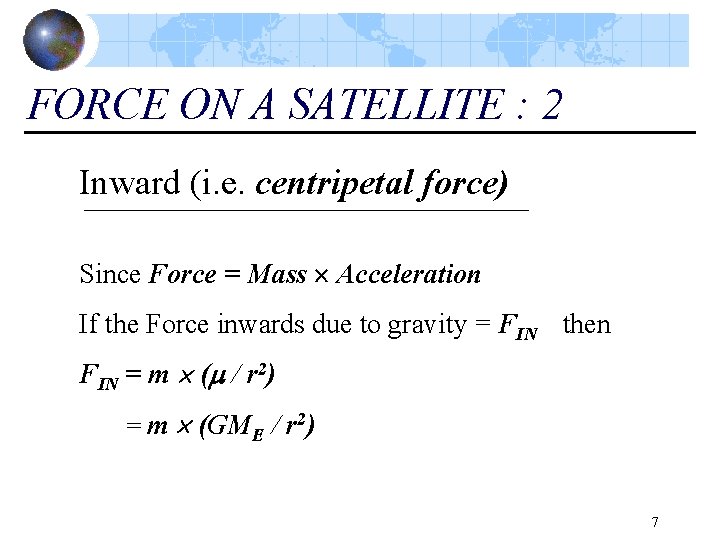
FORCE ON A SATELLITE : 2 Inward (i. e. centripetal force) Since Force = Mass Acceleration If the Force inwards due to gravity = FIN then FIN = m ( / r 2) = m (GME / r 2) 7
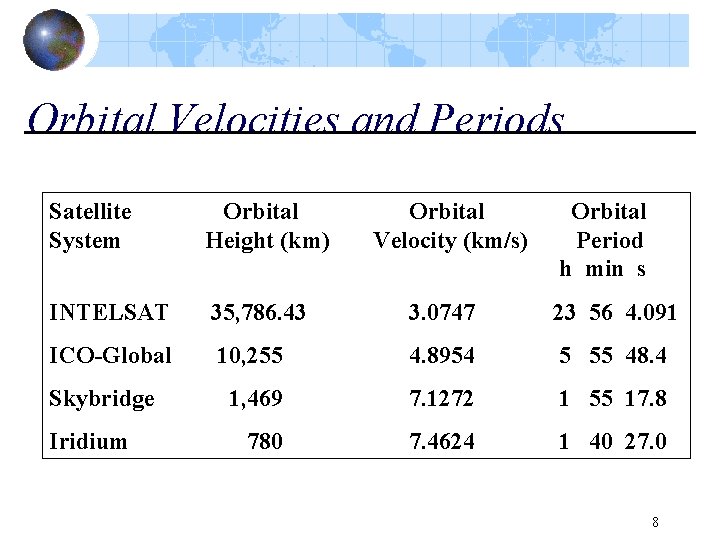
Orbital Velocities and Periods Satellite System Orbital Height (km) INTELSAT 35, 786. 43 3. 0747 23 56 4. 091 ICO-Global 10, 255 4. 8954 5 55 48. 4 1, 469 7. 1272 1 55 17. 8 780 7. 4624 1 40 27. 0 Skybridge Iridium Orbital Velocity (km/s) Orbital Period h min s 8
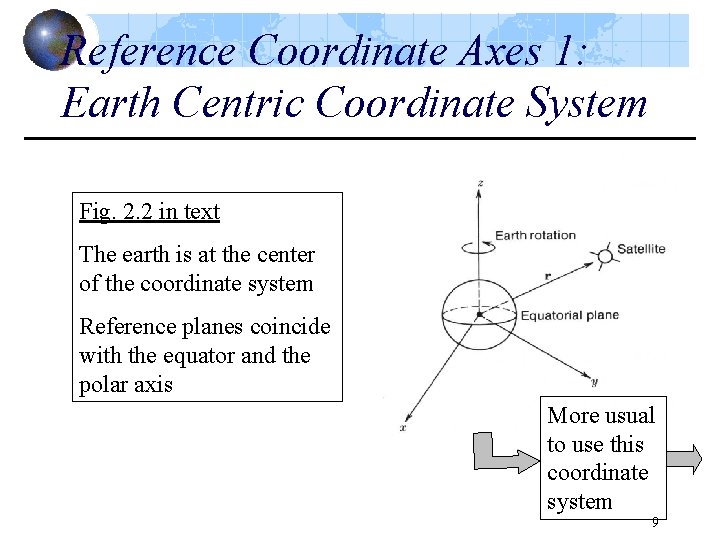
Reference Coordinate Axes 1: Earth Centric Coordinate System Fig. 2. 2 in text The earth is at the center of the coordinate system Reference planes coincide with the equator and the polar axis More usual to use this coordinate system 9
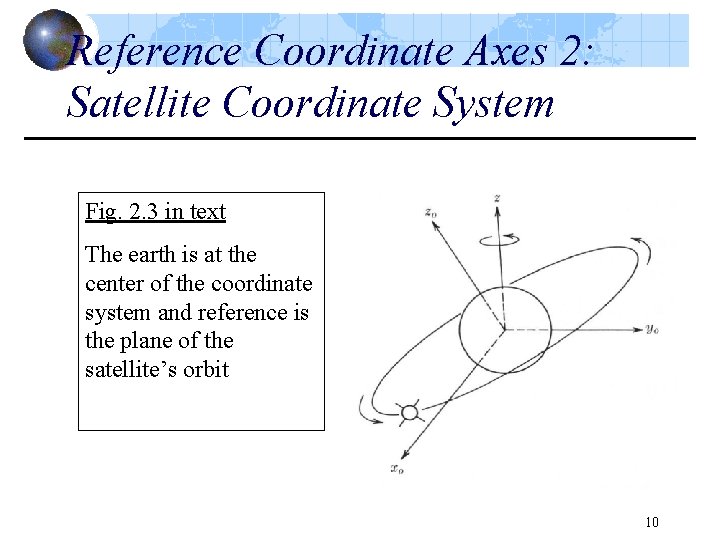
Reference Coordinate Axes 2: Satellite Coordinate System Fig. 2. 3 in text The earth is at the center of the coordinate system and reference is the plane of the satellite’s orbit 10
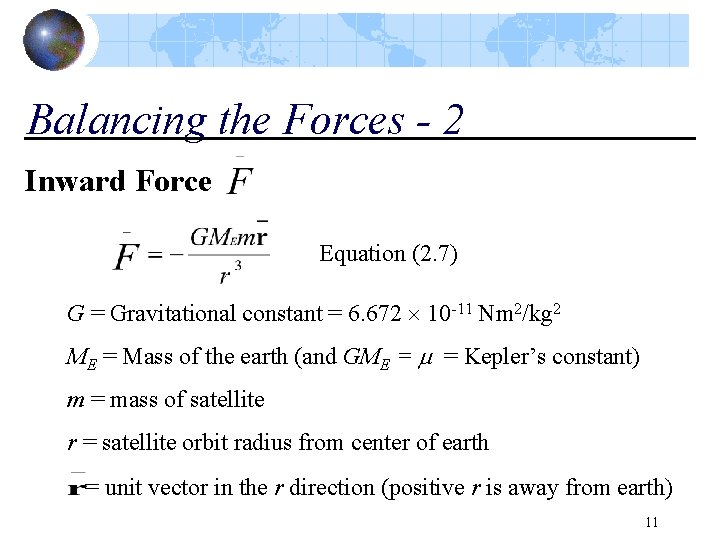
Balancing the Forces - 2 Inward Force Equation (2. 7) G = Gravitational constant = 6. 672 10 -11 Nm 2/kg 2 ME = Mass of the earth (and GME = = Kepler’s constant) m = mass of satellite r = satellite orbit radius from center of earth = unit vector in the r direction (positive r is away from earth) 11
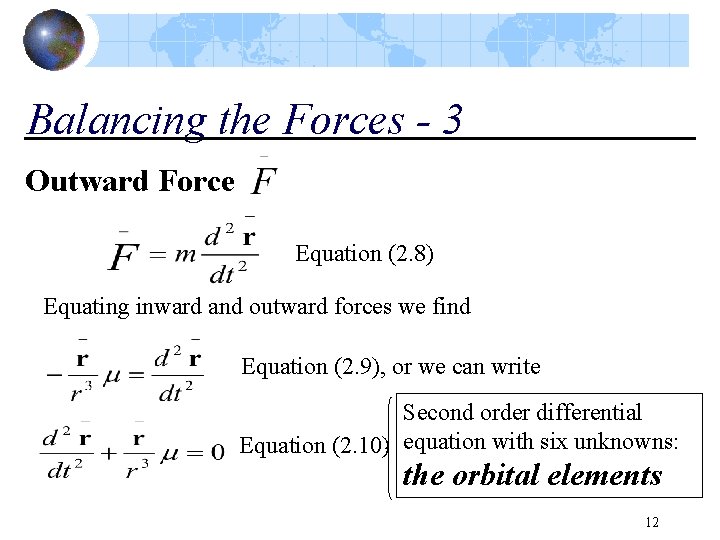
Balancing the Forces - 3 Outward Force Equation (2. 8) Equating inward and outward forces we find Equation (2. 9), or we can write Second order differential Equation (2. 10) equation with six unknowns: the orbital elements 12
THE ORBIT - 1 We have a second order differential equation See text p. 21 for a way to find a solution If we re-define our co-ordinate system into polar coordinates (see Fig. 2. 4) we can re-write equation (2. 11) as two second order differential equations in terms of r 0 and 0 13
THE ORBIT - 2 Solving the two differential equations leads to six constants (the orbital constants) which define the orbit, and three laws of orbits (Kepler’s Laws of Planetary Motion) Johaness Kepler (1571 - 1630) a German Astronomer and Scientist 14
KEPLER’S THREE LAWS Orbit is an ellipse with the larger body (earth) at one focus The satellite sweeps out equal arcs (area) in equal time (NOTE: for an ellipse, this means that the orbital velocity varies around the orbit) The square of the period of revolution equals a CONSTANT the THIRD POWER of SEMIMAJOR AXIS of the ellipse We’ll look at each of these in turn 15
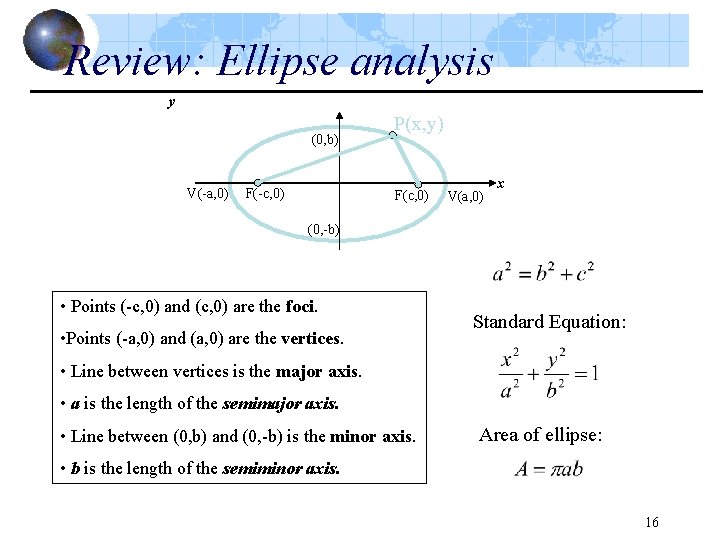
Review: Ellipse analysis y (0, b) V(-a, 0) F(-c, 0) P(x, y) F(c, 0) V(a, 0) x (0, -b) • Points (-c, 0) and (c, 0) are the foci. • Points (-a, 0) and (a, 0) are the vertices. Standard Equation: • Line between vertices is the major axis. • a is the length of the semimajor axis. • Line between (0, b) and (0, -b) is the minor axis. Area of ellipse: • b is the length of the semiminor axis. 16
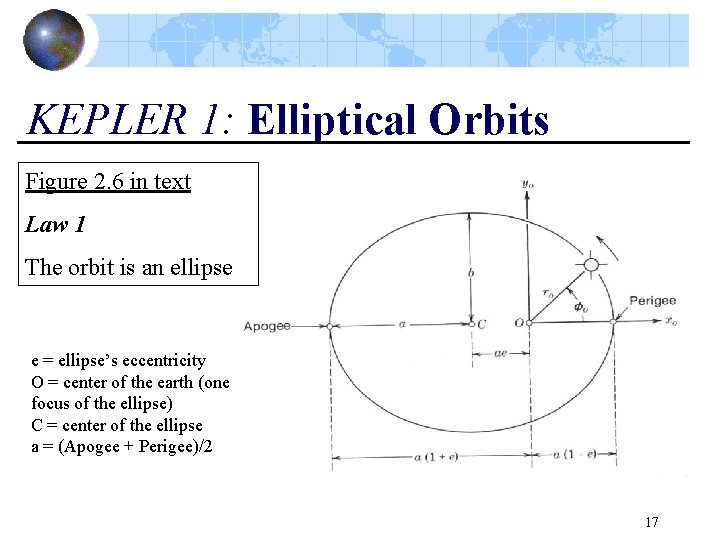
KEPLER 1: Elliptical Orbits Figure 2. 6 in text Law 1 The orbit is an ellipse e = ellipse’s eccentricity O = center of the earth (one focus of the ellipse) C = center of the ellipse a = (Apogee + Perigee)/2 17
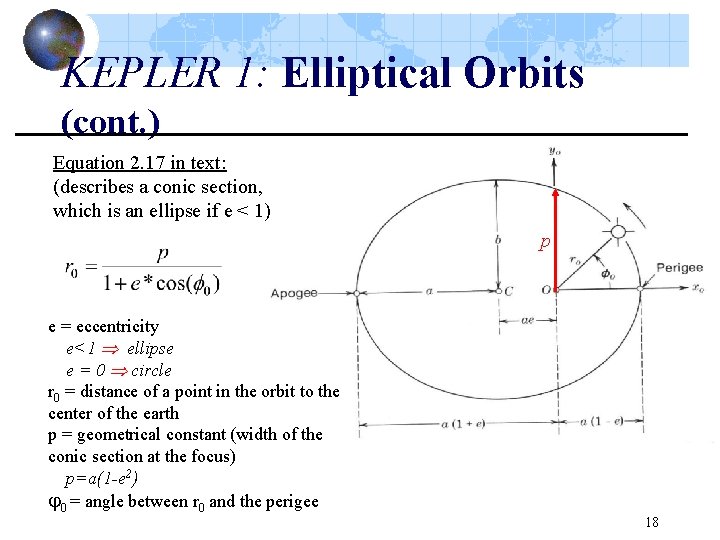
KEPLER 1: Elliptical Orbits (cont. ) Equation 2. 17 in text: (describes a conic section, which is an ellipse if e < 1) p e = eccentricity e<1 ellipse e = 0 circle r 0 = distance of a point in the orbit to the center of the earth p = geometrical constant (width of the conic section at the focus) p=a(1 -e 2) 0 = angle between r 0 and the perigee 18
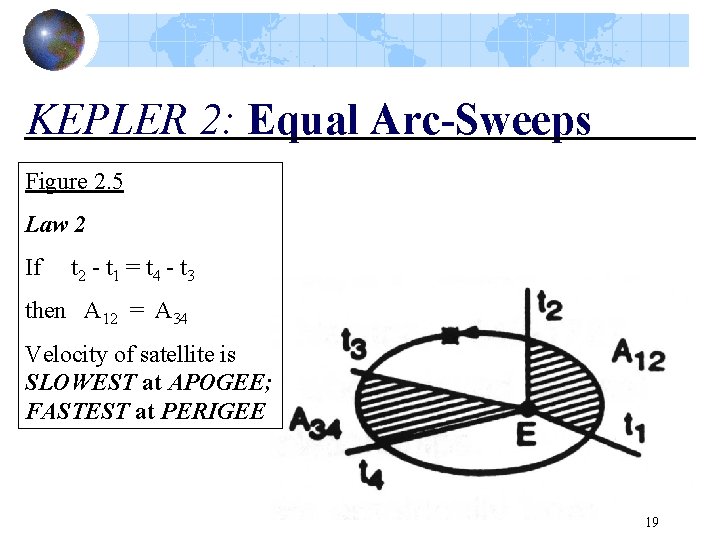
KEPLER 2: Equal Arc-Sweeps Figure 2. 5 Law 2 If t 2 - t 1 = t 4 - t 3 then A 12 = A 34 Velocity of satellite is SLOWEST at APOGEE; FASTEST at PERIGEE 19
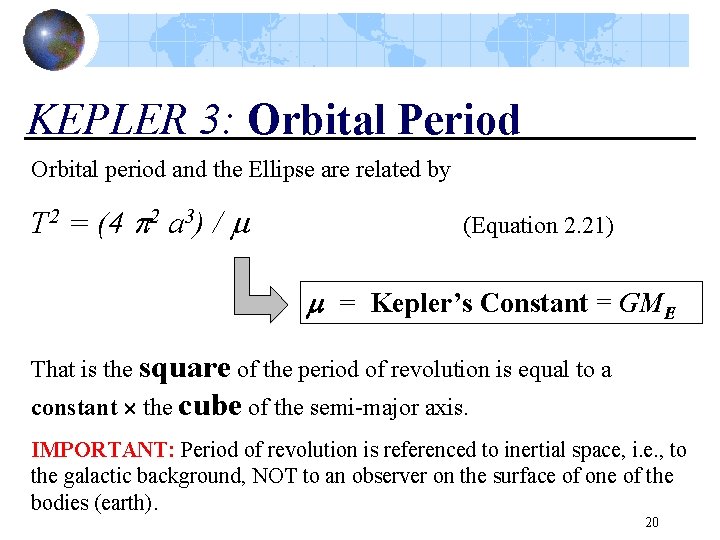
KEPLER 3: Orbital Period Orbital period and the Ellipse are related by T 2 = (4 2 a 3) / (Equation 2. 21) = Kepler’s Constant = GME That is the square of the period of revolution is equal to a constant the cube of the semi-major axis. IMPORTANT: Period of revolution is referenced to inertial space, i. e. , to the galactic background, NOT to an observer on the surface of one of the bodies (earth). 20
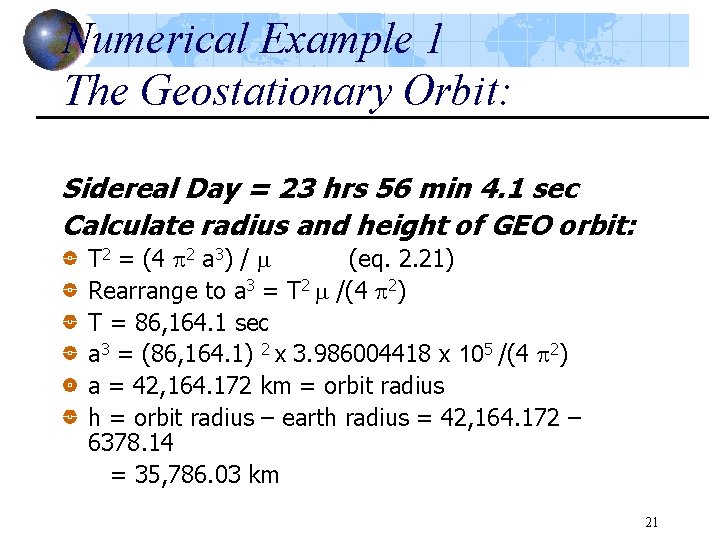
Numerical Example 1 The Geostationary Orbit: Sidereal Day = 23 hrs 56 min 4. 1 sec Calculate radius and height of GEO orbit: T 2 = (4 2 a 3) / (eq. 2. 21) Rearrange to a 3 = T 2 /(4 2) T = 86, 164. 1 sec a 3 = (86, 164. 1) 2 x 3. 986004418 x 105 /(4 2) a = 42, 164. 172 km = orbit radius h = orbit radius – earth radius = 42, 164. 172 – 6378. 14 = 35, 786. 03 km 21
Solar vs. Sidereal Day A sidereal day is the time between consecutive crossings of any particular longitude on the earth by any star other than the sun. A solar say is the time between consecutive crossings of any particular longitude of the earth by the sun-earth axis. Solar day = EXACTLY 24 hrs Sidereal day = 23 h 56 min. 4. 091 s Why the difference? By the time the Earth completes a full rotation with respect to an external point (not the sun), it has already moved its center position with respect to the sun. The extra time it takes to cross the sun-earth axis, averaged over 4 full years (because every 4 years one has 366 deays) is of about 3. 93 minutes per day. Calculation next page 22
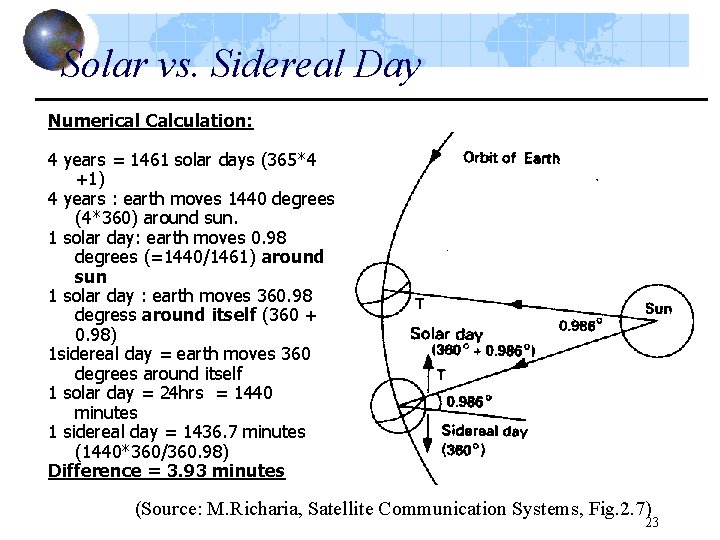
Solar vs. Sidereal Day Numerical Calculation: 4 years = 1461 solar days (365*4 +1) 4 years : earth moves 1440 degrees (4*360) around sun. 1 solar day: earth moves 0. 98 degrees (=1440/1461) around sun 1 solar day : earth moves 360. 98 degress around itself (360 + 0. 98) 1 sidereal day = earth moves 360 degrees around itself 1 solar day = 24 hrs = 1440 minutes 1 sidereal day = 1436. 7 minutes (1440*360/360. 98) Difference = 3. 93 minutes (Source: M. Richaria, Satellite Communication Systems, Fig. 2. 7) 23
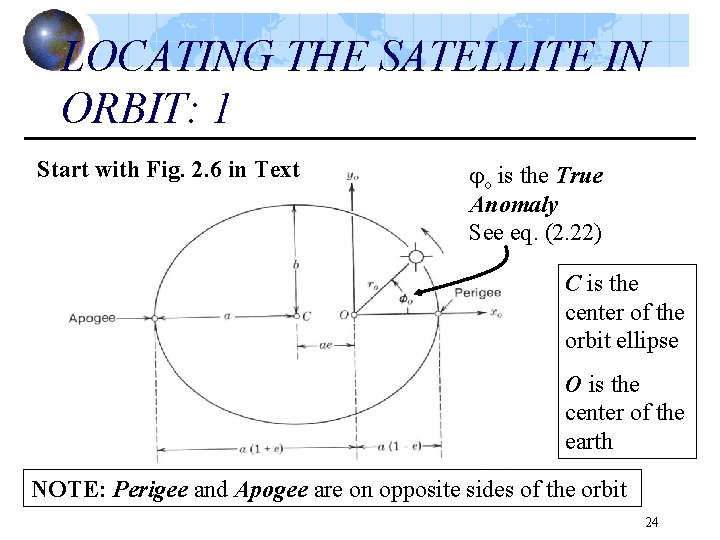
LOCATING THE SATELLITE IN ORBIT: 1 Start with Fig. 2. 6 in Text o is the True Anomaly See eq. (2. 22) C is the center of the orbit ellipse O is the center of the earth NOTE: Perigee and Apogee are on opposite sides of the orbit 24
LOCATING THE SATELLITE IN ORBIT: 2 Need to develop a procedure that will allow the average angular velocity to be used If the orbit is not circular, the procedure is to use a Circumscribed Circle A circumscribed circle is a circle that has a radius equal to the semi-major axis length of the ellipse and also has the same center See next slide 25
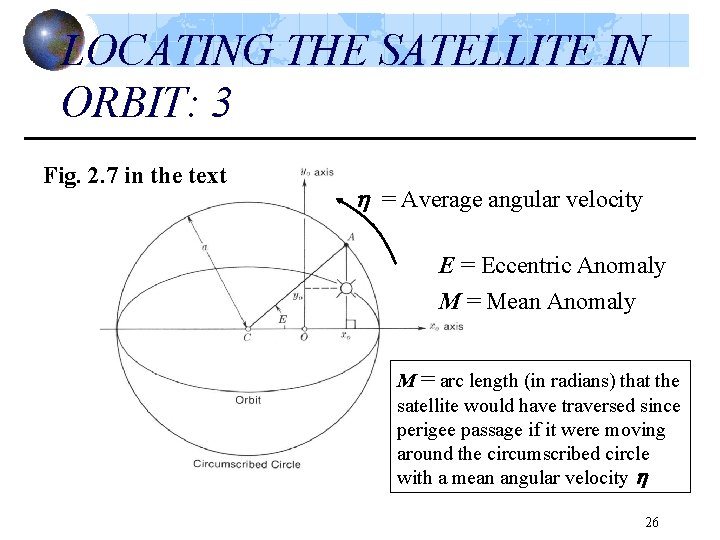
LOCATING THE SATELLITE IN ORBIT: 3 Fig. 2. 7 in the text = Average angular velocity E = Eccentric Anomaly M = Mean Anomaly M = arc length (in radians) that the satellite would have traversed since perigee passage if it were moving around the circumscribed circle with a mean angular velocity 26
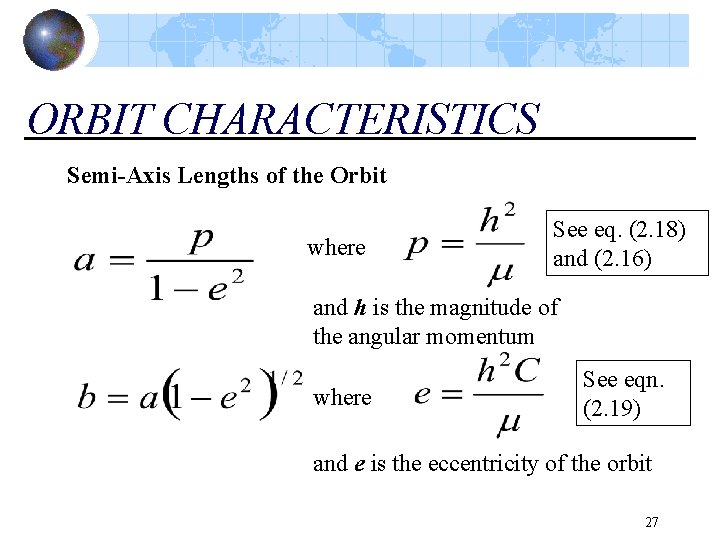
ORBIT CHARACTERISTICS Semi-Axis Lengths of the Orbit where See eq. (2. 18) and (2. 16) and h is the magnitude of the angular momentum where See eqn. (2. 19) and e is the eccentricity of the orbit 27
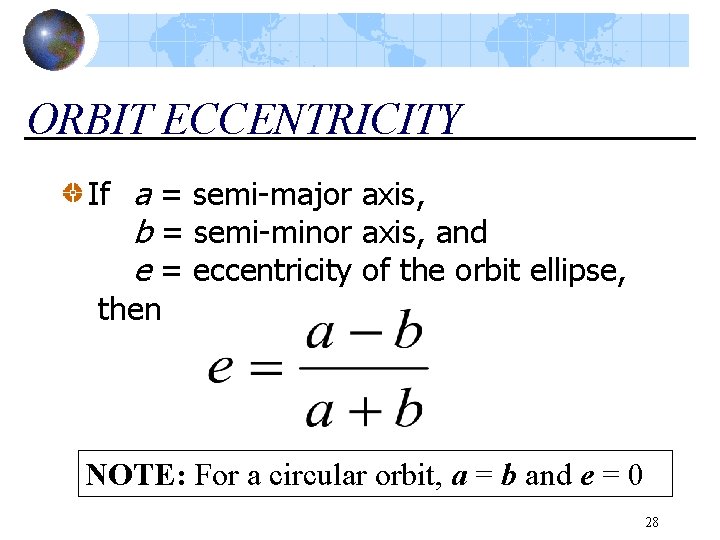
ORBIT ECCENTRICITY If a = semi-major axis, b = semi-minor axis, and e = eccentricity of the orbit ellipse, then NOTE: For a circular orbit, a = b and e = 0 28
Time reference: tp Time of Perigee = Time of closest approach to the earth, at the same time, time the satellite is crossing the x 0 axis, according to the reference used. t- tp = time elapsed since satellite last passed the perigee. 29
ORBIT DETERMINATION 1: Procedure: Given the time of perigee tp, the eccentricity e and the length of the semimajor axis a: Average Angular Velocity (eqn. 2. 25) M Mean Anomaly (eqn. 2. 30) E Eccentric Anomaly (solve eqn. 2. 30) ro Radius from orbit center (eqn. 2. 27) o True Anomaly (solve eq. 2. 22) x 0 and y 0 (using eqn. 2. 23 and 2. 24) 30
ORBIT DETERMINATION 2: Orbital Constants allow you to determine coordinates (ro, o) and (xo, yo) in the orbital plane Now need to locate the orbital plane with respect to the earth More specifically: need to locate the orbital location with respect to a point on the surface of the earth 31
LOCATING THE SATELLITE WITH RESPECT TO THE EARTH The orbital constants define the orbit of the satellite with respect to the CENTER of the earth To know where to look for the satellite in space, we must relate the orbital plane and time of perigee to the earth’s axis NOTE: Need a Time Reference to locate the satellite. The time reference most often used is the Time of Perigee, tp 32
GEOCENTRIC EQUATORIAL COORDINATES - 1 zi axis Earth’s rotational axis (N-S poles with N as positive z) xi axis In equatorial plane towards FIRST POINT OF ARIES yi axis Orthogonal to zi and xi NOTE: The First Point of Aries is a line from the center of the earth through the center of the sun at the vernal equinox (spring) in the northern hemisphere 33
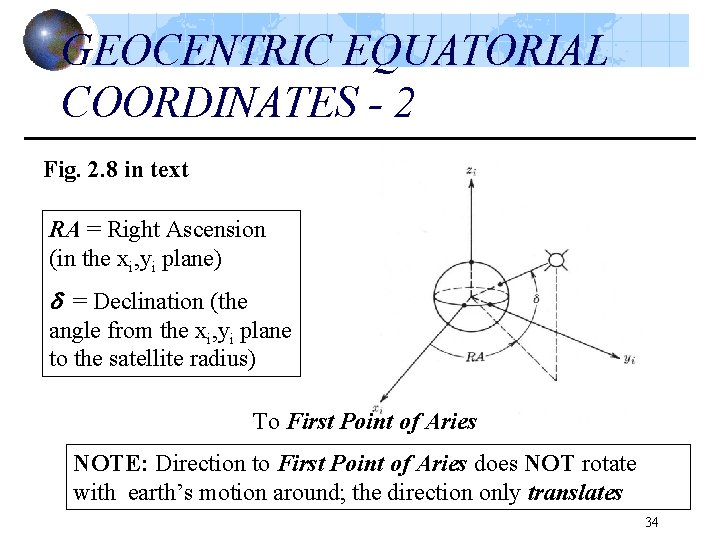
GEOCENTRIC EQUATORIAL COORDINATES - 2 Fig. 2. 8 in text RA = Right Ascension (in the xi, yi plane) = Declination (the angle from the xi, yi plane to the satellite radius) To First Point of Aries NOTE: Direction to First Point of Aries does NOT rotate with earth’s motion around; the direction only translates 34
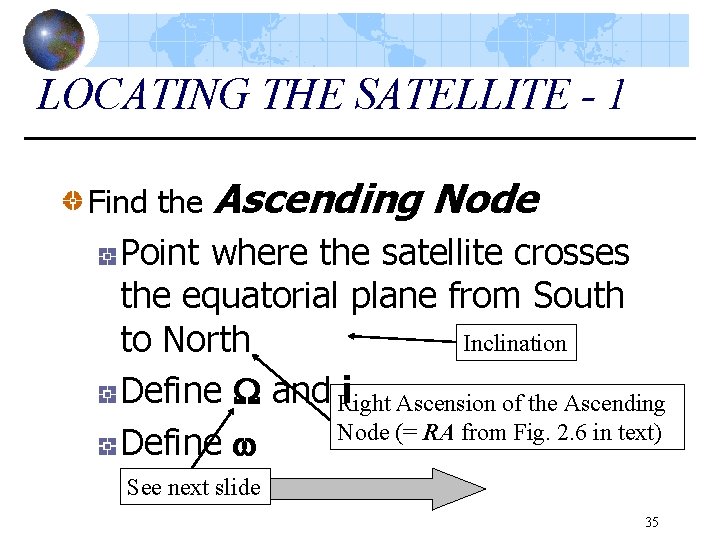
LOCATING THE SATELLITE - 1 Find the Ascending Node Point where the satellite crosses the equatorial plane from South Inclination to North Define and Right i Ascension of the Ascending Node (= RA from Fig. 2. 6 in text) Define See next slide 35
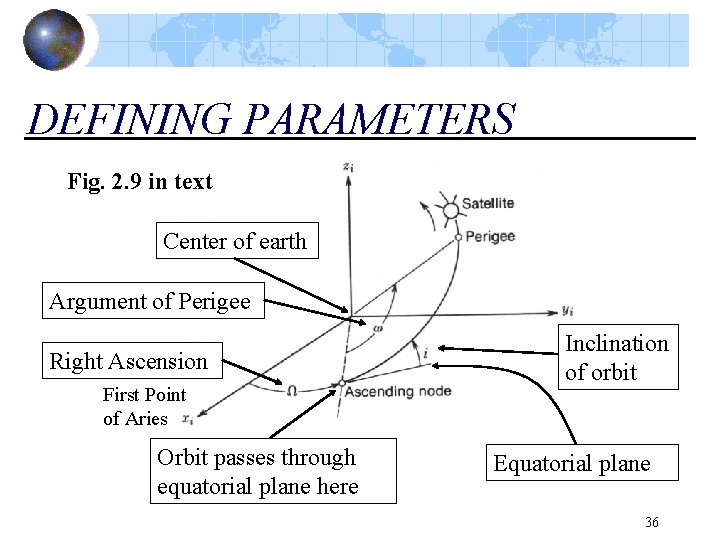
DEFINING PARAMETERS Fig. 2. 9 in text Center of earth Argument of Perigee Right Ascension First Point of Aries Orbit passes through equatorial plane here Inclination of orbit Equatorial plane 36
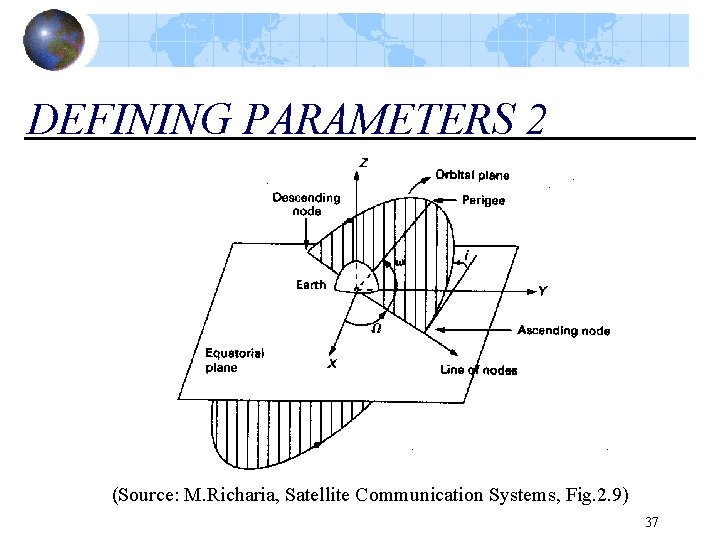
DEFINING PARAMETERS 2 (Source: M. Richaria, Satellite Communication Systems, Fig. 2. 9) 37
LOCATING THE SATELLITE - 2 and i together locate the Orbital plane with respect to the Equatorial plane. locates the Orbital coordinate system with respect to the Equatorial coordinate system. 38
LOCATING THE SATELLITE - 2 Astronomers use Julian Days or Julian Dates Space Operations are in Universal Time Constant (UTC) taken from Greenwich Meridian (This time is sometimes referred to as “Zulu”) To find exact position of an orbiting satellite at a given instant, we need the Orbital Elements 39
ORBITAL ELEMENTS (P. 29) Right Ascension of the Ascending Node i Inclination of the orbit Argument of Perigee (See Figures 2. 6 & 2. 7 in the text) tp Time of Perigee e Eccentricity of the elliptical orbit a Semi-major axis of the orbit ellipse (See Fig. 2. 4 in the text) 40
Numerical Example 2: Space Shuttle Circular orbit (height = h = 250 km). Use earth radius = 6378 km a. Period = ? b. Linear velocity = ? Solution: a) r = (re + h) = 6378 + 250 = 6628 km From equation 2. 21: T 2 = (4 2 a 3) / = 4 2 (6628)3 / 3. 986004418 105 s 2 = 2. 8838287 107 s 2 T = 5370. 13 s = 89 mins 30. 13 secs b) The circumference of the orbit is 2 a = 41, 644. 95 km v = 2 a / T = 41, 644. 95 / 5370. 13 = 7. 755 km/s Alternatively: v = ( /r)2. =7. 755 km/s. 41
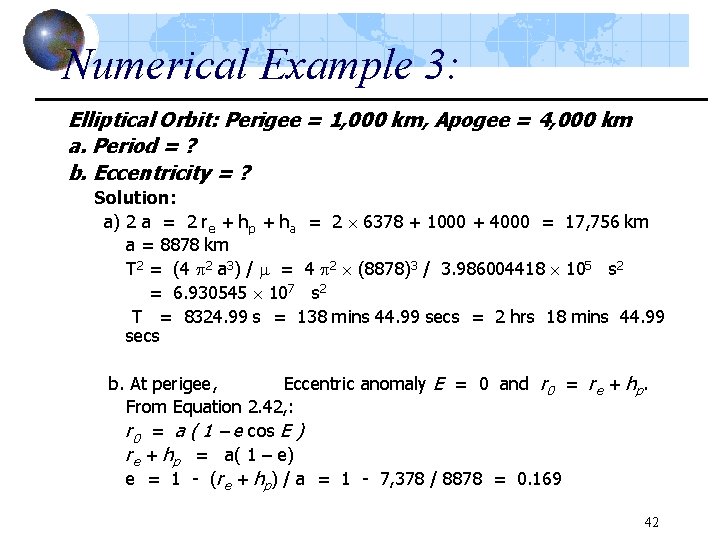
Numerical Example 3: Elliptical Orbit: Perigee = 1, 000 km, Apogee = 4, 000 km a. Period = ? b. Eccentricity = ? Solution: a) 2 a = 2 re + hp + ha = 2 6378 + 1000 + 4000 = 17, 756 km a = 8878 km T 2 = (4 2 a 3) / = 4 2 (8878)3 / 3. 986004418 105 s 2 = 6. 930545 107 s 2 T = 8324. 99 s = 138 mins 44. 99 secs = 2 hrs 18 mins 44. 99 secs b. At perigee, Eccentric anomaly E = 0 and r 0 = re + hp. From Equation 2. 42, : r 0 = a ( 1 – e cos E ) re + hp = a( 1 – e) e = 1 - (re + hp) / a = 1 - 7, 378 / 8878 = 0. 169 42
Look Angle Determination 43
CALCULATING THE LOOK ANGLES 1: HISTORICAL Need six Orbital Elements Calculate the orbit from these Orbital Elements Define the orbital plane Locate satellite at time t with respect to the First Point of Aries Find location of the Greenwich Meridian relative to the first point of Aries Use Spherical Trigonometry to find the position of the satellite relative to a point on the earth’s surface 44
CALCULATING THE LOOK ANGLES 2: AGE OF THE PC Go to http: //www. stk. com and go to the “downloads” area. ANALYTICAL GRAPHICS software suite called Satellite Tool Kit for orbit determination Used by LM, Hughes, NASA, etc. Current suite is STK© 4. 2 series Need two basic look-angle parameters: Elevation Angle Azimuth Angle 45
ANGLE DEFINITIONS - 1 46
Coordinate System 1 • Latitude: Angular distance, measured in degrees, north or south of the equator. L from -90 to +90 (or from 90 S to 90 N) • Longitude: Angular distance, measured in degrees, from a given reference longitudinal line (Greenwich, London). l from 0 to 360 E (or 180 W to 180 E) 47
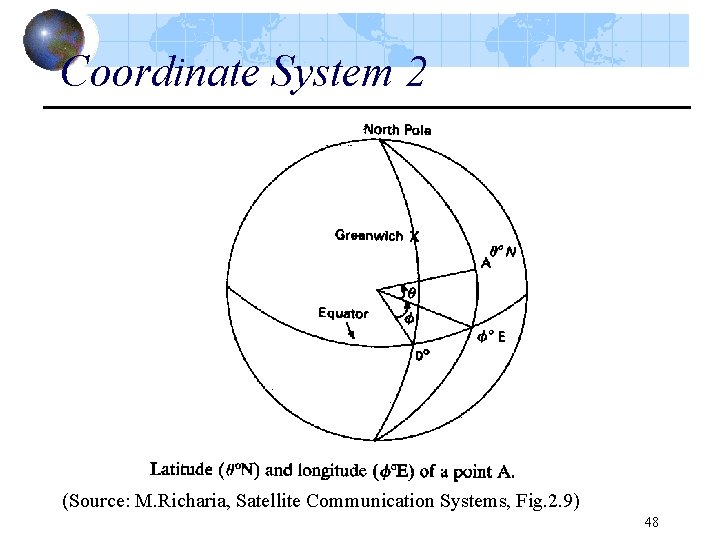
Coordinate System 2 (Source: M. Richaria, Satellite Communication Systems, Fig. 2. 9) 48
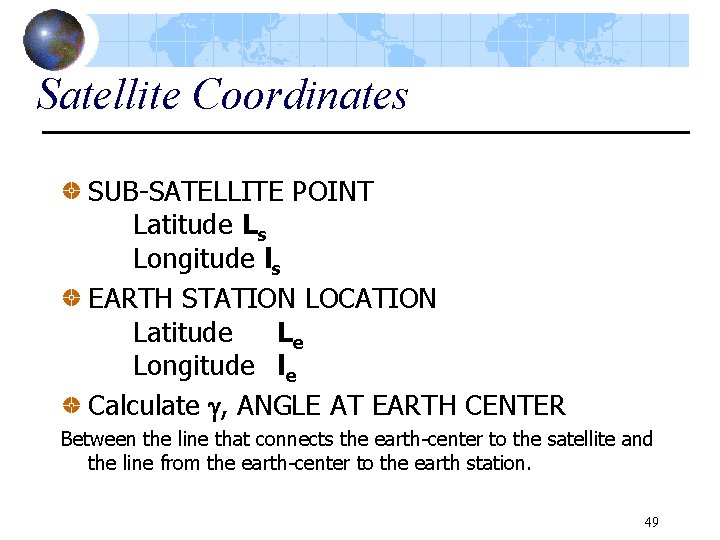
Satellite Coordinates SUB-SATELLITE POINT Latitude Ls Longitude ls EARTH STATION LOCATION Latitude Le Longitude le Calculate , ANGLE AT EARTH CENTER Between the line that connects the earth-center to the satellite and the line from the earth-center to the earth station. 49
LOOK ANGLES 1 • Azimuth: Measured eastward (clockwise) from geographic north to the projection of the satellite path on a (locally) horizontal plane at the earth station. • Elevation Angle: Measured upward from the local horizontal plane at the earth station to the satellite path. 50
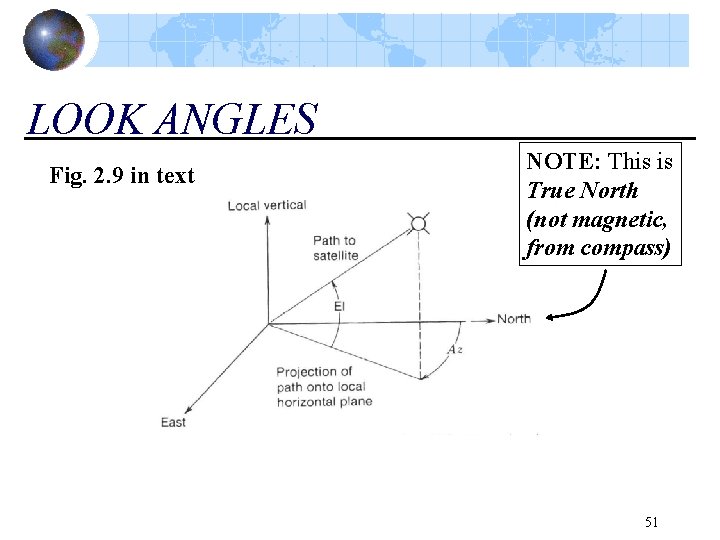
LOOK ANGLES Fig. 2. 9 in text NOTE: This is True North (not magnetic, from compass) 51
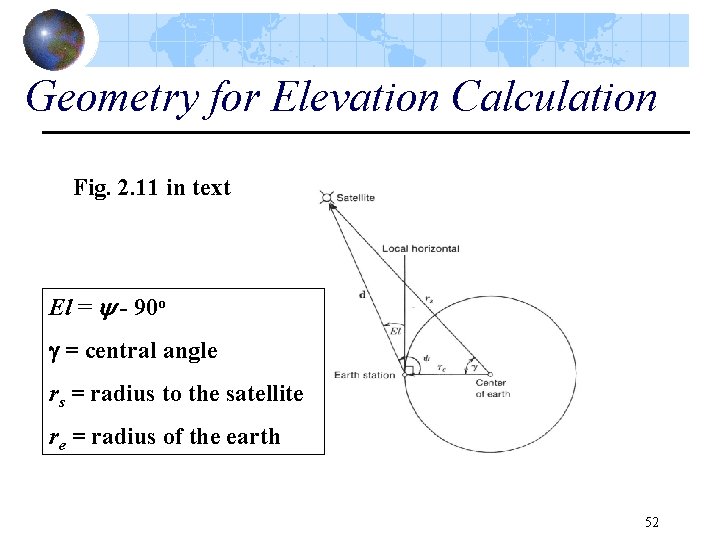
Geometry for Elevation Calculation Fig. 2. 11 in text El = - 90 o = central angle rs = radius to the satellite re = radius of the earth 52
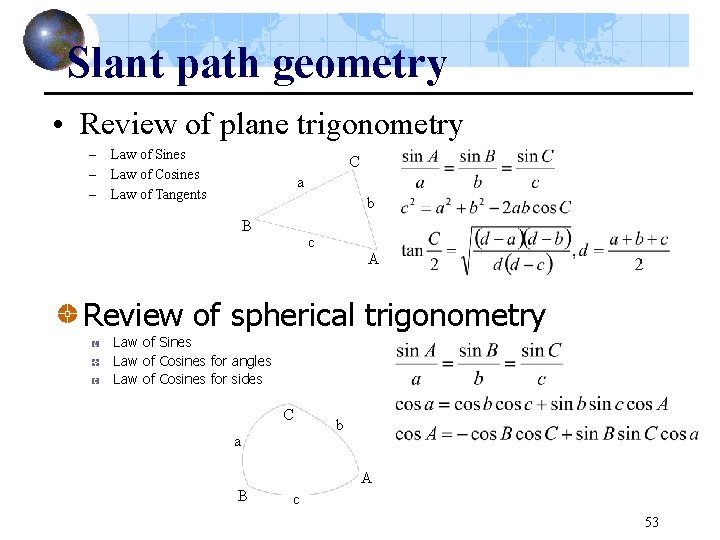
Slant path geometry • Review of plane trigonometry – – – Law of Sines Law of Cosines Law of Tangents C a b B c A Review of spherical trigonometry Law of Sines Law of Cosines for angles Law of Cosines for sides C a B b A c 53
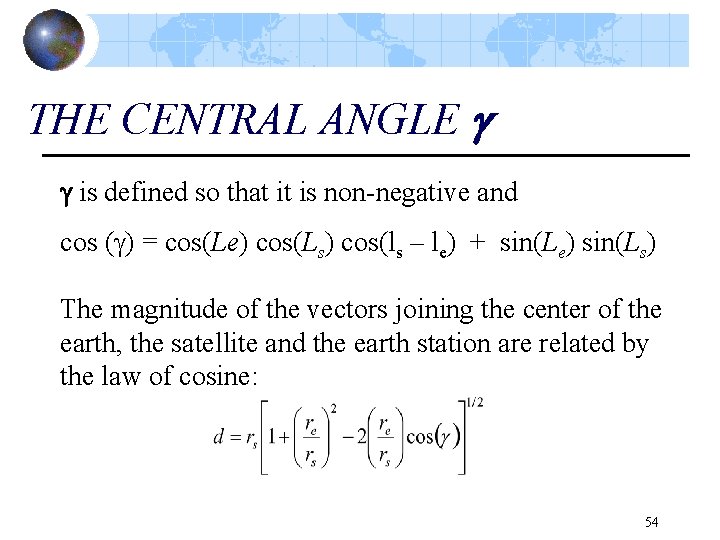
THE CENTRAL ANGLE is defined so that it is non-negative and cos ( ) = cos(Le) cos(Ls) cos(ls – le) + sin(Le) sin(Ls) The magnitude of the vectors joining the center of the earth, the satellite and the earth station are related by the law of cosine: 54
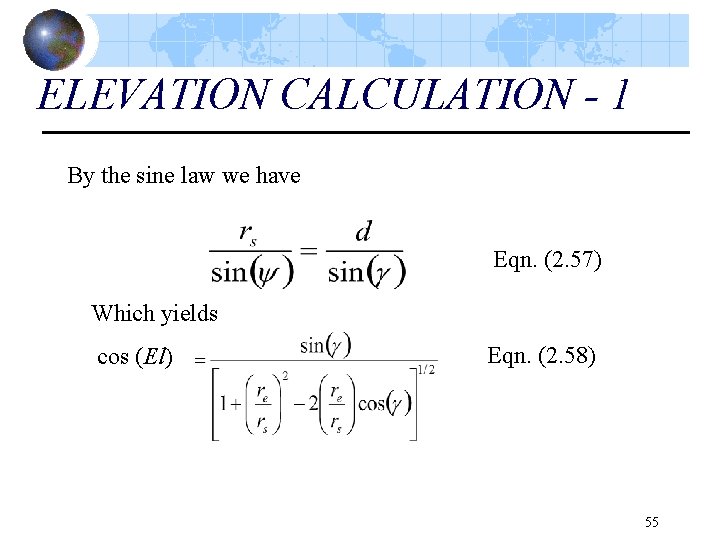
ELEVATION CALCULATION - 1 By the sine law we have Eqn. (2. 57) Which yields cos (El) Eqn. (2. 58) 55
AZIMUTH CALCULATION - 1 More complex approach for non-geo satellites. Different formulas and corrections apply depending on the combination of positions of the earth station and subsatellite point with relation to each of the four quadrants (NW, NE, SW, SE). A simplified method for calculating azimuths in the Geostationary case is shown in the next slides. 56
GEOSTATIONARY SATELLITES We will concentrate on the GEOSTATIONARY CASE This will allow some simplifications in the formulas SUB-SATELLITE POINT (Equatorial plane, Latitude Ls = 0 o Longitude ls) EARTH STATION LOCATION Latitude Le Longitude le 57
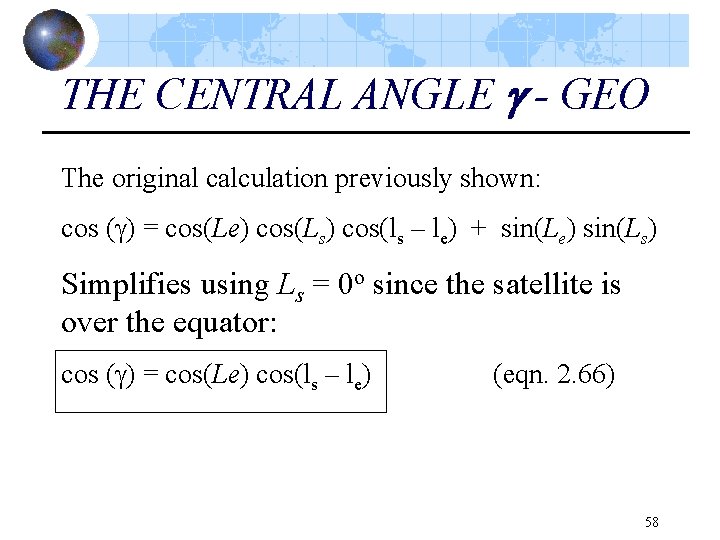
THE CENTRAL ANGLE - GEO The original calculation previously shown: cos ( ) = cos(Le) cos(Ls) cos(ls – le) + sin(Le) sin(Ls) Simplifies using Ls = 0 o since the satellite is over the equator: cos ( ) = cos(Le) cos(ls – le) (eqn. 2. 66) 58
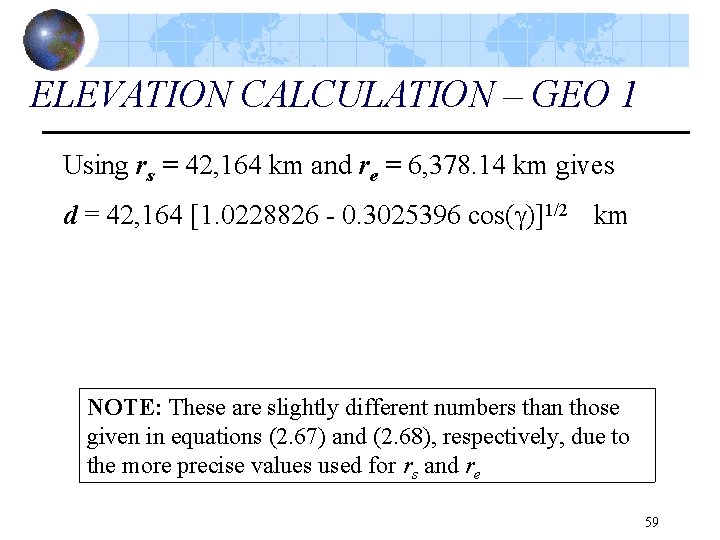
ELEVATION CALCULATION – GEO 1 Using rs = 42, 164 km and re = 6, 378. 14 km gives d = 42, 164 [1. 0228826 - 0. 3025396 cos( )]1/2 km NOTE: These are slightly different numbers than those given in equations (2. 67) and (2. 68), respectively, due to the more precise values used for rs and re 59
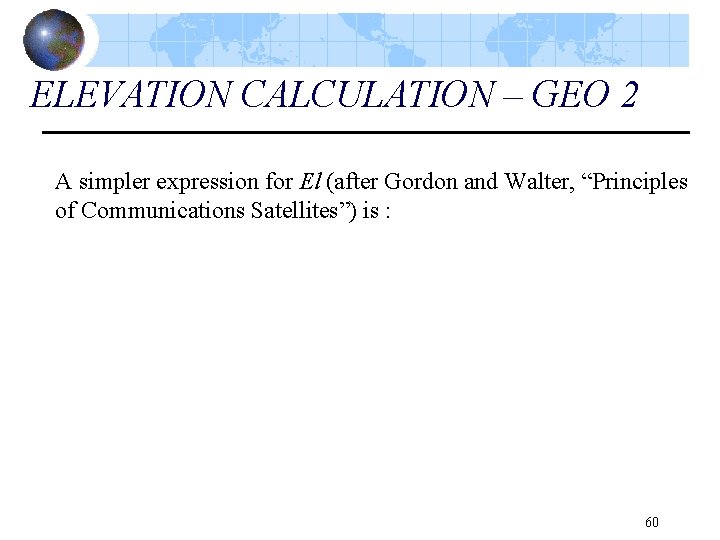
ELEVATION CALCULATION – GEO 2 A simpler expression for El (after Gordon and Walter, “Principles of Communications Satellites”) is : 60
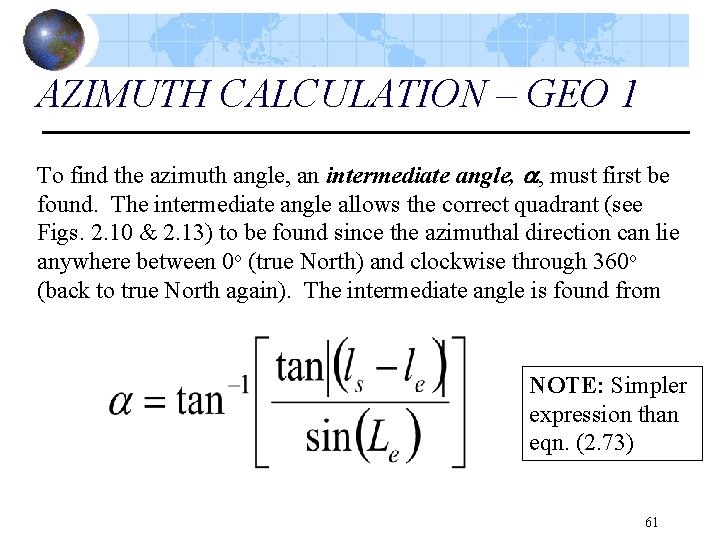
AZIMUTH CALCULATION – GEO 1 To find the azimuth angle, an intermediate angle, , must first be found. The intermediate angle allows the correct quadrant (see Figs. 2. 10 & 2. 13) to be found since the azimuthal direction can lie anywhere between 0 o (true North) and clockwise through 360 o (back to true North again). The intermediate angle is found from NOTE: Simpler expression than eqn. (2. 73) 61
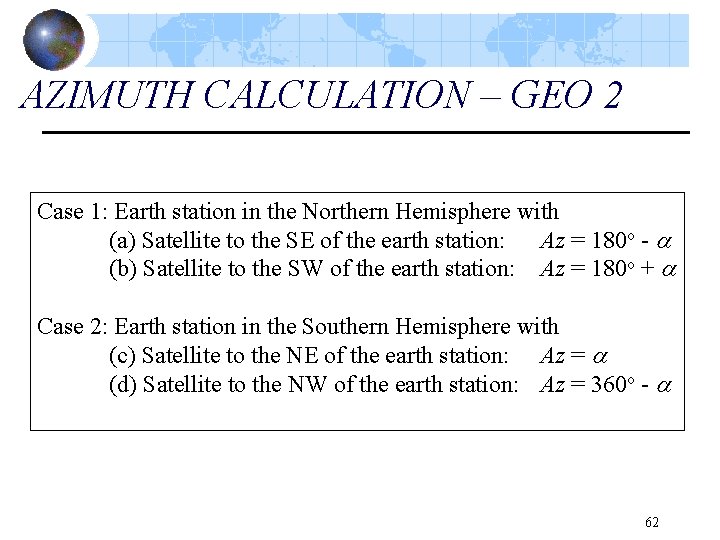
AZIMUTH CALCULATION – GEO 2 Case 1: Earth station in the Northern Hemisphere with (a) Satellite to the SE of the earth station: Az = 180 o - (b) Satellite to the SW of the earth station: Az = 180 o + Case 2: Earth station in the Southern Hemisphere with (c) Satellite to the NE of the earth station: Az = (d) Satellite to the NW of the earth station: Az = 360 o - 62
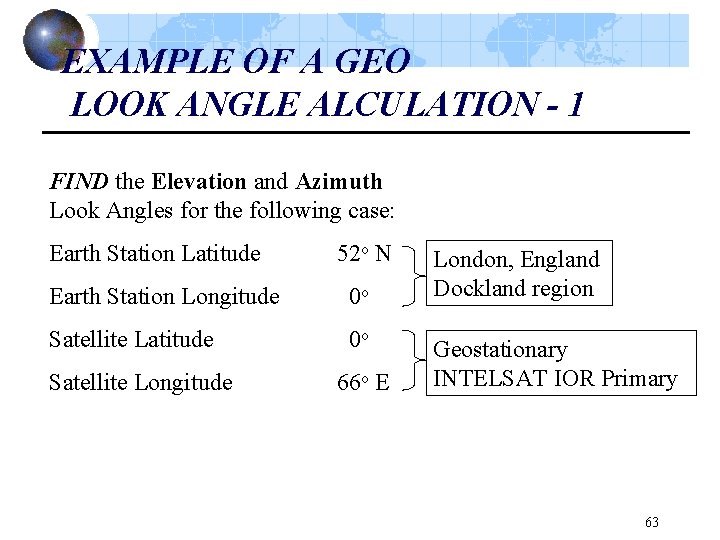
EXAMPLE OF A GEO LOOK ANGLE ALCULATION - 1 FIND the Elevation and Azimuth Look Angles for the following case: Earth Station Latitude 52 o N Earth Station Longitude 0 o Satellite Latitude 0 o Satellite Longitude 66 o E London, England Dockland region Geostationary INTELSAT IOR Primary 63
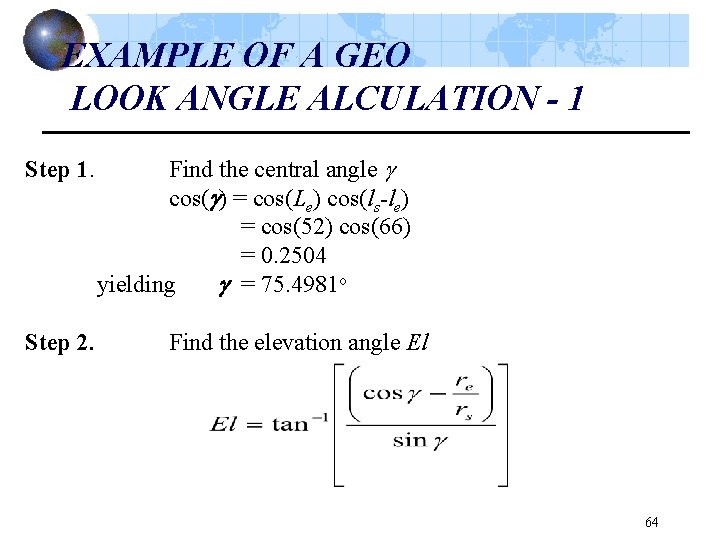
EXAMPLE OF A GEO LOOK ANGLE ALCULATION - 1 Step 1. Step 2. Find the central angle cos( ) = cos(Le) cos(ls-le) = cos(52) cos(66) = 0. 2504 yielding = 75. 4981 o Find the elevation angle El 64
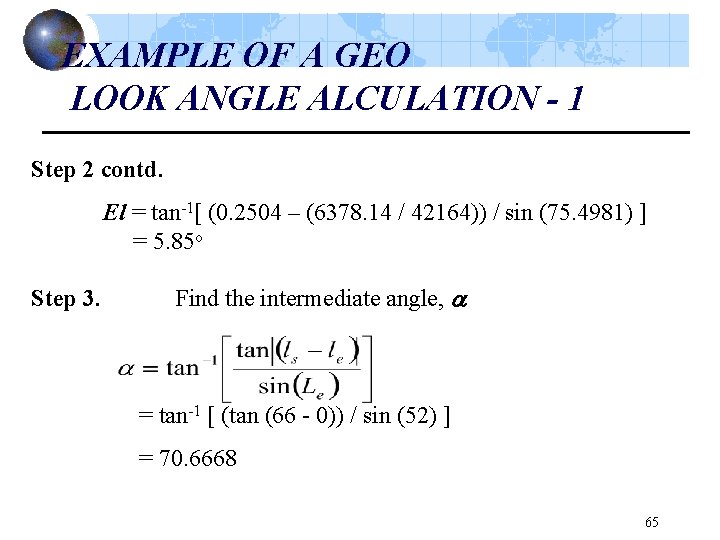
EXAMPLE OF A GEO LOOK ANGLE ALCULATION - 1 Step 2 contd. El = tan-1[ (0. 2504 – (6378. 14 / 42164)) / sin (75. 4981) ] = 5. 85 o Step 3. Find the intermediate angle, = tan-1 [ (tan (66 - 0)) / sin (52) ] = 70. 6668 65
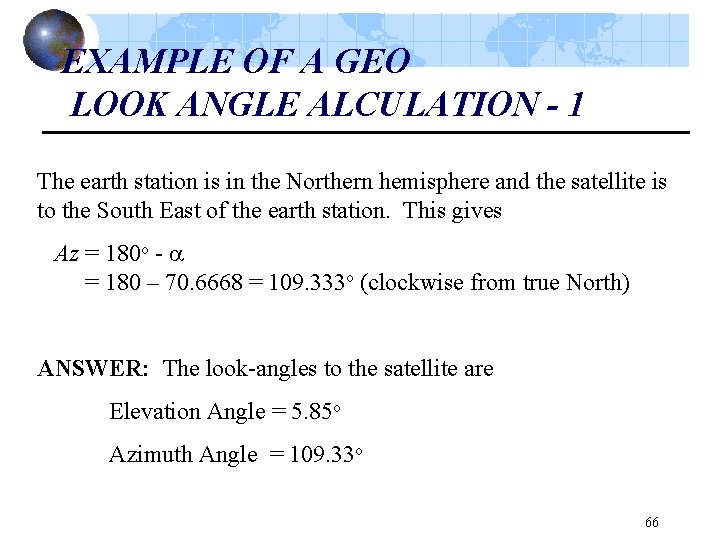
EXAMPLE OF A GEO LOOK ANGLE ALCULATION - 1 The earth station is in the Northern hemisphere and the satellite is to the South East of the earth station. This gives Az = 180 o - = 180 – 70. 6668 = 109. 333 o (clockwise from true North) ANSWER: The look-angles to the satellite are Elevation Angle = 5. 85 o Azimuth Angle = 109. 33 o 66
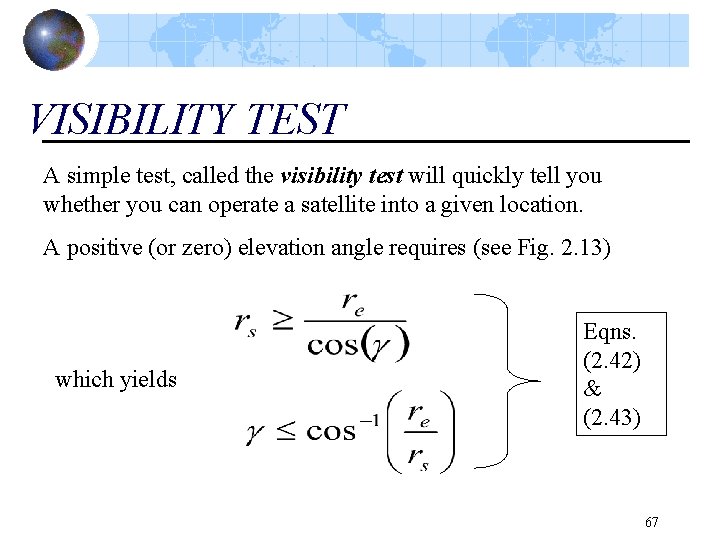
VISIBILITY TEST A simple test, called the visibility test will quickly tell you whether you can operate a satellite into a given location. A positive (or zero) elevation angle requires (see Fig. 2. 13) which yields Eqns. (2. 42) & (2. 43) 67
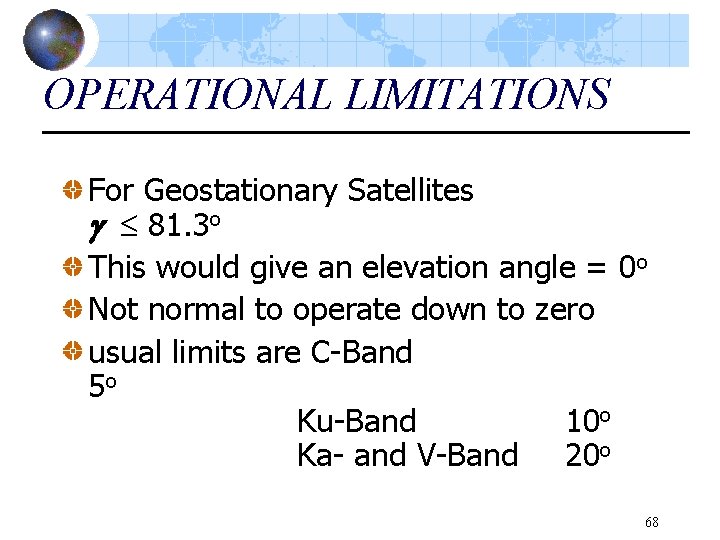
OPERATIONAL LIMITATIONS For Geostationary Satellites 81. 3 o This would give an elevation angle = 0 o Not normal to operate down to zero usual limits are C-Band 5 o Ku-Band 10 o Ka- and V-Band 20 o 68
- Slides: 68