
Orange Shirt Day September 30 2019 What is
Orange Shirt Day September 30, 2019
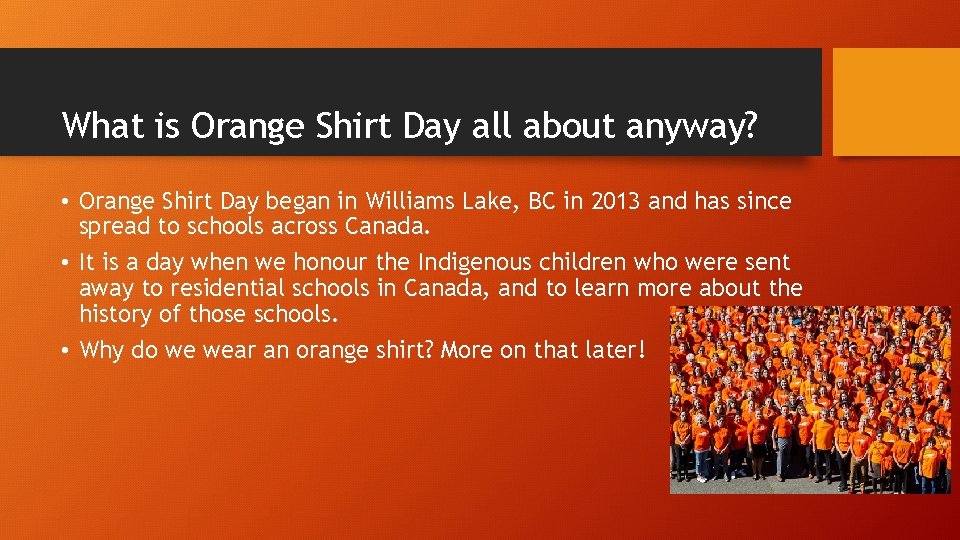
What is Orange Shirt Day all about anyway? • Orange Shirt Day began in Williams Lake, BC in 2013 and has since spread to schools across Canada. • It is a day when we honour the Indigenous children who were sent away to residential schools in Canada, and to learn more about the history of those schools. • Why do we wear an orange shirt? More on that later!
What were “Indian Residential Schools? ” • When Canada was a new country in the late 1800’s, government leaders were not sure what to about the Indigenous people living here. It was believed that Indigenous culture and ways were inferior to those of Euro-Canadians (settlers). Furthermore, the Indigenous population was viewed as an inconvenience when it came to settling and developing the land. The government referred to this as the “Indian Problem” and tried different ways to solve it, but with limited success. Finally, it was decided that the best thing would be to assimilate First Nation, Metis and Inuit peoples into “white” culture. The government decided to start with the children. . .
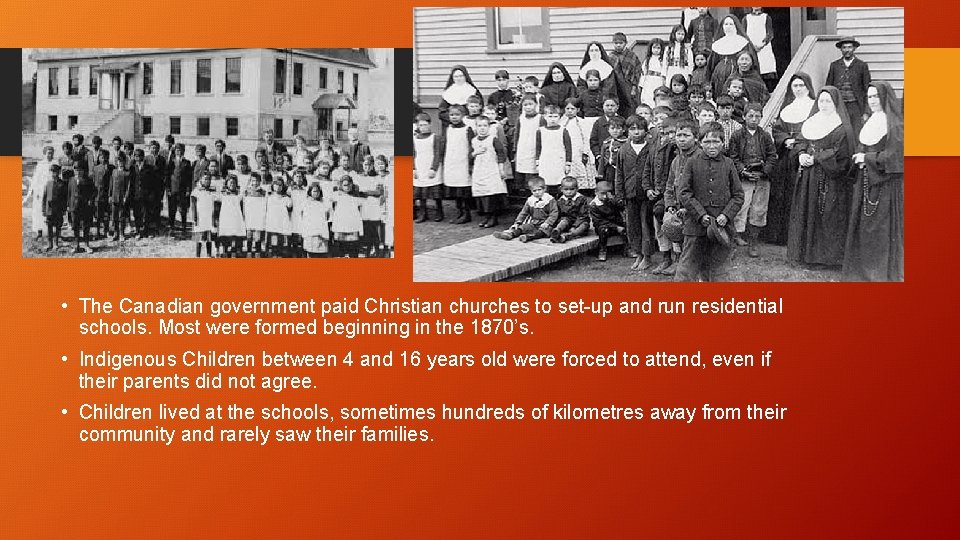
• The Canadian government paid Christian churches to set-up and run residential schools. Most were formed beginning in the 1870’s. • Indigenous Children between 4 and 16 years old were forced to attend, even if their parents did not agree. • Children lived at the schools, sometimes hundreds of kilometres away from their community and rarely saw their families.
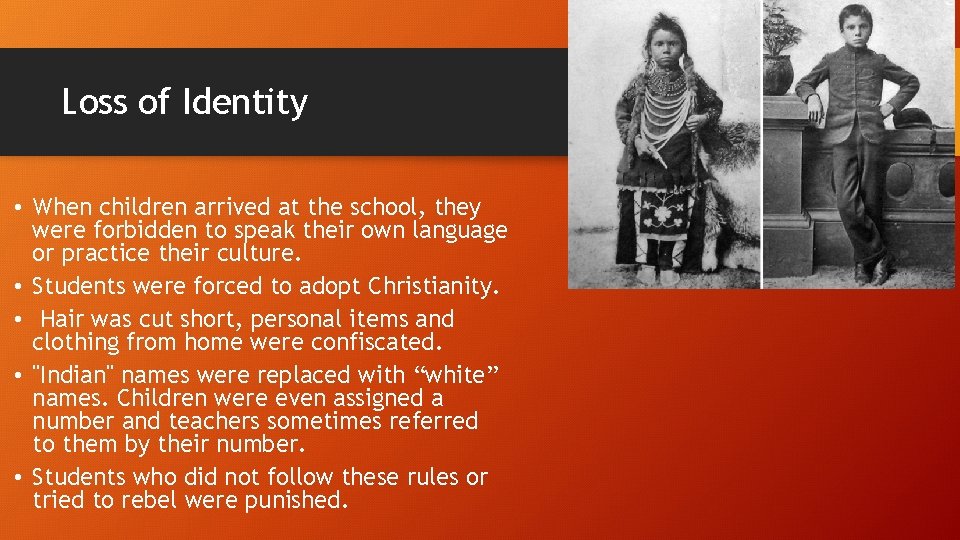
Loss of Identity • When children arrived at the school, they were forbidden to speak their own language or practice their culture. • Students were forced to adopt Christianity. • Hair was cut short, personal items and clothing from home were confiscated. • "Indian" names were replaced with “white” names. Children were even assigned a number and teachers sometimes referred to them by their number. • Students who did not follow these rules or tried to rebel were punished.
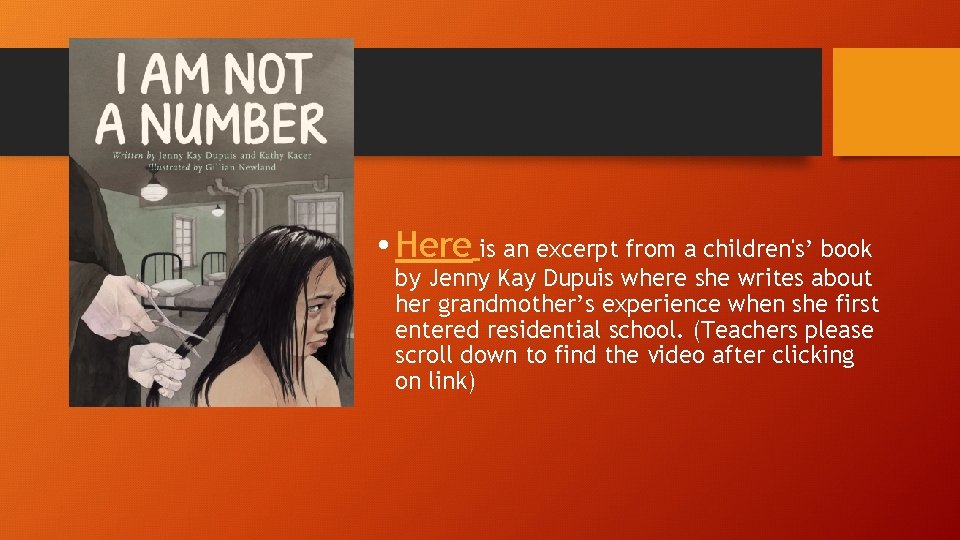
• Here is an excerpt from a children's’ book by Jenny Kay Dupuis where she writes about her grandmother’s experience when she first entered residential school. (Teachers please scroll down to find the video after clicking on link)
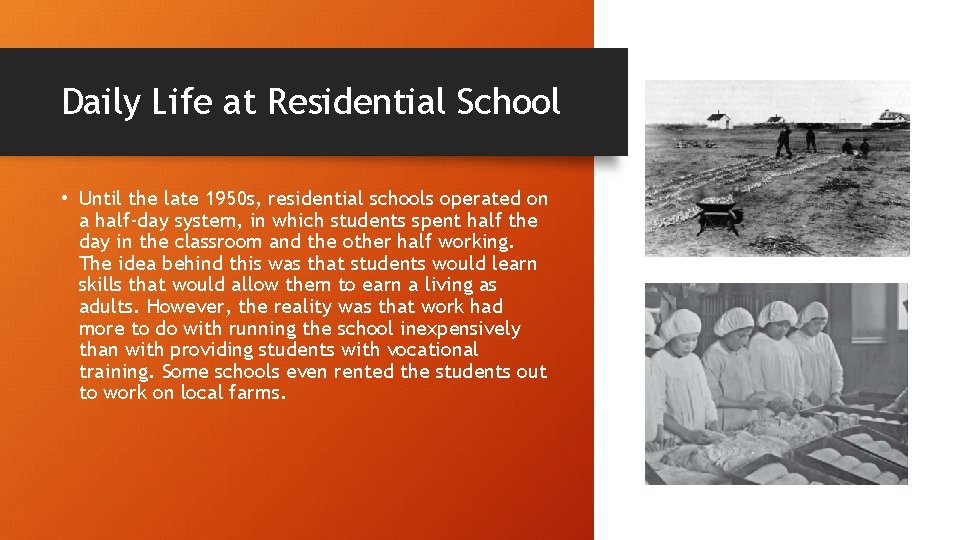
Daily Life at Residential School • Until the late 1950 s, residential schools operated on a half-day system, in which students spent half the day in the classroom and the other half working. The idea behind this was that students would learn skills that would allow them to earn a living as adults. However, the reality was that work had more to do with running the school inexpensively than with providing students with vocational training. Some schools even rented the students out to work on local farms.
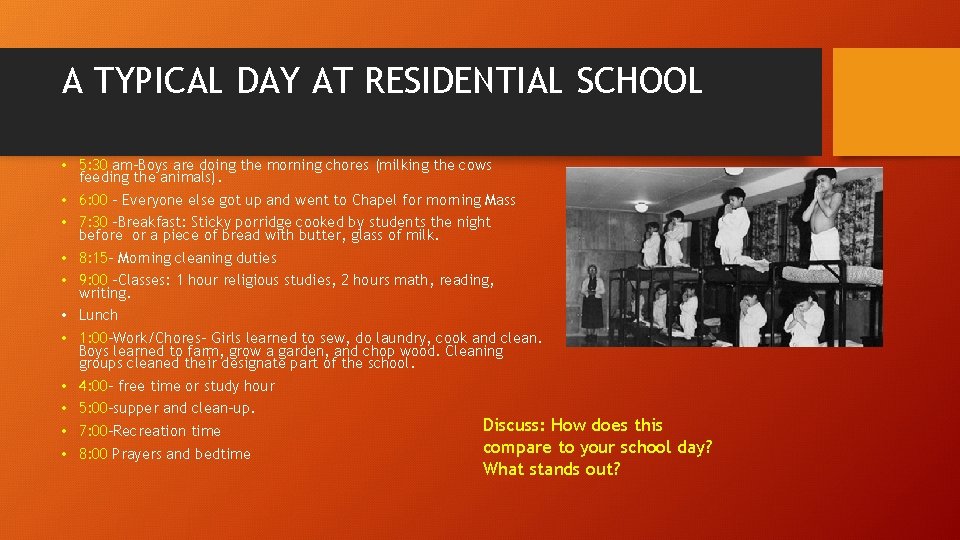
A TYPICAL DAY AT RESIDENTIAL SCHOOL • 5: 30 am-Boys are doing the morning chores (milking the cows feeding the animals). • 6: 00 - Everyone else got up and went to Chapel for morning Mass • 7: 30 -Breakfast: Sticky porridge cooked by students the night before or a piece of bread with butter, glass of milk. • 8: 15 - Morning cleaning duties • 9: 00 -Classes: 1 hour religious studies, 2 hours math, reading, writing. • Lunch • 1: 00 -Work/Chores- Girls learned to sew, do laundry, cook and clean. Boys learned to farm, grow a garden, and chop wood. Cleaning groups cleaned their designate part of the school. • 4: 00 - free time or study hour • 5: 00 -supper and clean-up. Discuss: How does this • 7: 00 -Recreation time compare to your school day? • 8: 00 Prayers and bedtime What stands out?
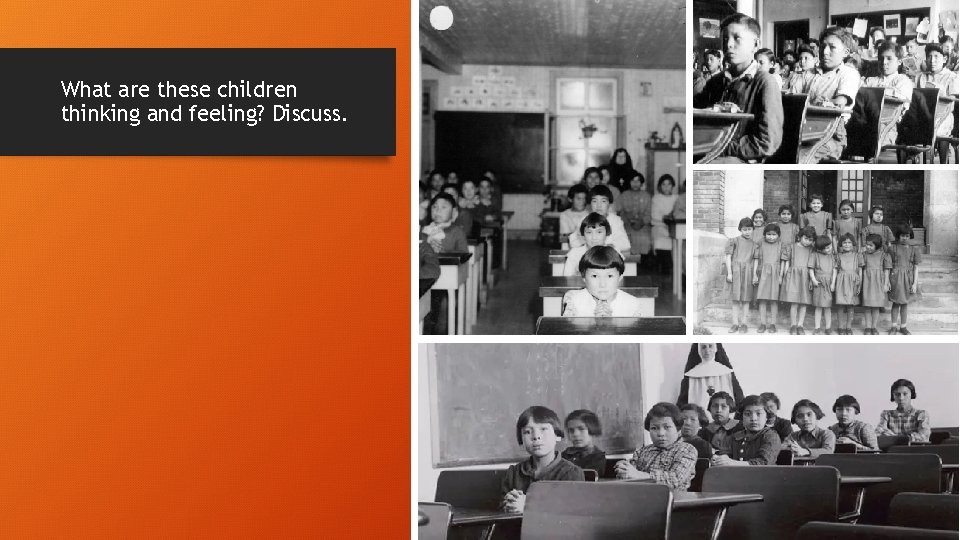
What are these children thinking and feeling? Discuss.
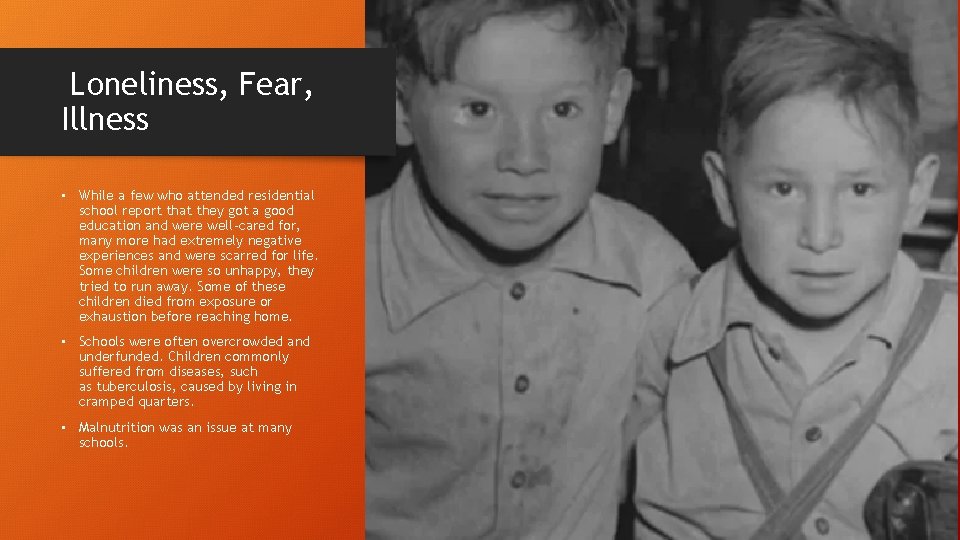
Loneliness, Fear, Illness • While a few who attended residential school report that they got a good education and were well-cared for, many more had extremely negative experiences and were scarred for life. Some children were so unhappy, they tried to run away. Some of these children died from exposure or exhaustion before reaching home. • Schools were often overcrowded and underfunded. Children commonly suffered from diseases, such as tuberculosis, caused by living in cramped quarters. • Malnutrition was an issue at many schools.
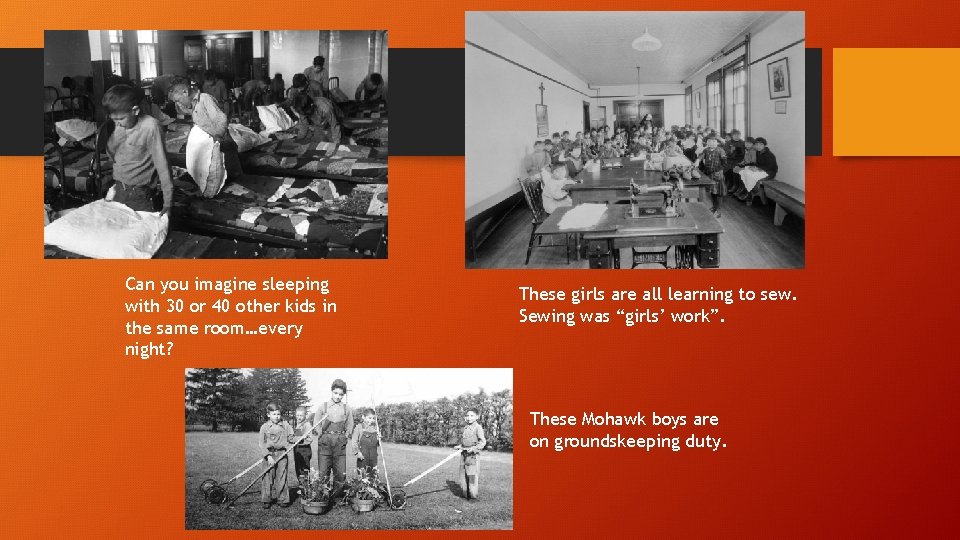
Can you imagine sleeping with 30 or 40 other kids in the same room…every night? These girls are all learning to sew. Sewing was “girls’ work”. These Mohawk boys are on groundskeeping duty.
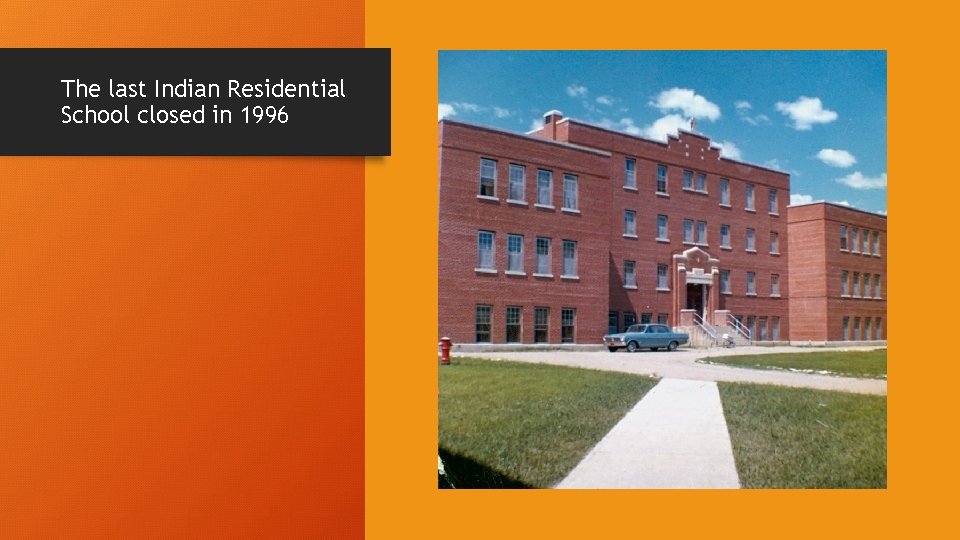
The last Indian Residential School closed in 1996
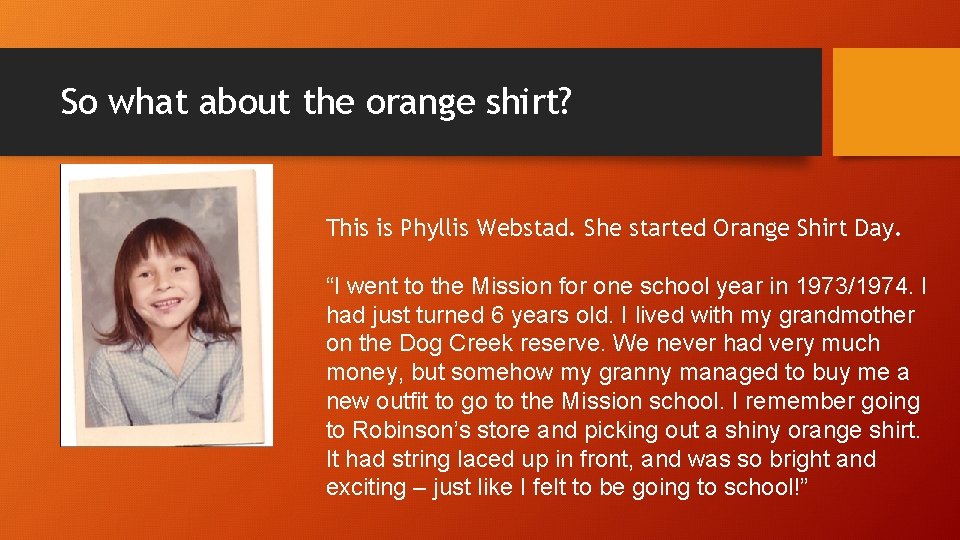
So what about the orange shirt? This is Phyllis Webstad. She started Orange Shirt Day. “I went to the Mission for one school year in 1973/1974. I had just turned 6 years old. I lived with my grandmother on the Dog Creek reserve. We never had very much money, but somehow my granny managed to buy me a new outfit to go to the Mission school. I remember going to Robinson’s store and picking out a shiny orange shirt. It had string laced up in front, and was so bright and exciting – just like I felt to be going to school!”
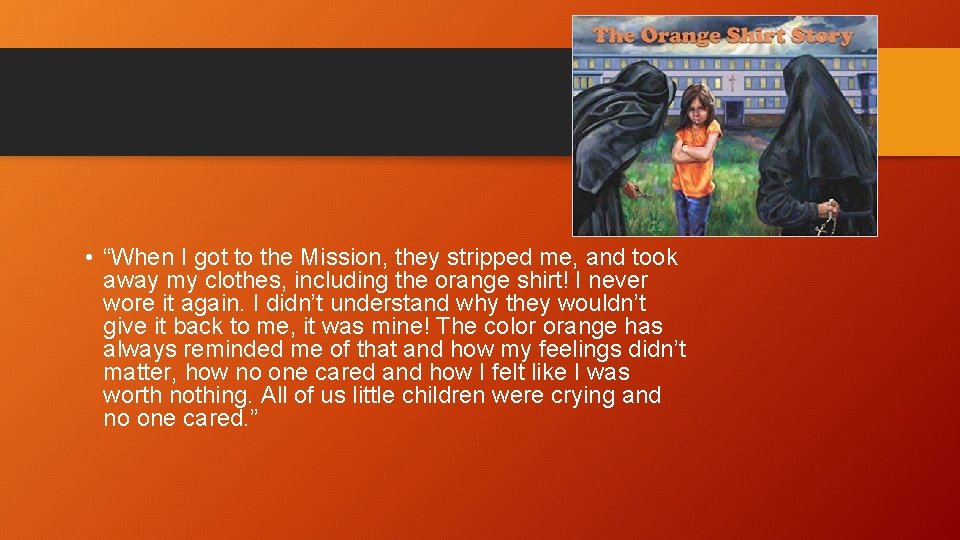
• “When I got to the Mission, they stripped me, and took away my clothes, including the orange shirt! I never wore it again. I didn’t understand why they wouldn’t give it back to me, it was mine! The color orange has always reminded me of that and how my feelings didn’t matter, how no one cared and how I felt like I was worth nothing. All of us little children were crying and no one cared. ”
Why September 30 th? • This date was chosen because this was the time of year that the “Indian Agent” went around to Indigenous communities rounding up children and bringing them to the residential schools. • On Monday, please try to find an orange shirt to wear. This will help to show that we care about what happened to Phyllis and the 150, 000 other children who attended residential schools in Canada. • Phyllis Speaks (video)
- Slides: 15