
Orange Fruit Processing Luis CisnerosZevallos Ph D Department


- Slides: 31
Orange Fruit Processing Luis Cisneros-Zevallos, Ph. D. Department of Horticultural Sciences Texas A&M University
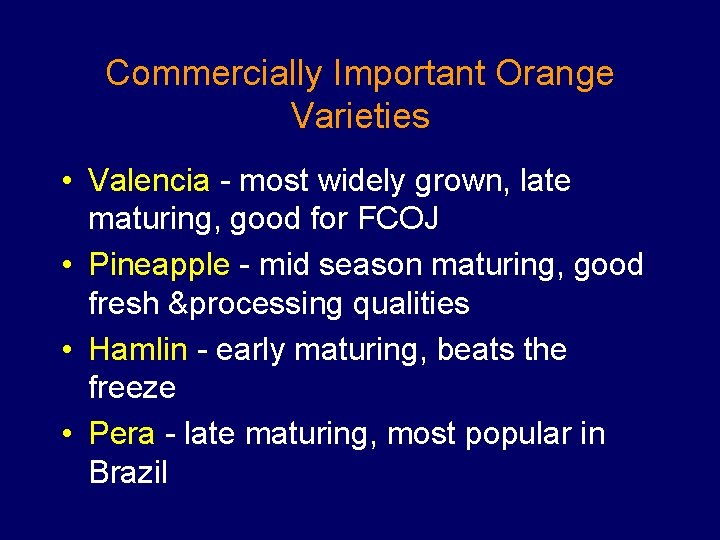
Commercially Important Orange Varieties • Valencia - most widely grown, late maturing, good for FCOJ • Pineapple - mid season maturing, good fresh &processing qualities • Hamlin - early maturing, beats the freeze • Pera - late maturing, most popular in Brazil
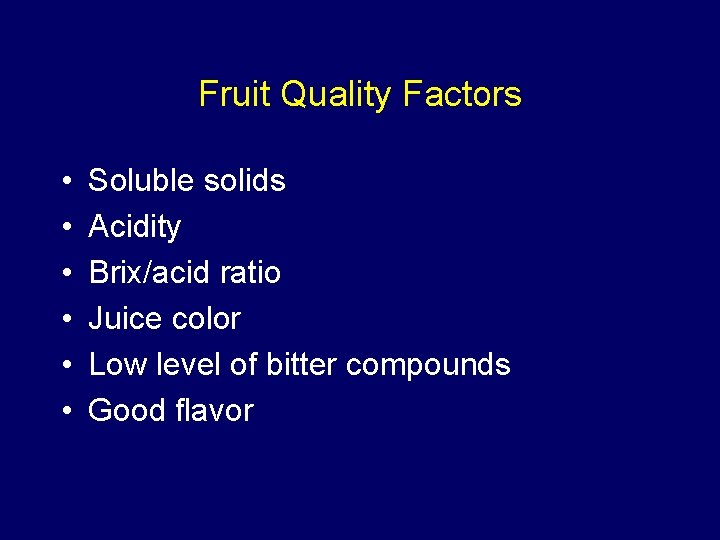
Fruit Quality Factors • • • Soluble solids Acidity Brix/acid ratio Juice color Low level of bitter compounds Good flavor
Juice Categories • • Fresh unpasteurized FCOJ Chilled orange juice Canned orange juice
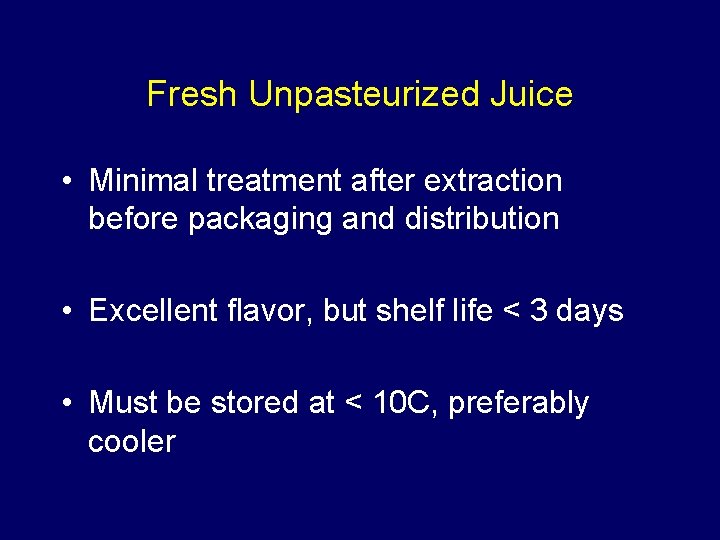
Fresh Unpasteurized Juice • Minimal treatment after extraction before packaging and distribution • Excellent flavor, but shelf life < 3 days • Must be stored at < 10 C, preferably cooler
Preparation for Processing Washing Sorting Fresh Processed Fungicide/wax Extractor
Frozen Concentrated Orange Juice (FCOJ) • Developed 1940’s • Initial product had poor flavor & color • Development of high vacuum, low temperature evaporator improved quality • Concentrate was added to a small quantity of fresh “cut back” juice to restore flavor & aroma lost during concentration
Frozen Concentrated Orange Juice (FCOJ) • Original low temperature evaporators have been replaced by: A) multi-effect, multi-stage, high temperature, short time evaporators B) thermally accelerated short time evaporators (TASTE) • Volatile aroma & flavors compounds are collected (aqueous essence or essence oil)
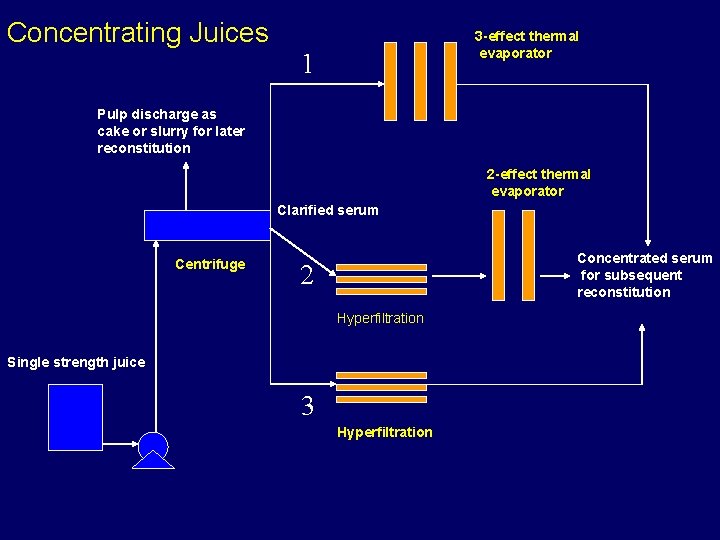
Concentrating Juices 3 -effect thermal evaporator 1 Pulp discharge as cake or slurry for later reconstitution 2 -effect thermal evaporator Clarified serum Centrifuge Concentrated serum for subsequent reconstitution 2 Hyperfiltration Single strength juice 3 Hyperfiltration
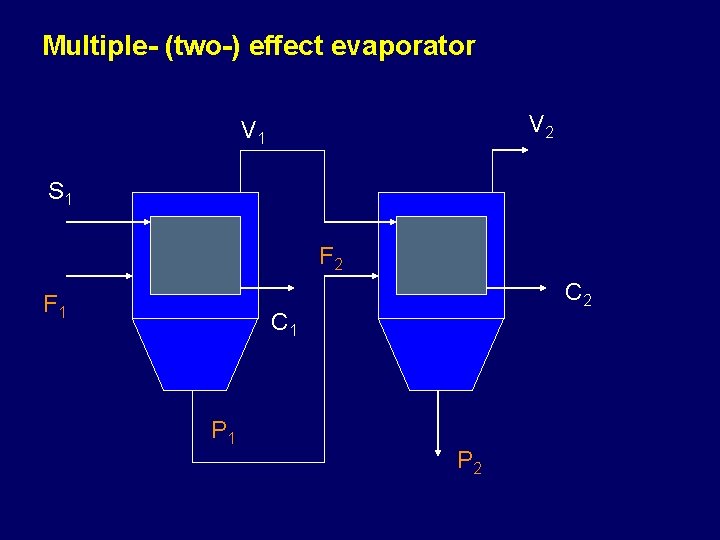
Multiple- (two-) effect evaporator V 2 V 1 S 1 F 2 F 1 C 2 C 1 P 2
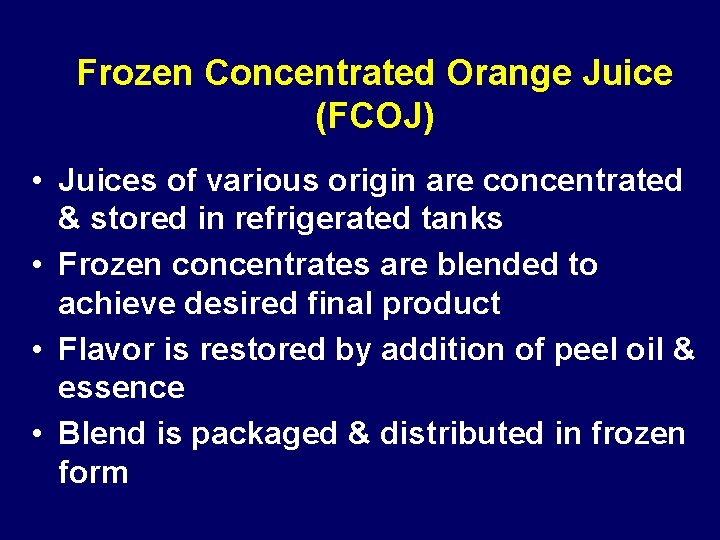
Frozen Concentrated Orange Juice (FCOJ) • Juices of various origin are concentrated & stored in refrigerated tanks • Frozen concentrates are blended to achieve desired final product • Flavor is restored by addition of peel oil & essence • Blend is packaged & distributed in frozen form
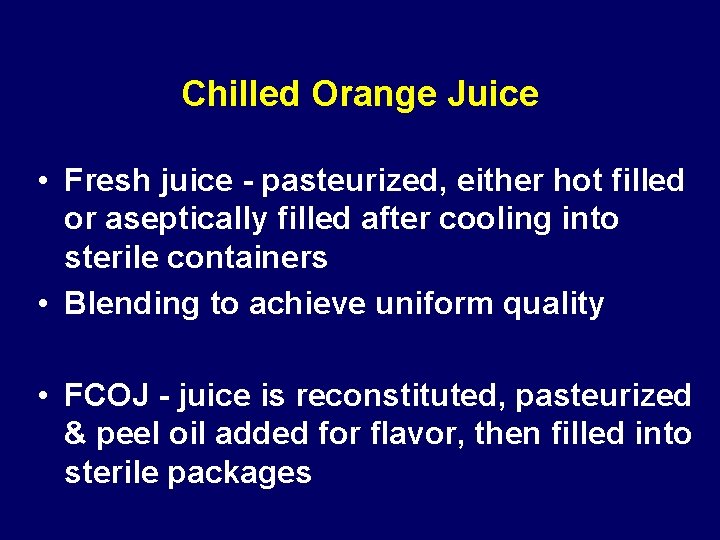
Chilled Orange Juice • Fresh juice - pasteurized, either hot filled or aseptically filled after cooling into sterile containers • Blending to achieve uniform quality • FCOJ - juice is reconstituted, pasteurized & peel oil added for flavor, then filled into sterile packages
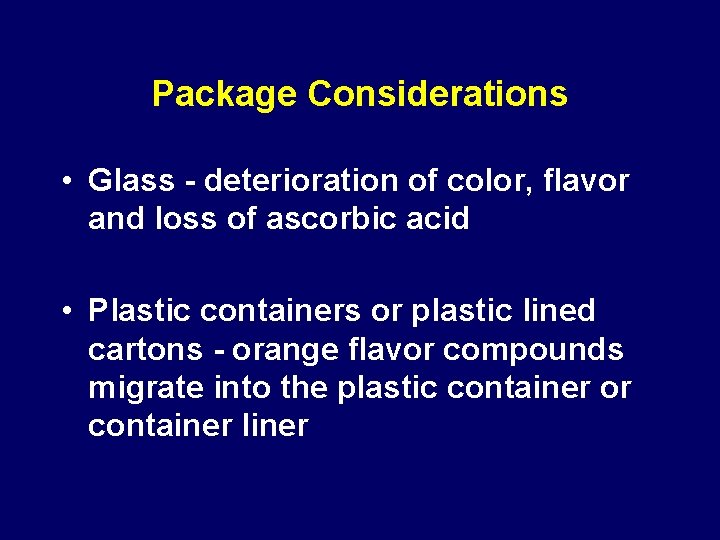
Package Considerations • Glass - deterioration of color, flavor and loss of ascorbic acid • Plastic containers or plastic lined cartons - orange flavor compounds migrate into the plastic container or container liner
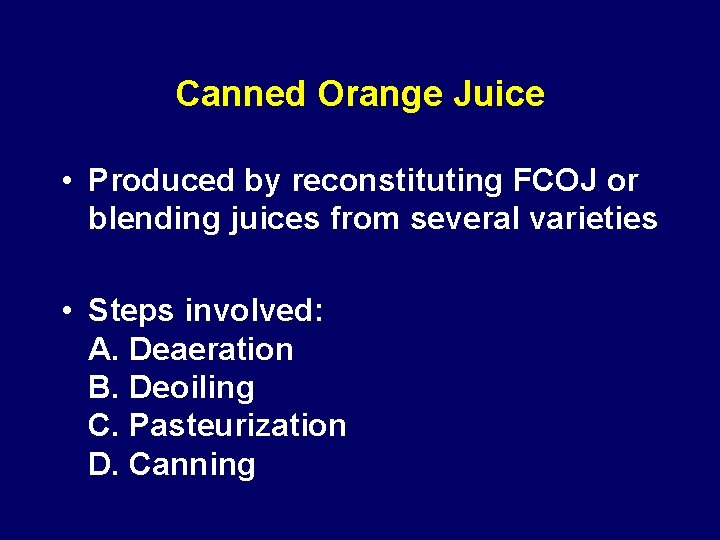
Canned Orange Juice • Produced by reconstituting FCOJ or blending juices from several varieties • Steps involved: A. Deaeration B. Deoiling C. Pasteurization D. Canning
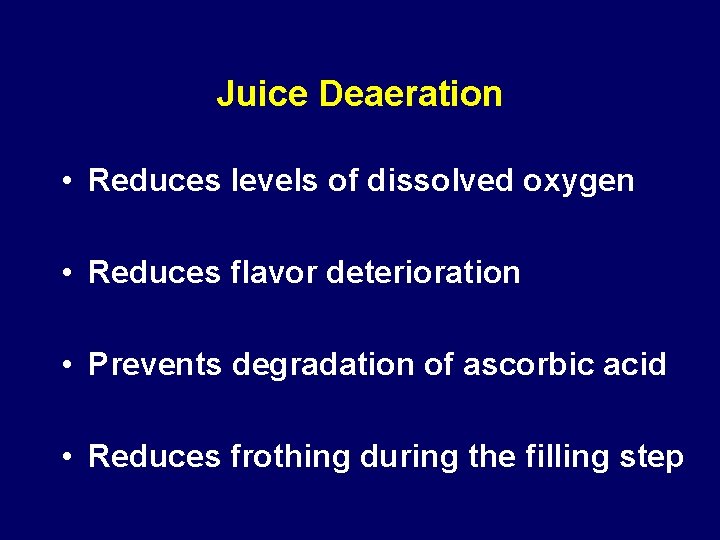
Juice Deaeration • Reduces levels of dissolved oxygen • Reduces flavor deterioration • Prevents degradation of ascorbic acid • Reduces frothing during the filling step
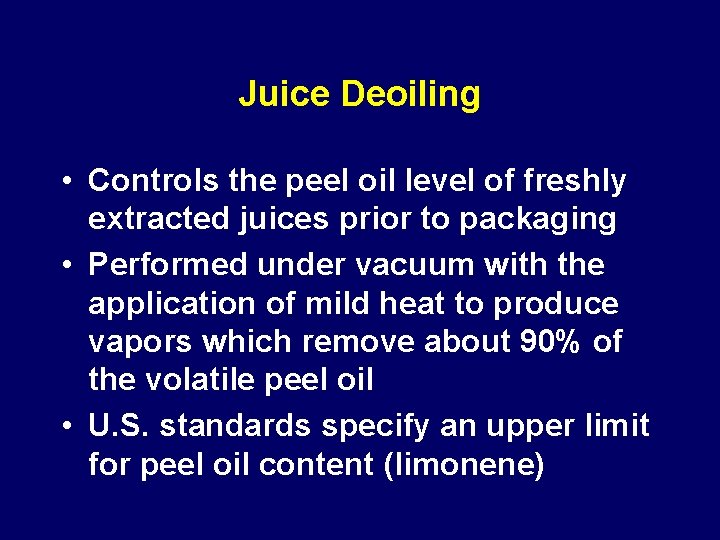
Juice Deoiling • Controls the peel oil level of freshly extracted juices prior to packaging • Performed under vacuum with the application of mild heat to produce vapors which remove about 90% of the volatile peel oil • U. S. standards specify an upper limit for peel oil content (limonene)
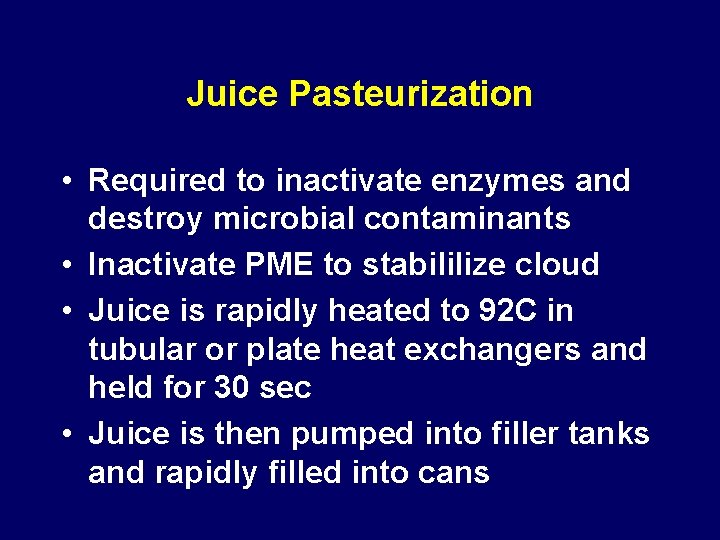
Juice Pasteurization • Required to inactivate enzymes and destroy microbial contaminants • Inactivate PME to stabililize cloud • Juice is rapidly heated to 92 C in tubular or plate heat exchangers and held for 30 sec • Juice is then pumped into filler tanks and rapidly filled into cans
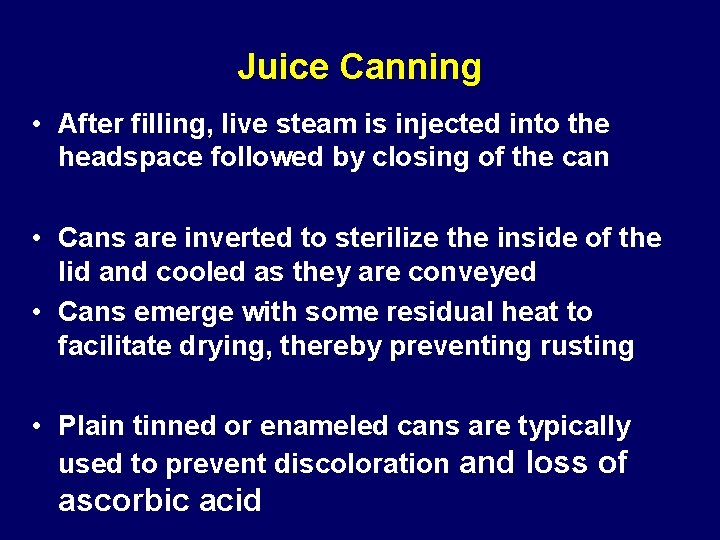
Juice Canning • After filling, live steam is injected into the headspace followed by closing of the can • Cans are inverted to sterilize the inside of the lid and cooled as they are conveyed • Cans emerge with some residual heat to facilitate drying, thereby preventing rusting • Plain tinned or enameled cans are typically used to prevent discoloration and loss of ascorbic acid
Processing By-Products • Orange flavor volatiles - aqueous essence, used for flavoring purposes • Orange peel oils - cold pressed oil, used for flavoring purposes • Water extracted soluble solids (WESOS) or pulp wash - used for beverages • Waste products - animal feed, flavonoids, pectin
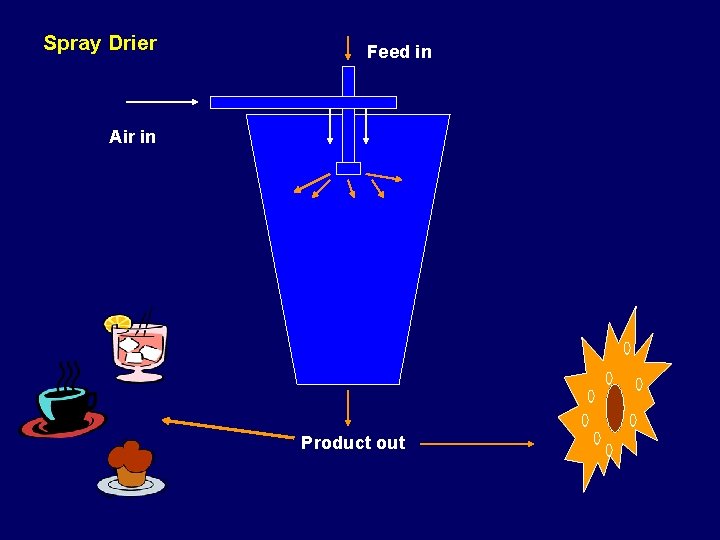
Spray Drier Feed in Air in Product out
Fruit Sections • Manual sections - Cold peel method where the peel & outer membrane is sliced off manually with a knife, or hot peel method where the peel is subjected to steam scalding or hot water immersion • Sections are separated with knife from the peeled fruit, followed by packing into containers in juice or light syrup
Syrup for Refrigerated Grapefruit Sections • 12 - 15 Brix • Citric acid (0. 5 - 1%) • Potassium sorbate and sodium benzoate (0. 1% each) • 30 day shelf life when stored at < 40 F
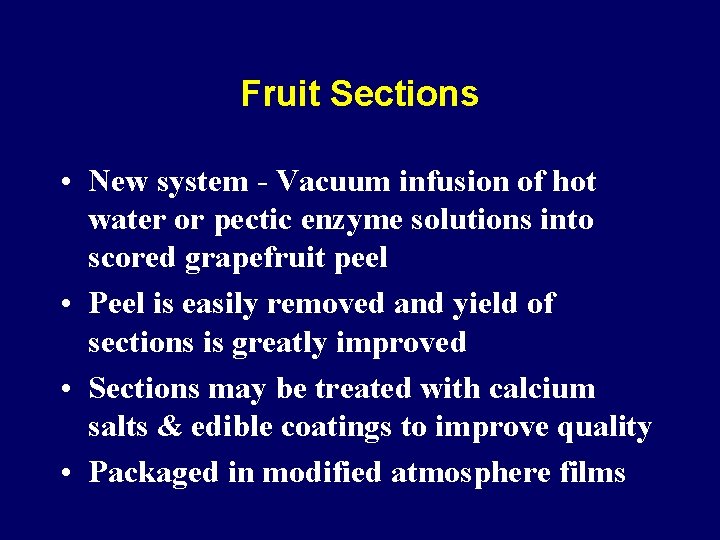
Fruit Sections • New system - Vacuum infusion of hot water or pectic enzyme solutions into scored grapefruit peel • Peel is easily removed and yield of sections is greatly improved • Sections may be treated with calcium salts & edible coatings to improve quality • Packaged in modified atmosphere films
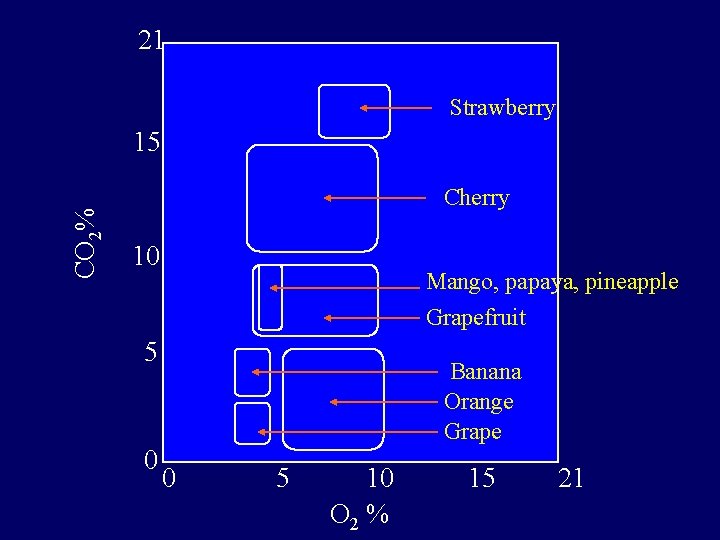
21 Strawberry CO 2% 15 Cherry 10 Mango, papaya, pineapple Grapefruit 5 0 Banana Orange Grape 0 5 10 O 2 % 15 21
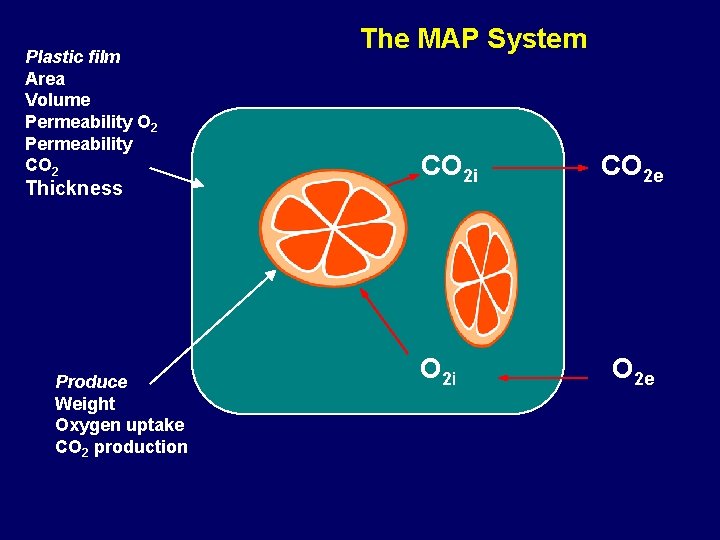
Plastic film Area Volume Permeability O 2 Permeability CO 2 Thickness Produce Weight Oxygen uptake CO 2 production The MAP System CO 2 i CO 2 e
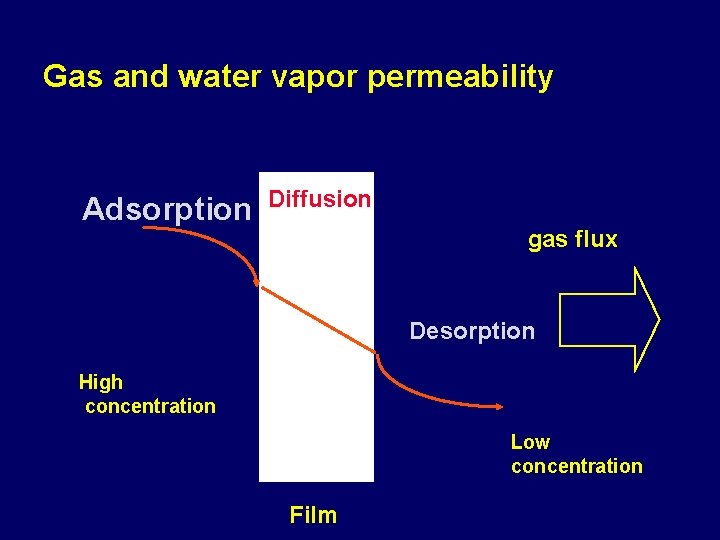
Gas and water vapor permeability Adsorption Diffusion gas flux Desorption High concentration Low concentration Film
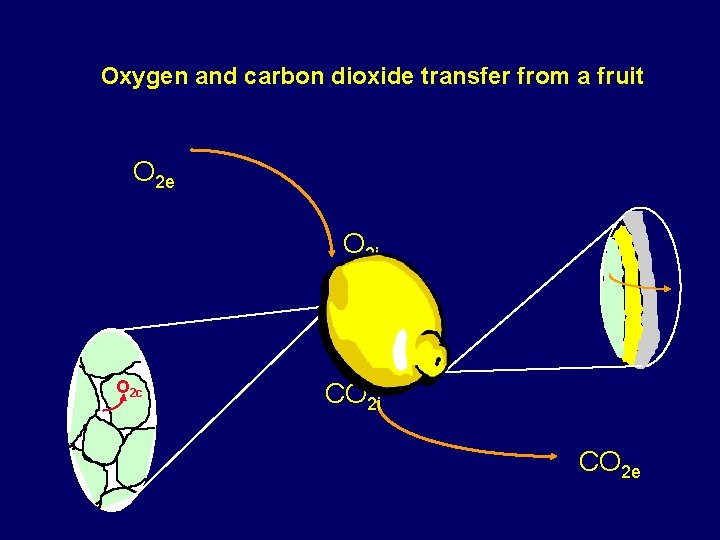
Oxygen and carbon dioxide transfer from a fruit O 2 e O 2 i O 2 c CO 2 i CO 2 e
Post-harvest Handling • The objective: To extend the shelf life of fresh horticultural commodities. • We must understand the biological and environmental factors involved in deterioration. • Use Post-harvest technology procedures which will delay senescence and maintain the best possible quality
Post-harvest Handling (Some benefits) • Standardize/Increase benefits: By sorting, sizing, washing. • Extend shelf-life: Temperature, relative humidity, gas composition, light, physical damage. • Provide added value: Fresh-cut, packaging
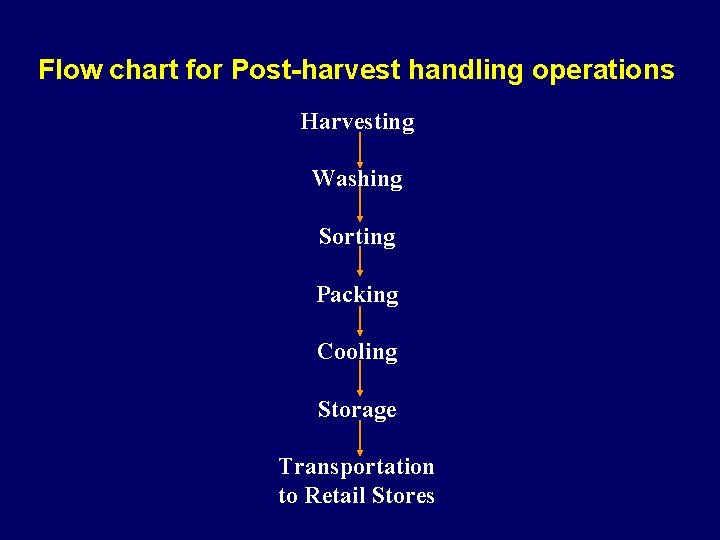
Flow chart for Post-harvest handling operations Harvesting Washing Sorting Packing Cooling Storage Transportation to Retail Stores
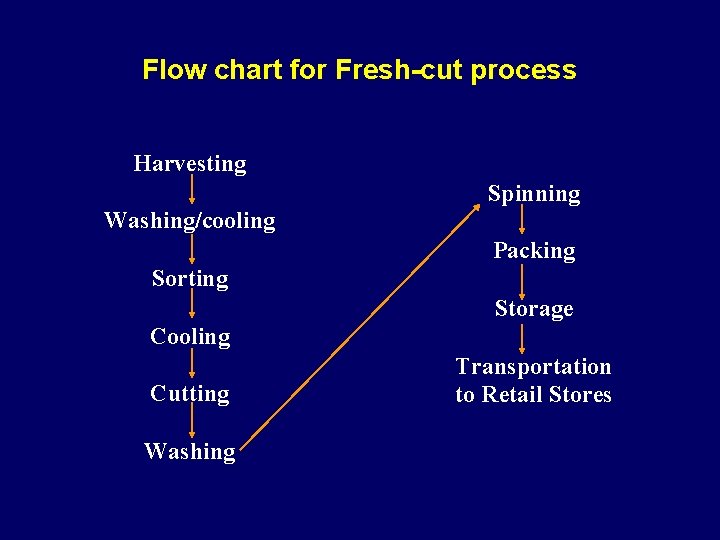
Flow chart for Fresh-cut process Harvesting Spinning Washing/cooling Packing Sorting Storage Cooling Cutting Washing Transportation to Retail Stores