
Orange Class Curriculum Overview 2018 2019 MEET THE
- Slides: 1
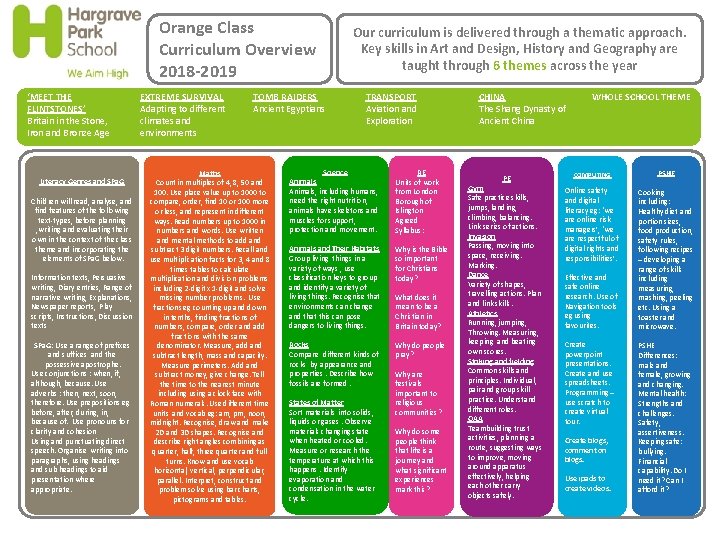
Orange Class Curriculum Overview 2018 -2019 ‘MEET THE FLINTSTONES’ Britain in the Stone, Iron and Bronze Age Literacy Genres and SPa. G Children will read, analyse, and find features of the following text-types, before planning , writing and evaluating their own in the context of the class theme and incorporating the elements of SPa. G below. Information texts, Persuasive writing, Diary entries, Range of narrative writing, Explanations, Newspaper reports, Play scripts, Instructions, Discussion texts SPa. G: Use a range of prefixes and suffixes and the possessive apostrophe. Use conjunctions : when, if, although, because. Use adverbs : then, next, soon, therefore. Use prepositions eg before, after, during, in, because of. Use pronouns for clarity and cohesion Using and punctuating direct speech. Organise writing into paragraphs, using headings and sub headings to aid presentation where appropriate. EXTREME SURVIVAL Adapting to different climates and environments TOMB RAIDERS Ancient Egyptians Maths Count in multiples of 4, 8, 50 and 100. Use place value up to 1000 to compare, order, find 10 or 100 more or less, and represent in different ways. Read numbers up to 1000 in numbers and words. Use written and mental methods to add and subtract 3 digit numbers. Recall and use multiplication facts for 3, 4 and 8 times tables to calculate multiplication and division problems including 2 -digit x 1 -digit and solve missing number problems. Use fractions eg counting up and down in tenths, finding fractions of numbers, compare, order and add fractions with the same denominator. Measure, add and subtract length, mass and capacity. Measure perimeters. Add and subtract money, give change. Tell the time to the nearest minute including using a clock face with Roman numerals. Use different time units and vocab eg: am, pm, noon, midnight. Recognise, draw and make 2 D and 3 D shapes. Recognise and describe right angles combining as quarter, half, three quarter and full turns. Know and use vocab horizontal, vertical, perpendicular, parallel. Interpret, construct and problem solve using bar charts, pictograms and tables. Our curriculum is delivered through a thematic approach. Key skills in Art and Design, History and Geography are taught through 6 themes across the year TRANSPORT Aviation and Exploration Science Animals, including humans, need the right nutrition, animals have skeletons and muscles for support, protection and movement. RE Units of work from London Borough of Islington Agreed Syllabus: Animals and Their Habitats Group living things in a variety of ways , use classification keys to group and identify a variety of living things. Recognise that environments can change and that this can pose dangers to living things. Why is the Bible so important for Christians today? Rocks Compare different kinds of rocks by appearance and properties. Describe how fossils are formed. Why do people pray? States of Matter Sort materials into solids, liquids or gases. Observe materials changing state when heated or cooled. Measure or research the temperature at which this happens. Identify evaporation and condensation in the water cycle. What does it mean to be a Christian in Britain today? Why are festivals important to religious communities? Why do some people think that life is a journey and what significant experiences mark this? CHINA The Shang Dynasty of Ancient China PE Gym Safe practice skills, jumps, landing, climbing, balancing. Link series of actions. Invasion Passing, moving into space, receiving. Marking. Dance Variety of shapes, travelling actions. Plan and link skills. Athletics Running, jumping, Throwing. Measuring, keeping and beating own scores. Striking and fielding Common skills and principles. Individual, pair and group skill practice. Understand different roles. OAA Teambuilding trust activities, planning a route, suggesting ways to improve, moving around apparatus effectively, helping each other carry objects safely. WHOLE SCHOOL THEME COMPUTING PSHE Online safety and digital literacy eg: ‘we are online risk managers’, ‘we are respectful of digital rights and responsibilities’. Cooking including: Healthy diet and portion sizes, food production, safety rules, following recipes – developing a range of skills including measuring, mashing, peeling etc. Using a toaster and microwave. Effective and safe online research. Use of Navigation tools eg using favourites. Create powerpoint presentations. Create and use spreadsheets. Programming – use scratch to create virtual tour. Create blogs, comment on blogs. Use ipads to create videos. PSHE Differences: male and female, growing and changing. Mental health: Strengths and challenges. Safety, assertiveness. Keeping safe: bullying. Financial capability. Do I need it? Can I afford it?