
Oral Motor Exam Adapted from presentation by Elise
Oral Motor Exam Adapted from presentation by Elise Peltier, MS CCC-SLP and Jeanine Geisler, MS CCC-SLP
What is an Oral Motor Exam • Determine the structural and functional adequacy of the oral mechanisms • A variety of medical professionals may complete dentists, doctors and speech language pathologists.
Alternative terminology • Oral Motor Exam • Oral Peripheral Exam • Oral Mechanism Exam (Oral Mech) • Speech Mechanism
Why do an Oral Motor Exam ? • Stroke ( CVA) • Feeding and Swallowing • Articulation Disorder • Motor Speech Disorder • Dysarthria • Apraxia
Tools • Gloves • Tongue Depressor • Pen Light • Small hand held mirror • Watch ( stop watch) or clock
What structures do we look at ? • Face • Lips • Teeth • Tongue • Jaw ( mandible) • Hard/Soft Palate • Cheeks
How do we illicit desired results • Adult clients • Give direct verbal instructions • Model
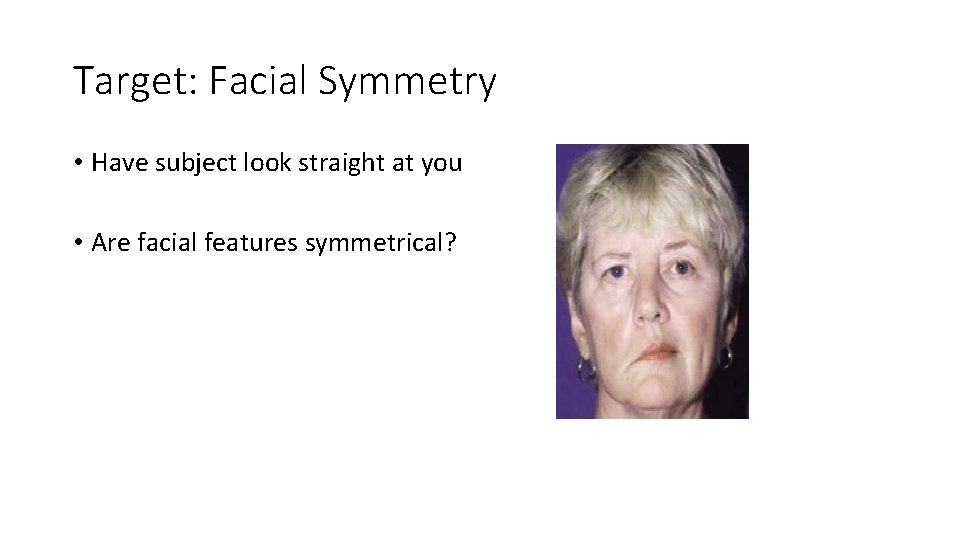
Target: Facial Symmetry • Have subject look straight at you • Are facial features symmetrical?
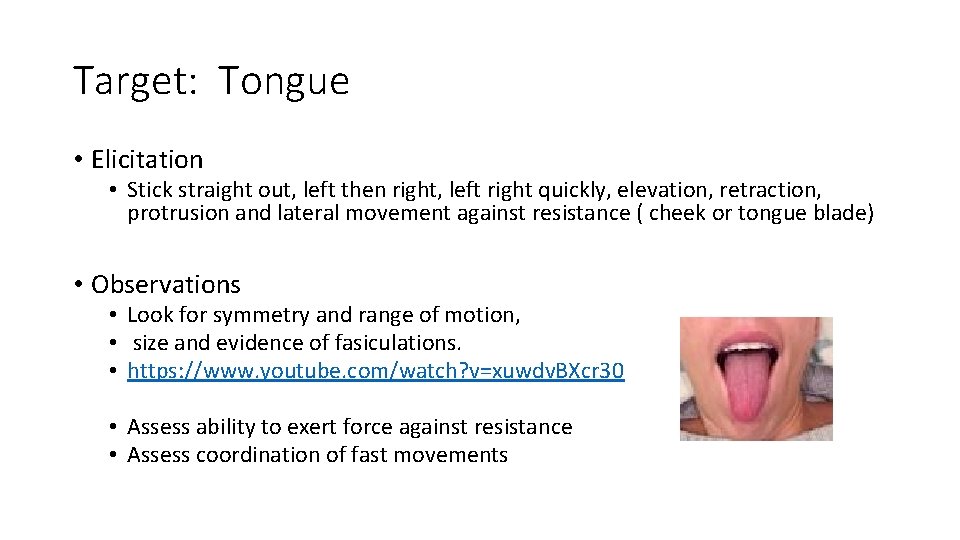
Target: Tongue • Elicitation • Stick straight out, left then right, left right quickly, elevation, retraction, protrusion and lateral movement against resistance ( cheek or tongue blade) • Observations • Look for symmetry and range of motion, • size and evidence of fasiculations. • https: //www. youtube. com/watch? v=xuwdv. BXcr 30 • Assess ability to exert force against resistance • Assess coordination of fast movements
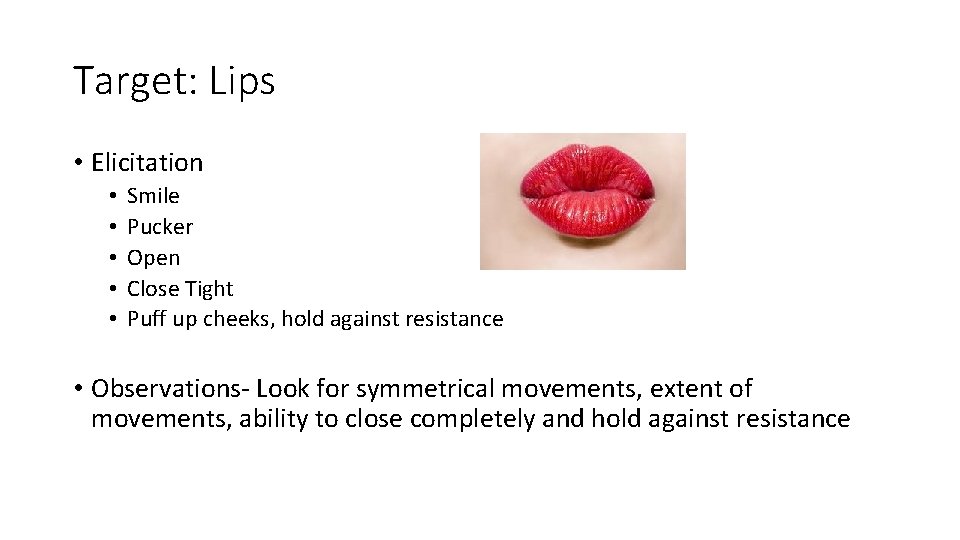
Target: Lips • Elicitation • • • Smile Pucker Open Close Tight Puff up cheeks, hold against resistance • Observations- Look for symmetrical movements, extent of movements, ability to close completely and hold against resistance
Target: Oral Cavity and Velum • Elicitation • Open Wide • Say “ah” or “E-E-E-” • Observation • Look at conditions of teeth, any dentures or partials? • Watch for extent and symmetry of velar elevation and pharyngeal constriction
Target: Voice/Airway Protection • Elicitation • • Maximum phonation duration S: Z ratio, pitch glides Volitional cough and Throat clearing • Observations • Listen for intensity, pitch and quality • Listen for breathy, horas/harsh, strained, wet/gurgly • Listen for hyper or hyponasality
Special considerations for adults • Hearing loss or auditory comprehension - check for hearing aids, write instructions, model • Adults with Apraxia • Blow a kiss, smile • Give a spoon or straw
Assessing for Apraxia of Speech • Diadochokinetic Rate - Repeat “papa” - Repeat “tata” - Repeat “kakaka” • Alternate Motion Rate - Repeat “pataka” • Nonspeech tasks (assess for oral apraxia)
How can we describe/ measure • We can describe muscle and function and movement using STARRS • • • MUSCLE STRENGTH MUSCLE TONE ACCURACY OF MOVEMENT RANGE OF MOVEMENT SPEED OF MOVEMENT STEADINESS OF MOVEMENT
STARRS Characteristics • One way to describe muscle function and movement • Rating Scale from 0 -4 with • • • 0 indicating normal function 1 mild impairment ( ~25% or less impaired) 2 moderate ( ~50% or more is impaired ) 3 severe (~ 75% or more is impaired) 4 indicating profound deficits ( unable to perform)
Muscle Strength • Descriptive terms: weakness, asymmetry, atrophy • Potential causes- Bell’s Palsy, facial Palsy, lower motor neuron lesion, upper motor neuron lesion, tumor, TBI, Stroke CVA
Muscle Tone • Look for Hypotonic • Example- Tongue or lips may appear thickened and have little or no movement • Common causes- Cerebral Palsy, Down Syndrome • Hypertonic • Increased activity and resistance • Common causes Bells palsy, facial palsy symptoms
Accuracy of movement • Descriptive terms: Uncoordinated or groping • Potential causes : Apraxia- problem assembling the appropriate sequence of movements often results from unilateral left hemisphere lesion ( Darley, Aronson, and Brown 1975, 1969)
Range of Movement • Descriptive terms: reduced or decreased • Hypokinesia- decreased body movement Excessive range is not common in neurological disease but decreased range is more common and may occur in the context of slow, normal or excessively rapid rate • Example: Hypokinetic dysarthria- decreased range of motion and sometimes excessive rate ( Duffy 2005)
Speed of Movement • Descriptive terms: Slow • Bradykinesia- slowness of movement • Potential causes; neuroanatomical area or system involvement ( upper motor neuron system, lower motor neuron system, cerebellum, extrapyramidal system or combination • Dysarthria – a group of speech disorders resulting in weakness, slowness, incoordination due to damage central or peripheral nervous system or both • Term dysarthria encompasses coexisting neurogenic disorders of several or all of the basic processes of speech: respiration, phonation, resonance, articulation and prosody ( Darley, 1969)
Steadiness of Movement • Tremor- unintentional, rhythmic muscle movement involving to and fro movements • Neurological causes include Multiple Sclerosis, stroke, traumatic brain injury, or some medications or alcohol use or withdrawal • fasciculations- involuntary muscle contraction and relaxation which may be visible under the skin • Causes -lower motor neuron lesions • ALS- • Spasms ( lingual dystonia) involuntary muscle contractions • Possible causes Cerebral Palsy, MS, nerve damage from a stroke

- Slides: 23