
Oracy in the Foundation Phase classroom Nicola Hambridge
Oracy in the Foundation Phase classroom. Nicola Hambridge and Kate Roberts Ysgol Penmorfa - Prestatyn
Us and our school Assistant Head Teacher with responsibility for Foundation Phase Both teaching year 2 Large (455 pupils) school on the coast in Prestatyn Two form entry, Nursery to Year 6 Mixed catchment with pockets of deprivation. In a Flying Start area, providing Flying Start childcare in our onsite preschool On entry baseline assessments are consistently below county average LLC outcomes 2015 -2016: 87% Outcome 5 + 35% Outcome 6 FSM 27. 5% 25. 5% ALN Green school. Estyn 2014. Key questions 1, 2 and 3 -good. ‘Care, support and guidance’ and ‘Leadership’ -excellent. Integrated Foundation Phase days, Nursery to Year 2
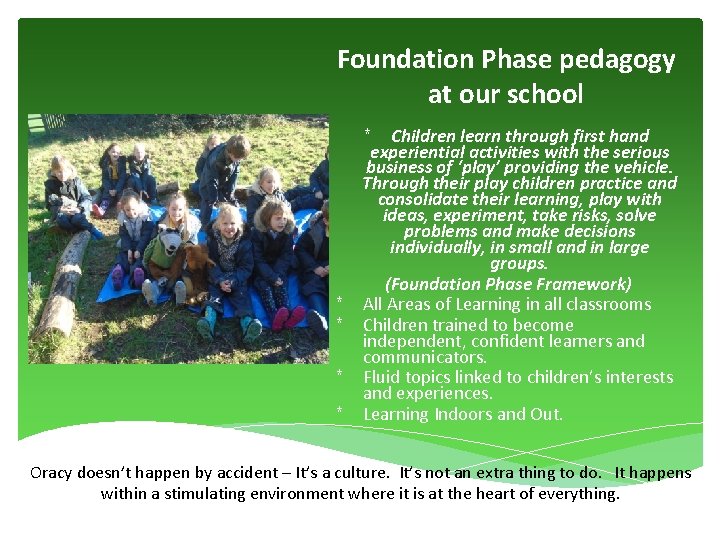
Foundation Phase pedagogy at our school * * * Children learn through first hand experiential activities with the serious business of ‘play’ providing the vehicle. Through their play children practice and consolidate their learning, play with ideas, experiment, take risks, solve problems and make decisions individually, in small and in large groups. (Foundation Phase Framework) All Areas of Learning in all classrooms Children trained to become independent, confident learners and communicators. Fluid topics linked to children’s interests and experiences. Learning Indoors and Out. Oracy doesn’t happen by accident – It’s a culture. It’s not an extra thing to do. It happens within a stimulating environment where it is at the heart of everything.
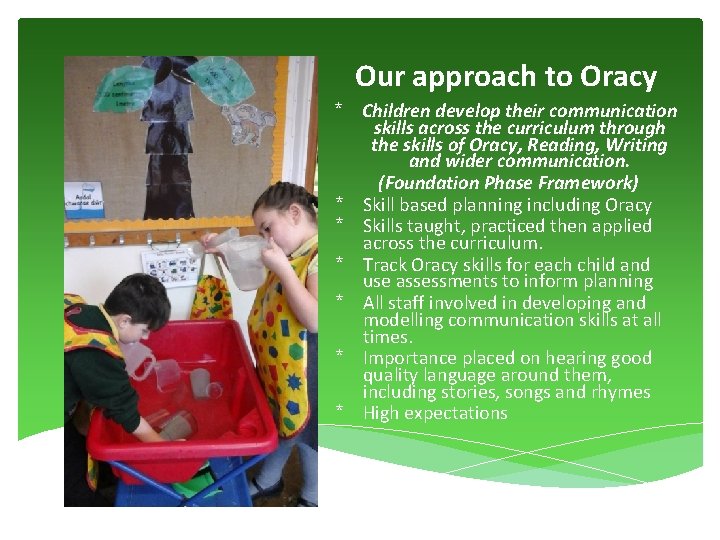
Our approach to Oracy * Children develop their communication skills across the curriculum through the skills of Oracy, Reading, Writing and wider communication. (Foundation Phase Framework) * Skill based planning including Oracy * Skills taught, practiced then applied across the curriculum. * Track Oracy skills for each child and use assessments to inform planning * All staff involved in developing and modelling communication skills at all times. * Importance placed on hearing good quality language around them, including stories, songs and rhymes * High expectations
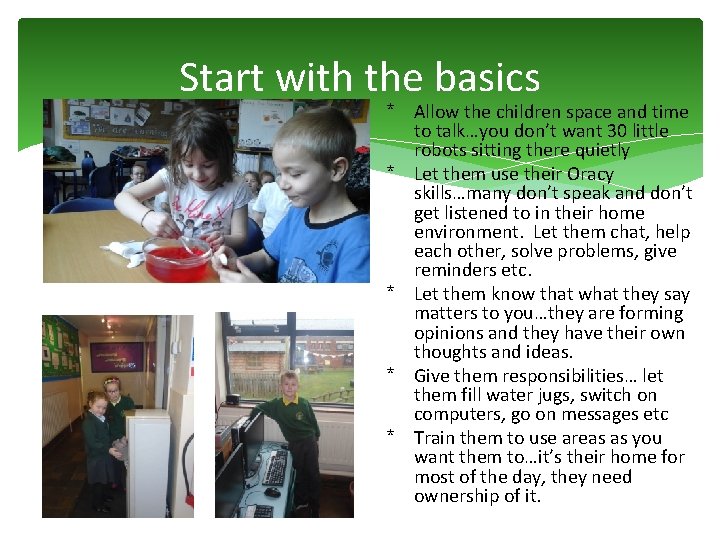
Start with the basics * Allow the children space and time to talk…you don’t want 30 little robots sitting there quietly * Let them use their Oracy skills…many don’t speak and don’t get listened to in their home environment. Let them chat, help each other, solve problems, give reminders etc. * Let them know that what they say matters to you…they are forming opinions and they have their own thoughts and ideas. * Give them responsibilities… let them fill water jugs, switch on computers, go on messages etc * Train them to use areas as you want them to…it’s their home for most of the day, they need ownership of it.
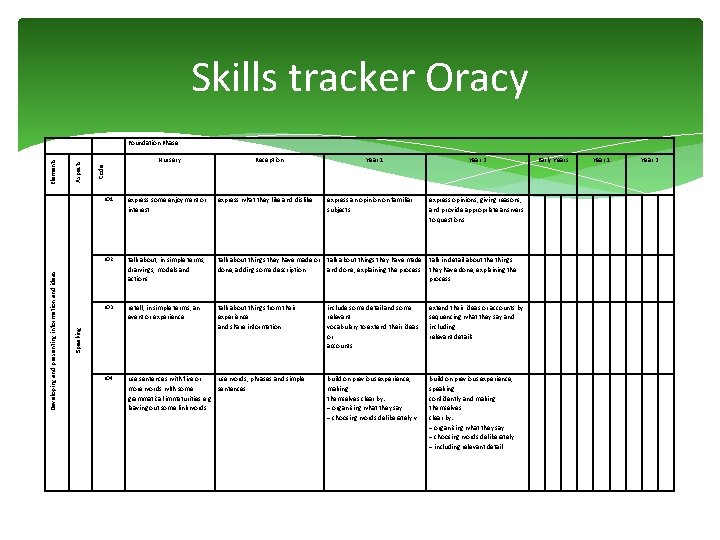
Skills tracker Oracy Foundation Phase Nursery Reception Year 1 Year 2 Early Years Year 1 Year 2 Code Aspects LO 1 express some enjoyment or interest express what they like and dislike LO 2 talk about, in simple terms, drawings, models and actions LO 3 retell, in simple terms, an event or experience LO 4 use sentences with five or use words, phrases and simple more words with some sentences grammatical immaturities e. g. leaving out some link words Speaking Developing and presenting information and ideas. Elements talk about things they have made or talk about things they have made talk in detail about the things done, adding some description and done, explaining the process they have done, explaining the process talk about things from their experience and share information express an opinion on familiar subjects express opinions, giving reasons, and provide appropriate answers to questions include some detail and some relevant vocabulary to extend their ideas or accounts by sequencing what they say and including relevant details build on previous experience, making themselves clear by: – organising what they say – choosing words deliberately v build on previous experience, speaking confidently and making themselves clear by: – organising what they say – choosing words deliberately – including relevant detail
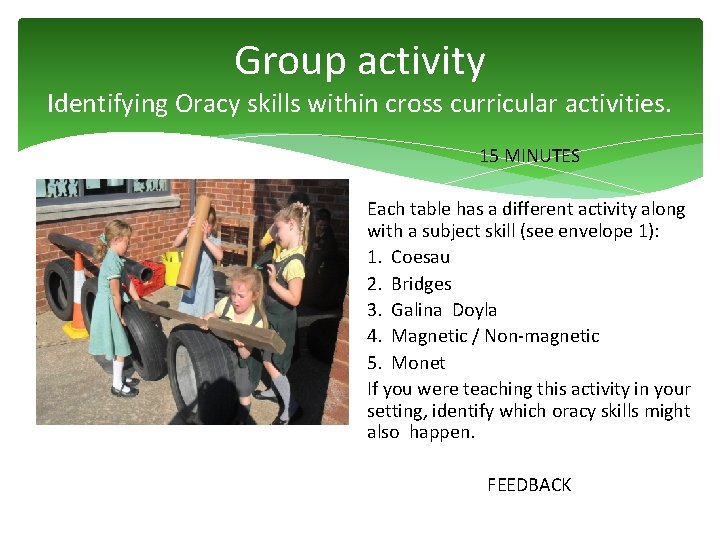
Group activity Identifying Oracy skills within cross curricular activities. 15 MINUTES Each table has a different activity along with a subject skill (see envelope 1): 1. Coesau 2. Bridges 3. Galina Doyla 4. Magnetic / Non-magnetic 5. Monet If you were teaching this activity in your setting, identify which oracy skills might also happen. FEEDBACK
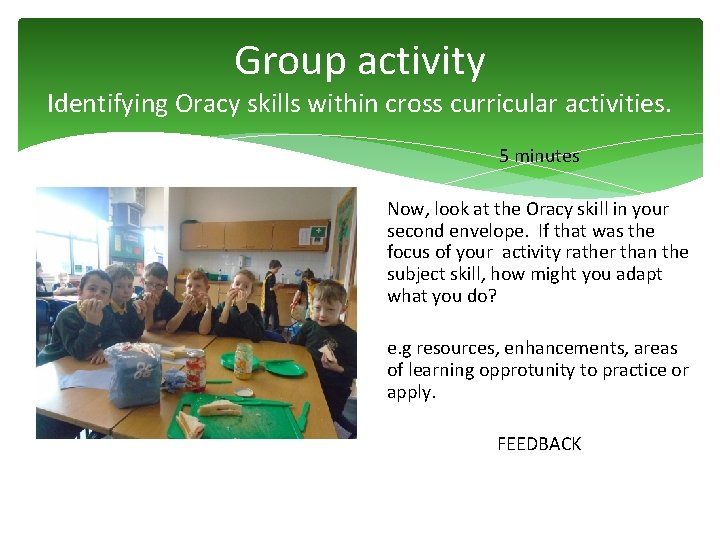
Group activity Identifying Oracy skills within cross curricular activities. 5 minutes Now, look at the Oracy skill in your second envelope. If that was the focus of your activity rather than the subject skill, how might you adapt what you do? e. g resources, enhancements, areas of learning opprotunity to practice or apply. FEEDBACK
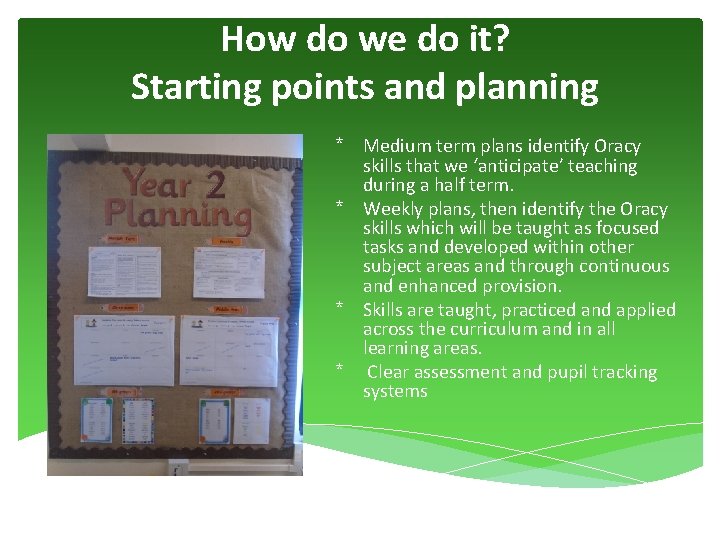
How do we do it? Starting points and planning * Medium term plans identify Oracy skills that we ‘anticipate’ teaching during a half term. * Weekly plans, then identify the Oracy skills which will be taught as focused tasks and developed within other subject areas and through continuous and enhanced provision. * Skills are taught, practiced and applied across the curriculum and in all learning areas. * Clear assessment and pupil tracking systems
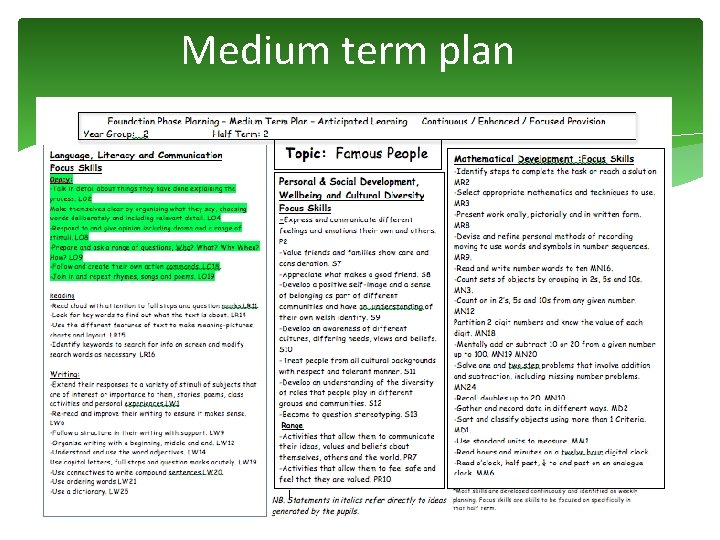
Medium term plan
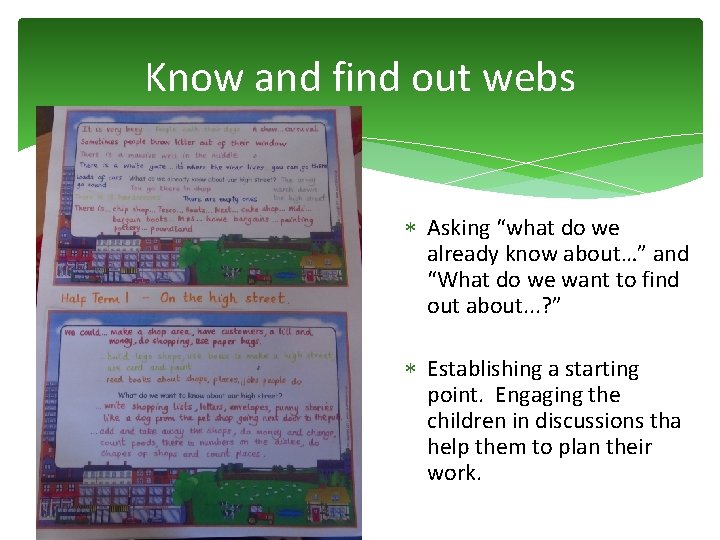
Know and find out webs Asking “what do we already know about…” and “What do we want to find out about. . . ? ” Establishing a starting point. Engaging the children in discussions tha help them to plan their work.
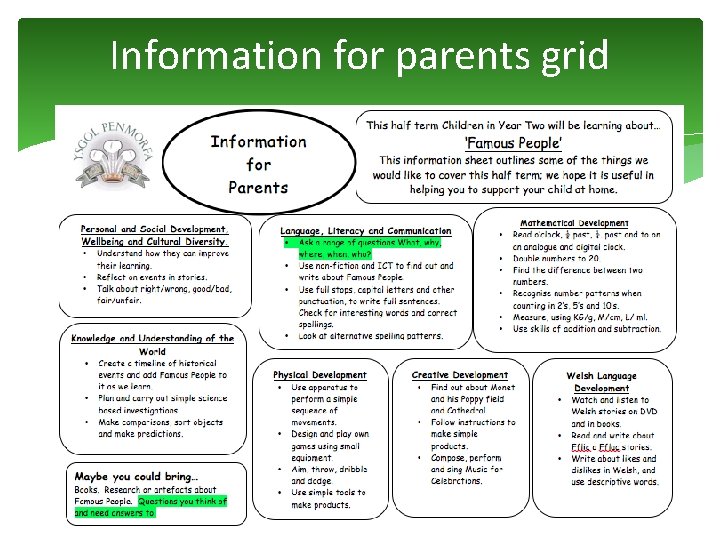
Information for parents grid
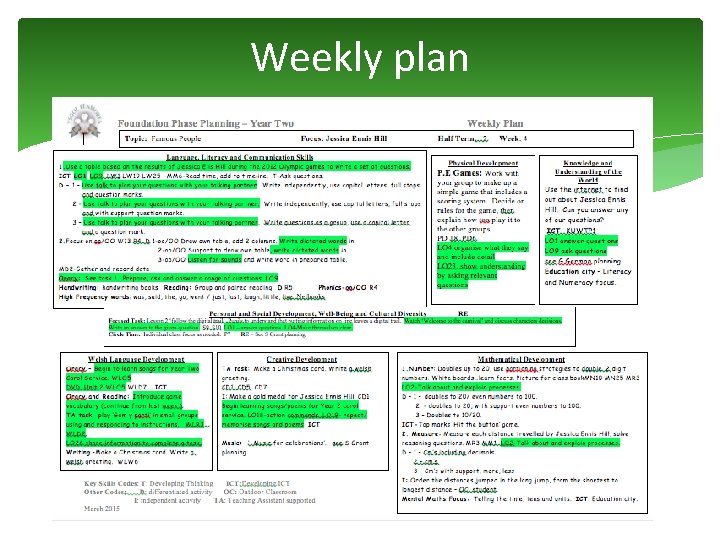
Weekly plan
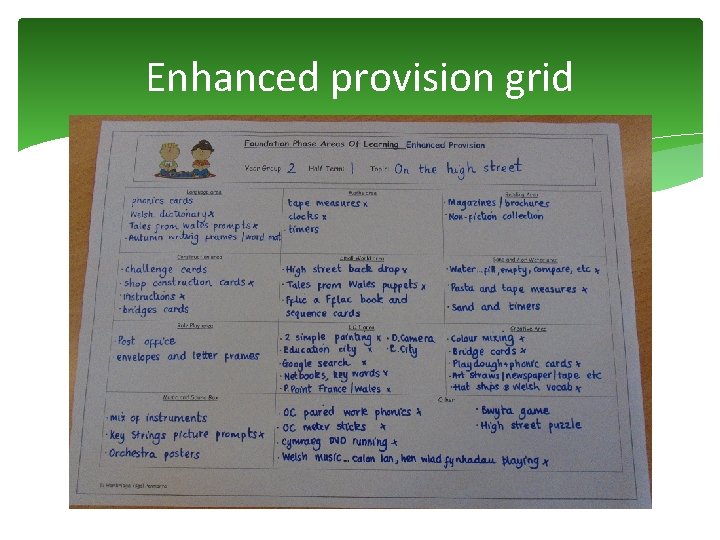
Enhanced provision grid
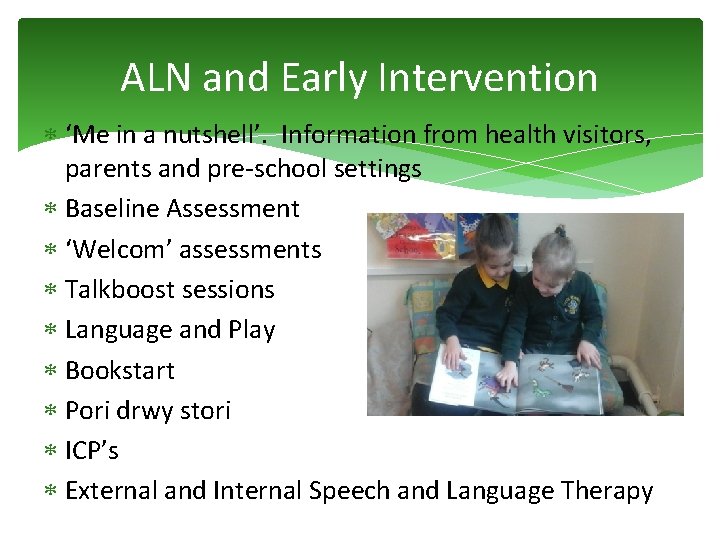
ALN and Early Intervention ‘Me in a nutshell’. Information from health visitors, parents and pre-school settings Baseline Assessment ‘Welcom’ assessments Talkboost sessions Language and Play Bookstart Pori drwy stori ICP’s External and Internal Speech and Language Therapy
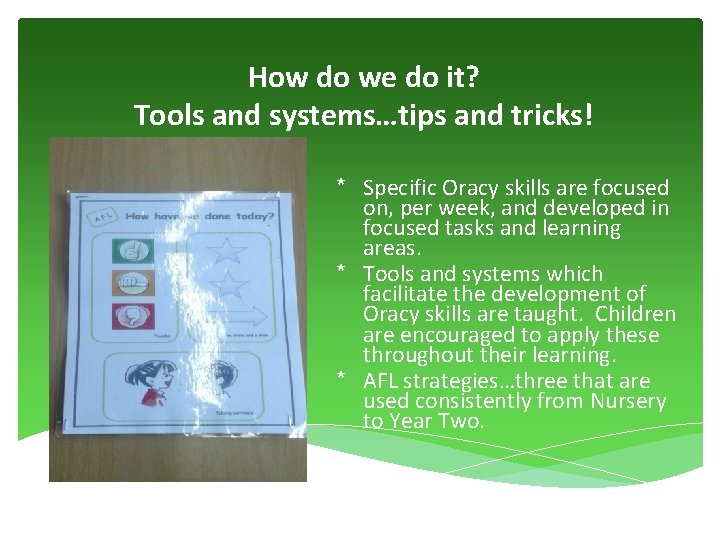
How do we do it? Tools and systems…tips and tricks! * Specific Oracy skills are focused on, per week, and developed in focused tasks and learning areas. * Tools and systems which facilitate the development of Oracy skills are taught. Children are encouraged to apply these throughout their learning. * AFL strategies…three that are used consistently from Nursery to Year Two.
Tools that have worked for us * Real life experiences * ‘What do know’ and ‘What do we want to find out’ opportunities * Information for parents grid * Talking partners * Talking table * Presentations * Galina Doyla – Key to Learning * Story mountains * Speaking to a range of audiences * Planning visits * Planning performances * Interviews * Forest school and Outdoor classroom * Communication friendly spaces – Elizabeth Jarman
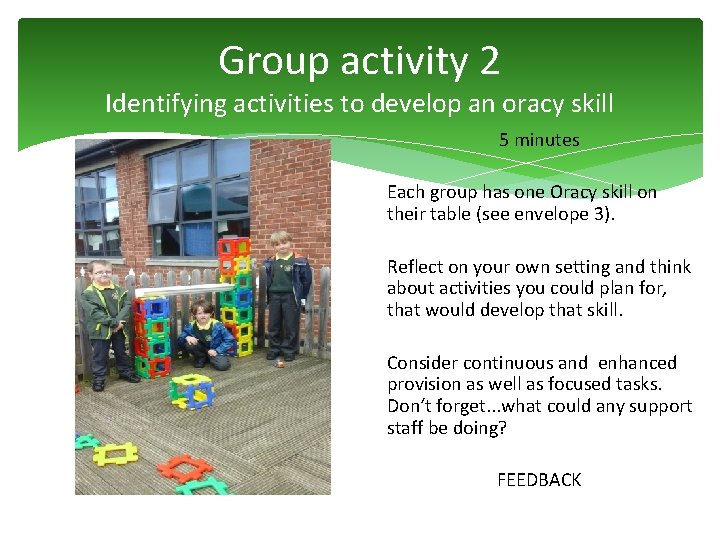
Group activity 2 Identifying activities to develop an oracy skill 5 minutes Each group has one Oracy skill on their table (see envelope 3). Reflect on your own setting and think about activities you could plan for, that would develop that skill. Consider continuous and enhanced provision as well as focused tasks. Don‘t forget. . . what could any support staff be doing? FEEDBACK
Aiming for Outcome 6 – what does it look like? Children begin to modify their talk to the requirements of the audience, varying the use of vocabulary and level of detail. -thinks creatively about questions that they may ask. -uses own ideas and makes links to previous experiences. -uses detailed and descriptive vocabulary. -varies vocabulary and tone used depending on the audience and responses appropriately e. g gives amusing answers. They explore and communicate ideas, showing an awareness of sequence and progression in a range of contexts. -gives clear instructions, recounts stories and information, showing an awareness of the importance of the sequence. -uses writing to plan talk, and can switch from informal notes to a formal speech style Through relevant comments and questions, they show that they have listened carefully. -makes relevant and interesting comments. -asks relevant questions when requiring more detail. –listens to questions asked and is able to expand explain aspects when speaking.
Thank you for listening Any further questions are welcome. . Nicola Hambridge and Kate Roberts Ysgol Penmorfa - Prestatyn
- Slides: 20