
Oracle RAC Overview of Real Application Clustering Features


- Slides: 32
Oracle RAC Overview of Real Application Clustering Features and Functionality
Overview ¢ ¢ ¢ What is RAC? Cache Fusion Failover and Load-balancing Transparent Application Failover (TAF) Other RAC Features
RAC – What is it? ¢ ¢ Multiple instances of Oracle running on up to 8 nodes Multiple instances share a single physical database All instances can simultaneously execute transactions against the single database Caches are synchronized using Oracle’s Global Cache Management technology (Cache Fusion)
History of Oracle RAC ¢ Previous Oracle Clustering Products n n n ¢ ¢ Oracle Fail. Safe on Windows OPS (Oracle Parallel Server) on multiple platforms OPS to RAC: 7. 3 OPS 8 i OPS 9 i RAC 10 g RAC The clustering mechanism used to be more dependent on the Operating System. With 10 g RAC, clustered database is built into Oracle
Oracle RAC Features ¢ ¢ ¢ ¢ ¢ Full Cache Fusion Enhanced coordination of cache management and distributed lock manager (DLM) Lock simplification and automation Global Cache Service coordinates local buffer cache and remote block transfers Enhanced IPC Resource configuration simplification and automation Improved cluster aware tools Enhanced DBCA Oracle Enterprise Manager and Grid Control Integration Enhancements
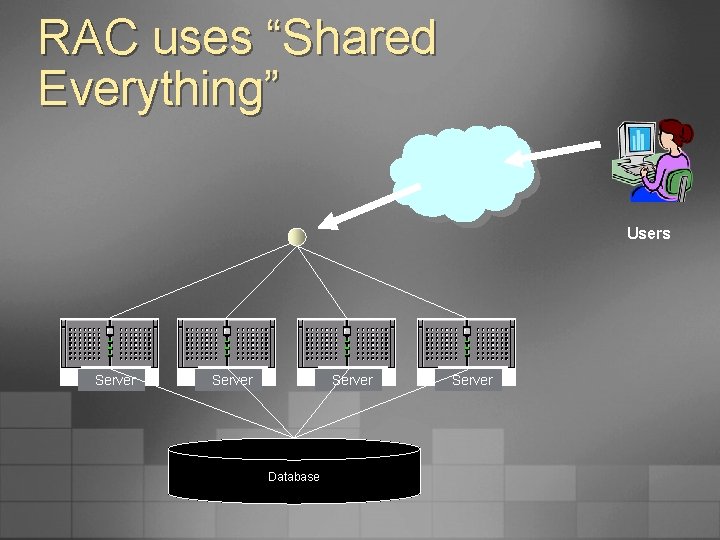
RAC uses “Shared Everything” Users Server Database Server
How RAC clustering is done ¢ ¢ One set of data All nodes in the cluster see the same set of data All nodes have access Any node can update the data
Increased Manageability ¢ One virtual system to configure and manage n n n ¢ ¢ ¢ Single Oracle Database Single management console Single system image for the database integrated with the cluster Cluster-wide monitoring and diagnostics Oracle Enterprise Manager Integration (9 i) Oracle DBConsole and Grid Control Integration (10 g)
What’s shared; What’s not ¢ Shared n n n ¢ Disk access Resources that manage data All instances have common data & controls files Not Shared n Each node has its own dedicated: n n n System memory Operating system Database instance Application software Each instance has individual n n Log files and Rollback segments
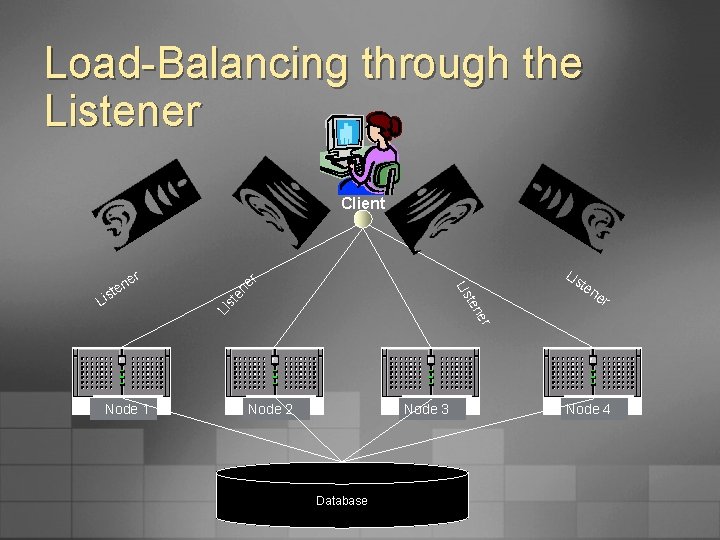
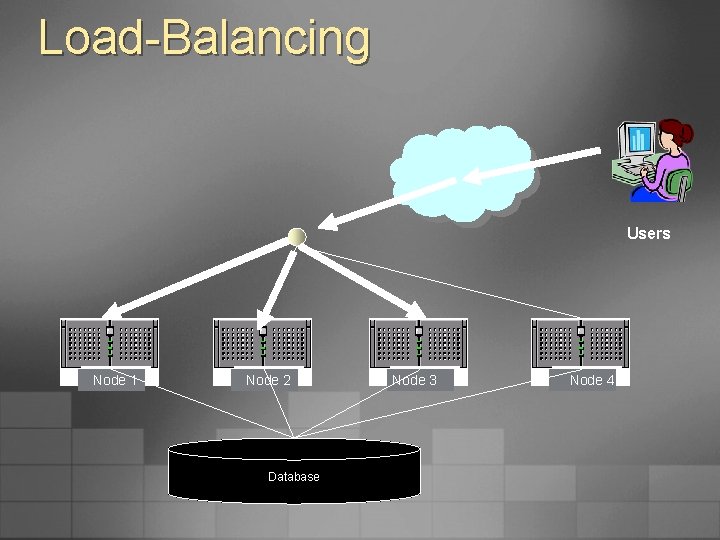
RAC can perform ¢ ¢ Load-balancing Failover
Load-Balancing through the Listener en Lis ten er er ten Li Li st r ne e t s er Client Node 1 Node 2 Node 3 Database Node 4
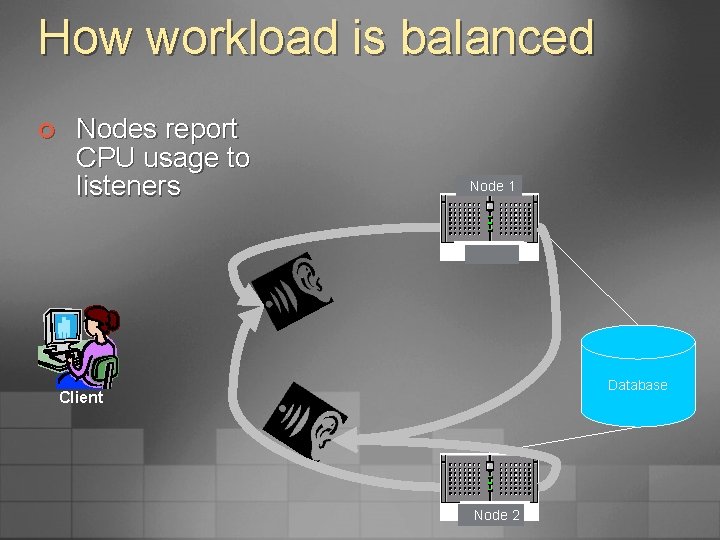
How workload is balanced ¢ Nodes report CPU usage to listeners Node 1 Database Client Node 2
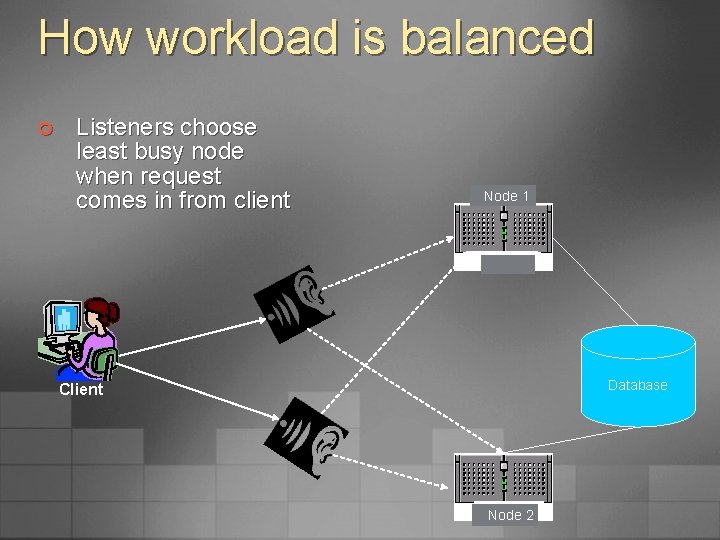
How workload is balanced ¢ Listeners choose least busy node when request comes in from client Node 1 Database Client Node 2
Load-Balancing Users Node 1 Node 2 Database Node 3 Node 4
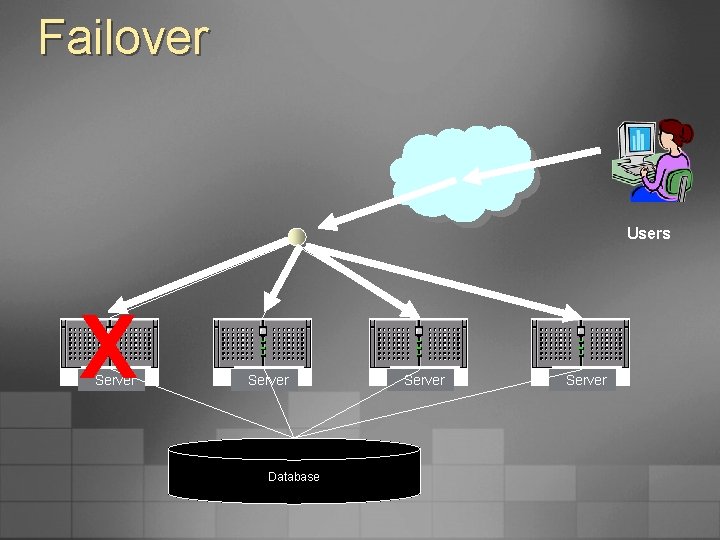
Failover ¢ ¢ If a node in the shared disk cluster fails, the system dynamically redistributes the workload among the surviving cluster nodes. RAC checks to detect node and network failures. A disk-based heartbeat mechanism uses the control file to monitor node membership and the cluster interconnect is regularly checked to determine correct operation. Reduced time to recovery with concurrent resource configuration and instance (cache) recovery Enhanced failover reliability in 10 g with the use of Virtual IP addresses (VIPs)
Failover Users X Server Database Server
Transparent Application Failover ¢ ¢ ¢ Masks failures to end users; they don’t need to log back into the system Applications and users are transparently reconnected to another node Applications and queries continue uninterrupted n ¢ ¢ Transactions can failover and replay Login context maintained DML transactions are rolled back
RAC Improvements for Oracle 9 i ¢ ¢ ¢ Full Cache Fusion Enhanced coordination of cache management and distributed lock manager (DLM) Lock simplification and automation Global Cache Service coordinates local buffer cache and remote block transfers Enhanced IPC (Inter. Process Communication) Resource configuration simplification and automation
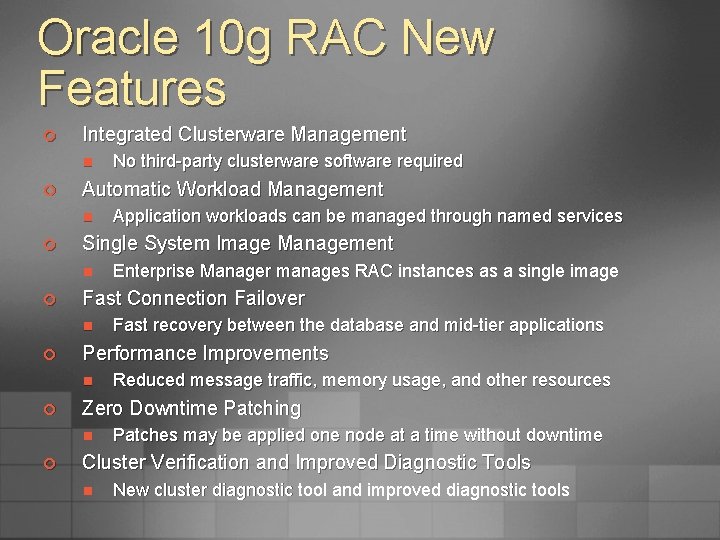
Oracle 10 g RAC New Features ¢ Integrated Clusterware Management n ¢ Automatic Workload Management n ¢ Reduced message traffic, memory usage, and other resources Zero Downtime Patching n ¢ Fast recovery between the database and mid-tier applications Performance Improvements n ¢ Enterprise Manager manages RAC instances as a single image Fast Connection Failover n ¢ Application workloads can be managed through named services Single System Image Management n ¢ No third-party clusterware software required Patches may be applied one node at a time without downtime Cluster Verification and Improved Diagnostic Tools n New cluster diagnostic tool and improved diagnostic tools
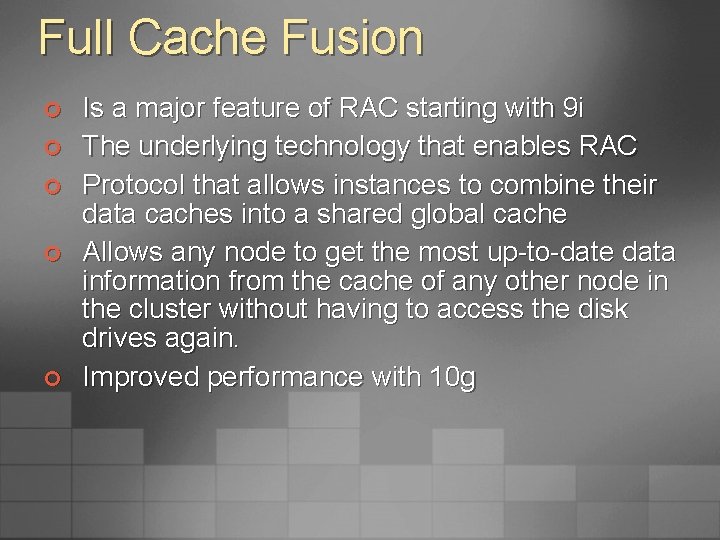
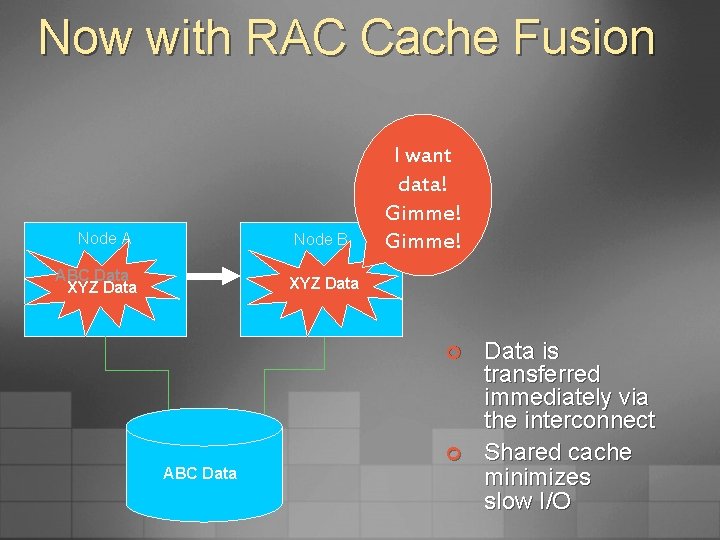
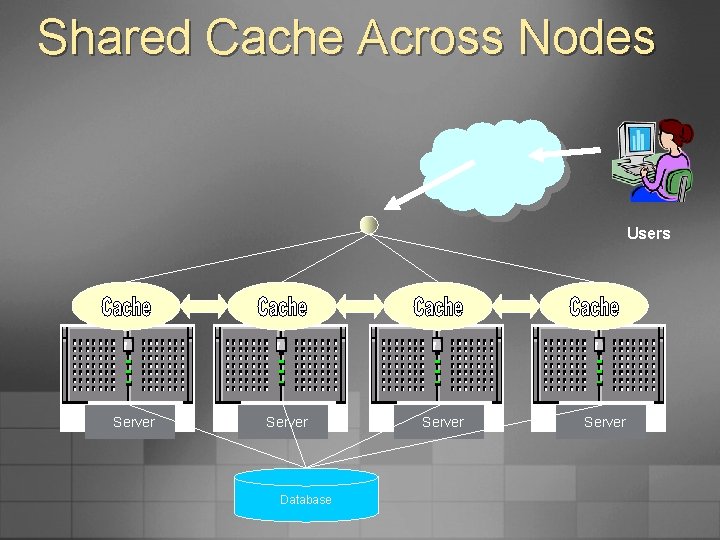
Full Cache Fusion ¢ ¢ ¢ Is a major feature of RAC starting with 9 i The underlying technology that enables RAC Protocol that allows instances to combine their data caches into a shared global cache Allows any node to get the most up-to-date data information from the cache of any other node in the cluster without having to access the disk drives again. Improved performance with 10 g
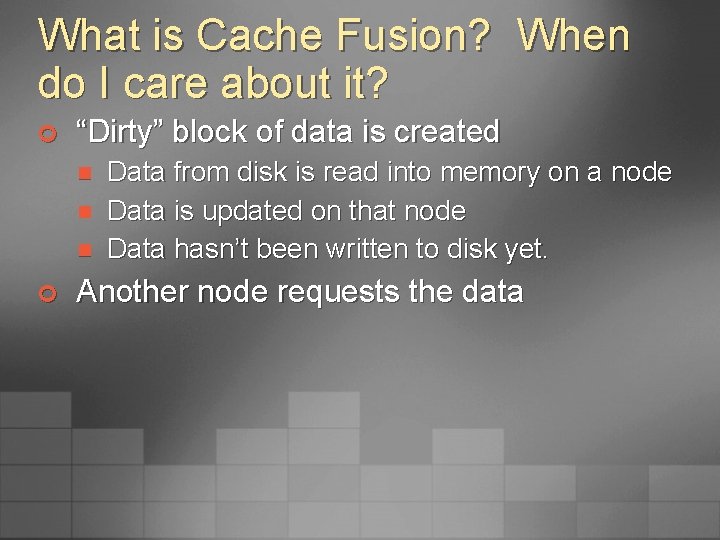
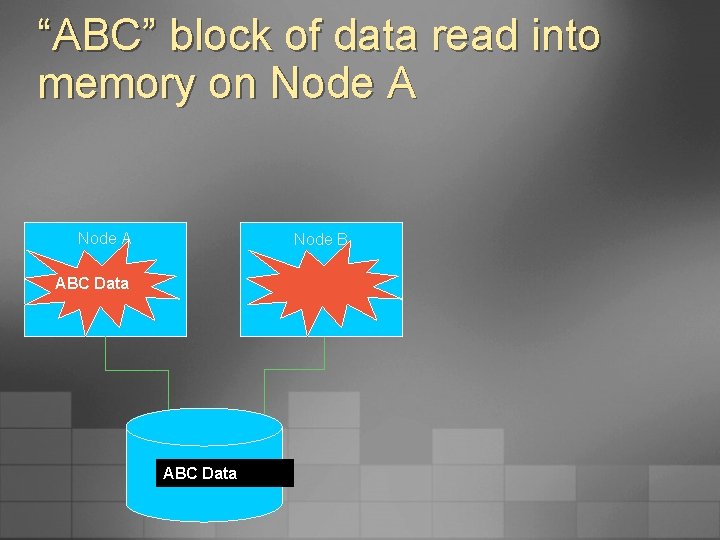
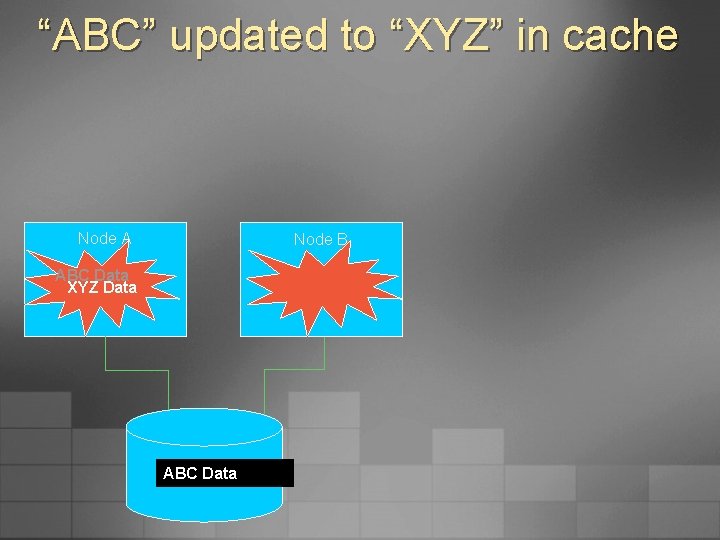
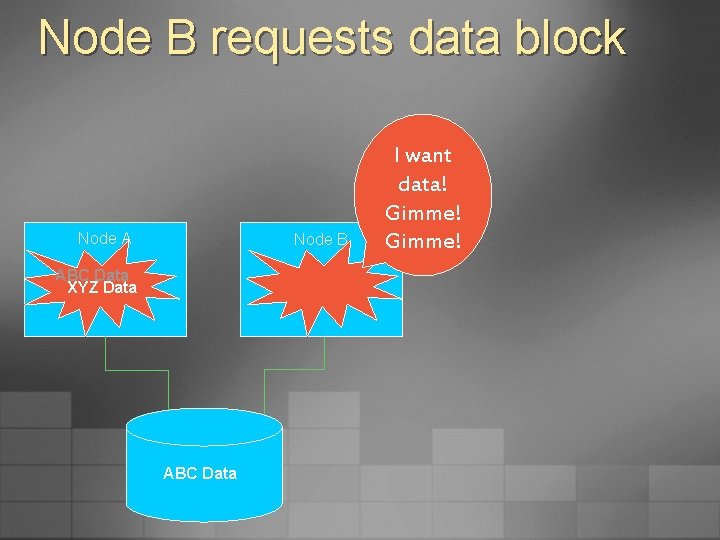
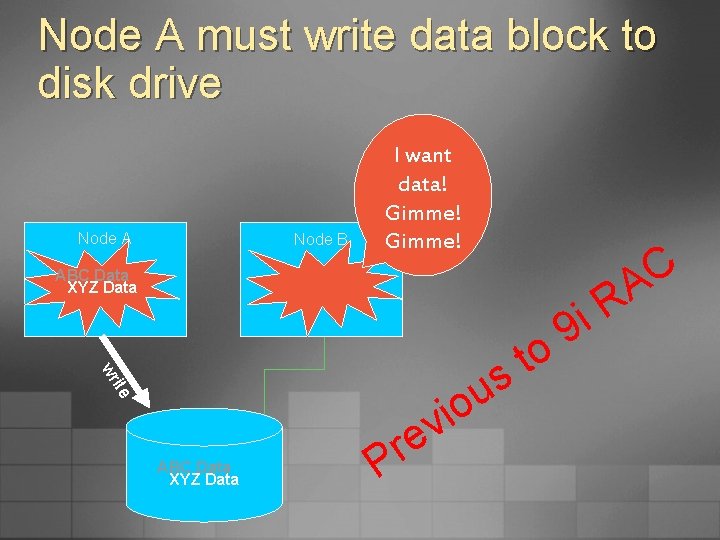
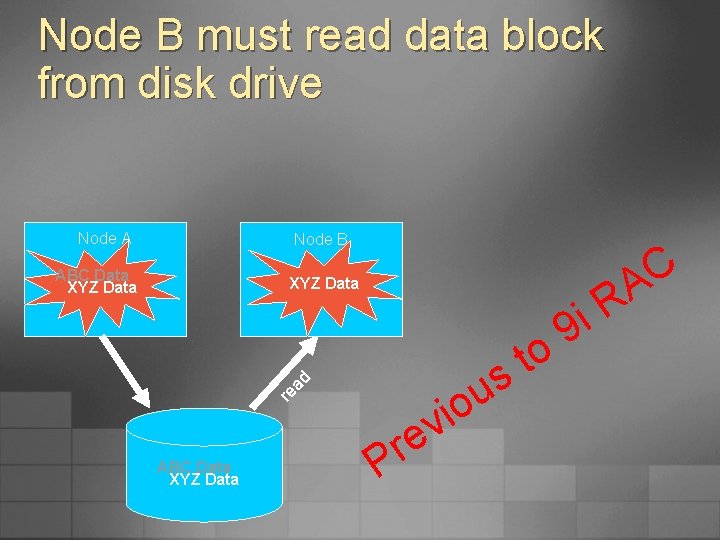
What is Cache Fusion? When do I care about it? ¢ “Dirty” block of data is created n n n ¢ Data from disk is read into memory on a node Data is updated on that node Data hasn’t been written to disk yet. Another node requests the data
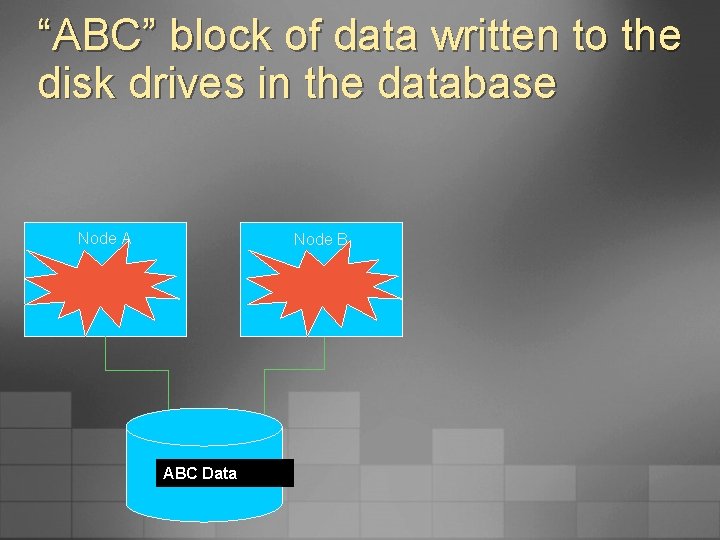
“ABC” block of data written to the disk drives in the database Node A Node B ABC Data
“ABC” block of data read into memory on Node A Node B ABC Data
“ABC” updated to “XYZ” in cache Node A Node B ABC Data XYZ Data ABC Data
Node B requests data block Node A Node B ABC Data XYZ Data ABC Data I want data! Gimme!
Node A must write data block to disk drive Node A Node B I want data! Gimme! ABC Data XYZ Data ite wr u o i v ABC Data XYZ Data e r P t s 9 o R i C A
Node B must read data block from disk drive Node A Node B ABC Data XYZ Data re ad u o i v ABC Data XYZ Data e r P t s 9 o R i C A
Now with RAC Cache Fusion Node A Node B ABC Data XYZ Data I want data! Gimme! XYZ Data ¢ ABC Data ¢ Data is transferred immediately via the interconnect Shared cache minimizes slow I/O
Shared Cache Across Nodes Users Server Database Server
Resource Simplification and Automation ¢ ¢ No init. ora parameters required Resource affinity n ¢ to move the location of the resource masters for a database file to the instance where block operations are most frequently occurring. This optimizes Dynamic resource remastering n n Ability to move the ownership of a resource between instances of Real Application Clusters. Dynamic resource remastering is used to implement resource affinity for increased performance.
Review ¢ ¢ ¢ What does cache fusion avoid that was mandatory in previous versions of Oracle Parallel Server? Which Oracle process is most important in managing user session failover? If the purpose of the interconnect is NOT to serve as a “heartbeat”, where is the heartbeat?
Summary ¢ ¢ New Features Shared Everything Clustering Cache Fusion RAC Clustering failover & load-balancing