
Oracle 11 g SQL Chapter 13 Views Objectives
Oracle 11 g: SQL Chapter 13 Views
Objectives • Create a view by using CREATE VIEW command or the CREATE OR REPLACE VIEW command • Employ the FORCE and NOFORCE options • State the purpose of the WITH CHECK OPTION constraint • Explain the effect of the WITH READ ONLY option • Update a record in a simple view • Re-create a view Oracle 11 g: SQL 2
Objectives (continued) • Explain the implication of an expression in a view for DML operations • Update a record in a complex view • Identify problems associated with adding records to a complex view • Identify the key-preserved table underlying a complex view • Drop a view • Explain inline views and the use of ROWNUM to perform a “TOP-N” analysis • Create a materialized view to replicate data Oracle 11 g: SQL 3
Views • Permanent objects that store no data • Store a query • Two purposes – Reduce complex query requirements – Restrict users’ access to sensitive data Oracle 11 g: SQL 4
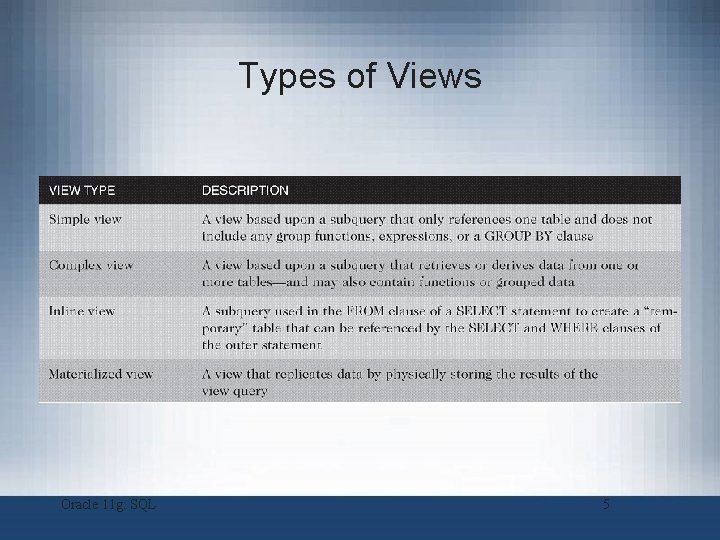
Types of Views Oracle 11 g: SQL 5
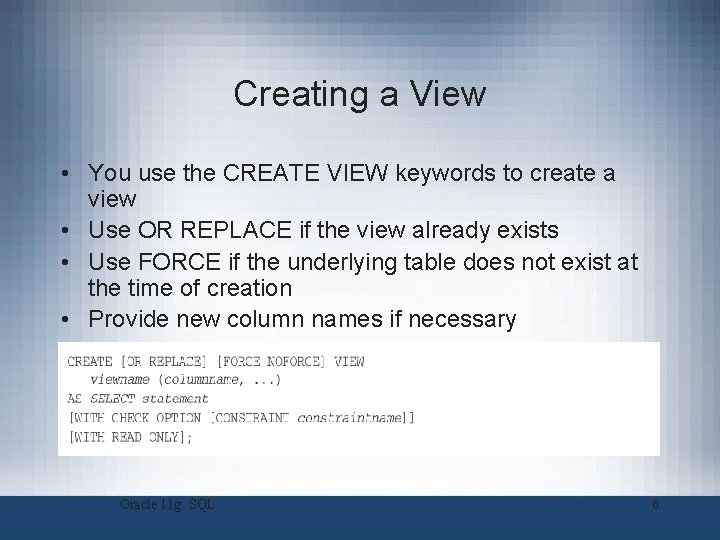
Creating a View • You use the CREATE VIEW keywords to create a view • Use OR REPLACE if the view already exists • Use FORCE if the underlying table does not exist at the time of creation • Provide new column names if necessary Oracle 11 g: SQL 6
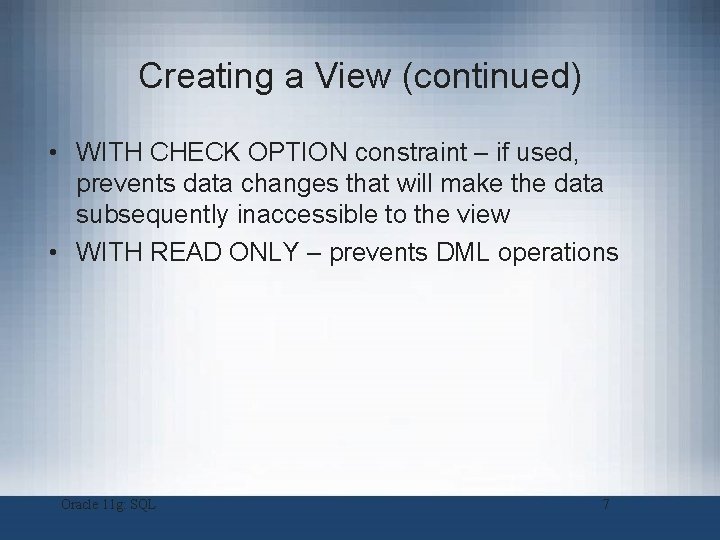
Creating a View (continued) • WITH CHECK OPTION constraint – if used, prevents data changes that will make the data subsequently inaccessible to the view • WITH READ ONLY – prevents DML operations Oracle 11 g: SQL 7
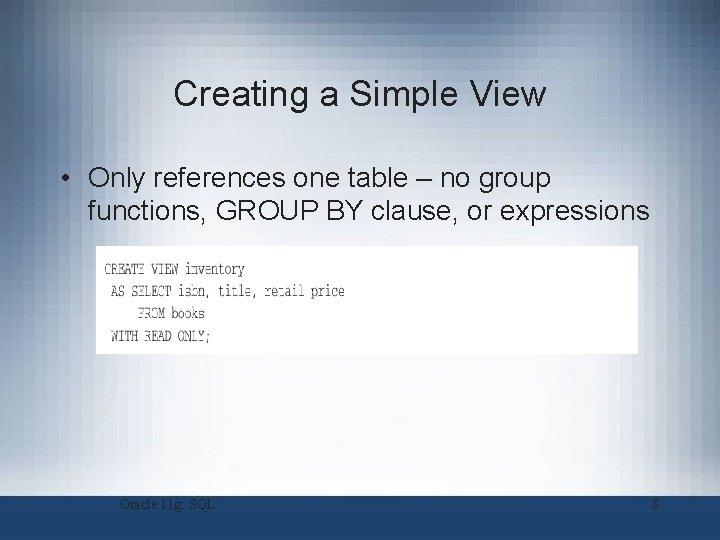
Creating a Simple View • Only references one table – no group functions, GROUP BY clause, or expressions Oracle 11 g: SQL 8
DML Operations on a Simple View • Any DML operations are allowed through simple views unless created with WITH READ ONLY option • DML operations that violate constraints on the underlying table are not allowed Oracle 11 g: SQL 9
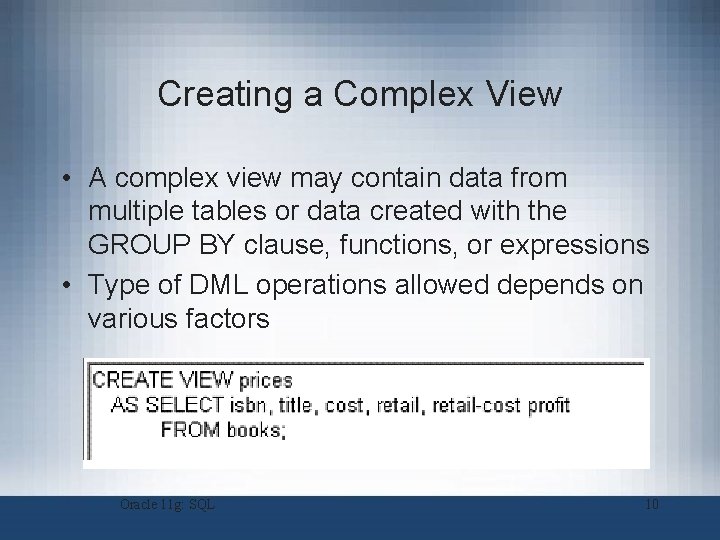
Creating a Complex View • A complex view may contain data from multiple tables or data created with the GROUP BY clause, functions, or expressions • Type of DML operations allowed depends on various factors Oracle 11 g: SQL 10
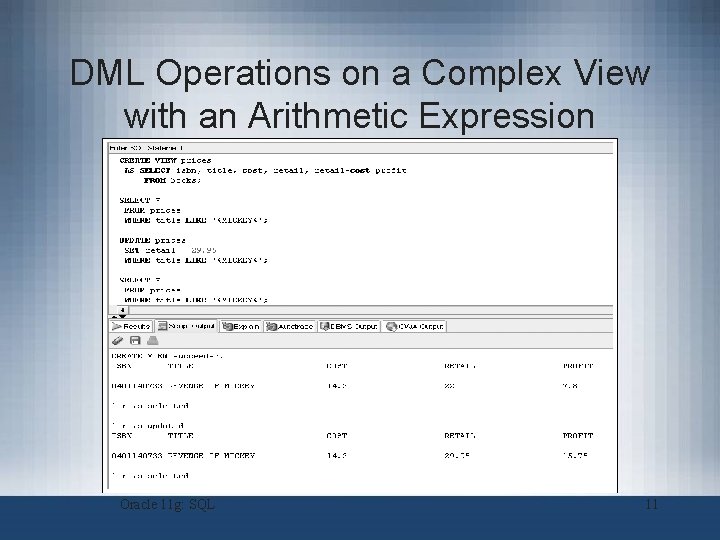
DML Operations on a Complex View with an Arithmetic Expression Oracle 11 g: SQL 11
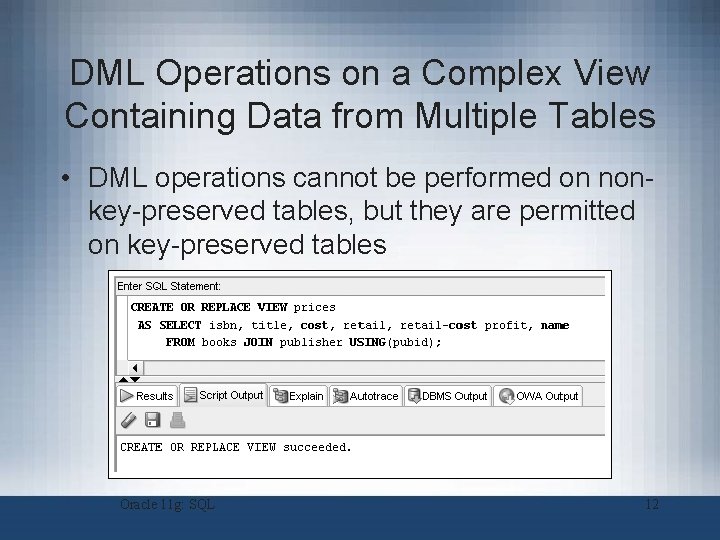
DML Operations on a Complex View Containing Data from Multiple Tables • DML operations cannot be performed on nonkey-preserved tables, but they are permitted on key-preserved tables Oracle 11 g: SQL 12
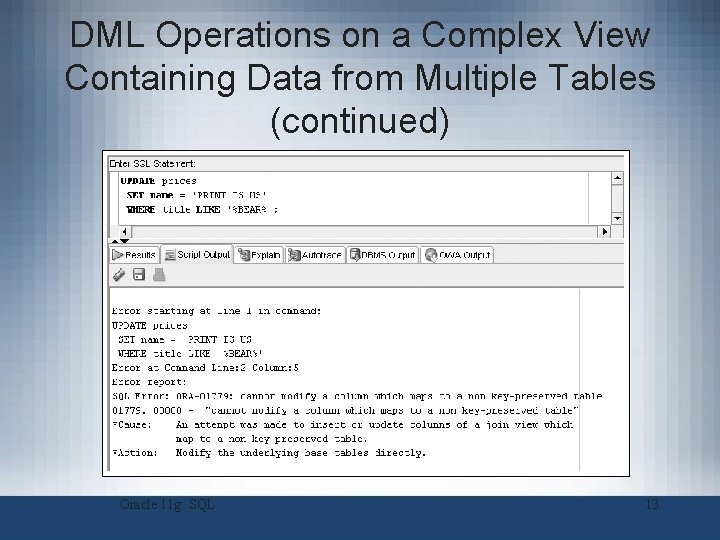
DML Operations on a Complex View Containing Data from Multiple Tables (continued) Oracle 11 g: SQL 13
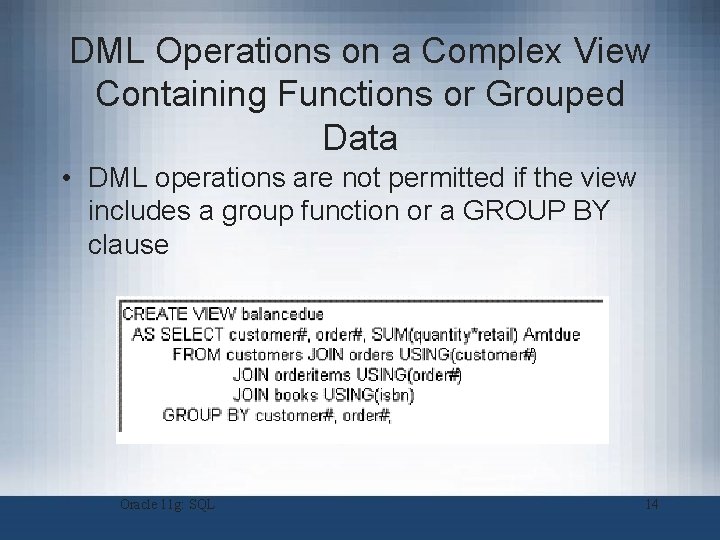
DML Operations on a Complex View Containing Functions or Grouped Data • DML operations are not permitted if the view includes a group function or a GROUP BY clause Oracle 11 g: SQL 14
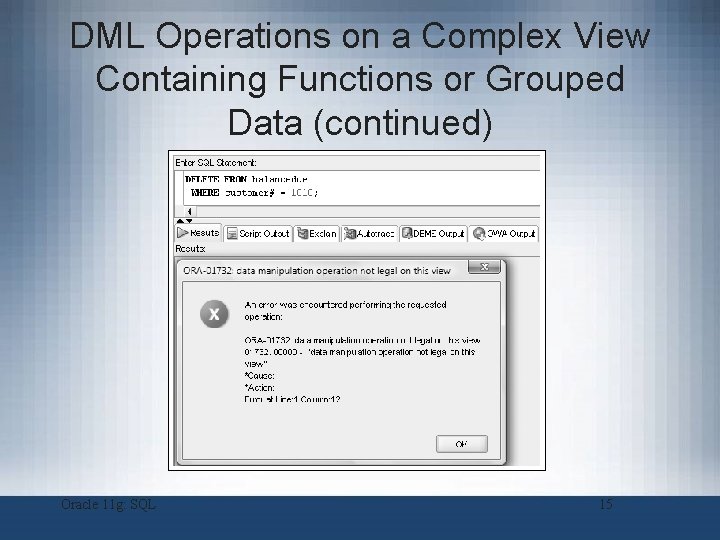
DML Operations on a Complex View Containing Functions or Grouped Data (continued) Oracle 11 g: SQL 15
DML Operations on a Complex View Containing DISTINCT or ROWNUM • DML operations on a view that contains the DISTINCT keyword or ROWNUM are not permitted Oracle 11 g: SQL 16
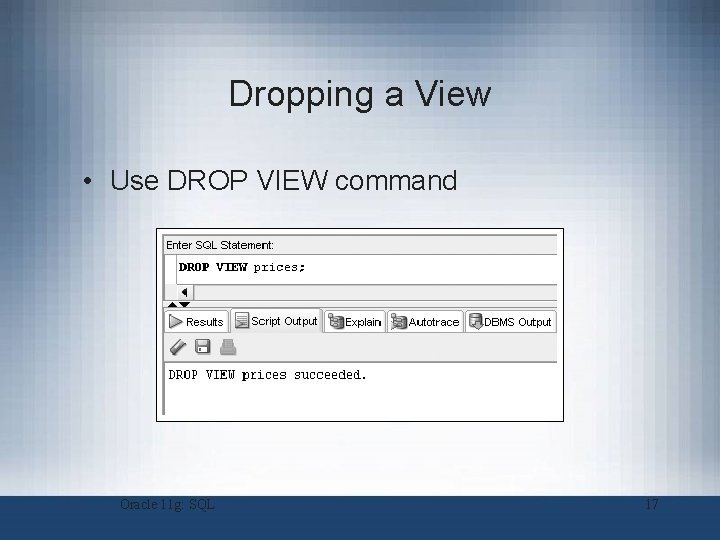
Dropping a View • Use DROP VIEW command Oracle 11 g: SQL 17
Creating an Inline View • An inline view is a temporary table created by using a subquery in the FROM clause • It can only be referenced while the command is being executed • Most common usage – “TOP-N” analysis Oracle 11 g: SQL 18
“TOP-N” Analysis • ORDER BY included to identify top values: – Descending for highest values – Ascending for lowest values • Extract data based on ROWNUM Oracle 11 g: SQL 19
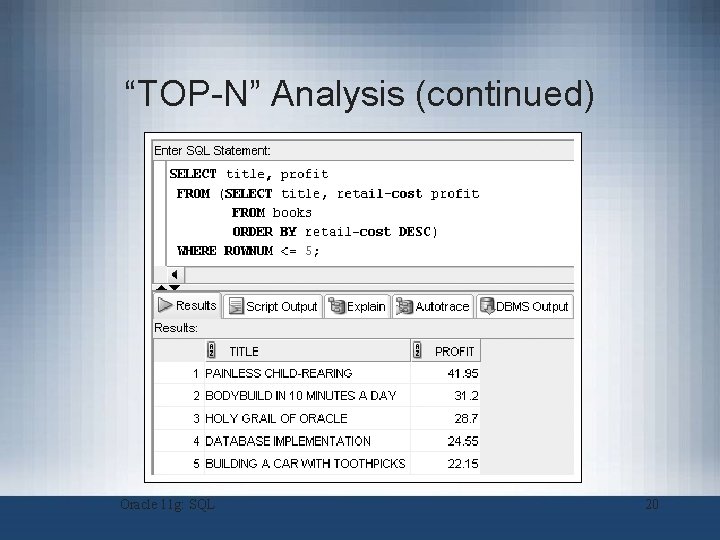
“TOP-N” Analysis (continued) Oracle 11 g: SQL 20
Materialized Views • Replicate data • Store data retrieved from view query • Referred to as “snapshots” Oracle 11 g: SQL 21
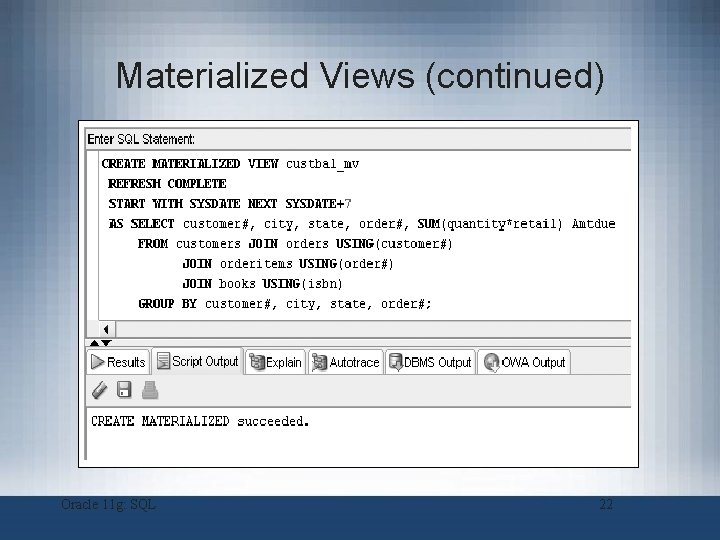
Materialized Views (continued) Oracle 11 g: SQL 22
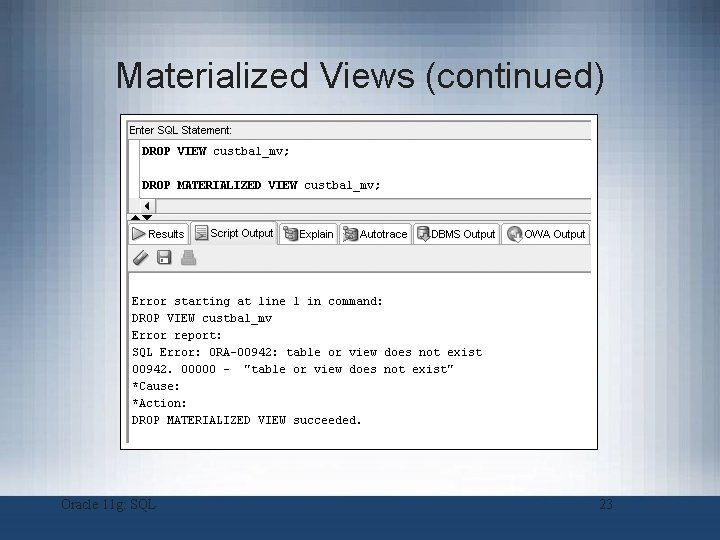
Materialized Views (continued) Oracle 11 g: SQL 23
Summary • A view is a temporary or virtual table that is used to retrieve data that exists in the underlying database tables • The view query must be executed each time the view is used • A view can be used to simplify queries or to restrict access to sensitive data • A view is created with the CREATE VIEW command • A view cannot be modified; to change a view, it must be dropped and then re-created, or the CREATE OR REPLACE VIEW command must be used Oracle 11 g: SQL 24
Summary (continued) • Any DML operation can be performed on a simple query if it does not violate a constraint • A view that contains expressions or functions, or that joins multiple tables, is considered a complex view • A complex view can be used to update only one table; the table must be a key-preserved table • Data cannot be added to a view column that contains an expression • DML operations are not permitted on non-key-preserved tables Oracle 11 g: SQL 25
Summary (continued) • DML operations are not permitted on views that include group functions, a GROUP BY clause, the ROWNUM pseudocolumn, or the DISTINCT keyword • Oracle 11 g assigns a row number to every row in a table to indicate its position in the table; the row number can be referenced by the keyword ROWNUM • A view can be dropped with the DROPVIEW command; the data is not affected, because it exists in the original tables • An inline view can be used only by the current statement and can include an ORDER BY clause • “TOP-N” analysis uses the row number of sorted data to determine a range of top values • Materialized views physically store view query results Oracle 11 g: SQL 26
- Slides: 26