
Or Everything you wanted to know about the
Or Everything you wanted to know about the Higgs particle Introduction To Particle Physics … but were afraid to ask • Why do we need accelerators and detectors? • Particle Detectors with examples. • Standard Model of Particle Physics • Introduction to the Higgs • The future APPEAL July '14 Tony Weidberg, Oxford University 1
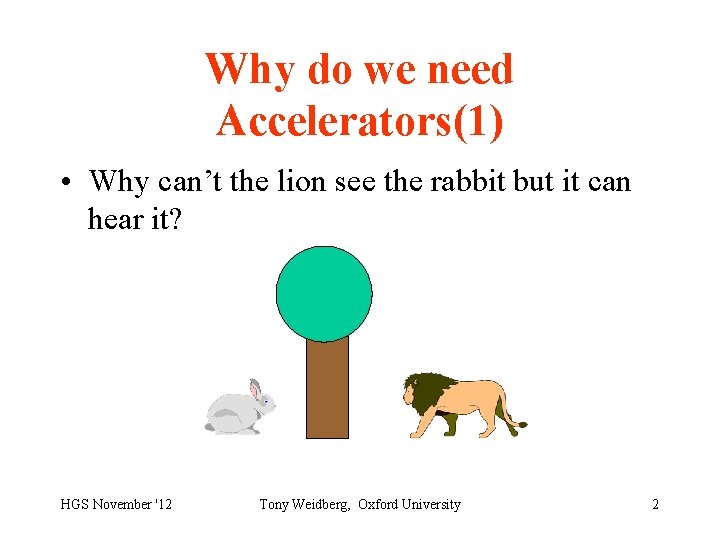
Why do we need Accelerators(1) • Why can’t the lion see the rabbit but it can hear it? HGS November '12 Tony Weidberg, Oxford University 2
Why do we need Accelerators(2) • To study an object of size R, need resolution much better than R wavelength of probe l <R. • Optical microscopes resolution limited ~ mm but we need resolution of ~10 -15 m to study quarks. • Quantum mechanics says l=h/p (h =Plank’s constant, p=momentum). • High energy/momentum particles to study structure of matter at smallest scales. HGS November '12 Tony Weidberg, Oxford University 3
Particle Detectors • Everybody has examples of particle detectors at home • Examples are … APPEAL July '14 Tony Weidberg, Oxford University 4
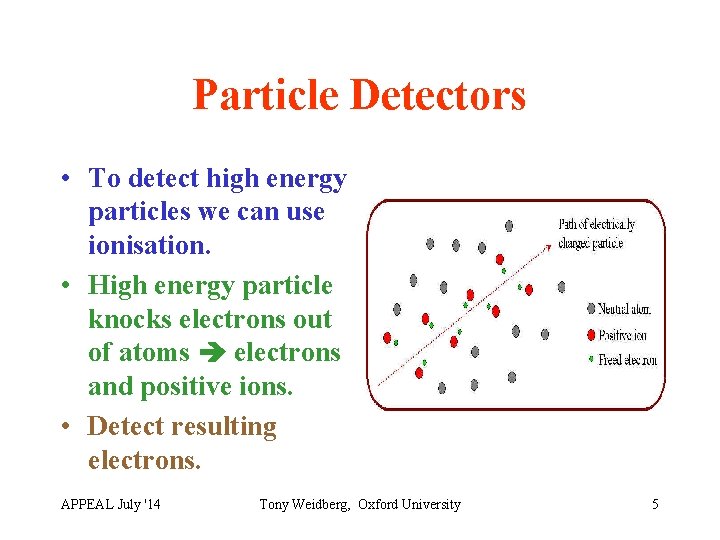
Particle Detectors • To detect high energy particles we can use ionisation. • High energy particle knocks electrons out of atoms electrons and positive ions. • Detect resulting electrons. APPEAL July '14 Tony Weidberg, Oxford University 5
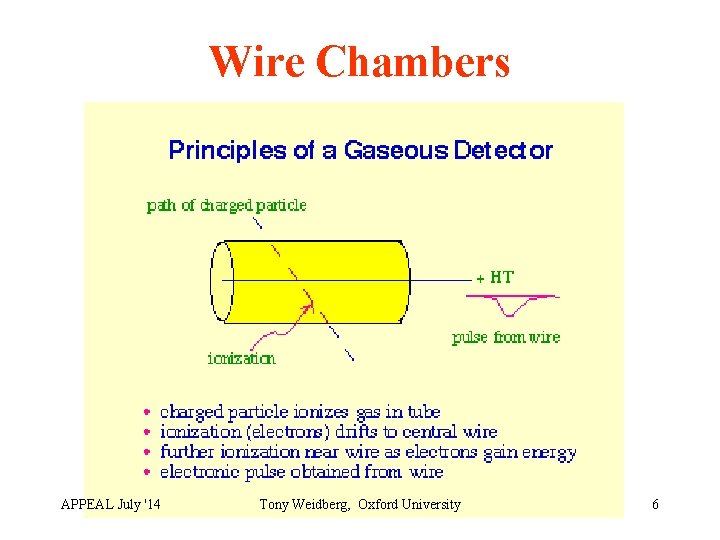
Wire Chambers APPEAL July '14 Tony Weidberg, Oxford University 6
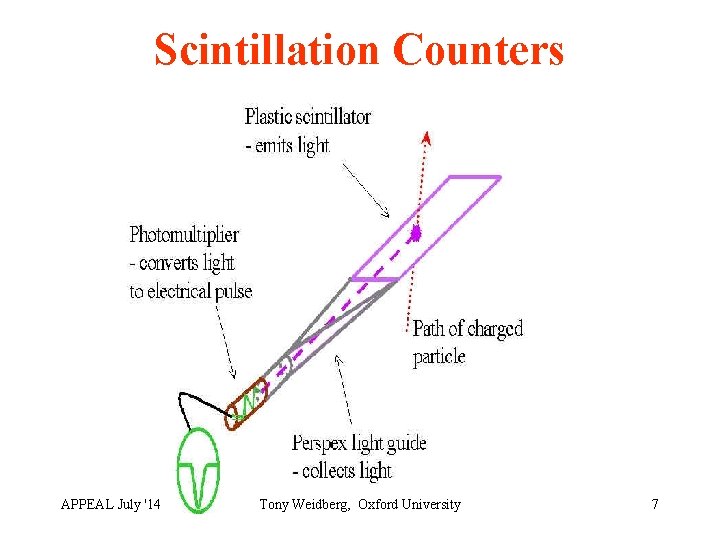
Scintillation Counters APPEAL July '14 Tony Weidberg, Oxford University 7
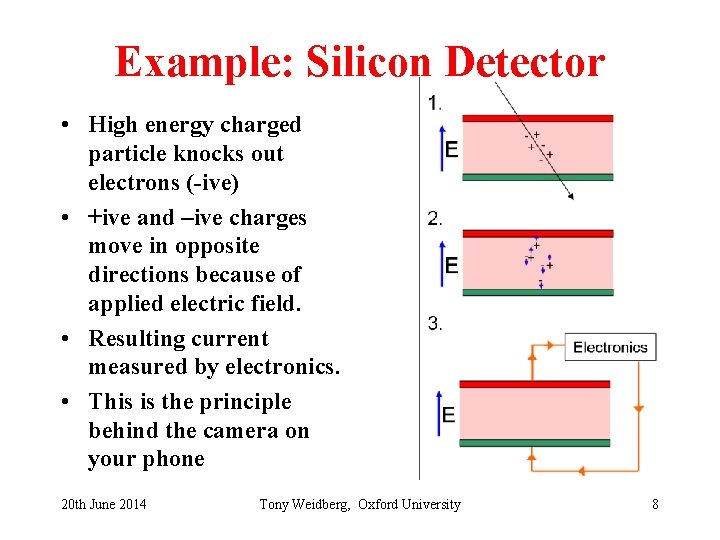
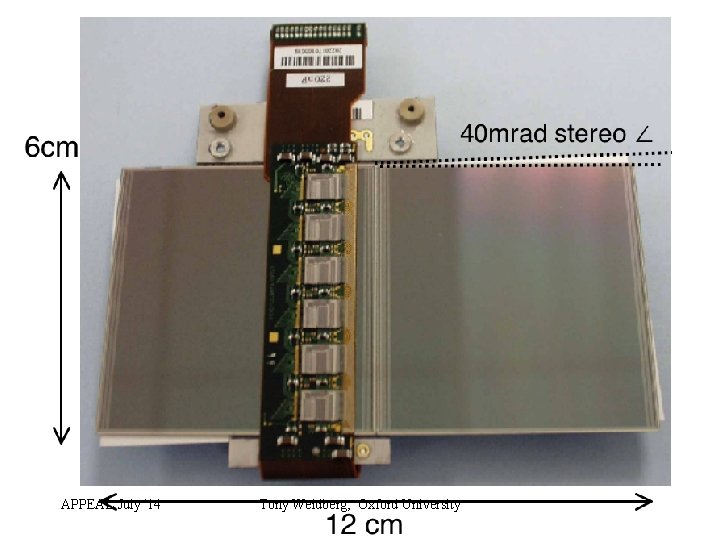
Example: Silicon Detector • High energy charged particle knocks out electrons (-ive) • +ive and –ive charges move in opposite directions because of applied electric field. • Resulting current measured by electronics. • This is the principle behind the camera on your phone 20 th June 2014 Tony Weidberg, Oxford University 8
APPEAL July '14 Tony Weidberg, Oxford University 9
ATLAS Si detector barrel @ Oxford APPEAL July '14 Tony Weidberg, Oxford University 10
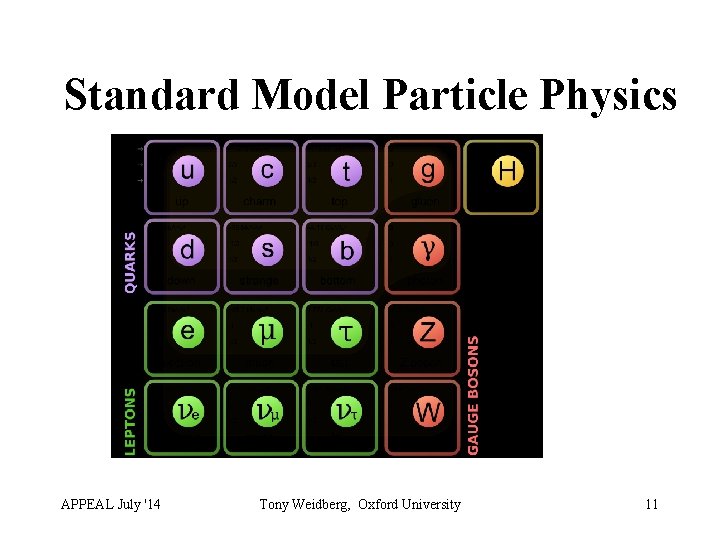
Standard Model Particle Physics APPEAL July '14 Tony Weidberg, Oxford University 11
How do we know all these particles exist ? • Experiments ! • Electron is easy measure e/m • Quarks confined in hadrons more difficult. • How about unstable particles? – Take Z 0 as an example t~ 10 -24 s. APPEAL July '14 Tony Weidberg, Oxford University 12
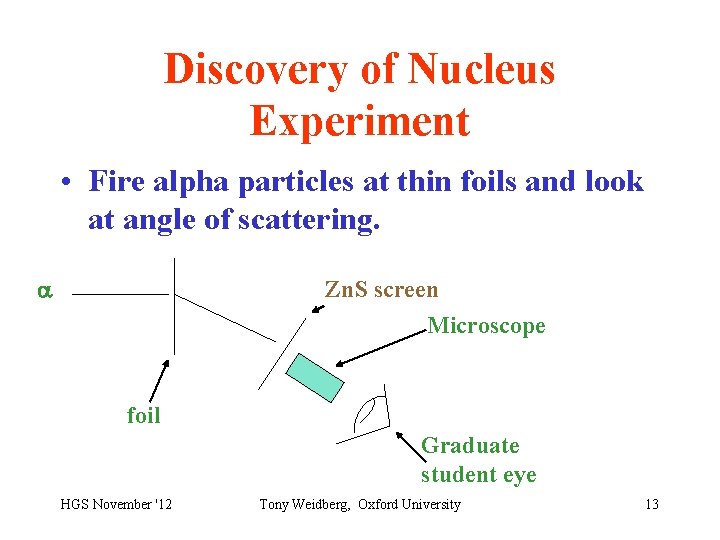
Discovery of Nucleus Experiment • Fire alpha particles at thin foils and look at angle of scattering. a Zn. S screen Microscope foil Graduate student eye HGS November '12 Tony Weidberg, Oxford University 13
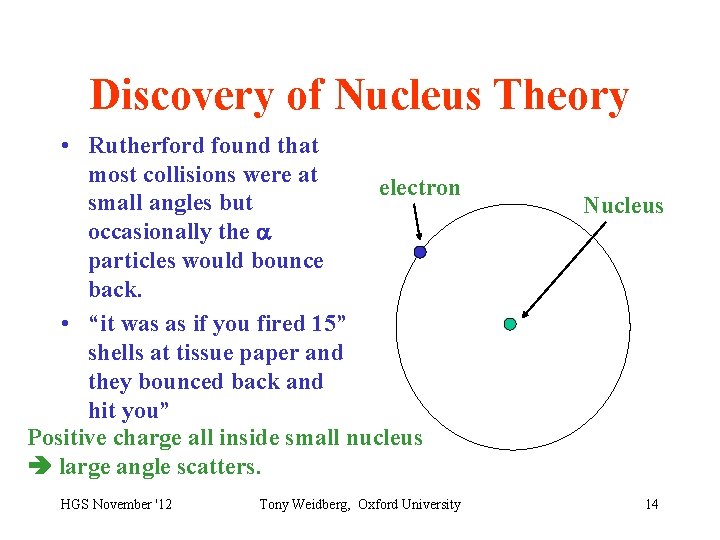
Discovery of Nucleus Theory • Rutherford found that most collisions were at electron small angles but occasionally the a particles would bounce back. • “it was as if you fired 15” shells at tissue paper and they bounced back and hit you” Positive charge all inside small nucleus large angle scatters. HGS November '12 Tony Weidberg, Oxford University Nucleus 14
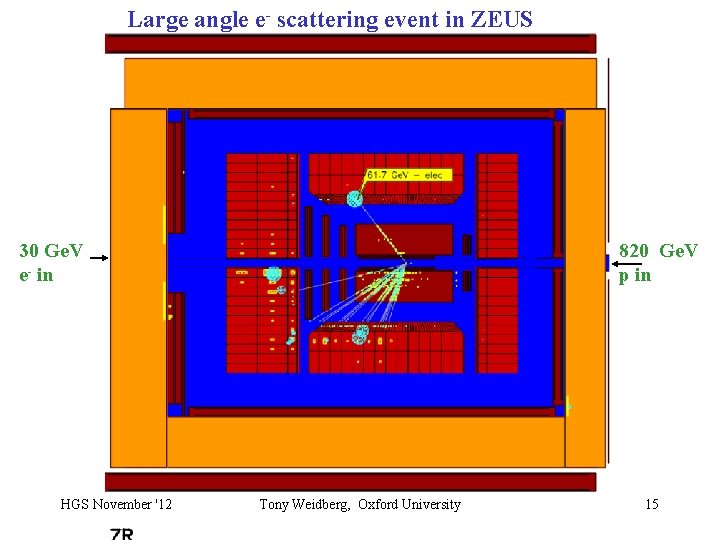
Large angle e- scattering event in ZEUS 30 Ge. V e- in HGS November '12 820 Ge. V p in Tony Weidberg, Oxford University 15
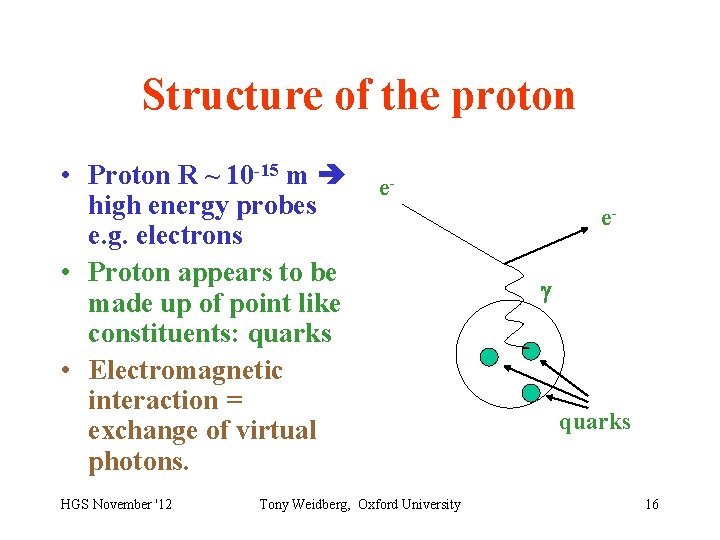
Structure of the proton • Proton R ~ 10 -15 m high energy probes e. g. electrons • Proton appears to be made up of point like constituents: quarks • Electromagnetic interaction = exchange of virtual photons. HGS November '12 e- Tony Weidberg, Oxford University eg quarks 16
0 Z decays • Reconstruct decay products e. g. Z e +e • Boost to CMS • Use E=mc 2 APPEAL July '14 Tony Weidberg, Oxford University 17
Origin of Mass • Consider Feynman’s wheelbarrow experiment: – Put ball in wheelbarrow, push it forward and stop suddenly. – The ball continues to move forward and rolls out. • Why ? ? ? APPEAL July '14 Tony Weidberg, Oxford University 18
Origin of Mass(2) • So classical mechanics doesn’t explain origin of mass. • Quantum theory predicts masses of all particles should be 0 ! • Need to understand quantum vacuum – What is left in a bottle after I remove all the molecules? – Remember Heisenberg DE Dt > h – Why does this matter? APPEAL July '14 Tony Weidberg, Oxford University 19
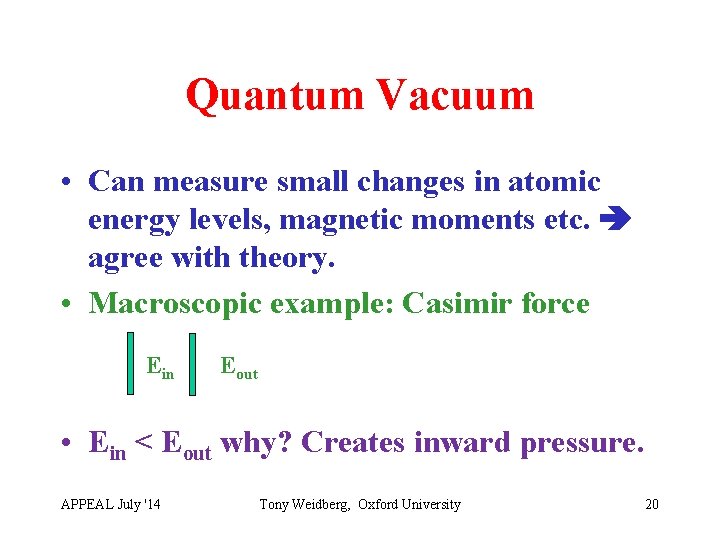
Quantum Vacuum • Can measure small changes in atomic energy levels, magnetic moments etc. agree with theory. • Macroscopic example: Casimir force Ein Eout • Ein < Eout why? Creates inward pressure. APPEAL July '14 Tony Weidberg, Oxford University 20
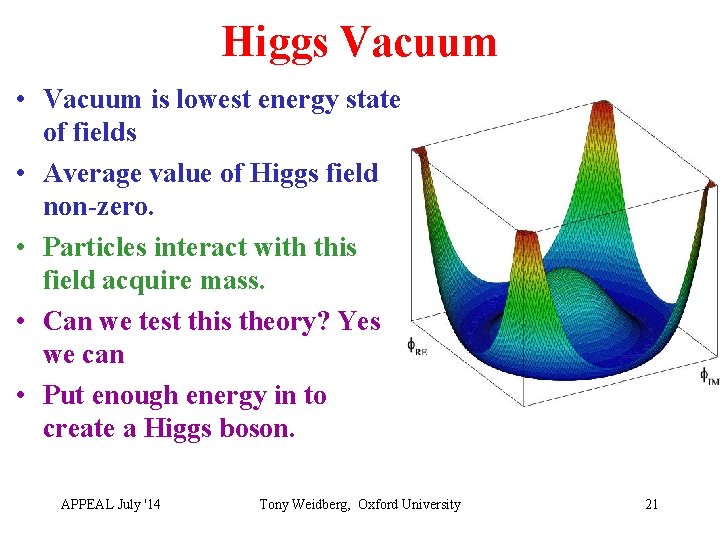
Higgs Vacuum • Vacuum is lowest energy state of fields • Average value of Higgs field non-zero. • Particles interact with this field acquire mass. • Can we test this theory? Yes we can • Put enough energy in to create a Higgs boson. APPEAL July '14 Tony Weidberg, Oxford University 21
Higgs hunting • How would we know if we made a Higgs boson? • Use good old E=mc 2 • Measure energies of decay products reconstruct m. H. APPEAL July '14 Tony Weidberg, Oxford University 22
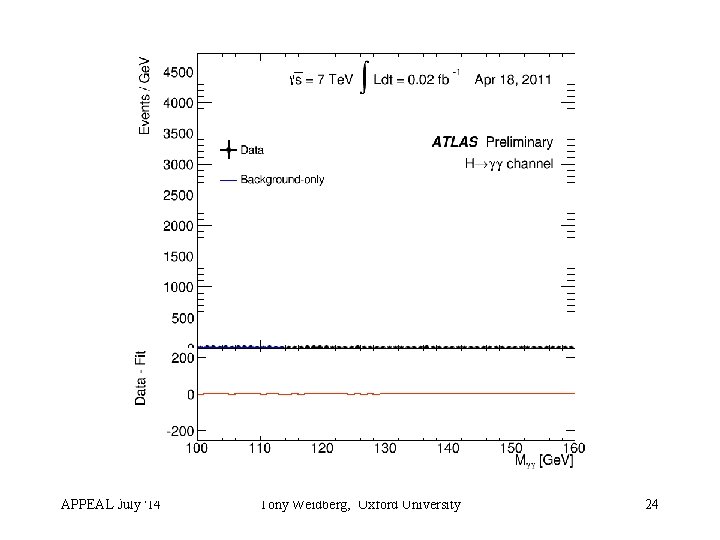
Higgs Hunting • Look for Higgs decaying to two photons and reconstruct Higgs mass E=mc 2 • Evidence for Higgs boson also seen in other decay modes (ZZ and WW). • How do we know the signal is real and not just a statistical fluctuation? • Calculate probability of a fluctuation producing a larger signal APPEAL July '14 Tony Weidberg, Oxford University 23
APPEAL July '14 Tony Weidberg, Oxford University 24
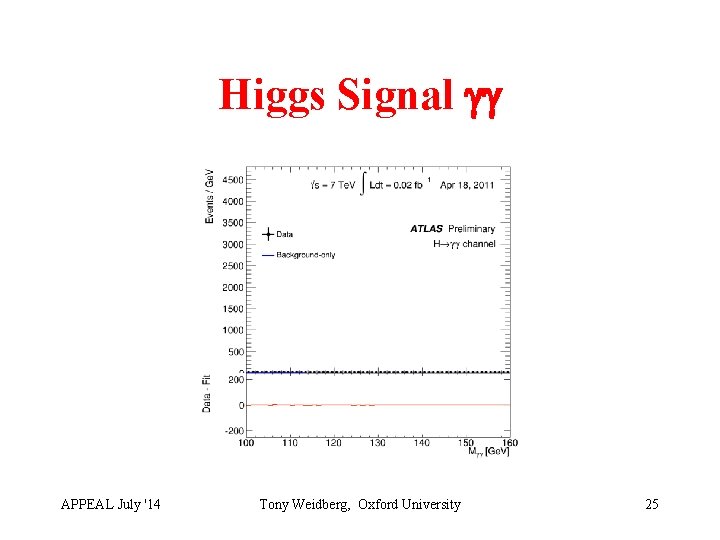
Higgs Signal gg APPEAL July '14 Tony Weidberg, Oxford University 25
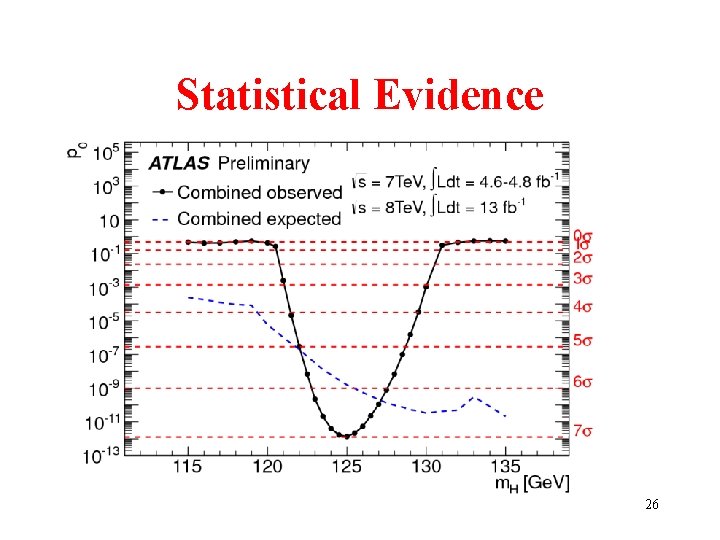
Statistical Evidence APPEAL July '14 Tony Weidberg, Oxford University 26
Outlook • We have definitely discovered a new boson but is it the Standard Model Higgs? • Measurements of spin=0 suggest it is a Higgs boson but is it SM or exotic? • Need much more data … APPEAL July '14 Tony Weidberg, Oxford University 27
Q. Why do Particle Physics? • Answer: because it is interesting ! • fundamental questions of what the Universe is made of and how it interacts. • Towards a T. O. E. • Also help to explain how the Universe evolved. • Dark Matter APPEAL July '14 Tony Weidberg, Oxford University 28
Other Benefits of Particle Physics • Many important applications of technology developed for Particle Physics are used. • Ion beam accelerators required in semiconductor industry. • Synchrotron radiation – By-product of particle accelerators. • • Accelerators used in hospitals to produce radio-isotopes. Medical imaging (e. g. PET). Safe transformation of nuclear waste. World Wide Web invented at CERN (by Oxford Physics graduate). APPEAL July '14 Tony Weidberg, Oxford University 29
Accelerators • Use E=mc 2 What does this mean? • We know Higgs mass m. H>115 Ge. V/c 2 • Need very high energy particle accelerator: – LHC centre of mass proton – proton collisions 7 to 8 Te. V (upgrade to 14 Te. V). – 1 Te. V = 1012 e. V: 1 e. V is energy given to an electron by a 1 V battery APPEAL July '14 Tony Weidberg, Oxford University 30
Particle Accelerators • Everybody has a particle accelerator at home. • It is called a … APPEAL July '14 Tony Weidberg, Oxford University 31
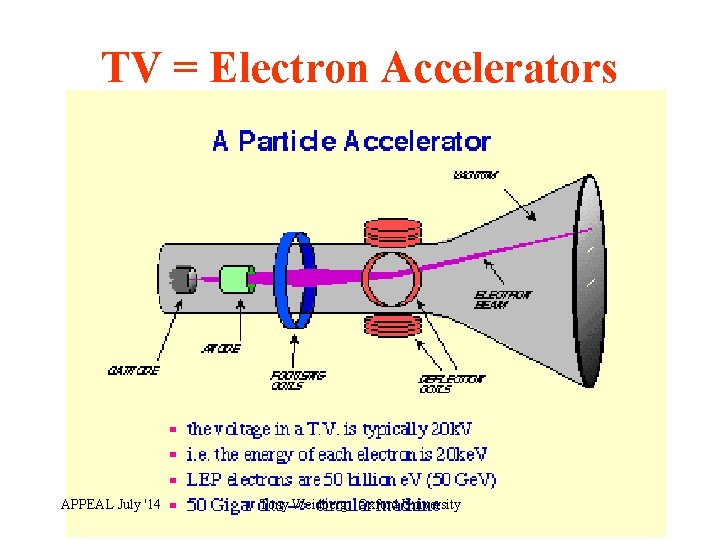
TV = Electron Accelerators APPEAL July '14 Tony Weidberg, Oxford University 32
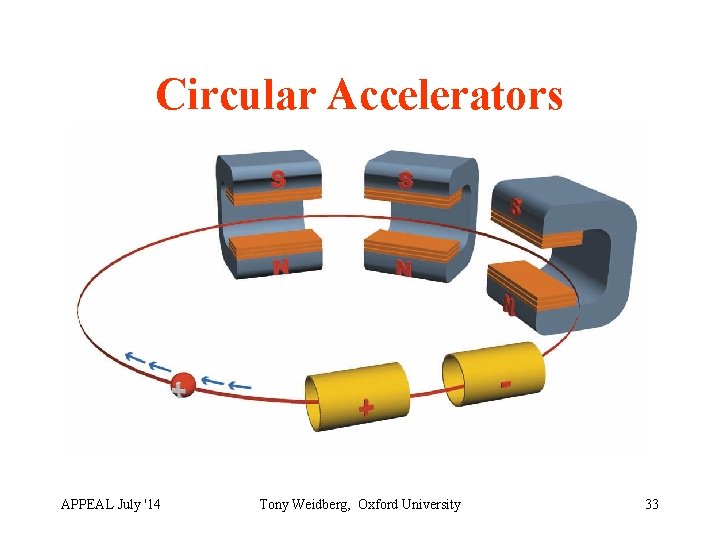
Circular Accelerators APPEAL July '14 Tony Weidberg, Oxford University 33
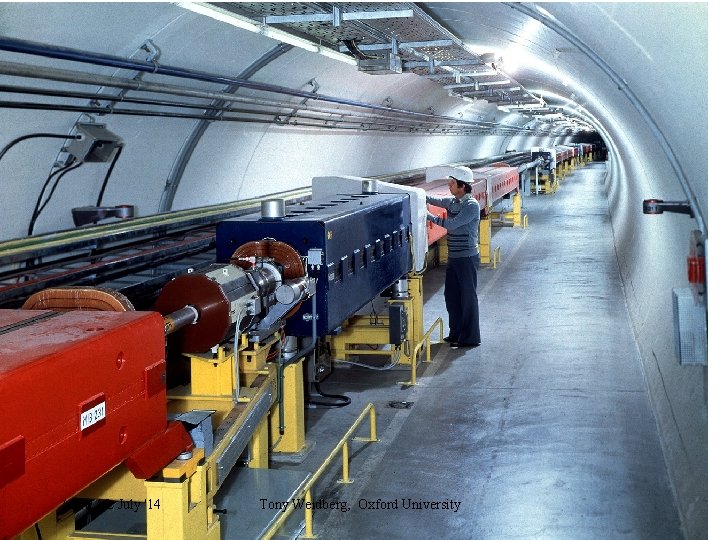
APPEAL July '14 Tony Weidberg, Oxford University 34
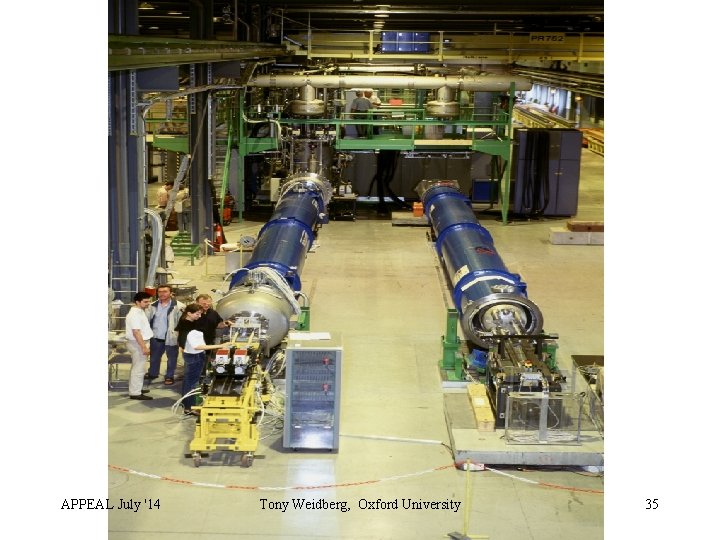
Superconducting Magnets APPEAL July '14 Tony Weidberg, Oxford University 35
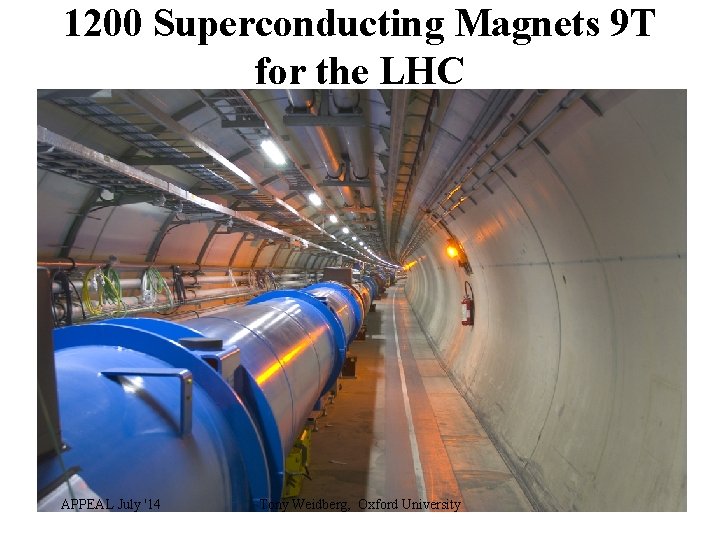
1200 Superconducting Magnets 9 T for the LHC APPEAL July '14 Tony Weidberg, Oxford University 36
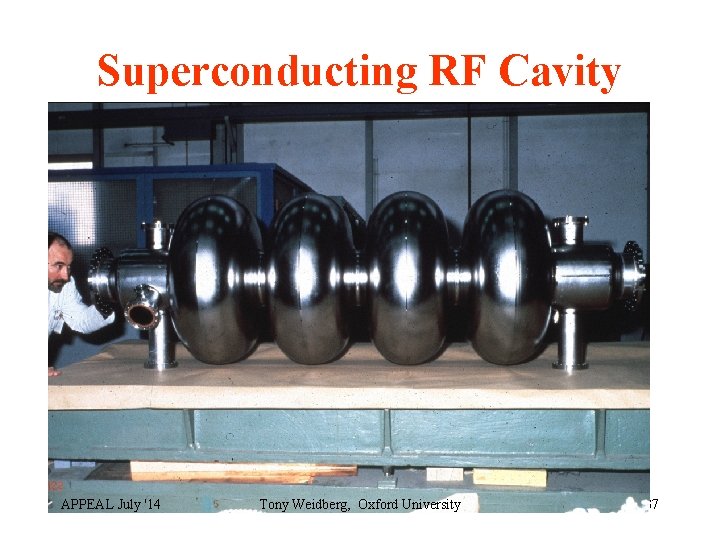
Superconducting RF Cavity APPEAL July '14 Tony Weidberg, Oxford University 37
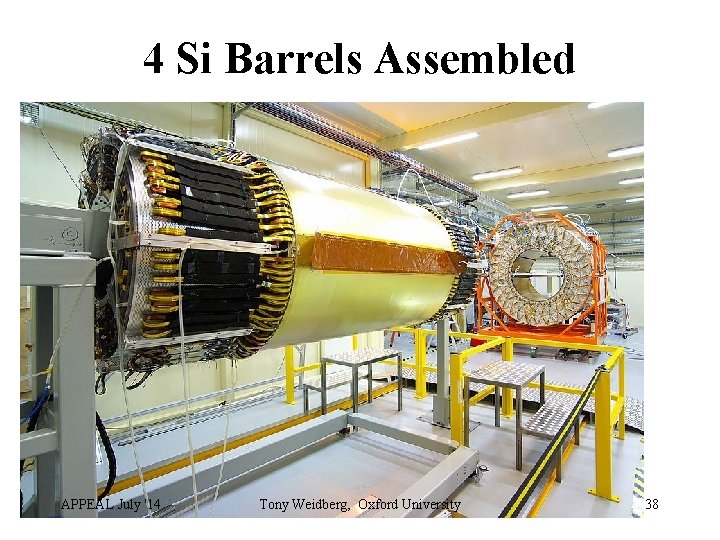
4 Si Barrels Assembled APPEAL July '14 Tony Weidberg, Oxford University 38
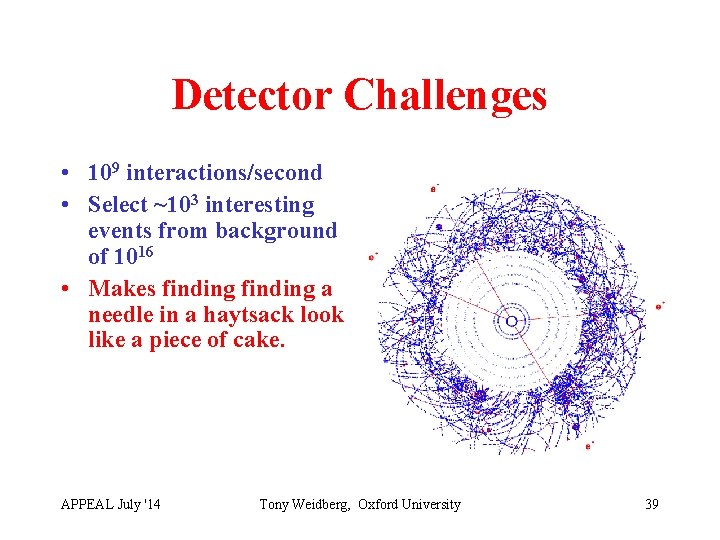
Detector Challenges • 109 interactions/second • Select ~103 interesting events from background of 1016 • Makes finding a needle in a haytsack look like a piece of cake. APPEAL July '14 Tony Weidberg, Oxford University 39
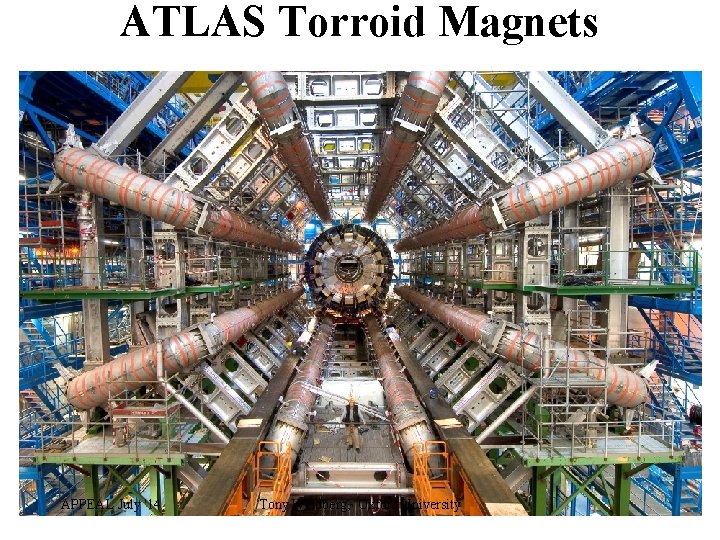
ATLAS Torroid Magnets APPEAL July '14 Tony Weidberg, Oxford University 40
- Slides: 40