
Optomechanics with atoms Darrick Chang ICFO The Institute

- Slides: 85
Optomechanics with atoms Darrick Chang ICFO – The Institute of Photonic Sciences Barcelona, Spain School on Quantum Nano- and Opto-Mechanics July 8, 2016
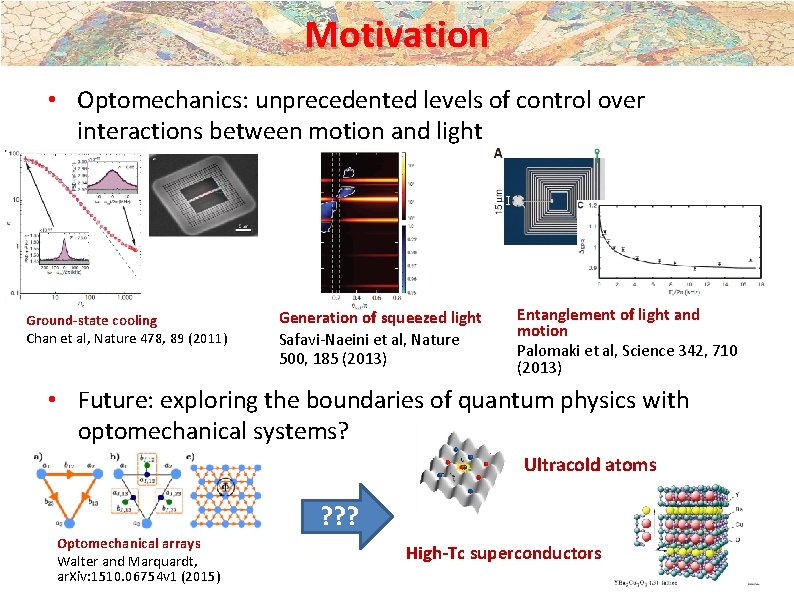
Motivation • Optomechanics: unprecedented levels of control over interactions between motion and light Ground-state cooling Chan et al, Nature 478, 89 (2011) Generation of squeezed light Safavi-Naeini et al, Nature 500, 185 (2013) Entanglement of light and motion Palomaki et al, Science 342, 710 (2013) • Future: exploring the boundaries of quantum physics with optomechanical systems? Ultracold atoms ? ? ? Optomechanical arrays Walter and Marquardt, ar. Xiv: 1510. 06754 v 1 (2015) High-Tc superconductors
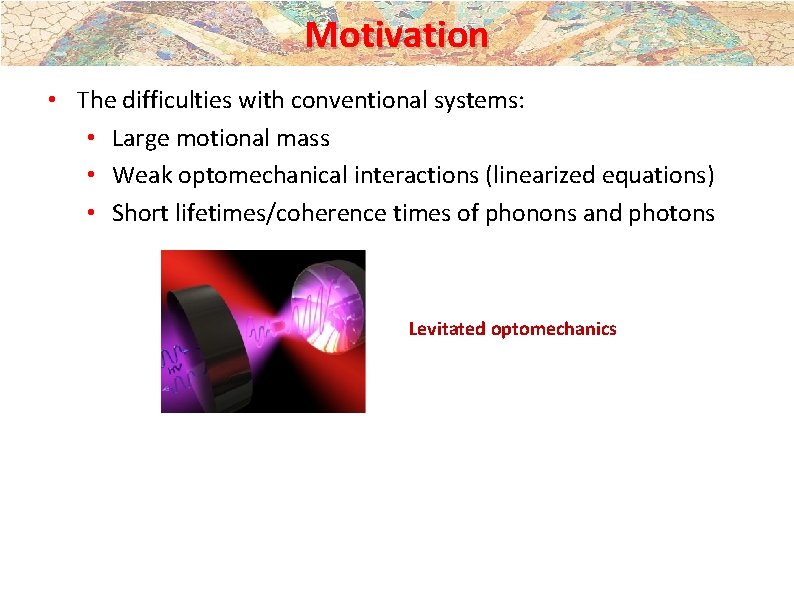
Motivation • The difficulties with conventional systems: • Large motional mass • Weak optomechanical interactions (linearized equations) • Short lifetimes/coherence times of phonons and photons Levitated optomechanics
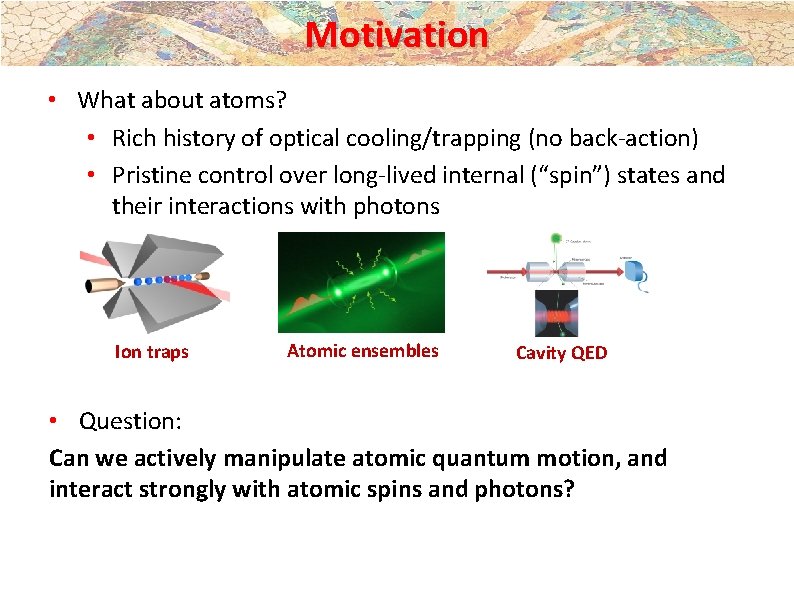
Motivation • What about atoms? • Rich history of optical cooling/trapping (no back-action) • Pristine control over long-lived internal (“spin”) states and their interactions with photons Ion traps Atomic ensembles Cavity QED • Question: Can we actively manipulate atomic quantum motion, and interact strongly with atomic spins and photons?
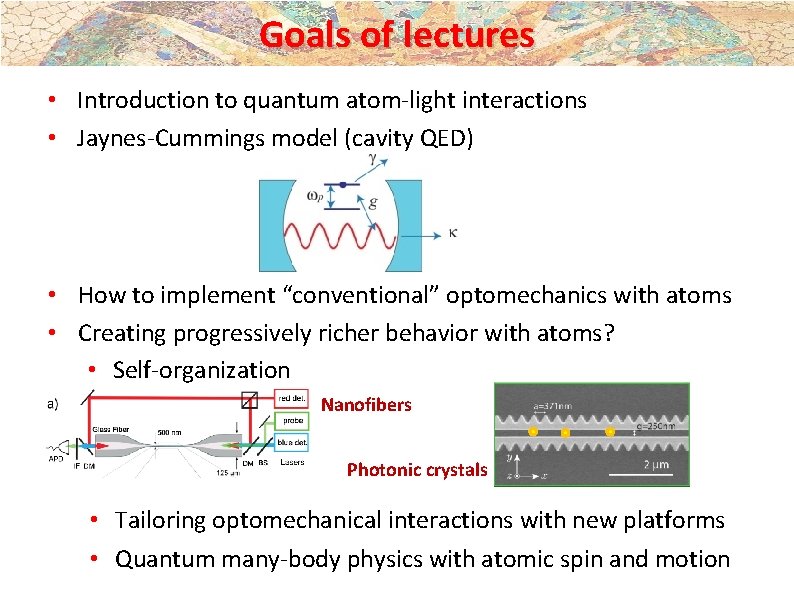
Goals of lectures • Introduction to quantum atom-light interactions • Jaynes-Cummings model (cavity QED) • How to implement “conventional” optomechanics with atoms • Creating progressively richer behavior with atoms? • Self-organization Nanofibers Photonic crystals • Tailoring optomechanical interactions with new platforms • Quantum many-body physics with atomic spin and motion
Introduction to atom-light interactions
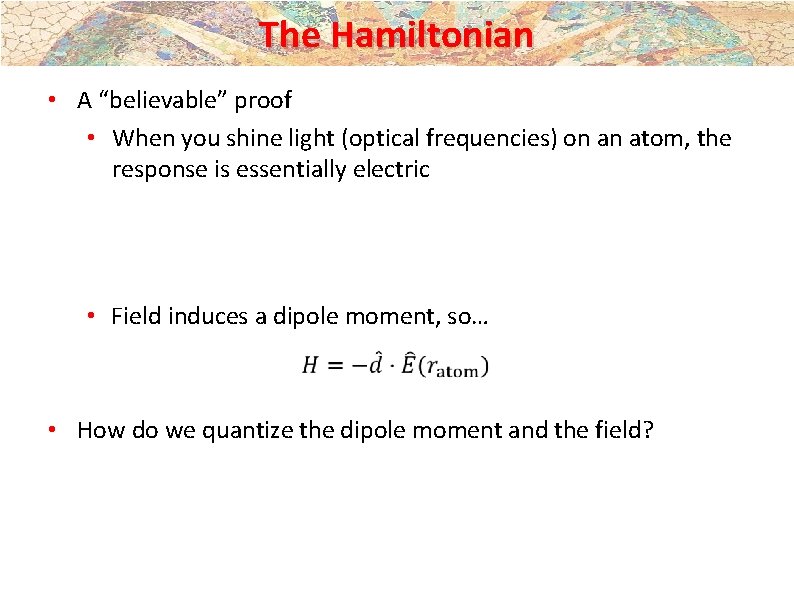
The Hamiltonian • A “believable” proof • When you shine light (optical frequencies) on an atom, the response is essentially electric • Field induces a dipole moment, so… • How do we quantize the dipole moment and the field?
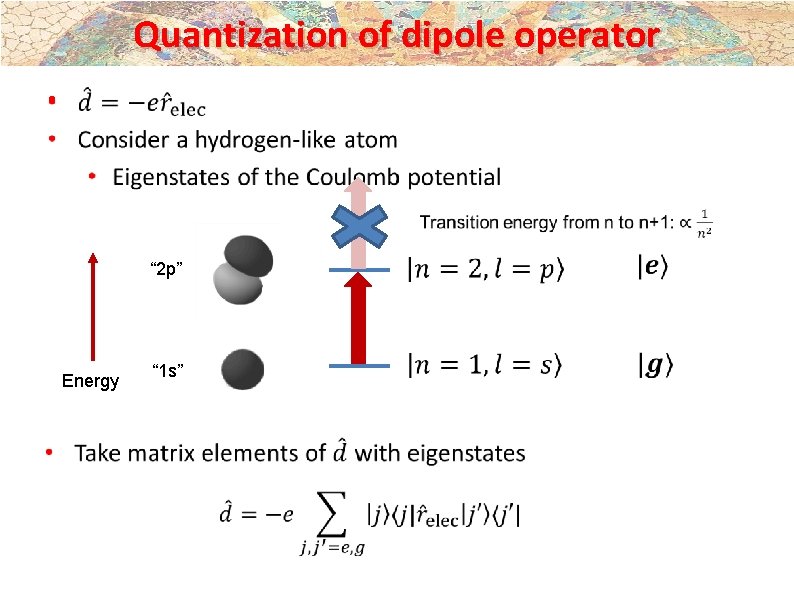
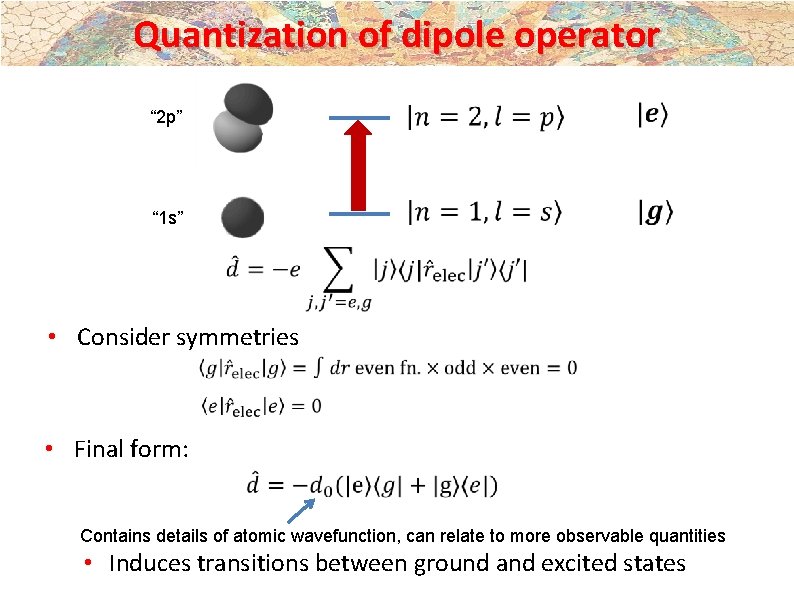
Quantization of dipole operator • “ 2 p” Energy “ 1 s”
Quantization of dipole operator “ 2 p” “ 1 s” • Consider symmetries • Final form: Contains details of atomic wavefunction, can relate to more observable quantities • Induces transitions between ground and excited states
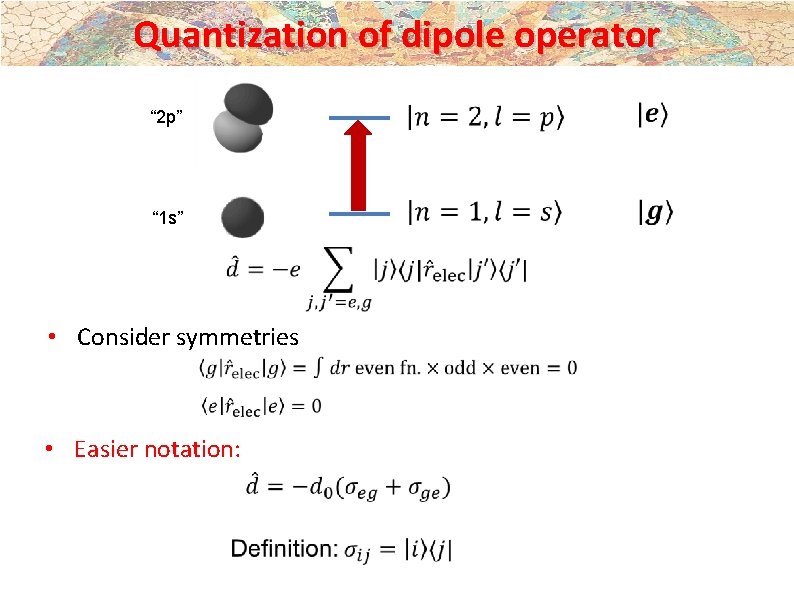
Quantization of dipole operator “ 2 p” “ 1 s” • Consider symmetries • Easier notation:
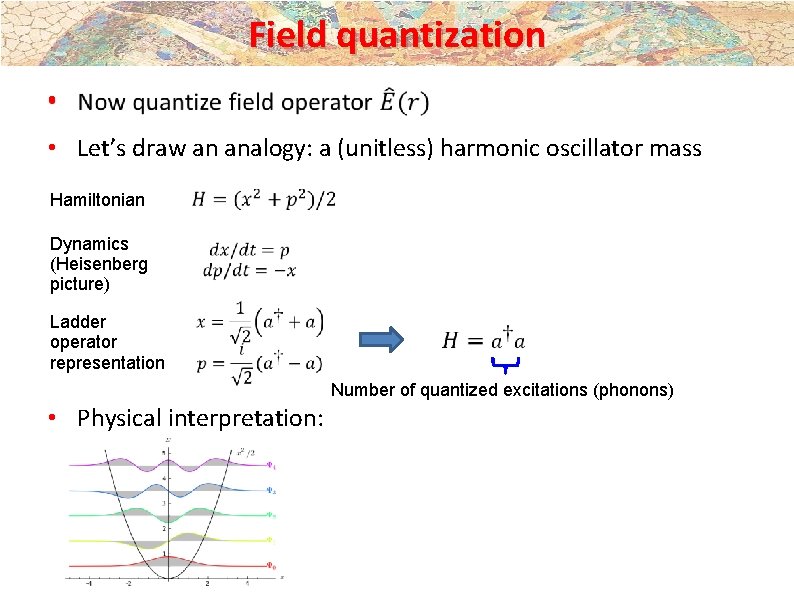
Field quantization • • Let’s draw an analogy: a (unitless) harmonic oscillator mass Hamiltonian Dynamics (Heisenberg picture) Ladder operator representation Number of quantized excitations (phonons) • Physical interpretation:
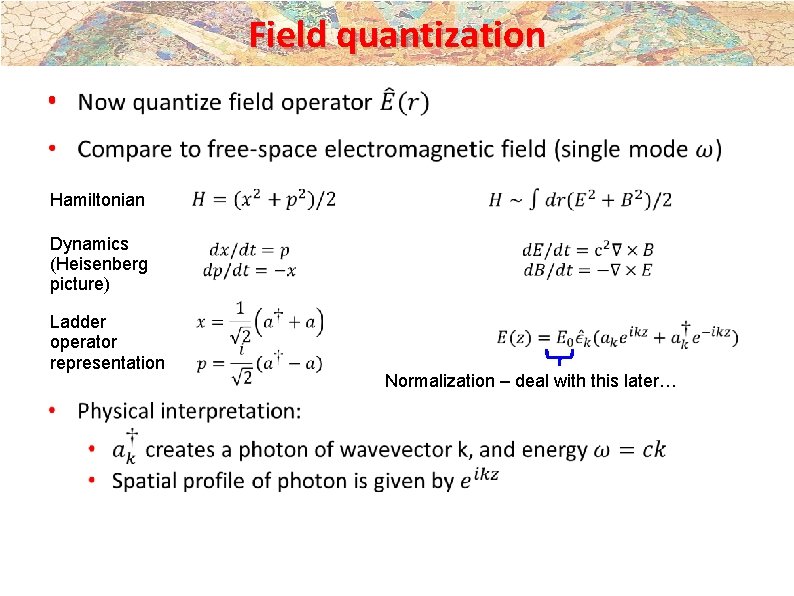
Field quantization • Hamiltonian Dynamics (Heisenberg picture) Ladder operator representation Normalization – deal with this later…
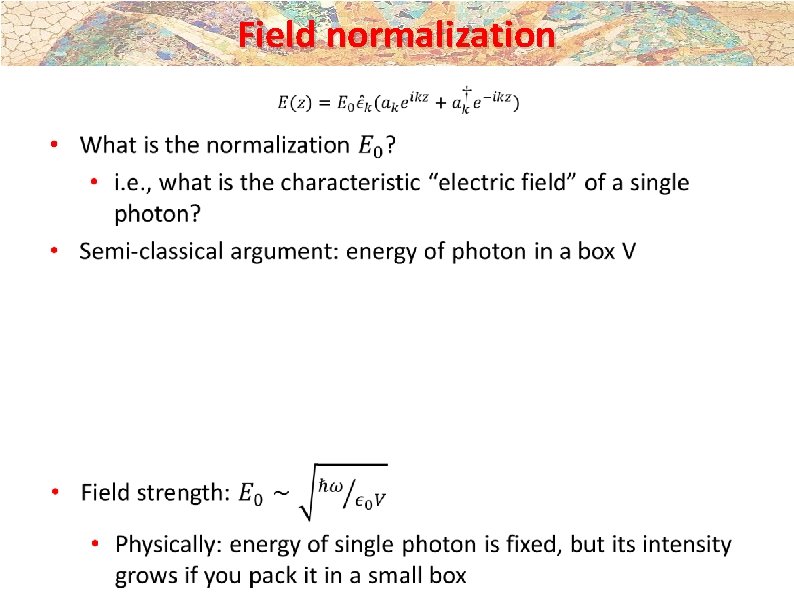
Field normalization •
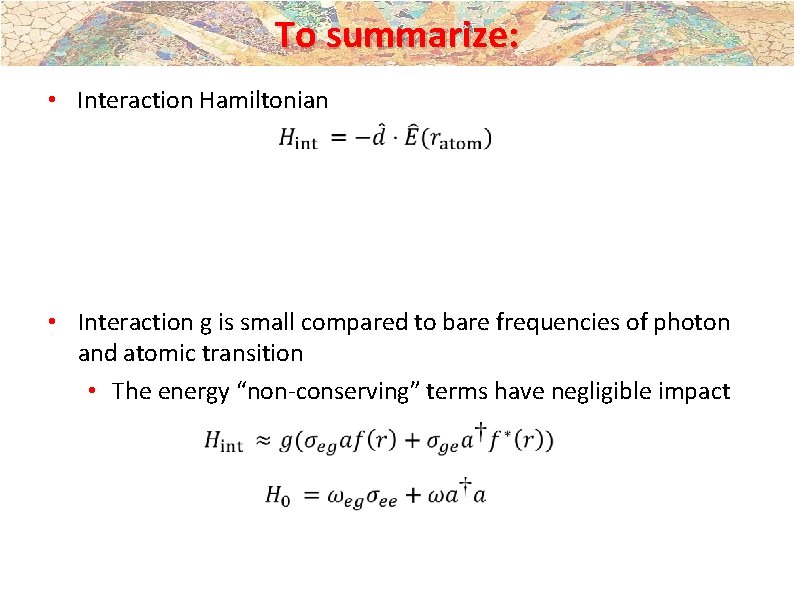
To summarize: • Interaction Hamiltonian • Interaction g is small compared to bare frequencies of photon and atomic transition • The energy “non-conserving” terms have negligible impact
Jaynes-Cummings model
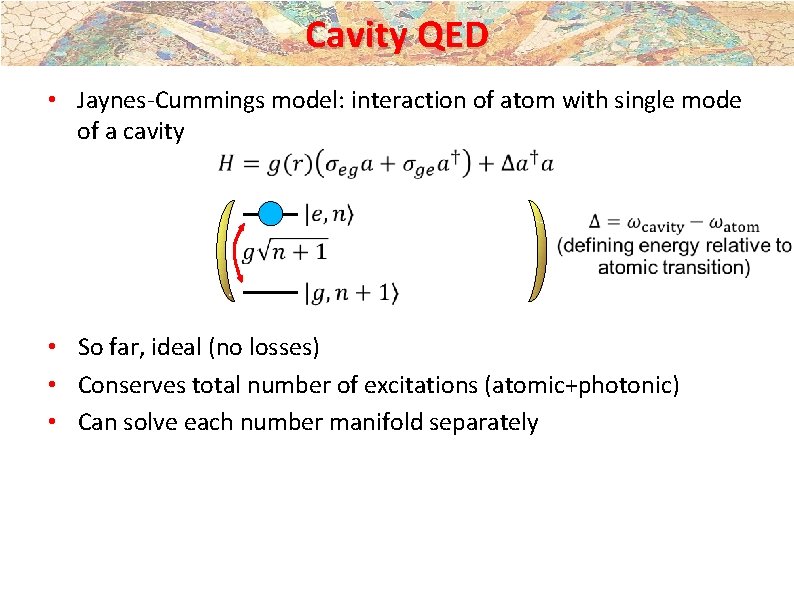
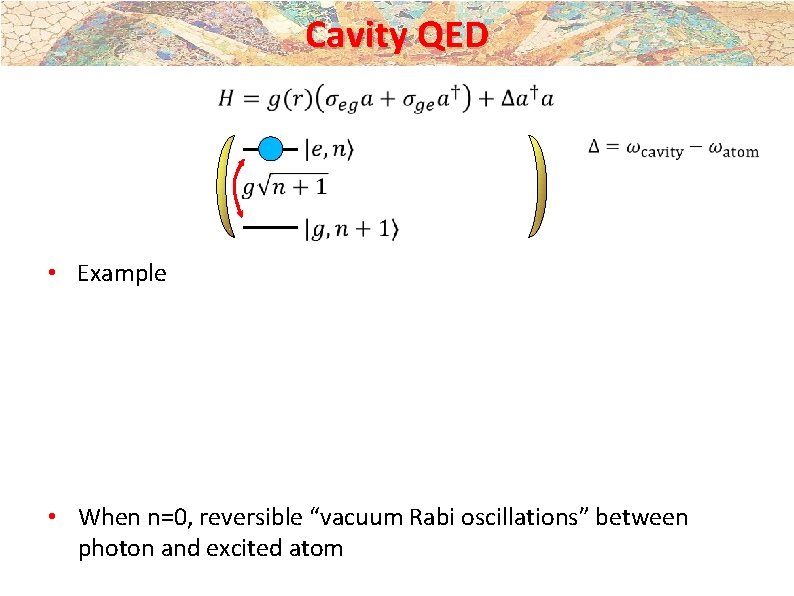
Cavity QED • Jaynes-Cummings model: interaction of atom with single mode of a cavity • So far, ideal (no losses) • Conserves total number of excitations (atomic+photonic) • Can solve each number manifold separately
Cavity QED • Example • When n=0, reversible “vacuum Rabi oscillations” between photon and excited atom
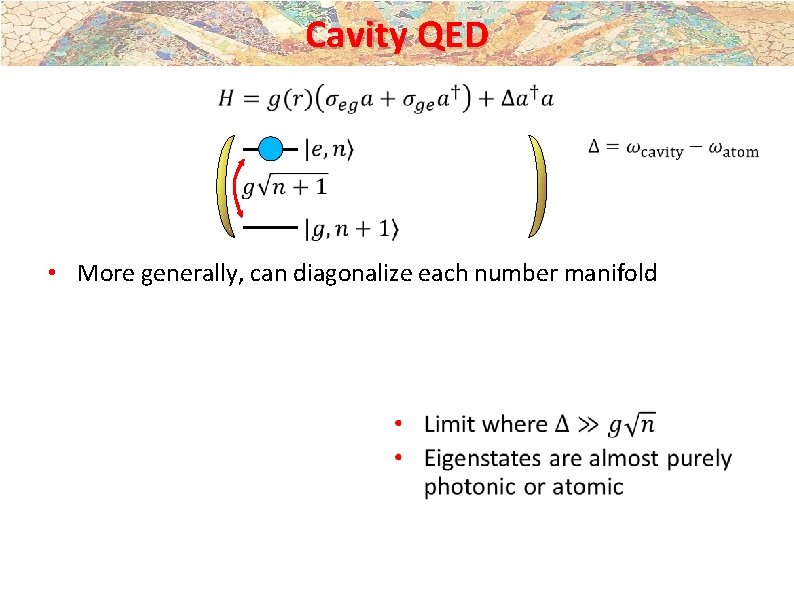
Cavity QED • More generally, can diagonalize each number manifold
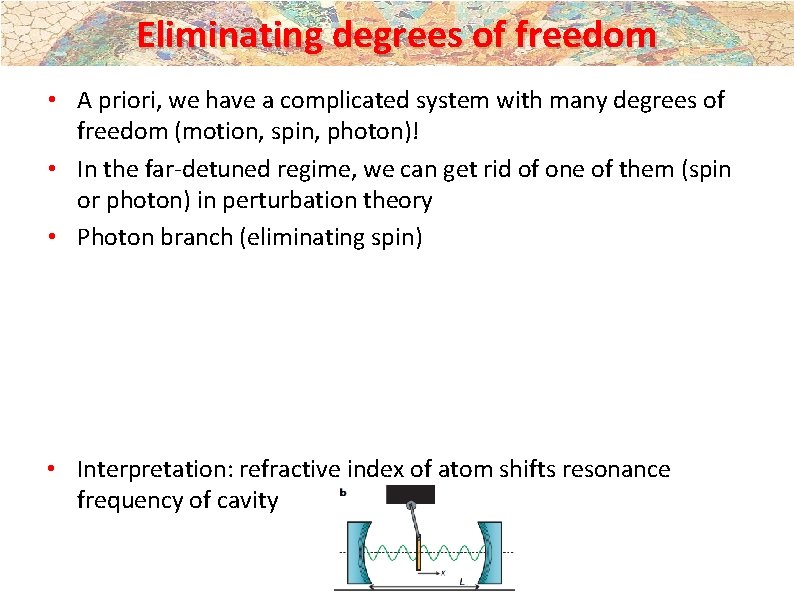
Eliminating degrees of freedom • A priori, we have a complicated system with many degrees of freedom (motion, spin, photon)! • In the far-detuned regime, we can get rid of one of them (spin or photon) in perturbation theory • Photon branch (eliminating spin) • Interpretation: refractive index of atom shifts resonance frequency of cavity
Conventional optomechanics with atoms
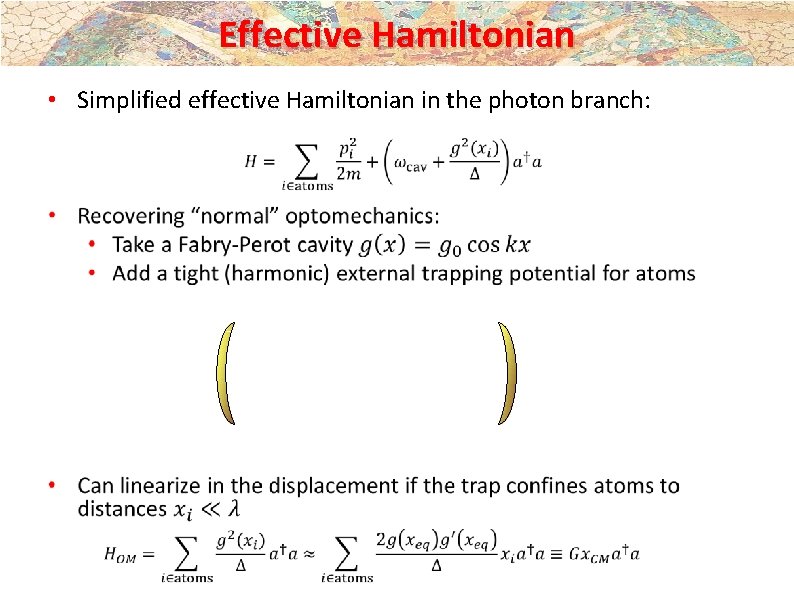
Effective Hamiltonian • Simplified effective Hamiltonian in the photon branch:
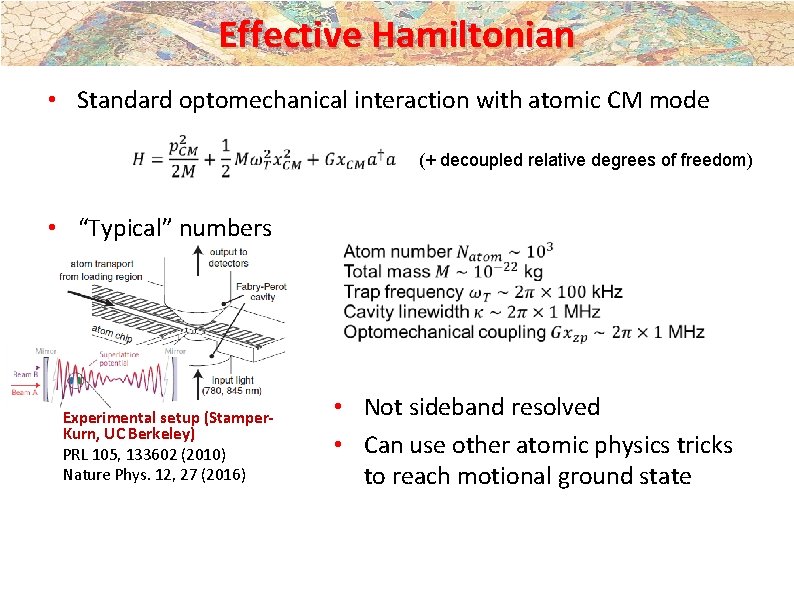
Effective Hamiltonian • Standard optomechanical interaction with atomic CM mode • “Typical” numbers Experimental setup (Stamper. Kurn, UC Berkeley) PRL 105, 133602 (2010) Nature Phys. 12, 27 (2016) (+ decoupled relative degrees of freedom) • Not sideband resolved • Can use other atomic physics tricks to reach motional ground state
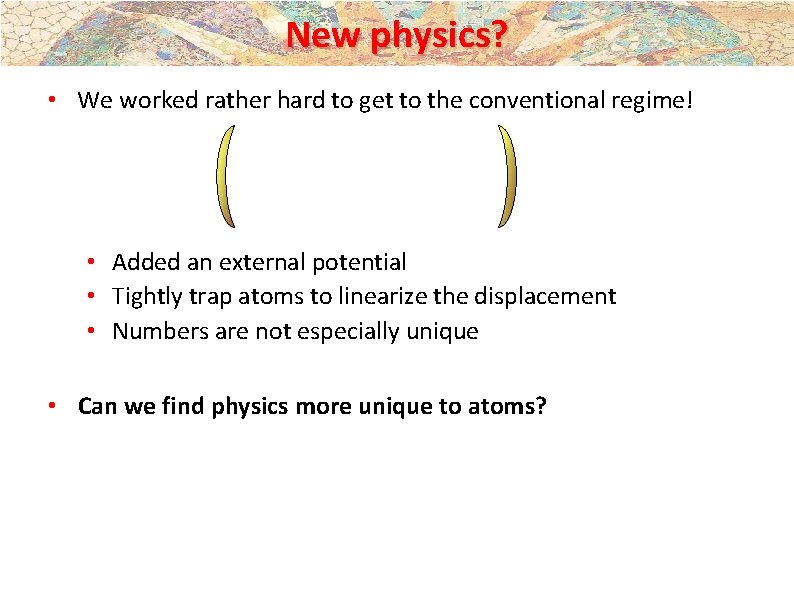
New physics? • We worked rather hard to get to the conventional regime! • Added an external potential • Tightly trap atoms to linearize the displacement • Numbers are not especially unique • Can we find physics more unique to atoms?
Jaynes-Cummings model: Spin branch
Eliminating the photons • A priori, we have a complicated system with many degrees of freedom (motion, spin, photon)! • What if we eliminate the photons instead?
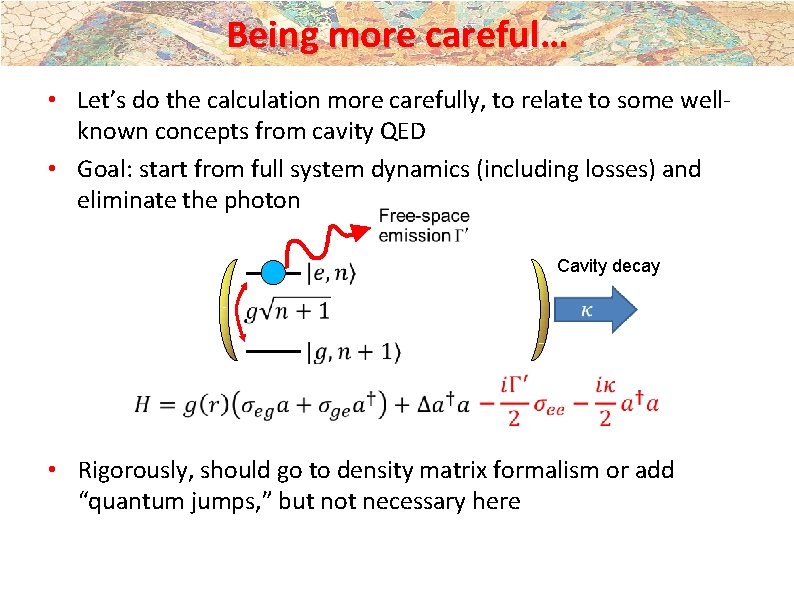
Being more careful… • Let’s do the calculation more carefully, to relate to some wellknown concepts from cavity QED • Goal: start from full system dynamics (including losses) and eliminate the photon Cavity decay • Rigorously, should go to density matrix formalism or add “quantum jumps, ” but not necessary here
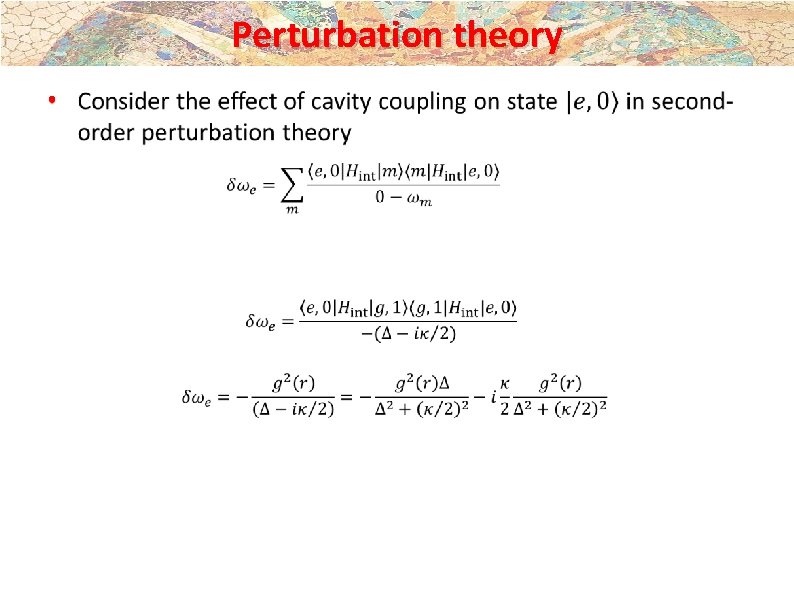
Perturbation theory •
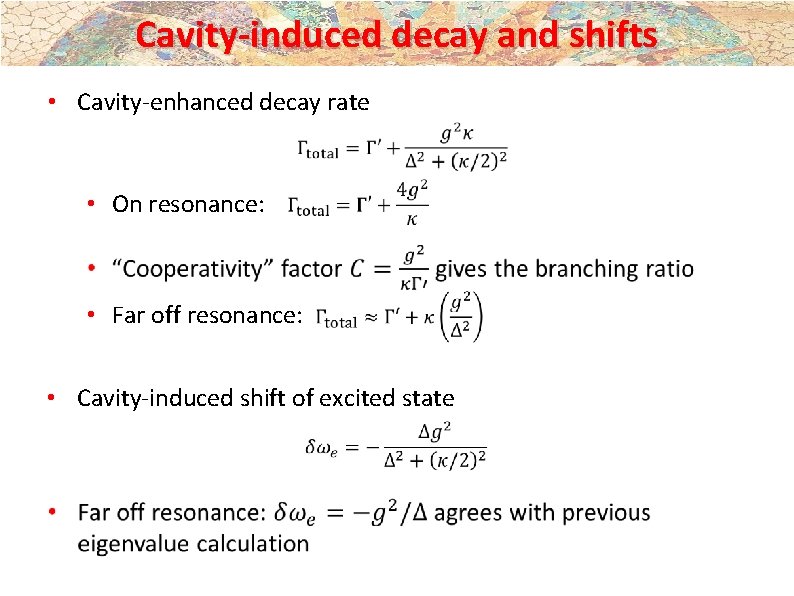
Cavity-induced decay and shifts • Cavity-enhanced decay rate • On resonance: • Far off resonance: • Cavity-induced shift of excited state
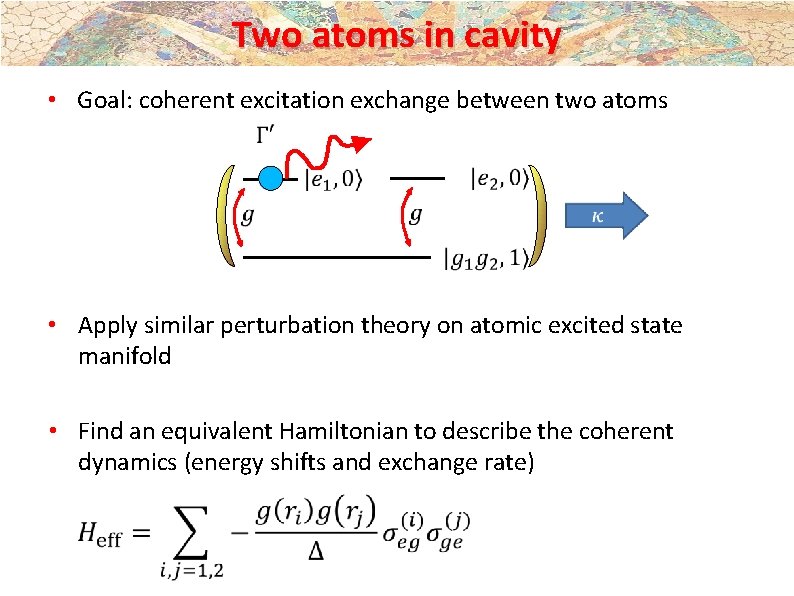
Two atoms in cavity • Goal: coherent excitation exchange between two atoms • Apply similar perturbation theory on atomic excited state manifold • Find an equivalent Hamiltonian to describe the coherent dynamics (energy shifts and exchange rate)
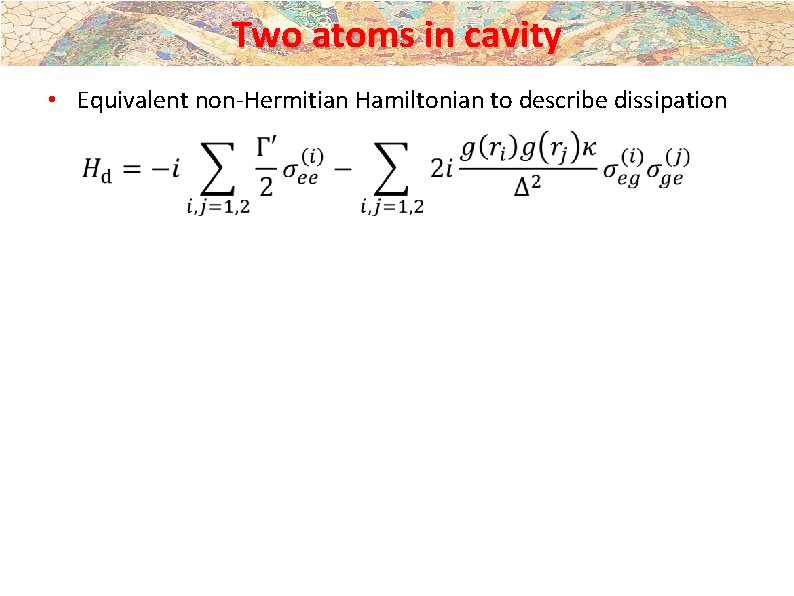
Two atoms in cavity • Equivalent non-Hermitian Hamiltonian to describe dissipation
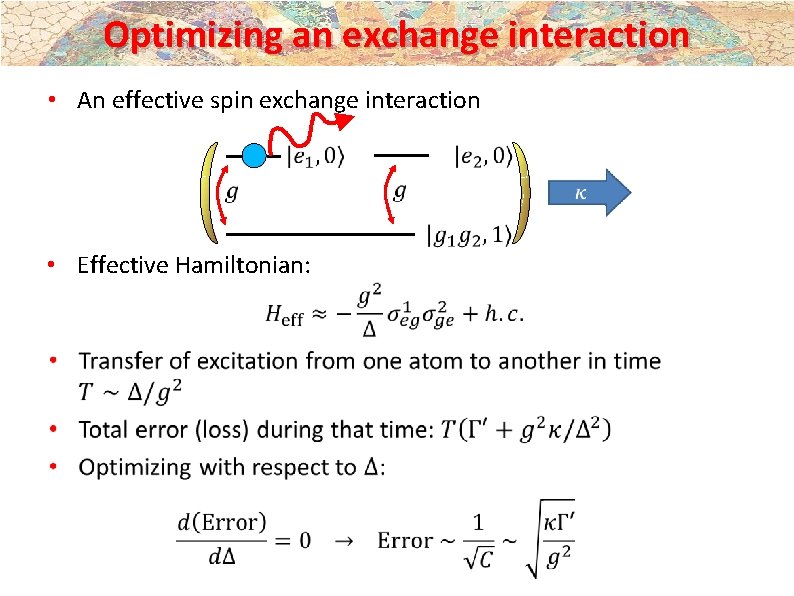
Optimizing an exchange interaction • An effective spin exchange interaction • Effective Hamiltonian:
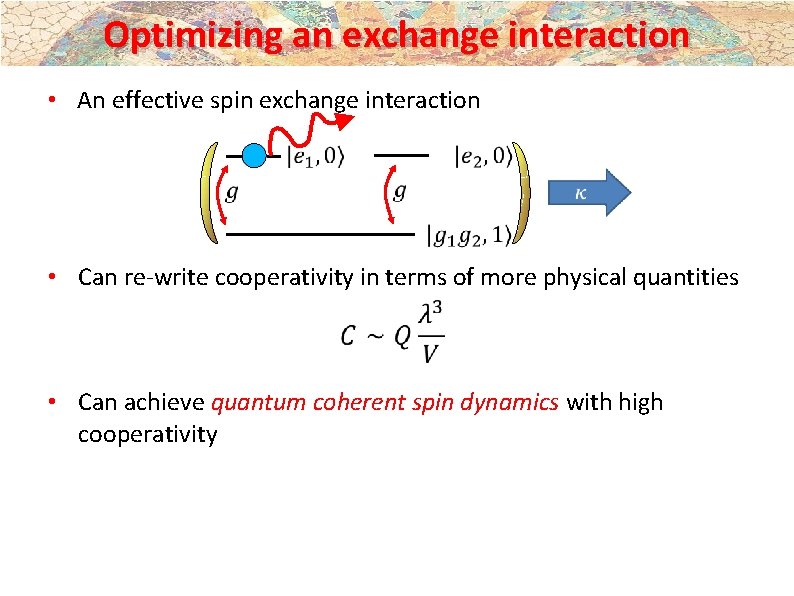
Optimizing an exchange interaction • An effective spin exchange interaction • Can re-write cooperativity in terms of more physical quantities • Can achieve quantum coherent spin dynamics with high cooperativity
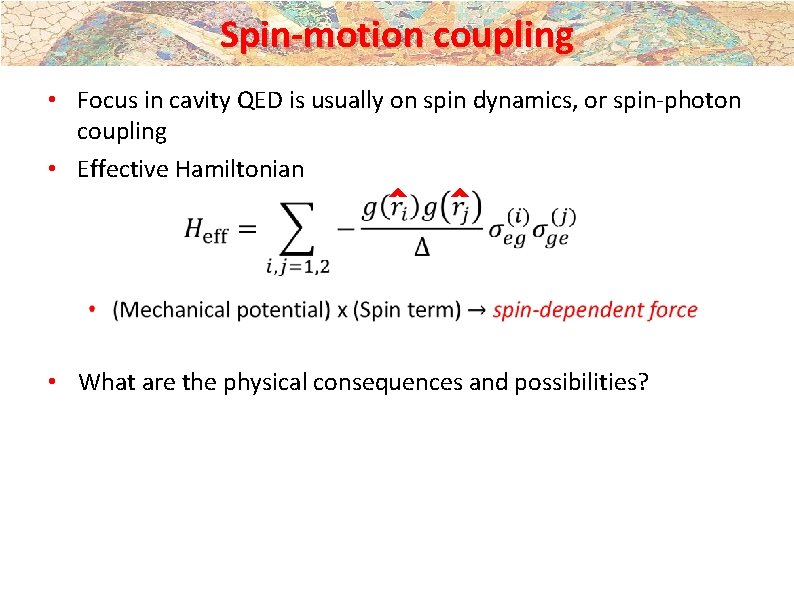
Spin-motion coupling • Focus in cavity QED is usually on spin dynamics, or spin-photon coupling • Effective Hamiltonian • What are the physical consequences and possibilities?
Self-organization of atoms in a cavity
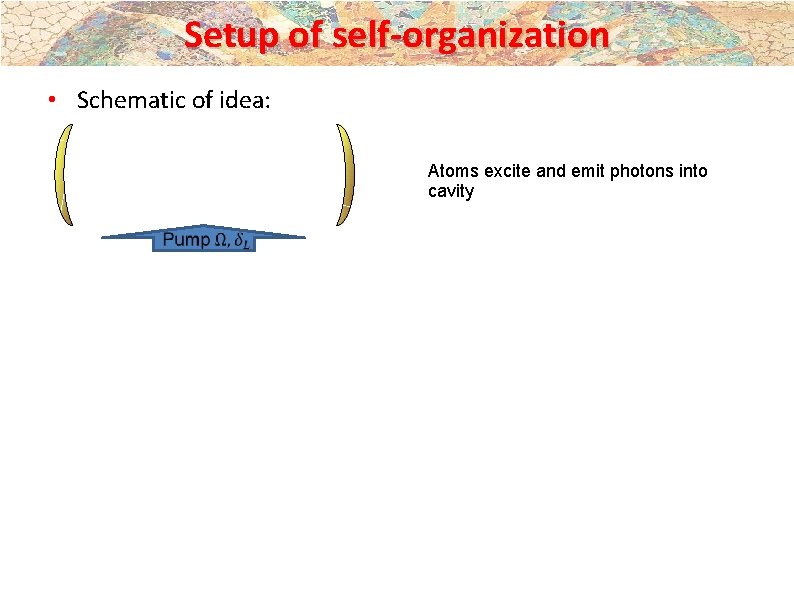
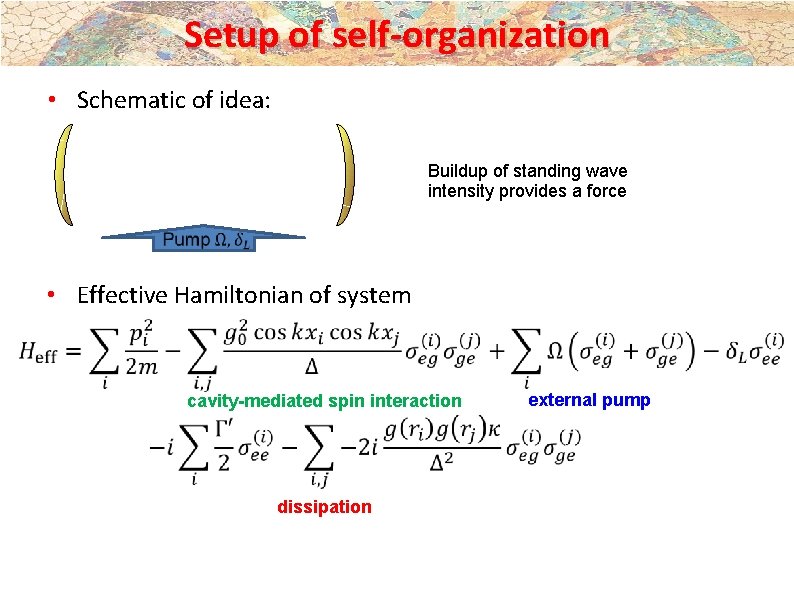
Setup of self-organization • Schematic of idea: Atoms excite and emit photons into cavity
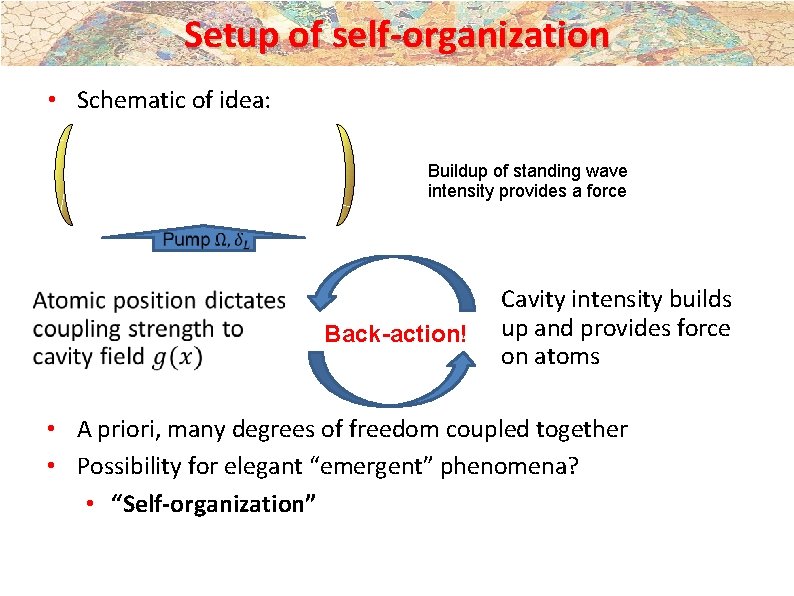
Setup of self-organization • Schematic of idea: Buildup of standing wave intensity provides a force Back-action! Cavity intensity builds up and provides force on atoms • A priori, many degrees of freedom coupled together • Possibility for elegant “emergent” phenomena? • “Self-organization”
Setup of self-organization • Schematic of idea: Buildup of standing wave intensity provides a force • Effective Hamiltonian of system cavity-mediated spin interaction dissipation external pump
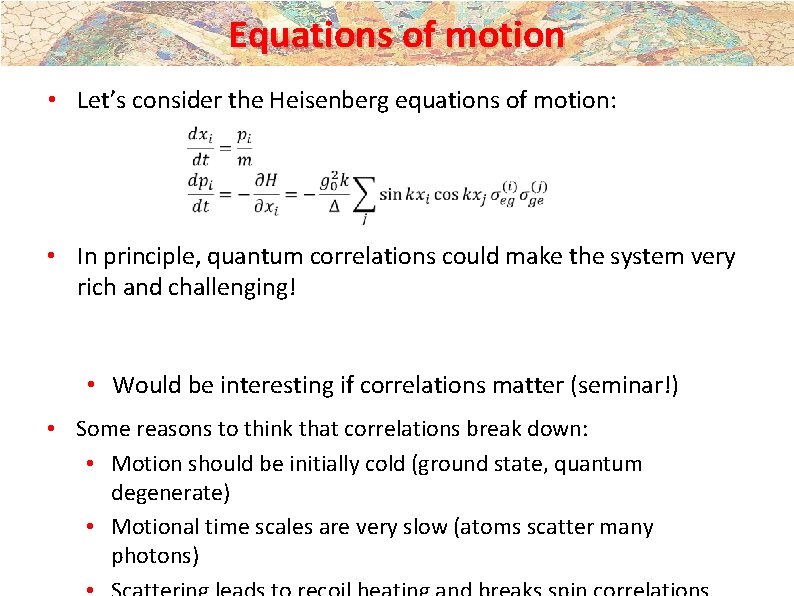
Equations of motion • Let’s consider the Heisenberg equations of motion: • In principle, quantum correlations could make the system very rich and challenging! • Would be interesting if correlations matter (seminar!) • Some reasons to think that correlations break down: • Motion should be initially cold (ground state, quantum degenerate) • Motional time scales are very slow (atoms scatter many photons)
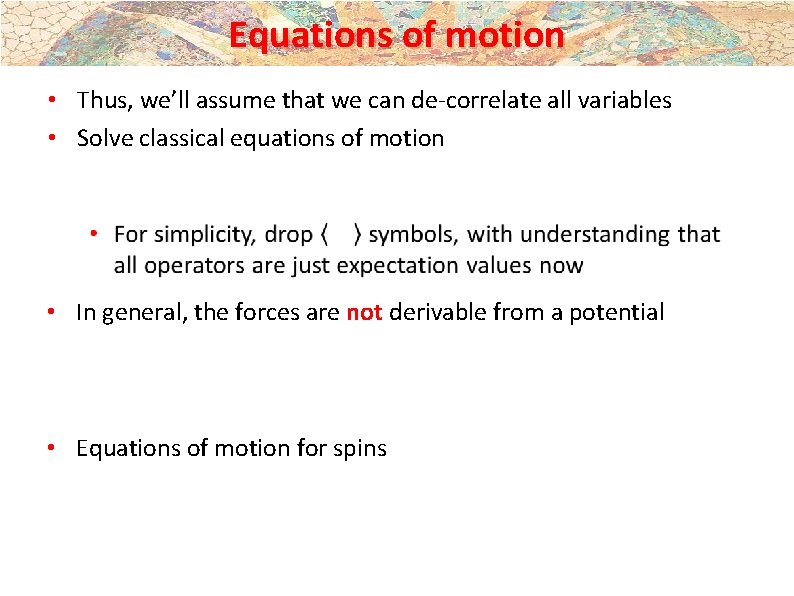
Equations of motion • Thus, we’ll assume that we can de-correlate all variables • Solve classical equations of motion • In general, the forces are not derivable from a potential • Equations of motion for spins
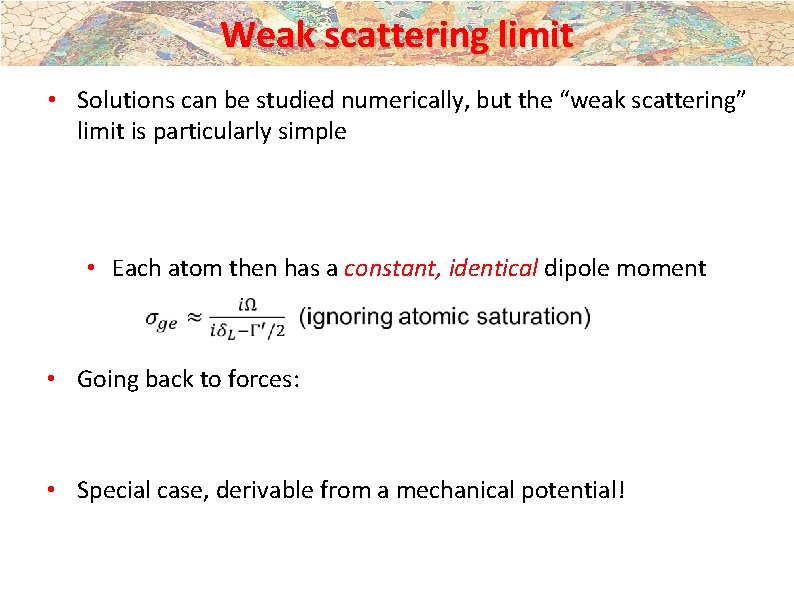
Weak scattering limit • Solutions can be studied numerically, but the “weak scattering” limit is particularly simple • Each atom then has a constant, identical dipole moment • Going back to forces: • Special case, derivable from a mechanical potential!
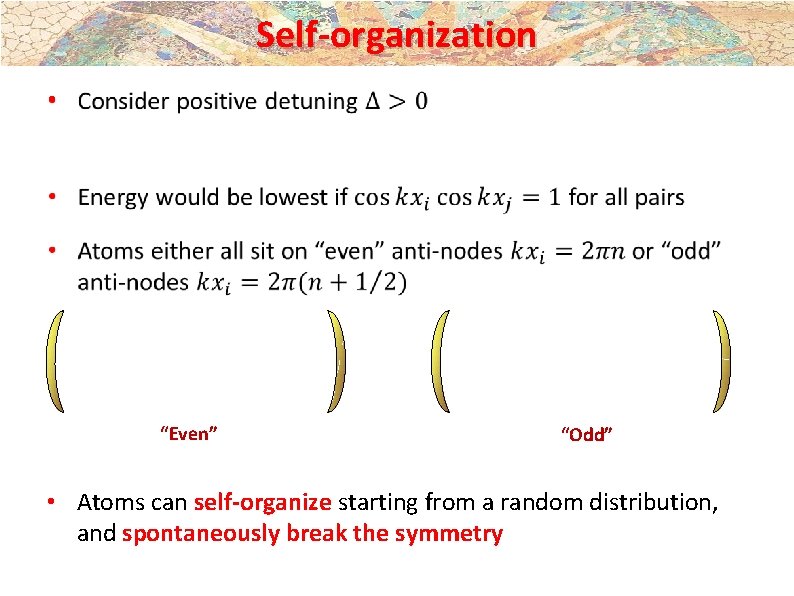
Self-organization • “Even” “Odd” • Atoms can self-organize starting from a random distribution, and spontaneously break the symmetry
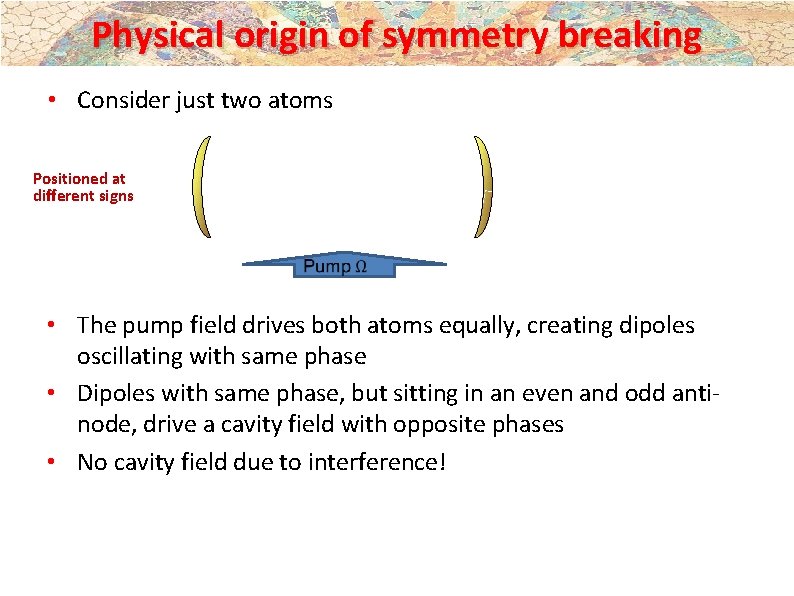
Physical origin of symmetry breaking • Consider just two atoms Positioned at different signs • The pump field drives both atoms equally, creating dipoles oscillating with same phase • Dipoles with same phase, but sitting in an even and odd antinode, drive a cavity field with opposite phases • No cavity field due to interference!
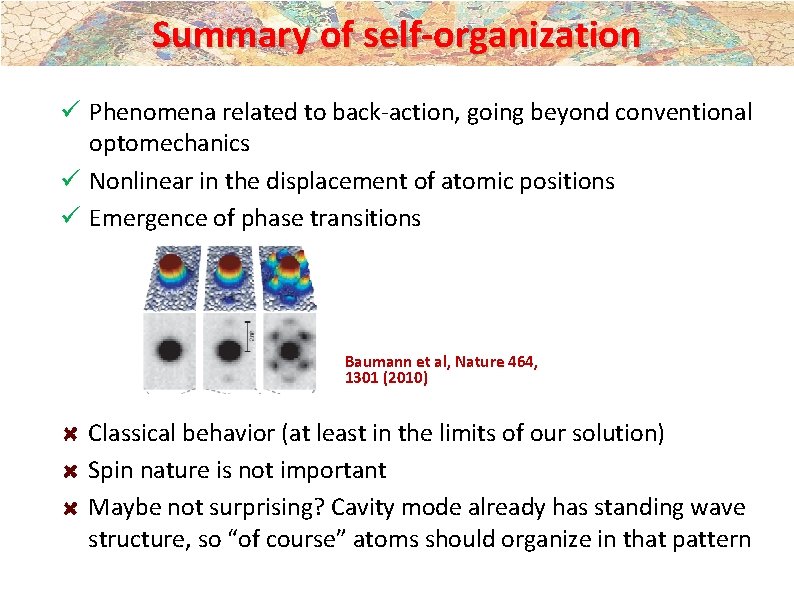
Summary of self-organization ü Phenomena related to back-action, going beyond conventional optomechanics ü Nonlinear in the displacement of atomic positions ü Emergence of phase transitions Baumann et al, Nature 464, 1301 (2010) Classical behavior (at least in the limits of our solution) Spin nature is not important Maybe not surprising? Cavity mode already has standing wave structure, so “of course” atoms should organize in that pattern
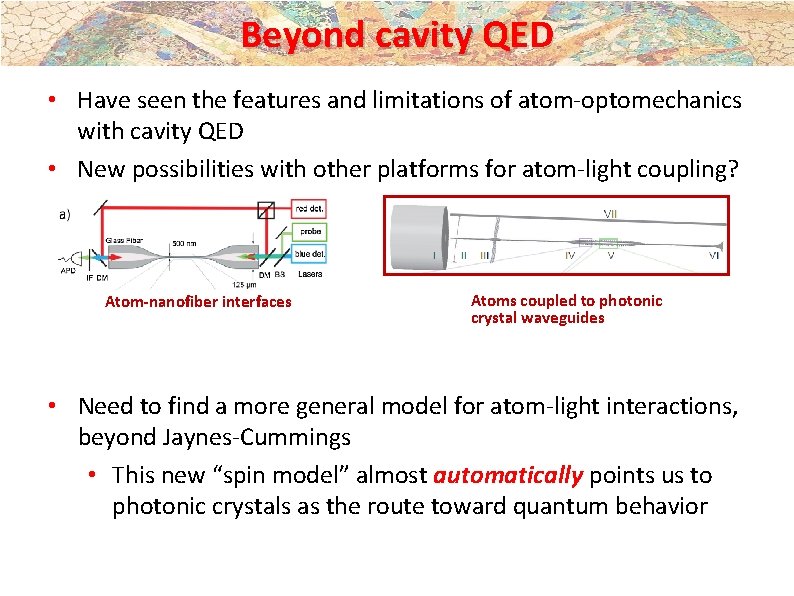
Beyond cavity QED • Have seen the features and limitations of atom-optomechanics with cavity QED • New possibilities with other platforms for atom-light coupling? Atom-nanofiber interfaces Atoms coupled to photonic crystal waveguides • Need to find a more general model for atom-light interactions, beyond Jaynes-Cummings • This new “spin model” almost automatically points us to photonic crystals as the route toward quantum behavior
Quantum spin model for atom-light interfaces
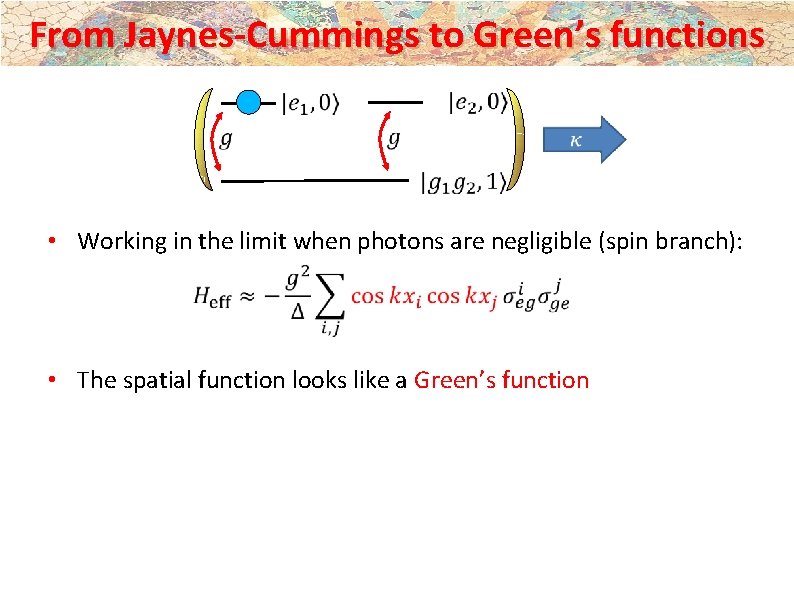
From Jaynes-Cummings to Green’s functions • Working in the limit when photons are negligible (spin branch): • The spatial function looks like a Green’s function
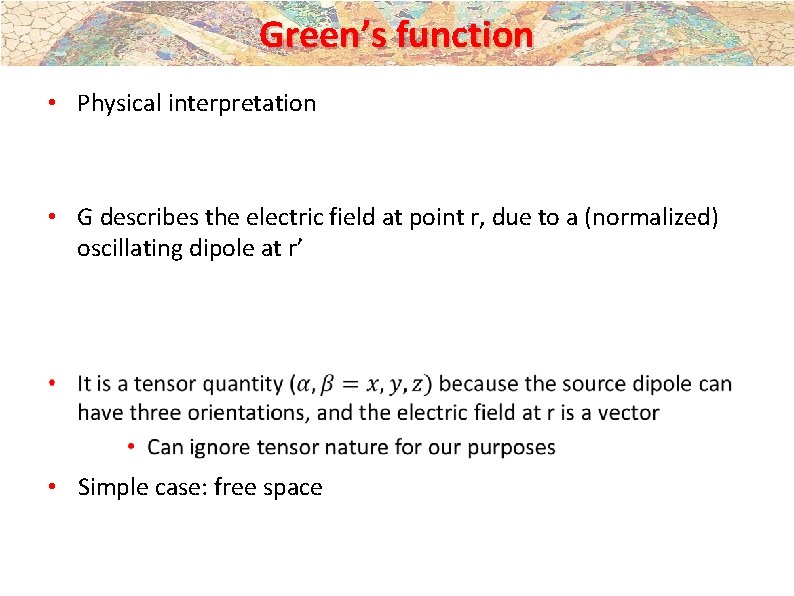
Green’s function • Physical interpretation • G describes the electric field at point r, due to a (normalized) oscillating dipole at r’ • Simple case: free space
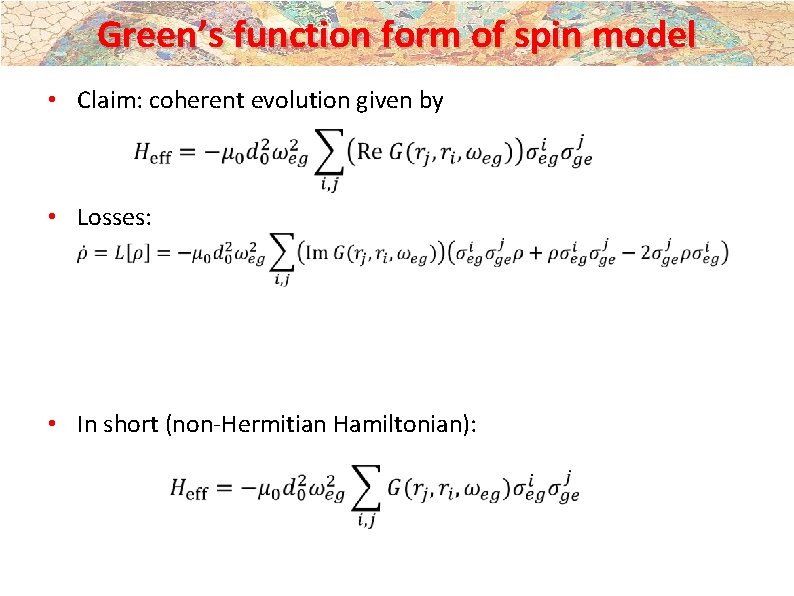
Green’s function form of spin model • Claim: coherent evolution given by • Losses: • In short (non-Hermitian Hamiltonian):
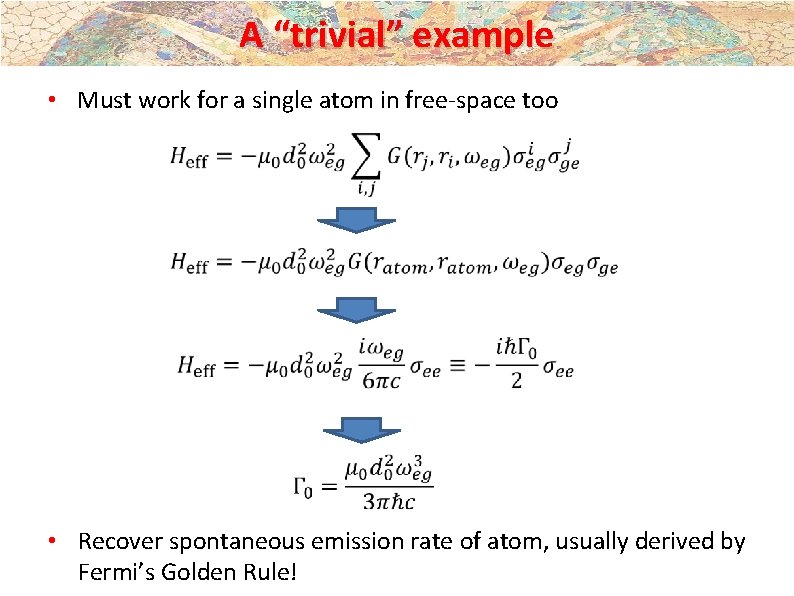
A “trivial” example • Must work for a single atom in free-space too • Recover spontaneous emission rate of atom, usually derived by Fermi’s Golden Rule!
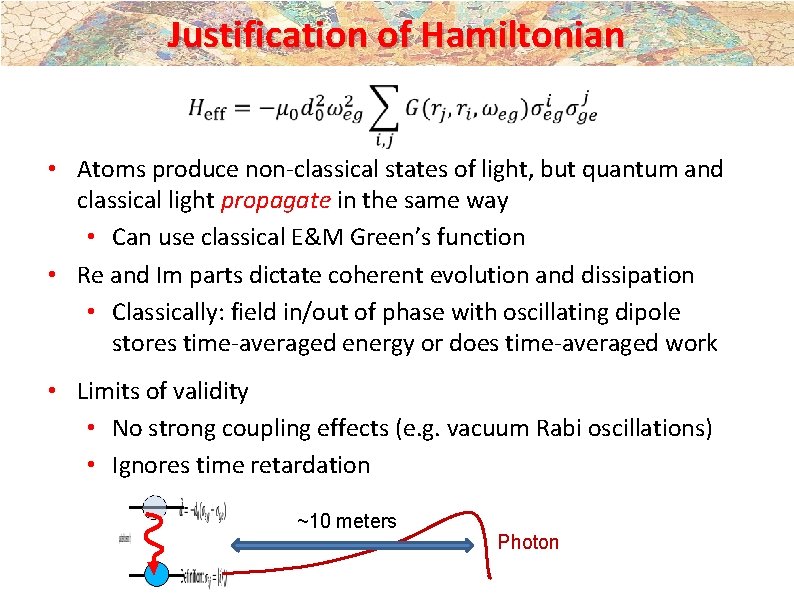
Justification of Hamiltonian • Atoms produce non-classical states of light, but quantum and classical light propagate in the same way • Can use classical E&M Green’s function • Re and Im parts dictate coherent evolution and dissipation • Classically: field in/out of phase with oscillating dipole stores time-averaged energy or does time-averaged work • Limits of validity • No strong coupling effects (e. g. vacuum Rabi oscillations) • Ignores time retardation ~10 meters Photon
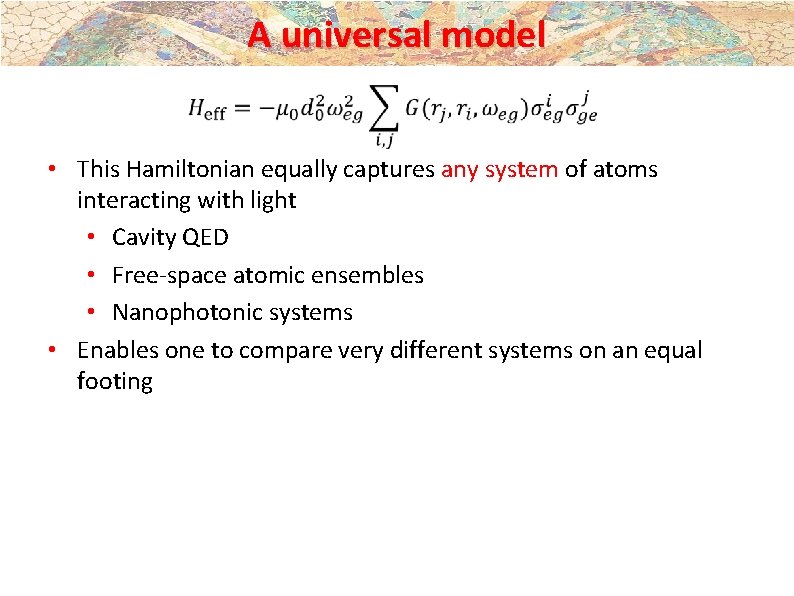
A universal model • This Hamiltonian equally captures any system of atoms interacting with light • Cavity QED • Free-space atomic ensembles • Nanophotonic systems • Enables one to compare very different systems on an equal footing
Basics of atom-nanofiber experiment
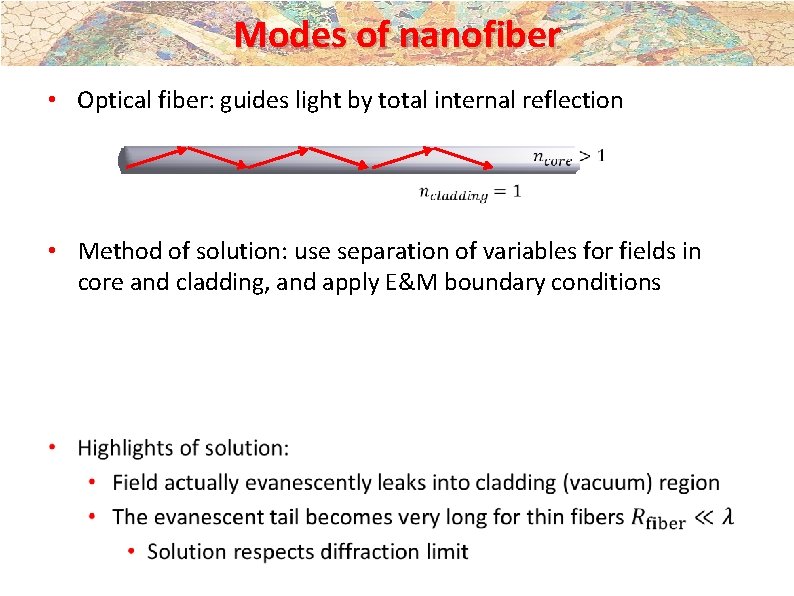
Modes of nanofiber • Optical fiber: guides light by total internal reflection • Method of solution: use separation of variables for fields in core and cladding, and apply E&M boundary conditions
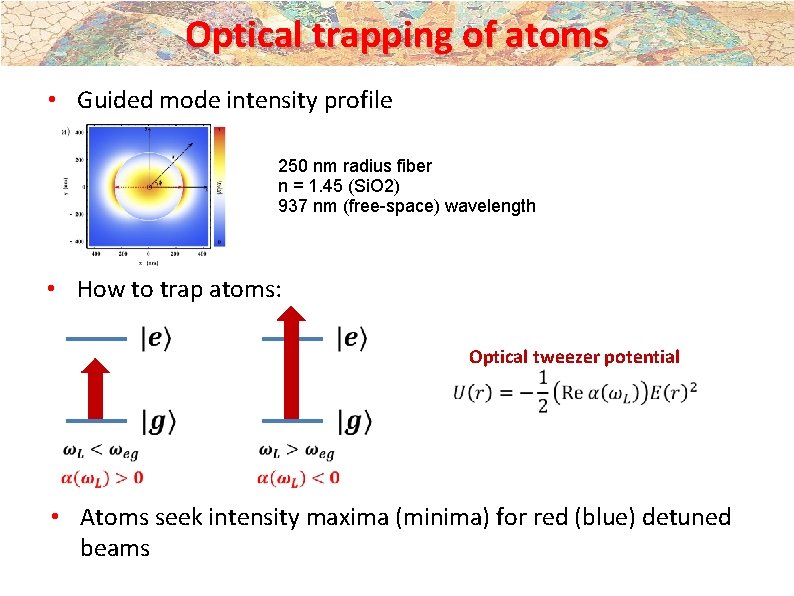
Optical trapping of atoms • Guided mode intensity profile 250 nm radius fiber n = 1. 45 (Si. O 2) 937 nm (free-space) wavelength • How to trap atoms: Optical tweezer potential • Atoms seek intensity maxima (minima) for red (blue) detuned beams
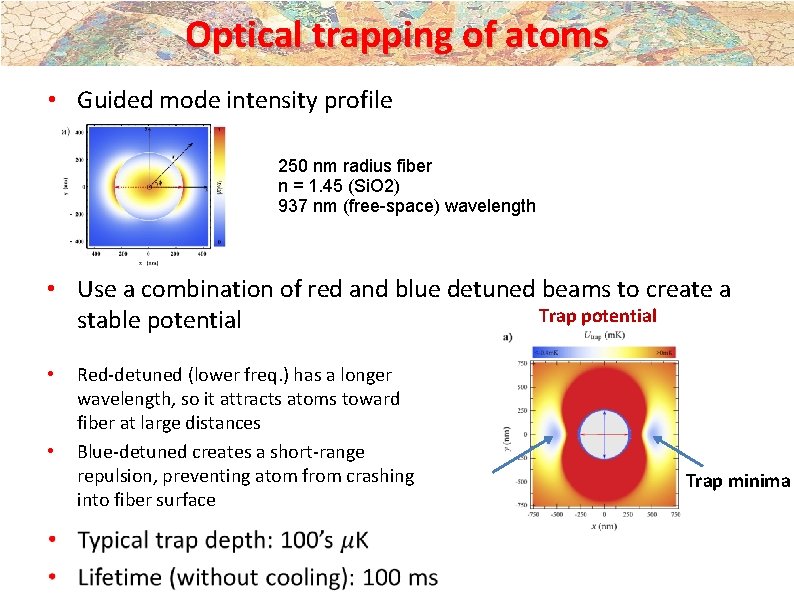
Optical trapping of atoms • Guided mode intensity profile 250 nm radius fiber n = 1. 45 (Si. O 2) 937 nm (free-space) wavelength • Use a combination of red and blue detuned beams to create a Trap potential stable potential • • Red-detuned (lower freq. ) has a longer wavelength, so it attracts atoms toward fiber at large distances Blue-detuned creates a short-range repulsion, preventing atom from crashing into fiber surface Trap minima
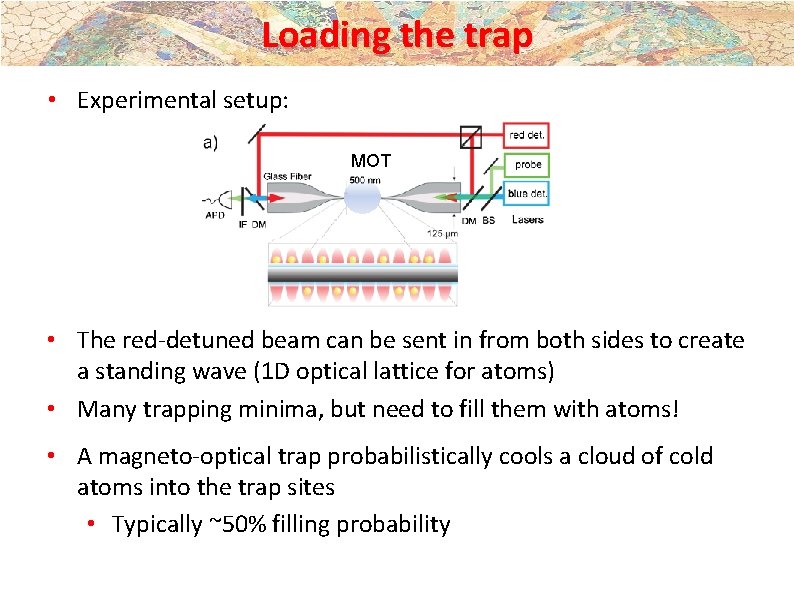
Loading the trap • Experimental setup: MOT • The red-detuned beam can be sent in from both sides to create a standing wave (1 D optical lattice for atoms) • Many trapping minima, but need to fill them with atoms! • A magneto-optical trap probabilistically cools a cloud of cold atoms into the trap sites • Typically ~50% filling probability
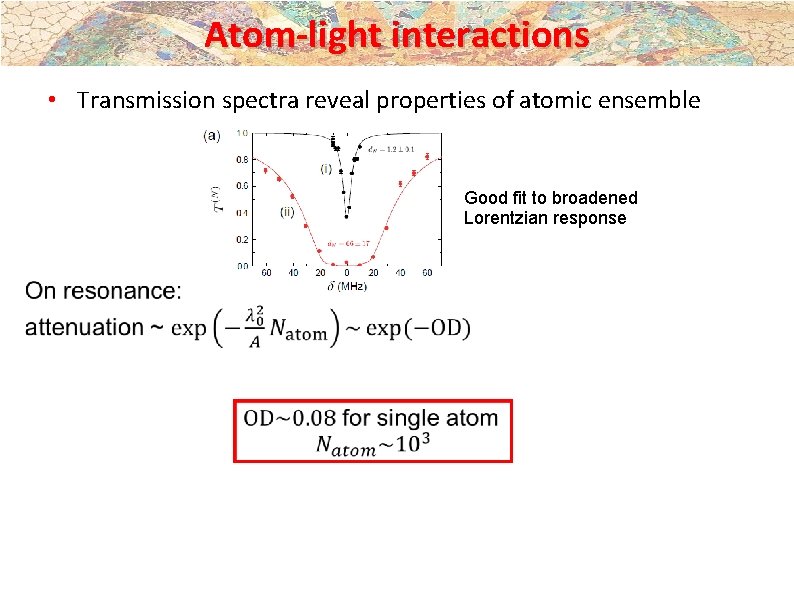
Atom-light interactions • Transmission spectra reveal properties of atomic ensemble Good fit to broadened Lorentzian response
Atom-nanofiber spin model
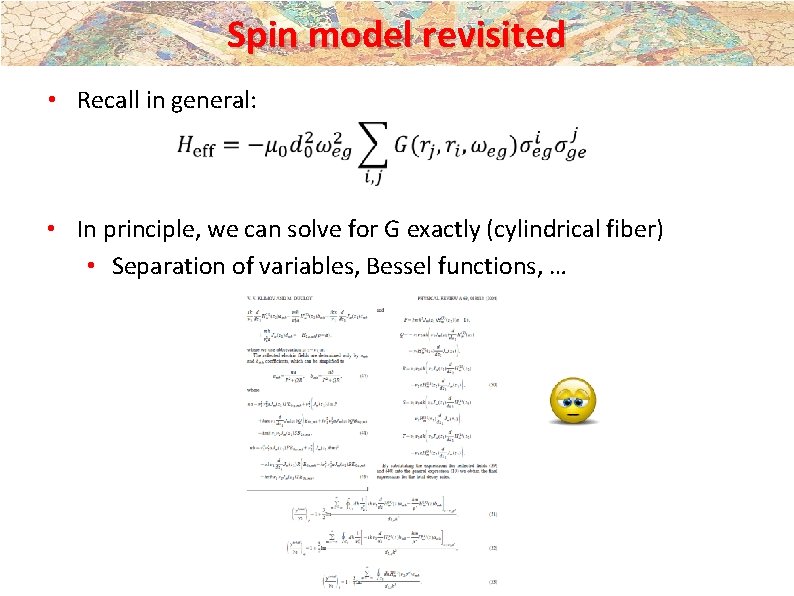
Spin model revisited • Recall in general: • In principle, we can solve for G exactly (cylindrical fiber) • Separation of variables, Bessel functions, …
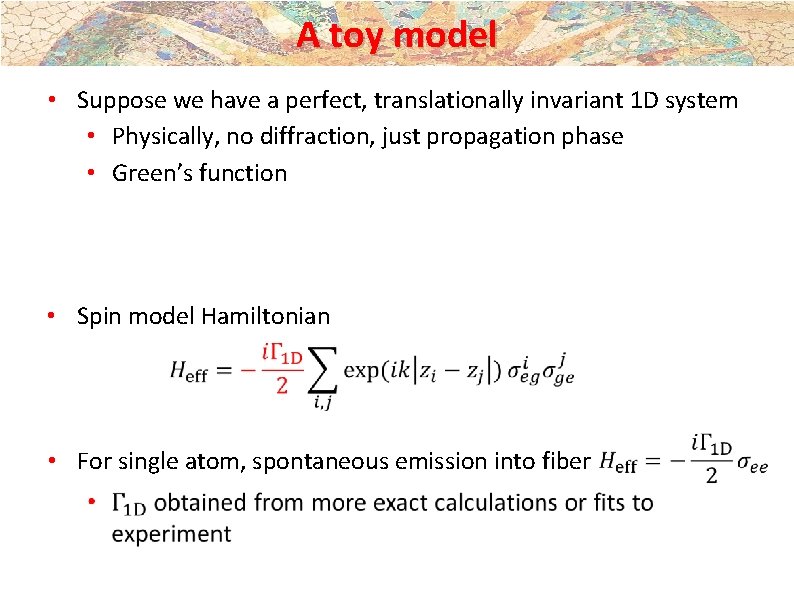
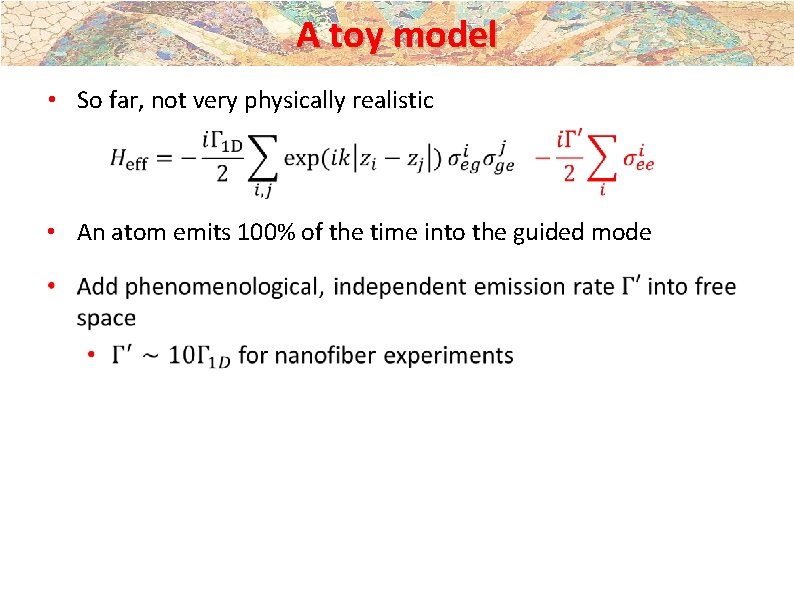
A toy model • Suppose we have a perfect, translationally invariant 1 D system • Physically, no diffraction, just propagation phase • Green’s function • Spin model Hamiltonian • For single atom, spontaneous emission into fiber
A toy model • So far, not very physically realistic • An atom emits 100% of the time into the guided mode
Self-organization of fibers in waveguide (recall the discussion session!)
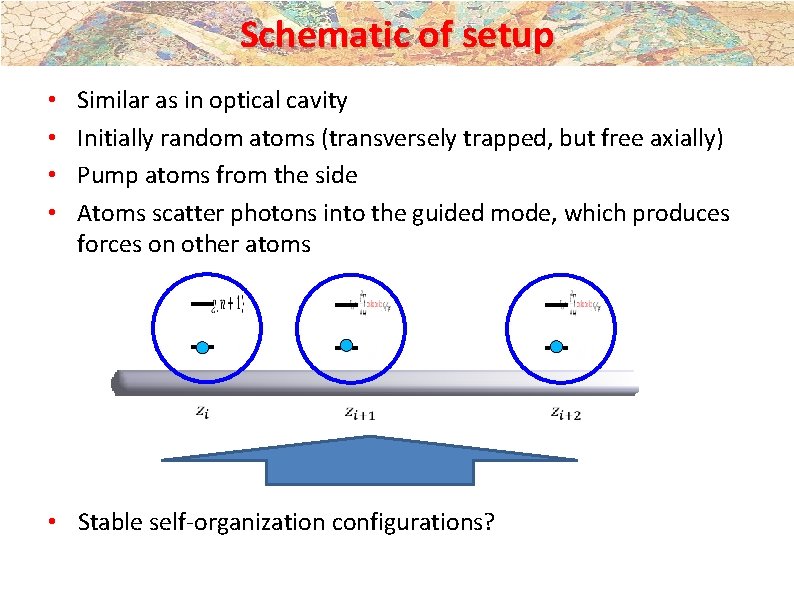
Schematic of setup • • Similar as in optical cavity Initially random atoms (transversely trapped, but free axially) Pump atoms from the side Atoms scatter photons into the guided mode, which produces forces on other atoms • Stable self-organization configurations?
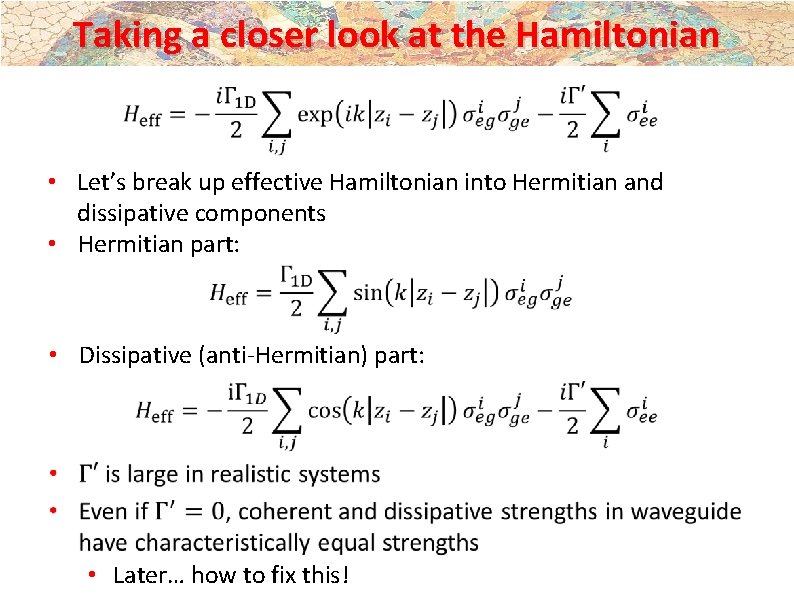
Taking a closer look at the Hamiltonian • Let’s break up effective Hamiltonian into Hermitian and dissipative components • Hermitian part: • Dissipative (anti-Hermitian) part: • Later… how to fix this!
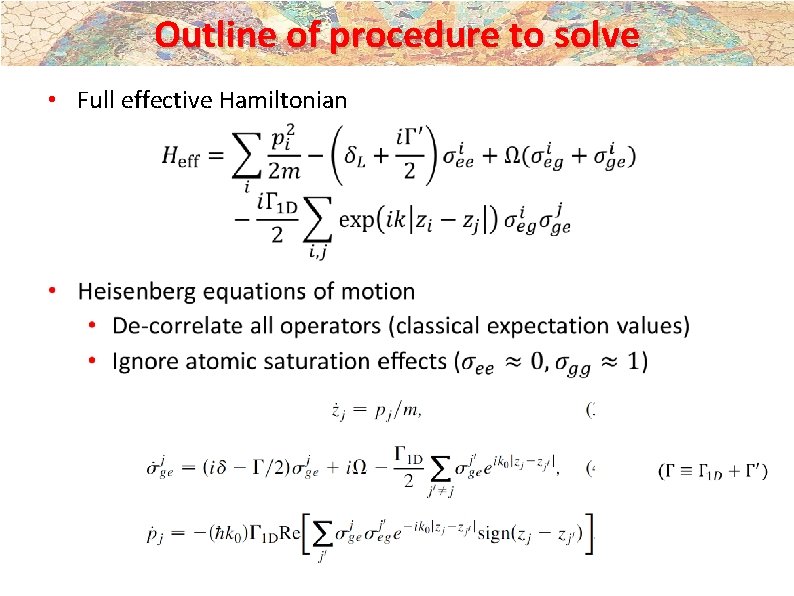
Outline of procedure to solve • Full effective Hamiltonian
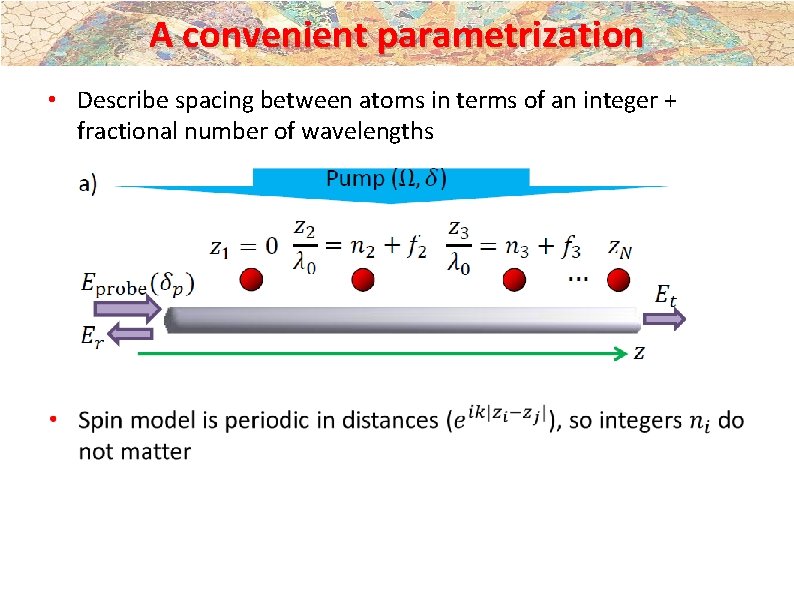
A convenient parametrization • Describe spacing between atoms in terms of an integer + fractional number of wavelengths
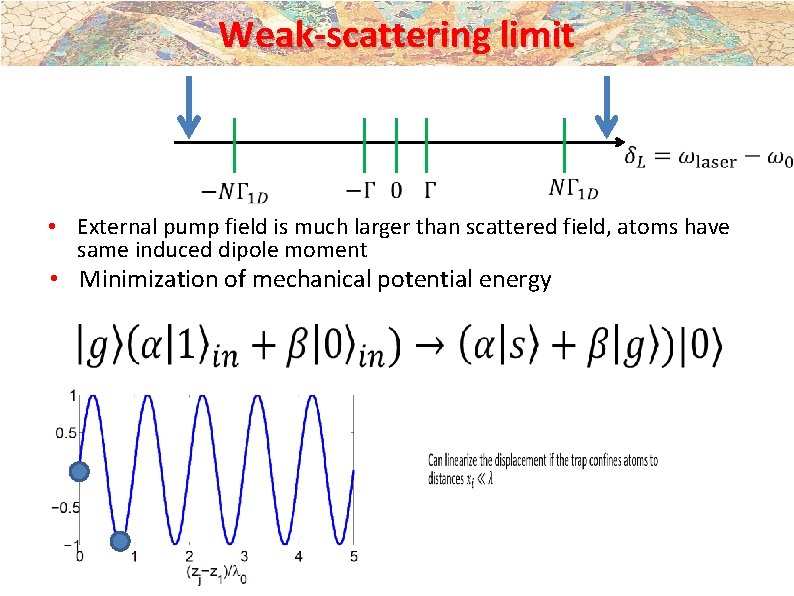
Weak-scattering limit • External pump field is much larger than scattered field, atoms have same induced dipole moment • Minimization of mechanical potential energy
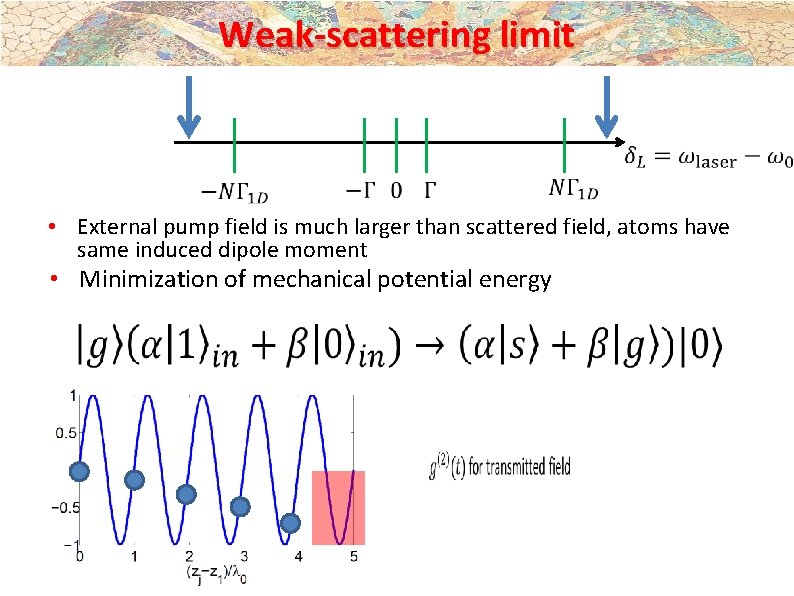
Weak-scattering limit • External pump field is much larger than scattered field, atoms have same induced dipole moment • Minimization of mechanical potential energy
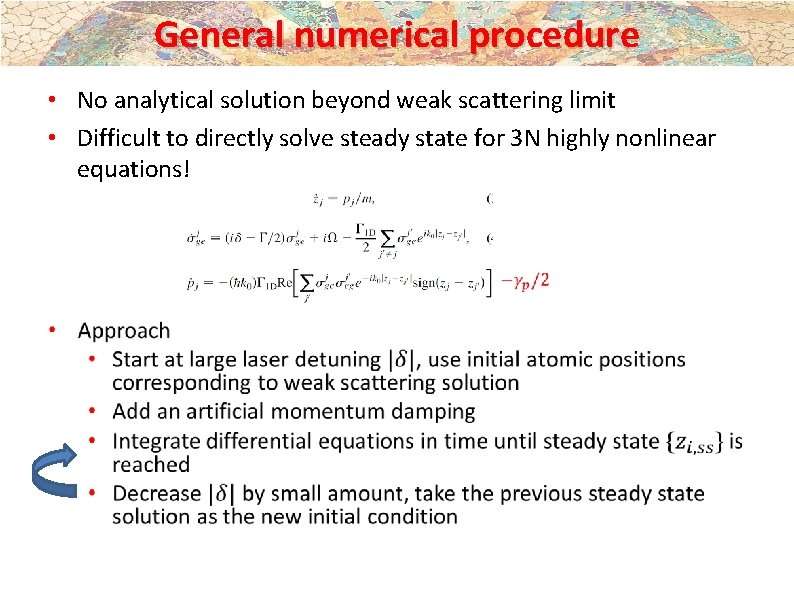
General numerical procedure • No analytical solution beyond weak scattering limit • Difficult to directly solve steady state for 3 N highly nonlinear equations!
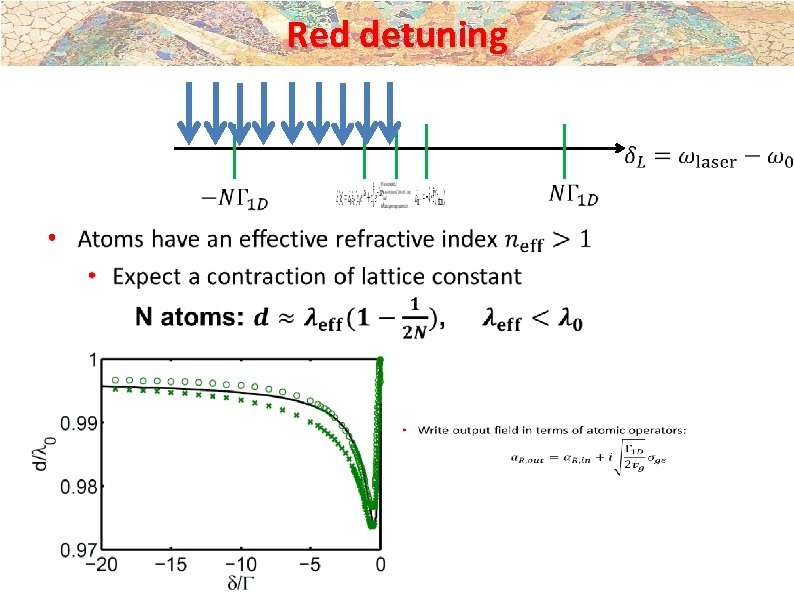
Red detuning •
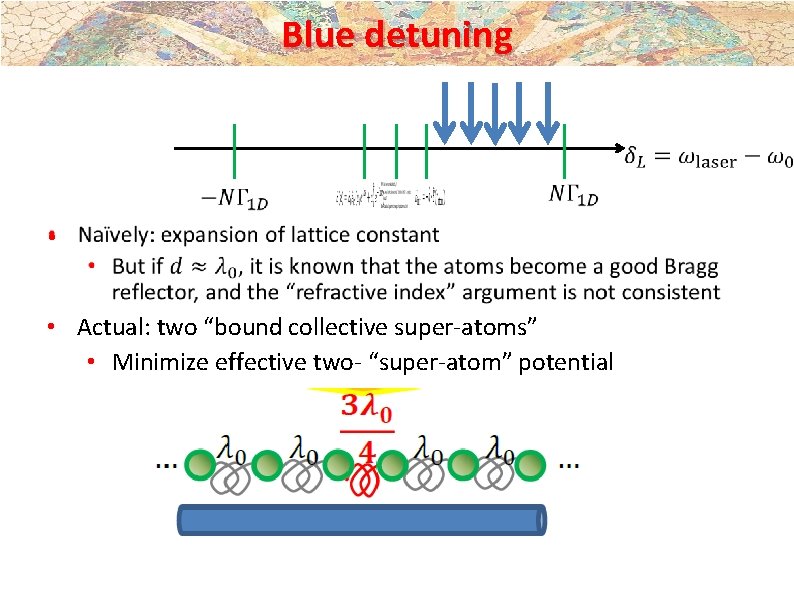
Blue detuning • • Actual: two “bound collective super-atoms” • Minimize effective two- “super-atom” potential
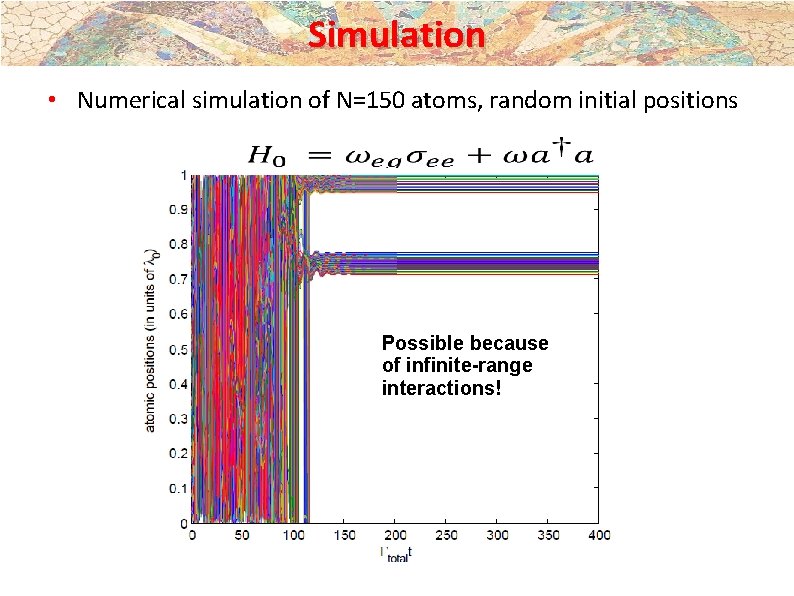
Simulation • Numerical simulation of N=150 atoms, random initial positions Possible because of infinite-range interactions!
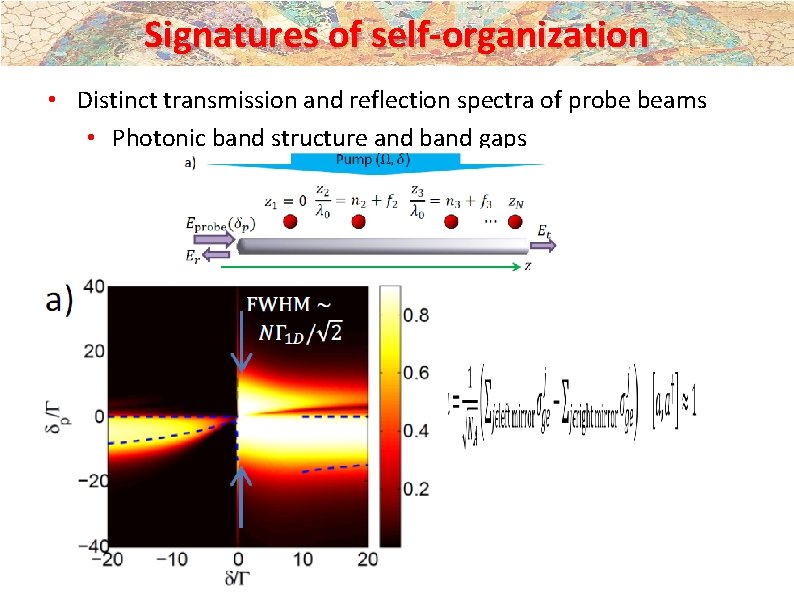
Signatures of self-organization • Distinct transmission and reflection spectra of probe beams • Photonic band structure and band gaps
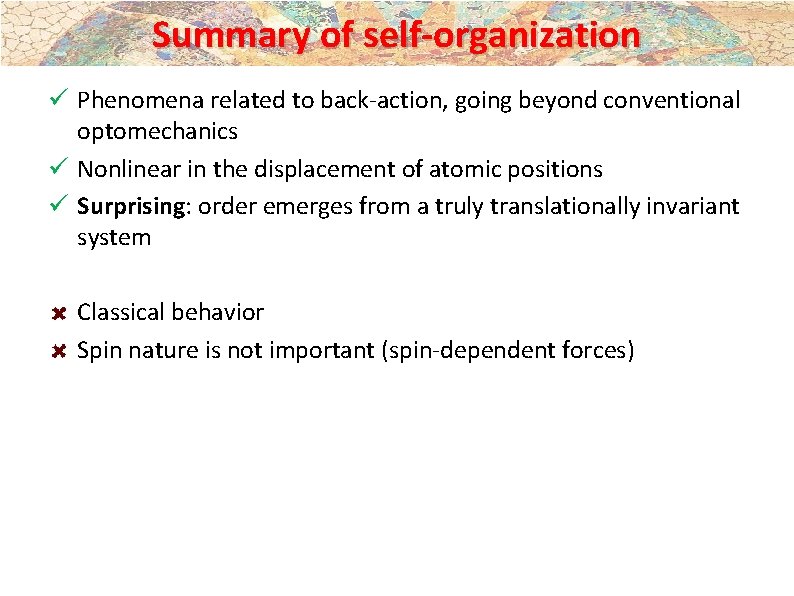
Summary of self-organization ü Phenomena related to back-action, going beyond conventional optomechanics ü Nonlinear in the displacement of atomic positions ü Surprising: order emerges from a truly translationally invariant system Classical behavior Spin nature is not important (spin-dependent forces)
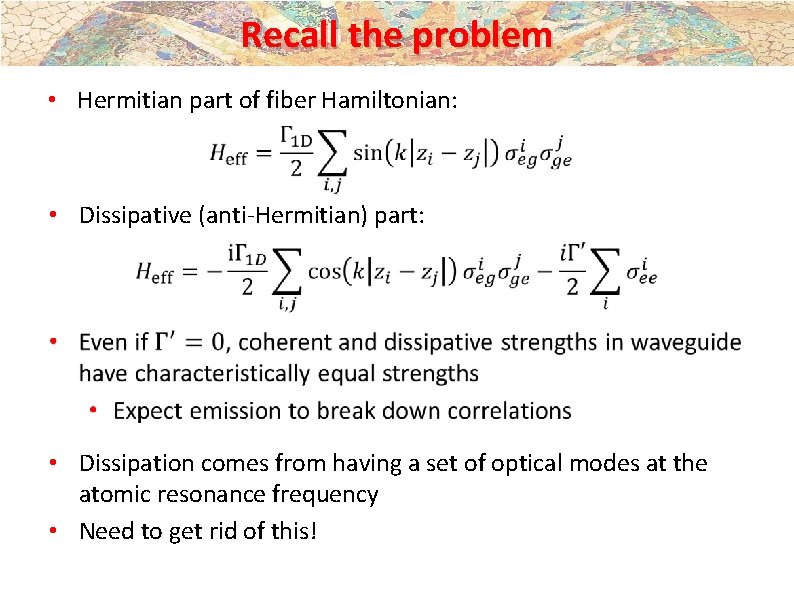
Recall the problem • Hermitian part of fiber Hamiltonian: • Dissipative (anti-Hermitian) part: • Dissipation comes from having a set of optical modes at the atomic resonance frequency • Need to get rid of this!
The fix – photonic crystals
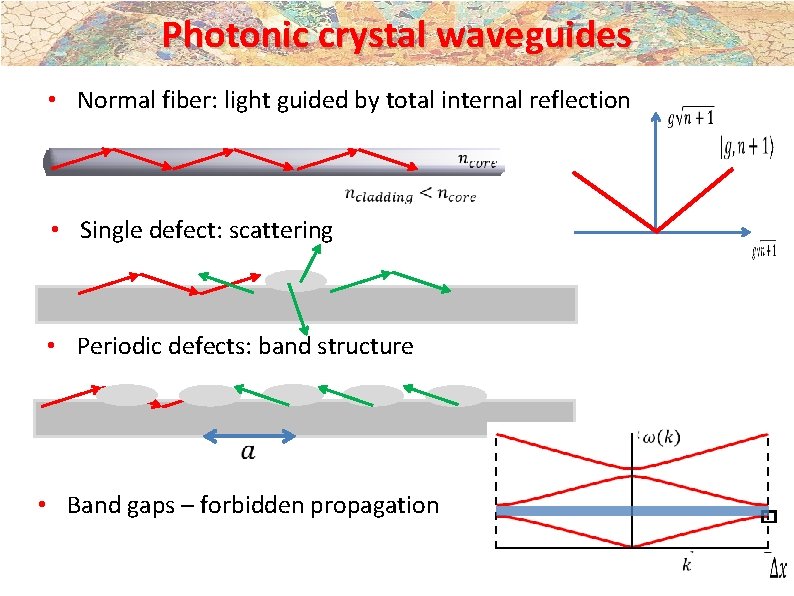
Photonic crystal waveguides • Normal fiber: light guided by total internal reflection • Single defect: scattering • Periodic defects: band structure • Band gaps – forbidden propagation
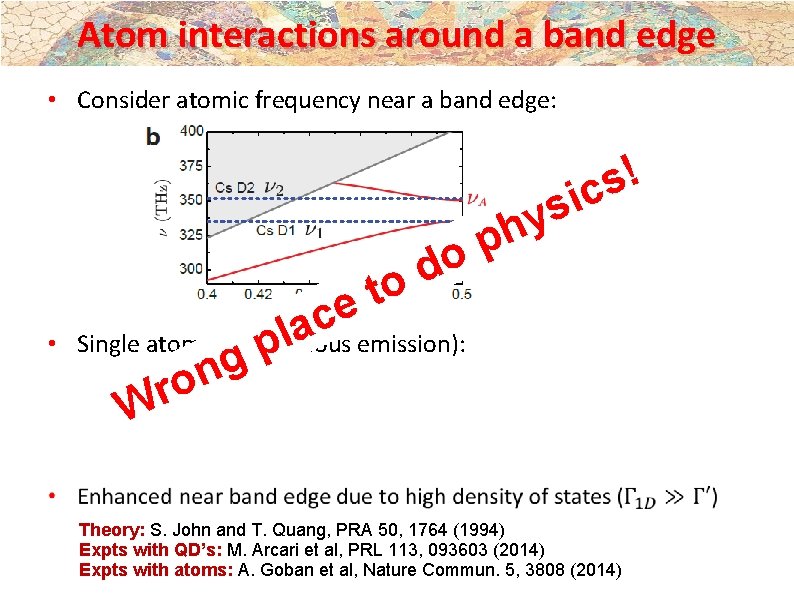
Atom interactions around a band edge • Consider atomic frequency near a band edge: ! s ic s y h p o d o • t e c a l Single atom (spontaneous emission): p g n o r W Theory: S. John and T. Quang, PRA 50, 1764 (1994) Expts with QD’s: M. Arcari et al, PRL 113, 093603 (2014) Expts with atoms: A. Goban et al, Nature Commun. 5, 3808 (2014)
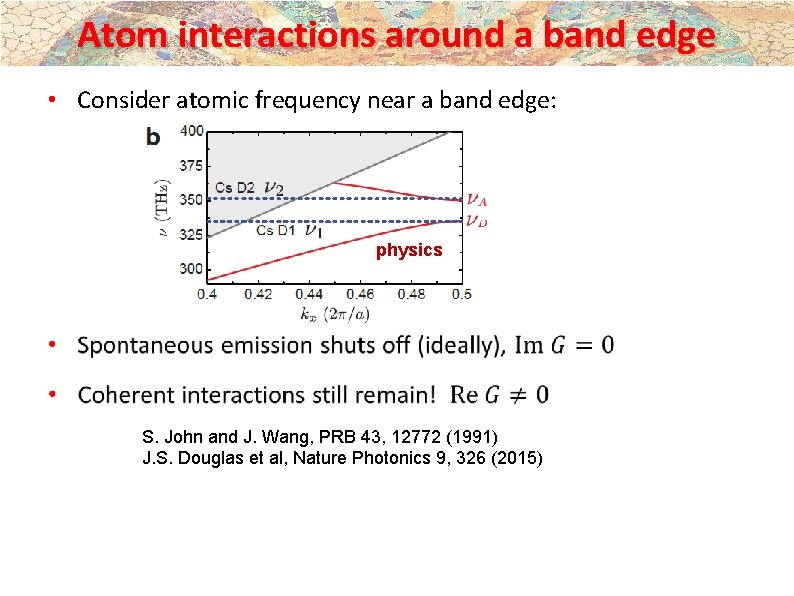
Atom interactions around a band edge • Consider atomic frequency near a band edge: physics S. John and J. Wang, PRB 43, 12772 (1991) J. S. Douglas et al, Nature Photonics 9, 326 (2015)
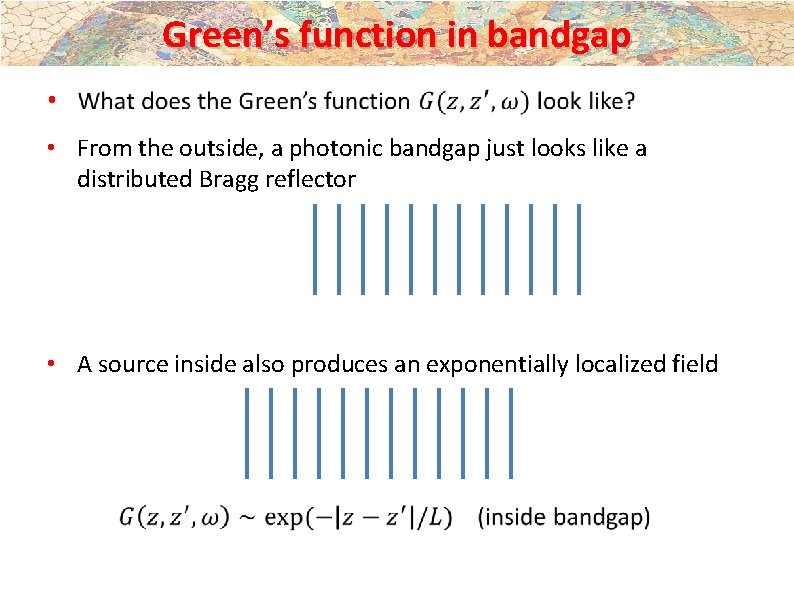
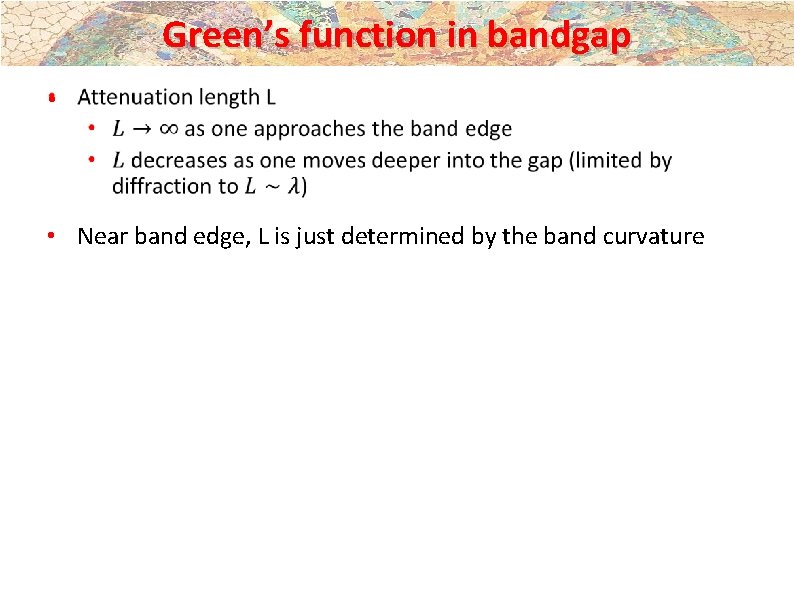
Green’s function in bandgap • • From the outside, a photonic bandgap just looks like a distributed Bragg reflector • A source inside also produces an exponentially localized field
Green’s function in bandgap • • Near band edge, L is just determined by the band curvature
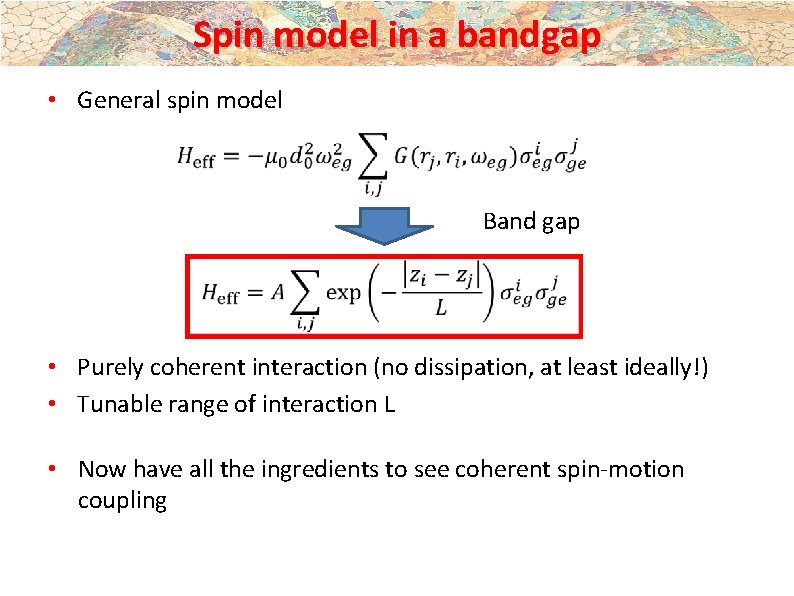
Spin model in a bandgap • General spin model Band gap • Purely coherent interaction (no dissipation, at least ideally!) • Tunable range of interaction L • Now have all the ingredients to see coherent spin-motion coupling
A sneak preview of the seminar…
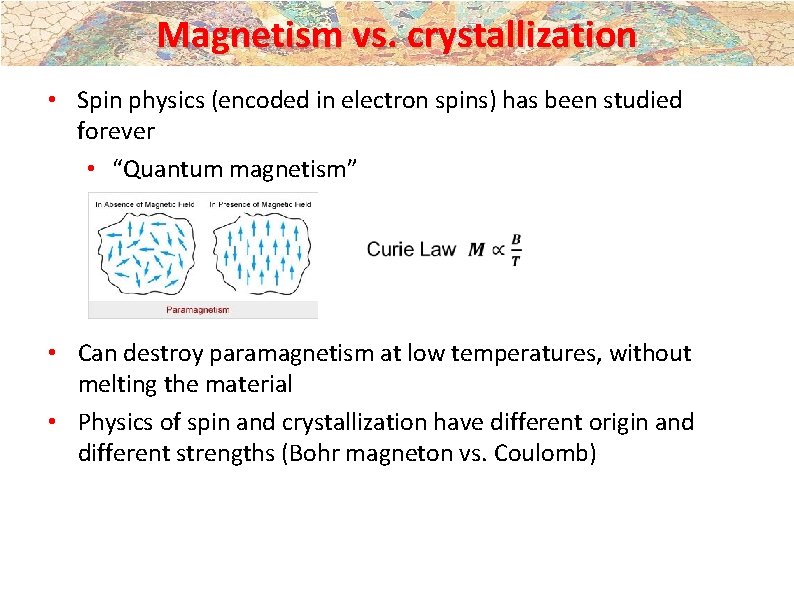
Magnetism vs. crystallization • Spin physics (encoded in electron spins) has been studied forever • “Quantum magnetism” • Can destroy paramagnetism at low temperatures, without melting the material • Physics of spin and crystallization have different origin and different strengths (Bohr magneton vs. Coulomb)
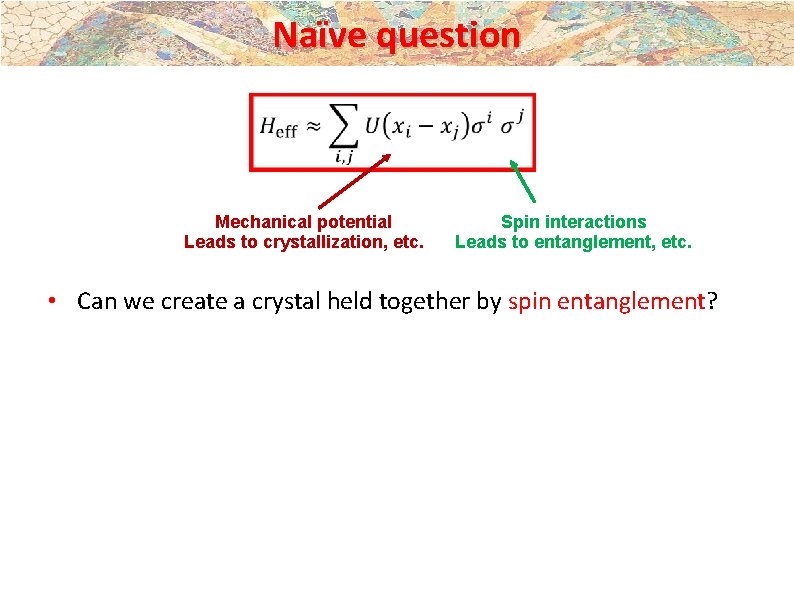
Naïve question Mechanical potential Leads to crystallization, etc. Spin interactions Leads to entanglement, etc. • Can we create a crystal held together by spin entanglement?