
OptoMechanics of Lasercom Windows OPTI 521 Tim Williams



- Slides: 28
Opto-Mechanics of Lasercom Windows OPTI 521 Tim Williams Dec. 12, 2006
Outline Motivation n Introduction n Strawman Window n Loss Analysis n Summary n
Why Windows? Protection – from Dust, Rain, Bugs, etc. n Isolation – from Temp & Press change, Air Turbulence n Filter (base) – pass signal, block background n
Window Environments Thermal gradients n Pressure differentials n Acceleration n Vibration n Structure induced stress n Radiation n
Window Environments (cont. ) Impact n Improper cleaning procedures n Chemical attack n Abrasive attack n
Good Practises Cover window except during use n Insure coating is as durable as window n Employ proper cleaning procedures n Replaceable windows for hostile environments n
Laser. Com Windows Laser. Com is usually power limited. n Any loss of power makes link less robust or decreases data rate. n Low loss is the goal for Laser. Com windows. n
Laser. Com Windows Smaller is better. n Less deflection, less stress, less cost. n
Strawman Window n n n Assume Standard BK 7 glass & λ=1550 nm Minimum size = Aperture + FOR ¨ Assume 10” (. 25 m) diameter is required Minimum thickness = just strong enough For simply supported, with safety factor of 4, thk = 1. 06*Dia* Pressure/σys ½ (Vuk. Pg 173) For Strawman @ 1 atm, thk ~ 1. 00”
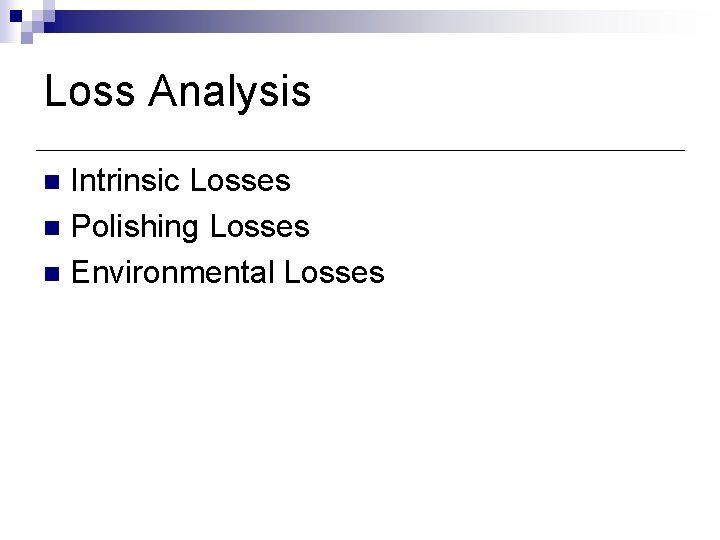
Loss Analysis Intrinsic Losses n Polishing Losses n Environmental Losses n
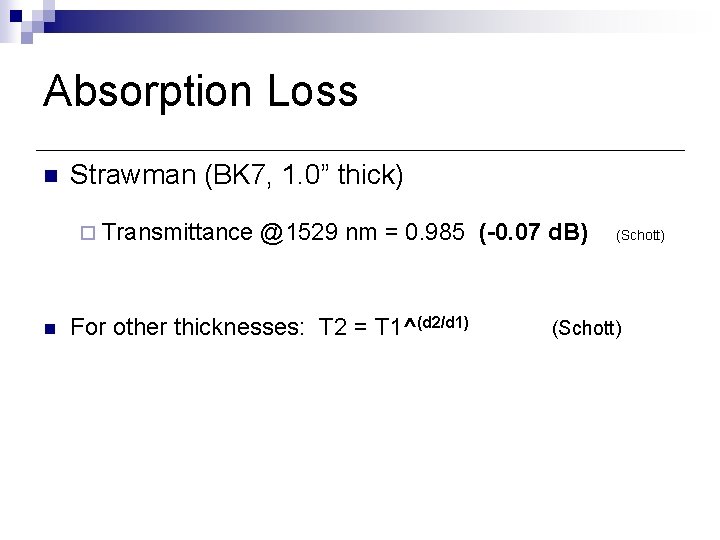
Absorption Loss n Strawman (BK 7, 1. 0” thick) ¨ Transmittance @1529 nm = 0. 985 (-0. 07 d. B) (Schott) n For other thicknesses: T 2 = T 1^(d 2/d 1) (Schott)
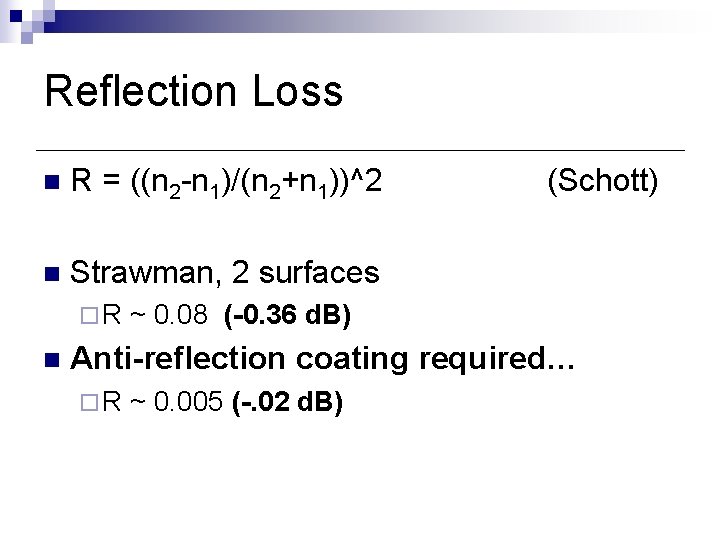
Reflection Loss n R = ((n 2 -n 1)/(n 2+n 1))^2 n Strawman, 2 surfaces (Schott) ¨ R ~ 0. 08 (-0. 36 d. B) n Anti-reflection coating required… ¨ R ~ 0. 005 (-. 02 d. B)
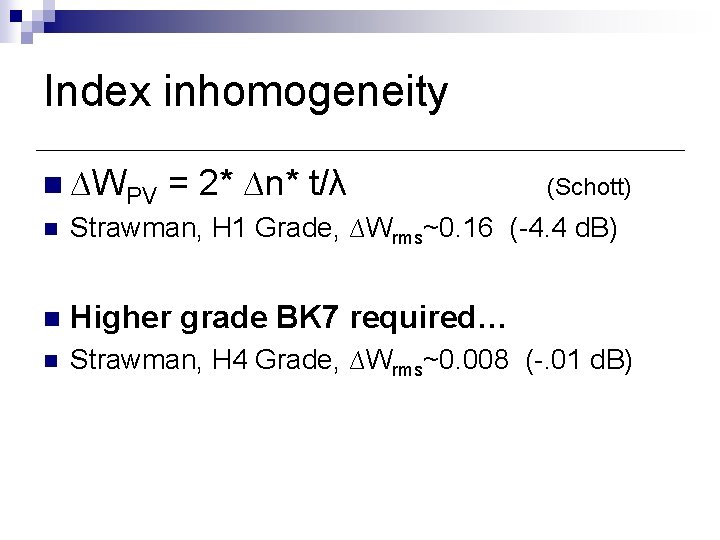
Index inhomogeneity n ∆WPV = 2* ∆n* t/λ (Schott) n Strawman, H 1 Grade, ∆Wrms~0. 16 (-4. 4 d. B) n Higher grade BK 7 required… n Strawman, H 4 Grade, ∆Wrms~0. 008 (-. 01 d. B)
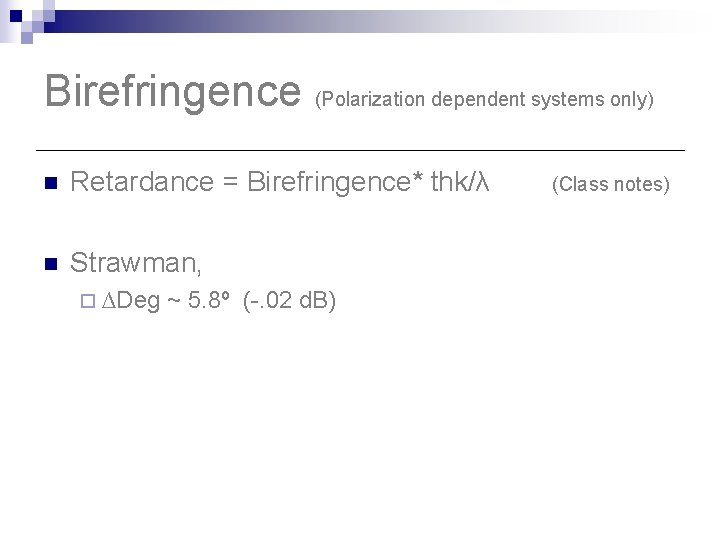
Birefringence (Polarization dependent systems only) n Retardance = Birefringence* thk/λ (Class notes) n Strawman, ¨ ∆Deg ~ 5. 8º (-. 02 d. B)
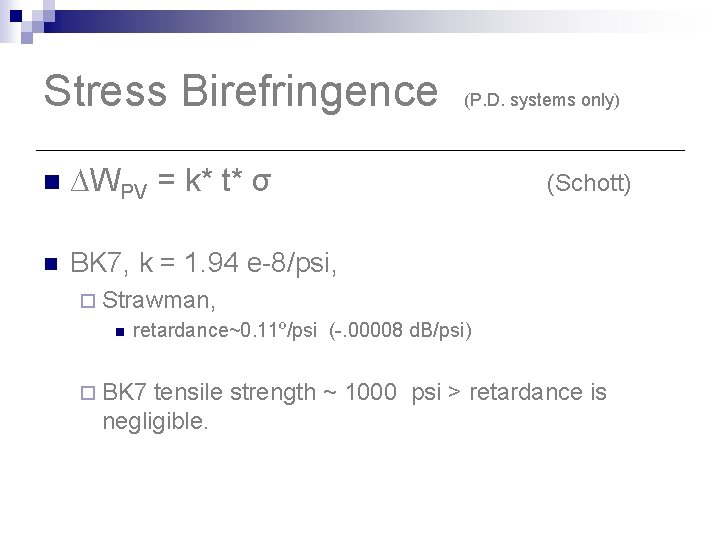
Stress Birefringence (P. D. systems only) n ∆WPV = k* t* σ n BK 7, k = 1. 94 e-8/psi, (Schott) ¨ Strawman, n retardance~0. 11º/psi (-. 00008 d. B/psi) ¨ BK 7 tensile strength ~ 1000 psi > retardance is negligible.
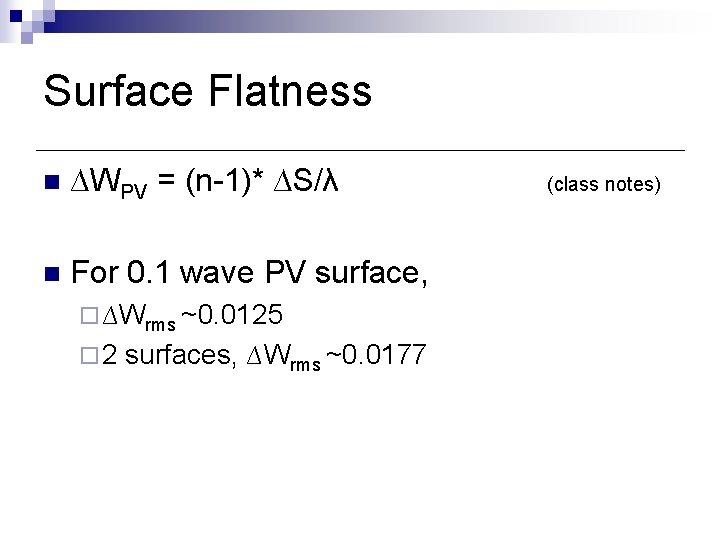
Surface Flatness n ∆WPV = (n-1)* ∆S/λ n For 0. 1 wave PV surface, ¨ ∆Wrms ~0. 0125 ¨ 2 surfaces, ∆Wrms ~0. 0177 (class notes)
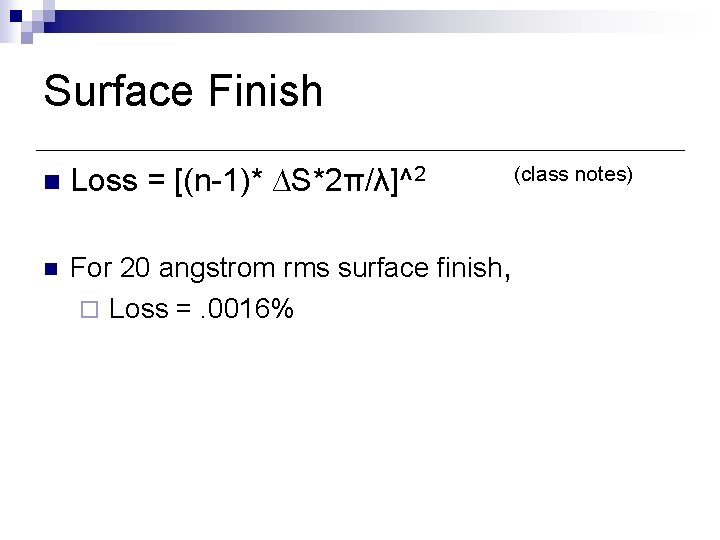
Surface Finish n Loss = [(n-1)* ∆S*2π/λ]^2 (class notes) n For 20 angstrom rms surface finish, ¨ Loss =. 0016%
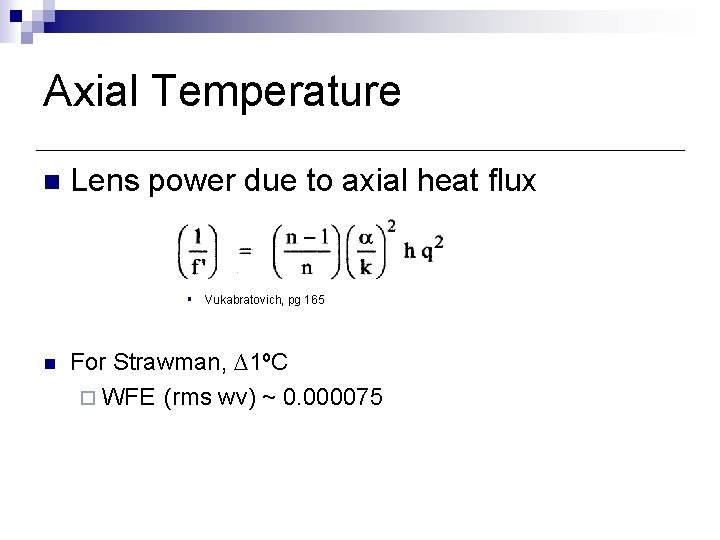
Axial Temperature n Lens power due to axial heat flux § Vukabratovich, pg 165 n For Strawman, ∆1ºC ¨ WFE (rms wv) ~ 0. 000075
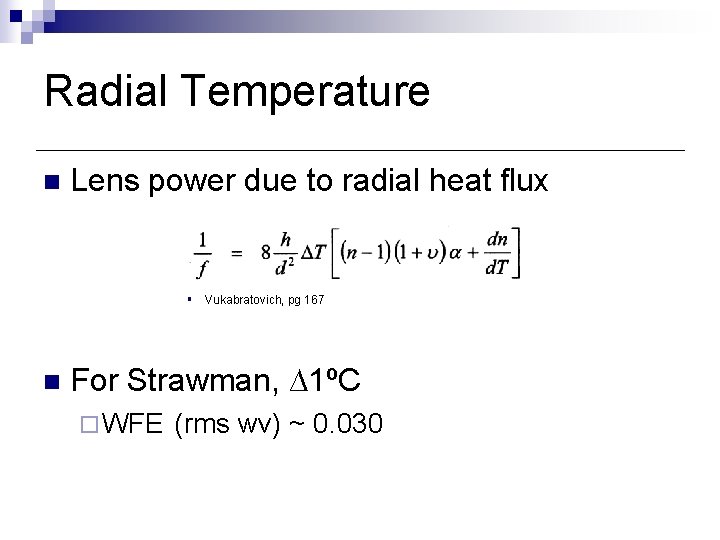
Radial Temperature n Lens power due to radial heat flux § Vukabratovich, pg 167 n For Strawman, ∆1ºC ¨ WFE (rms wv) ~ 0. 030
Pressure Differential n OPD due to pressure differential § Vukabratovich, pg 168 n For Strawman, 1 atm ¨ OPD rms wv = 0. 0000087
Aerodynamic Pressure n OPD due to ∆P~0. 7 Pfs. Mach 2 Vukabratovich, pg 169 For Strawman, Pfs 1 atm, M=0. 75 ¨ OPD rms wv = 0. 00000054
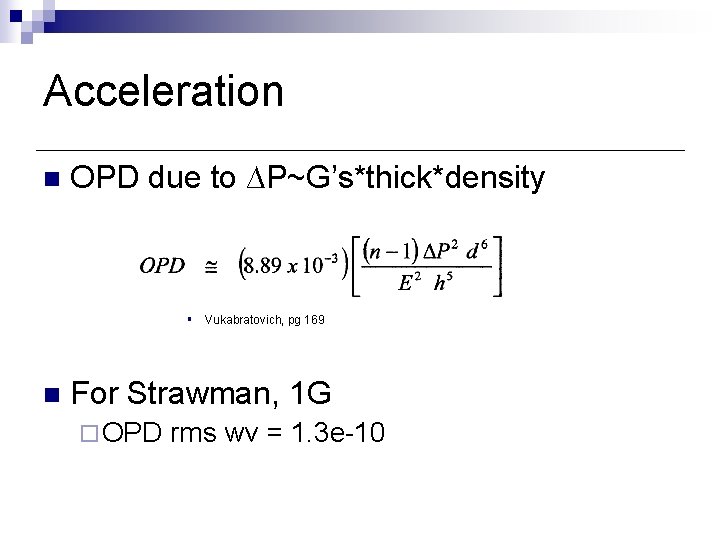
Acceleration n OPD due to ∆P~G’s*thick*density § Vukabratovich, pg 169 n For Strawman, 1 G ¨ OPD rms wv = 1. 3 e-10
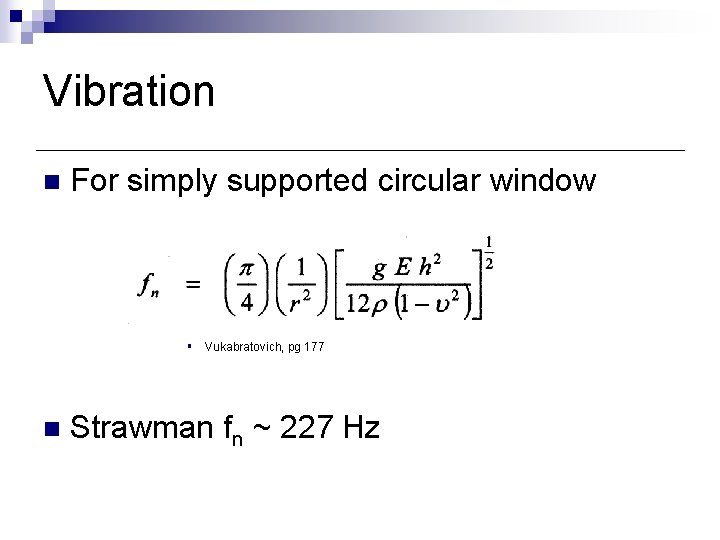
Vibration n For simply supported circular window § Vukabratovich, pg 177 n Strawman fn ~ 227 Hz
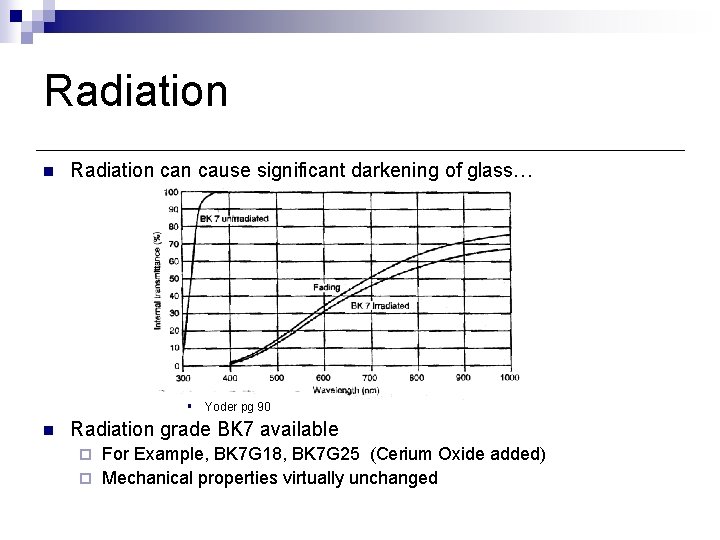
Radiation n Radiation cause significant darkening of glass… § Yoder pg 90 n Radiation grade BK 7 available For Example, BK 7 G 18, BK 7 G 25 (Cerium Oxide added) ¨ Mechanical properties virtually unchanged ¨
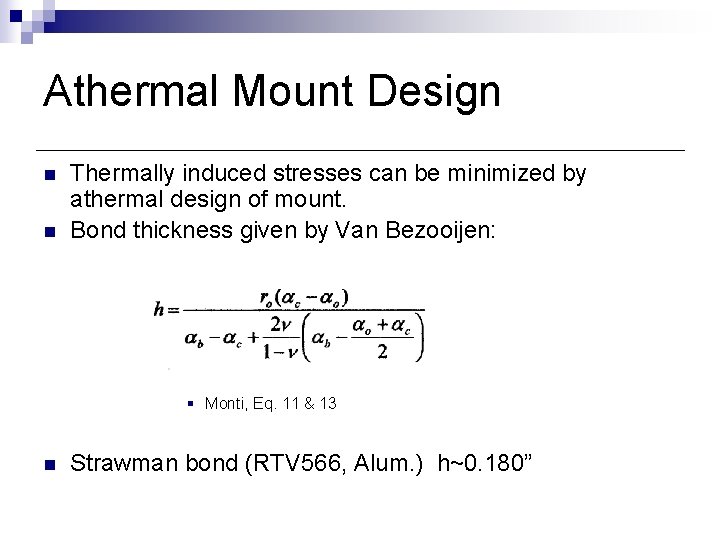
Athermal Mount Design n n Thermally induced stresses can be minimized by athermal design of mount. Bond thickness given by Van Bezooijen: § Monti, Eq. 11 & 13 n Strawman bond (RTV 566, Alum. ) h~0. 180”
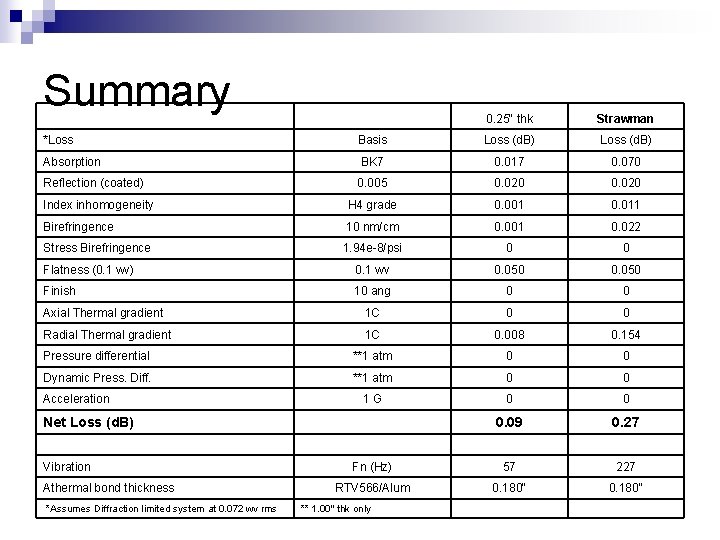
Summary 0. 25" thk Strawman *Loss Basis Loss (d. B) Absorption BK 7 0. 017 0. 070 0. 005 0. 020 Index inhomogeneity H 4 grade 0. 001 0. 011 Birefringence 10 nm/cm 0. 001 0. 022 Stress Birefringence 1. 94 e-8/psi 0 0 Flatness (0. 1 wv) 0. 1 wv 0. 050 Finish 10 ang 0 0 Axial Thermal gradient 1 C 0 0 Radial Thermal gradient 1 C 0. 008 0. 154 Pressure differential **1 atm 0 0 Dynamic Press. Diff. **1 atm 0 0 1 G 0 0 0. 09 0. 27 Reflection (coated) Acceleration Net Loss (d. B) Vibration Athermal bond thickness *Assumes Diffraction limited system at 0. 072 wv rms Fn (Hz) 57 227 RTV 566/Alum 0. 180" ** 1. 00" thk only
Summary Low loss windows for Laser. Com are achievable given a proper application of opto-mechanical principles. n Understanding of Thermal and Pressure environments is essential for correct window design. n
References n n Vukabratovich, D. , Introduction to Opto-Mechanical Design, 2006. Yoder, P. , Opto-Mechanical Systems Design, CRC, 2006. Class Notes, OPTI 521, Introductory Opto-Mechanical Engineering, UA, Prof. Jim Burge, 2006. Schott Glass Catalog, http: //www. us. schott. com/optics_devices/english/download/. n Athermal Bonded Mounts, Monti, C. , Tutorial for OPTI 521, 2006.