
Optocoupler radiation behaviour testing methodology and test results

Optocoupler radiation behaviour, testing methodology and test results Rudy Ferraro Ph. D Supervisors: Salvatore Danzeca (CERN) Luigi Dilillo (LIRMM-UM-CNRS)
Outlook • • Optocoupler applications Radiation effects on Optocoupler Standard optocoupler test recommendations Standard test protocol for space applications CERN test protocol Test results Mitigation techniques: CTR degradation compensation Conclusion
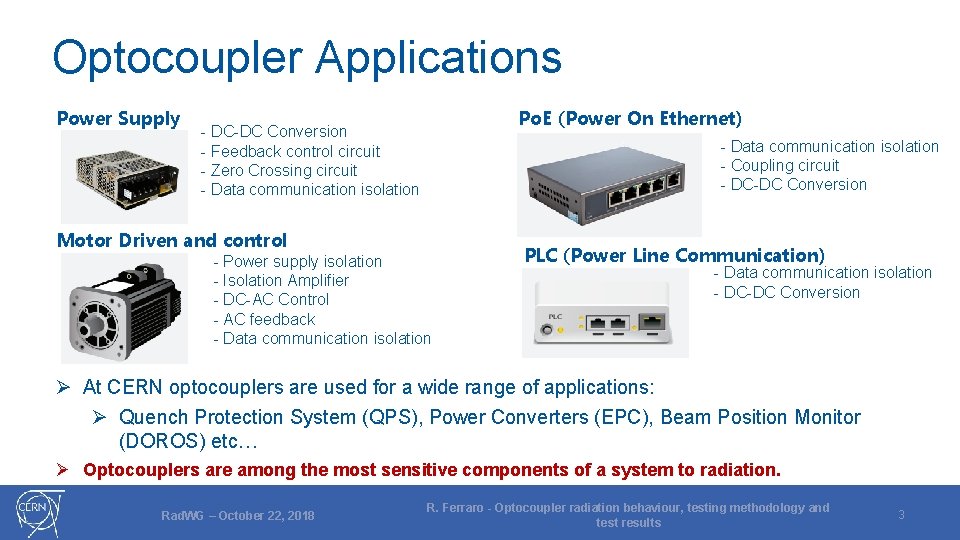
Optocoupler Applications Power Supply Po. E (Power On Ethernet) - DC-DC Conversion - Feedback control circuit - Zero Crossing circuit - Data communication isolation - Coupling circuit - DC-DC Conversion Motor Driven and control - Power supply isolation - Isolation Amplifier - DC-AC Control - AC feedback - Data communication isolation PLC (Power Line Communication) - Data communication isolation - DC-DC Conversion Ø At CERN optocouplers are used for a wide range of applications: Ø Quench Protection System (QPS), Power Converters (EPC), Beam Position Monitor (DOROS) etc… Ø Optocouplers are among the most sensitive components of a system to radiation. Rad. WG – October 22, 2018 R. Ferraro - Optocoupler radiation behaviour, testing methodology and test results 3
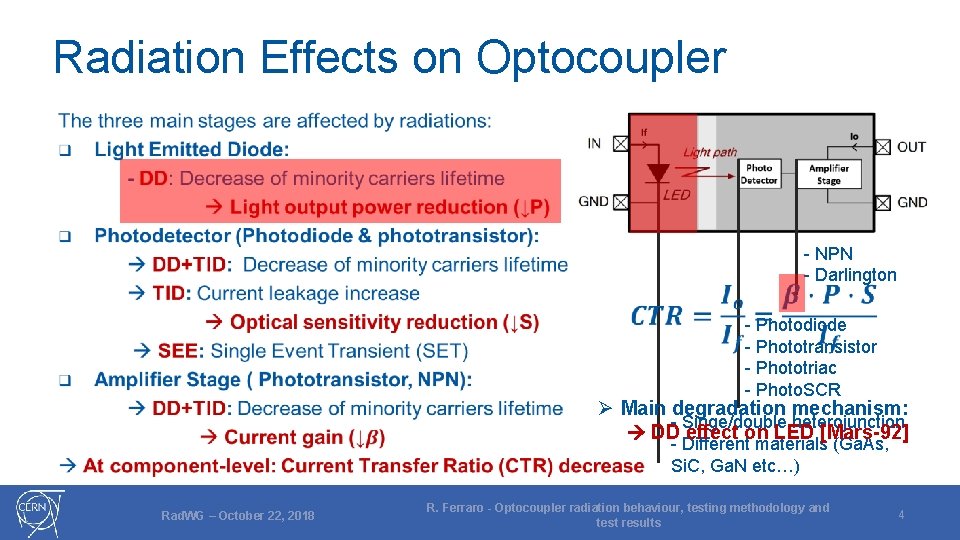
Radiation Effects on Optocoupler - NPN - Darlington - Photodiode - Phototransistor - Phototriac - Photo. SCR Ø Main degradation mechanism: - Singe/double heterojunction DD effect on LED [Mars-92] - Different materials (Ga. As, Si. C, Ga. N etc…) Rad. WG – October 22, 2018 R. Ferraro - Optocoupler radiation behaviour, testing methodology and test results 4
Standard optocoupler test recommendations Ø No international test standards exist for Displacement Damage Ø … But optocoupler test guidelines exist [Reed-02] Ø What guidelines say: Ø Optocoupler are COTS hybrid, the same internal components not guaranteed Leads to a high lot-to-lot radiation response variability Part-to-part sample size should be used instead of lot-to-lot sample size. Ø Input current can anneal the DD-induced degradation of LEDs [Barn 84, John-99 a] Higher is the input current, lower is the degradation Biasing/operating conditions will have a strong impact the degradation Ø SET: Ø Photodiodes sensitive to SET only when the LED is off. Ø Photodiodes sensitive to proton-induced SET with a high angular dependency [Labe-97] Ø TID and DD are assumed to be independent in degradation [Military Handbook 814] : • Independent TID [ASTM Standard 883] and DD tests can be performed. Rad. WG – October 22, 2018 R. Ferraro - Optocoupler radiation behaviour, testing methodology and test results 5
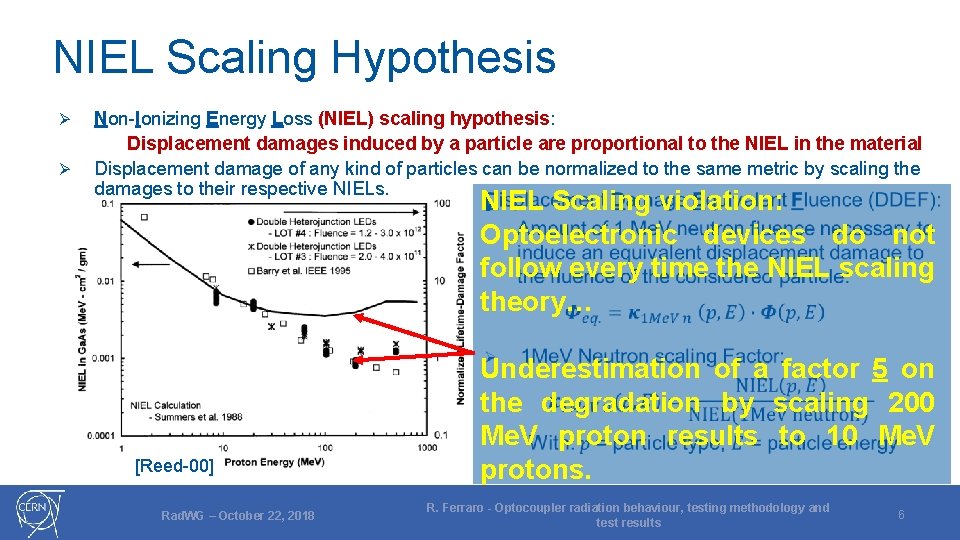
NIEL Scaling Hypothesis Ø Ø Non-Ionizing Energy Loss (NIEL) scaling hypothesis: Displacement damages induced by a particle are proportional to the NIEL in the material Displacement damage of any kind of particles can be normalized to the same metric by scaling the damages to their respective NIELs. NIEL • Scaling violation: Optoelectronic devices do not follow every time the NIEL scaling theory… [Reed-00] Rad. WG – October 22, 2018 Underestimation of a factor 5 on the degradation by scaling 200 Me. V proton results to 10 Me. V protons. R. Ferraro - Optocoupler radiation behaviour, testing methodology and test results 6
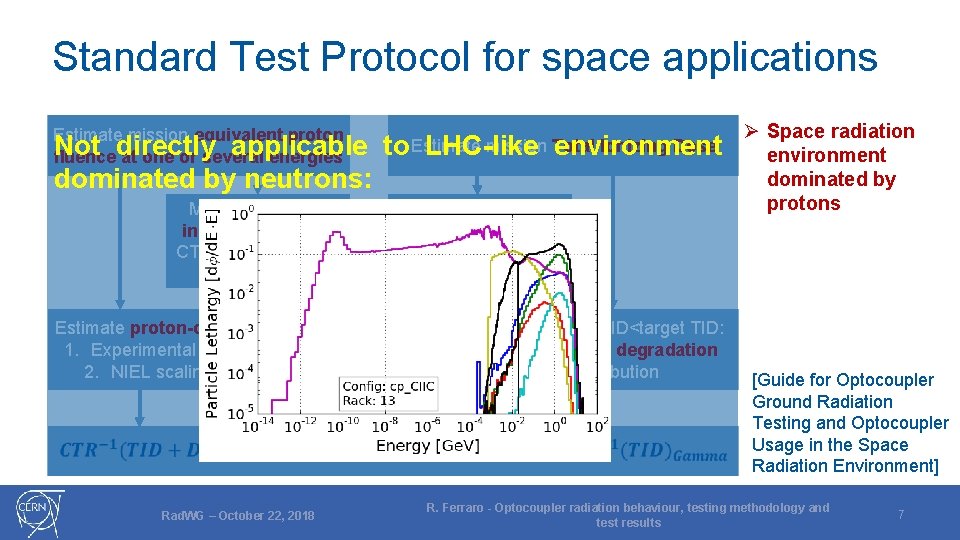
Standard Test Protocol for space applications Estimate mission equivalent proton Not directly applicable fluence at one or several energies Ionizing Dose to Estimate mission Total LHC-like environment dominated by neutrons: Measure protoninduced (TID+DD) CTR degradation for each energy Measure TIDinduced CTR degradation with a gamma source Estimate proton-degradation contribution in space: 1. Experimental effective NIEL scaling estimation 2. NIEL scaling + margin of 10 if one energy Rad. WG – October 22, 2018 If p-induced TID<target TID: Estimate TID degradation contribution Ø Space radiation environment dominated by protons [Guide for Optocoupler Ground Radiation Testing and Optocoupler Usage in the Space Radiation Environment] R. Ferraro - Optocoupler radiation behaviour, testing methodology and test results 7
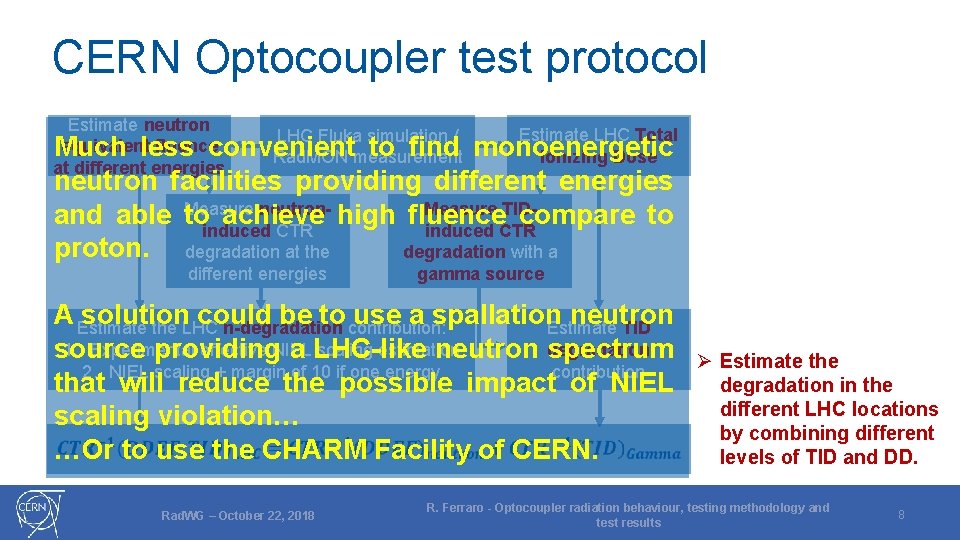
CERN Optocoupler test protocol Estimate neutron LHC Fluka simulation / equivalent fluence Much less convenient to find Rad. MON measurement at different energies Estimate LHC Total monoenergetic Ionizing Dose neutron facilities providing different energies Measure TIDand able Measure neutrontoinduced achieve high fluence compare to CTR induced CTR proton. degradation at the degradation with a different energies gamma source A Estimate the LHC n-degradation contribution: solution could be to use a spallation neutron Estimate TID 1. Experimental effective NIEL scaling estimation source providing a LHC-like neutron degradation spectrum 2. NIEL scaling + margin of 10 if one energy contribution that will reduce the possible impact of NIEL scaling violation… …Or to use the CHARM Facility of CERN. Rad. WG – October 22, 2018 Ø Estimate the degradation in the different LHC locations by combining different levels of TID and DD. R. Ferraro - Optocoupler radiation behaviour, testing methodology and test results 8
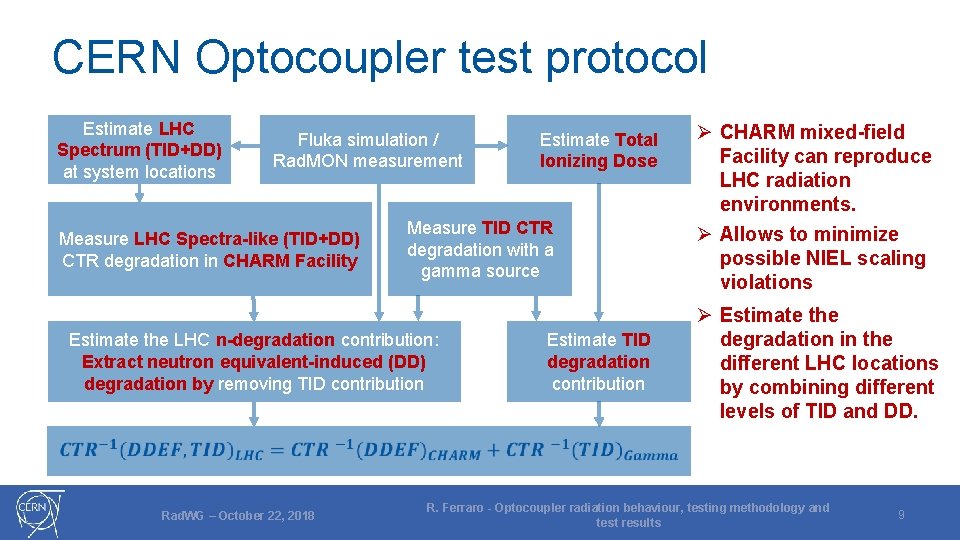
CERN Optocoupler test protocol Estimate LHC Spectrum (TID+DD) at system locations Fluka simulation / Rad. MON measurement Measure LHC Spectra-like (TID+DD) CTR degradation in CHARM Facility Estimate Total Ionizing Dose Measure TID CTR degradation with a gamma source Estimate the LHC n-degradation contribution: Extract neutron equivalent-induced (DD) degradation by removing TID contribution Estimate TID degradation contribution Ø CHARM mixed-field Facility can reproduce LHC radiation environments. Ø Allows to minimize possible NIEL scaling violations Ø Estimate the degradation in the different LHC locations by combining different levels of TID and DD. Rad. WG – October 22, 2018 R. Ferraro - Optocoupler radiation behaviour, testing methodology and test results 9
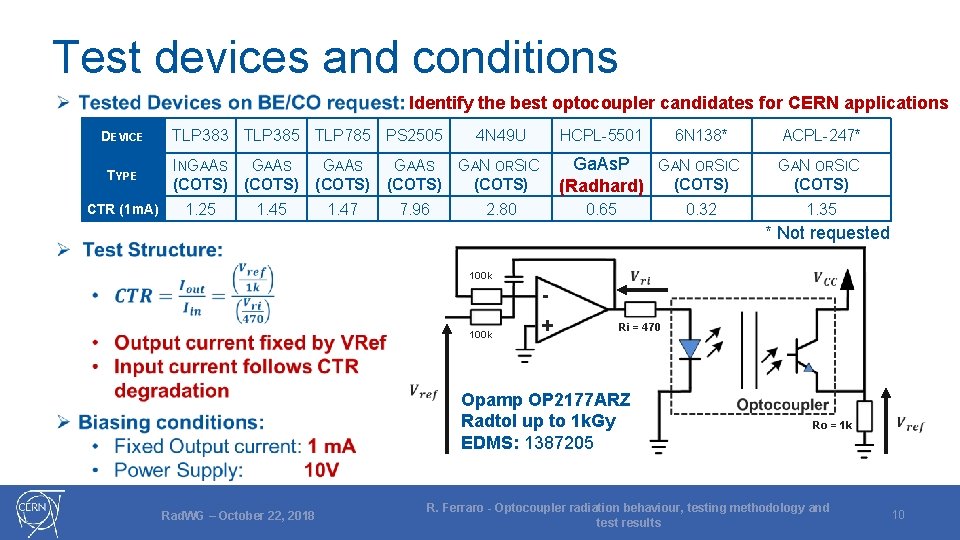
Test devices and conditions Identify the best optocoupler candidates for CERN applications DEVICE TLP 383 TLP 385 TLP 785 PS 2505 4 N 49 U TYPE IN GAAS (COTS) GAN ORS IC (COTS) CTR (1 m. A) 1. 25 1. 45 1. 47 7. 96 2. 80 HCPL-5501 6 N 138* Ga. As. P GAN ORS IC (COTS) (Radhard) 0. 65 0. 32 ACPL-247* GAN ORS IC (COTS) 1. 35 * Not requested 100 k Rad. WG – October 22, 2018 + Ri = 470 Opamp OP 2177 ARZ Radtol up to 1 k. Gy EDMS: 1387205 Ro = 1 k R. Ferraro - Optocoupler radiation behaviour, testing methodology and test results 10
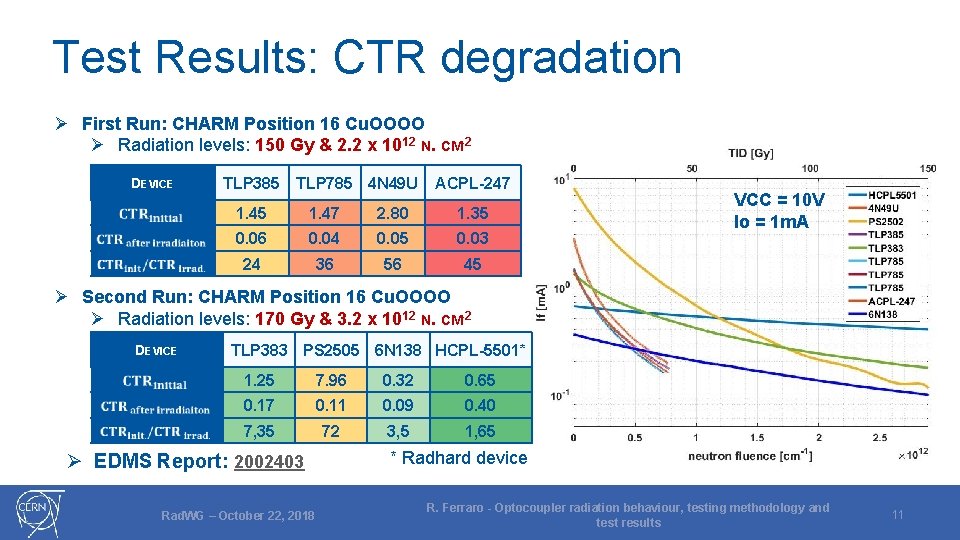
Test Results: CTR degradation Ø First Run: CHARM Position 16 Cu. OOOO Ø Radiation levels: 150 Gy & 2. 2 x 10¹² N. CM-2 DEVICE TLP 385 TLP 785 4 N 49 U ACPL-247 1. 45 1. 47 2. 80 1. 35 0. 06 0. 04 0. 05 0. 03 24 36 56 45 VCC = 10 V Io = 1 m. A Ø Second Run: CHARM Position 16 Cu. OOOO Ø Radiation levels: 170 Gy & 3. 2 x 10¹² N. CM-2 DEVICE TLP 383 PS 2505 6 N 138 HCPL-5501* 1. 25 7. 96 0. 32 0. 65 0. 17 0. 11 0. 09 0. 40 7, 35 72 3, 5 1, 65 Ø EDMS Report: 2002403 Rad. WG – October 22, 2018 * Radhard device R. Ferraro - Optocoupler radiation behaviour, testing methodology and test results 11
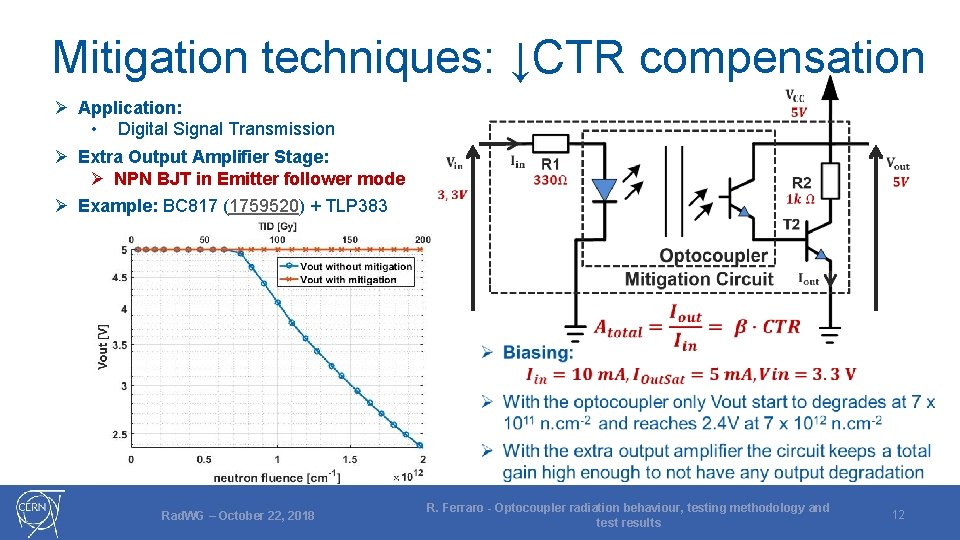
Mitigation techniques: ↓CTR compensation Ø Application: • Digital Signal Transmission Ø Extra Output Amplifier Stage: Ø NPN BJT in Emitter follower mode Ø Example: BC 817 (1759520) + TLP 383 Rad. WG – October 22, 2018 R. Ferraro - Optocoupler radiation behaviour, testing methodology and test results 12
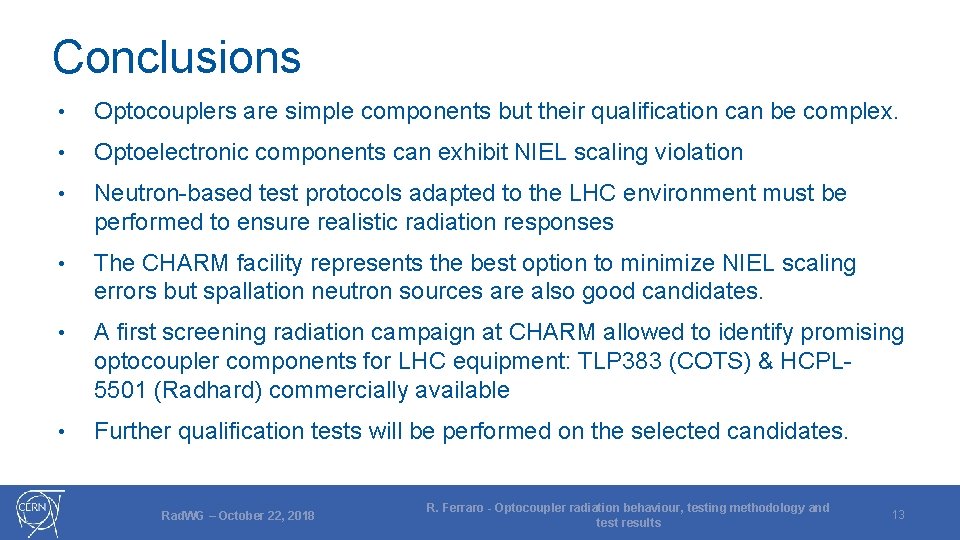
Conclusions • Optocouplers are simple components but their qualification can be complex. • Optoelectronic components can exhibit NIEL scaling violation • Neutron-based test protocols adapted to the LHC environment must be performed to ensure realistic radiation responses • The CHARM facility represents the best option to minimize NIEL scaling errors but spallation neutron sources are also good candidates. • A first screening radiation campaign at CHARM allowed to identify promising optocoupler components for LHC equipment: TLP 383 (COTS) & HCPL 5501 (Radhard) commercially available • Further qualification tests will be performed on the selected candidates. Rad. WG – October 22, 2018 R. Ferraro - Optocoupler radiation behaviour, testing methodology and test results 13
Backup slides Rad. WG – October 22, 2018 R. Ferraro - Optocoupler radiation behaviour, testing methodology and test results
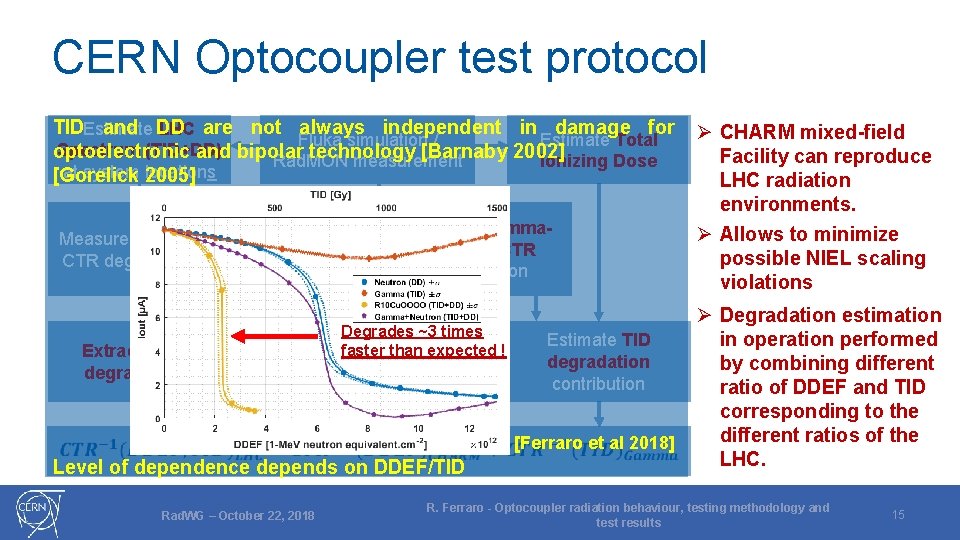
CERN Optocoupler test protocol TIDEstimate LHC and DD are not always independent in damage for Fluka simulation / Estimate Total Spectrum (TID+DD) optoelectronic and bipolar technology [Barnaby 2002] Rad. MON measurement Ionizing Dose at system locations [Gorelick 2005] Measure LHC Spectra-like (TID+DD) CTR degradation in CHARM Facility Measure gammainduced CTR degradation Degrades ~3 times faster (DD) than expected ! Extract neutron equivalent-induced degradation by removing TID contribution Estimate TID degradation contribution [Ferraro et al 2018] Level of dependence depends on DDEF/TID Rad. WG – October 22, 2018 Ø CHARM mixed-field Facility can reproduce LHC radiation environments. Ø Allows to minimize possible NIEL scaling violations Ø Degradation estimation in operation performed by combining different ratio of DDEF and TID corresponding to the different ratios of the LHC. R. Ferraro - Optocoupler radiation behaviour, testing methodology and test results 15
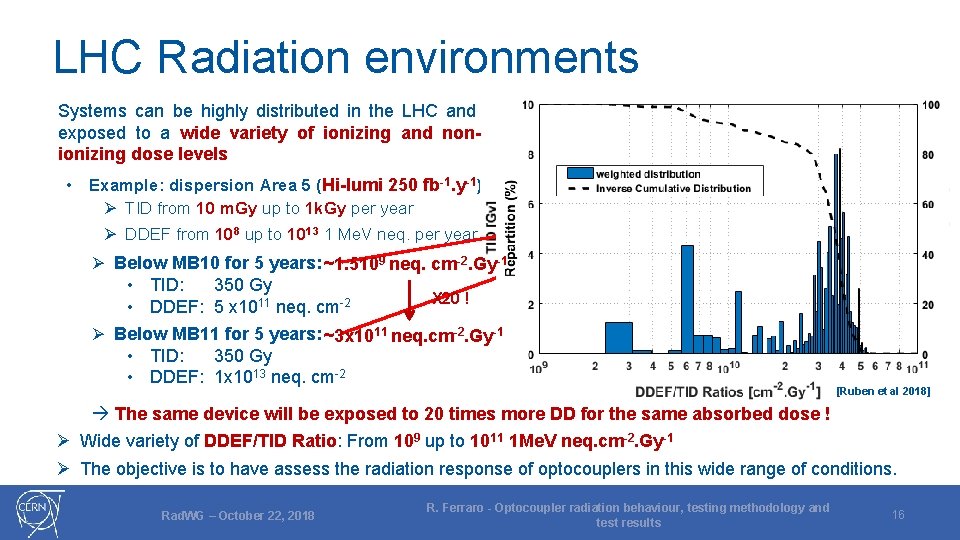
LHC Radiation environments Systems can be highly distributed in the LHC and exposed to a wide variety of ionizing and nonionizing dose levels • Example: dispersion Area 5 (Hi-lumi 250 fb-1. y-1) Ø TID from 10 m. Gy up to 1 k. Gy per year Ø DDEF from 108 up to 1013 1 Me. V neq. per year Ø Below MB 10 for 5 years: ~1. 5109 neq. cm-2. Gy-1 • • TID: 350 Gy DDEF: 5 x 10¹¹ neq. cm-2 X 20 ! Ø Below MB 11 for 5 years: ~3 x 10¹¹ neq. cm-2. Gy-1 • • TID: 350 Gy DDEF: 1 x 10¹³ neq. cm-2 [Ruben et al 2018] The same device will be exposed to 20 times more DD for the same absorbed dose ! Ø Wide variety of DDEF/TID Ratio: From 109 up to 1011 1 Me. V neq. cm-2. Gy-1 Ø The objective is to have assess the radiation response of optocouplers in this wide range of conditions. Rad. WG – October 22, 2018 R. Ferraro - Optocoupler radiation behaviour, testing methodology and test results 16
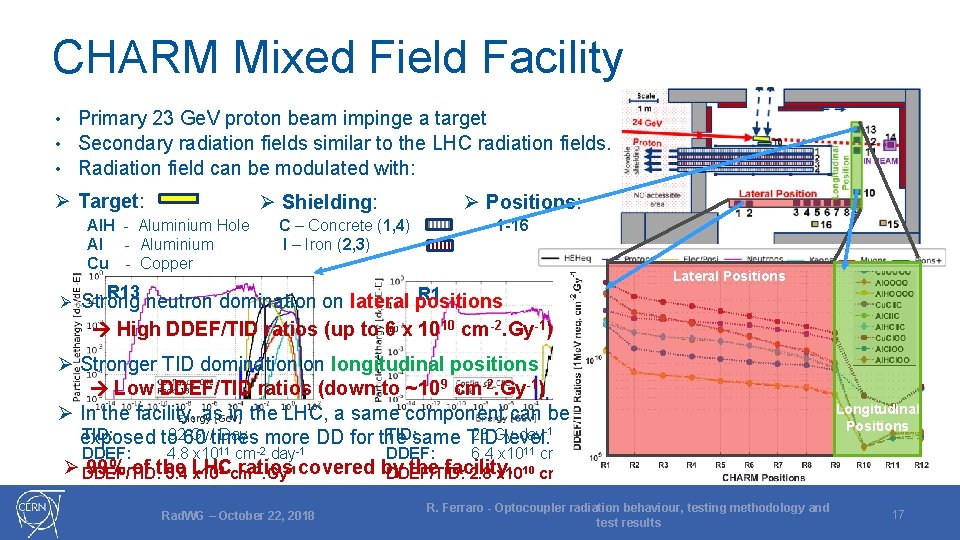
CHARM Mixed Field Facility • • • Primary 23 Ge. V proton beam impinge a target Secondary radiation fields similar to the LHC radiation fields. Radiation field can be modulated with: Ø Target: Ø Shielding: Al. H - Aluminium Hole Al - Aluminium Cu - Copper Ø C – Concrete (1, 4) I – Iron (2, 3) Ø Positions: 1 -16 R 13 R 1 Strong neutron domination on lateral positions High DDEF/TID ratios (up to 6 x 1010 cm-2. Gy-1) Ø Stronger TID domination on longitudinal positions Low DDEF/TID ratios (down to ~109 cm-2. Gy-1) Ø In the facility, as in the LHC, a same component can be TID: 92 Gy/ Day TID: 23 Gy. day-1 exposed to 60 times more DD for the same TID level. DDEF: 4. 8 x 1011 cm-2. day-1 DDEF: 6. 4 x 1011 cm-2. day-1 -2. Gy-1 covered by Ø DDEF/TID: 99% of the ratios the facility. 5. 4 LHC x 109 cm DDEF/TID: 2. 8 x 1010 cm-2. Gy-1 Rad. WG – October 22, 2018 Lateral Positions R 10 Longitudinal Positions TID: 46. 2 Gy/ Day DDEF: 4. 5 x 1011 cm-2. day-1 DDEF/TID: 4 x 1011 cm-2. Gy-1 R. Ferraro - Optocoupler radiation behaviour, testing methodology and test results 17
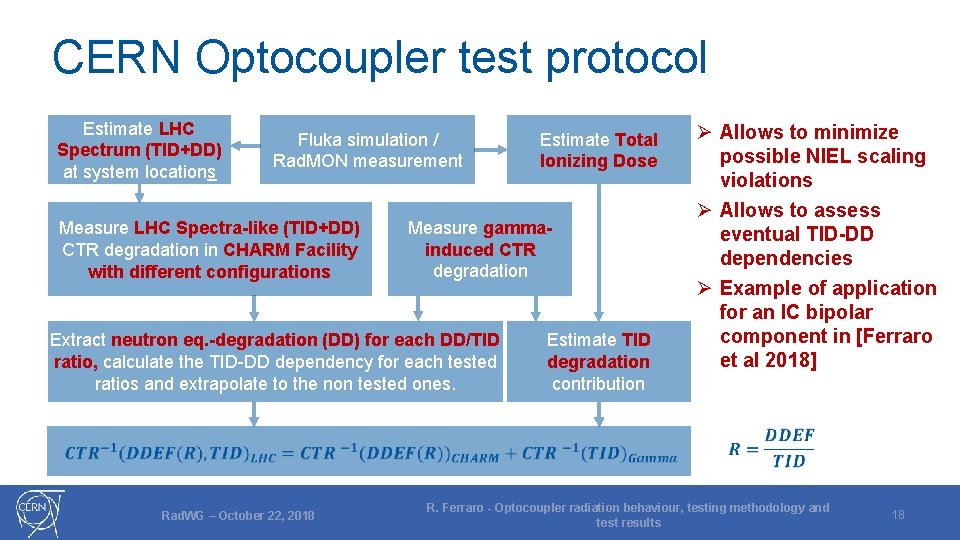
CERN Optocoupler test protocol Estimate LHC Spectrum (TID+DD) at system locations Fluka simulation / Rad. MON measurement Measure LHC Spectra-like (TID+DD) CTR degradation in CHARM Facility with different configurations Estimate Total Ionizing Dose Measure gammainduced CTR degradation Extract neutron eq. -degradation (DD) for each DD/TID ratio, calculate the TID-DD dependency for each tested ratios and extrapolate to the non tested ones. Estimate TID degradation contribution Ø Allows to minimize possible NIEL scaling violations Ø Allows to assess eventual TID-DD dependencies Ø Example of application for an IC bipolar component in [Ferraro et al 2018] Rad. WG – October 22, 2018 R. Ferraro - Optocoupler radiation behaviour, testing methodology and test results 18
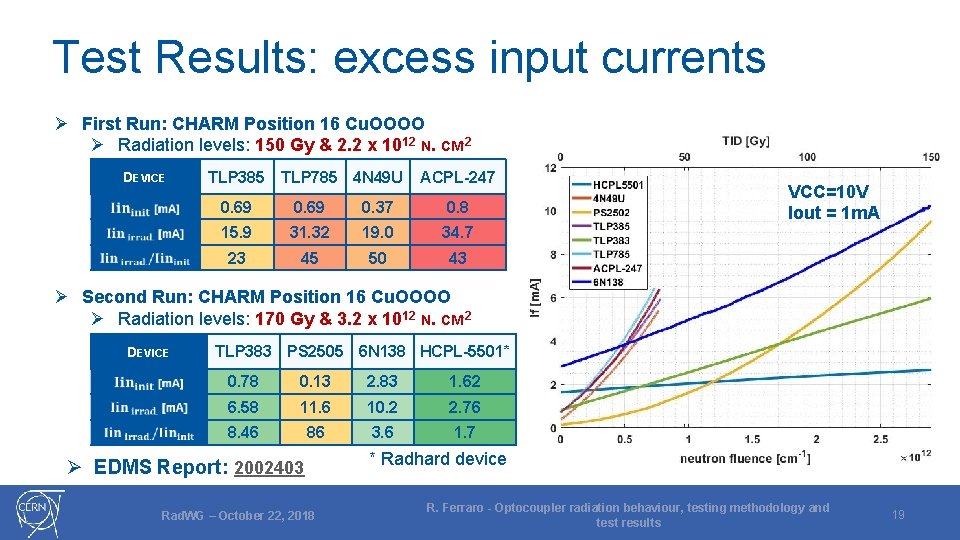
Test Results: excess input currents Ø First Run: CHARM Position 16 Cu. OOOO Ø Radiation levels: 150 Gy & 2. 2 x 10¹² N. CM-2 DEVICE TLP 385 TLP 785 4 N 49 U ACPL-247 0. 69 0. 37 0. 8 15. 9 31. 32 19. 0 34. 7 23 45 50 43 VCC=10 V Iout = 1 m. A Ø Second Run: CHARM Position 16 Cu. OOOO Ø Radiation levels: 170 Gy & 3. 2 x 10¹² N. CM-2 DEVICE TLP 383 PS 2505 6 N 138 HCPL-5501* 0. 78 0. 13 2. 83 1. 62 6. 58 11. 6 10. 2 2. 76 8. 46 86 3. 6 1. 7 Ø EDMS Report: 2002403 Rad. WG – October 22, 2018 * Radhard device R. Ferraro - Optocoupler radiation behaviour, testing methodology and test results 19
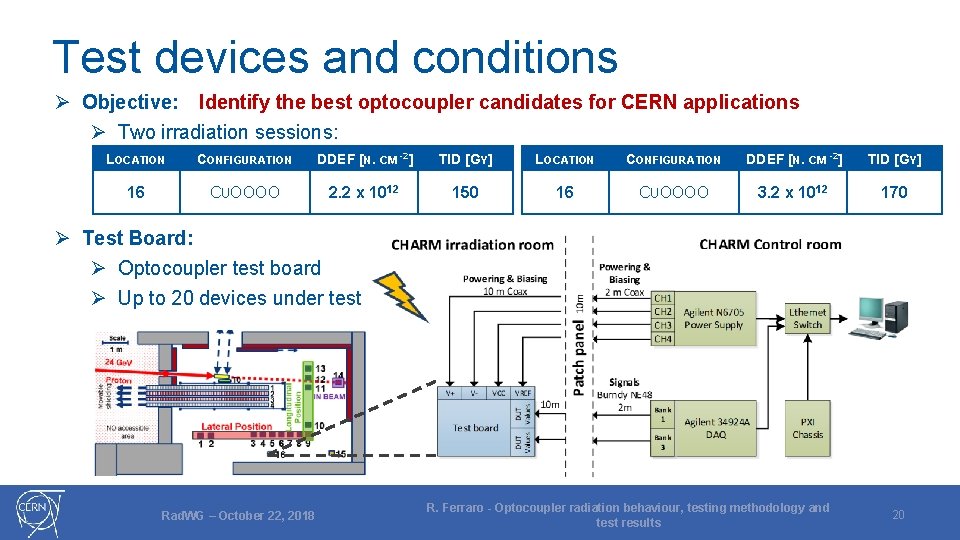
Test devices and conditions Ø Objective: Identify the best optocoupler candidates for CERN applications Ø Two irradiation sessions: LOCATION CONFIGURATION DDEF [N. CM -2] TID [GY] 16 CUOOOO 2. 2 x 10¹² 150 16 CUOOOO 3. 2 x 10¹² 170 R. Ferraro - Optocoupler radiation behaviour, testing methodology and test results 20 Ø Test Board: Ø Optocoupler test board Ø Up to 20 devices under test Rad. WG – October 22, 2018
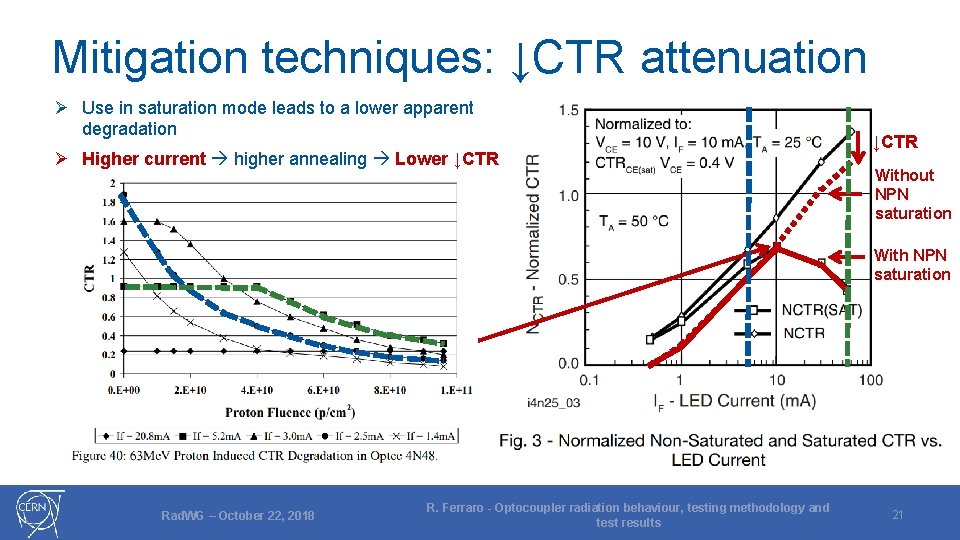
Mitigation techniques: ↓CTR attenuation Ø Use in saturation mode leads to a lower apparent degradation Ø Higher current higher annealing Lower ↓CTR Without NPN saturation With NPN saturation Rad. WG – October 22, 2018 R. Ferraro - Optocoupler radiation behaviour, testing methodology and test results 21
- Slides: 21