
OPTO 435 Microbiology II Gamal ElHiti Diagnostic Methods
OPTO 435 Microbiology II Gamal El-Hiti
Diagnostic Methods in Microbiology Lecture Eleven
Learning Outcomes What is the antigen-antibody precipitation reactions? What is meant by the agglutination reactions? What are the main principles of enzyme linked immunosorbent assay (ELISA)? What are the main principles of Immunofluorescence staining? What is the polymerase chain reaction (PCR)? 22/04/2018 OPT 435 L 11 – W 14 3
Diagnostic Immunology The concept was introduced in 1960 as a test for serum insulin. A second test was developed in 1970 as a test for thyroxine. Diagnostic immunology tests are based on interactions of antibodies and antigens. These tests determine the presence of antibodies or antigens in a patient. The test allow the detection of even for small amounts of biochemical substances. 22/04/2018 OPT 435 L 11 – W 14 4

Diagnostic Immunology Antibodies specific for a desired antigen can be attached to a fluorescent label or radiolabel and used as a "probe" to detect it. The speed, accuracy and simplicity of such tests has led to the development of rapid techniques for the diagnosis of disease, microbes and even illegal drugs in vivo. Such testing is also used to distinguish compatible blood types. Well known applications include the pregnancy tests. 22/04/2018 OPT 435 L 11 – W 14 5
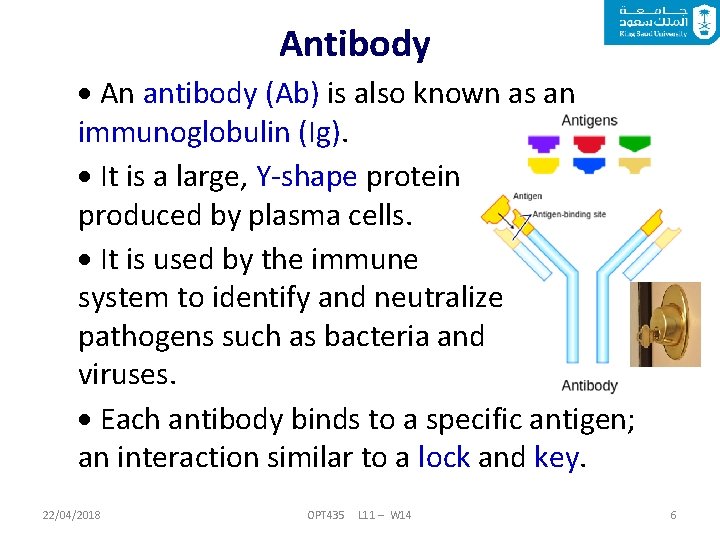
Antibody An antibody (Ab) is also known as an immunoglobulin (Ig). It is a large, Y-shape protein produced by plasma cells. It is used by the immune system to identify and neutralize pathogens such as bacteria and viruses. Each antibody binds to a specific antigen; an interaction similar to a lock and key. 22/04/2018 OPT 435 L 11 – W 14 6
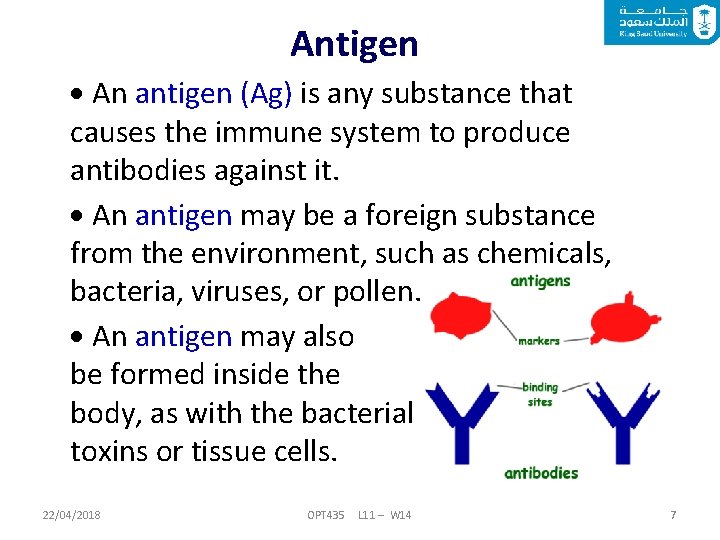
Antigen An antigen (Ag) is any substance that causes the immune system to produce antibodies against it. An antigen may be a foreign substance from the environment, such as chemicals, bacteria, viruses, or pollen. An antigen may also be formed inside the body, as with the bacterial toxins or tissue cells. 22/04/2018 OPT 435 L 11 – W 14 7
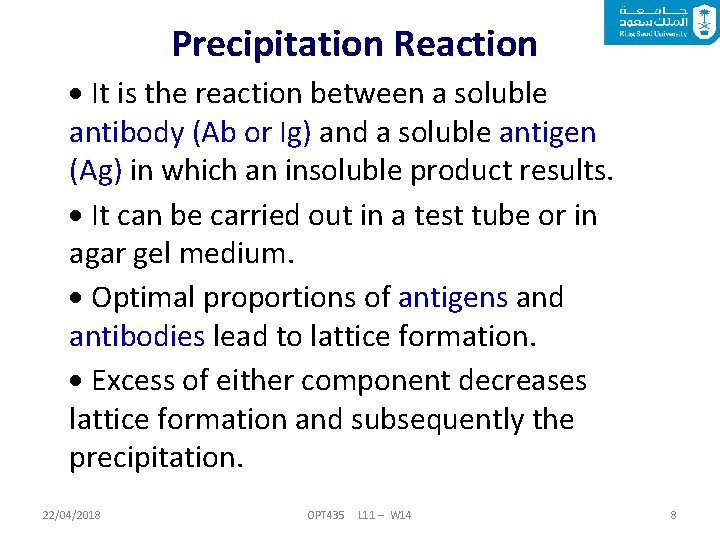
Precipitation Reaction It is the reaction between a soluble antibody (Ab or Ig) and a soluble antigen (Ag) in which an insoluble product results. It can be carried out in a test tube or in agar gel medium. Optimal proportions of antigens and antibodies lead to lattice formation. Excess of either component decreases lattice formation and subsequently the precipitation. 22/04/2018 OPT 435 L 11 – W 14 8
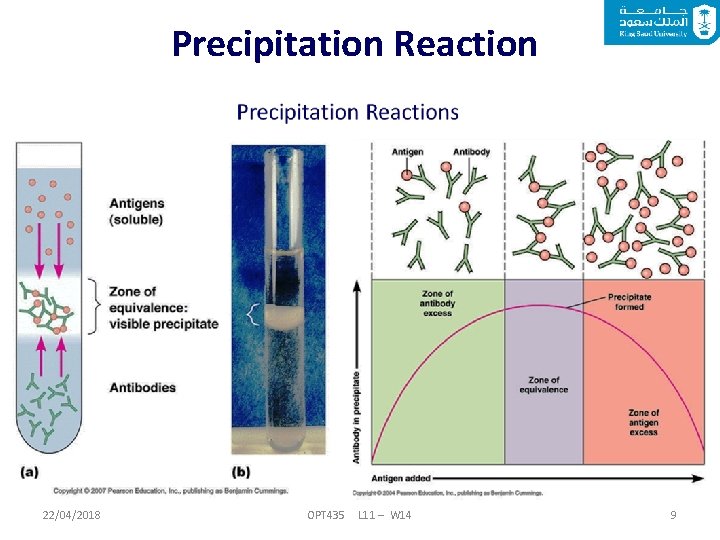
Precipitation Reaction 22/04/2018 OPT 435 L 11 – W 14 9
Agglutination Reactions Agglutination reaction is the interaction of particulate antigens and antibodies. The antibodies cross-link the antigens and as a result form visible clumps. Diseases may be diagnosed by combining the patient’s serum with a known antigen. Diseases can be diagnosed by a rising titer (antibody concentration in serum) or seroconversion (from no antibodies to the presence of antibodies). 22/04/2018 OPT 435 L 11 – W 14 10

Agglutination Reactions Direct Agglutination Reaction It test the patient serum for the presence of antibodies against large antigens. Used to determine antibody titer. 22/04/2018 OPT 435 L 11 – W 14 11
Agglutination Reactions Indirect Agglutination Reaction To test the patient serum for the presence of antibodies against soluble antigens. Serum is mixed with latex spheres with the soluble antigens attached. Antibodies will then cause visible agglutination of the latex spheres with the soluble antigens attached. Alternatively, antibodies may be attached to the latex spheres. 22/04/2018 OPT 435 L 11 – W 14 12

Agglutination Reactions 22/04/2018 OPT 435 L 11 – W 14 13

Hemagglutination Reactions Hemagglutination reaction involves agglutination reaction using red blood cells. It can be used in blood typing, diagnosis of certain diseases and identification of viruses. 22/04/2018 OPT 435 L 11 – W 14 14

Hemagglutination Reactions Viral hemagglutination occurs when spikes on the virus cause agglutination of red blood cells in which there is no antigen -antibody interaction. Antibodies prevent hemagglutination. 22/04/2018 OPT 435 L 11 – W 14 15
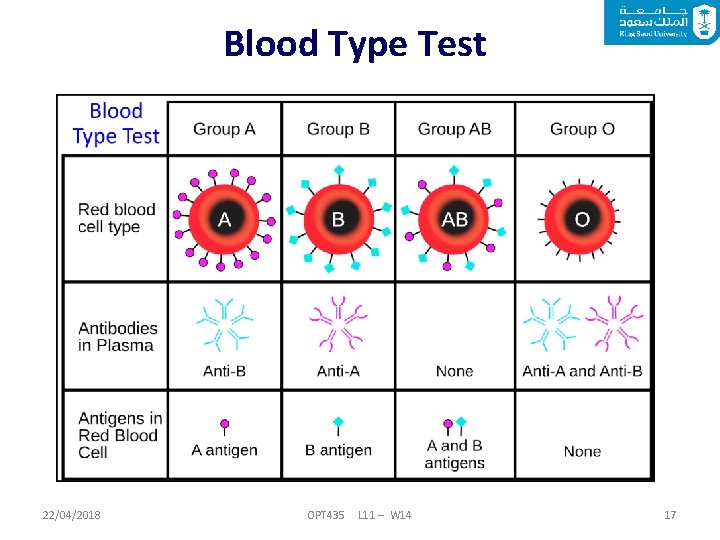
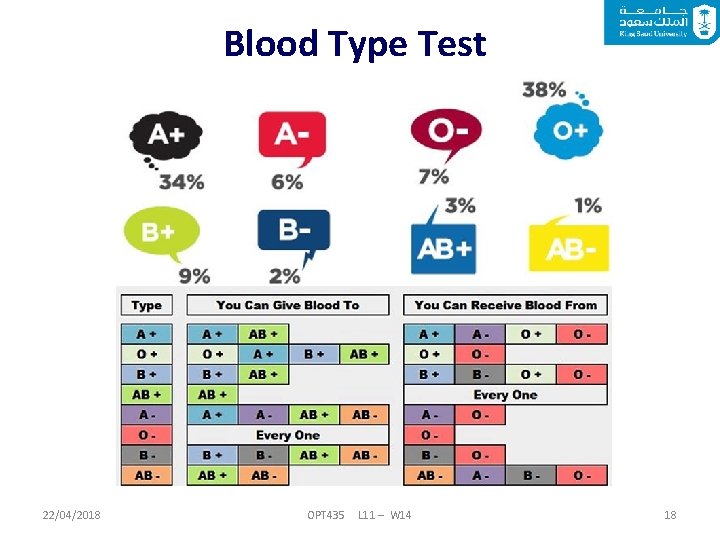
Blood Type Test Human blood is typed by certain markers (called antigens) on the surface of red blood cells. Blood type may also be done to see if two people are likely to be blood relatives. The most important antigens are blood group antigens (ABO). ABO is either present (positive, +) or absent (negative, ) The ABO test shows that people have one of four blood types: A, B, AB or O. 22/04/2018 OPT 435 L 11 – W 14 16
Blood Type Test 22/04/2018 OPT 435 L 11 – W 14 17
Blood Type Test 22/04/2018 OPT 435 L 11 – W 14 18
ELISA The Enzyme-Linked Immunosorbent Assay (ELISA) is a test that uses antibodies and colour change to identify a substance. It uses a solid-phase enzyme immunoassay (EIA) to detect the presence of a substance, usually an antigen, in a liquid sample or wet sample. The ELISA has been used as a diagnostic tool in medicine and plant pathology, as well as a quality-control check in various industries. 22/04/2018 OPT 435 L 11 – W 14 19
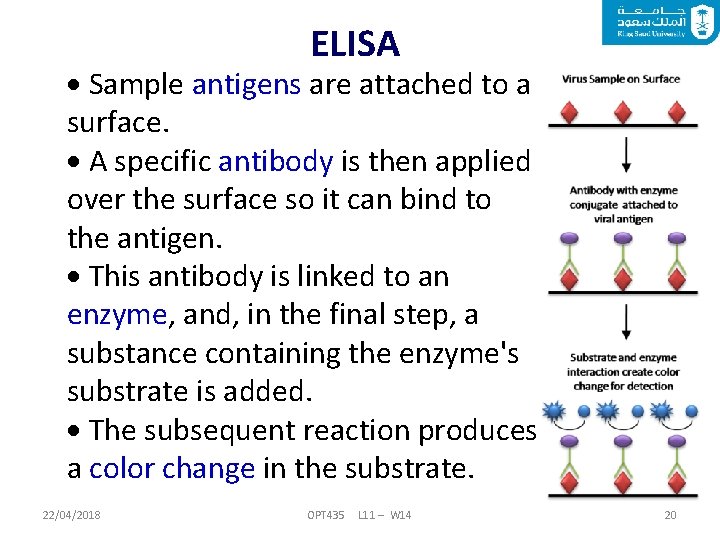
ELISA Sample antigens are attached to a surface. A specific antibody is then applied over the surface so it can bind to the antigen. This antibody is linked to an enzyme, and, in the final step, a substance containing the enzyme's substrate is added. The subsequent reaction produces a color change in the substrate. 22/04/2018 OPT 435 L 11 – W 14 20
ELISA 22/04/2018 OPT 435 L 11 – W 14 21
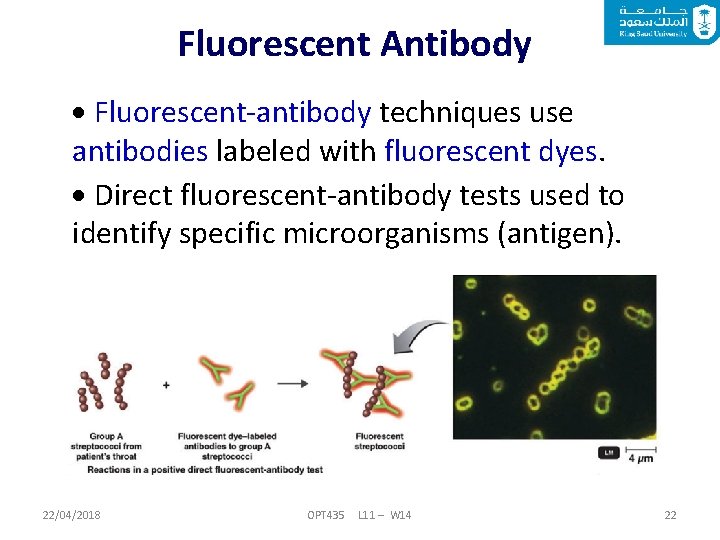
Fluorescent Antibody Fluorescent-antibody techniques use antibodies labeled with fluorescent dyes. Direct fluorescent-antibody tests used to identify specific microorganisms (antigen). 22/04/2018 OPT 435 L 11 – W 14 22
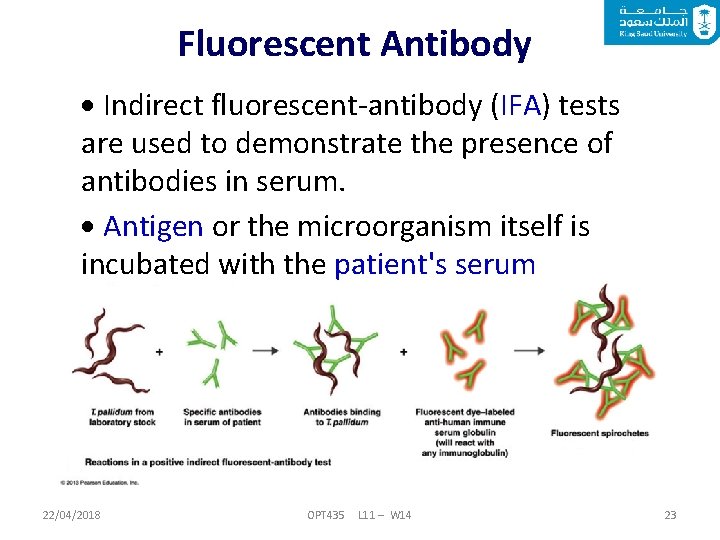
Fluorescent Antibody Indirect fluorescent-antibody (IFA) tests are used to demonstrate the presence of antibodies in serum. Antigen or the microorganism itself is incubated with the patient's serum 22/04/2018 OPT 435 L 11 – W 14 23
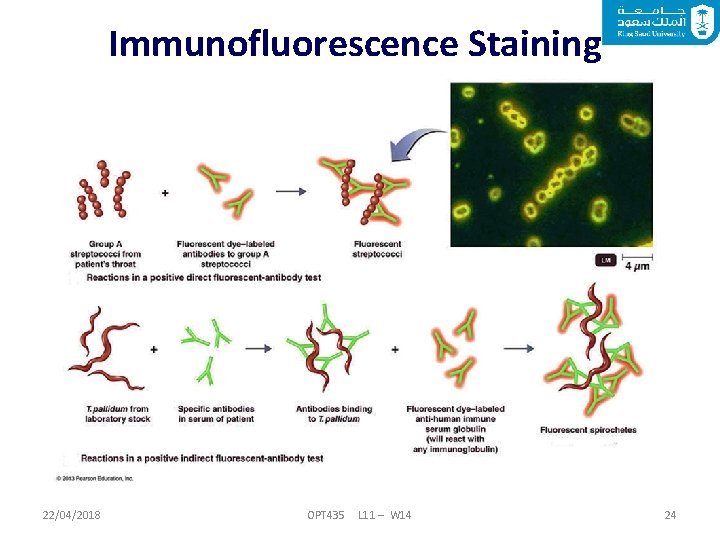
Immunofluorescence Staining 22/04/2018 OPT 435 L 11 – W 14 24
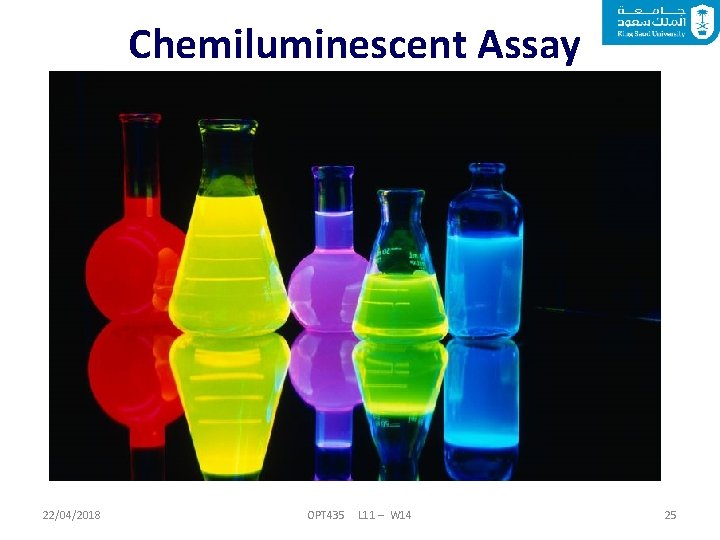
Chemiluminescent Assay 22/04/2018 OPT 435 L 11 – W 14 25

Chemiluminescent Assay 22/04/2018 OPT 435 L 11 – W 14 26
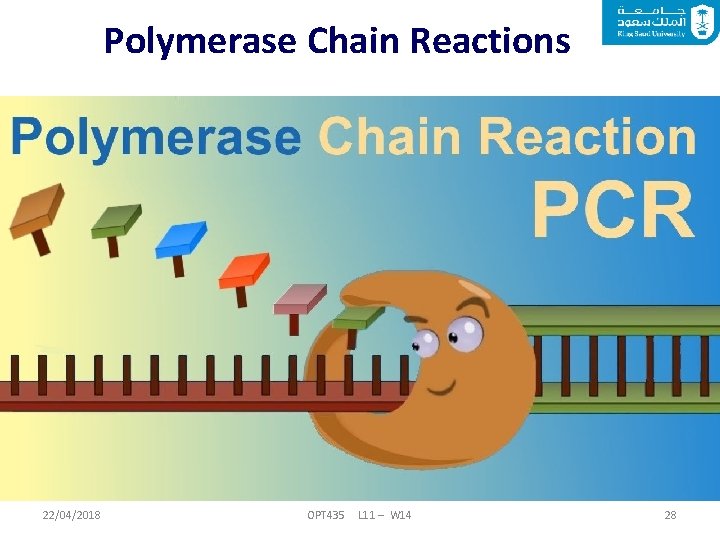
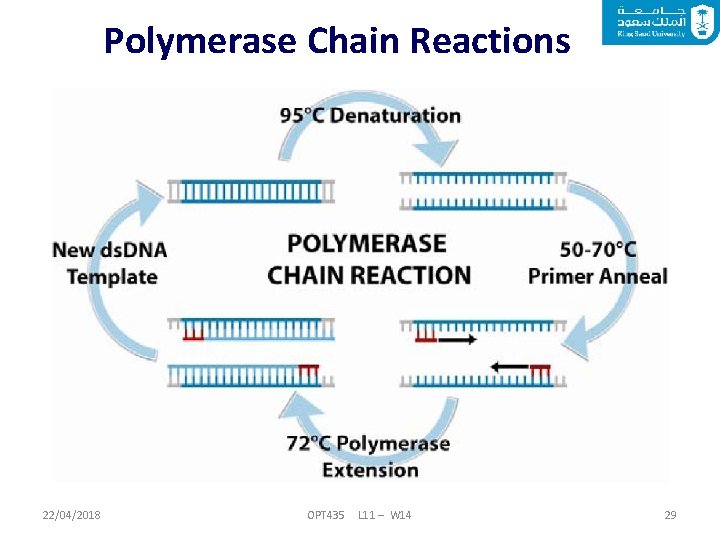
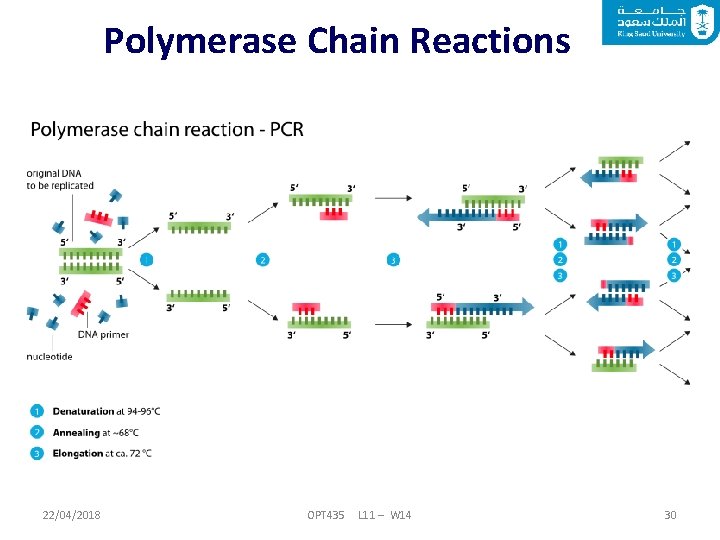
Polymerase Chain Reactions PCR is used to amplify a single copy or pieces of DNA generating thousands to millions of copies of a particular DNA. PCR involves denaturation of target DNA. Annealing of target-specific oligonucleotide primers to each strand of DNA. Extension of the primers by polymerase enzyme to produce a copy of selected region. The cycle of denaturation, primer annealing and extension was repeated. 22/04/2018 OPT 435 L 11 – W 14 27
Polymerase Chain Reactions 22/04/2018 OPT 435 L 11 – W 14 28
Polymerase Chain Reactions 22/04/2018 OPT 435 L 11 – W 14 29
Polymerase Chain Reactions 22/04/2018 OPT 435 L 11 – W 14 30

- Slides: 31