
Options for Transforming the IT Function Using Bimodal
Options for Transforming the IT Function Using Bimodal IT Haffke, Kalgovas, and Benlian – June 2017 Options for Transforming the IT Function Using Bimodal IT decomposes the IT function into two modes—Traditional and Agile—the former focused on stability, the latter on the speed and experimentation necessary to support innovative uses of IT in a digital business context. Our study identified four bimodal IT archetypes and the factors that drive an organization to adopt bimodal IT. We found that companies switch between different archetypes as they transform the IT function, and we describe possible IT transformation journeys they can take. The article concludes with guidelines for transforming the IT function in the context of bimodal IT. Page 1/24

Options for Transforming the IT Function Using Bimodal IT Haffke, Kalgovas, and Benlian – June 2017 Agenda Ø Introduction to the Bimodal IT Function Ø Insights from this Research into Bimodal IT Ø Navigating the IT Transformation Journey Ø Guidelines for Transforming the IT Function Ø Moving Beyond Bimodal IT Page 2/24
Options for Transforming the IT Function Using Bimodal IT Haffke, Kalgovas, and Benlian – June 2017 Introduction to a Bimodal IT Function Ø Bimodal IT – decomposes the IT function into 2 modes – Traditional and Agile Ø Traditional IT is focused on stability Ø Agile IT is focused on experimentation Ø Agile is needed to support digital transformation Ø Bimodal IT allows the IT function to operate in two parallel modes—Traditional and Agile Ø Bimodal IT enables organizations to transform the IT function to support digitization Page 3/24
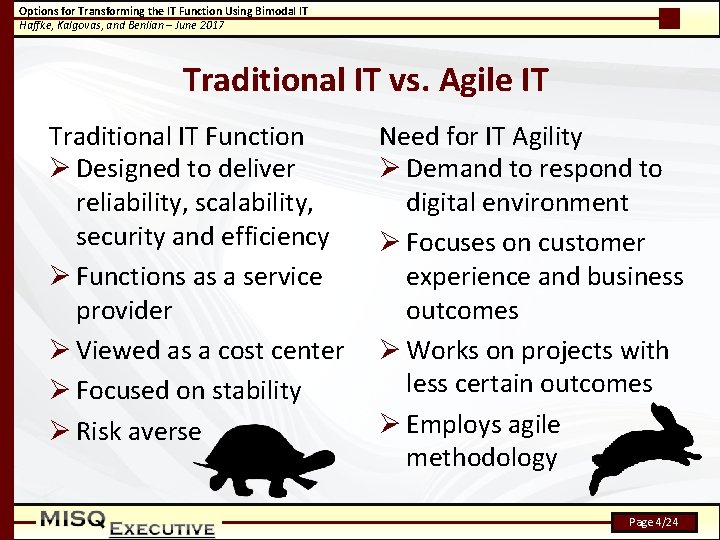
Options for Transforming the IT Function Using Bimodal IT Haffke, Kalgovas, and Benlian – June 2017 Traditional IT vs. Agile IT Traditional IT Function Ø Designed to deliver reliability, scalability, security and efficiency Ø Functions as a service provider Ø Viewed as a cost center Ø Focused on stability Ø Risk averse Need for IT Agility Ø Demand to respond to digital environment Ø Focuses on customer experience and business outcomes Ø Works on projects with less certain outcomes Ø Employs agile methodology Page 4/24
Options for Transforming the IT Function Using Bimodal IT Haffke, Kalgovas, and Benlian – June 2017 The Bimodal IT Approach Resolves Conflicting Goals Ø A challenge to achieve optimal balance of explorative and exploitative IT while simultaneously delivering agility and reliability Ø Firms must have IT agility and IT explorative capabilities while simultaneously not losing sight of the IT function’s traditional objectives Ø An increasing number of firms are considering bimodal IT approaches as the means to develop these capabilities Page 5/24
Options for Transforming the IT Function Using Bimodal IT Haffke, Kalgovas, and Benlian – June 2017 Agenda Ø Introduction to the Bimodal IT Function Ø Insights from this Research into Bimodal IT Ø Navigating the IT Transformation Journey Ø Guidelines for Transforming the IT Function Ø Moving Beyond Bimodal IT Page 6/24
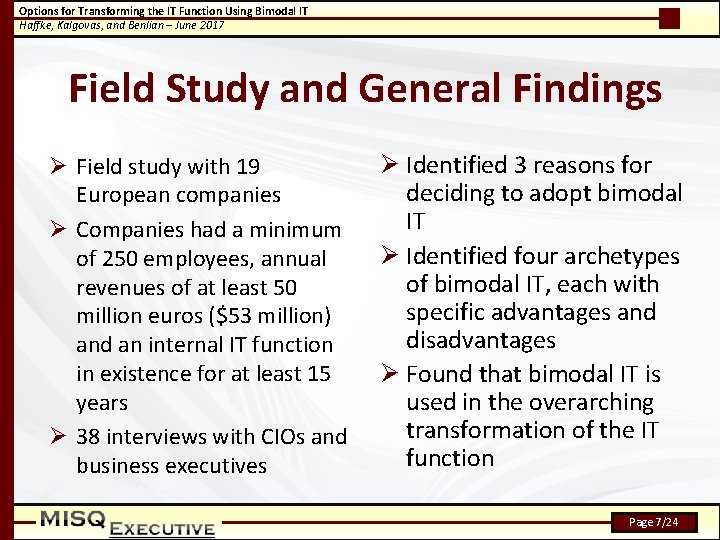
Options for Transforming the IT Function Using Bimodal IT Haffke, Kalgovas, and Benlian – June 2017 Field Study and General Findings Ø Field study with 19 European companies Ø Companies had a minimum of 250 employees, annual revenues of at least 50 million euros ($53 million) and an internal IT function in existence for at least 15 years Ø 38 interviews with CIOs and business executives Ø Identified 3 reasons for deciding to adopt bimodal IT Ø Identified four archetypes of bimodal IT, each with specific advantages and disadvantages Ø Found that bimodal IT is used in the overarching transformation of the IT function Page 7/24
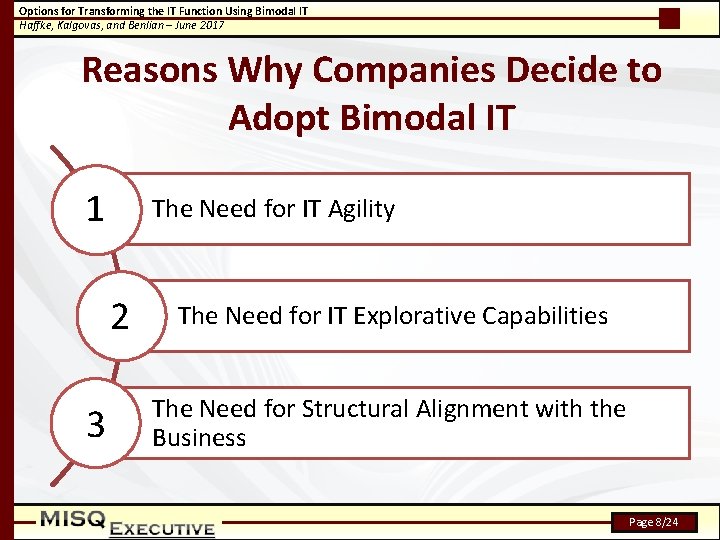
Options for Transforming the IT Function Using Bimodal IT Haffke, Kalgovas, and Benlian – June 2017 Reasons Why Companies Decide to Adopt Bimodal IT 1 The Need for IT Agility 2 3 The Need for IT Explorative Capabilities The Need for Structural Alignment with the Business Page 8/24
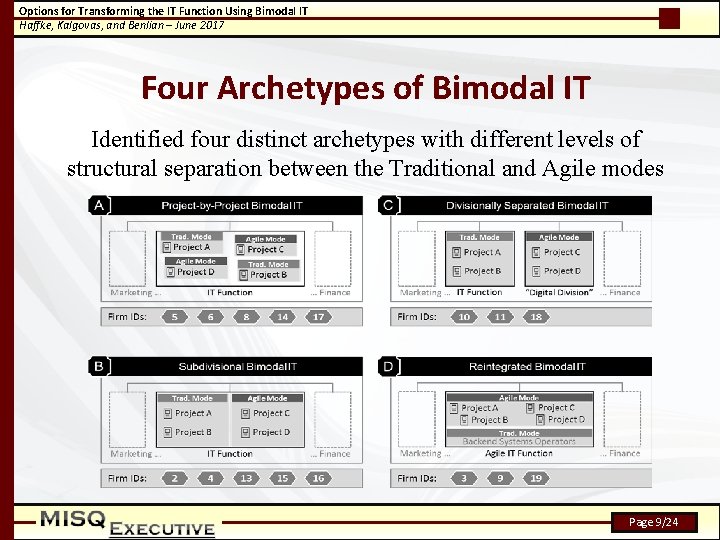
Options for Transforming the IT Function Using Bimodal IT Haffke, Kalgovas, and Benlian – June 2017 Four Archetypes of Bimodal IT Identified four distinct archetypes with different levels of structural separation between the Traditional and Agile modes Page 9/24
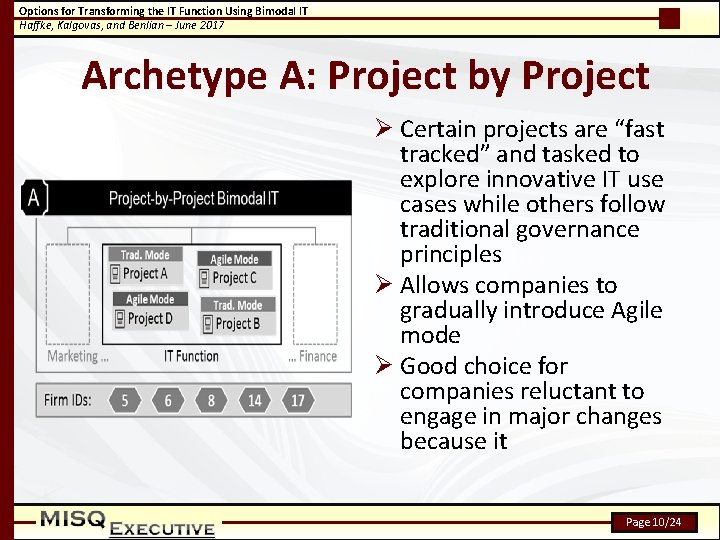
Options for Transforming the IT Function Using Bimodal IT Haffke, Kalgovas, and Benlian – June 2017 Archetype A: Project by Project Ø Certain projects are “fast tracked” and tasked to explore innovative IT use cases while others follow traditional governance principles Ø Allows companies to gradually introduce Agile mode Ø Good choice for companies reluctant to engage in major changes because it Page 10/24
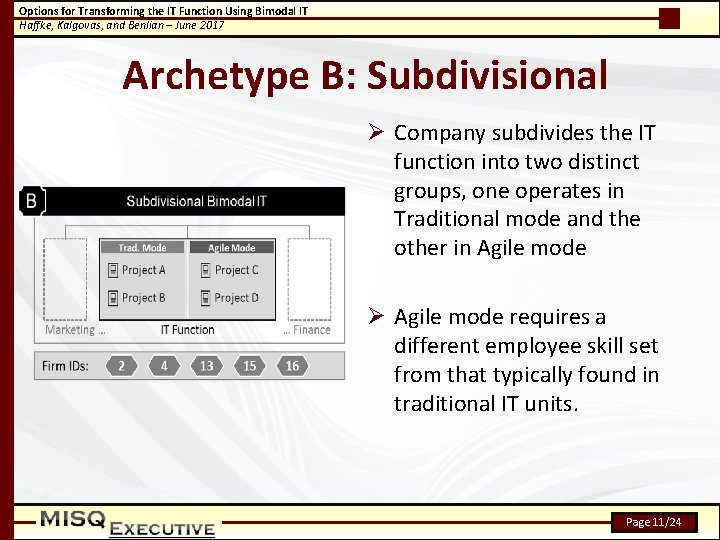
Options for Transforming the IT Function Using Bimodal IT Haffke, Kalgovas, and Benlian – June 2017 Archetype B: Subdivisional Ø Company subdivides the IT function into two distinct groups, one operates in Traditional mode and the other in Agile mode Ø Agile mode requires a different employee skill set from that typically found in traditional IT units. Page 11/24
Options for Transforming the IT Function Using Bimodal IT Haffke, Kalgovas, and Benlian – June 2017 Archetype C: Divisionally Separated Ø Establishes an Agile mode division outside the traditional IT function Ø The Agile division is frequently led by a chief digital officer (CDO) and is often referred to as the “digital division. ” Ø Causes the highest level of internal disruption Ø Appropriate for firms that have fallen behind their increasingly digital competitors and want to signal their digital ambitions both internally and externally Page 12/24
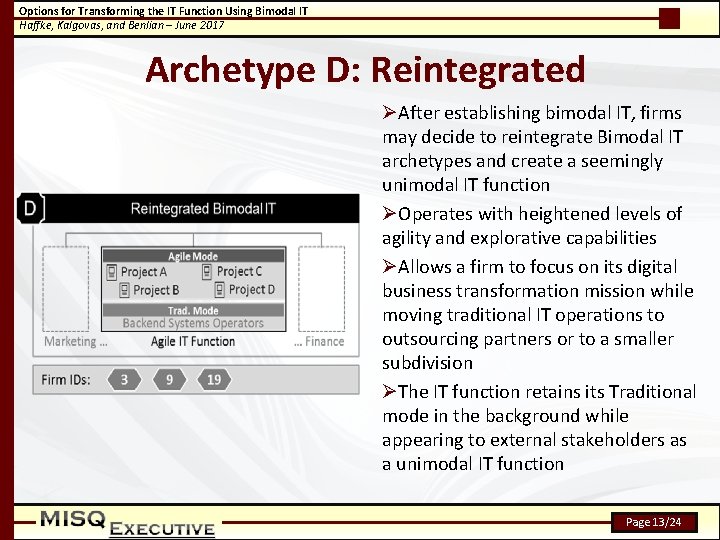
Options for Transforming the IT Function Using Bimodal IT Haffke, Kalgovas, and Benlian – June 2017 Archetype D: Reintegrated ØAfter establishing bimodal IT, firms may decide to reintegrate Bimodal IT archetypes and create a seemingly unimodal IT function ØOperates with heightened levels of agility and explorative capabilities ØAllows a firm to focus on its digital business transformation mission while moving traditional IT operations to outsourcing partners or to a smaller subdivision ØThe IT function retains its Traditional mode in the background while appearing to external stakeholders as a unimodal IT function Page 13/24

Options for Transforming the IT Function Using Bimodal IT Haffke, Kalgovas, and Benlian – June 2017 Difference between Four Bimodal IT Archetypes Ø The differences between the four different archetypes are: ØExtent of internal disruption caused by the bimodal split ØLevel of cultural divide caused by split ØManagement of IT resources ØAlignment mechanisms between the business and IT function and the two modes of IT. Page 14/24
Options for Transforming the IT Function Using Bimodal IT Haffke, Kalgovas, and Benlian – June 2017 Differences between the Four Bimodal IT Archetypes Page 15/24
Options for Transforming the IT Function Using Bimodal IT Haffke, Kalgovas, and Benlian – June 2017 Agenda Ø Introduction to the Bimodal IT Function Ø Insights from this Research into Bimodal IT Ø Navigating the IT Transformation Journey Ø Guidelines for Transforming the IT Function Ø Moving Beyond Bimodal IT Page 16/24
Options for Transforming the IT Function Using Bimodal IT Haffke, Kalgovas, and Benlian – June 2017 Switching Between Archetypes Ø Common practice to switch as firms gain experience and learn from the difficulties Ø Movement through archetypes is not necessarily sequential from A to D Ø Duration and effort required for a transition between archetypes can differ Ø Various motivations to switch Page 17/24
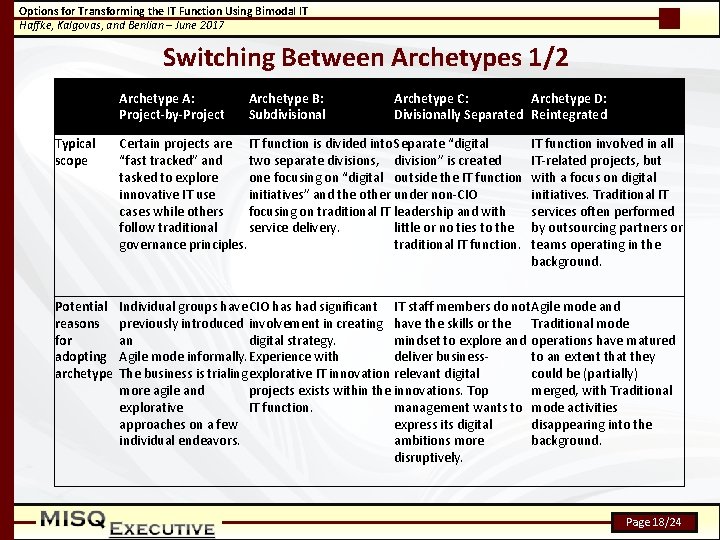
Options for Transforming the IT Function Using Bimodal IT Haffke, Kalgovas, and Benlian – June 2017 Switching Between Archetypes 1/2 Archetype A: Project-by-Project Archetype B: Subdivisional Archetype C: Archetype D: Divisionally Separated Reintegrated Typical scope Certain projects are IT function is divided into Separate “digital “fast tracked” and two separate divisions, division” is created tasked to explore one focusing on “digital outside the IT function innovative IT use initiatives” and the other under non-CIO cases while others focusing on traditional IT leadership and with follow traditional service delivery. little or no ties to the governance principles. traditional IT function involved in all IT-related projects, but with a focus on digital initiatives. Traditional IT services often performed by outsourcing partners or teams operating in the background. Potential reasons for adopting archetype Individual groups have CIO has had significant IT staff members do not Agile mode and previously introduced involvement in creating have the skills or the Traditional mode an digital strategy. mindset to explore and operations have matured Agile mode informally. Experience with deliver businessto an extent that they The business is trialing explorative IT innovation relevant digital could be (partially) more agile and projects exists within the innovations. Top merged, with Traditional explorative IT function. management wants to mode activities approaches on a few express its digital disappearing into the individual endeavors. ambitions more background. disruptively. Page 18/24
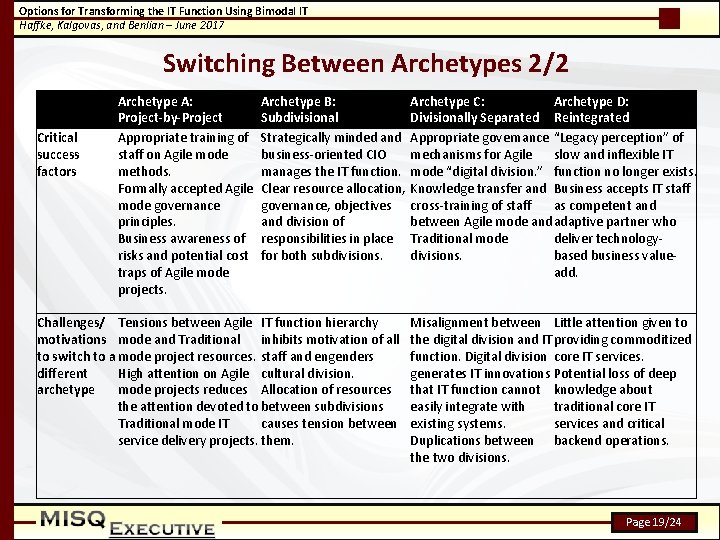
Options for Transforming the IT Function Using Bimodal IT Haffke, Kalgovas, and Benlian – June 2017 Switching Between Archetypes 2/2 Critical success factors Archetype A: Project-by-Project Appropriate training of staff on Agile mode methods. Formally accepted Agile mode governance principles. Business awareness of risks and potential cost traps of Agile mode projects. Archetype B: Subdivisional Strategically minded and business-oriented CIO manages the IT function. Clear resource allocation, governance, objectives and division of responsibilities in place for both subdivisions. Challenges/ Tensions between Agile IT function hierarchy motivations mode and Traditional inhibits motivation of all to switch to a mode project resources. staff and engenders different High attention on Agile cultural division. archetype mode projects reduces Allocation of resources the attention devoted to between subdivisions Traditional mode IT causes tension between service delivery projects. them. Archetype C: Archetype D: Divisionally Separated Reintegrated Appropriate governance “Legacy perception” of mechanisms for Agile slow and inflexible IT mode “digital division. ” function no longer exists. Knowledge transfer and Business accepts IT staff cross-training of staff as competent and between Agile mode and adaptive partner who Traditional mode deliver technologydivisions. based business valueadd. Misalignment between Little attention given to the digital division and IT providing commoditized function. Digital division core IT services. generates IT innovations Potential loss of deep that IT function cannot knowledge about easily integrate with traditional core IT existing systems. services and critical Duplications between backend operations. the two divisions. Page 19/24
Options for Transforming the IT Function Using Bimodal IT Haffke, Kalgovas, and Benlian – June 2017 Pathways for Transforming the IT Function to Bimodal IT Page 20/24
Options for Transforming the IT Function Using Bimodal IT Haffke, Kalgovas, and Benlian – June 2017 Agenda Ø Introduction to the Bimodal IT Function Ø Insights from this Research into Bimodal IT Ø Navigating the IT Transformation Journey Ø Guidelines for Transforming the IT Function Ø Moving Beyond Bimodal IT Page 21/24
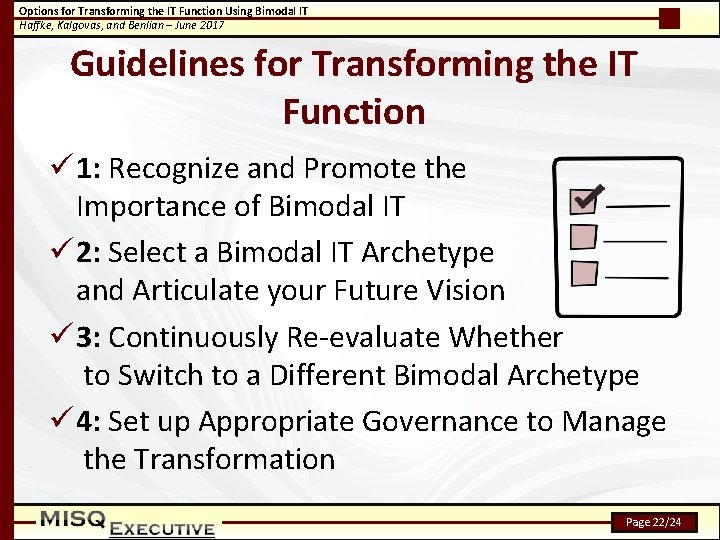
Options for Transforming the IT Function Using Bimodal IT Haffke, Kalgovas, and Benlian – June 2017 Guidelines for Transforming the IT Function ü 1: Recognize and Promote the Importance of Bimodal IT ü 2: Select a Bimodal IT Archetype and Articulate your Future Vision ü 3: Continuously Re-evaluate Whether to Switch to a Different Bimodal Archetype ü 4: Set up Appropriate Governance to Manage the Transformation Page 22/24
Options for Transforming the IT Function Using Bimodal IT Haffke, Kalgovas, and Benlian – June 2017 Agenda Ø Introduction to the Bimodal IT Function Ø Insights from this Research into Bimodal IT Ø Navigating the IT Transformation Journey Ø Guidelines for Transforming the IT Function Ø Moving Beyond Bimodal IT Page 23/24
Options for Transforming the IT Function Using Bimodal IT Haffke, Kalgovas, and Benlian – June 2017 Moving Beyond Bimodal IT Ø Firms may eventually move away from bimodal concepts to realize their future vision of corporate IT Ø Some companies strive for a unimodal agile design Ø Unimodal agile design can be achieved by outsourcing Traditional mode operations so that the IT function can fully focus on supporting digital business objectives Page 24/24
- Slides: 24