
Options for FlowControl Compliance and Stream Stability Analysis
Options for Flow-Control Compliance and Stream Stability Analysis Christie Beeman & Andrew Collison Philip Williams & Associates Dan Cloak Environmental Consultants c. beeman@pwa-ltd. com; a. collison@pwa-ltd. com
Flow Control Standard Post-project runoff peaks and durations must not exceed preproject levels if an increase could cause erosion or other significant effects on beneficial uses.
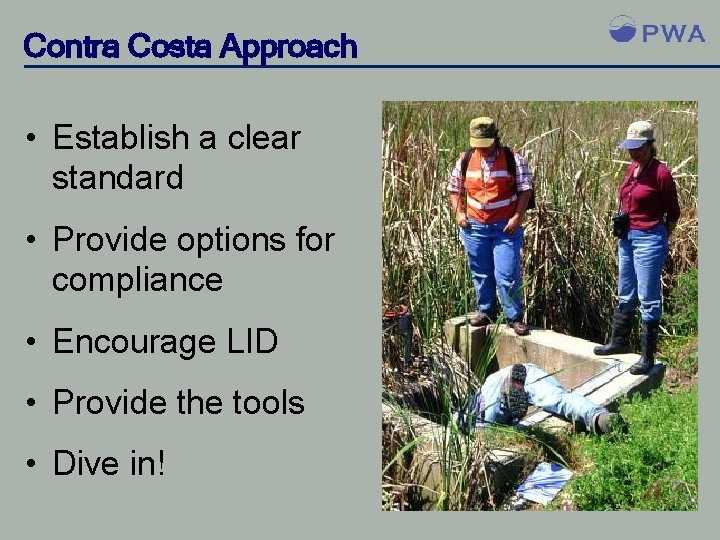
Contra Costa Approach • Establish a clear standard • Provide options for compliance • Encourage LID • Provide the tools • Dive in!

Flow Control Compliance Options 1. No increase in directly connected impervious area (or drainage efficiency) 2. Implementation of flow control IMPs 3. Runoff does not exceed pre-project flow peaks and durations 4. Projected increases in runoff peaks and durations will not accelerate erosion of receiving stream

Flow Control Compliance Options (Stormwater C. 3 Guidebook: Appendix D) 1. No increase in directly connected impervious area (or drainage efficiency) – – – Site design to minimize imperviousness and retain/detain runoff (LID approach, Ch. 3) Inventory of existing vs proposed impervious area Qualitative comparison of pre- vs post-project drainage efficiency; describe: • • Design of self-retaining areas & treatment IMPs, OR Decreased time of concentration and runoff volume

Flow Control Compliance Options 2. Implementation of flow control IMPs • Select and size IMPs following C. 3 Guidebook procedure
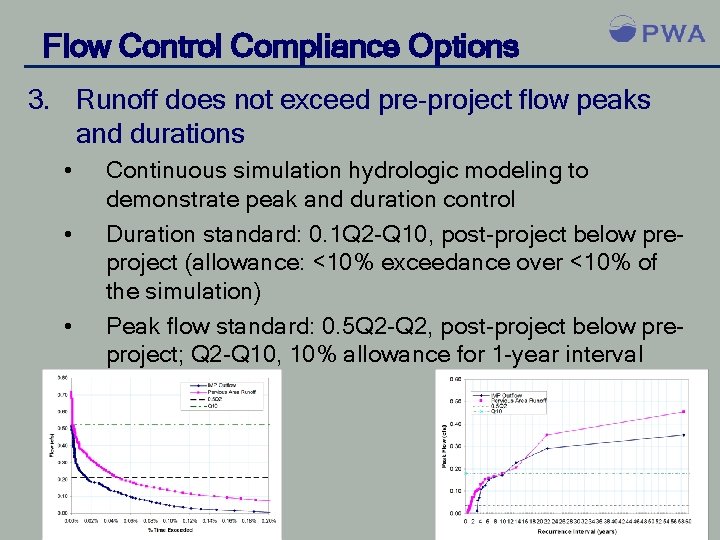
Flow Control Compliance Options 3. Runoff does not exceed pre-project flow peaks and durations • • • Continuous simulation hydrologic modeling to demonstrate peak and duration control Duration standard: 0. 1 Q 2 -Q 10, post-project below preproject (allowance: <10% exceedance over <10% of the simulation) Peak flow standard: 0. 5 Q 2 -Q 2, post-project below preproject; Q 2 -Q 10, 10% allowance for 1 -year interval
Flow Control Compliance Options 4. Projected increases in runoff peaks and durations will not accelerate erosion of receiving stream • Assess vulnerability of receiving stream to hydrograph modification impacts: 4. a Low Risk – stream not vulnerable, project complies 4. b Medium Risk – stream currently stable, but accelerated erosion cannot be ruled out; propose in-stream measures to mitigate for increased runoff 4. c High Risk – stream unstable under current conditions, vulnerable to increases in flow peak/duration; propose comprehensive in-stream restoration (or flow control)
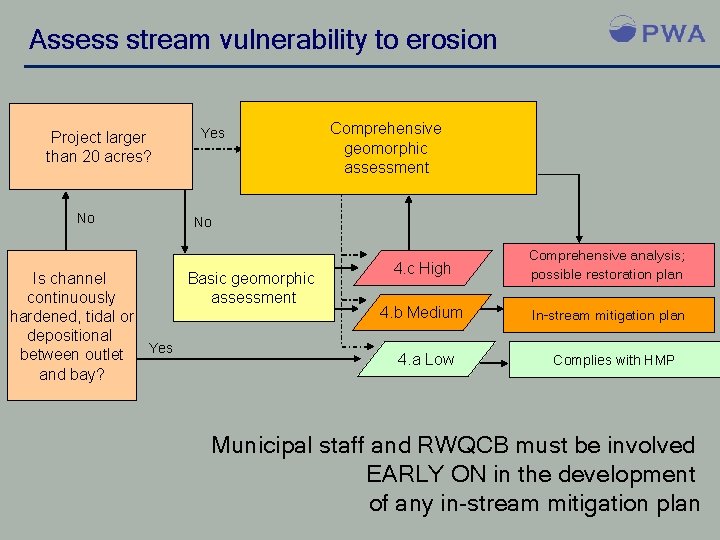
Assess stream vulnerability to erosion Project larger than 20 acres? No Yes Comprehensive geomorphic assessment No Is channel Basic geomorphic continuously assessment hardened, tidal or depositional Yes between outlet and bay? 4. c High Comprehensive analysis; possible restoration plan 4. b Medium In-stream mitigation plan 4. a Low Complies with HMP Municipal staff and RWQCB must be involved EARLY ON in the development of any in-stream mitigation plan
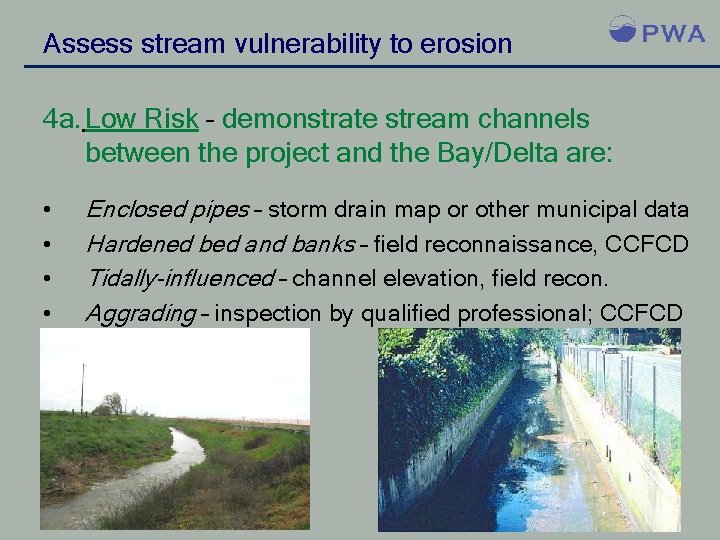
Assess stream vulnerability to erosion 4 a. Low Risk – demonstrate stream channels between the project and the Bay/Delta are: • • Enclosed pipes – storm drain map or other municipal data Hardened bed and banks – field reconnaissance, CCFCD Tidally-influenced – channel elevation, field recon. Aggrading – inspection by qualified professional; CCFCD
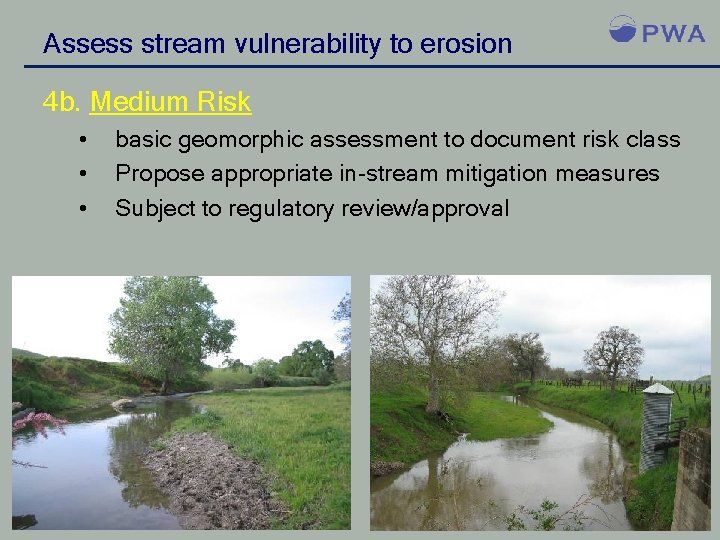
Assess stream vulnerability to erosion 4 b. Medium Risk • • • basic geomorphic assessment to document risk class Propose appropriate in-stream mitigation measures Subject to regulatory review/approval
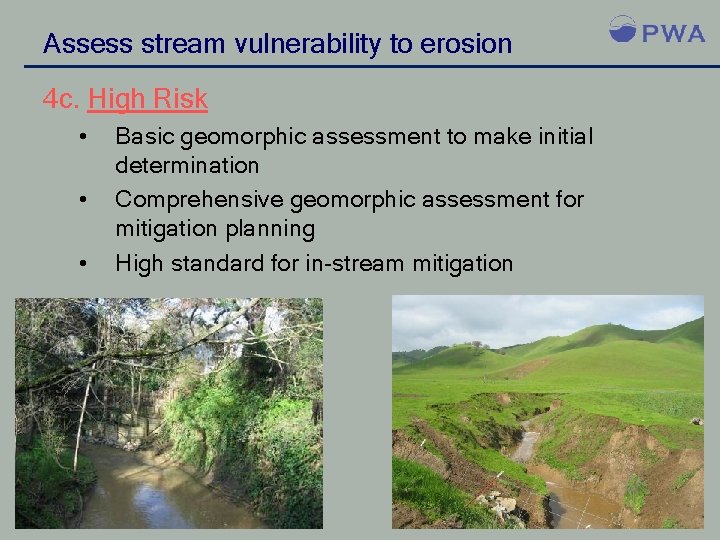
Assess stream vulnerability to erosion 4 c. High Risk • • • Basic geomorphic assessment to make initial determination Comprehensive geomorphic assessment for mitigation planning High standard for in-stream mitigation
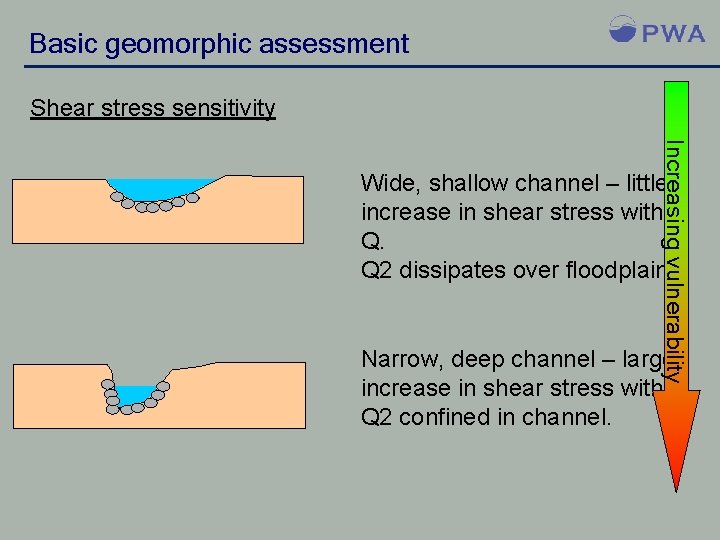
Basic geomorphic assessment Shear stress sensitivity Increasing vulnerability Wide, shallow channel – little increase in shear stress with Q. Q 2 dissipates over floodplain Narrow, deep channel – large increase in shear stress with Q. Q 2 confined in channel.
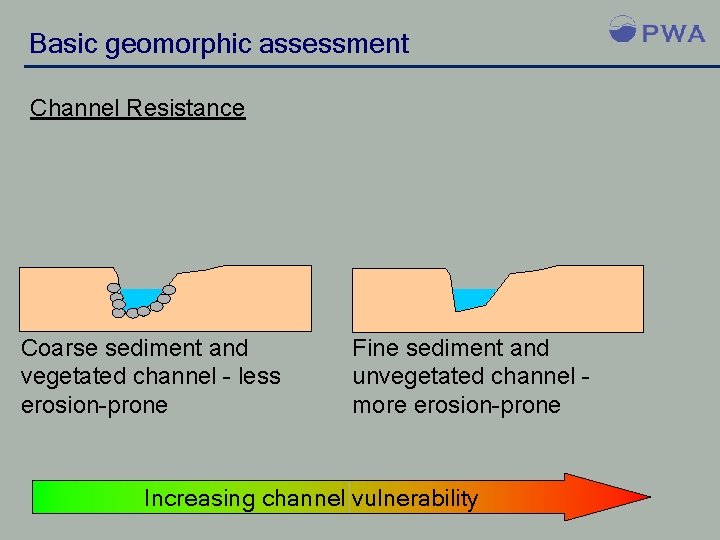
Basic geomorphic assessment Channel Resistance Coarse sediment and vegetated channel - less erosion-prone Fine sediment and unvegetated channel more erosion-prone Increasing channel vulnerability
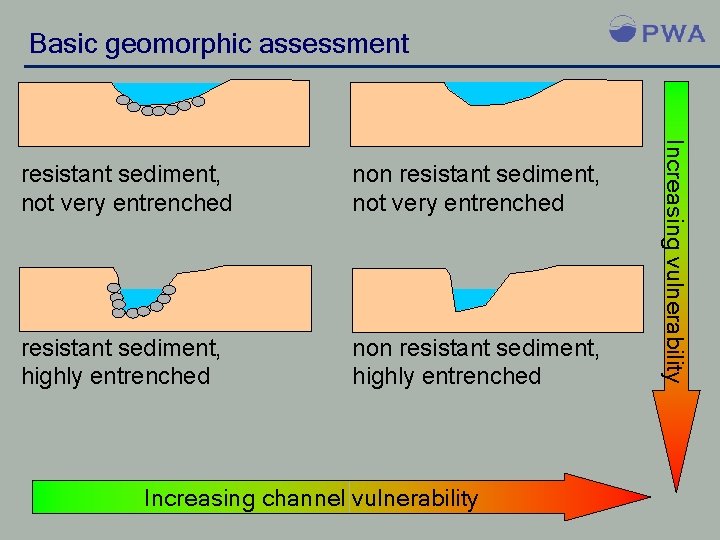
Basic geomorphic assessment non resistant sediment, not very entrenched resistant sediment, highly entrenched non resistant sediment, highly entrenched Increasing channel vulnerability Increasing vulnerability resistant sediment, not very entrenched
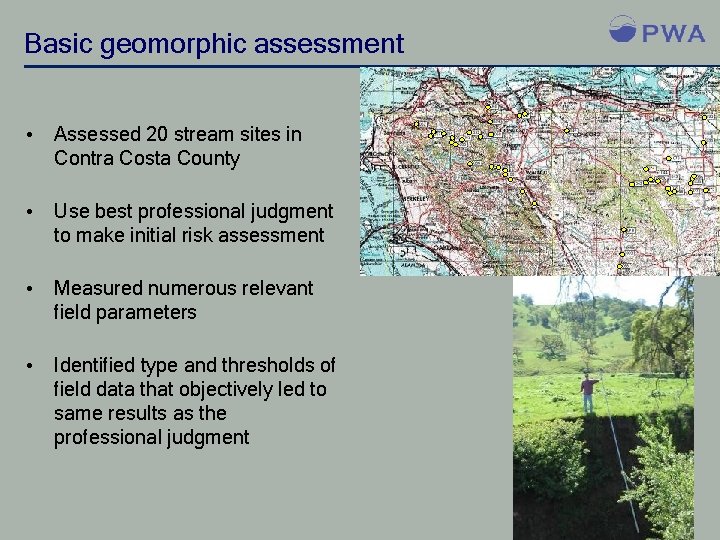
Basic geomorphic assessment • Assessed 20 stream sites in Contra Costa County • Use best professional judgment to make initial risk assessment • Measured numerous relevant field parameters • Identified type and thresholds of field data that objectively led to same results as the professional judgment
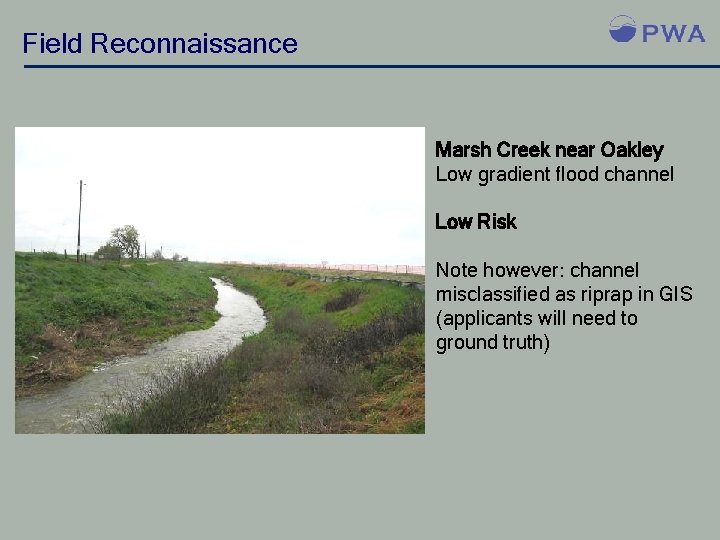
Field Reconnaissance Marsh Creek near Oakley Low gradient flood channel Low Risk Note however: channel misclassified as riprap in GIS (applicants will need to ground truth)
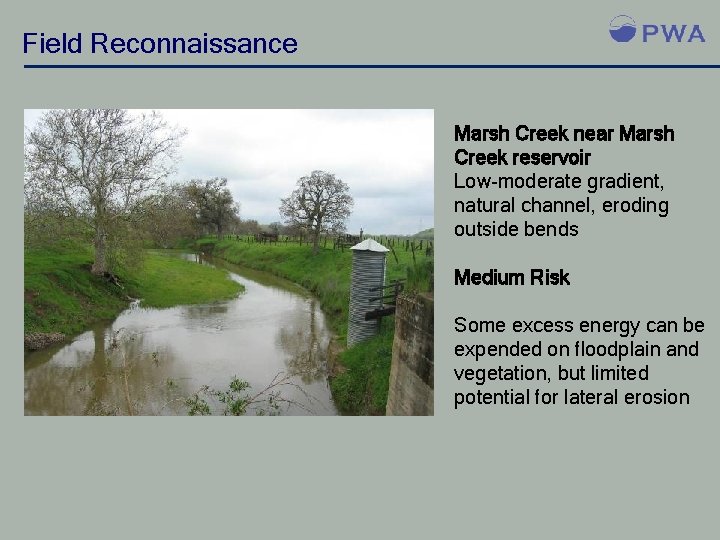
Field Reconnaissance Marsh Creek near Marsh Creek reservoir Low-moderate gradient, natural channel, eroding outside bends Medium Risk Some excess energy can be expended on floodplain and vegetation, but limited potential for lateral erosion
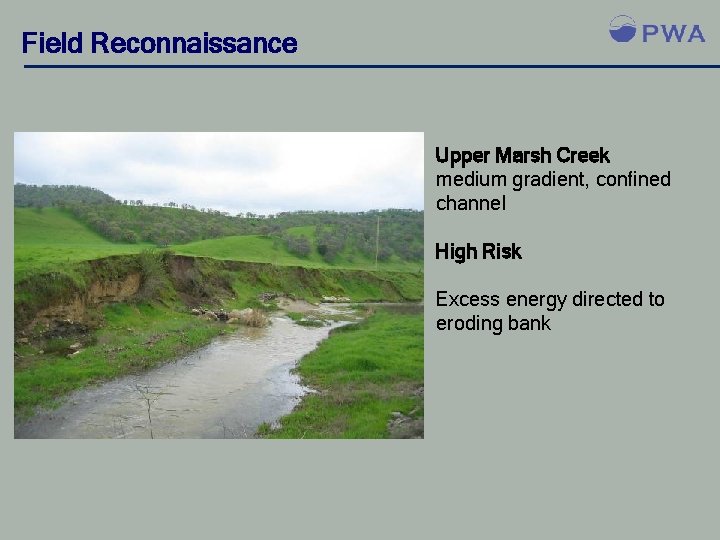
Field Reconnaissance Upper Marsh Creek medium gradient, confined channel High Risk Excess energy directed to eroding bank
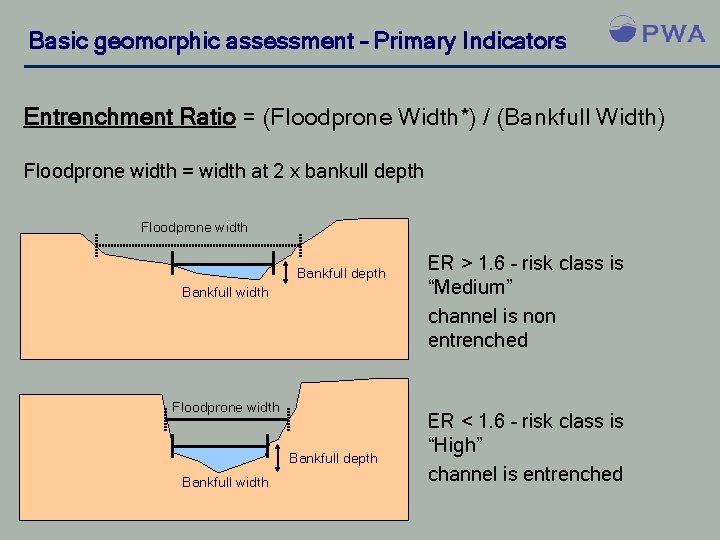
Basic geomorphic assessment – Primary Indicators Entrenchment Ratio = (Floodprone Width*) / (Bankfull Width) Floodprone width = width at 2 x bankull depth Floodprone width Bankfull depth Bankfull width ER > 1. 6 – risk class is “Medium” channel is non entrenched ER < 1. 6 – risk class is “High” channel is entrenched
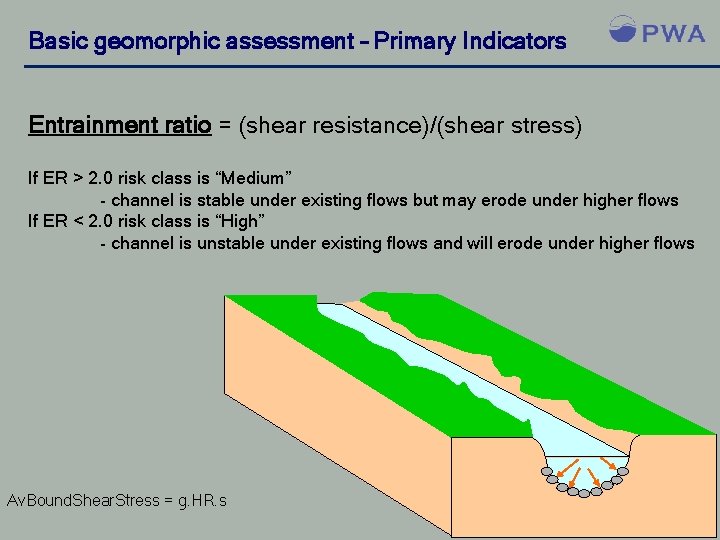
Basic geomorphic assessment – Primary Indicators Entrainment ratio = (shear resistance)/(shear stress) If ER > 2. 0 risk class is “Medium” - channel is stable under existing flows but may erode under higher flows If ER < 2. 0 risk class is “High” - channel is unstable under existing flows and will erode under higher flows Av. Bound. Shear. Stress = g. HR. s
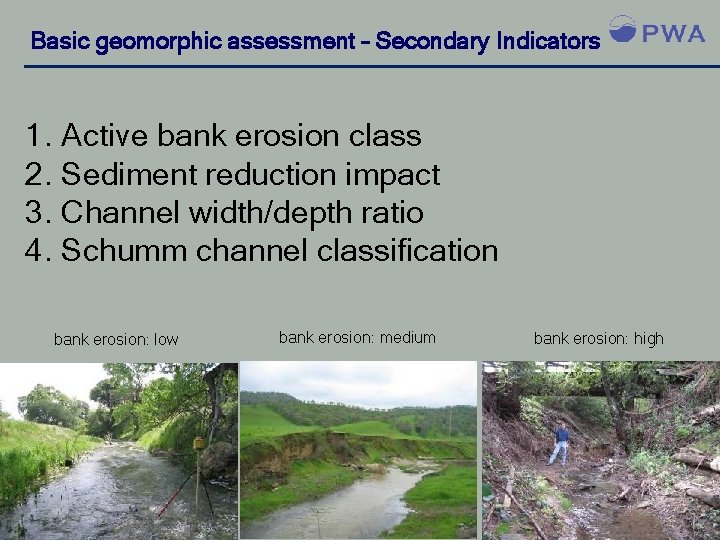
Basic geomorphic assessment – Secondary Indicators 1. Active bank erosion class 2. Sediment reduction impact 3. Channel width/depth ratio 4. Schumm channel classification bank erosion: low bank erosion: medium bank erosion: high
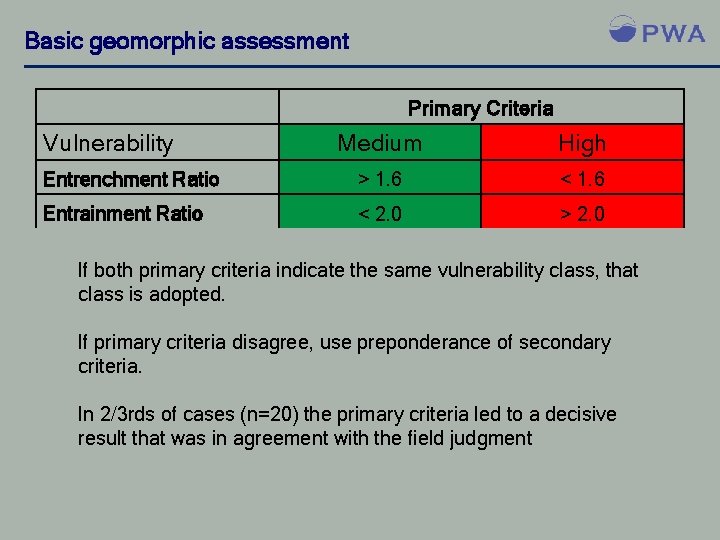
Basic geomorphic assessment Primary Criteria Vulnerability Medium High Entrenchment Ratio > 1. 6 < 1. 6 Entrainment Ratio < 2. 0 > 2. 0 Secondary Criteria If both primary criteria indicate the same vulnerability class, that Confinement Class UC WC or MC class is adopted. Active Bank Erosion Class Low or High If primary criteria disagree, use preponderance of. Moderate secondary criteria. Active Sedimentation Class varies In 2/3 rds of cases (n=20) the primary criteria led to a decisive Width to Depth Ratio 12 field judgment < 12 result that was in agreement with> the Schumm State Class 1, 5 & 6 2, 3 & 4
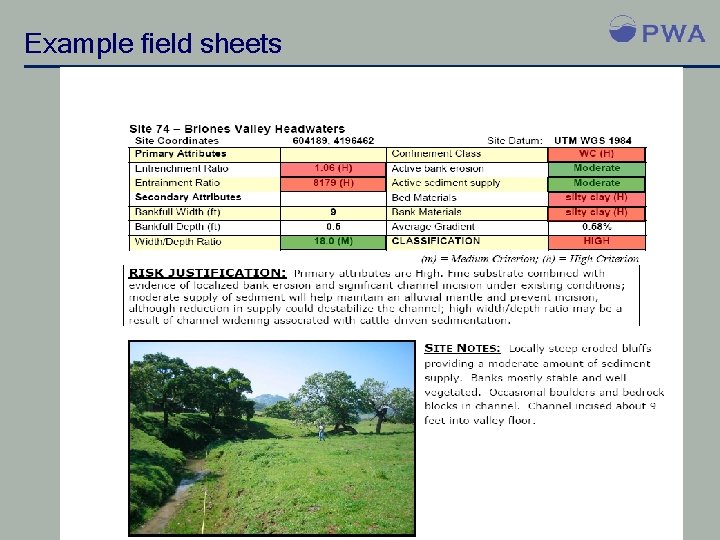
Example field sheets
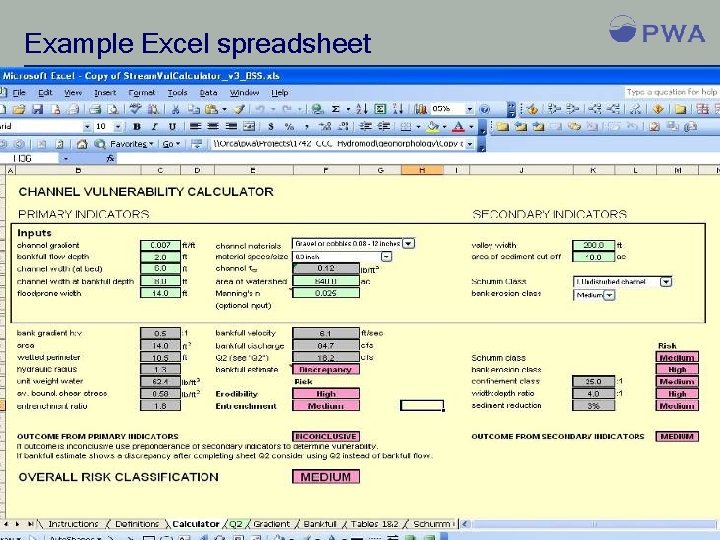
Example Excel spreadsheet
Mitigation on ‘medium’ and ‘high’ risk streams • Basic assessment can provide some guidance on mitigation, but more assessment and design analysis will be needed • Modify channel so that attributes indicate greater stability – e. g. lower floodplain to reduce entrenchment ratio, - e. g. increase sinuosity to reduce entrainment ratio
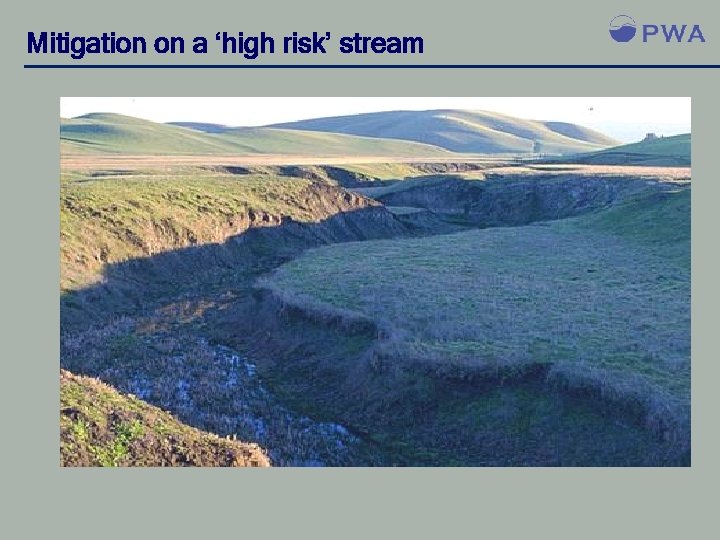
Mitigation on a ‘high risk’ stream
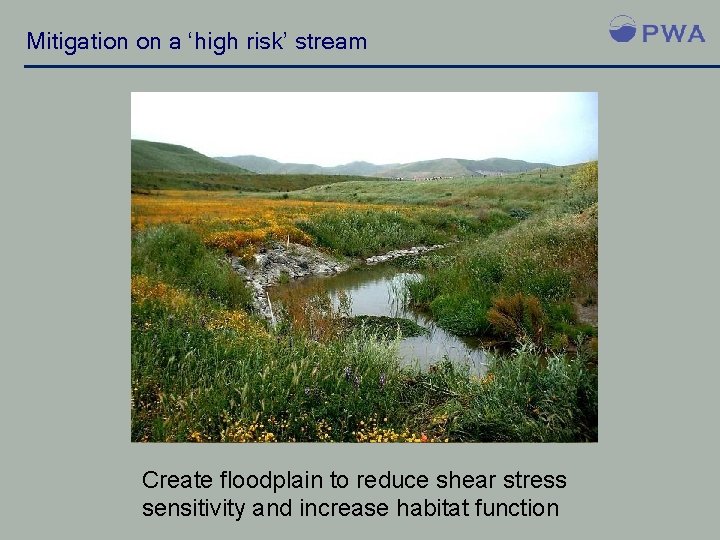
Mitigation on a ‘high risk’ stream Create floodplain to reduce shear stress sensitivity and increase habitat function
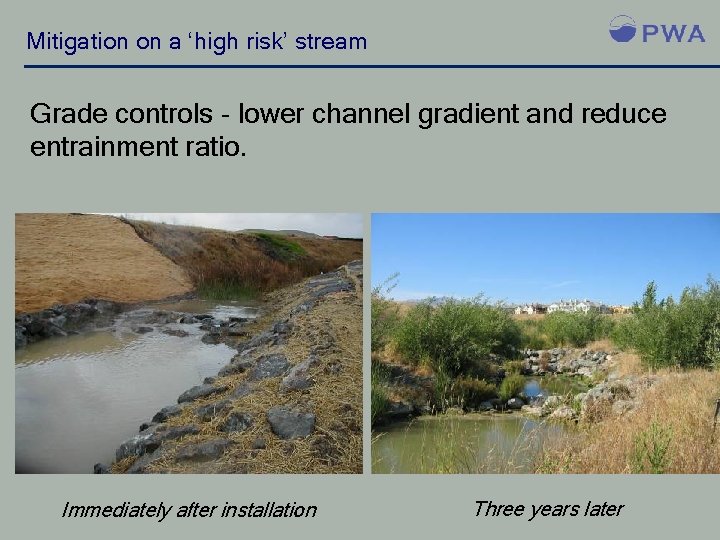
Mitigation on a ‘high risk’ stream Grade controls - lower channel gradient and reduce entrainment ratio. Immediately after installation Three years later
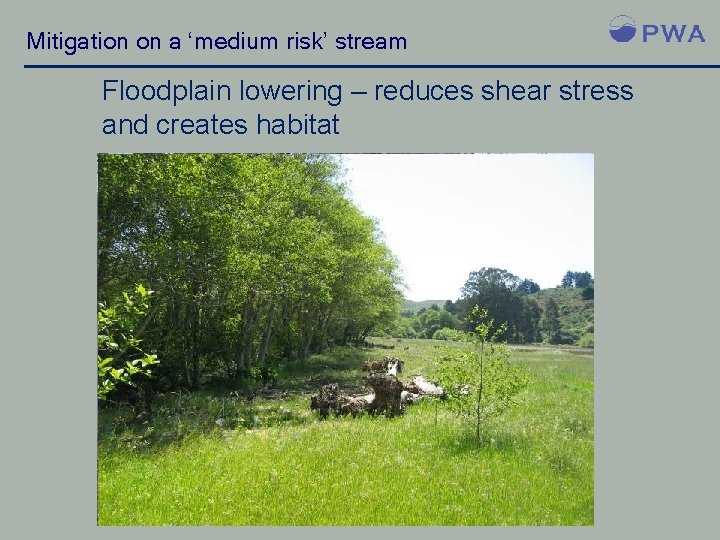
Mitigation on a ‘medium risk’ stream Floodplain lowering – reduces shear stress and creates habitat
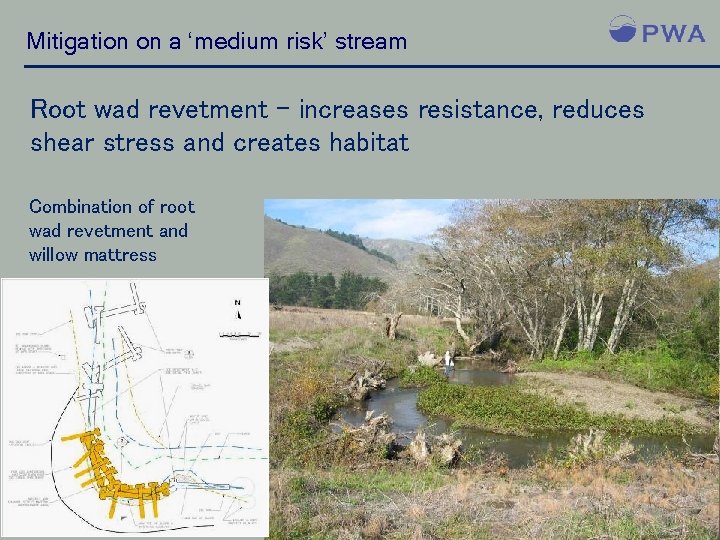
Mitigation on a ‘medium risk’ stream Root wad revetment – increases resistance, reduces shear stress and creates habitat Combination of root wad revetment and willow mattress
Summary • For small projects, relatively simple field indicators can be used to quickly classify the majority of streams into risk categories • Larger projects and/or more complex stream systems require more sophisticated approaches • Mitigation should address the underlying cause of erosion, not just harden eroded areas • Early involvement of municipal staff and regulatory agencie is key to approval of instream mitigation projects
Questions?
- Slides: 33