
Optimizing User Qo E through Overlay Routing Bandwidth
Optimizing User Qo. E through Overlay Routing, Bandwidth Management and Dynamic Transcoding Maarten Wijnants, Wim Lamotte Hasselt University - Expertise Centre for Digital Media Bart De Vleeschauwer, Filip De Turck, Bart Dhoedt, Piet Demeester Ghent University – IBCN - Department of Information Technology Peter Lambert, Dieter Van de Walle, Jan De Cock, Stijn Notebaert, Rik Van de Walle Ghent University – MMLab - Department of Electronics and Information Systems Optimizing User Qo. E through Overlay Routing, Bandwidth Management and Dynamic Transcoding
Outline • Introduction and Motivation • End-to-End Qo. E Optimization Architecture – Overlay Routing Components – Network Intelligence Proxy • H. 264/AVC Video Transcoding • Evaluation – Experimental Setup – Experimental Results – Discussion • Conclusions Optimizing User Qo. E through Overlay Routing, Bandwidth Management and Dynamic Transcoding 23/06/2008 ADAMUS 2008 2
Introduction and Motivation • Rising networked access of MM services – Strict requirements on transportation network • Service consumption environment has become highly heterogeneous – Growing service dependability & adaptation requirements • Current-gen networks often not capable of guaranteeing requirements are satisfied – Internet routing service is best-effort – Constrained access network connections • Insufficient last mile bandwidth Congestion Optimizing User Qo. E through Overlay Routing, Bandwidth Management and Dynamic Transcoding 23/06/2008 ADAMUS 2008 3
Introduction and Motivation • Current networks often unable to provide MM users an acceptable usage experience – More formally: Quality of Experience (Qo. E) • Network architecture supporting full endto-end Qo. E optimization needed – Proposed by us in previous work • We extended network architecture with a H. 264/AVC video transcoding service – Dynamic rate adaptation of H. 264/AVC video – Enables further optimization of user Qo. E Optimizing User Qo. E through Overlay Routing, Bandwidth Management and Dynamic Transcoding 23/06/2008 ADAMUS 2008 4
End-to-End Qo. E Optimization Architecture • Proposed architecture employs 2 -tier approach to achieve E 2 E Qo. E optimization – Enhance data dissemination in network core • Through provision resilient overlay routing service – Last mile user Qo. E optimization • Network traffic shaping • Multimedia service provision • Consists of 3 types of components – Overlay Server – Overlay Access Component – Network Intelligence Proxy Resilient overlay routing Last mile Qo. E optimization Optimizing User Qo. E through Overlay Routing, Bandwidth Management and Dynamic Transcoding 23/06/2008 ADAMUS 2008 5
End-to-End Qo. E Optimization Architecture • Overlay Server (OS) – Deployed in network core – Maintain an overlay topology • Perform active monitoring to obtain connectivity info • Info is used to construct overlay routing tables • Overlay Access Component (AC) – Located near end-users – Decide when to forward traffic to overlay servers (based on quality direct IP connection) • OSs exploit overlay routing tables to transport traffic to AC close to target node Optimizing User Qo. E through Overlay Routing, Bandwidth Management and Dynamic Transcoding 23/06/2008 ADAMUS 2008 6
End-to-End Qo. E Optimization Architecture • Network Intelligence Proxy (NIProxy) – Deployed close to end-user – Improve user Qo. E by intelligently managing last mile content delivery to clients – Context introduction in transportation network • Network awareness: Access channel conditions • Application awareness: E. g. stream significance – Last mile network traffic shaping: Orchestrate last mile BW consumption of applications • Prevent over-encumbrance of client's access link • Intelligently allocate available client downstream BW (based on application awareness) Optimizing User Qo. E through Overlay Routing, Bandwidth Management and Dynamic Transcoding 23/06/2008 ADAMUS 2008 7
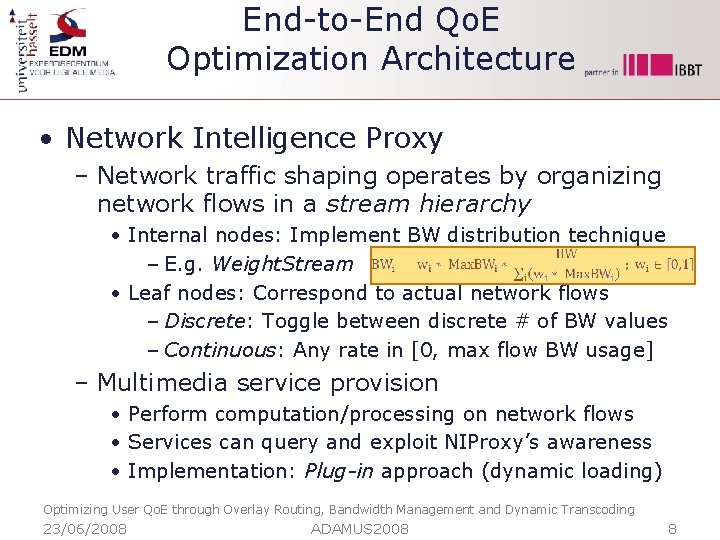
End-to-End Qo. E Optimization Architecture • Network Intelligence Proxy – Network traffic shaping operates by organizing network flows in a stream hierarchy • Internal nodes: Implement BW distribution technique – E. g. Weight. Stream • Leaf nodes: Correspond to actual network flows – Discrete: Toggle between discrete # of BW values – Continuous: Any rate in [0, max flow BW usage] – Multimedia service provision • Perform computation/processing on network flows • Services can query and exploit NIProxy’s awareness • Implementation: Plug-in approach (dynamic loading) Optimizing User Qo. E through Overlay Routing, Bandwidth Management and Dynamic Transcoding 23/06/2008 ADAMUS 2008 8
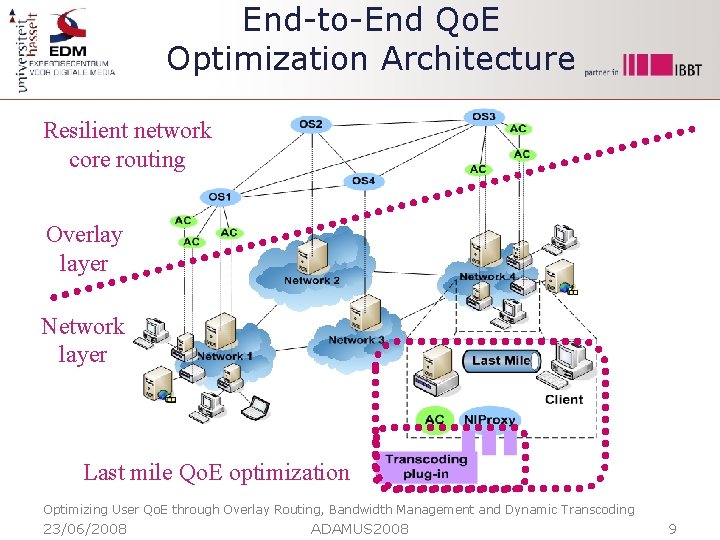
End-to-End Qo. E Optimization Architecture Resilient network core routing Overlay layer Network layer Last mile Qo. E optimization Optimizing User Qo. E through Overlay Routing, Bandwidth Management and Dynamic Transcoding 23/06/2008 ADAMUS 2008 9
H. 264/AVC Video Transcoding • Focus on bit rate reduction • Operates entirely in compressed domain – Only entropy decoding and encoding required – # transformed coefficients are set to 0 based on dynamically changing cut-off frequency – Transcoder steered by rate control alg • Ensures desired bit rate is achieved (Track buffer occupancy Estimate bit budget current frame Dynamically adjust cut-off frequency) • Integrated as plug-in for NIProxy – Dynamically set desired bit rate H. 264 flows • Enables H. 264 flow mgmnt using continuous leaves Optimizing User Qo. E through Overlay Routing, Bandwidth Management and Dynamic Transcoding 23/06/2008 ADAMUS 2008 10
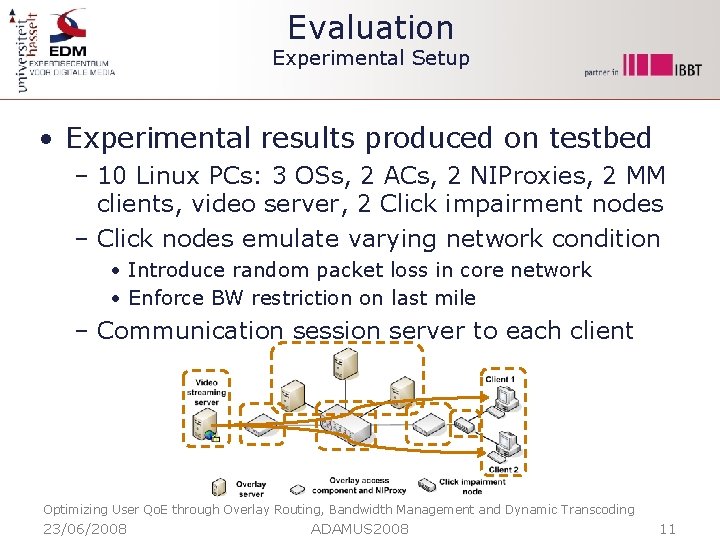
Evaluation Experimental Setup • Experimental results produced on testbed – 10 Linux PCs: 3 OSs, 2 ACs, 2 NIProxies, 2 MM clients, video server, 2 Click impairment nodes – Click nodes emulate varying network condition • Introduce random packet loss in core network • Enforce BW restriction on last mile – Communication session server to each client Optimizing User Qo. E through Overlay Routing, Bandwidth Management and Dynamic Transcoding 23/06/2008 ADAMUS 2008 11
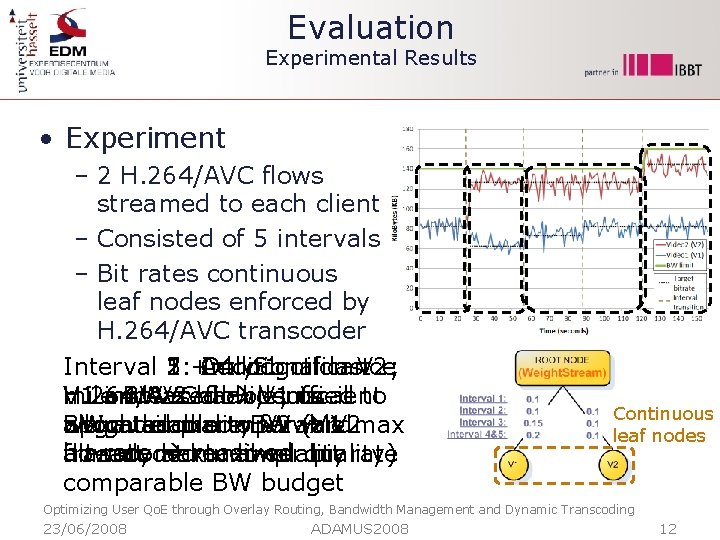
Evaluation Experimental Results • Experiment – 2 H. 264/AVC flows streamed to each client – Consisted of 5 intervals – Bit rates continuous leaf nodes enforced by H. 264/AVC transcoder Interval 5: 1: +Additional 2: 3 Only Introduction 4: Significance 1 last V 2; V 1 increased identical V 1 is H. 264/AVC mile and BWV 2 available; had flow; sufficient used to allocated more V 2 max BW available weight upgrade and quality comparable to. BW forward V 2 (V 1 bit transcoded to lower bit rate flowrate already at maximal at received maximal quality) comparable BW budget Continuous leaf nodes Optimizing User Qo. E through Overlay Routing, Bandwidth Management and Dynamic Transcoding 23/06/2008 ADAMUS 2008 12
Evaluation Discussion • Findings – Client’s last mile downstream capacity respected Last mile congestion avoided • Outcome = Optimal flow reception at client-side – BW distribution captured stream importance • Due to NIProxy’s application awareness – H. 264/AVC transcoding service enabled continuous video adaptation • Optimal and full exploitation available last mile BW • Did not apply for the “unprotected” client! – Degraded video playback at client-side – Clear difference in Qo. E provided to both clients! Optimizing User Qo. E through Overlay Routing, Bandwidth Management and Dynamic Transcoding 23/06/2008 ADAMUS 2008 13
Conclusions • E 2 E Qo. E optimization platform – Resilient overlay routing service circumvents erratic parts of network core – Last mile Qo. E optimization through bandwidth management and multimedia service provision • Extended with H. 264/AVC transcoding – Enables continuous video adaptation • Experimental results demonstrate positive impact on Qo. E optimization capabilities – Full exploitation available last mile BW – More dynamic and effective BW distributions Optimizing User Qo. E through Overlay Routing, Bandwidth Management and Dynamic Transcoding 23/06/2008 ADAMUS 2008 14
Thank you for your attention! Any questions? Optimizing User Qo. E through Overlay Routing, Bandwidth Management and Dynamic Transcoding
- Slides: 15