
OPTIMIZING THE SELFORGANIZING MAP FOR PATTERN AND IMAGE

- Slides: 30
OPTIMIZING THE SELF-ORGANIZING MAP FOR PATTERN AND IMAGE CLASSIFICATION C. C. Hung, H. Ijaz, E. Jung, and B. -C. Kuo# School of Computing and Software Engineering Southern Polytechnic State University, Marietta, Georgia USA #Graduate Institute of Educational Measurement and Statistics, National Taichung University of Education, Taichung, Taiwan, R. O. C.
Contents • Introduction • Self-Organizing Maps (SOM) • Artificial Bee Colony (ABC) Algorithm • Combining SOM and ABC • Experimental Results • Conclusions & Future Work
Introduction Self-Organizing Map (SOM) has been used for image classification. Similar to K-means algorithm, the local minimum problem is inevitable in a complex problem domain. Several solutions have been proposed for optimizing the SOM in remote sensing applications. Example: Simulated annealing.
Introduction Can we use Bee algorithms (BA) to accomplish the more robust classification? Many bee algorithms have been developed. The artificial bee colony (ABC) was used with SOM for this study.
Self-Organizing Map (SOM) The self-organizing map (SOM) is a method for unsupervised learning, based on a grid of artificial neurons whose weights are adapted to match input vectors in a training set. It was first described by the Finnish professor Teuvo Kohonen and is thus sometimes referred to as a Kohonen map. SOM is one of the popular neural computation methods in use, and several thousand scientific articles have been written about it. SOM is especially good at producing visualizations of highdimensional data.
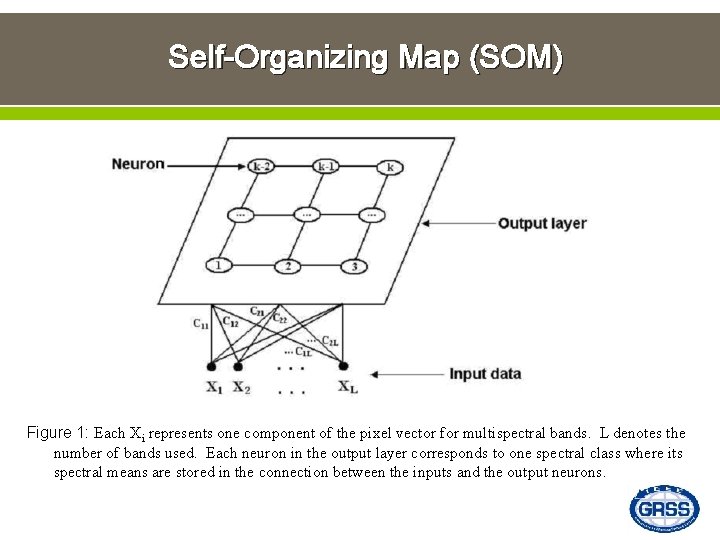
Self-Organizing Map (SOM) Figure 1: Each Xi represents one component of the pixel vector for multispectral bands. L denotes the number of bands used. Each neuron in the output layer corresponds to one spectral class where its spectral means are stored in the connection between the inputs and the output neurons. 6
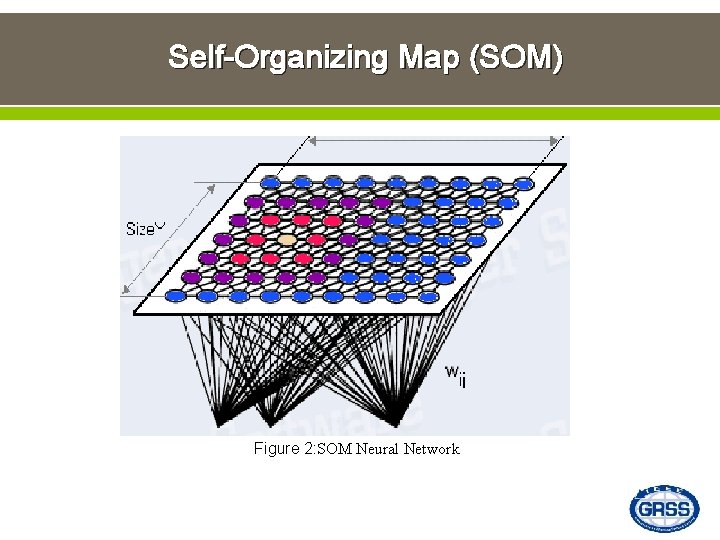
Self-Organizing Map (SOM) Figure 2: SOM Neural Network 7
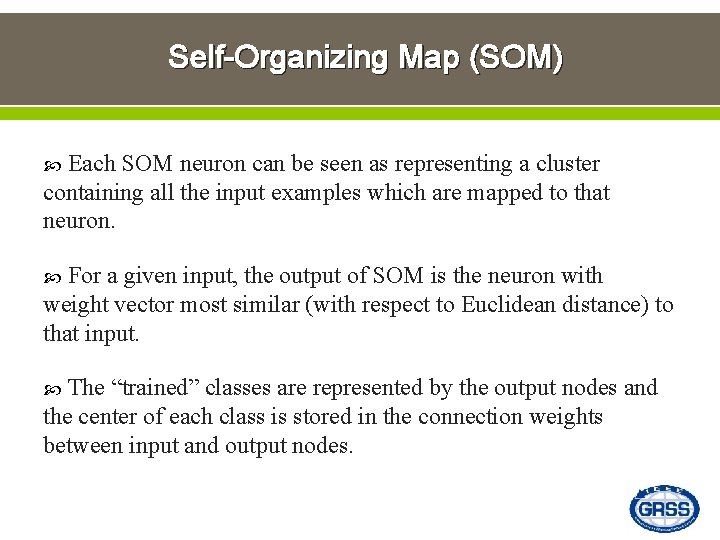
Self-Organizing Map (SOM) Each SOM neuron can be seen as representing a cluster containing all the input examples which are mapped to that neuron. For a given input, the output of SOM is the neuron with weight vector most similar (with respect to Euclidean distance) to that input. The “trained” classes are represented by the output nodes and the center of each class is stored in the connection weights between input and output nodes. 8
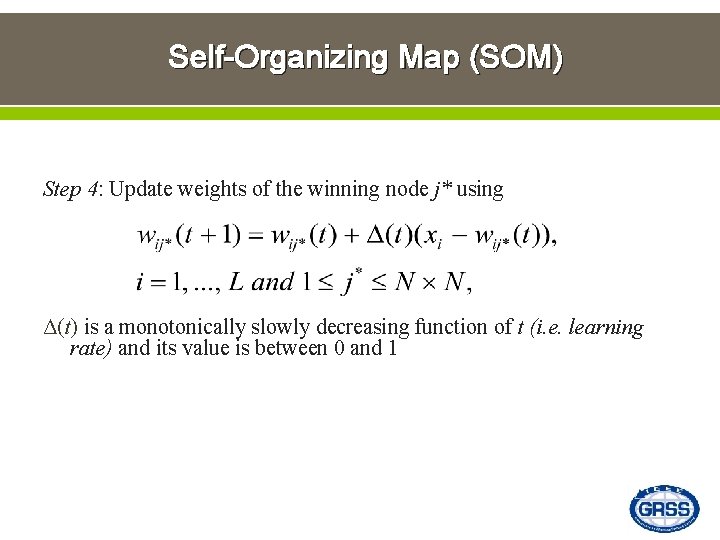
Self-Organizing Map (SOM) Step 4: Update weights of the winning node j* using Δ(t) is a monotonically slowly decreasing function of t (i. e. learning rate) and its value is between 0 and 1 9
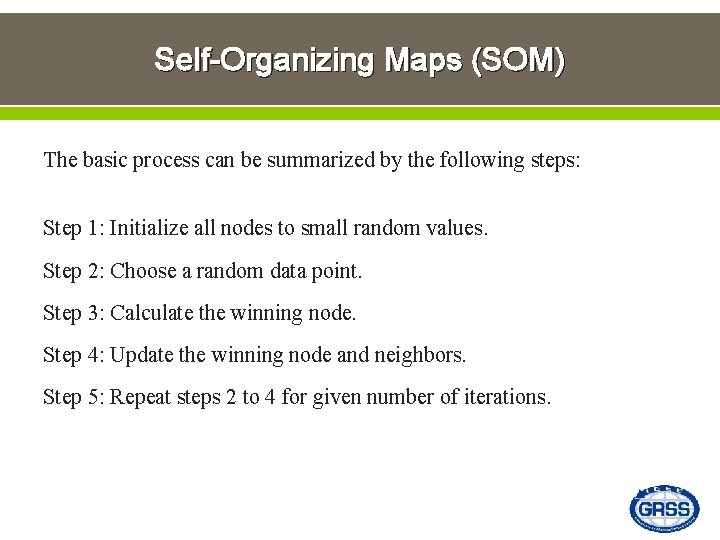
Self-Organizing Maps (SOM) The basic process can be summarized by the following steps: Step 1: Initialize all nodes to small random values. Step 2: Choose a random data point. Step 3: Calculate the winning node. Step 4: Update the winning node and neighbors. Step 5: Repeat steps 2 to 4 for given number of iterations.
Bees Algorithm The Bees Algorithm is a population-based search algorithm inspired by the natural foraging behaviour of honey bees to find the optimal solution. The algorithm performs a kind of neighbourhood search combined with random search. 11
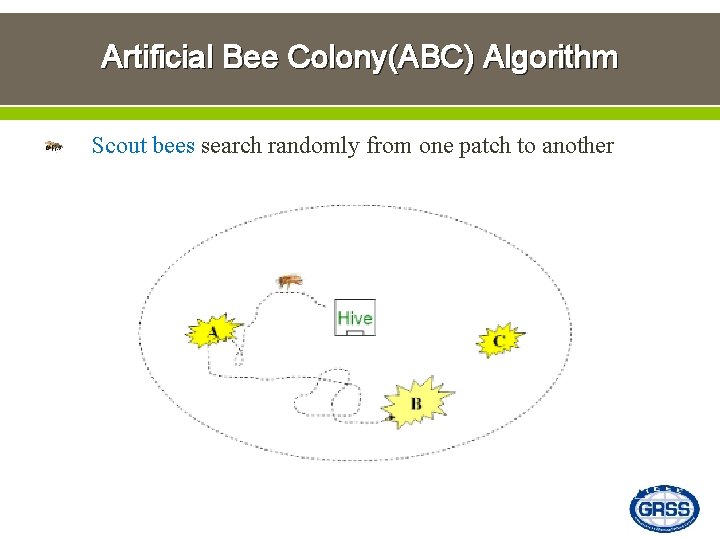
Artificial Bee Colony(ABC) Algorithm Scout bees search randomly from one patch to another 12
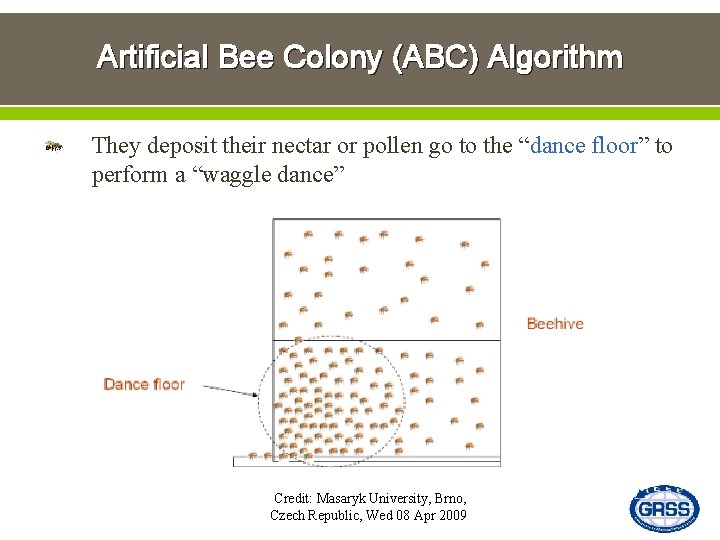
Artificial Bee Colony (ABC) Algorithm They deposit their nectar or pollen go to the “dance floor” to perform a “waggle dance” Credit: Masaryk University, Brno, Czech Republic, Wed 08 Apr 2009
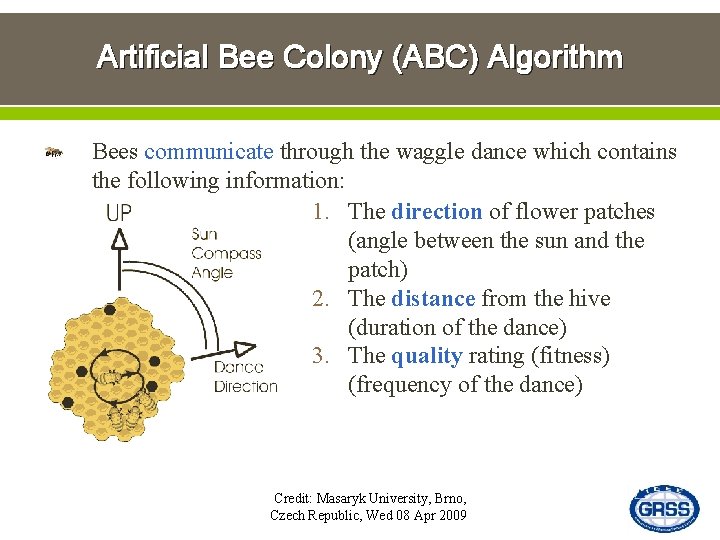
Artificial Bee Colony (ABC) Algorithm Bees communicate through the waggle dance which contains the following information: 1. The direction of flower patches (angle between the sun and the patch) 2. The distance from the hive (duration of the dance) 3. The quality rating (fitness) (frequency of the dance) Credit: Masaryk University, Brno, Czech Republic, Wed 08 Apr 2009
Artificial Bee Colony (ABC) Algorithm Three type of Bees in ABC: 1) Employed bees 2) Onlooker bees, and 3) Scouts. Employed and onlooker bees perform the exploitation search. Scouts carry out the exploration search.
Artificial Bee Colony (ABC) Algorithm ABC employs four different selection processes: 1) a global selection process used by onlookers, 2) a local selection process carried out in a region by employed and onlooker bees, 3) a greedy selection process used by all bees, and 4) a random selection process used by scouts.
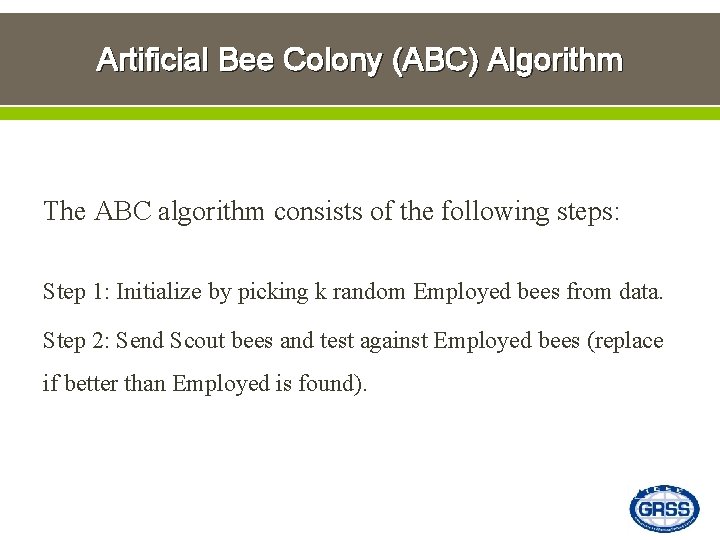
Artificial Bee Colony (ABC) Algorithm The ABC algorithm consists of the following steps: Step 1: Initialize by picking k random Employed bees from data. Step 2: Send Scout bees and test against Employed bees (replace if better than Employed is found).
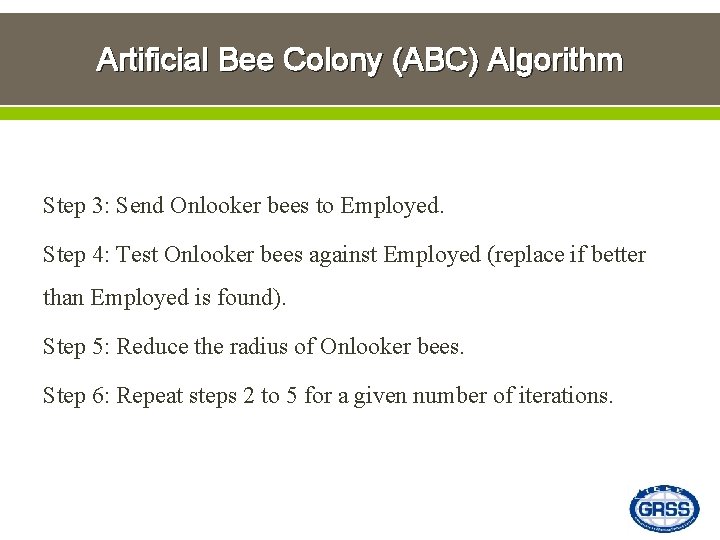
Artificial Bee Colony (ABC) Algorithm Step 3: Send Onlooker bees to Employed. Step 4: Test Onlooker bees against Employed (replace if better than Employed is found). Step 5: Reduce the radius of Onlooker bees. Step 6: Repeat steps 2 to 5 for a given number of iterations.
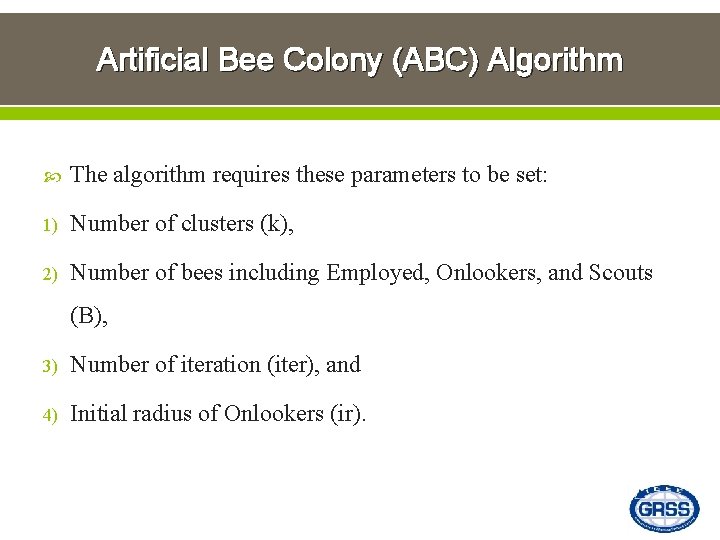
Artificial Bee Colony (ABC) Algorithm The algorithm requires these parameters to be set: 1) Number of clusters (k), 2) Number of bees including Employed, Onlookers, and Scouts (B), 3) Number of iteration (iter), and 4) Initial radius of Onlookers (ir).
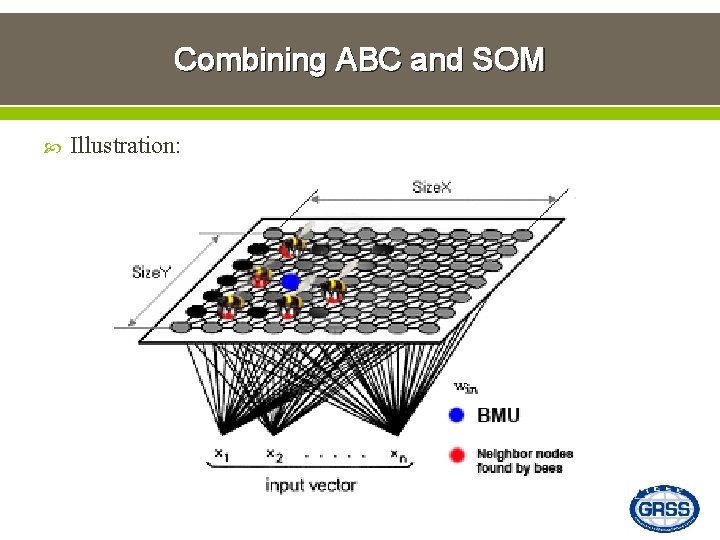
Combining ABC and SOM The proposed algorithm selects some neighboring nodes in SOM for weights update by using the ABC.
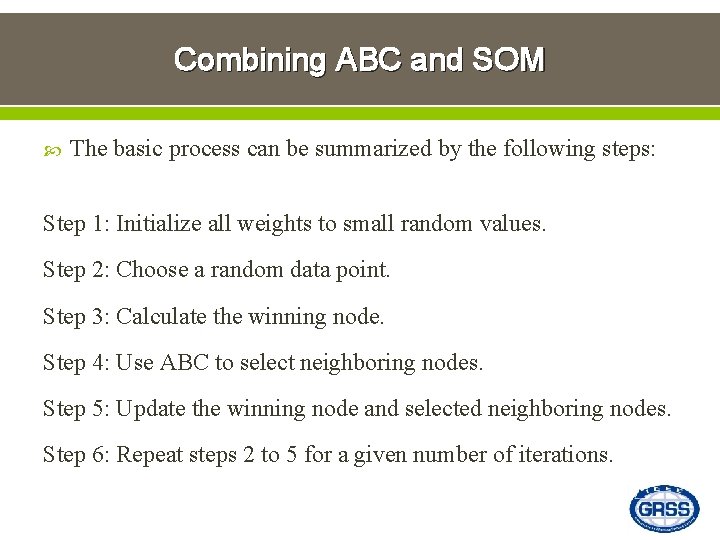
Combining ABC and SOM The basic process can be summarized by the following steps: Step 1: Initialize all weights to small random values. Step 2: Choose a random data point. Step 3: Calculate the winning node. Step 4: Use ABC to select neighboring nodes. Step 5: Update the winning node and selected neighboring nodes. Step 6: Repeat steps 2 to 5 for a given number of iterations.
Combining ABC and SOM Illustration:
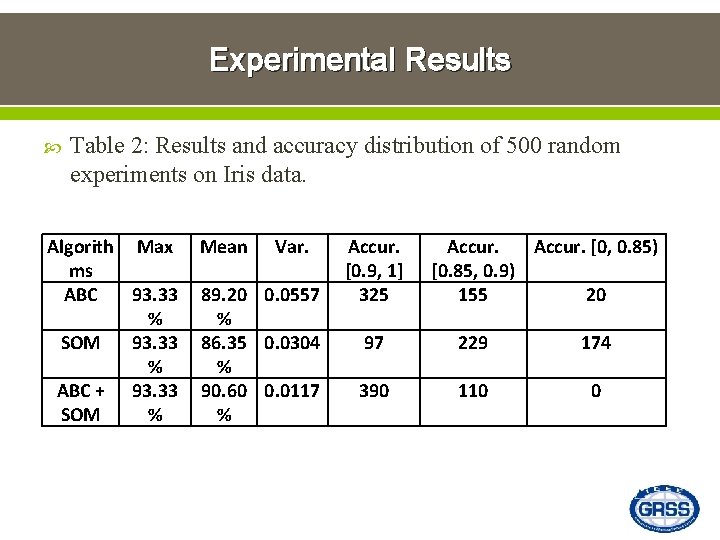
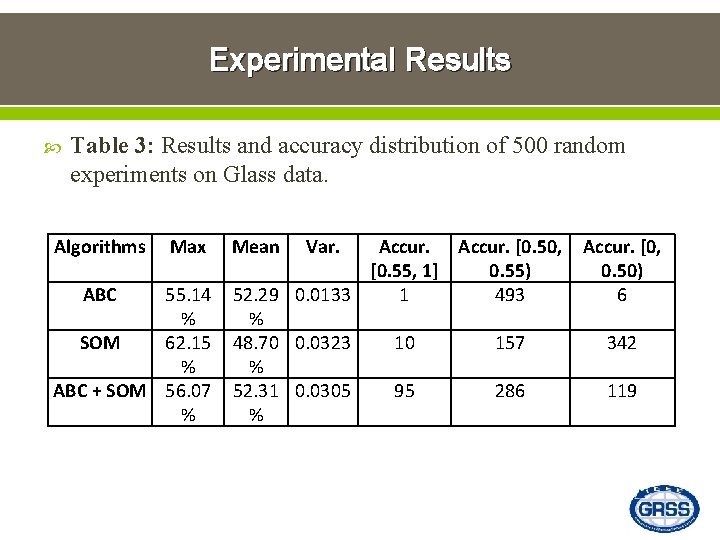
Experimental Results • Some of results on Iris and Glass data sets are shown in Tables 1 and 2. Columns Max, Mean and Variance, give the maximum accuracy achieved, mean accuracy of 500 runs and the standard deviation respectively. The accuracy distribution is also given.
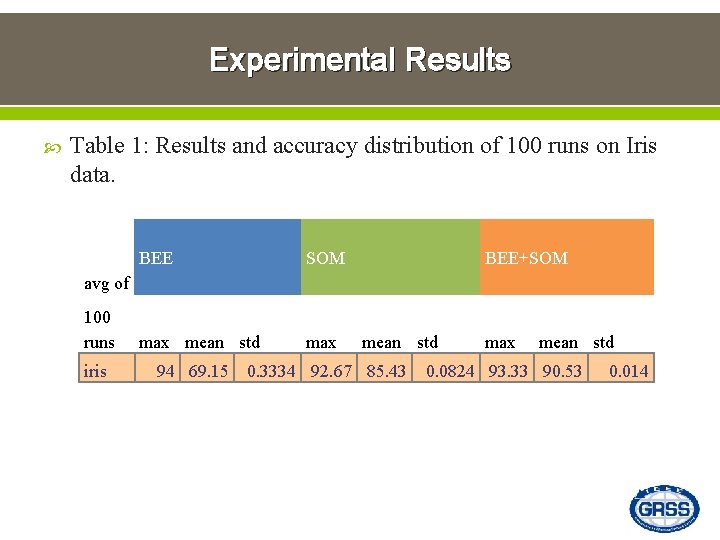
Experimental Results Table 1: Results and accuracy distribution of 100 runs on Iris data. BEE avg of SOM 100 runs max iris max mean std BEE+SOM mean std 94 69. 15 0. 3334 92. 67 85. 43 max mean std 0. 0824 93. 33 90. 53 0. 014
Experimental Results Table 2: Results and accuracy distribution of 500 random experiments on Iris data. Algorith Max ms ABC 93. 33 % SOM 93. 33 % ABC + 93. 33 SOM % Mean Var. 89. 20 0. 0557 % 86. 35 0. 0304 % 90. 60 0. 0117 % Accur. [0. 9, 1] 325 Accur. [0, 0. 85) [0. 85, 0. 9) 155 20 97 229 174 390 110 0
Experimental Results Table 3: Results and accuracy distribution of 500 random experiments on Glass data. Algorithms ABC Max 55. 14 % SOM 62. 15 % ABC + SOM 56. 07 % Mean Var. Accur. [0. 50, [0. 55, 1] 0. 55) 52. 29 0. 0133 1 493 % 48. 70 0. 0323 10 157 % 52. 31 0. 0305 95 286 % Accur. [0, 0. 50) 6 342 119
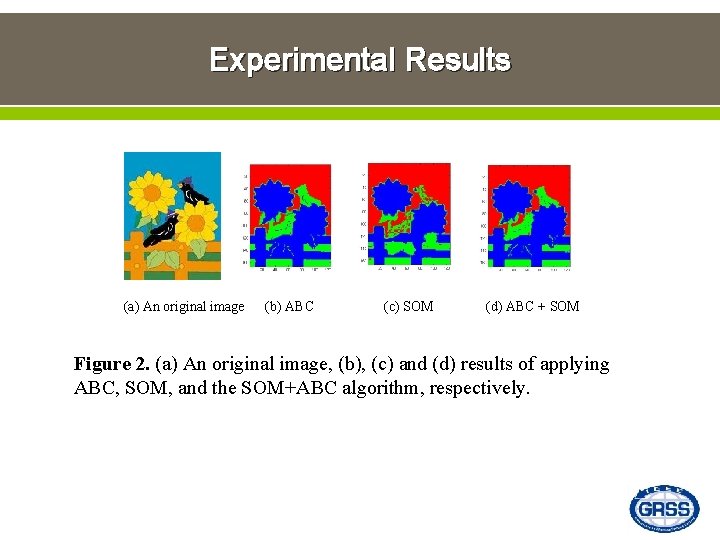
Experimental Results (a) An original image (b) ABC (c) SOM (d) ABC + SOM Figure 2. (a) An original image, (b), (c) and (d) results of applying ABC, SOM, and the SOM+ABC algorithm, respectively.
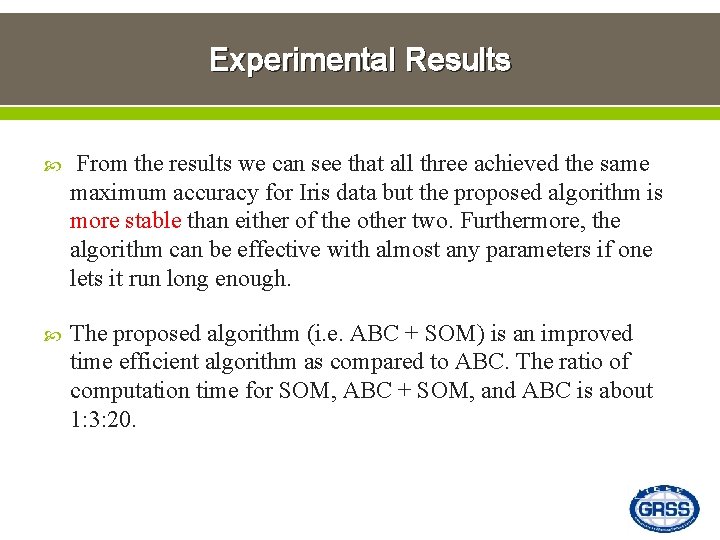
Experimental Results From the results we can see that all three achieved the same maximum accuracy for Iris data but the proposed algorithm is more stable than either of the other two. Furthermore, the algorithm can be effective with almost any parameters if one lets it run long enough. The proposed algorithm (i. e. ABC + SOM) is an improved time efficient algorithm as compared to ABC. The ratio of computation time for SOM, ABC + SOM, and ABC is about 1: 3: 20.
Conclusions & Future Work This is a very primitive experiment. Further study and comparison with other similar methods are still need be done. The robustness of the algorithm can be improved by refining the bee model.