
OPTIMIZING TEAM DYNAMICS IN ORGANIZATIONS TEAM MENTAL MODELS

- Slides: 25
OPTIMIZING TEAM DYNAMICS IN ORGANIZATIONS: TEAM MENTAL MODELS Susan Mohammed The Pennsylvania State University 1
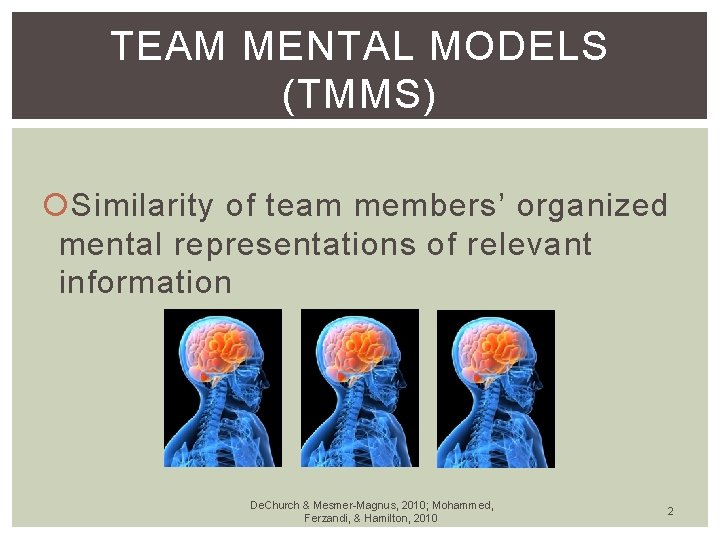
TEAM MENTAL MODELS (TMMS) Similarity of team members’ organized mental representations of relevant information De. Church & Mesmer-Magnus, 2010; Mohammed, Ferzandi, & Hamilton, 2010 2
TMM FUNCTIONS Description – Team members interpret information in a similar manner Prediction – Team members share expectations regarding future events Explanation – Team members develop similar causal accounts for a situation Cannon-Bowers et al. , 1993; Klimoski & Mohammed, 1994 3
IMPORTANCE OF TMMS Theoretically § TMMs recognized as one of the hallmarks of effective teams § Featured prominently in multiple team models Empirically § Meta-analysis of 65 studies (De. Church & Mesmer-Magnus, 2010) § Team cognition contributed positively and uniquely to team performance beyond other emergent states and team processes Practically § Lack of TMM similarity implicated in team Mohammed, Ferzandi, & Hamilton, 2010 performance breakdowns 4 § Space missions, surgical errors, airline accidents, fratricide
ANTECEDENTS OF TMM SIMILARITY Interventions § Training (e. g. , cross-training) § Leadership § Reflexivity Compositional determinants: § Cognitive ability § Agreeableness § Tenure, experience, organizational similarity Contextual factors: § Stress Mohammed, Ferzandi, & Hamilton, 2010 5
EXPANDING THE TMM CONTENT DOMAIN Temporal TMMs 6
TMM TEMPORAL DEFICIENCY TMM content has emphasized: § Taskwork: § What work needs to be accomplished? § Teamwork: § How work needs to be accomplished? BUT NOT § “Timework” § When work needs to be accomplished? Mohammed et al. , 2010; Mohammed, Tesler, & Hamilton, 2012; Standifer & Bluedorn, 2006 7
DIFFERING TEMPORAL ORIENTATIONS Convergence on temporal TMMs is nontrivial because team members often have differing temporal orientations: § Time urgency versus time patience § Present versus Future time perspective § Early versus Deadline action style § Monochronic versus Polychronic Mohammed & Harrison, 2013; Mohammed & Nadkarni, 2011, 2014 8
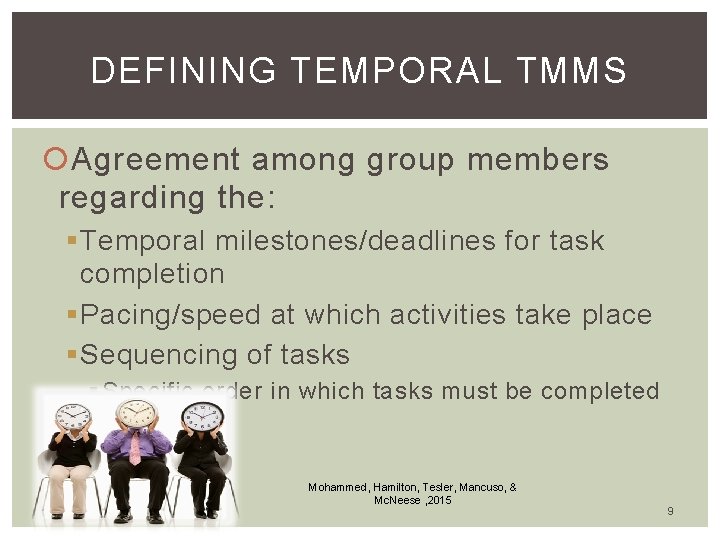
DEFINING TEMPORAL TMMS Agreement among group members regarding the: § Temporal milestones/deadlines for task completion § Pacing/speed at which activities take place § Sequencing of tasks § Specific order in which tasks must be completed Mohammed, Hamilton, Tesler, Mancuso, & Mc. Neese , 2015 9
EMPIRICAL SUPPORT FOR TEMPORAL TMMS 98 student teams performing a computerized team simulation Temporal TMM similarity positively and uniquely contributed to team performance beyond traditionally measured: § Taskwork and § Teamwork content domains § True for concept map and pairwise rating operationalizations Temporal TMMs assessed later in teams’ development exerted strong effects on performance than those assessed earlier Mohammed, Hamilton, Tesler, Mancuso, & Mc. Neese , 2015 10
TEMPORAL TMM IMPLICATIONS Results provide encouraging evidence that temporality should continue to be investigated as a key content domain of TMMs § Disagreement about task sequencing lowered team performance § Establishing and maintaining congruence in team members’ temporal perceptions is a non-trivial task § Need to expand the definition of TMMs beyond shared representations of who is going to do what and how to “when” Mohammed, Hamilton, Tesler, Mancuso, & Mc. Neese , 2015 11
STORYTELLING AS A TMM ANTECEDENT Stories are intended to be engaging, drawing the audience in and elucidating deeper meaning Could storytelling be used as a team training intervention: § To help motivate the need for team training § To help teams get on the same page § especially in virtual environments Mancuso, Parr, Mc. Millan, Tesler, Mc. Neese, Hamilton, & Mohammed, 2011 12
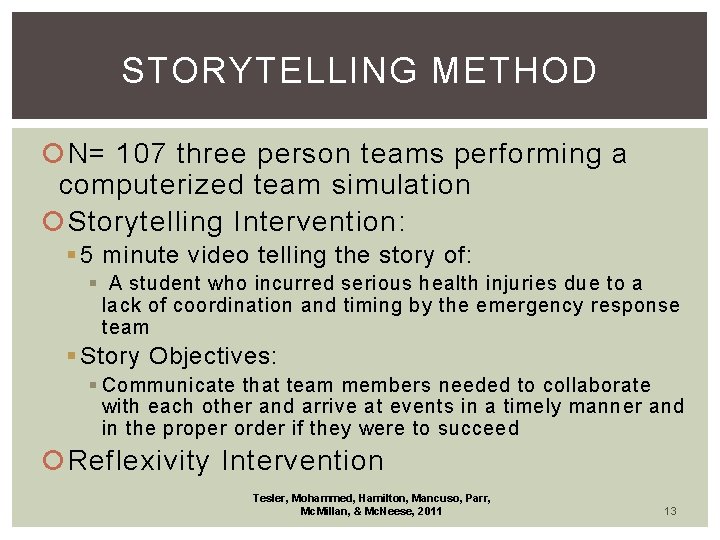
STORYTELLING METHOD N= 107 three person teams performing a computerized team simulation Storytelling Intervention: § 5 minute video telling the story of: § A student who incurred serious health injuries due to a lack of coordination and timing by the emergency response team § Story Objectives: § Communicate that team members needed to collaborate with each other and arrive at events in a timely manner and in the proper order if they were to succeed Reflexivity Intervention Tesler, Mohammed, Hamilton, Mancuso, Parr, Mc. Millan, & Mc. Neese, 2011 13
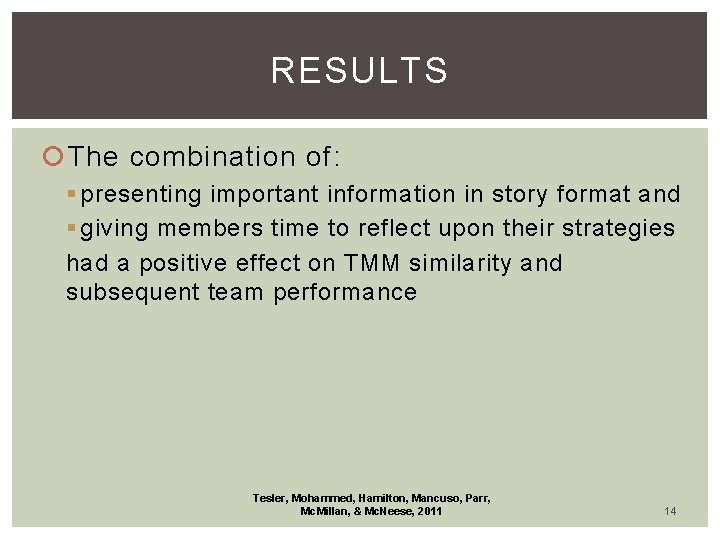
RESULTS The combination of: § presenting important information in story format and § giving members time to reflect upon their strategies had a positive effect on TMM similarity and subsequent team performance Tesler, Mohammed, Hamilton, Mancuso, Parr, Mc. Millan, & Mc. Neese, 2011 14
CHALLENGING SIMPLISTIC ASSUMPTIONS TMM literature is ripe for theoretical refinement 15
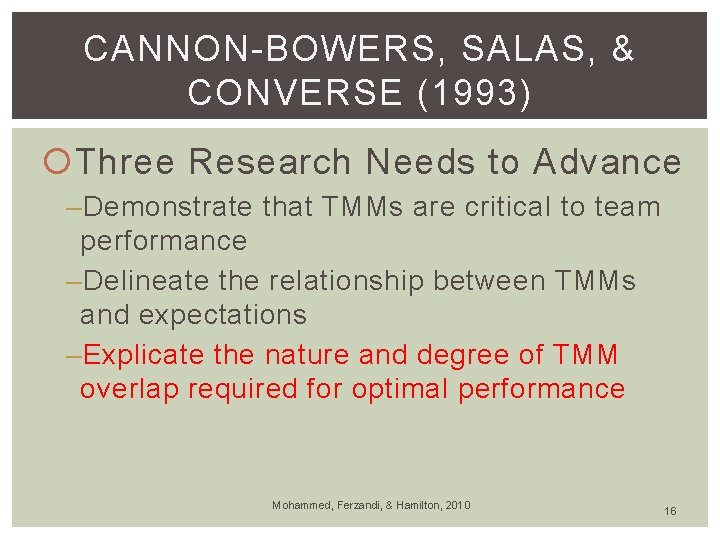
CANNON-BOWERS, SALAS, & CONVERSE (1993) Three Research Needs to Advance – Demonstrate that TMMs are critical to team performance – Delineate the relationship between TMMs and expectations – Explicate the nature and degree of TMM overlap required for optimal performance Mohammed, Ferzandi, & Hamilton, 2010 16
TMM SIMILARITY ASSUMPTIONS What content should be shared? § Everything Who should share? § Everyone How much should be shared? § As much as possible Mohammed, Ferzandi, & Hamilton, 2010 17
NAÏVE ASSUMPTIONS INCREASINGLY UNWORKABLE Theoretically § Diversity is a key advantage of teams Empirically § Results for different types of TMM content are not uniform within and across studies Practically § Increasing complexity of teams exacerbates the inefficiencies resulting from unnecessary redundancy 18
TMMS VERSUS TRANSACTIVE MEMORY SYSTEMS Team Mental Models (TMMs) Transactive Memory Systems (TMS) Shared/Overlapping Knowledge Distributed/Compleme ntary Knowledge Compositional Emergence Compilational Emergence Broad Content Domain: Narrow Content Domain § Taskwork § Teamwork § “Timework” § Taskwork expertise De. Church & Mesmer-Magnus, 2010; Mohammed et al. , 2010 19
INTEGRATION OF OVERLAPPING AND DISTRIBUTED KNOWLEDGE Calls for research to integrate across types of team cognition (e. g. , Mohammed & Dumville, 2001; Salas & Wildman, 2009) Transactive memory systems (TMS) integrate: § Unique knowledge held by specific members with a collective awareness of who knows what § Expertise specialization with coordination Advocating that TMMs integrate: § Taskwork, teamwork, and “timework” convergence and divergence Lewis & Herndon, 2011; Wegner, 1987 20
TOWARD AN INTEGRATED MODEL OF TMM CONVERGENCE AND DIVERGENCE 21
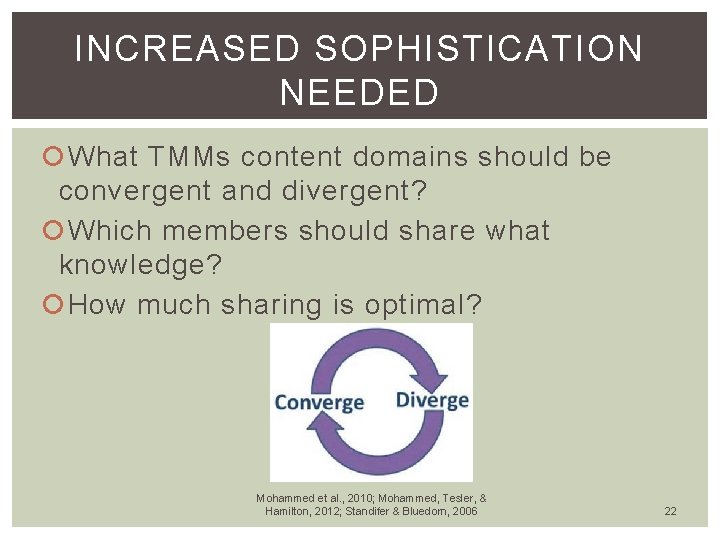
INCREASED SOPHISTICATION NEEDED What TMMs content domains should be convergent and divergent? Which members should share what knowledge? How much sharing is optimal? Mohammed et al. , 2010; Mohammed, Tesler, & Hamilton, 2012; Standifer & Bluedorn, 2006 22
IT DEPENDS ON TEAM/TASK CHARACTERISTICS Skill differentiation § Degree of specialized knowledge that makes it difficult to substitute members Authority differentiation § Degree to which decision making responsibility resides in individuals, subgroups, or collectives Task interdependence § Team members depending on one another for access to critical resources § Workflows that require coordinated action Courtright et al. , 2015; Hollgenbeck, Beersma, & Schouten, 2012 23
WHAT TMM CONTENT DOMAINS SHOULD BE CONVERGENT AND DIVERGENT? High Skill Differentiation & High Task & Outcome Interdependence § More divergence of taskwork TMMs § More convergence of teamwork TMMs § More convergence of timework TMMs 24
Thank you for your time! 25