
Optimizing Research Michael H Elliott CEO Atrium Research
- Slides: 26
Optimizing Research Michael H Elliott CEO Atrium Research melliott@atriumresearch. com +1 203 938 6924
About Atrium Research is an independent, vendor-agnostic informatics market research and management consulting organization We develop packaged and customized research reports; strategy, analysis, and change acceleration services Multiple publications on research informatics © Copyright 2008 Atrium Research & Consulting Not to be reproduced without permission
Teams and Leadership “Insanity is doing the same thing over and over again and expecting a different result” - Bill Walsh Champion Football* Coach *American Football that is © Copyright 2008 Atrium Research & Consulting Not to be reproduced without permission
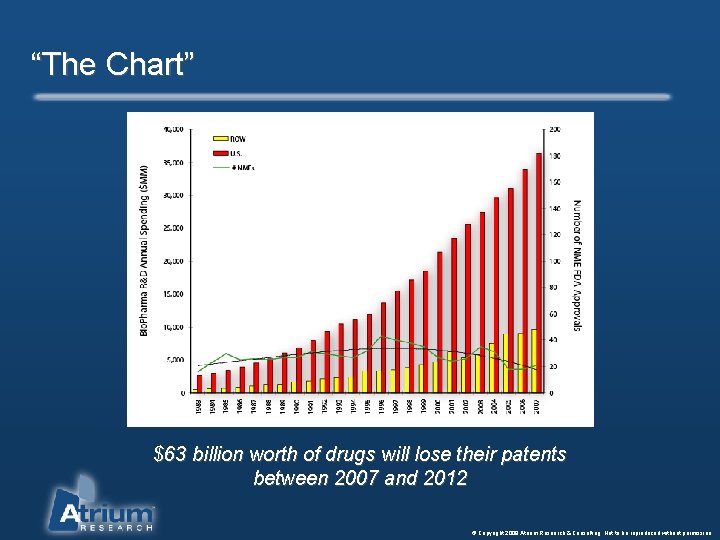
“The Chart” $63 billion worth of drugs will lose their patents between 2007 and 2012 © Copyright 2008 Atrium Research & Consulting Not to be reproduced without permission
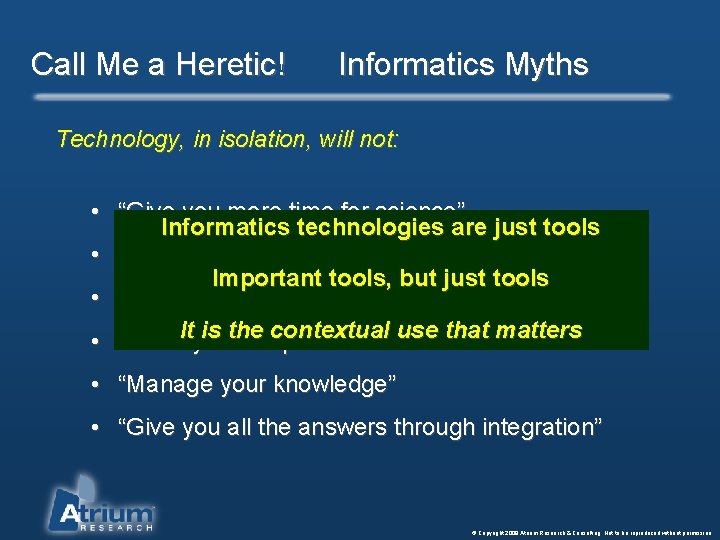
Call Me a Heretic! Informatics Myths Technology, in isolation, will not: • “Give you more time for science” Informatics technologies are just tools • “Get your drug to market faster” Important tools, but just tools • “Break down barriers between departments” is the contextual use that matters • “Make. Ityou compliant” • “Manage your knowledge” • “Give you all the answers through integration” © Copyright 2008 Atrium Research & Consulting Not to be reproduced without permission
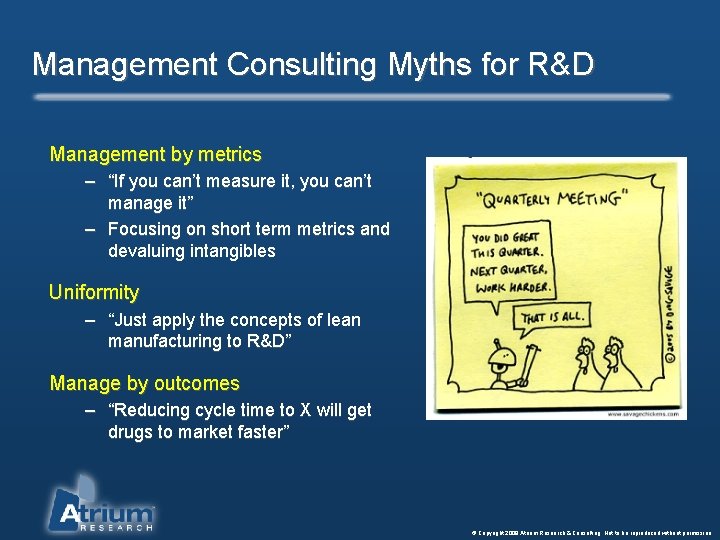
Management Consulting Myths for R&D Management by metrics – “If you can’t measure it, you can’t manage it” – Focusing on short term metrics and devaluing intangibles Uniformity – “Just apply the concepts of lean manufacturing to R&D” Manage by outcomes – “Reducing cycle time to X will get drugs to market faster” © Copyright 2008 Atrium Research & Consulting Not to be reproduced without permission
It is Not About Working Faster… It is about sustaining an effective organization Effectiveness is gained through systems thinking Systems thinking : A holistic approach that focuses on the way a system's constituent parts interrelate The human element tends to be overlooked © Copyright 2008 Atrium Research & Consulting Not to be reproduced without permission
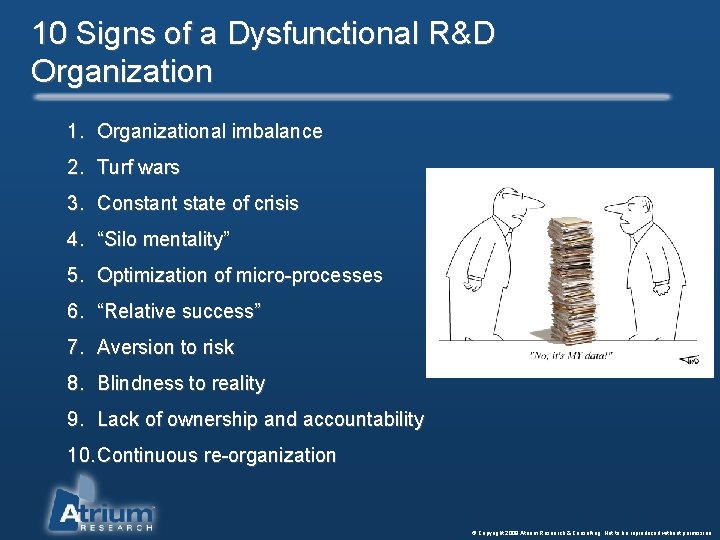
10 Signs of a Dysfunctional R&D Organization 1. Organizational imbalance 2. Turf wars 3. Constant state of crisis 4. “Silo mentality” 5. Optimization of micro-processes 6. “Relative success” 7. Aversion to risk 8. Blindness to reality 9. Lack of ownership and accountability 10. Continuous re-organization © Copyright 2008 Atrium Research & Consulting Not to be reproduced without permission
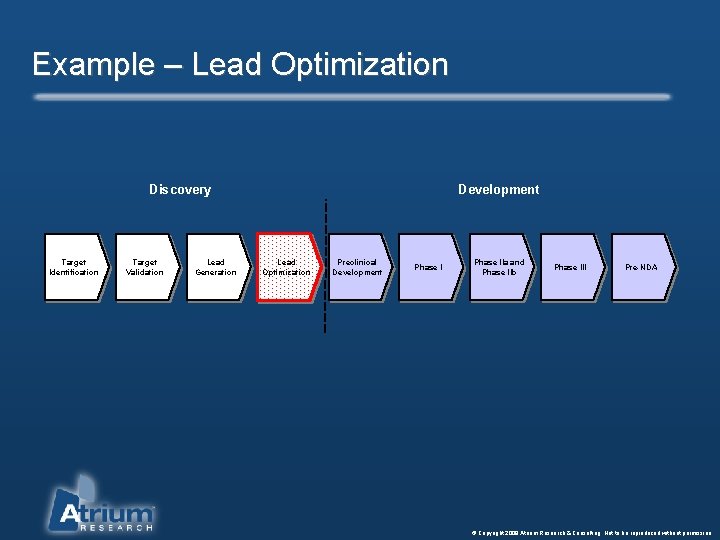
Example – Lead Optimization Discovery Target Identification Target Validation Lead Generation Development Lead Optimization Preclinical Development Phase IIa and Phase IIb Phase III Pre-NDA © Copyright 2008 Atrium Research & Consulting Not to be reproduced without permission
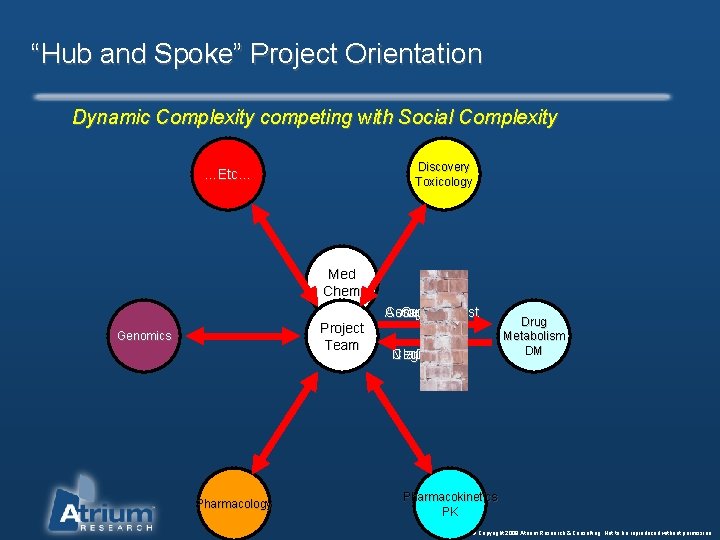
“Hub and Spoke” Project Orientation Dynamic Complexity competing with Social Complexity Discovery Toxicology …Etc… Med Chem Project Team Genomics Pharmacology Compounds Assay Questions Request Clarification Negotiation Data Drug Metabolism DM Pharmacokinetics PK © Copyright 2008 Atrium Research & Consulting Not to be reproduced without permission
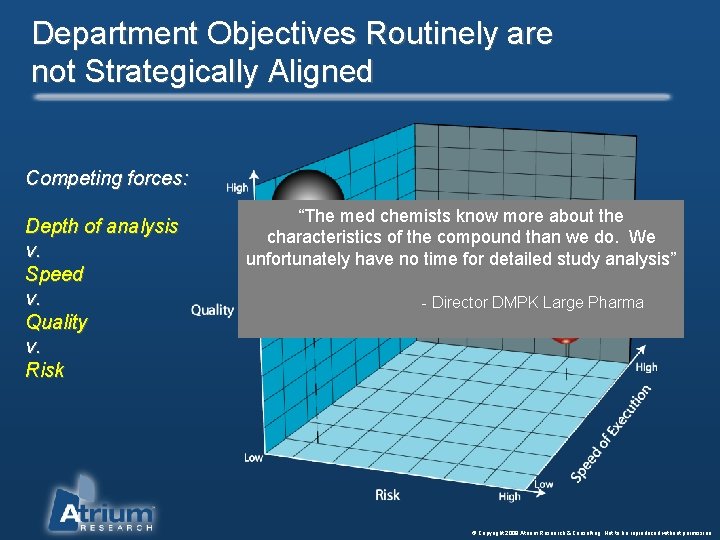
Department Objectives Routinely are not Strategically Aligned Competing forces: Depth of analysis v. Speed v. Quality v. Risk “The med chemists know more about the characteristics of the compound than we do. We unfortunately have no time for detailed study analysis” - Director DMPK Large Pharma © Copyright 2008 Atrium Research & Consulting Not to be reproduced without permission
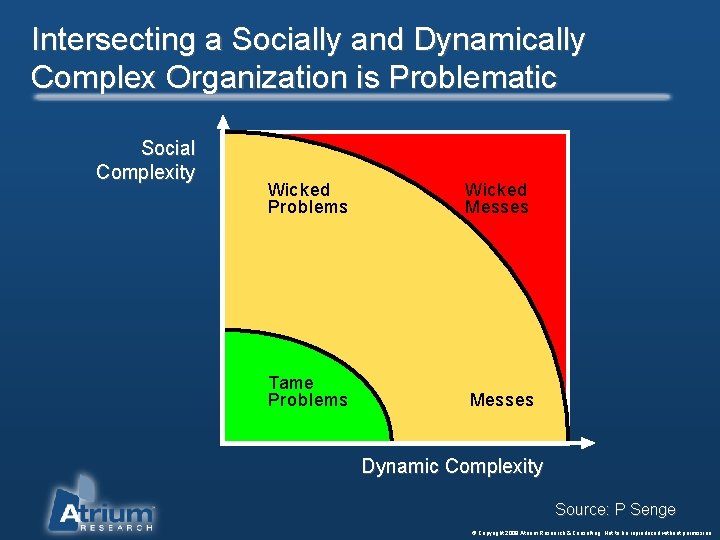
Intersecting a Socially and Dynamically Complex Organization is Problematic Social Complexity Wicked Problems Wicked Messes Tame Problems Messes Dynamic Complexity Source: P Senge © Copyright 2008 Atrium Research & Consulting Not to be reproduced without permission
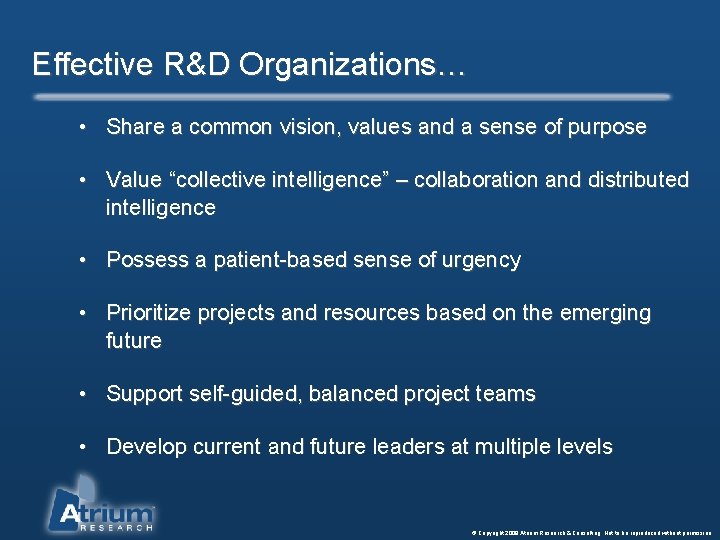
Effective R&D Organizations… • Share a common vision, values and a sense of purpose • Value “collective intelligence” – collaboration and distributed intelligence • Possess a patient-based sense of urgency • Prioritize projects and resources based on the emerging future • Support self-guided, balanced project teams • Develop current and future leaders at multiple levels © Copyright 2008 Atrium Research & Consulting Not to be reproduced without permission
Teams and Leadership "Problems cannot be solved by the same level of thinking that created them" - Albert Einstein
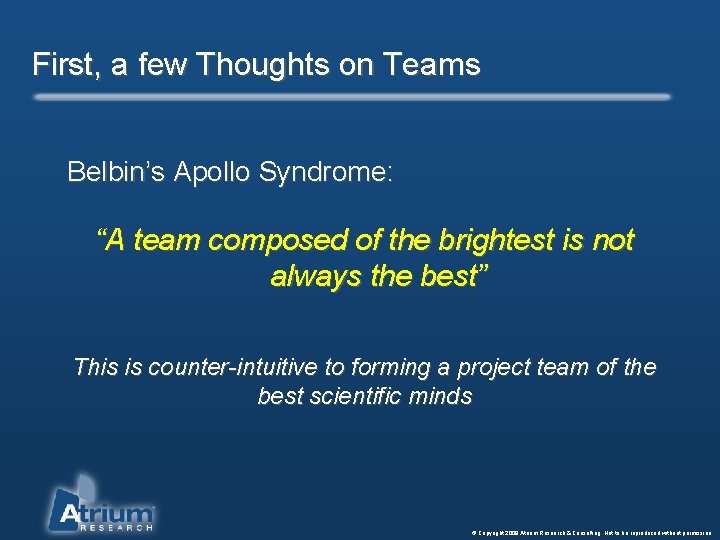
First, a few Thoughts on Teams Belbin’s Apollo Syndrome: “A team composed of the brightest is not always the best” This is counter-intuitive to forming a project team of the best scientific minds © Copyright 2008 Atrium Research & Consulting Not to be reproduced without permission
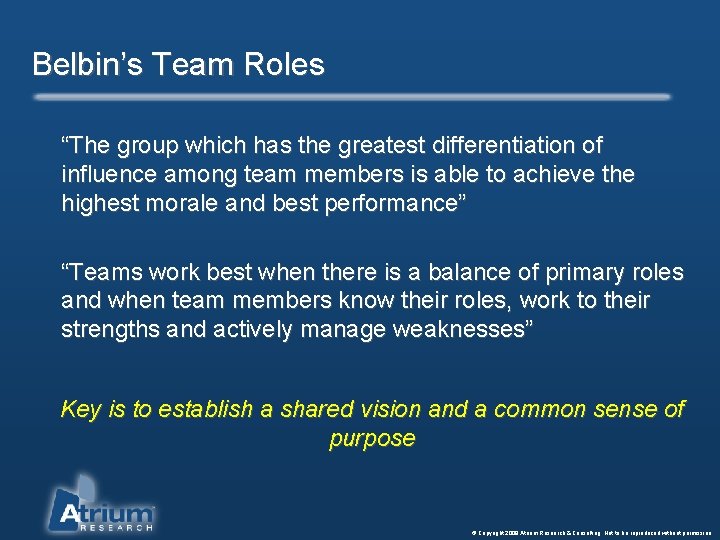
Belbin’s Team Roles “The group which has the greatest differentiation of influence among team members is able to achieve the highest morale and best performance” “Teams work best when there is a balance of primary roles and when team members know their roles, work to their strengths and actively manage weaknesses” Key is to establish a shared vision and a common sense of purpose © Copyright 2008 Atrium Research & Consulting Not to be reproduced without permission
Effective Project Teams • Share common goals and vision • Trust each other • Know their role and respect others • Communicate openly • Seek out knowledge sources • Work in concert (teamwork) • Don’t use command control to obtain results © Copyright 2008 Atrium Research & Consulting Not to be reproduced without permission
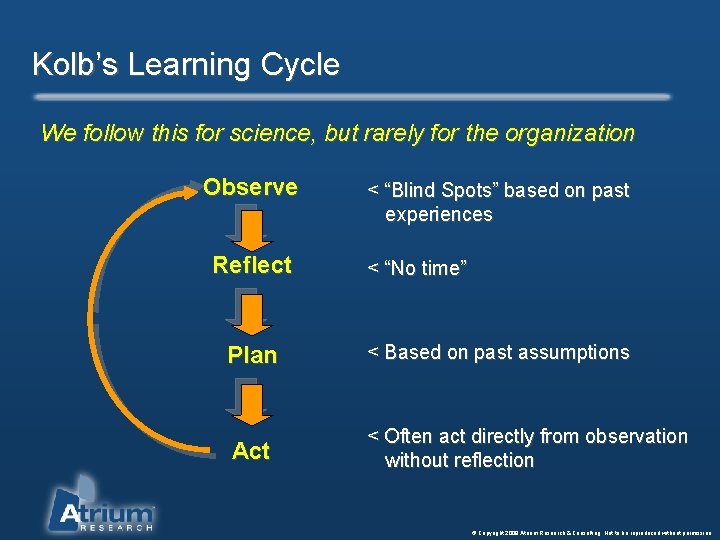
Kolb’s Learning Cycle We follow this for science, but rarely for the organization Observe Reflect < “Blind Spots” based on past experiences < “No time” Plan < Based on past assumptions Act < Often act directly from observation without reflection © Copyright 2008 Atrium Research & Consulting Not to be reproduced without permission
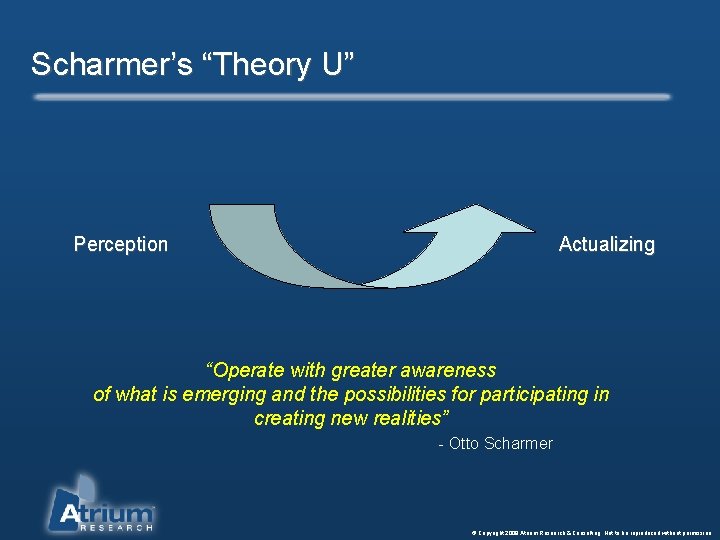
Scharmer’s “Theory U” Perception Actualizing “Operate with greater awareness of what is emerging and the possibilities for participating in creating new realities” - Otto Scharmer © Copyright 2008 Atrium Research & Consulting Not to be reproduced without permission
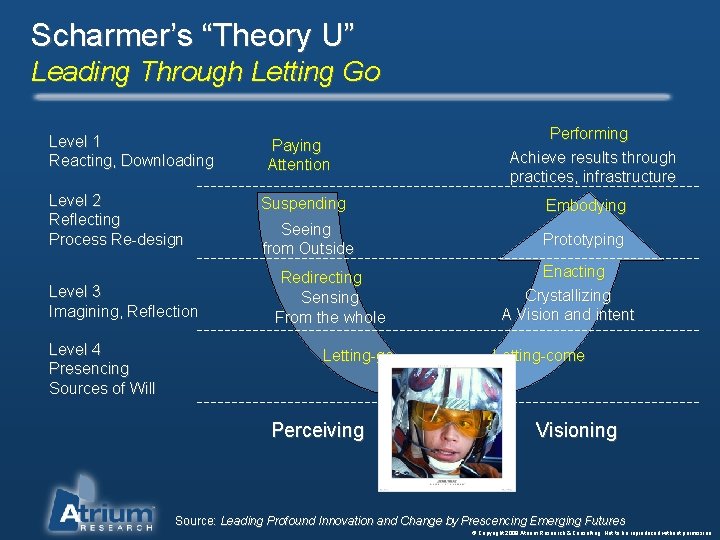
Scharmer’s “Theory U” Leading Through Letting Go Level 1 Reacting, Downloading Level 2 Reflecting Process Re-design Level 3 Imagining, Reflection Level 4 Presencing Sources of Will Performing Achieve results through practices, infrastructure Paying Attention Suspending Embodying Seeing from Outside Prototyping Enacting Crystallizing A Vision and intent Redirecting Sensing From the whole Letting-go Letting-come Presencing Perceiving Visioning Source: Leading Profound Innovation and Change by Prescencing Emerging Futures © Copyright 2008 Atrium Research & Consulting Not to be reproduced without permission
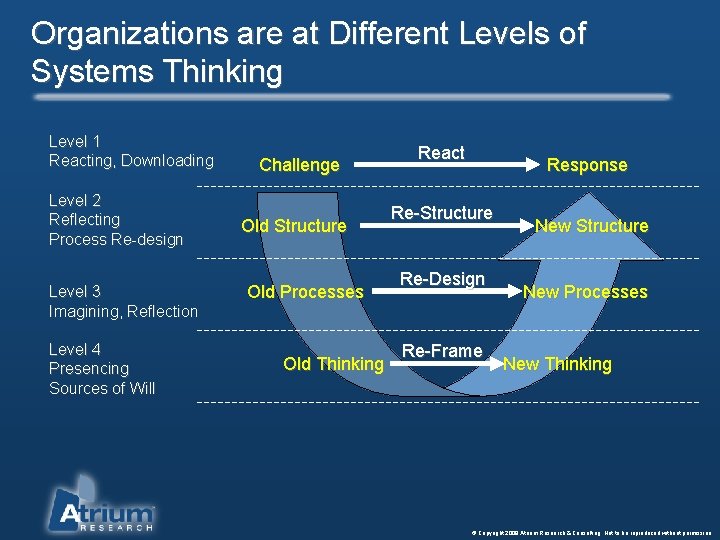
Organizations are at Different Levels of Systems Thinking Level 1 Reacting, Downloading Level 2 Reflecting Process Re-design Level 3 Imagining, Reflection Level 4 Presencing Sources of Will Challenge Old Structure Old Processes Old Thinking React Response Re-Structure Re-Design Re-Frame New Structure New Processes New Thinking © Copyright 2008 Atrium Research & Consulting Not to be reproduced without permission
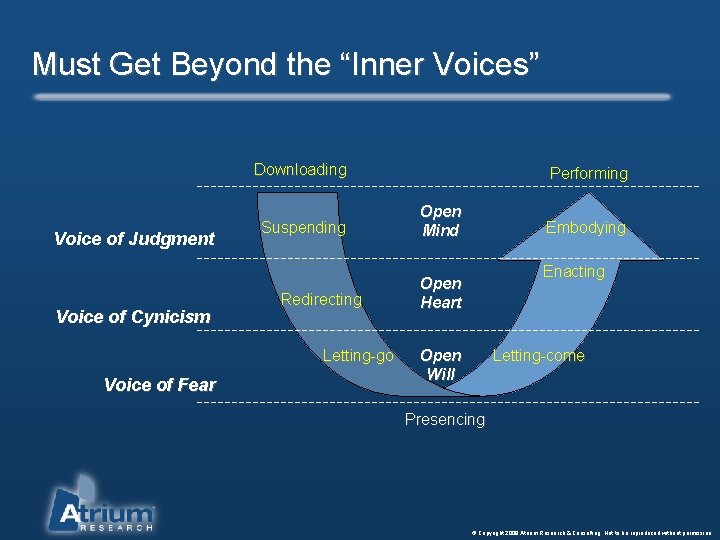
Must Get Beyond the “Inner Voices” Downloading Voice of Judgment Voice of Cynicism Suspending Redirecting Letting-go Voice of Fear Performing Open Mind Embodying Enacting Open Heart Open Will Letting-come Presencing © Copyright 2008 Atrium Research & Consulting Not to be reproduced without permission
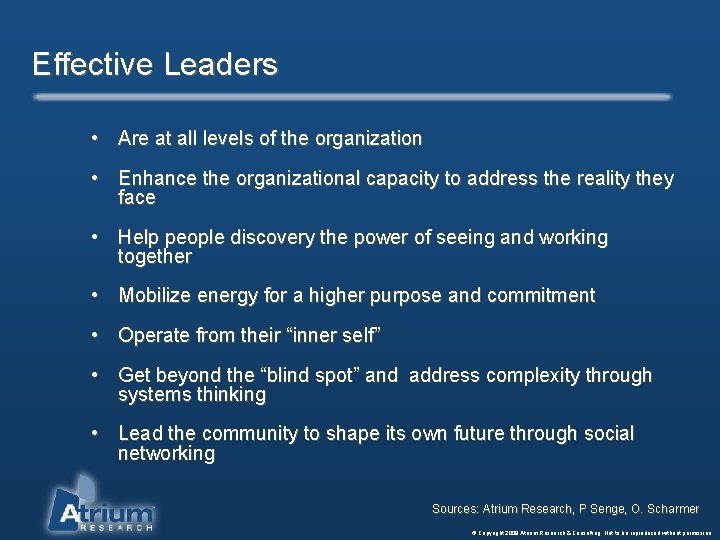
Effective Leaders • Are at all levels of the organization • Enhance the organizational capacity to address the reality they face • Help people discovery the power of seeing and working together • Mobilize energy for a higher purpose and commitment • Operate from their “inner self” • Get beyond the “blind spot” and address complexity through systems thinking • Lead the community to shape its own future through social networking Sources: Atrium Research, P Senge, O. Scharmer © Copyright 2008 Atrium Research & Consulting Not to be reproduced without permission
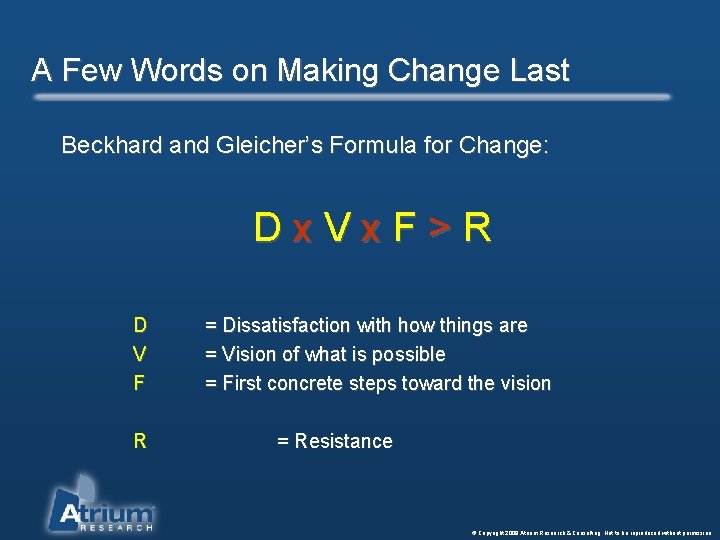
A Few Words on Making Change Last Beckhard and Gleicher’s Formula for Change: Dx. Vx. F>R D V F R = Dissatisfaction with how things are = Vision of what is possible = First concrete steps toward the vision = Resistance © Copyright 2008 Atrium Research & Consulting Not to be reproduced without permission
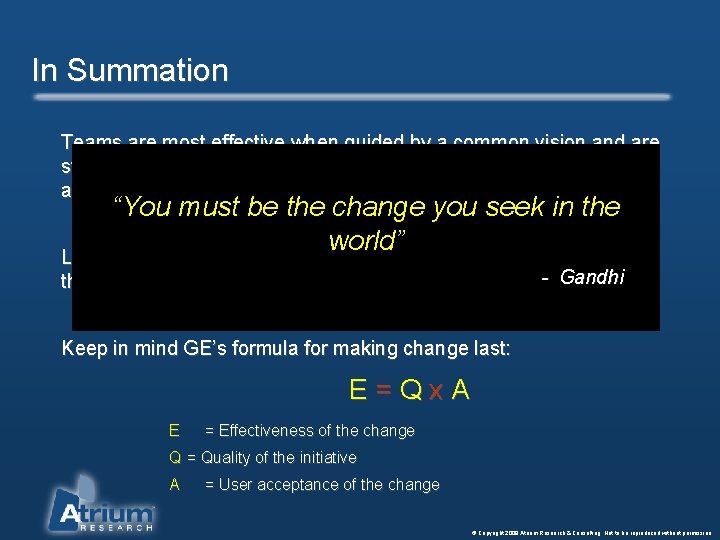
In Summation Teams are most effective when guided by a common vision and are staffed with competence-based roles who stimulate communication and innovation “You must be the change you seek in the world” Leaders crystallize visions of the future state through systemsthinking, communication, reflection, and “letting go” - Gandhi Keep in mind GE’s formula for making change last: E=Qx. A E = Effectiveness of the change Q = Quality of the initiative A = User acceptance of the change © Copyright 2008 Atrium Research & Consulting Not to be reproduced without permission
Thank You! Michael Elliott Atrium Research melliott@atriumresearch. com +1 203 938 6924