
OPTIMIZING RECURSIVE QUERIES IN SQL BY Mark Gruszecki

OPTIMIZING RECURSIVE QUERIES IN SQL BY: Mark Gruszecki
Overview What is a Recursive Query? Definition(s) and Algorithm(s) Optimization Techniques Practical Issues Impact of each Optimization Conclusion

In order to understand a Recursive Query, you must first understand a Recursive Query… CREATE RECURSIVE VIEW R(d, i, j, v) AS ( SELECT 1, i, j, v FROM T UNION ALL SELECT d+1, R. i, T. j, R. v + T. v FROM R JOIN T ON R. j = T. i WHERE d < 8);
What is a Recursive Query used for? Any kind of Hierarchical Data is more easily accessed using a Recursive Query. For example, displaying Employees in an orginizational chart.

Definition(s) and Algorithm(s) A base table T is defined as T(i, j, v) with primary key (i, j) and v representing a numerical value. Define the result table from a recursive query by R(d, i, j, v) with primary key (d, i, j). The queries of interest are of the form R[k] = T � T � … � T where � is the recursive q Let G = (V, E) be a directed graph with n vertices and m edges. The algorithm to evaluate optimizations is: R=
Optimization Techniques 1. 2. 3. Early evaluation of row select conditions. Deleting Duplicate Rows. Indexing base and result tables for efficient joins.
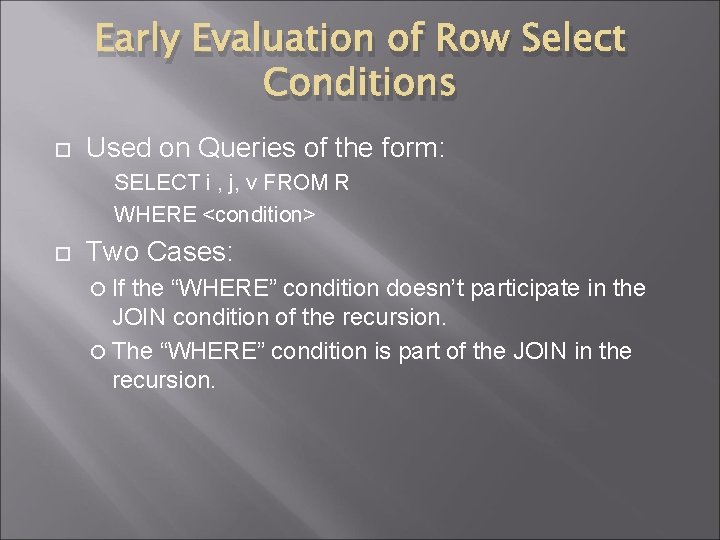
Early Evaluation of Row Select Conditions Used on Queries of the form: SELECT i , j, v FROM R WHERE <condition> Two Cases: If the “WHERE” condition doesn’t participate in the JOIN condition of the recursion. The “WHERE” condition is part of the JOIN in the recursion.

Deleting Duplicate Rows Suppose we want to know which vertices of a graph are connected to a specific node (e. g. all dependants of a particular person). What if G is complete, dense, sparse, or even a tree? Queries are optimized by deleting duplicate rows at each step.
Indexing Base and Result Tables for Efficient Joins Two Choices: Index based on i and j. Gives rise to an optimal Hash Join Cannot uniquely identify rows Index based on primary key of T and R Can uniquely identify rows
Practical Issues The possible size of a result table of a recursive query is |T| x … |T|. In general, if there are n recursive steps and T has m entries, then there are m^n.
Impact of each Optimization Early Evaluation of Row Selection Conditions Good Deleting Duplicate Rows Good in all cases in certain cases, but not necessary in all Indexing Base and Result Tables for Efficient Joins If G is highly connected, slight loss of performance (Hash Collisions). Otherwise, this is the best optimization.
Conclusion Recursive Queries are an important tool to be exposed to when dealing with databases. There are three types of optimizations of these queries discussed: Early evaluation of row selections Deleting duplicate rows Indexing for more efficient joins Every optimization is good, but some are more applicable in certain circumstances than others.
Questions(? ) and References Carlos Ordonez (2005) Optimizing Recursive Queries in SQL. Retrieved February 10, 2009 from IEEE Computer Science Digital Library http: //publib. boulder. ibm. com/infocenter/iseries/v 5 r 4/index. jsp? topic=/rzajqrcteexample. ht m
- Slides: 13