
Optimizing Past Perfect for Archival Description CELIA CAUSTELLENBOGEN
Optimizing Past. Perfect for Archival Description CELIA CAUST-ELLENBOGEN HCI-PSAR PROJECT SURVEYOR
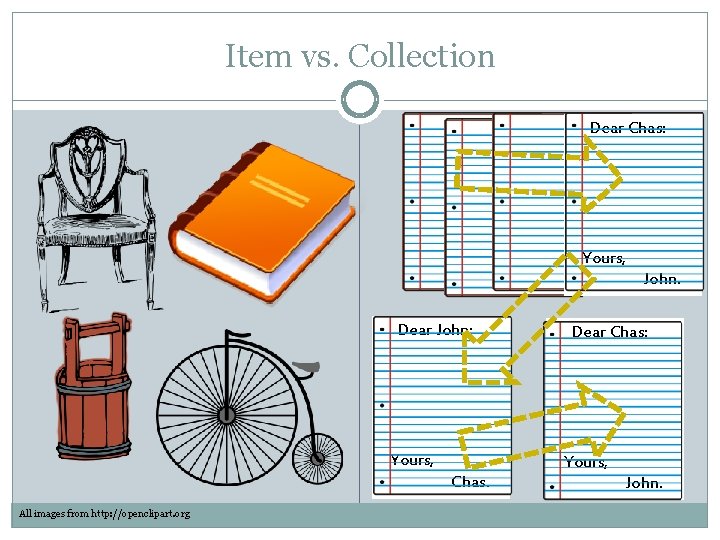
Item vs. Collection Dear Chas: Yours, John. Dear John: Yours, Chas. All images from http: //openclipart. org Dear Chas: Yours, John.
Key Concepts for Archival Description 1. PROVENANCE AND ORIGINAL ORDER 2. HIERARCHICAL ARRANGEMENT AND DESCRIPTION 3. METADATA STANDARDS
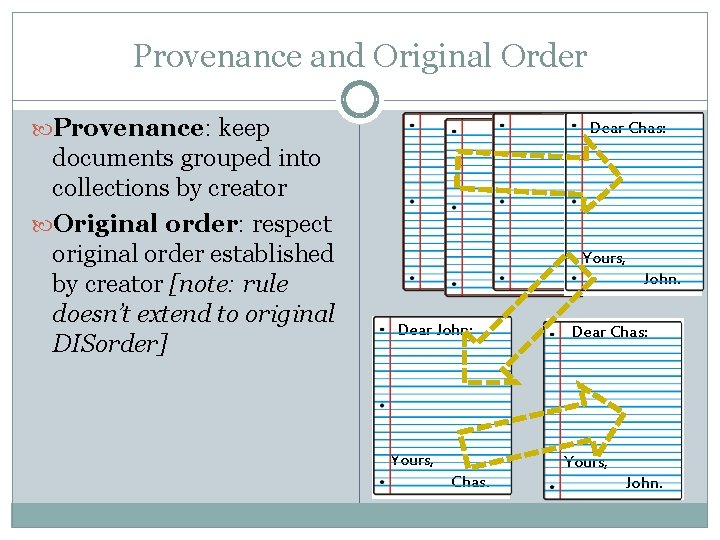
Provenance and Original Order Provenance: keep documents grouped into collections by creator Original order: respect original order established by creator [note: rule doesn’t extend to original DISorder] Dear Chas: Yours, John. Dear John: Yours, Chas. Dear Chas: Yours, John.
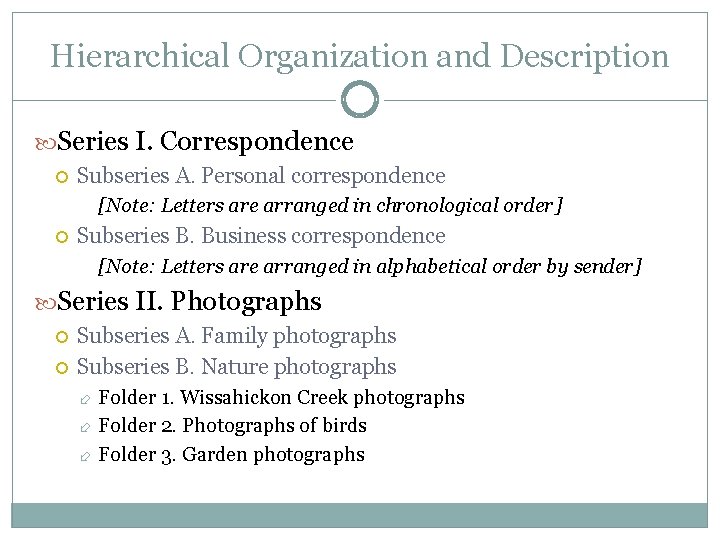
Hierarchical Organization and Description Series I. Correspondence Subseries A. Personal correspondence [Note: Letters are arranged in chronological order] Subseries B. Business correspondence [Note: Letters are arranged in alphabetical order by sender] Series II. Photographs Subseries A. Family photographs Subseries B. Nature photographs Folder 1. Wissahickon Creek photographs Folder 2. Photographs of birds Folder 3. Garden photographs
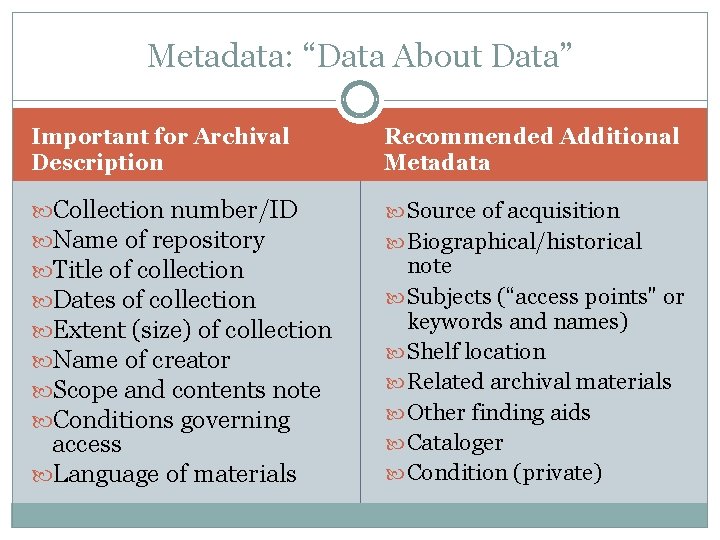
Metadata: “Data About Data” Important for Archival Description Recommended Additional Metadata Collection number/ID Name of repository Title of collection Dates of collection Extent (size) of collection Name of creator Scope and contents note Conditions governing Source of acquisition access Language of materials Biographical/historical note Subjects (“access points" or keywords and names) Shelf location Related archival materials Other finding aids Cataloger Condition (private)
Using Past. Perfect for Archival Description
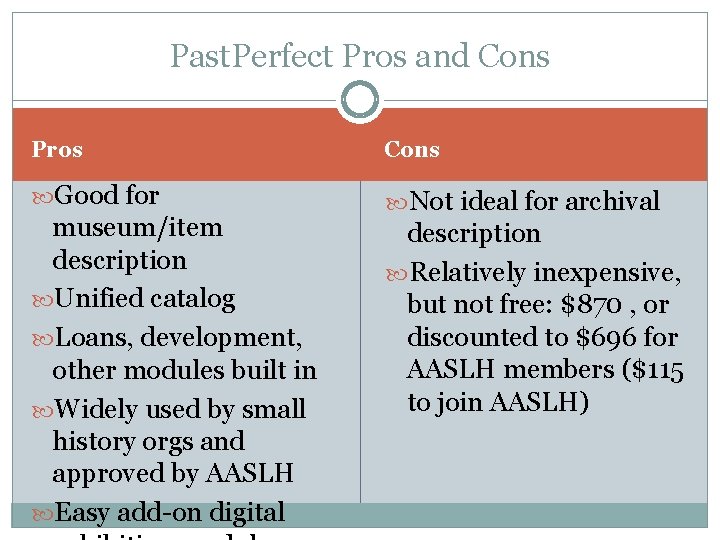
Past. Perfect Pros and Cons Pros Cons Good for Not ideal for archival museum/item description Unified catalog Loans, development, other modules built in Widely used by small history orgs and approved by AASLH Easy add-on digital description Relatively inexpensive, but not free: $870 , or discounted to $696 for AASLH members ($115 to join AASLH)
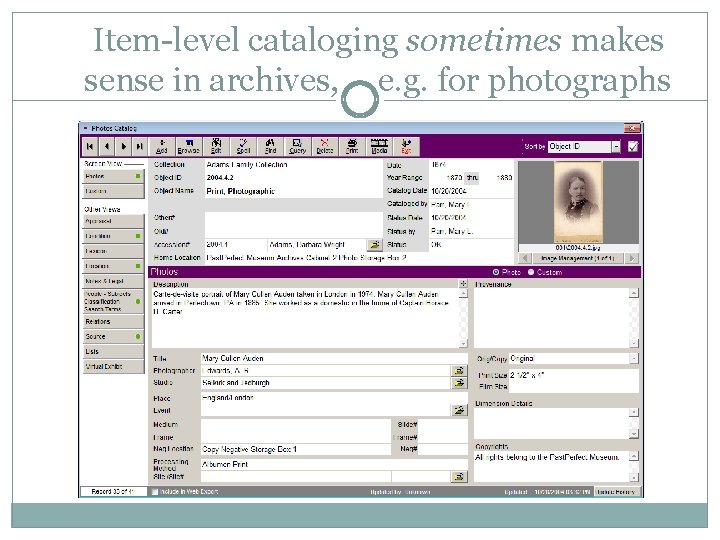
Item-level cataloging sometimes makes sense in archives, e. g. for photographs
In archival description. . . Collection is King àSTART BY CREATING A RECORD FOR THE COLLECTION AS A WHOLE! àADDING LOWER-LEVEL DESCRIPTION IS OPTIONAL DEPENDING ON THE COMPLEXITY AND IMPORTANCE OF THE COLLECTION
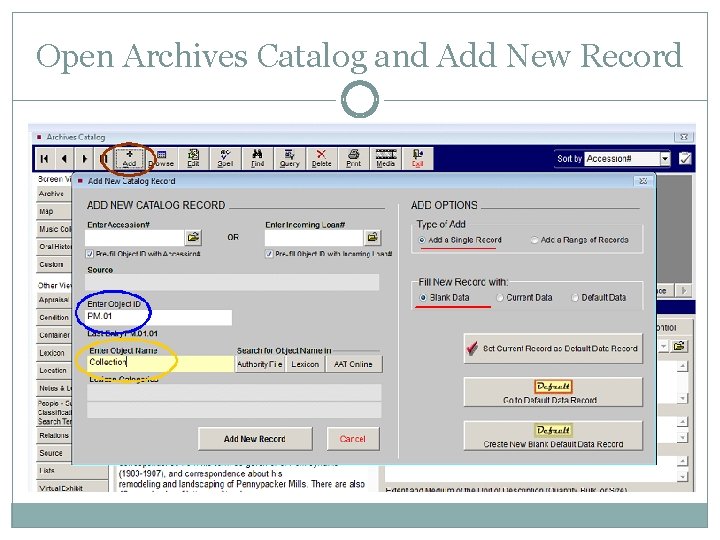
Open Archives Catalog and Add New Record
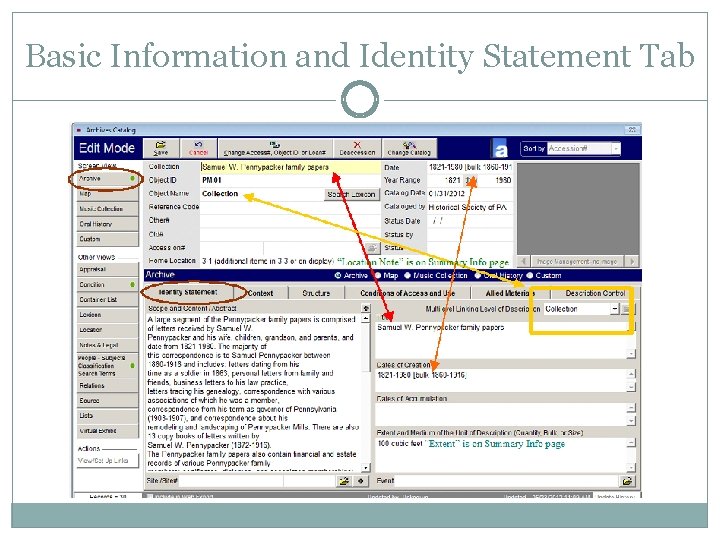
Basic Information and Identity Statement Tab
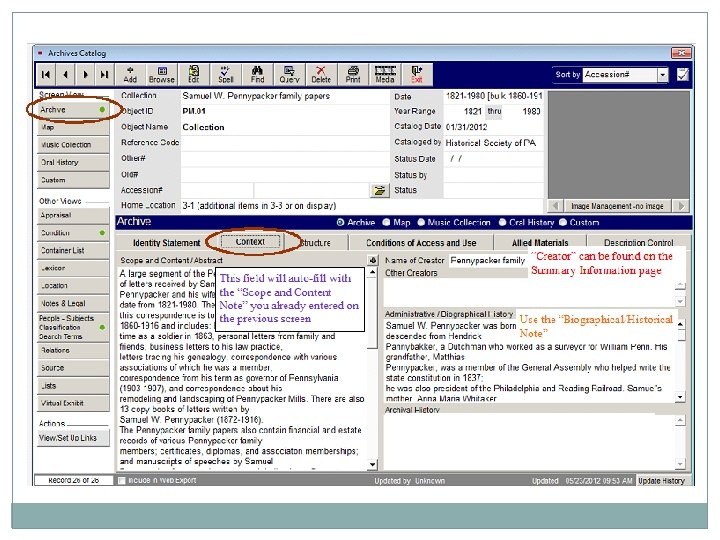
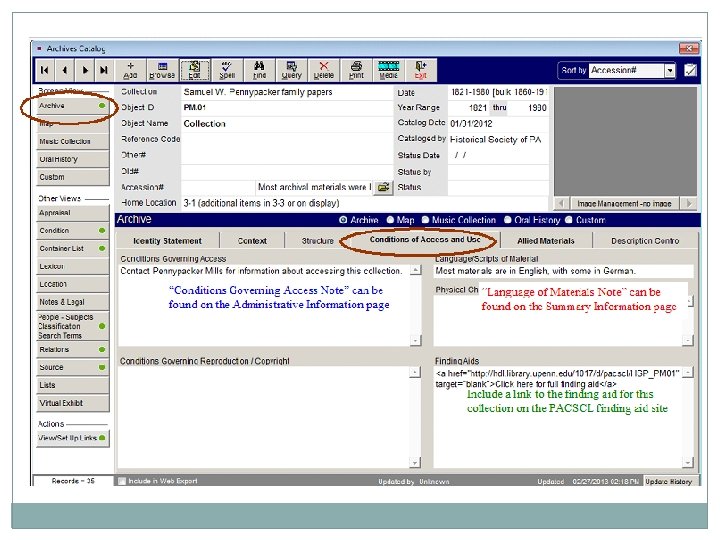
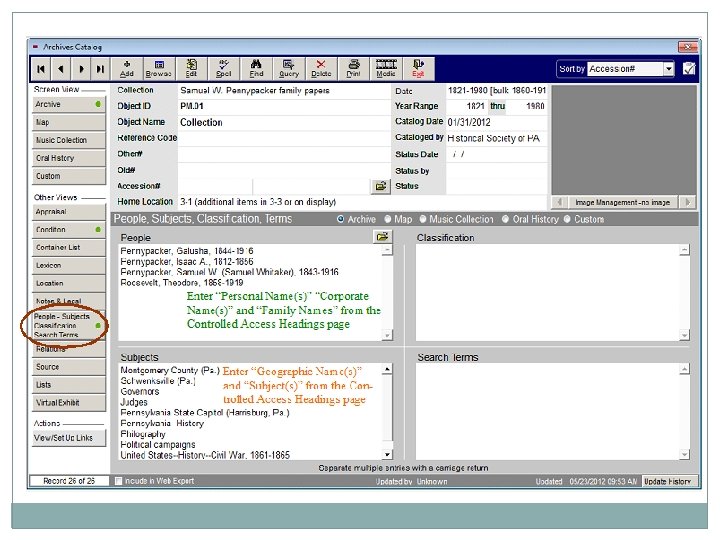
Lower-Level Description LOWER-LEVEL DESCRIPTION IS NOT NECESSARY, BUT IT IS RECOMMENDED FOR COMPLEX AND/OR IMPORTANT COLLECTIONS
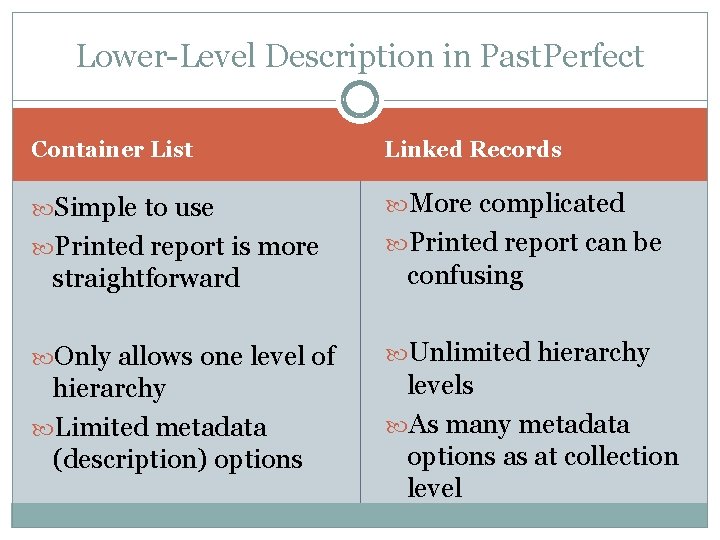
Lower-Level Description in Past. Perfect Container List Linked Records Simple to use More complicated Printed report is more Printed report can be straightforward Only allows one level of hierarchy Limited metadata (description) options confusing Unlimited hierarchy levels As many metadata options as at collection level
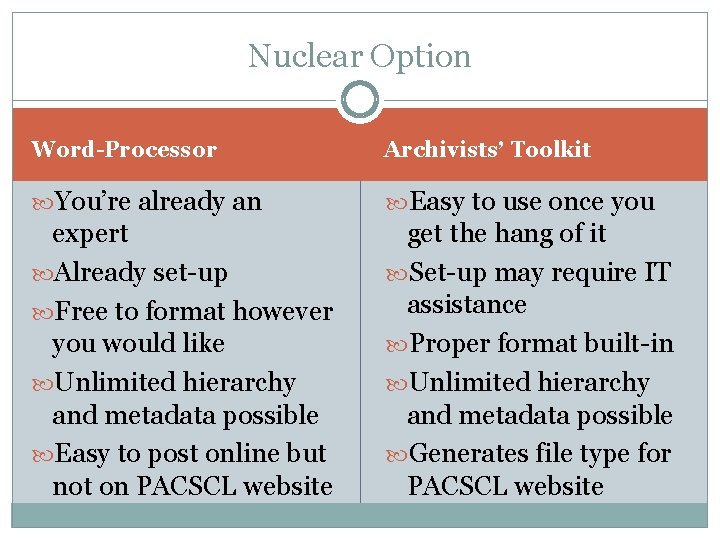
Nuclear Option Word-Processor Archivists’ Toolkit You’re already an Easy to use once you expert Already set-up Free to format however you would like Unlimited hierarchy and metadata possible Easy to post online but not on PACSCL website get the hang of it Set-up may require IT assistance Proper format built-in Unlimited hierarchy and metadata possible Generates file type for PACSCL website
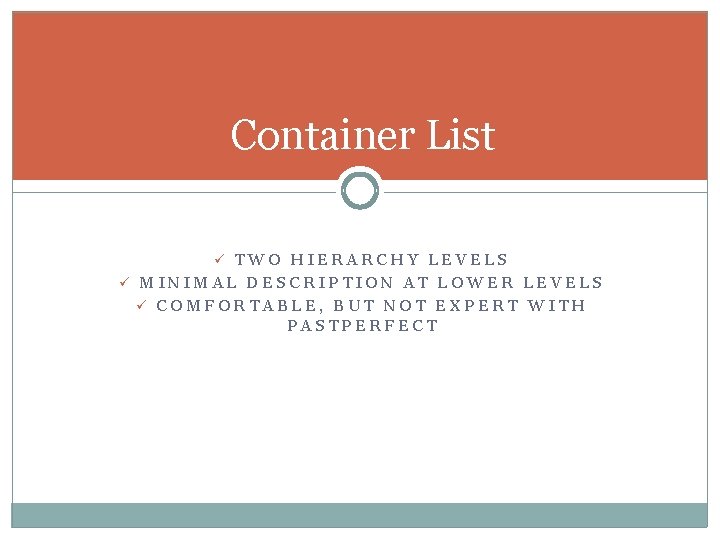
Container List ü TWO HIERARCHY LEVELS ü MINIMAL DESCRIPTION AT LOWER LEVELS ü COMFORTABLE, BUT NOT EXPERT WITH PASTPERFECT
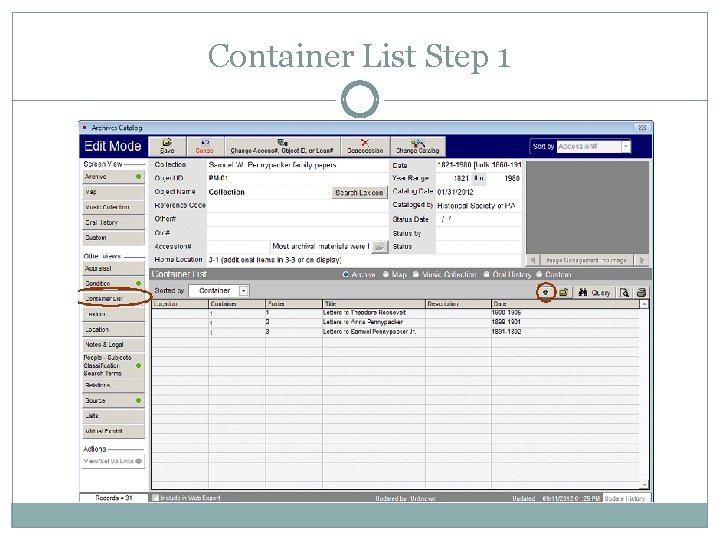
Container List Step 1

Container List Step 2

Container List Report
Linked Records ü MORE THAN TWO HIERARCHY LEVELS ü MAXIMAL DESCRIPTION AT LOWER LEVELS ü EXPERT WITH PASTPERFECT
General Pointers for Linked Records Stay in the Archives Catalog Recommend multi-part Object ID (collection=PM. 01; series=PM. 01. A; etc. ) Enter the unit level (e. g. , "Series, " "Sub-series, " "File") as object name Don’t repeat metadata info that already exists at higher level (such as Language, Creator, etc. ) Fill in the Collection name at the top of the screen; this will make it easier to use the browse view You need to create lower level records and link UP through the hierarchy
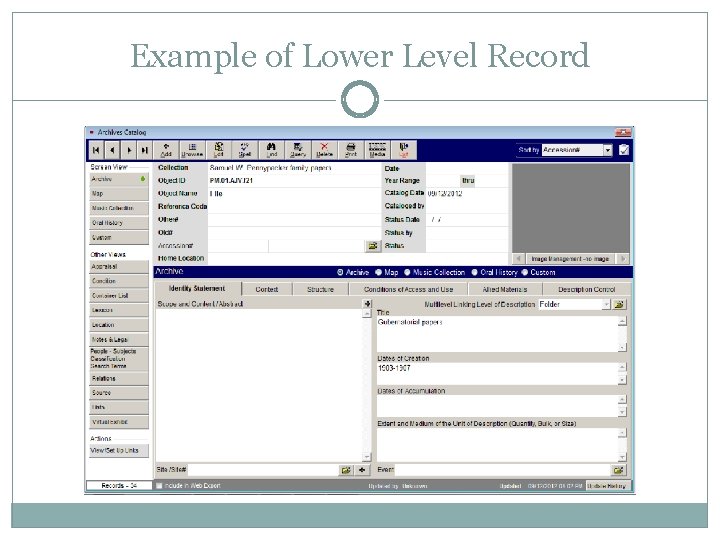
Example of Lower Level Record
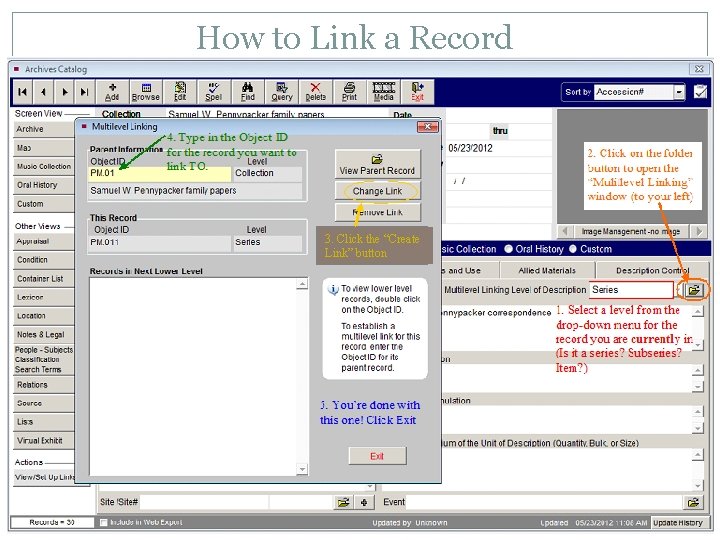
How to Link a Record 3. Click the “Create Link” button
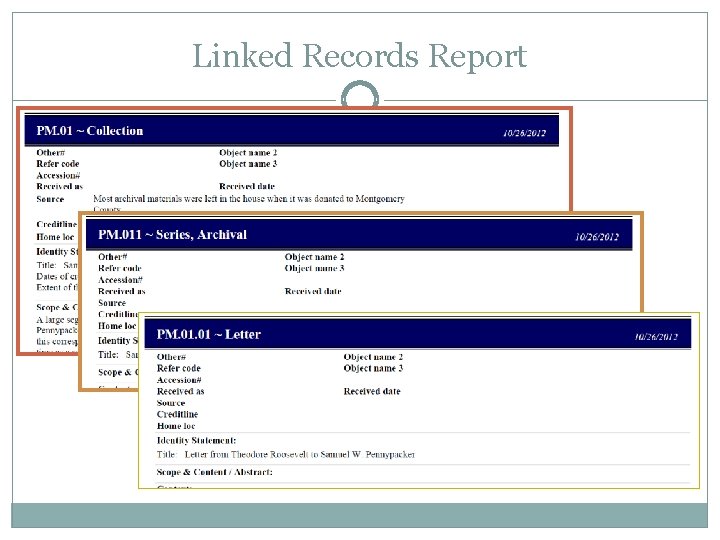
Linked Records Report
External Finding Aid ü FORMAT CONDUCIVE TO ARCHIVAL DESCRIPTION ü DON’T MIND JUGGLING TWO PROGRAMS
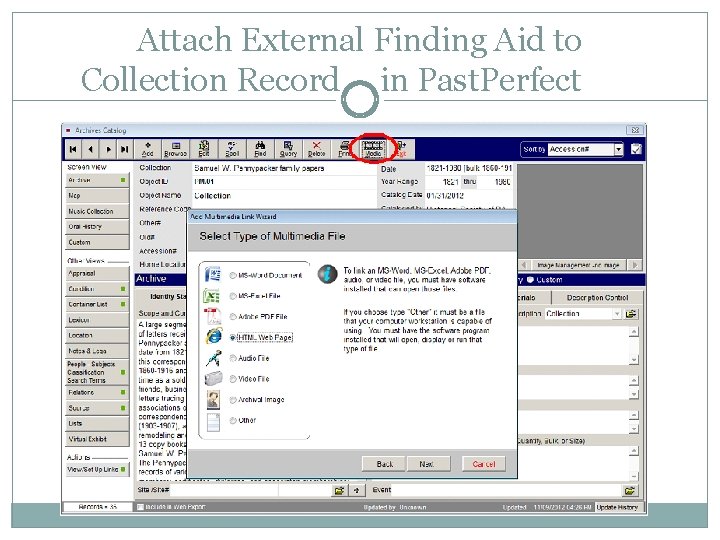
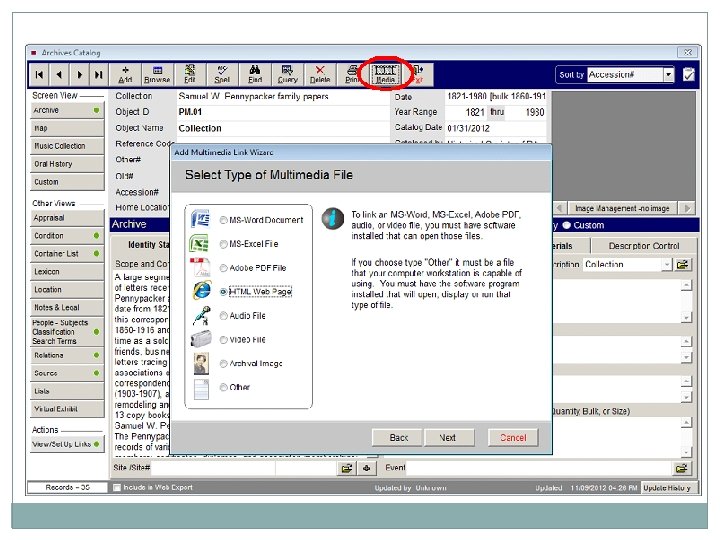
Attach External Finding Aid to Collection Record in Past. Perfect .
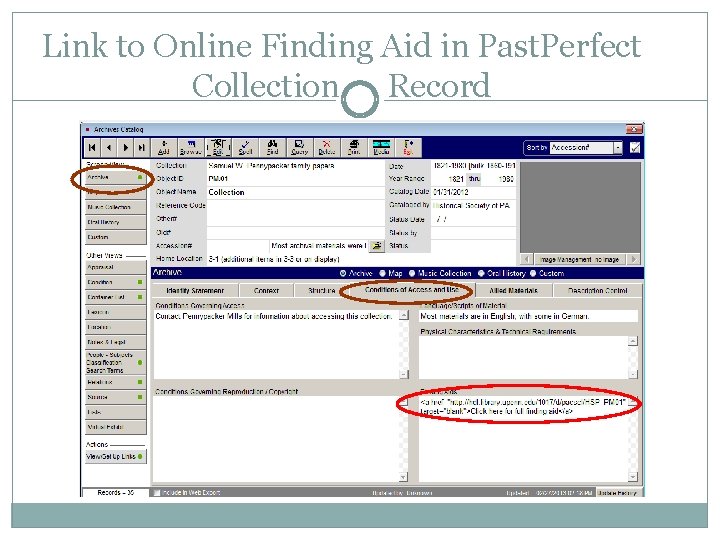
Link to Online Finding Aid in Past. Perfect Collection Record
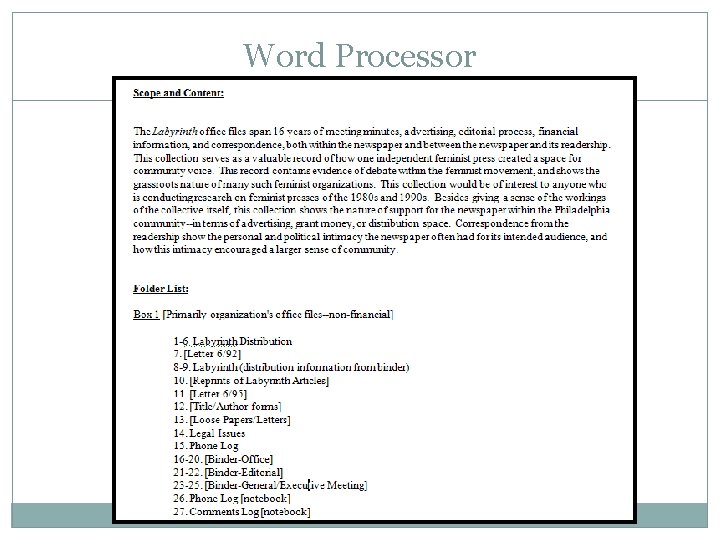
Word Processor
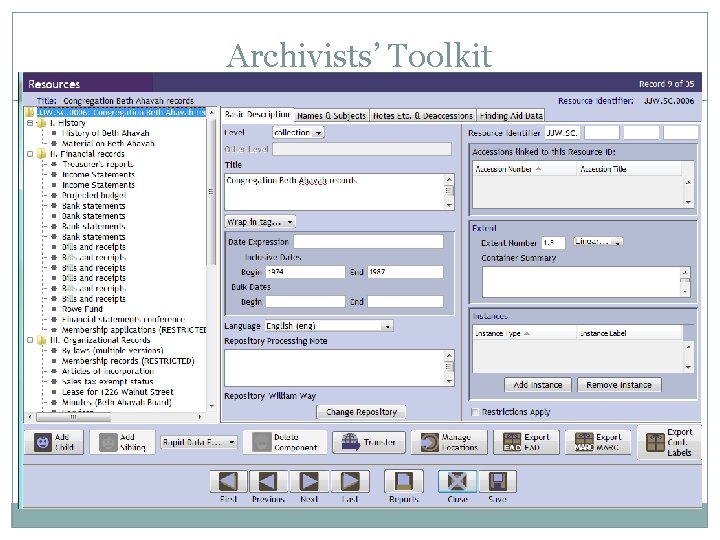
Archivists’ Toolkit
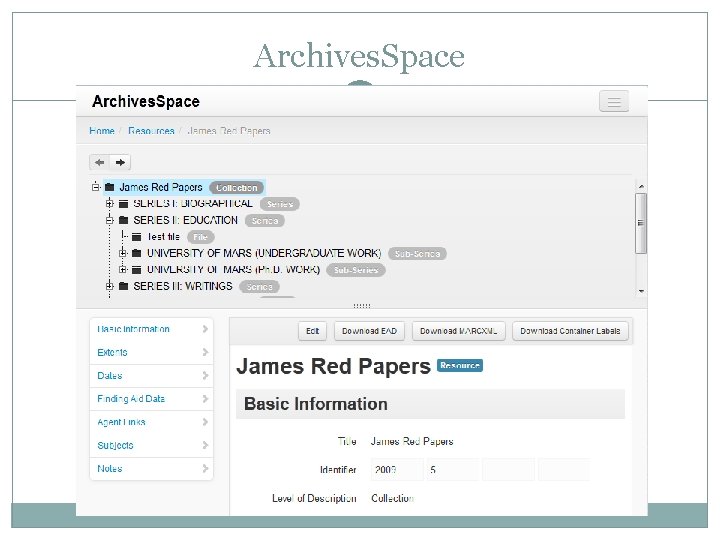
Archives. Space
Resources
Archival Description with Past. Perfect Witt, Betsy S. , Jennifer C. Whitfield, and Adam J. Stepansky. Past. Perfect Software for Museum Collections, Version 5 User’s Guide, 3 rd edition. Past. Perfect Software, Inc. , 2011. http: //www. museumsoftware. com/userguide. shtml. University of Maryland, Baltimore County Special Collections, Albin O. Kuhn Library & Gallery. Archives Processing Manual: Description. 2010. https: //wiki. umbc. edu/download/attachments/1143 7110/UMBCProcessing_Description. pdf? version=1& modification. Date=1279567785000.
General Archival Description Kathleen D. Roe, Arranging and Describing Archives and Manuscripts (Archival Fundamentals Series II; Chicago: Society of American Archivists, 2005) David W. Carmicheal, Organizing Archival Records: A Practical Method of Arrangement & Description for Small Archives (2 nd edition; Walnut Creek, CA: Alta. Mira Press, 2004) Yale University-Beinecke Rare Book and Manuscript Library, Archival Processing Manual (1997; http: //www. library. yale. edu/beinecke/manuscript/p rocess/index. html).
Archivists’ Toolkit http: //www. archiviststoolkit. org/ Using AT: Holly Mengel and Courtney Smerz, Hidden Collections Processing Project Guide to the Archivists’ Toolkit (http: //clir. pacscl. org/wpcontent/uploads/2009/07/PACSCL_Archivists_Too lkit_Guide. pdf) Installing AT: Holly Mengel and Courtney Smerz, Installing the Archivists’ Toolkit and My. SQL and Connecting the Two (http: //clir. pacscl. org/wpcontent/uploads/2009/07/install_My. SQL_AT. pdf Stay tuned for Archives. Space: www. archivesspace. org
Optimizing Past. Perfect for Archival Description CELIA CAUST-ELLENBOGEN PROJECT SURVEYOR HIDDEN COLLECTIONS INITIATIVE FOR PENNSYLVANIA SMALL ARCHIVAL REPOSITORIES HISTORICAL SOCIETY OF PENNSYLVANIA CCAUSTELLENBOGEN@HSP. ORG HTTP: //WWW. HSP. ORG/HCIPSAR
- Slides: 39