
Optimizing Open CL Applications for FPGAs Hongbin Zheng

Optimizing Open. CL Applications for FPGAs Hongbin Zheng, Alexandre Isoard
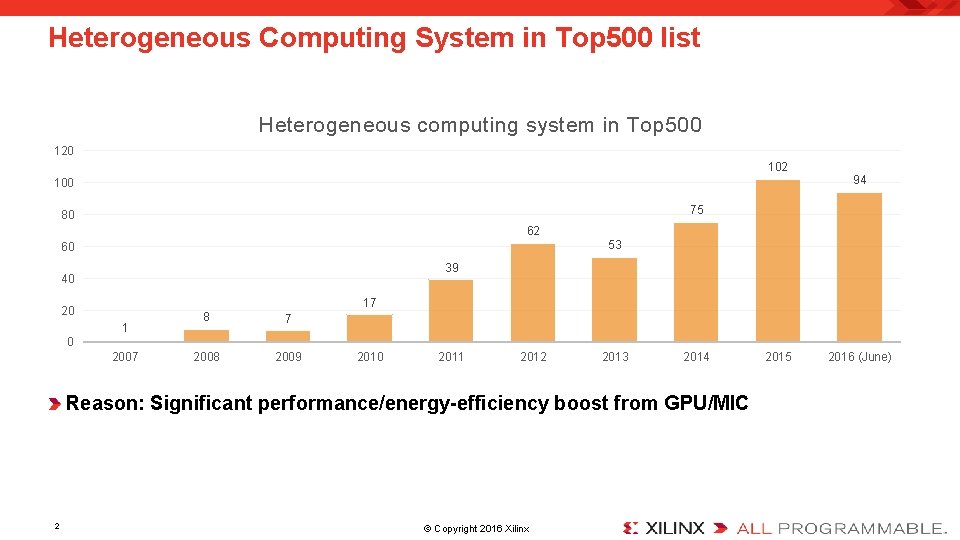
Heterogeneous Computing System in Top 500 list Heterogeneous computing system in Top 500 120 102 100 94 75 80 62 53 60 39 40 17 20 1 8 7 2008 2009 0 2007 2010 2011 2012 2013 2014 Reason: Significant performance/energy-efficiency boost from GPU/MIC 2 © Copyright 2016 Xilinx. 2015 2016 (June)
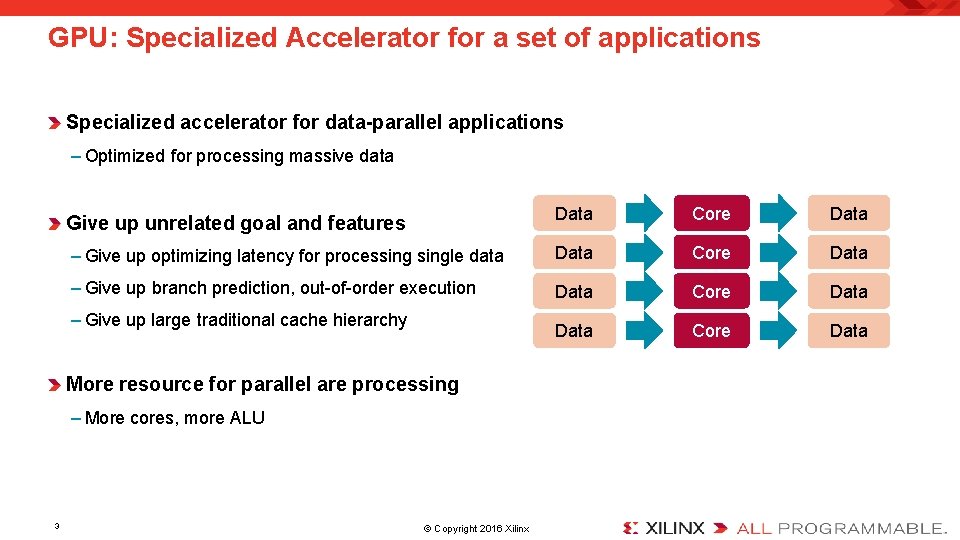
GPU: Specialized Accelerator for a set of applications Specialized accelerator for data-parallel applications – Optimized for processing massive data Give up unrelated goal and features Data Core Data – Give up optimizing latency for processingle data Data Core Data – Give up branch prediction, out-of-order execution Data Core Data – Give up large traditional cache hierarchy More resource for parallel are processing – More cores, more ALU 3 © Copyright 2016 Xilinx.
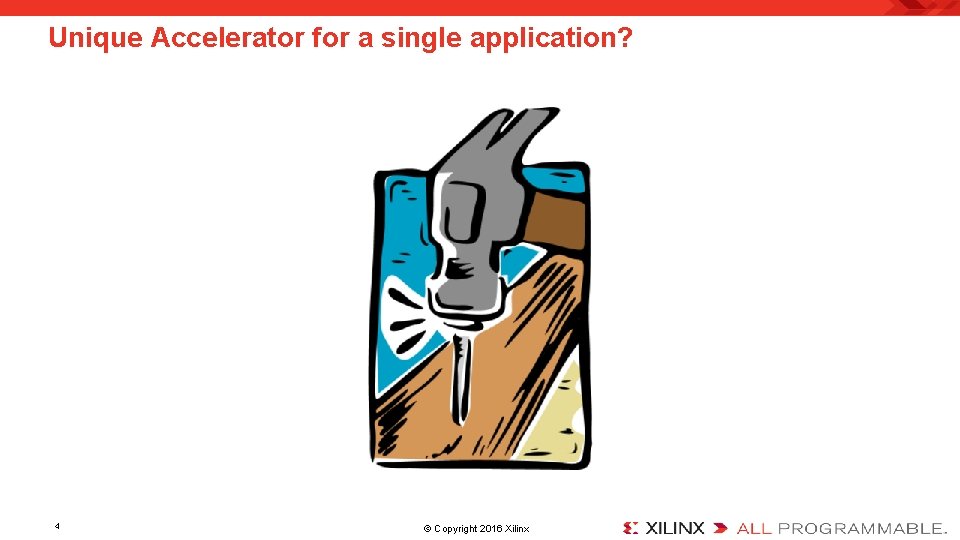
Unique Accelerator for a single application? 4 © Copyright 2016 Xilinx.
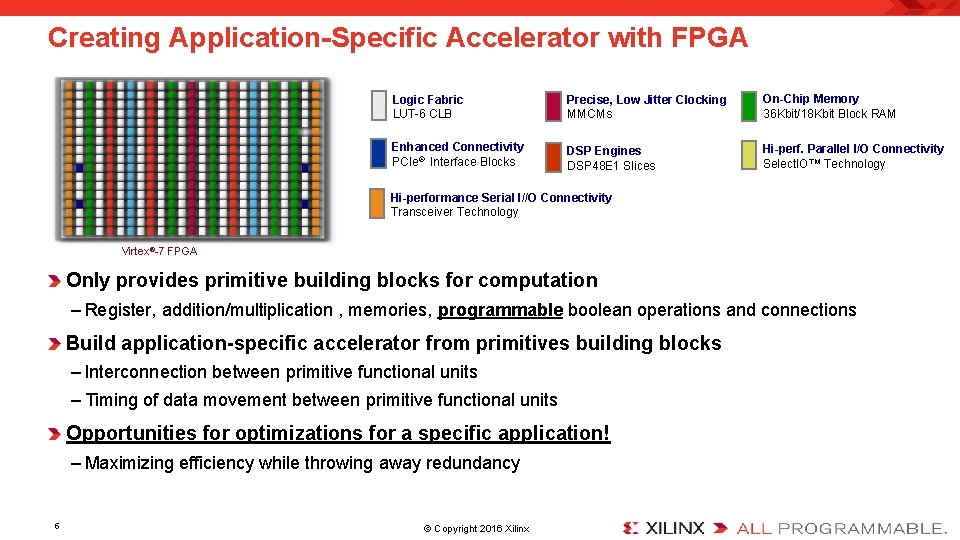
Creating Application-Specific Accelerator with FPGA Logic Fabric LUT-6 CLB Precise, Low Jitter Clocking MMCMs On-Chip Memory 36 Kbit/18 Kbit Block RAM Enhanced Connectivity PCIe® Interface Blocks DSP Engines DSP 48 E 1 Slices Hi-perf. Parallel I/O Connectivity Select. IO™ Technology Hi-performance Serial I//O Connectivity Transceiver Technology Virtex®-7 FPGA Only provides primitive building blocks for computation – Register, addition/multiplication , memories, programmable boolean operations and connections Build application-specific accelerator from primitives building blocks – Interconnection between primitive functional units – Timing of data movement between primitive functional units Opportunities for optimizations for a specific application! – Maximizing efficiency while throwing away redundancy 5 © Copyright 2016 Xilinx.
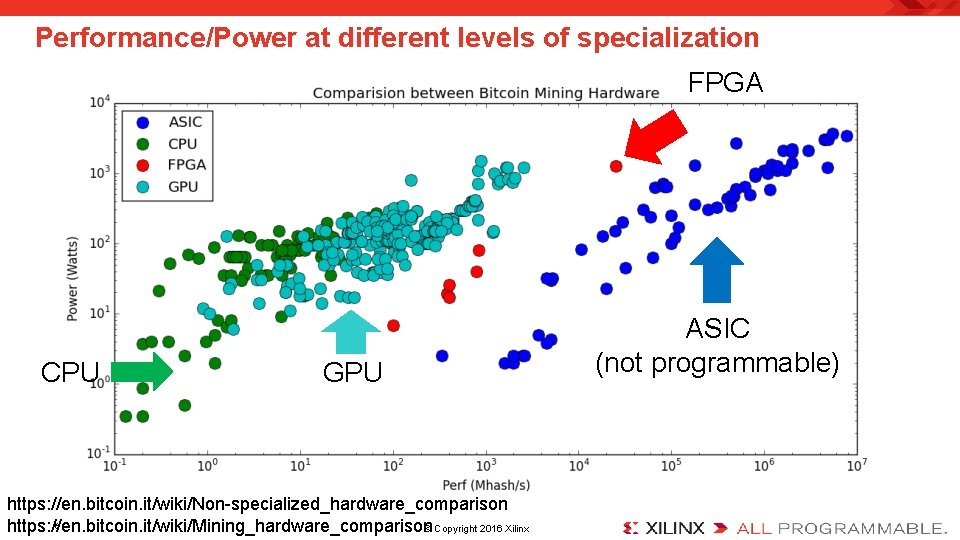
Performance/Power at different levels of specialization FPGA CPU ASIC (not programmable) GPU https: //en. bitcoin. it/wiki/Non-specialized_hardware_comparison 6 © Copyright 2016 Xilinx https: //en. bitcoin. it/wiki/Mining_hardware_comparison.
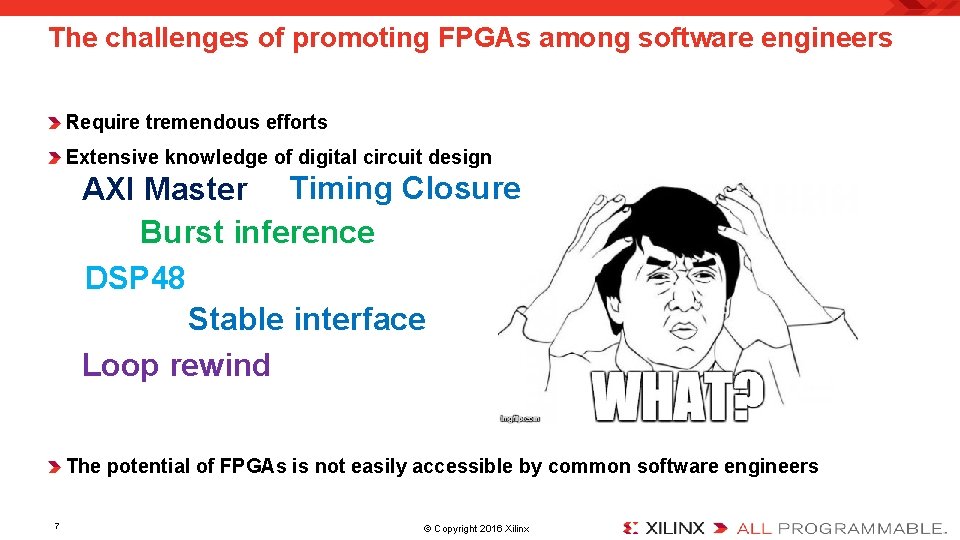
The challenges of promoting FPGAs among software engineers Require tremendous efforts Extensive knowledge of digital circuit design AXI Master Timing Closure Burst inference DSP 48 Stable interface Loop rewind The potential of FPGAs is not easily accessible by common software engineers 7 © Copyright 2016 Xilinx.
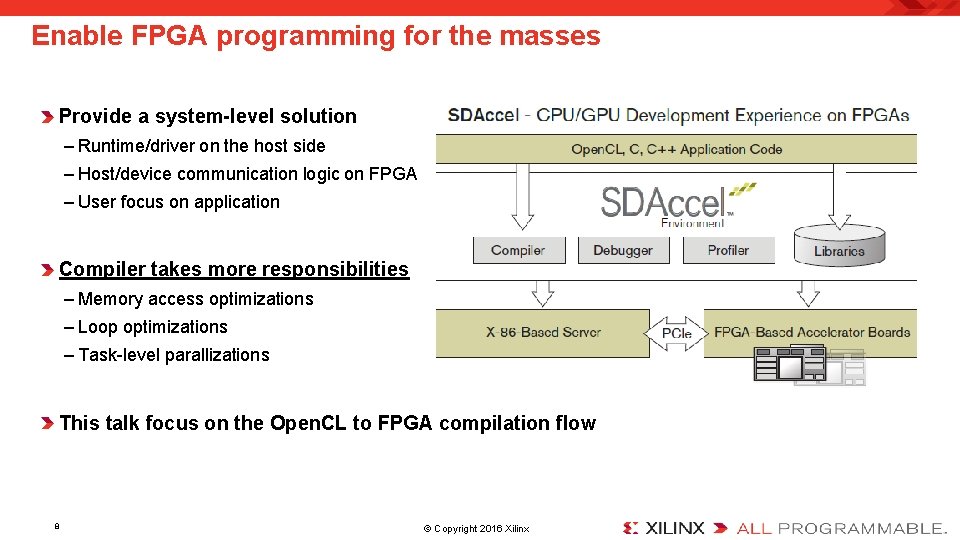
Enable FPGA programming for the masses Provide a system-level solution – Runtime/driver on the host side – Host/device communication logic on FPGA – User focus on application Compiler takes more responsibilities – Memory access optimizations – Loop optimizations – Task-level parallizations This talk focus on the Open. CL to FPGA compilation flow 8 © Copyright 2016 Xilinx.
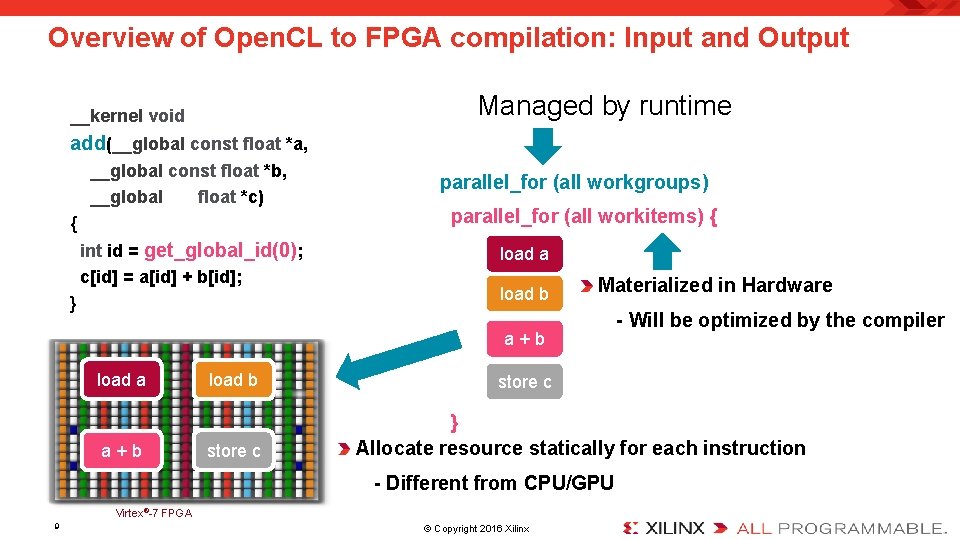
Overview of Open. CL to FPGA compilation: Input and Output Managed by runtime __kernel void add(__global const float *a, __global const float *b, __global float *c) { parallel_for (all workgroups) parallel_for (all workitems) { int id = get_global_id(0); c[id] = a[id] + b[id]; load a load b } Materialized in Hardware a+b load a a+b load b store c } Allocate resource statically for each instruction - Different from CPU/GPU Virtex®-7 FPGA 9 - Will be optimized by the compiler © Copyright 2016 Xilinx.
Objectives of Open. CL to FPGA compilation Approach the peak throughput of FPGAs – Energy is usually not a problem as FPGA is running at a low frequencies (200 MHz to 600 MHz) Approaching peak throughput for computation part is not a big problem – Even the traditional FPGA design flow without C-to-FPGA compilation is sufficient The difficult part is fetching data fast enough to saturate the computation part – Especially true for the data-parallel tasks Maximize memory bandwidth utilization – External memory - FPGA/DDR interface – On-chip memories – block RAM and registers 10 © Copyright 2016 Xilinx.
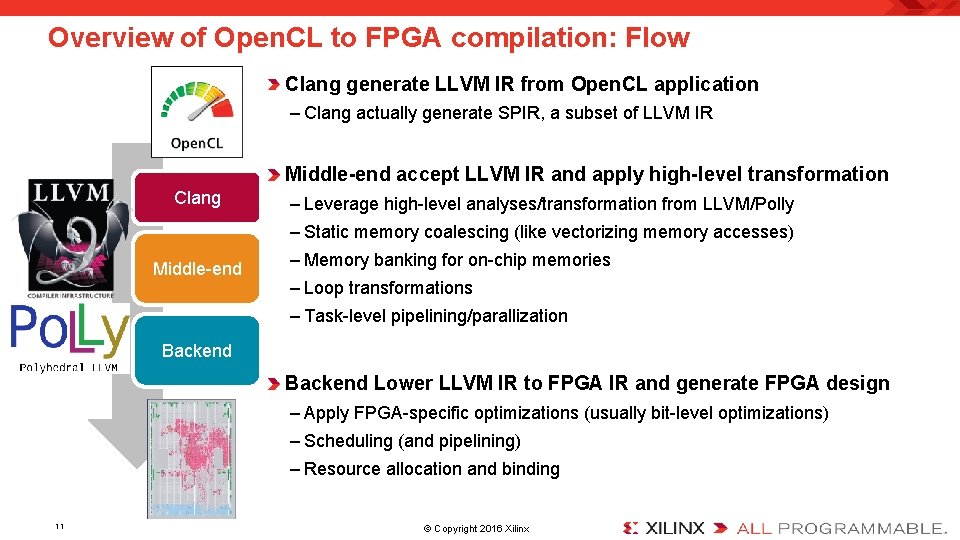
Overview of Open. CL to FPGA compilation: Flow Clang generate LLVM IR from Open. CL application – Clang actually generate SPIR, a subset of LLVM IR Middle-end accept LLVM IR and apply high-level transformation Clang – Leverage high-level analyses/transformation from LLVM/Polly – Static memory coalescing (like vectorizing memory accesses) Middle-end – Memory banking for on-chip memories – Loop transformations – Task-level pipelining/parallization Backend Lower LLVM IR to FPGA IR and generate FPGA design – Apply FPGA-specific optimizations (usually bit-level optimizations) – Scheduling (and pipelining) – Resource allocation and binding 11 © Copyright 2016 Xilinx.
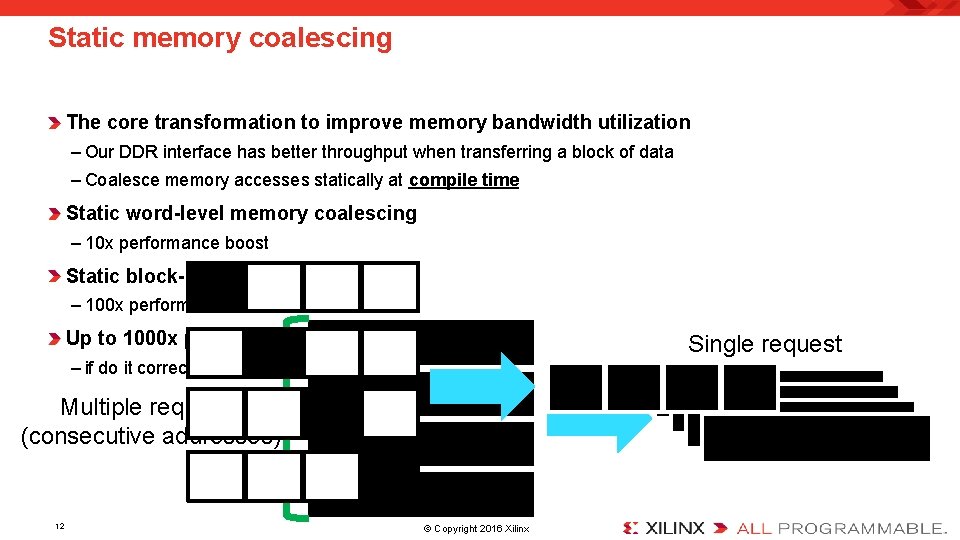
Static memory coalescing The core transformation to improve memory bandwidth utilization – Our DDR interface has better throughput when transferring a block of data – Coalesce memory accesses statically at compile time Static word-level memory coalescing – 10 x performance boost Static block-level memory coalescing – 100 x performance boost Up to 1000 x performance boost! Single request – if do it correctly <= the challenging part Multiple requests (consecutive addresses) 12 © Copyright 2016 Xilinx.
Static memory coalescing – identifying the opportunities Look for accesses that accesses consecutive memory addresses – Be aware of alignment – need specially handling in code generation Prove those accesses can be parallelized – Need dependencies analysis – More a less like vectorizing the memory accesses Strided accesses are also supported – Do not introduce any overhead for word-level coalescing – Need to consider the ratio between used/transferred data for block-level coalescing 13 © Copyright 2016 Xilinx.
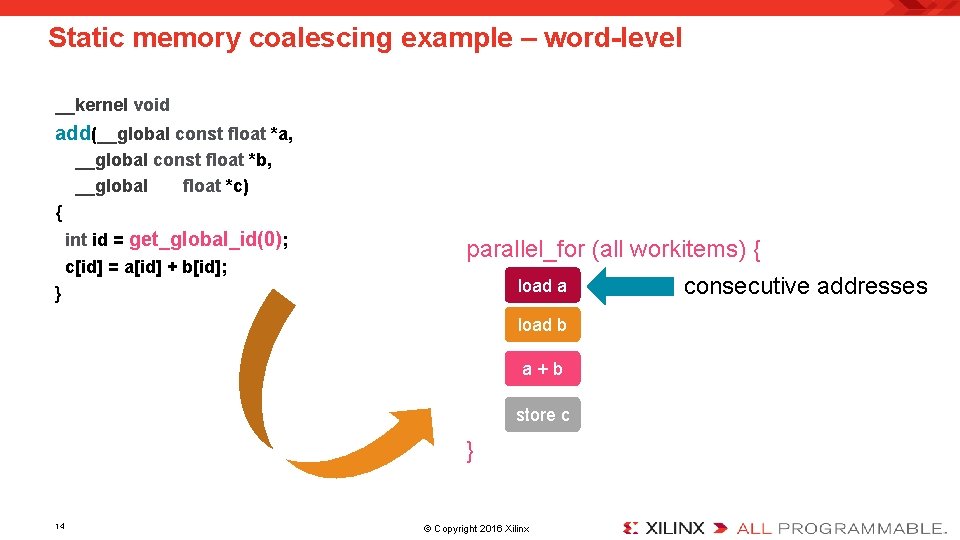
Static memory coalescing example – word-level __kernel void add(__global const float *a, __global const float *b, __global float *c) { int id = get_global_id(0); c[id] = a[id] + b[id]; parallel_for (all workitems) { load a } load b a+b store c } 14 © Copyright 2016 Xilinx. consecutive addresses
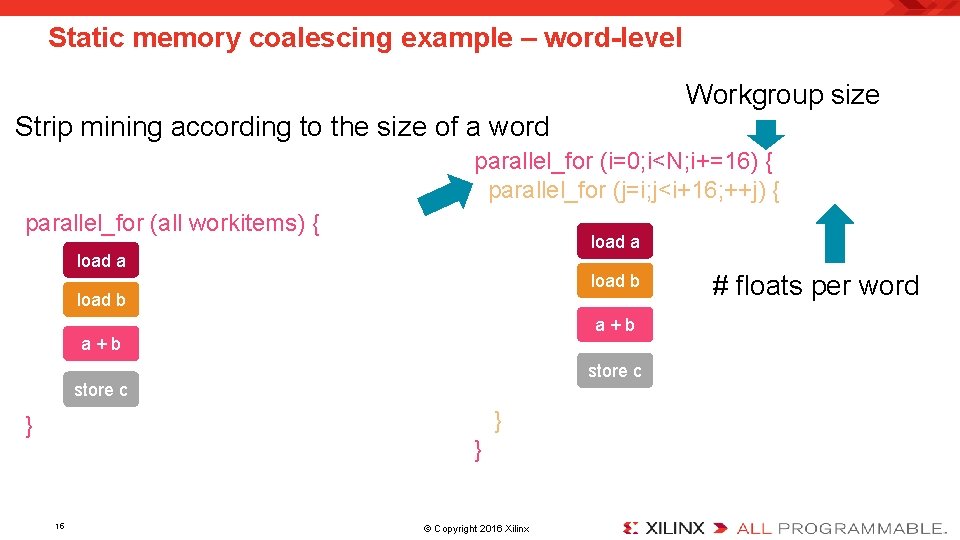
Static memory coalescing example – word-level Workgroup size Strip mining according to the size of a word parallel_for (i=0; i<N; i+=16) { parallel_for (j=i; j<i+16; ++j) { parallel_for (all workitems) { load a load b a+b store c } } } 15 © Copyright 2016 Xilinx. # floats per word
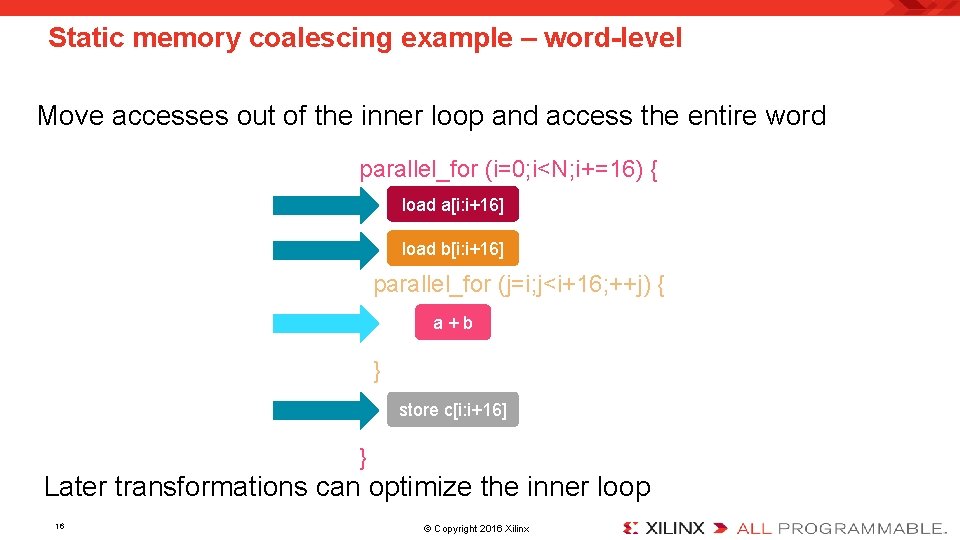
Static memory coalescing example – word-level Move accesses out of the inner loop and access the entire word parallel_for (i=0; i<N; i+=16) { load a[i: i+16] load b[i: i+16] parallel_for (j=i; j<i+16; ++j) { a+b } store c[i: i+16] } Later transformations can optimize the inner loop 16 © Copyright 2016 Xilinx.
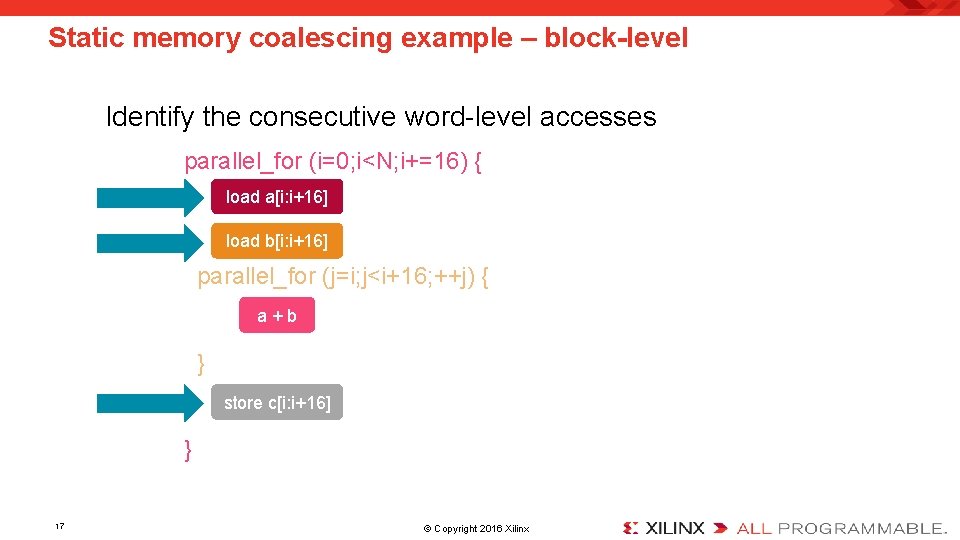
Static memory coalescing example – block-level Identify the consecutive word-level accesses parallel_for (i=0; i<N; i+=16) { load a[i: i+16] load b[i: i+16] parallel_for (j=i; j<i+16; ++j) { a+b } store c[i: i+16] } 17 © Copyright 2016 Xilinx.
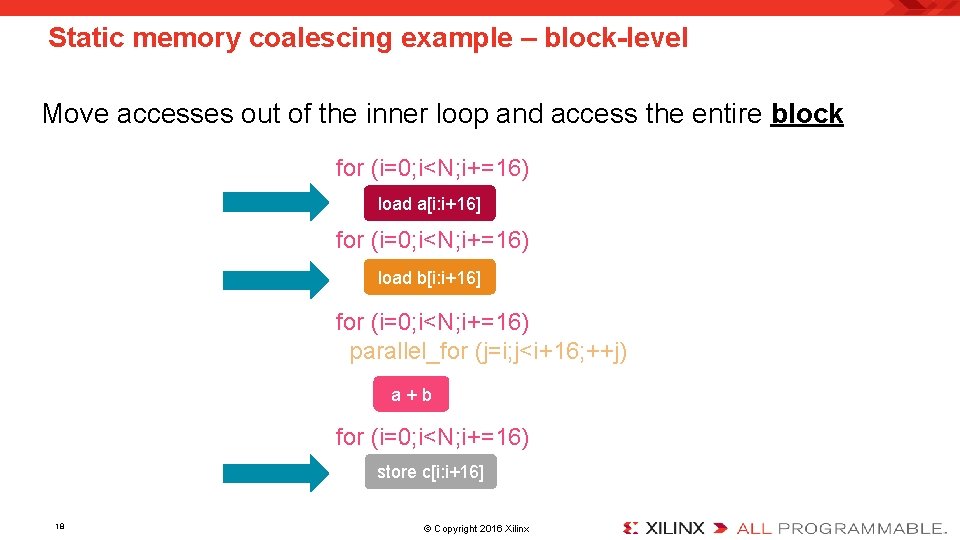
Static memory coalescing example – block-level Move accesses out of the inner loop and access the entire block for (i=0; i<N; i+=16) load a[i: i+16] for (i=0; i<N; i+=16) load b[i: i+16] for (i=0; i<N; i+=16) parallel_for (j=i; j<i+16; ++j) a+b for (i=0; i<N; i+=16) store c[i: i+16] 18 © Copyright 2016 Xilinx.
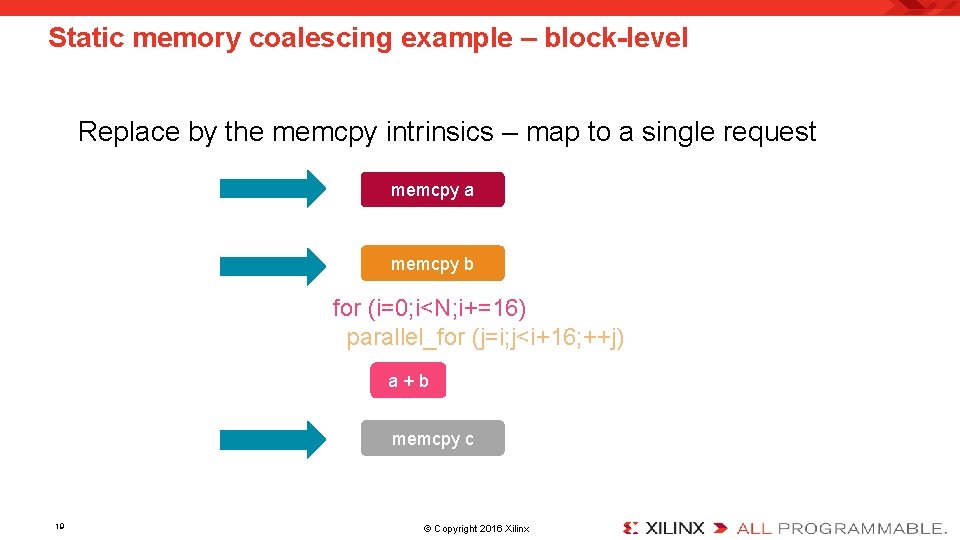
Static memory coalescing example – block-level Replace by the memcpy intrinsics – map to a single request memcpy a memcpy b for (i=0; i<N; i+=16) parallel_for (j=i; j<i+16; ++j) a+b memcpy c 19 © Copyright 2016 Xilinx.
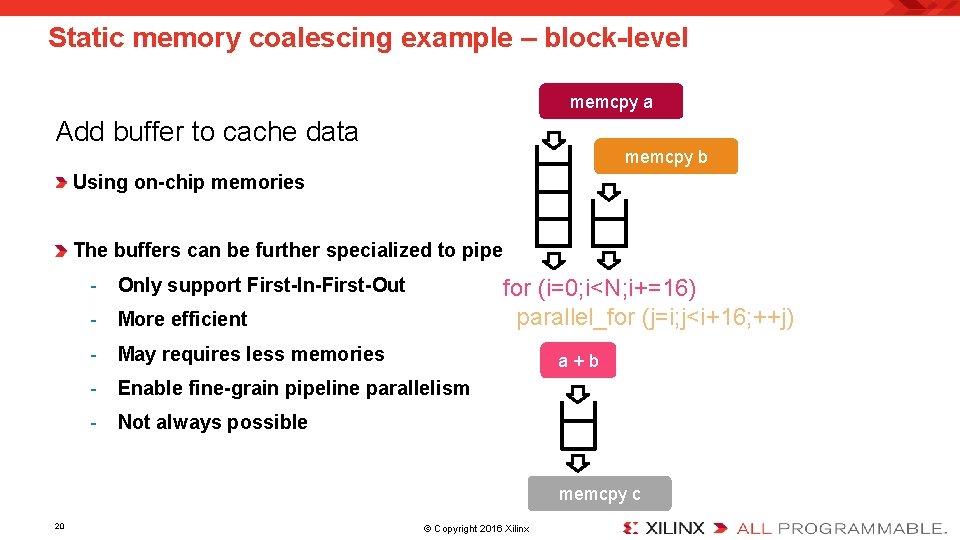
Static memory coalescing example – block-level memcpy a Add buffer to cache data memcpy b Using on-chip memories The buffers can be further specialized to pipe - Only support First-In-First-Out - More efficient - May requires less memories - Enable fine-grain pipeline parallelism - Not always possible for (i=0; i<N; i+=16) parallel_for (j=i; j<i+16; ++j) a+b memcpy c 20 © Copyright 2016 Xilinx.
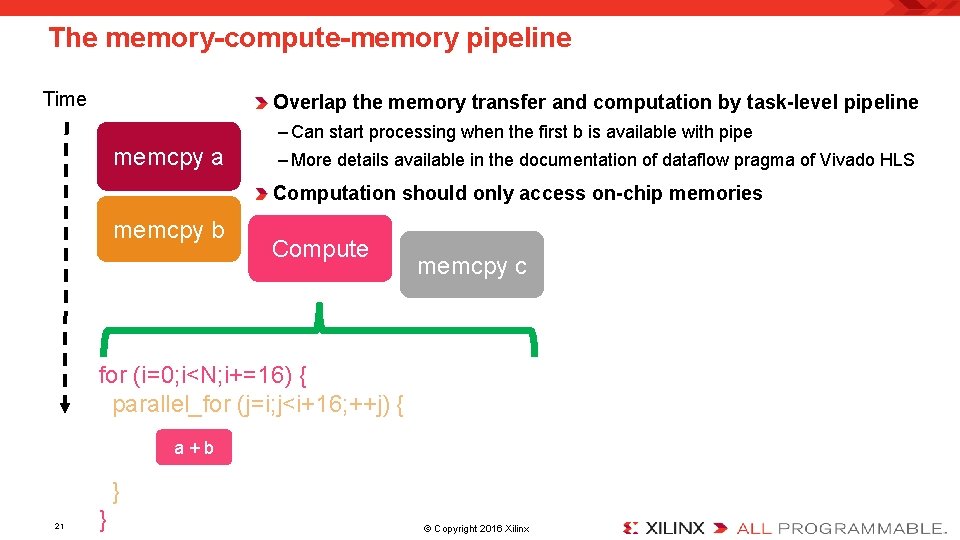
The memory-compute-memory pipeline Time Overlap the memory transfer and computation by task-level pipeline – Can start processing when the first b is available with pipe memcpy a – More details available in the documentation of dataflow pragma of Vivado HLS Computation should only access on-chip memories memcpy b Compute memcpy c for (i=0; i<N; i+=16) { parallel_for (j=i; j<i+16; ++j) { a+b } 21 } © Copyright 2016 Xilinx.
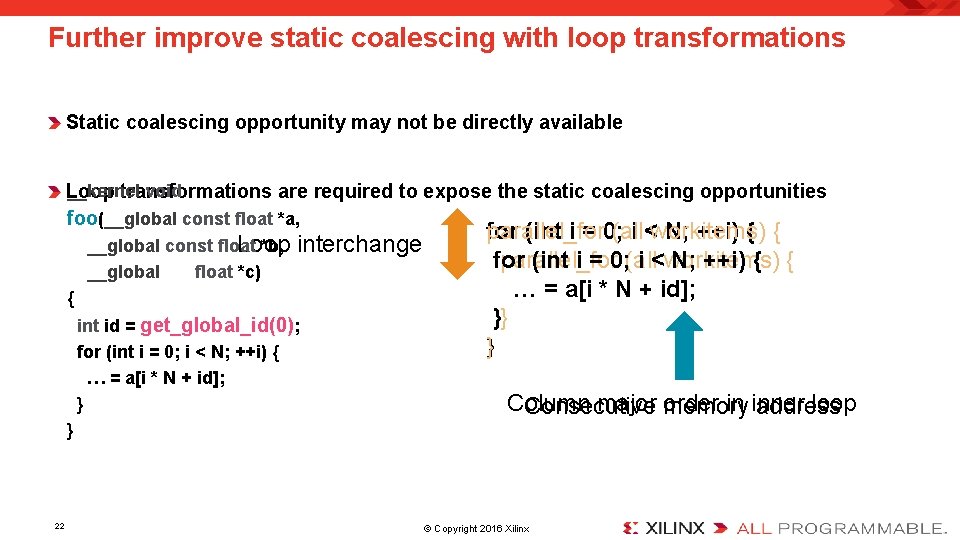
Further improve static coalescing with loop transformations Static coalescing opportunity may not be directly available __kernel void Loop transformations are required to expose the static coalescing opportunities foo(__global const float *a, __global const float *b, Loop __global float *c) parallel_for (int i = 0; (all i <workitems) N; ++i) { { for parallel_for (int i = 0; (all i <workitems) N; ++i) { { … = a[i * N + id]; }} } interchange { int id = get_global_id(0); for (int i = 0; i < N; ++i) { … = a[i * N + id]; } Column major memory order in inner loop Consecutive address } 22 © Copyright 2016 Xilinx.
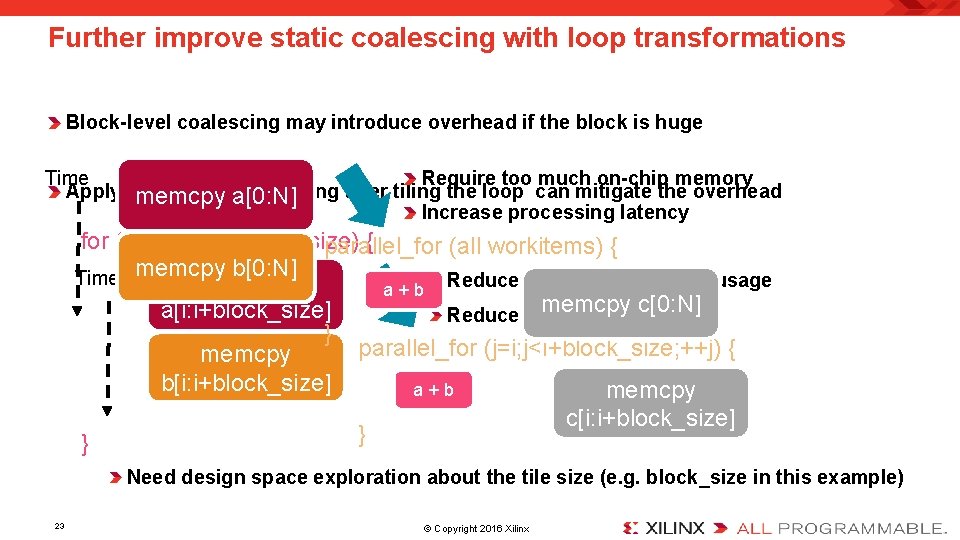
Further improve static coalescing with loop transformations Block-level coalescing may introduce overhead if the block is huge Time Require too much on-chip memory Apply block-level coalescing after tiling the loop can mitigate the overhead memcpy a[0: N] Increase processing latency for (i=0; i<N; i+=block_size) { parallel_for (all workitems) { b[0: N] Time memcpy Reduced on-chip memories usage memcpy a+b memcpy latency c[0: N] a[i: i+block_size] Reduce processing } parallel_for (j=i; j<i+block_size; ++j) { memcpy b[i: i+block_size] a+b memcpy c[i: i+block_size] } } Need design space exploration about the tile size (e. g. block_size in this example) 23 © Copyright 2016 Xilinx.
Other important optimizations Memory banking/array partition – Map data to different (on-chip) memory banks – Improve internal memory bandwidth utilization / internal memory access parallelism – Include transformation from array-of-struct to struct-of-array Array-to-pipe transformation – Further reduce on-chip memory usage – Enable fine-grain parallelism in task-level pipeline And a lot more … join us to find out! 24 © Copyright 2016 Xilinx.
Summary FPGA-based acceleration has a big potential – Allow maximizing efficiency while minimizing redundancy for a given application Need system-level solution, i. e. compiler + runtime + interface, to realize the potential Compiler need to takes more responsibility to help the users Static memory coalescing may achieve 1000 x performance boost Sophisticated loop transformation is required to improve static memory coalescing 25 © Copyright 2016 Xilinx.

Thank you & Questions?

27 © Copyright 2016 Xilinx.
- Slides: 27